Rose’s Angels: Courtney Cohen, centre, is holding two bags, and Lynne Fader is to Cohen’s left. The two women created the group in honor of Rose Lewin, Cohen’s grandmother. (photo by Lianne Cohen)
Each Rose’s Angels contributor, supporter and volunteer has a story about why they give back to the community. With Rose’s Angels, it is not only to ensure that Rose Lewin’s legacy of love and generosity lives on, but also to support the many not-for-profit organizations in Richmond that desperately are in need of assistance.
Rose’s Angels was created by Richmond residents Lynne Fader and Courtney Cohen. Lewin, Cohen’s grandmother, was a well-respected and much-loved Holocaust survivor who believed in doing good for everyone she could.
(photo by Lianne Cohen)
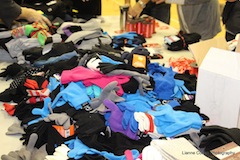
Now in its third year, Rose’s Angels, which is supported and endorsed by the Richmond Kehila Society, just wrapped up its Feb. 14 Care Package Campaign. With the help of 40-plus volunteers, more than 400 toiletry and non-perishable-food care packages, along with 750 warmth bundles (toques, scarves, gloves and socks), were packaged and distributed to a variety of nonprofit organizations in Richmond servicing individuals living in poverty or well below low-income standards. Recipients included the St. Alban Drop-In Centre, Touchstone Family Services, Chimo Outreach, Richmond Multicultural Community Services, Richmond Food Bank, Jewish Food Bank, Turning Point Recovery, Richmond Family Place, Pathways Clubhouse and Light of Shabbat Program.
“It was very fitting to coordinate this event on Valentine’s Day,” said Cohen, “as this is a day when people go on dates and it’s supposed to be ‘extra-special,’ where people buy each other cards, heart-shaped boxes of chocolate, roses, teddy bears and other stuff that basically tells them they love them…. We wanted to share our love within the Richmond community.”
Anyone wishing to make a donation to Rose’s Angels should contact the Richmond Kehila Society at 604-241-9270.
While the three stated goals of the boycott, divestment and sanction (BDS) movement are an end to Israel’s “occupation” of “Arab lands occupied in June 1967,” equal rights for Arab Israelis and the right of return for Palestinian refugees (bdsmovement.net), its real aim is the destruction of Israel. As BDS activist Norman Finkelstein succinctly explained in a 2012 video, the ultimate result if the BDS’s three goals are achieved is: “There’s no Israel. That’s what it’s really about.” And, indeed, Palestinian Authority president Mahmoud Abbas has said, “I will not accept a Jewish state.”
In a Jan. 19, 2016, interview Fatah Central Commitee member Tawfiq Al-Tirawi said: “a Palestinian state in the 1967 borders [i.e. limited to the West Bank and Gaza], with Jerusalem as its capital, is just a phase.” While initially suggesting giving Jews plane tickets to leave the region, he says, “I want to live together with them” in “Palestine, in its historical borders, and we want all the Palestinian refugees [to] return to their country.” Omar Barghouti, a BDS leader who apparently studied at Tel Aviv University for a time, acknowledged during a University of Ottawa talk in 2009, “if the refugees were to return, you cannot have a two-state solution like one Palestinian commentator remarked, you will have a Palestinian state next to a Palestinian state rather than a Palestinian state next to Israel.”
There are many other myths perpetuated by the BDS movement and its supporters, which point to it being antisemitism disguised as anti-Zionism, the denial of the right of Jewish people to live in peace and security in their own homeland. Examples follow.
BDS supporters talk about boycotting products from the Israeli “invasion of Palestine.” Jews did not invade nor did they steal the land. Thousands of Jews were already living in the region before the state of Israel was established, and Jews used to call themselves Palestinians. Jews are indigenous to Israel. Jerusalem was the capital of the Jews. Even during the British Mandate, banknotes, coins and stamps had the initials of Eretz Israel (Land of Israel). And the Jews who immigrated to Palestine, as Israel was then called, as a reaction to the ethnic cleansing and genocide they suffered in European and Muslim countries, bought their properties, as returning Jews had been doing for decades.
The Arab Palestinians rejected the United Nations partition of the land (77% for Arab Palestinians and 23% for Jewish Palestinians) in November 1947, and have yet to establish their own state. After the War of Independence, it was not Israel but Jordan and Egypt that occupied illegally Cisjordan (Judea and Samaria, or the West Bank) and Gaza, respectively.
Abbas, Barghouti and others also have accused Israel of genocide. Israel has done no such thing. While its military has been forced to act against terrorism, it has not set out to deliberately wipe out an entire people. The Palestinian population is growing, according to the Palestinian Central Bureau of Statistics. At the same time, 1.7 million Arabs make up 20% of the Israeli population.
The charge of apartheid is another false accusation. As Dr. Kenneth Meshoe, South African politician, president of the African Christian Democratic Party, aptly put it: “Israel apartheid is a lie.” Every Israeli citizen has rights and freedoms. All minorities in Israel, including Arabs, can study in universities, are allowed to become professionals, businesspeople, athletes, work in public sector jobs and hold seats in the Knesset. In the current Parliament, Arab Israelis occupy 14 seats. As an anecdote, the sentence of Israel’s Supreme Court of former prime minister Ehud Olmert was read by an Arab Israeli judge, Justice Salim Joubran. Could that happen in an “apartheid” country?
Another issue BDSers protest is that of Israel’s blockade on Gaza, despite that it is legal, according to international law and the San Remo Manual, given that “relations between Israel and Hamas (which has ruled the Gaza Strip since 2007) are in the nature of armed conflict.” What would be illegal is if Israel let only some boats seeking to break the blockade pass, as a blockade must apply to every ship unless special permission is given. For more on this, see the article by Prof. Ruth Lapidoth (jcpa.org/article/the-legal-basis-of-israel’s-naval-blockade-of-gaza).
The blockade is needed to prevent terrorist groups from getting more weapons. Hamas’ charter specifically states their will to destroy Israel. More than 15,000 missiles in the past 15 years have been launched from Gaza at innocent Israeli civilians, leaving in their wake deaths, injuries and billions of dollars in damages, in addition to three wars and continued missile and rocket fire at Israel, combined with ongoing incitement against Israel and Jews on Palestinian TV and in schools and training camps.
The security fence – yet another mark against Israel in BDSers’ views – is also a legal method of self-defence. While it is not ideal and while some of it (less than 10%) is an imposing concrete wall as opposed to a wire fence, it reduced terrorist attacks by 90% in its first many years. While terrorist attacks have since increased, there are still fewer than before, and the barrier is a part of the reason for the decline.
As to the BDSers’ demand for the right of return. “The Palestinian demand for the ‘right of return’ is totally unrealistic and would have to be solved by means of financial compensation and resettlement in Arab countries,” Egypt’s then-president Hosni Mubarak noted in 1989. As Barghouti correctly observed, if Israel were to absorb the more than six million Palestinian Arab refugees, Israel as a Jewish and democratic state would disappear.
Refugees, as defined by the UN Relief and Works Agency, are “persons whose normal place of residence was Palestine during the period 1 June 1946 to 15 May 1948, and who lost both home and means of livelihood as a result of the 1948 conflict” – which began when Arab countries attacked the newly forming state of Israel – and their descendants. Approximately 750,000 Palestinians fled or left Israel by choice because of that conflict, and more left after the 1967 Six Day War, which was also the result of Arab aggression.
As former Canadian justice minister Irwin Cotler wrote in a 2014 Times of Israel blog and has spoken and written about elsewhere, there is another aspect that must be considered when speaking of the rights of refugees: “the pain and plight of 850,000 Jews uprooted and displaced from Arab countries – the forced yet ‘forgotten exodus,’ as it has been called – has been expunged and eclipsed from both the Middle East peace and justice agenda for 67 years.”
Another question more people need to ask of BDS supporters is about the lack of protest when Egypt considers building a wall on her border with Gaza, blockades Gaza, destroys neighborhoods adjacent to her border with Gaza to create a buffer zone and destroys tunnels used for arms smuggling, kidnapping of civilians and soldiers and infiltration for attacks.
If BDSers really were concerned about Palestinians, they would be protesting the treatment by the Palestinian Authority and Hamas of their own people, the lack of basic human rights and freedoms that people living in the West Bank and Gaza possess. But they’re not. Instead, they focus their sights on Israel, their ultimate goal its destruction.
Silvana Goldemberg is an award-winning author of more than 20 books and magazines published in Spanish and English throughout the Americas. Originally from Argentina, she is currently based in Richmond.
English class at Shaked School in Raanana. The school participates in the Arab Teacher Integration in Jewish Schools program. The teacher’s name is Fatam and she is from the Arab town of Tayibe. (photo from Merchavim)
In a country of eight million, one-fifth of Israel’s population are Arabs. According to research published last year in the Jerusalem Post, 35% of Jewish teenagers have never spoken to an Arab peer and 27% of Arab Israelis reported never having spoken with a Jewish youth.
In a conflict-ridden political climate, there is no shortage of angry rhetoric. Reading this rhetoric, it is tempting to imagine that Israeli society is simply a dysfunctional collection of intergroup battles. Nonetheless, there are organizations that remain focused on Israel’s immense social capital, its long history of social innovation and the initiative and dedication of its educators. Guided by words like tolerance, fairness and mutual understanding, these organizations value diversity rather than emphasize differences, and continue to work to build a more egalitarian society.
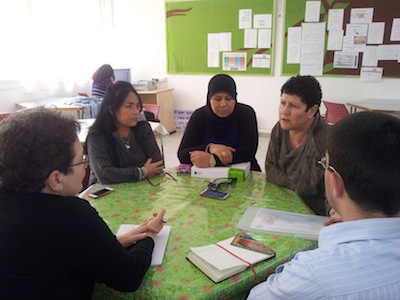
Esti Halperin, Merchavim Institute chief executive officer, is the woman on the right. (photo from Merchavim)
Merchavim Institute is one such organization. Founded in 1998 and based in Lod, Merchavim promotes shared citizenship in several ways. It places Arab teachers in Jewish schools, to teach spoken Arabic. It offers a wealth of classroom materials to teachers and supports 500 schools and kindergartens in the Jewish-secular, Jewish-religious and Arab-Israeli school streams.
In a separate collaboration with the Ministry of Education, Merchavim also places Arab teachers of English, science and mathematics in Jewish schools. These teachers cover material on Arab culture and society.
Merchavim’s chief operating officer, Roi Maor, explained that “dialogue, shared culture, education and improved communication” are essential if one wants to stem the flood of anger and resentment on both sides. Rather than getting stuck on debates about the country’s flag, for example, he argued, “Israel’s best chance for growth and self-improvement is through programs that focus on enrichment.”
The Arabic Teacher Integration (ATI) program does just that, by giving Arab teachers an opportunity to work in and become part of a Jewish community. But, quite apart from meeting their curricular goals, these teachers – all of whom are women – are excellent role models, said Maor. He described them as resilient and “charismatic, with exceptional leadership skills.”
Nonetheless, he acknowledged, “There is a degree of concern or tension when an Arab teacher enters a Jewish school; half of these teachers wear headscarves. Often, the teacher herself has her own concerns and worries, concerns about how she will be integrated.” Since more than one teacher has been stopped by school security and refused entry, these concerns seem valid.
Fortunately for the teachers, Merchavim’s idealism is tempered with the clear-sighted pragmatism of lived experience. Encounters between Arab teachers and their Jewish students and colleagues follow a framework, leaving little to chance. Maor wants the ATI program to be “the gold standard” and explained how encounters must be continuous. “They have to happen in the context of a larger project and be a powerful, meaningful experience,” he said.
Maor also respects the students’ “legitimate desire to maintain and preserve [their] cultural identity.” He believes that one’s identity is a tool to meet the other, rather than a hindrance or a threat. “It allows you to understand and connect to your own identity better,” he said.
Of course, change does not happen overnight. Tamara Klinger-Levi, Merchavim’s director of resource development, reflected that, even with a wonderful start to the school year, acts of violence create a “public sentiment of hatred or prejudice,” which can be a tremendous setback for Merchavim staff and partners.
Rana Younis has been teaching at Gvanim Junior High School, Kadima-Zoran, for nine years. She related an incident in her school, where she had overheard a student speaking ill of Arabs. There had been a violent incident and emotions were running high. Having turned and seen her, the student apologized instantly. “I am sorry,” he said. “It’s not you.” Younis told him, “I understand, it’s not you and it’s not me, and he hugged me. It was so touching. I tell them: there are bad people and good people in Arab society, just like any society.”
Merchavim staff are well aware of this dynamic and their staff make regular visits to Gvanim. Younis is unequivocal in her praise of the support they offer. “They help me all the time. They are like my family,” she said.
A highlight of the program comes in the form of tours for overseas visitors. This is an example of the kind of “powerful, meaningful experience” described by Maor. “Children don’t have a strongly formulated notion of [Arabs]. All kinds of negative ideas flourish in isolation but [with Merchavim teachers] all that evaporates. They learn to regard each person as an individual. We are building a generation that doesn’t generalize.”
Younis’ observations confirm this. “Reality is not what you read,” she said. “Putting the idea of Arabs and Jews aside, I am just there to teach. I love my work as a teacher. I love my students.”
Younis’ voice conveys energy, dedication and love. She spoke of an upcoming collaboration between Israeli and Arab students, called
Living Together, for which only a limited number of places was available. “When some of the students didn’t get in, they cried, they were so disappointed,” she said.
About what her own family thought of her work, Younis laughed as she related her mother’s frequent questions. “Are you OK, are you happy? I tell her, I am happy! I have no problems.”
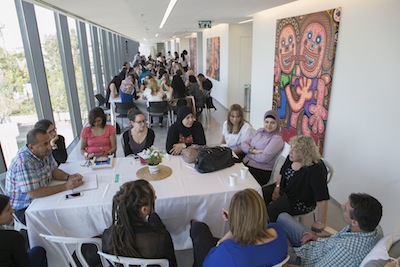
The annual Arabic Teacher Integration conference, held jointly with IDC Herzliya, is when all the players (government officials, school administrators, teachers, researchers, funders et al) meet to discuss issues and learn about new research. (photo from Merchavim)
Merchavim’s contribution to Israeli education and society at large have gained recognition at home and abroad. The new language initiative of Israel’s education ministry, led by Naftali Bennett (Jewish Home), dovetails nicely with Merchavim’s vision. In this program, Arab students will learn Hebrew starting in kindergarten and continue right through high school. As Likud MK Oren Hazan said last year (Israel National News), “When the Jewish population understands Arabic the way the Arab public understands Hebrew, we will see better days.”
Thanks to the investments of Merchavim and other organizations, these ways of thinking could become the norm for a whole generation of children. These children will finish school and assume leadership positions in society. When they do, they will have communication skills, as well as the empathy and cultural capital needed to reinvest in a fair future for all Israelis.
Speaking of the wider Arab population, Maor said Merchavim’s program “sends a message to people back in the communities that they can be successful in Jewish society.” And, while Arab women meet the urgent need for more teachers in the Jewish system and find empowerment through work, their presence enriches the entire school site.
The Arab Teacher Integration program enjoys financial support from numerous philanthropic groups in Israel, all of which support civil rights, social justice and democracy in the country. These include the Moriah Fund, the Beracha Foundation and the Jacob and Hilda Blaustein Foundation. Overseas funders include the Jewish Federations of North America and the Hadassah Foundation, which also works in Israel.
Nonetheless, even with this and the Ministry of Education support for Merchavim’s work, funding remains a challenge. Discretionary budgets for enrichment are small and programs like music are typically prioritized above Arabic electives. Maor, who finds it “outrageous” that Arabic is not a mandatory subject in Israeli schools, described this as a “missed opportunity for cross-cultural learning and huge advancement for the cause of shared society in Israel.”
However, Maor is optimistic about the future because “animosity and fear comes from ignorance.” With long-term, committed professional relationships between Arab and Jewish educators, and between Arab teachers and their Jewish students, Israeli society can change. “Citizenship is not just a piece of paper,” said Maor. “It’s about being part of a collective enterprise, in which we share a joint destiny.”
That destiny relies on every individual having the right to prosperity under egalitarian social and economic conditions. Once the majority of Israelis understand this, he said, they will also see that “the success of Israeli Arabs is not a separate phenomenon but a boon to all sectors of the population.”
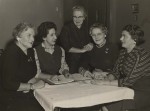
Pioneer Women meeting, circa 1960. Cissie Eppel is sitting second from left. (photo from JWB fonds, JMABC L.12598)
If you know someone in this photo, please help the JI fill the gaps of its predecessor’s (the Jewish Western Bulletin’s) collection at the Jewish Museum and Archives of B.C. by contacting [email protected] or 604-257-5199. To find out who has been identified in the photos, visit jewishmuseum.ca/blog.
Julianne Moore as Alice in Still Alice. (photo by Jojo Whilden, courtesy of Sony Pictures Classics)
Fifteen years ago, the subject of dementia was the “elephant in the room,” a very large issue that everyone is acutely aware of, but nobody wants to talk about. If you or a member of your family developed symptoms such as forgetfulness or confusion, you kept it quiet as long as you could. The first time your grandfather found himself somewhere and did not know why he was there was but the coup de grâce, the decisive stroke that heralded the end of a lifestyle as he knew it. This was the beginning of a terrifying and tragic journey towards senility and death.
I remember my paternal grandmother; she was a wonderful cook, Polish style. Her husband took care of her until she had to be placed in a seniors residence. The topic of her illness never came up at home. My father visited her every week. My brother and I did not go with him. Then there was the telephone conversation with my aunt: she was surprised to hear that I lived in Vancouver (I had moved here eight years prior). I knew then that she had Alzheimer’s disease. It was a shock.
During the last 10 years, things have changed. Articles about dementia, in terms of statistics, symptoms, prevention strategies, caregivers and residential settings, abound in our newspapers, magazines, on the radio and on the internet. Seminars, forums, courses, self-help and support groups are readily available – and world cinema has made up for lost time. For the last few years, I have been tracking American, Canadian, British, European and Israeli films that feature people who are suffering from some form of dementia, especially Alzheimer’s. These movies show the impact of their condition on caregivers, whether they be spouses, sons, daughters or friends.
Jim Broadbent with Judi Dench in Iris. (photo from Everett Collection / Rex Features)
The British film Iris (2001) reveals the true story of the lifelong romance between novelist Iris Murdoch and her husband John Bayley, and her gradual deterioration due to Alzheimer’s disease.
The Canadian movie Away from Her (2006) follows a loving couple; she acknowledges her condition and moves into a seniors residence, and the husband must cope with his wife’s new romantic attachment to a male resident of the facility. Still Mine (2012), also a Canadian movie, is an old-age love story told with minimal sentimentality and spiky integrity. She has Alzheimer’s, he wants to build her a smaller house, with his own hands; complications ensue.
Amour (2012), a French film, gives us an unflinching vision of dementia caused by stroke and the complex relationship between the members of the octogenarian couple. It was widely acclaimed and nominated for several Academy Awards.
The British comedy Quartet (2013) brings together four superb actors in a magnificent seniors residence for musicians. Each member of the ensemble has his or her own impairments and talents. Somehow they cope and produce beautiful music together.
The American movie Still Alice (2014) shocked and educated every viewer who stayed until the end. We watch as early-onset dementia gradually overcomes the heroine’s intelligence and independence. Her strategies and courage educate and enrich our lives as she struggles with her loss of memory and mental abilities. Julianne Moore won an Academy Award for her performance.
In the American documentary Glen Campbell … I’ll be Me (2015), the legendary singer agrees to a final North American tour knowing that he has Alzheimer’s. The family supports, encourages and devises ways in which he can continue to perform despite the debilitating effects of the disease. A superb real-life drama that makes one appreciate how drastically the disease affects everyone close to the struggling singer.
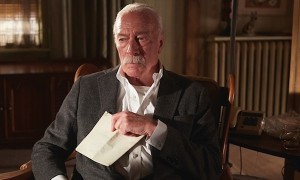
Christopher Plummer in Remember. (photo from Serendipity Point Films)
In the Canadian movie Remember (2015), two residents of a seniors home seek revenge against the Nazi killer of their families in the Holocaust. With Alzheimer’s robbing him of his capacity to remember, one old man goes forth, with detailed instructions in hand, to find and kill his tormentor. He struggles with his inadequacies and perseveres.
Then there is the Israeli drama The Farewell Party (2015), which deals with the topic of assisted suicide and dementia. Notwithstanding the topic, it is a sweet, funny and sad tale that teaches us compassion and acceptance.
I recommend all of these movies to you, no matter at what stage of life you find yourself. But you might say, why should I watch these movies, why should I care? I am not there yet. It is not my issue, I don’t need to know about all this. It is too depressing. I defy readers to tell me they do not know someone who is suffering or has suffered from dementia. One in nine people over the age of 65 will develop some form of dementia. We must acquire knowledge of the disease, we must become familiar with the signs and symptoms, we must acquaint ourselves with the various paths that dementia takes.
How can we understand, empathize and assist these people, our grandparents, our parents, our friends, in their journey? As ethical human beings, it is our obligation and privilege to make the disease and those who suffer from it an integral part of our society. Watching these movies will provide you with the tools and strategies to be informed, to be helpful and to be accepting of this condition. After all, you or I may receive the diagnosis of dementia tomorrow.
Dolores Luberis a retired psychotherapist and psychology teacher living in Vancouver. She writes regular columns for Senior Line, blogs for Yossilinks and writes movie reviews for Isaac Waldman Jewish Public Library. This article was originally published on yossilinks.com.
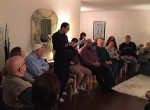
Farhad Sultanpour of the Kurdish Association of Manitoba speaks to members of the Winnipeg Jewish community and others. (photo by Yolanda Papini Pollock)
According to Farhad Sultanpour of the Kurdish Association of Manitoba, Kurds are the largest nation of people without a state. The majority of Kurdish people, he said, live in a strip of land that stretches through Iran, Iraq, Syria and Turkey.
Sultanpour was speaking to a Winnipeg audience about the connections between Kurds and Israel at an event organized by Winnipeg Friends of Israel (WFI).
Sultanpour came from Orumieh, in east Kurdistan, the northwest part of Iran, and was brought up as a Sunni Muslim. He made his way to Canada in the late 1980s.
“In 1979, during my mid-teens, the Islamic Revolution began and the Kurds fought adamantly to protect and liberate their towns and villages against Iran’s leader, Ayatollah Khomeini, who was rising to power,” said Sultanpour.
During this time, Khomeini was stalling in the negotiations with Dr. Abdul Rahman Ghassemlou, the Kurdish leader, regarding the creation of a Kurdish autonomous state. What was actually happening, said Sultanpour, was that “Khomeini was reinforcing his revolutionary army. He led the invasion of the Kurdish territories, while declaring jihad to all Kurds. In 1989, the agents of the Islamic Republic of Iran assassinated Dr. Ghassemlou in Vienna, Austria.”
Sultanpour, who was 19 at the time, needed to make a decision – join Khomeini’s army or join the Kurdish Peshmerga.
“I chose to be a Peshmerga, fighting against Khomeini’s regime,” said Sultanpour. “After a year and a half, I went to the United Nations office in Ankara, Turkey, to apply for refugee status. A year and a half later, I was granted a refugee visa by Canada.”
Integration into Canadian culture was challenging for Sultanpour, mainly due to the language barrier. At the time, he hardly understood or spoke English, and had made the move alone.
Sultanpour has nothing but good things to say about Canada and the second chance at life afforded to him by Canadians. “I painstakingly pursue my English class and university courses for self-improvement,” he said.
He and his wife feel it is time to raise awareness about the plight of the Kurds, especially with the rise of ISIS.
“In the last 10 years, my wife and I have built three public schools, purchased a prefabricated trailer home-style classroom, and built a community centre near the city of Orumieh, in east Kurdistan-Iran,” said Sultanpour. “For the last 20 years, we have been helping, financially, 65 to 100 very poor families in Kurdistan.”
Sultanpour is now working to strengthen the Kurdish-Jewish connection in Winnipeg. He is saddened by the lack of knowledge about the Kurdish situation in the general public, as well as with federal public servants who have not heard about Kurds or Kurdistan.
He referred to an article in the Dec. 29, 2015, issue of Time Magazine: “Alan Kurdi was one of a million. In the summer of 2015, the 3-year-old Syrian boy of Kurdish origins and his family fled the war engulfing their country, hoping to join relatives in the safety of Canada. They were part of a historic flow of refugees from the Middle East to Europe this year, and they followed the dangerous route taken by so many others. In the early hours of Sept. 2, the family crowded onto a small inflatable boat on the beach of Bodrum, Turkey. A few minutes into the journey to Greece, the dinghy capsized. Alan, his older brother, Ghalib, and his mother, Rihanna, all drowned, joining the more than 3,600 other refugees who died in the eastern Mediterranean this year.”
Sultanpour said, “Alan, his brother, Ghalib, and mother, Rihanna, were identified as Syrian when, in fact, they came from Kobane, the Kurdish town invaded by Syria. The tragedy of the death of these three Kurdish people made Alan’s father, Abdullah, prefer to bury his family in Kobane and stay in his beloved motherland, Kurdistan. Up to their dying day, Alan, Ghalib and Rihanna were stripped of their identity and state.
“In the heart of the Kurds, the Kurdi family are Kurds from Kobane, Kurdistan,” he continued. “Alan’s dead body was the only Kurdish child seen by the world, not knowing that there were hundreds of thousands of Kurdish men, women and children who are dead and are dying in Kurdistan – the biggest nation without a state.”
Sultanpour, like many other Kurds, sees Israel and the Jewish people as their only allies in the Middle East. He sees Kurdistan and Israel living in a very hostile region with common enemies, with both nations finding Iran and ISIS as threats to their existence.
With only about 500 members of the Kurdish community in Manitoba, the Kurdish Association of Manitoba is looking to network with the local Jewish community to have a larger impact.
“Both Yolanda Papini Pollock of the WFI and Bernie Bellan of the Jewish Post and News have been instrumental in the speedy interconnection of the Kurds and Jewish people in Manitoba,” said Sultanpour.
The approximately 35 attendees at the event had many questions for Sultanpour about Kurdish-Jewish connections, Kurdish political parties’ relationships with one another, and Palestinian-Kurdish relations.
According to Sultanpour, many in attendance were surprised to know that the present Kurdish capital of Erbil was the capital city of Jewish Kurds from the end of the first century when some Kurds converted freely to Judaism.
“There were numerous questions about political and religious issues regarding the Kurds,” said Sultanpour. “It was very obvious that the attendees were happy to welcome the Kurds and that they could have accepted them earlier had they known about them sooner. But, it’s not too late to develop a much stronger bond with the Jewish people here in Winnipeg and increase the connection globally.”
In related news, another manifestation of Kurdish-Jewish friendship occurred in January, when Israeli Justice Minister Ayelet Shaked called for an independent Kurdistan, saying, “The Kurds are an ancient, democratic, peace-loving people that have never attacked any country. It’s time to help them.”
March of the Living International (MOLI) has published a study examining the effects that the program has had on its participants. The educational program takes, on average, 10,000-20,000 students annually to Poland and Israel with the goal of educating and inspiring future generations to learn from the destruction of the European continent during the Second World War. MOLI accepts applicants from all walks of life and religions, hoping to ensure that not only is the Holocaust not forgotten, but also that it is never repeated.
The report studies the impacts that the program has on its Jewish participants, and highlights the educational and religious changes that the program has inspired since its creation in 1988. Of the population surveyed, most initially signed on to the program in order to better understand their Jewish culture. Many of the participants in the study said that the program has directly impacted them, leading many to visit, study in or move to Israel. Fifty percent of the respondents said that the program caused them to consider moving to Israel later in life.
The study was conducted by Prof. William Helmreich of CUNY Graduate Centre and the Colin Powell School at City College, a sociologist and expert on ethnic identity. “What’s most remarkable about the March is how deeply it impacts participants over a period of many years,” he states. “These include life choices like selecting a mate, moving to Israel and career choices. In addition, it greatly impacts not only on Jewish identity but also on compassion toward other people as well.”
Indeed, 54% of respondents said that the March had made them more tolerant towards other groups. And the effect increases over the years, as 66% of those who attended the March 10 years ago, reported it had made them more tolerant.
The study also found that 86% of the participants asserted the importance in their spouse being Jewish, and 91% in raising their children with some sort of Jewish education; 65% felt the importance of raising their children in a Jewish neighborhood.
Of those surveyed, 90% felt the March instilled in them the importance of reacting to confrontations with antisemitism, and 95% stated the March had strengthened their sense of Jewish identity.
“To think that the March is such a successful program in terms of ensuring and enhancing Jewish identity and in making people realize the importance of engaging as a Jew within their communities and caring for those outside of them, truly illustrates the goals that we had when initially forming the first March so many years ago,” said Dr. Shmuel Rosenman, MOLI chair.
March of the Living brings individuals to Poland and Israel to study the history of the Holocaust and to examine the roots of prejudice, intolerance and hate. Since the first March in 1988, more than 220,000 participants from 52 countries have marched down the same three-kilometre path leading from Auschwitz to Birkenau on Yom Hashoah as a silent tribute to all victims of the Holocaust. March of the Living is a partnership between March of the Living International, local MOTL foundations, the Claims Conference, individual donors, private philanthropists and Jewish communities around the world. Visit motl.org.
Sometimes there are jokes about how we’re all emotionally damaged to some degree. It’s a serious problem for us, because we all lived through wars and terror attacks,” shared Canadian-Israeli Yolanda Papini Pollock of Winnipeg Friends of Israel (WFI) at a lecture co-hosted by WFI on Feb. 9.
The discussion, which focused on the topic The Psychological Impact of War and Terrorism: Coping with and Minimizing Trauma, was held with the local Canadian Associates of Ben-Gurion University of the Negev chapter, the Jewish Post and News and Congregation Temple Shalom, at the synagogue.
Michel Strain (photo by Rebeca Kuropatwa)
“I’ve worked with refugees for the last decade,” said Michel Strain of the Manitoba Immigrant and Refugee Settlement Sector Association. “All have come from countries affected by war and many have experienced trauma and torture, many living in refugee situations for many years.
“In my role in the employment program I worked in, I was often one of the first people the refugees began to trust. And, during this trusting relationship, I had the privilege of many individuals sharing their stories with me…. Their resiliency was resoundingly evident to me.”
Holocaust survivor Edith Kimelman spoke about dealing with her personal trauma. She was 16 years old when Germany invaded her small community in Poland.
“I stood at a neighbor’s window and watched my father being led away by soldiers, only to find him later in a field – dead and riddled with bullets,” she said. “It was beyond my young comprehension to understand that no one in our non-Jewish community of neighbors would help us bring him home. My childish belief was, once he returns to our house, he would return to life.
Edith Kimelman (photo by Rebeca Kuropatwa)
“To watch from our window, as Jewish neighbors were led behind a stable, shot and quickly buried gives me, to this day, nightmares. To find my mother so severely beaten that it led to her death will haunt me forever. I felt like I was punished, having to remain alive without her.
“When I had my own children, I lived in constant fear that something terrible would happen to them or to my husband, and that I would be unable to help them.”
Kimelman explained how this trauma has affected every aspect of her life, including, of course, her relationships with family and friends. While she fears she will leave her sons with the heavy baggage of her unfortunate experiences, she is confident that her fierce love for life and her survival will carry them through.
The keynote speaker of the event, BGU’s Dr. Solly Dreman, who was born and raised in Winnipeg before moving to Israel 50 years ago, was introduced by Dr. Will Fleisher, a local therapist experienced in working with traumatized youth and adults. Dreman is professor emeritus in BGU’s department of psychology.
Dreman has witnessed the long-lasting effects of terrorism. Decades later, “soldiers are having night terrors, night sweats, family difficulties, are unable to cope.”
He differentiated between war and terrorism, explaining that war is usually preceded by prior events and circumstances, while terrorism occurs suddenly, without warning, causing a different type of trauma. Unlike war, terrorism is not confined to a specific geographic arena or time dimension.
“The threat persists, the fears, uncertainty, the sense of helplessness,” he said. “Such attacks are looming over our heads all the time. You have the unbridled devils lurking in your soul forever. That’s going to serve as the trigger for anxiety, feelings of helplessness and inability to cope.
“People who have lost loved ones may have been witness to the event, and we all know the symptoms of survivor guilt,” he continued. “By escaping unscathed, they experience feelings of guilt that they came out alive. There’s research that shows that people who have been injured in a terrorism event after having lost a family member have less PTSD [post-traumatic stress disorder] than someone who comes out unscathed. Survivor guilt has been a major factor.”
Dr. Solly Dreman (photo by Rebeca Kuropatwa)
Dreman pointed to the media as an aggravator in Israel, saying they continually expose the public to the horrific events, while frequently providing information that is unreliable and unconfirmed. He also said the general public, too, is responsible for watching, reading and listening to these reports more critically.
He spoke about his experiences with two separate terror incidents.
“Our initial therapeutic attempts were designed to deal with interpersonal things, like helping teachers in their contact with the young victim students, helping integrate them into the school system,” said Dreman.
The approach seemed to have worked for the first few years, but when Dreman went back to these families 10 years after the initial contact, he found them struggling with life and their interpersonal relationships.
“It was terrible,” said Dreman. “We failed. By the way, we got published in a very prestigious journal reporting on our failure. The conclusion, for those of you who are dealing with refugees or faced the Holocaust, is that there is a need for interpersonal intervention and getting back to business as usual.”
Dreman suggested that limiting media exposure may be helpful, as the constant repetition of the horror does not allow people to heal. But, on the other hand, he said it is important to not go completely off the grid, as that can cause anxiety to a breaking point that might create more trauma. A balance is needed, he said.
Dreman further advised that it is important to embrace life, that social support is a major factor in healthy adjustment.
“Be up front with your kids, explaining that you will do your best to protect everyone,” he said, “but don’t promise that nothing bad will happen, as that is a promise you may not be able to keep. We should allow kids the opportunity to express their fears, but not to dwell on them, as that will exacerbate the sense of trauma.
“Routine is very important – schoolwork, exercise, empowerment,” he added. “The only way to get that is establishing a routine in the face of incomprehensible uncertainty and trauma. Don’t send the kid to a shrink because, by doing that, you’re telling them you can’t manage things.”
With only about five percent of Canadians giving birth at home, one might think the practice is dangerous and that is why the number is so low. On the contrary. Studies show that, as long as the mother is at low risk, it is as safe to give birth at home as it is to give birth in a hospital.
Dr. Michael Klein is a family physician, pediatrician, newborn-intensive-care specialist, maternity care researcher and senior scientist emeritus at Vancouver’s Child and Family Research Institute.
“I am a part of a number of ongoing research projects,” said Klein. “We look at old and new technologies and assess them in relation to birth. I’m about normal birth – not complicated birth – keeping birth normal.”
Dr. Michael Klein (photo from Dr. Michael Klein)
In 2009, Klein worked on a study that looked at the safety of home births, evaluating three groups of births: home births by a midwife, hospital births by the same midwives, and a matched sample of physician births. The researchers looked at women who were identical in their risk profile and found that, regarding fetus development and the newborn baby, there was no difference in these three groups.
“Home birth seemed to be as safe as hospital birth, whether by the doctor or by the same midwife,” said Klein. “There are now two other studies from Ontario that show the same thing.
“Home birth is integrated within the health-care system in B.C.,” he continued. “Midwives are supported and part of the system, so when the midwife needs help from a hospital backup system, she gets it.
“Of course, what you also see is dramatically more interventions on the physician-hospital side than at home. And you find, interestingly, that the midwives – the same midwives delivering in hospitals – have results in terms of interventions of various sorts that are closer to the doctor’s side than they are to themselves at home.”
Klein attributes this observation to the influence of the hospital itself, a setting that is anxiety-driven. There may also be differences in the population, with women wanting a midwife in a hospital differently motivated from those wanting a midwife in a home setting.
In terms of the methodology of the study, it was very important that, once a woman was beginning her labor at home, no matter if the birth ended up being in a hospital or not, that she was counted in the home birth column or category.
“Roughly, a third of midwifery births will be home births,” said Klein. “That’s because this is what women are requesting. The model is what is called a ‘woman-centred model.’ If a woman wants a home birth and she meets the criteria in terms of her risk profile, then the midwife is obligated to deliver that service in the way she wants.
“I think there’s no question that we should have more home births. You may be unaware, but the minister of health in B.C. has supported that notion – that home births should be … I wouldn’t say promoted, but certainly made available.
“Women need to know what the options are and they need to know if they need help during labor that they will get it. A home birth, to be safe, needs to be within 30 minutes of an operating room. Contrary to what most people believe, things don’t suddenly go wrong. They evolve.”
Something else that can be a limiting factor in increasing home birth numbers is the lack of midwives across Canada.
“The joke is that you have to register with a midwife before conception,” said Klein.
In British Columbia, the midwifery class recently doubled in size. Why not quadruple the class size to keep up with demand? The simple answer is that the system is not currently able to support that, although it is estimated that a home birth costs the system between a third and half as much as a hospital birth.
“I think it’s too complex,” said Klein. “What we are talking about now is a serious planning exercise. That’s not happening. I think it will take time for the system to collapse a little bit more before it happens.
“The other player in all of this, which we haven’t talked about yet, is the doula. That movement is, of course, gaining more and more popularity. In some settings, it’s been so successful that some hospitals are supporting the doulas’ salaries.”
According to Klein, doulas are successful in lowering the caesarean-section rate and other interventions. “When you lower the c-section rate, it has a big impact on the hospital budget, because a person who has a caesarean stays twice as long in the hospital than one who has a vaginal birth,” he said.
Avoiding a c-section means less likelihood of a uterine scar in subsequent pregnancies. “Once a pregnant woman has a uterine scar, the whole reproductive trajectory is changed,” said Klein. “One is more likely to have a whole series of problems, complicated next pregnancies, placental attachment problems, ectopic pregnancies, stillborn births and infertility. With the c-section rate at four percent in home births and up to 30% in hospital births, that many more women will end up with a uterine scar and be at higher risk of complications.”
Dr. Brian Goldman (photo from Dr. Brian Goldman)
Dr. Brian Goldman, an emergency physician at Mount Sinai Hospital in Toronto, and the host of White Coat, Black Art on CBC Radio One, has, for years, had an eye on the growing demand among women in Canada for licensed midwives.
“Midwives are experts in low-risk, uncomplicated births, as are family doctors,” said Goldman. “However, even though low-risk birth is a core part of the training of family physicians, very few of them want to attend low-risk births once out in practice.
“In Canada, we have a situation in which the vast majority of births – high-risk and low-risk alike – are attended by obstetricians. These specialists have tremendous knowledge, skill and experience which, in my opinion, is best put to use managing women who are likely to have a complicated pregnancy and birth. We need more professionals like midwives and family doctors to attend low-risk births.
“Most family doctors run busy practices and find it difficult for practice, family and social reasons to devote a significant amount of time to attending women in labor through the night. To me, midwives represent the likeliest prospect for increasing the pool of professionals qualified and interested in attending low-risk births.”
United Hatzalah of Israel and Artists 4 Israel distributed art therapy kits to families in southern Israel and held a program that included visits by graffiti artists who worked with teens to paint neighborhood bomb shelters. (photo from United Hatzalah of Israel)
At the end of last year, 75 families from southern Israel received specialized art therapy kits, thanks to a new project organized by United Hatzalah of Israel’s Team Daniel initiative. In conjunction with Artists 4 Israel, the art therapy kits were distributed Dec. 8-10, along with a program showing parents how to use the kits with their children and visits by graffiti artists who worked with teens to paint neighborhood bomb shelters. Various art therapists also participated in the events.
Last summer, during Operation Protective Edge, a group of Chicagoans was touring the Eshkol region as sirens blared. These community members were so moved by their experience and, after hearing about the death of 4-year-old Daniel Tragerman, decided to raise money to help the region. Some 50 Chicago families established Team Daniel to fund the training, placement and equipment needed for 100 United Hatzalah medics to service southern Israel. The new kits are given directly to the families of these volunteers, who often run out on a moment’s notice to attend to rocket attacks and other local emergencies.
“Because these particular families are committed to saving lives as United Hatzalah medics, it was important to us that we give them a way to cope,” said Brielle Collins, Chicago regional manager for United Hatzalah. “Art is such a powerful tool to give to people who are recovering from war, stress and tragedy.”
The arts kit was developed by experts from Israel and the United States in the mental health field in collaboration with the nonprofit Artists 4 Israel. It is hoped that the “first aid kit for young minds” will combat the effects of trauma and eliminate the chances of PTSD by up to 80% through self-directed, creative play therapies.
United Hatzalah, a community-based emergency medical response organization, has been distributing the kits in a pilot program throughout Israel since July.