
Skip to content
  • Home
  • Subscribe / donate
  • Events calendar
  • News
    • Local
    • National
    • Israel
    • World
    • עניין בחדשות
      A roundup of news in Canada and further afield, in Hebrew.
  • Opinion
    • From the JI
    • Op-Ed
  • Arts & Culture
    • Performing Arts
    • Music
    • Books
    • Visual Arts
    • TV & Film
  • Life
    • Celebrating the Holidays
    • Travel
    • The Daily Snooze
      Cartoons by Jacob Samuel
    • Mystery Photo
      Help the JI and JMABC fill in the gaps in our archives.
  • Community Links
    • Organizations, Etc.
    • Other News Sources & Blogs
    • Business Directory
  • FAQ
  • JI Chai Celebration
  • JI@88! video

Recent Posts

  • Sharing her testimony
  • Fall fight takes leap forward
  • The balancing of rights
  • Multiple Tony n’ Tina roles
  • Stories of trauma, resilience
  • Celebrate our culture
  • A responsibility to help
  • What wellness means at JCC
  • Together in mourning
  • Downhill after Trump?
  • Birth control even easier now
  • Eco-Sisters mentorship
  • Unexpected discoveries
  • Study’s results hopeful
  • Bad behaviour affects us all
  • Thankful for the police
  • UBC needs a wake-up call
  • Recalling a shining star
  • Sleep well …
  • BGU fosters startup culture
  • Photography and glass
  • Is it the end of an era?
  • Taking life a step at a time
  • Nakba exhibit biased
  • Film festival starts next week
  • Musical with heart and soul
  • Rabbi marks 13 years
  • Keeper of VTT’s history
  • Gala fêtes Infeld’s 20th
  • Building JWest together
  • Challah Mom comes to Vancouver
  • What to do about media bias
  • Education offers hope
  • Remembrance – a moral act
  • What makes us human
  • המלחמות של נתניהו וטראמפ

Archives

Follow @JewishIndie
image - The CJN - Visit Us Banner - 300x600 - 101625

Month: April 2021

IHRA definition stifles speech

On June 25, 2019, the Liberal government of Justin Trudeau adopted the International Holocaust Remembrance Alliance (IHRA) definition of antisemitism, as part of Canada’s anti-racism strategy. Widely proposed around the world, the definition has evoked fierce debate.

In Canada, the NDP will consider a resolution against the definition at its national convention this month, one penned by B.C. former MPs Libby Davies and Svend Robinson. Meanwhile, a coalition of 100 Canadian Jewish organizations has objected to the NDP resolution.

Wherein lies the controversy with the IHRA definition?

The definition, though vague, is not, in itself, controversial: “Antisemitism is a certain perception of Jews, which may be expressed as hatred toward Jews. Rhetorical and physical manifestations of antisemitism are directed toward Jewish or non-Jewish individuals and/or their property, toward Jewish community institutions and religious facilities.” IHRA has promoted it as a “non-legally binding working definition.”

As is so often the case, the devil is in the details, and the details here are found in the 11 examples of what the definition considers actionable antisemitism: seven of them concern the state of Israel.

Those who defend the definition argue that Israel is treated unfairly in the media and in international political discourse and see antisemitism as the root of this discriminatory treatment. Yet Israel is a country whose founding wars and subsequent military occupation of the West Bank and Gaza have meant displacement of millions of Palestinians followed by the occupation and policing of that same population. The circumstances of the displacement and occupation are such that even the most generous interpretation of Israeli actions should recognize that an ongoing critical scrutiny of the Israeli state is a moral duty. Voices within and without Israel – and especially the voices of Palestinians and their allies – must be free to speak their experience and, yes, their accusations.

This is exactly the freedom that the IHRA definition would curtail. The burden should not be on those who criticize the Israeli state to prove that their statements are not antisemitic. Rather, the Israeli state, like any other, should bear the burden of demonstrating that criticisms of it are discriminatory, made in bad faith and nonfactual.

The definition’s history

The International Holocaust Remembrance Alliance was initiated in 1998. In 2016, it adopted a definition drafted by Kenneth Stern, director of the Bard Centre for the Study of Hate, to aid in the collection and sorting of possible instances of antisemitism. Stern has acknowledged that the definition has been misappropriated and is being “weaponized” against critics of Israel and has warned against the definition “being employed in an attempt to restrict academic freedom and punish political speech.”

In Canada, the adoption of the definition has been opposed by the B.C. Civil Liberties Association and the Ontario Civil Liberties Association. More than 450 Canadian academics have signed on to an open letter opposing its adoption by governing bodies. In 2021, the New Israel Fund Canada, which had previously urged Ontario to adopt the definition, reversed its position, citing concerns over free speech and academic freedom.

There have already been unjust consequences. Lives, livelihoods and reputations have been damaged, particularly in universities where academics have been harassed, censured and dismissed for teaching about the Israeli-Palestinian conflict or scheduling speakers on that topic – instances where the definition is acknowledged to be in play. The definition also has created what some argue is a limiting of speech critical of the Israeli state on social media platforms like Zoom or Facebook.

In one example, law professor Faisal Bhabha was accused of antisemitism by B’nai Brith Canada for his remarks in a debate that was sponsored by the Centre for Free Expression at Ryerson University. A petition was launched using the IHRA definition, calling for Bhabha to no longer teach human rights classes. The professor’s allegedly antisemitic act was to argue that Zionism as practised today in Israel amounts to “Jewish supremacy,” an opinion shared not only by many human rights organizations and Palestinian activists, but also by many Jews. Yet for those wielders of the definition the question cannot even be debated.

Similar incidents have been reported in the United States. To get a sense of the extreme rhetoric involved, consider that, in 2020, the U.S. State Department announced its intentions to declare the advocacy groups Oxfam, Amnesty International and Human Rights Watch antisemitic and to withdraw U.S. support for these groups. If only advocacy groups in Canada and the United States could find a way to declare criticism of the genocidal actions of the Burmese state to be merely anti-Asian prejudice, what a coup for Myanmar’s military junta that would be.

Not only is the speech of Jews not immune to these accusations, but even Jewish Holocaust survivors are not immune. When survivor Marika Sherwood attempted to give a talk at Manchester University called You’re Doing to the Palestinians What the Nazis Did to Me, Mark Regev, Israeli ambassador to the United Kingdom, intervened. The embassy claimed the title breached the definition and accused the Holocaust survivor of hate speech towards Jews.

Incredibly, the Simon Wiesenthal Centre listed the European Union’s insistence that products made in Israeli settlements must be so labeled as the third most serious antisemitic incident in 2015.

These examples, which are only a sample of many more, should be enough to convince anyone that there are few limits to the measures that Israel’s absolute defenders will take to use the IHRA definition to silence criticism of the Israeli state.

Opinions in Canada

Can the centuries-old hatred of Jews be redefined as criticism of the state of Israel or is this an unacceptable slippage of meaning? A recent (2020) poll indicated that a strong majority of Canadians believe that criticism of Israel is not antisemitic. Considering the importance of holding the state of Israel up to criticism, it must be demonstrated that said criticism is rooted in antisemitism, not assumed.

One of the examples in the IHRA definition states that referring to Israel as a “racist endeavour” is antisemitic, because it denies the Jewish people their right to self-determination. But surely there are methods of national self-determination that can be judged to be racist.

The definition claims that holding Israel to a higher moral standard than other countries is antisemitic. Considering the fact that every government on the planet receives vitriolic criticism, together with the previous claim that calling Israel a “racist endeavour” is antisemitic, one gets the sense that what is sought for Israel is a higher level of exemption from criticism than any other nation receives. We are perfectly free to call Canada a “racist endeavour,” after all. This happens frequently, often by the main victims of Canada’s very real history of racism, Indigenous peoples. Would we want to criminalize such speech in Canada as somehow a form of racism against Anglo-Saxons, or the French? Obviously not, yet our prime minister is willing to penalize the speech of Palestinians calling out Israel’s structural racism.

Most Jews live outside of Israel. Some are not Zionists or do not identify with the Israeli state as part of their Jewish identity. Yet, since Israel was founded as a reclamation of the ancient Jewish homeland and seeks to identify itself as “the Jewish state,” obviously those who hate Jews may hate the Israeli state and attempt to attack it. Yet states are prone, by their very nature, to all kinds of ethical challenges and must be held open to free and vociferous criticism. Again, the burden should be on the Israeli state to demonstrate that criticism of its actions is unfair and rooted in antisemitism. The claim that criticism of Israel is antisemitic should not be the first assumption but rather the last, after the criticisms – or, in the case of the recent investigation of Israel launched by the International Criminal Court, the legal allegations – have been fairly assessed.

Matthew Gindin is an independent journalist, writer and teacher of Jewish studies. You can follow his writing at matthewgindin.substack.com. Marty Roth is a retired professor of American literature and film studies, a freelance writer and member of Independent Jewish Voices.
Posted on April 2, 2021March 31, 2021Author Matthew Gindin and Marty RothCategories Op-EdTags academic freedom, antisemitism, discrimination, freedom of speech, IHRA, International Holocaust Remembrance Alliance, Israel, Israeli-Palestinian conflict, Judaism, NDP, politics, university campuses

IHRA definition a vital tool

Synagogues damaged. Community centres defaced. Children bullied. Threats of violence online. Hate targeting Jewish Canadians is growing. When it comes to hate crime, the Jewish community is the most frequently targeted group. According to Statistics Canada, an anti-Jewish hate crime occurs, on average, once every 24 hours.

We in British Columbia are not immune. The Vancouver Police Department reports that, in 2018, there were 141 hate crimes, of which Jews were the most targeted.

This rising threat is either unseen or misunderstood by most Canadians, which is why the International Holocaust Remembrance Alliance (IHRA) definition of antisemitism is so important. It can empower our political leaders, judges, educators, and others to recognize and address rising antisemitism. After all, if you cannot identify the problem, you will not solve it.

Grounded in decades of research by experts in Holocaust remembrance, antisemitism and Holocaust denial, IHRA, an international group comprising 34 member countries, including Canada, adopted – by consensus – a working definition of antisemitism.

The definition includes 11 illustrative examples that help Canadians understand the evolving nature of antisemitism. In all, the IHRA definition is a vital, non-legally binding instrument to combat antisemitism, one that provides flexibility, consistency and understanding of its many manifestations.

Since its publication in 2016, the IHRA definition has become the most widely supported definition of antisemitism for organizations and governments at home and abroad. It is an important instrument in the coordinated, consistent response to a grave international threat.

In Canada, support for the IHRA definition is widespread – backed by almost every Canadian Jewish organization, including the Canadian Rabbinic Caucus and rabbis and lay leaders of the Canadian Reform movement. The definition is a foundational part of the federal government’s national anti-racism strategy and is supported by the Canadian Human Rights Commission, the Canadian Race Relations Foundation, the Province of Ontario, and many municipalities.

Internationally, the definition has received extensive backing. From the European Union, to the United Nations Secretary General, to the Special Rapporteur on Freedom of Religion or Belief, to governments throughout the world, the IHRA definition of antisemitism is supported by leaders of every political stripe.

Notwithstanding the IHRA definition’s widespread recognition, there is a small but vocal cadre of detractors, unrepresentative of the Canadian Jewish community, who reject the IHRA definition, claiming it is a conspiracy to stifle criticism of the state of Israel. This contention is false.

The IHRA definition states explicitly that, “criticism of Israel similar to that leveled against any other country cannot be regarded as antisemitic.”

Here, the IHRA definition distinguishes between political expression on Israeli policies and hate targeting Israel as a Jewish collectivity. The IHRA definition describes manifestations of antisemitism, such as denying Jewish self-determination and characterizing Israel or Israelis with classic antisemitic images or symbols.

For nearly all Jewish Canadians, a connection with Israel is central to their Jewish identity. For 86% of Jewish Canadians, caring about Israel is an essential or important part of being Jewish, according to the 2018 Study of Jews in Canada. This link cannot be ignored or denied, nor can the link between anti-Zionism and antisemitism. Those denying the Jewish right to self-determination are, in essence, rejecting the heart of Jewish identity: peoplehood – a right to control our own destiny.

This tiny group of detractors also criticizes the IHRA definition as too vague. The IHRA definition is not a checklist. Context is critical. The real world is rarely black and white. When read together with the 11 examples, the IHRA definition provides a nuanced understanding that allows the specifics of a situation to be duly considered.

This unrepresentative faction goes on to assert that “real” antisemitism is rooted exclusively in white supremacy. This one-sided, dangerously narrow view erases Jewish experience, history and identity. While antisemitism is undoubtedly a prominent feature of white supremacy, antisemitism is not confined to any single position on the political spectrum. There is as much antisemitism on the extreme left as on the extreme right.

Antisemitism is not limited to a place, a time, or a specific political ideology. That is precisely one of the reasons that the IHRA definition is important. It is a tool to identify antisemitism wherever it may root, breaking through the subterfuge and identifying antisemitism in a thoughtful and context-specific manner, so that we can stand together as a society against antisemitism, building a better tomorrow.

Visit cija.ca/ihra to learn more about the IHRA definition of antisemitism and how you can get involved.

Geoffrey Druker chairs the Centre for Israel and Jewish Affairs (CIJA) Pacific Region Local Partnership Council. CIJA is the advocacy agent of the Jewish Federations of Canada, including the Jewish Federation of Greater Vancouver. CIJA is a national, non-partisan, nonprofit organization dedicated to protecting Jewish life in Canada through advocacy. It represents hundreds of thousands of Jewish Canadians affiliated with Jewish federations across Canada.

Posted on April 2, 2021March 31, 2021Author Geoffrey DrukerCategories Op-EdTags academic freedom, antisemitism, CIJA, discrimination, freedom of speech, IHRA, International Holocaust Remembrance Alliance, Israel, Israeli-Palestinian conflict, Judaism, university campuses

Declaration of independence

In this year of 2021, someone born in 1948 is or will soon be 73 years old. This is a good round age, surpassing the fabled three score and ten. A Jew born in that tumultuous year in Israel has lived their whole life in freedom, unhyphenated, and not as a member of an ethnic minority, as they might be in every other country in the world. Yet it has not been a garden of roses – three formal wars, and continuous threats from without and within.

We have to look back to better appreciate the miraculous story of Israel. In the days leading up to its Declaration of Independence, after the Partition decision at the United Nations, it seemed the whole world had turned against the Jews. Britain sold heavy weapons to a number of Arab countries, which announced non-recognition of the UN decision, and plans to march on Jerusalem. The U.S. State Department urged David Ben-Gurion not to declare statehood for fear of a new Holocaust. The Palmach numbered under 1,000; the Haganah, just organizing, a few thousand; the state, with no heavy armour and no air force. The Jewish population, numbering 600,000, scattered through the region, faced a hostile Arab population in the millions and seven organized armies amassing on its borders.

Ben-Gurion, our reborn Moses, appreciating that it was now or never, went ahead with the declaration. American President Harry Truman, thanks to the intervention of a Jewish friend, announced U.S. recognition. Nearly one million Arabs fled the territory at the urging of their Arab compatriots and for fear of Israeli retaliation.

Fighting even with sticks and stones, the Jews threw back the worst of the onslaught. Their secret weapon – they had nowhere else to go. Some Jews arrived from around the world to join the struggle. Some pilots flew in with their planes to create a small air force that was effective in turning back the Egyptian army. By the time a ceasefire was declared, Jordan had retained the Old City of Jerusalem and Judea and Samaria, which had been allocated to the Arabs. Similarly, Egypt occupied the Gaza Strip.

Israel ended with a larger land area than it had been allocated under the Partition. The price, aside from the destruction of war, was 1% of its population killed and exponentially more civilians and soldiers wounded. The agony of that time, when the issue of Israel’s existence was in doubt, is painful to relive, even today.

Egypt, Jordan and Syria attacked again in 1967, but Israel was better prepared. Israel drove out the Egyptians and Jordanians, and occupied the Egyptian Sinai, the Jordanian-controled West Bank and the Syrian Golan Heights. Though surprised by the Egyptians in 1973, Israel held the Sinai, and bartered it for a peace agreement with Egypt, followed by one with Jordan.

Today, so many things remain the same, and so many things are very different. The recent Abraham Accords have heralded a number of normalization agreements with Arab countries in the Middle East and Africa. The altered status of Israel among the nations is now recognized. Those who are near the pinnacle of technological achievement in the world recognize the Israeli presence among them, recognize that the country’s knowhow can offer important economic and security benefits to any who wish to engage to pursue such benefits. For some Arab countries, these benefits now appear much more advantageous than the sterile pursuit of Israel’s downfall.

Consider how Israel has changed the landscape around it. It is now supplying energy to Egypt and Jordan and pursuing the building of a pipeline to Europe. Arab countries are forming alliances because Israel is keeping hegemonic Iran in check both in its nuclear ambitions and militarily. Israel is working on relieving water shortages and dealing with desertification regionally and on a worldwide basis, as well as sharing security technology.

What appears no different is the widespread development of an anti-Israel sentiment, which is currently the more-politic face of antisemitic feeling. A product of pan-Arabism cum Islamism and carried into the West, it feeds and rejuvenates the embedded historic religious origins of anti-Jewish attitudes going back centuries. It has made a marriage with the white-supremacist movements in many countries, as well as making inroads in ostensibly progressive movements.

Israel is exhibiting still the growth pangs of its democracy. It is confronting the many challenges with which it was born. It is trying to absorb the 20% of its population who are Arabs, some of whom have been encouraged to exhibit rejection and hatred, some of whom are coming to the realization that life is actually better in Israel than it is for their co-religionists in the region. It also has to deal with the 10% in Orthodox Judaism who find it difficult to coexist with a secular government. It has to deal with a political system almost designed for impasse. And yet, Israelis have created a nation whose accomplishments astound the world. They will solve these problems as well.

While Jews everywhere have adhered to the biblical injunction toward loyalty and devotion to the countries of their refuge, most have never ceased “to weep by the rivers of Babylon.” This sentiment ultimately led to a “return” by some of our brothers and sisters. And, as they are our brothers and sisters, we in the Diaspora cannot fail to be concerned with their welfare. However, these days, more and more, the shoe is on the other foot. With the rising prominence and relevance of Israel, it is we Jews in the Diaspora who will be receiving warmth from the reflected glory of that Declaration of Independence.

For 2,000 years, the Jews of the world have been making it more or less on their own. They have not looked to the sovereign powers where they had landed to provide for them. They have made common cause with committed Jews and, time and time again, they have rebuilt the biblical community model. When the climate became stormy in one place, those who could ran to other places where Jews had found shelter and their brethren facilitated this when they could. Those who despaired of their fate went underground and discarded their label, some forever.

Jews in America – taking over from the Jews in Britain – have attempted to act as a proxy in defence of Jews for the last hundred or so years. In spite of the enormous resources available, rescuing important numbers of Jews in serious trouble was always limited by political considerations but it was done where possible.

The impact of Israel globally is yet to be fully appreciated. After three generations, they now have six-and-a-half million Jews, 10 times the population at inception. What will their impact be when their numbers are 10 times again?

The coming world impact of Jewry rivals that which it had during the pre- and post-Christian era of the Roman Empire. As then, our influence is in the realm of ideas. Then, it was ethics. These days, it centres on the importance of innovation and technology, though is by no means limited to these realms. The existence of the nation state concentrates the impacts and provides focus.

We Jews in the Western world may not yet have fully internalized that we now have someone in our court, as we have never had before. Wherever we are, if trouble arises, we have someone to look to. Since Israel’s Declaration of Independence, a voice has been raised when Jews anywhere are found to be in distress. Israel has done more than talk; it uses its limited resources to make a difference wherever it can – and not just for Jewish communities but for countries with few or no Jews. Israel’s independence, in part, represents our own.

Max Roytenberg is a Vancouver-based poet, writer and blogger. His book Hero in My Own Eyes: Tripping a Life Fantastic is available from Amazon and other online booksellers.

Posted on April 2, 2021March 31, 2021Author Max RoytenbergCategories Op-EdTags David Ben-Gurion, history, Independence Day, Israel, Yom Ha'atzmaut
Israel’s wildflowers of spring

Israel’s wildflowers of spring

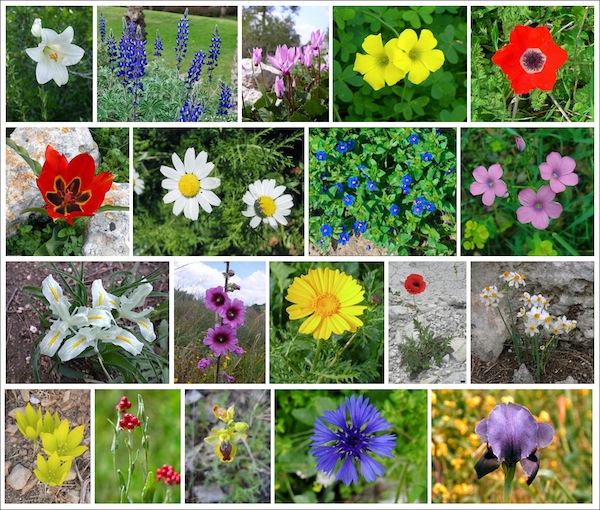
A collage of Israeli wildflowers. (MathKnight/Wikimedia Commons)

Every year, spring returns like a miracle and Israel is carpeted with wildflowers. There are nearly 3,000 types of wild plants in this tiny land, a wonderful profusion – among the most abundant on earth, growing in deserts and marshes, mountains and forests, and open fields.

We protect the wildflowers in Israel. Nature reserves prohibit picking any flowers, even the most common, which helps them propagate over wider areas. In turn, this brings the sunbirds, who feast on their nectar.

The Song of Songs, which we read every Passover, is the most beautiful love poem in the world. King Solomon wrote it as a dialogue between a young shepherd and his beloved: “Rise up, my love, my fair one and come away / For lo, the winter is past / The rain is over and gone / The flowers appear on the earth / The time of singing is come / And the voice of the turtle is heard in the land.”

The flowers he refers to, nitzanim, still carpet the fields – red poppies flaunting scarlet beauty in the grass.

In the Jerusalem Forest, cyclamens bloom in the crevices between the rocks. Called “Solomon’s Crown” in Hebrew, they lift their pink, cream or lilac heads on slender stalks. Clumps of wild violets, the dew shimmering, add their touch of magic.

We had good rains this winter and they have left a bequest of green. The Sharon Valley is dotted with tulips and narcissus – “I am the Rose of Sharon, a lily of the valleys.”

It is believed that King Solomon was referring to the black tulips of the Galilee. In spring, even the weeds are beautiful – the milk vetch (gadilan), which is just a common thistle, adds purple blooms to the roadside. The rock rose (labdanum) flowers abundantly in forest glades, and the orange ranunculus bursts forth. Like its velvety cousin, the anemone, it is a protected wild flower in Israel.

The perfume of daffodils, which delighted our winter, still wafts on the breeze, and the white, cream, yellow and blue noses of lupins are pushing through the soil. Oleanders are in bud, growing wild by the banks of the River Jordan and near streams in Galilee, promising summer. And the blue statice reminds us that we, too, have a Mediterranean coast like the famed Riviera – this sea plant flowers from spring until mid-summer, when its corolla drops off and only the sepal remains.

When you see the splendour of the land’s spring glory, the wildflowers glowing, you’ll echo the poet’s words: “Had I but two loaves of bread, I would sell one of them and buy white hyacinths to feed my soul.”

Dvora Waysman is a Jerusalem-based author. She has written 14 books, including The Pomegranate Pendant, which was made into a movie, and her latest novella, Searching for Sarah. She can be contacted at [email protected] or through her blog dvorawaysman.com.

Format ImagePosted on April 2, 2021March 31, 2021Author Dvora WaysmanCategories Op-EdTags Israel, King Solomon, landscape, Song of Songs, spring, wildflowers

Posts pagination

Previous page Page 1 … Page 3 Page 4
Proudly powered by WordPress