Left to right: Gary Segal, 2014 Jewish National Fund Negev Dinner honoree, 2016 honoree Shirley Barnett and Ilan Pilo, Jerusalem emissary and executive director of JNF Pacific Region. (photo by Robert Albanese)
The tally is in. On April 10, the Jewish National Fund, Pacific Region’s soldout Negev Dinner raised a record-breaking $1 million to rebuild a shelter in Rishon LeZion. To be called the Vancouver Shelter, it will be a safe haven for families of all religions and backgrounds while providing them with the time and space to forge new independent lives. It will be run and operated by the Israeli nonprofit No to Violence Against Women, which works with women and children fleeing domestic abuse. The shelter project was selected by dinner honoree Shirley Barnett.
Josh Cooper, chief executive officer of JNF of Canada, praised Barnett for her community leadership and Frank Sirlin, JNF-PR president, lauded her dedication to the Jewish value of tikkun olam, repairing the world. Addressing the dinner guests, Sirlin said about Barnett’s philanthropic work, “Shirley knows what she wants and she makes it happen.” He also thanked the JNF-PR’s board and donors for making the event a great success.
Ilan Pilo, JNF Jerusalem emissary and Pacific Region executive director, spoke about the importance of the shelter and the funds raised from the dinner for it. He thanked the community at large, as well as the volunteers, lay leaders, dinner chairs and committee and all JNF supporters for supporting the project and for making it a record-breaking year.
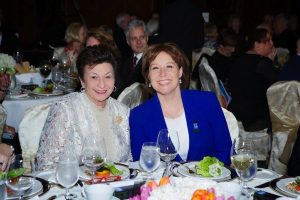
Jewish National Fund Negev Dinner honoree Shirley Barnett, left, and B.C. Premier Christy Clark. (photo by Robert Albanese)
Attending the dinner, which was held at the Four Seasons Hotel, were several dignitaries, including Consul-General of Israel to Toronto and Western Canada D.J. Schneeweiss, Premier Christy Clark, Speaker of the Legislative Assembly Linda Reid, Minister of Justice and Attorney General Suzanne Anton, Minister of Advanced Education Andrew Wilkinson, B.C. NDP House Leader and Official Opposition Solicitor General Critic Mike Farnworth, former member of Parliament Stockwell Day, former member of the Legislative Assembly Grace McCarthy, and founder of No to Violence Against Women, Ruth Rasnic.
Entertainment for the evening was provided by Arik Davidov, an Israeli trumpet player, who also impressed the audience with his shofar playing. Arnold and Anita Silber were this year’s honorary chairs for the Negev Dinner and television and radio broadcaster Shane Foxman was master of ceremonies. Lorne and Melita Segal hosted a reception at their home the night before the dinner.
Since its inception in 1901, JNF has been the sole agency responsible for the development and infrastructure of land in Israel. Its many programs include land reclamation, reforestation and road-building.
Donations go directly to fulfilling the needs of one of the many development areas such as water, forestry and environment, education, community development, security, tourism and recreation, and research and development. For more information, contact Pilo at ilan.pilo@jnf.ca or 604-257-5155, ext. 821.
Left to right: Esther Mogyoros, King David High School director of development; Shannon Gorski, PAC co-chair; speaker Josh Shipp; and Teaching for Tomorrow co-chairs Gaby Lutrin and Elaine Grobman. (photo from KDHS)
“What’s the difference between a watermelon and a cloud?” Josh Shipp asked the crowd. “Three percent. A watermelon is 94% water and a cloud is 97% water. All that separates them is three percent, but that little difference makes all the difference in the world. That little difference can be all that separates you from being average and being extraordinary.”
Shipp, a “teen expert” and motivational speaker, who graduated from Stanford and has lectured at Harvard and MIT, was speaking at Teaching for Tomorrow, an annual celebration of King David High School (KDHS), on May 17.
KDHS, which has 220 students and expects continued growth, is British Columbia’s only Jewish high school and one of six outside of Toronto. It is also one of the most successful Jewish high schools in Canada from the perspective of having growing enrolment each year.
The auditorium at the Chan Centre was packed, flanked on both sides by galleries full of KDHS students. After an introduction by emcee Liam Sasky, a Grade 12 student, the audience heard a concise, warm and humorous speech from school head Russ Klein. A musical interlude followed, with a duet about friends struggling with the romance that’s broken out between them. Following that came a video about KDHS and its values, focusing on the experience of current students and alumni – the students interviewed emphasized the sense of community at KDHS, and the feeling that they were known and valued personally at the school.
After that came the main event. Shipp was notable for his ability to get raucous laughter from the teens, who he seemed to hold in the palm of his hand throughout his talk. He peppered his speech with memorable images and questions, tech and pop culture references, and self-deprecating humor. Shipp, who was abandoned as a child and grew up a troubled delinquent in a series of foster homes, spoke candidly of his own horrific experiences of abuse and trauma. At the centre of his speech was the role that one caring adult can play; in his life, this was his foster father Rodney, who refused to reject Shipp, saving his life and turning it around. “All of you can be a Rodney to someone,” said Shipp. “Every child, every teenager, every human being is one caring adult away from success.”
Shipp challenged students to reach out to a “Rodney” in their own lives within 24 hours and say “thank you,” something Shipp said took him nine years to do after the day his Rodney turned his life around. Shipp also had a warning for students: face your ghosts.
“You guys are pretty serious here,” Shipp said. “I know it. I watched the propaganda video. You need to be unafraid to seek help for the things that are holding you back. This can be a problem in high-achieving communities like this. Don’t be afraid to seem weak, because talking about these things is not weak – it’s courageous.”
Matthew Gindinis a Vancouver freelance writer and journalist. He blogs on spirituality and social justice at seeking her voice (hashkata.com) and has been published in the Forward, Tikkun, Elephant Journal and elsewhere.
Canadian Museum for Human Rights researcher and curator Dr. Jeremy Maron discussed some of the issues the museum faced in deciding what to exhibit. (photo by Rebeca Kuropatwa)
The Canadian Museum for Human Rights (CMHR) in Winnipeg is one of the newest museums on the block. Dr. Jeremy Maron, a CMHR researcher and curator, discussed some of the issues the museum faced in deciding what to exhibit. The March 4 brown-bag lunch meeting at the University of Manitoba was open to students and the general community.
Maron’s main work at the museum is on the fourth floor, an area dedicated to the Holocaust. Displays on three perimeter walls take a case study approach, emphasizing themes closely related to the Holocaust as well as universal human rights.
“The first theme we look at is the abuse of state power,” he said. “This wall explores how Nazis used and deployed instruments of state power, such as the police, judiciary, laws and regulations, and even education to undermine human rights … and acquiring total dictatorial control of German society, promoting their racist and antisemitic ideology, targeting Jews and other specific groups for social exclusion and persecution, ultimately culminating in genocide.”
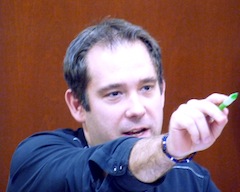
Dr. Jeremy Maron makes a point at a March 4 meeting in Winnipeg. (photo by Rebeca Kuropatwa)
Maron said the modern nation state, in its ideal sense, is supposed to be the guarantor of human rights. But, in reality, the centralized power of the modern state very often sets the stage for it to be the worst violator of human rights.
“The case of Nazi Germany is a good example of the centralized power and the capacity for it to be mobilized toward the violation of human rights, rather than protection,” he said. “There are many other stories in the museum in which state power is also being utilized in such a manner.
“The second thematic wall in this gallery … moves on to look at persecution and targeting of specific groups in Nazi Germany. This wall explores the increasing intensity of systematic oppression under the Nazis.”
According to Maron, the Allies did not fight the Second World War specifically because they were trying to save the Jews in Europe. However, their winning of the war ended the Nazi massacre of Jews, which continued nearly up until the day of the Germans’ surrender.
“Another exhibit, from which we try to draw human rights connections, is a large digital study table in our Breaking the Silence gallery, also on level four,” said Maron. “This gallery looks at breaking the silence specifically as a human rights act.”
Human rights violations are always accompanied by silence, distortion, justification, minimization and denial, he said. Perpetrators want to hide their crimes; victims who survive may feel scared for themselves or their families, or feel ashamed; witnesses and bystanders often look the other way, so the cycle continues.
The goal of the CMHR is to encourage people to speak out about these violations, to drag the violations out into the light of day and pursue justice, recovery and reconciliation, he said.
“This particular exhibit, Breaking the Silence … looks at a wide scale of human rights violations, putting an emphasis on how people have responded to them in order to break silence,” said Maron. “We tried to place the emphasis of the human rights response in this particular case. It’s a question of focus that tries to adopt a forward-looking perspective, rather than one that is trying to wholly examine the past in and of itself.”
While some visitors feel that the message and exhibit is too watered down, Maron said this was necessary to a certain degree, as the museum’s main focus is to educate and not to horrify or shock.
“It’s not just a sense of sensitivity we think about, it’s also a question of a fact,” said Maron. “Sometimes, when confronted with material that is explicitly horrific, even for someone like myself who has worked on this material extensively, it almost can shock you into silence as it overwhelms you. I think back to when I was doing my master’s in 2005. I went on a Holocaust commemoration tour [and] we toured Auschwitz. After you go through the gas chambers and you see the walls and the showerheads, you get back on that bus and you are just beaten down. You are sitting there and the guides are trying to debrief and talk, but no one wants to talk because they are beaten down.”
While the CMHR does not back away from the truth or gloss over troubling aspects, they choose to visualize these histories differently, he said. One of the concepts the museum is designed to highlight is that everyone’s actions are the result of choices, and that the consequences of these choices are not inevitable.
“That’s not to say that there are not constraints on choices,” said Maron. “If you’re in the midst of a particular human rights catastrophe and you do something like hide a potential victim in your attic, it’s very possible that you might be targeted as well. So, there are constraints on choices in certain historical circumstances. But, it’s still important to consider that these are choices and actions, and what happens isn’t inevitable. Some objects in the museum speak to some of the less obviously consequential choices that individuals might have made that allowed the Holocaust to be perpetrated on that scale.”
While Maron understands that it’s impossible to know for sure what a single individual could have done, with his display, he hopes to create a deep and meaningful reflection for CMHR visitors and, especially, students.
How to convey a history of conflicts accurately without reigniting tensions is another challenge the museum has taken into consideration, by using careful word choices and avoiding blanket statements. But, maybe the most important aspect and aspiration for the CMHR is ensuring that visitors leave with a sense of hope.
“This hope is not a naive hope that everything is going to be OK, but that … hope is possible as long as we promote the human rights of everyone, and the idea that hope is possible if people are willing to make hard choices and take action,” said Maron. “So, again, we hope our visitors leave with the idea that change is possible if people are willing to do something, while silence and acquiescence is the ally of rights violations.
“Until atrocities are recognized and acknowledged, until people believe action is possible, cycles of violations will continue. Such cycles, we hope, our museum, in some small part, can help improve by inspiring a lot of hard work and devotion by our visitors, who may become dedicated human rights advocates and defenders.”
At sundown on Saturday, June 11, Jews around the world will start the two-day holiday of Shavuot, which lasts only one day in Israel. Also known as the Festival of Weeks because it marks the completion of the counting of the Omer period – which is 49 days long, or seven weeks of seven days – Shavuot is one of the Jewish calendar’s shalosh regalim, three pilgrimage holidays.
Unlike the other two pilgrimage festivals – Passover and Sukkot – there is no definitive ritual associated with Shavuot in the text of the Torah. As such, many Jews struggle to connect with the holiday, which has yet another name: Chag Hakatsir, the Harvest Festival.
But, despite its undefined nature, Shavuot “is a gift of a holiday,” says Roberta Miller, a Chicago Jewish day school teacher. “It’s when we got the Ten Commandments, God’s greatest present to the Jewish people.”
In that spirit, here are seven ways to infuse more meaning and minhag (tradition) into your Shavuot this year:
1. Food. It is traditional on Shavuot to eat dairy foods. Rabbi Robyn Frisch, director of InterfaithFamily/Philadelphia, explained some believe this is because the scripture compares Torah to “honey and milk … under your tongue.” (Song of Songs 4:11) Another explanation is that when the Israelites received the Torah for the first time, they learned the kosher dietary laws and didn’t immediately have time to prepare kosher meat, so they ate dairy instead.
Baking and consuming dairy foods can differentiate Shavuot from other holidays, said Miller. “We all have very strong memories associated with scent. If I smell a honey cake, I think of my grandmother and Rosh Hashanah. The smell of cheesecake generates a connection to Shavuot for my kids.”
In Miller’s family, Shavuot marks the first ice cream cake of the season, and that knowledge builds anticipation for the holiday. Just as no one in her house is allowed to eat matzah until the seder, she said no one gets ice cream cake until Shavuot.
2. Games. For families with children, games are a great way to educate youth about the messages of Shavuot. Miller suggested counting games. “You can count up to 49 of anything: 49 ways Mommy loves you, 49 things you are grateful for,” she said.
For older children, Miller suggested a Jewish commandments version of Pictionary, in which, before the holiday, children write their favorite commandment or commandments on a notecard. The cards are mixed up and put into a box or bag. Then, the family gets together, members draw picture cards, and someone acts out each commandment while participants guess which commandment it is and why it is important.
3. Guests. On the second day of Shavuot, we read the Book of Ruth, the story of the first Jew by choice. Frisch explained that it is also a story of welcoming the stranger and inclusivity. Shavuot is the perfect holiday for inviting new friends over for a meal, or for opening one’s home to people who are interested in learning more about Jewish traditions, she said.
4. Learning. Taking part in a tikkun leil Shavuot (a night of Jewish learning) is another Shavuot custom. Many traditional Jews stay up all night on the first night of the holiday to study Torah. Frisch also suggested hosting a communal night of learning that can draw in a more diverse mix of Jewish learners, or hosting an evening of learning at an individual’s home.
“Jewish learning doesn’t have to be biblical texts.… It could be liberal values or social justice or just a discussion about Jewish identity or Jewish laws,” said Frisch.
5. Birthday party. Tradition has it that King David, Ruth’s great-grandson, was born and died on Shavuot. Miller suggested holding a King David birthday party featuring decorations, cake, ice cream and gifts.
“Use it as a learning tool,” she said, noting how the party can springboard into an historical discussion. “What would you write on a card to [King David]? What do you want to ask him? What would he want for a present? What would he put in the goody bag that he gives to each of us?”
6. Nature. On Shavuot, it is customary to decorate our homes and synagogues with flowers and plants. Ruthie Kaplan, who lives in the Nachlaot neighborhood of Jerusalem and is a former Hebrew school teacher, said following this tradition of surrounding ourselves with the lushness of the natural world could “add a lot of beauty to the day.” She said Shavuot is “the perfect time” to connect with nature and appreciate the beauty of the world that God created for us.
7. Goals. Kaplan said a deeper reading of the Book of Ruth can transform Shavuot from simply another Jewish holiday into an opportunity to set goals and resolutions. Ruth, she said, believed in something (Judaism) and followed through on her belief.
“That story of Ruth excites me and really comes to life on Shavuot,” said Kaplan. “Ruth is open to the truth and, therefore, she sees it and she is willing to be honest with herself. For anyone searching and struggling, Ruth is a good role model for life.”
Prof. Eytan Mor, left, and Dr. Evyatar Nesher with a kidney transplant recipient at Petach Tikvah’s Beilinson Hospital, which is part of the Rabin Medical Centre. Mor is director of the transplant department and Nesher, the department’s deputy head. (photo from Ashernet)
About nine years ago, a 55-year-old woman with a congenital kidney disease underwent a kidney transplant in the Philippines. Last week, she died following a stroke and her brother, who suffered from the same congenital disease and needed a transplant, received his sister’s kidney, which was still viable, though she had died. This was the first time such a surgical procedure had been performed in Israel, and it is thought that this procedure has been performed only five times in the world. This is also the first time that such a transplant has been carried out between family members. It is hoped that this landmark operation will encourage more live donations of kidneys.
קנדה לא תבחר בדונלד טראמפ: המלון דירות בטורונטו שבניהולו מוצע למכירה עקב הצטברות חובות בהיקף 260 מיליון דולר
אין זה סוד שהקנדים לא אוהבים את המועמד של המפלגה הרפובליקנית לנשיאות בארצות הברית, דונלד טראמפ. סגנונו הבוטה והתבטאויותיו החריפות זרות להם והם שמחים לאידם של האמריקנים השכנים מדרום, שנאלצים להתמודד עם התופעה היוצאת דופן הזו מדי יום.
למלון הדירות טראמפ אינטרנשיונל הוטל ומגדל טורונטו בניהול חברתו של טראמפ יצא מונטין רע מאוד, תוך הדגשה על שירות וניהול גרועים, מרגע פתיחתו לפני כארבע שנים. המלון שייך לחברת טאלון אינטרנשיונל דבלופמנט שבבעלות המיליארדר היהודי-רוסי, אלכס שניידר, שגר בטורונטו. שניידר גר בסוויטה המפוארת במלון ששוויה מוערך בעשרים מיליון דולר. חברתו של טראמפ אחראית על מערכי השיווק, ההזמנות והניקיון. חלק לא מבוטל מרוכשי הסוויטות בפרוייקט הגיש תביעה לבית המשפט נגד טראמפ וטאלון, בטענות שונות בהן בנייה באיכות ירודה ועל כך שהתפוסה הנמוכה של החדרים שבבעלותם שמיועדת להשכרה, לעומת מה שהובטח להם עת רכשו את נכסיהם.
מלון דירות טראמפ מתנשא לגובה של 65 קומות והוא כולל: 261 חדרי מלון ו-118 דירות. מרבית הסוויטות במלון והדירות בניין לא נמכרו עד היום, כאמור לאור המוניטין הרע שיצא לפרוייקט. אגב תפוסת המלון עומדת על 55-75 אחוז בלבד.
חברתו של שניידר לא מסוגלת להחזיר במלואה הלוואה בהיקף 310 מיליון דולר שלקחה מבנק אירופאי למימון בניית המלון, שעלותו הגיע לכחצי מיליארד דולר. טאלון יצויין פתחה בהליכים של הגנה בפני נושים בקייץ אשתקד. טאלון חייבת לבנק האוסטרי אר.בי.איי 260 מיליון דולר והבנק מנסה בימים אלה למכור את המלון, כדי להציל לפחות חלק מכספי החוב של שניידר. לפי הערכה הבנק יקבל עבור המכירה לכל היותר בין 180-200 מיליון דולר. בכל מקרה הרוכשים החדשים של הנכס לא מתכוונים להמשיך ולהשאיר את השם טראמפ על הבניין, כיוון שלא ירצו עוד בחברת ניהול הכושלת של טראמפ. הם יאלצו אף להשקיע סכומים נכרים בשיפוץ הפרוייקט. תושבי טורונטו בוודאי ישמחו לדעת שהשם טראמפ ימחק מהמלון דירות, שעד כה לא הסב שום נחת לעיר. אגב חברתו של טראמפ הגישה בעצמה תביעה לבית המשפט נגד חברתו של שיינדר, בטענה שהאחרונה מבקשת לנשלה מניהול הפרוייקט.
חברת הניהול של טראמפ מנהלת ארבעה עשר פרוייקטים דומים ברחבי העולם בהם בטורקיה ובפנמה, ובכל מקום יצא לה שם גרוע מאוד. במהלך הקיץ הקרוב יפתח מלון הדירות טראמפ אינטרנשיונל הוטל ומגדל ונקובר (בבעלות מיליארדר ממלזיה), שממוקם ברחוב ג’ורג’יה שבדאון טאון. יהיה מעניין לדעת אם גם הפעם טראמפ יצור לעצמו שם רע כל כך מהר. לאור ההתבטאויות הקשות בקמפיין הבחירות שלו, ניסו חלק מתושבי ונקובר כולל ראש העיר, גרגור רוברטסון, לפתוח בפעילות להורדת השם טראמפ מהפרוייקט שבניהולו, אך נכשלו לפי שעה.
שניידר (יליד 1968) צבר את הונו מפעילותו בתעשיית הפלדה של אוקראינה, באמצעות קבוצת מידלנד שבבעלותו (ביחד עם אדוארד שיפרין). הוא עלה לישראל כילד קטן עם משפחתו ב-1972 ולאחר כעשר שנים עברה המשפחה לטורונטו. שניידר למד באוניברסיטת יורק בטורונטו וכיום הוא נשוי ואב לשלושה ילדים. בסוף שנת 2007 רכש שניידר 80 אחוז מקבוצת הכדורגל מכבי ת”א תמורת כ-65 מיליון ש”ח. לאחר שנתיים הוא מכר את הבעלות על הקבוצה למיליארדר היהודי שגם כן גר בטורונטו, מיטשל (מיץ’) גולדהאר. שניידר היה בעבר הבעלים של פורמולה 1 ואשתקד הוא רכש כרבע מחברת מישורים הישראלית.