בנימין נתניהו – 5 בינואר. סוגיית מתן הצבעה לישראלים שגרים בחו”ל חוזרת לחדשות. (צילום: Ashernet)
לקראת הבחירות: יש ישראלים שרוצים שיאפשרו להם לבחור בחו”ל
סוגיית מתן הצבעה לישראלים שגרים בחו”ל עולה על סדר היום בדרך כלל, לקראת קיום בחירות חדשות. הנושא שוב חוזר לחדשות לקראת הבחירות הקרובות שיתקיימו ב-17 במרץ.
אליהו גורדון שגר בחו”ל כבר למעלה מ-16 שנים, עוקב בדאגה אחרי מה שקורה בישראל. גורדון (50, נשוי+3) גר ב-12 השנים האחרונות בריצ’מונד ועובד ברשות המיסים הקנדית. הוא בעל תואר ראשון ביחסים בינ”ל ומדע המדינה.
גורדון חושש מאוד ממה שעומד לקרות בעתיד הקרוב בישראל. לדבריו: “הנתונים הדמוגרפים לא משקרים ובשנת 2020 חלקם של הילדים החילוניים בכיתה א’ בבתי הספר הממלכתיים, יהיה פחות מ-50 אחוז, למרות שהם מהווים למעלה מ-50 אחוז מכלל האוכלוסיה. ומה המשמעות של נתון זה? שמספרם של האזרחים הלא ציונים, החרדים, הדתיים וכן הערבים ילך ויגדל בחברה הישראלית, ואילו כוחם של החילונים ילך ויקטן”.
לדברי גורדון למדינה צפוי גורל קשה אם בתחום הילודה לא יהיו שינויים, וכנראה שלא יהיו שינויים, כי כידוע במגזרים הדתי והערבי עושים יותר ילדים. לכן הפתרון יכול לבוא רק מצד הישראלים שגרים בחו”ל. כיום גרים בחו”ל למעלה מ-600 אלף ישראלים בעלי זכות בחירה, ורובם המוחלט חילונים.
גורדון: “עומדות לפנינו שתי אופציות. לאפשר להמשיך ולתת לאנטי ציונים, החרדים והערבים להמשיך ולהגדיל את כוחם. או לאפשר לישראלים בחו”ל להצביע כאשר כוחם שווה בין 10-15 מנדטים שיתחלקו בכנסת, בין המחנה החילוני והמחנה הלאומי. ועל ידי כך המחנה החילוני יגדל באופן מאוד משמעותי. ומה שלא יעשה הרחם של האמהות הציוניות, יעשה קול הבחירה של הישראלים בחו”ל. בעיני רבים בארץ, הישראלים שגרים בחו”ל נחשבים ליורדים, נפולת של נמושות ובוגדים שנטשו את המערכה ולא מוכנים לשאת עוד בנטל. אז לתת להם לבחור ממרחקים ולהשפיע על מה שקורה בישראל? אולי כדאי לעצור רגע ולשאול מי יכול באמת לעזור לעתיד המדינה. הישראלים בחו”ל שילמו ביטוח לאומי ומס הכנסה ועשו מילואים. לעומת זאת רבים שגרים כיום בישראל לא עושים בכלל צבא. כמו שכבה שלמה של המגזר החרדי והערבים, שמהווה נטל גדול על המדינה, בזמן שהם חיים על קצבאות. אך יש להם כוח רב ביום הבחירה”.
גורדון מציין כי בכל המדינות הנאורות בהן ארה”ב קנדה, אנגליה, גרמניה, צרפת, איטליה והולנד, מאפשרים לאזרחים שגרים בחו”ל להצביע. ואילו ישראל שייכת למחנה קטן שכולל את סין ורוסיה, שלא מאפשר לאזרחים בחו”ל להצביע.
גורדון מסכם את דבריו: “חלון ההזדמנויות הולך ונסגר ואם לא נתעורר הדמוקרטיה הישראלית חילונית תעלם, ובמדינה ישלוט רוב דתי חרדי עם מיעוט של ערבים שהולך וגדל בהתמדה. אך לעומת זאת אם ניתן לישראלים בחו”ל להצביע מפת הכנסת תשתנה לחלוטין, ויתאפשר לרוב החילוני ציוני לנהל את ענייני המדינה, ולחוקק חוקים חשובים ונאורים, בזמן שכוחן של המפלגות הסוחטות יקטן משמעותית. ומי שלא יעשה צבא יחוייב לעשות שירות לאומי, כך שהנטל יתחלק שווה בשווה בין האזרחים. הארכת שעון הקיץ תבוצע כמו בכל מדינה מתוקנת במערב, כדי להגדיל את החסכון במשק. תתקיים תחבורה ציבורית בשבת לעזור בעיקר למעוטי היכולת והקשישים. יתוקן העיוות בקצבאות
הילדים, כך שעד הילד השלישי תהיה בהן עליה, ומהרביעי תהיה ירידה באופן יחסי. ובסופו של דבר את גורל המדינה לא יקבעו החרדים הלא ציונים והערבים, אלה הישראלים שגרים בחו”ל. הם אלו שיצילו את הציונות ויחזירו את השליטה למחנה החילוני. ובכך גם יגרמו ליותר חילונים ודתיים ציוניים לחזור הביתה”.
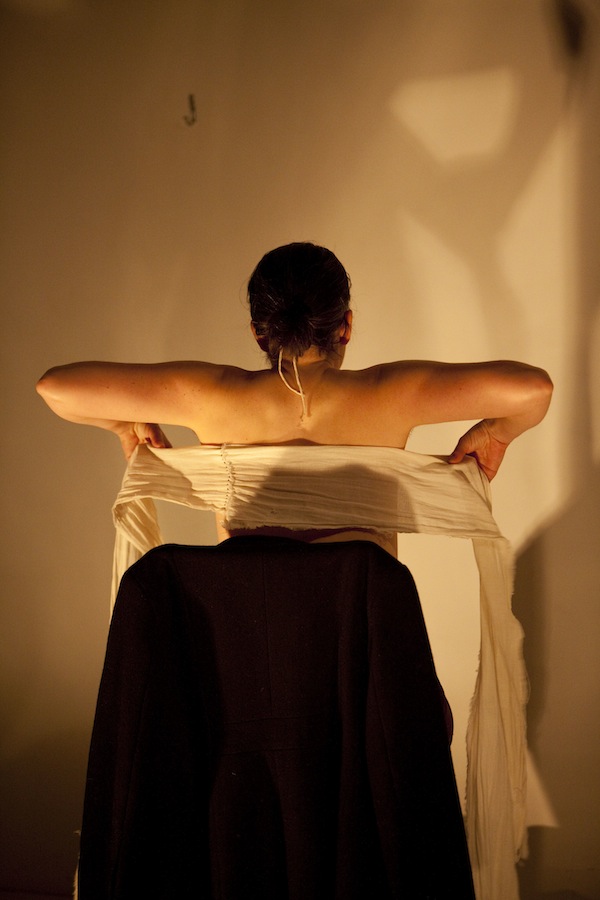
Heather Hermant in ribcage, which will be at the Firehall Arts Centre March 3-8. (photo by Tim Matheson)
As a graduate student, Toronto spoken word artist Heather Hermant took a workshop taught by Diane Roberts, a former artistic director of Vancouver’s urban ink productions. Roberts asked her students to research and embody an ancestor, and Hermant chose her great-great-grandmother Riva. The process eventually led to the multimedia theatrical project ribcage: this wide passage, which comes to Vancouver’s Firehall Arts Centre next month.
ribcage centres on Esther Brandeau, a Jewish woman who, posing as Jacques La Farge, a male Christian laborer, came to Canada from France in 1738. Said to be the first Jew to ever set foot in Canada, she was discovered, interrogated and later deported when she wouldn’t convert to Catholicism. Writes Hermant in a 2013 Canadian Theatre Review article, “Riva stepped aside as I followed an archival labyrinth – in Ottawa, Montreal and Quebec City, and in every place that Brandeau was purported to have worked as a young man over five years across France.”
The 2005 workshop was Hermant’s introduction to Roberts’ Personal Legacy process and, writes Hermant in the CTR, it is “the first performance to move from idea to production through the Personal Legacy process. It was workshopped and presented in Vancouver as part of the 2010 Tremors Festival. The full production premièred at Le MAI in Montreal in October 2010.” A French version of the performance has also been created: thorax: une cage en éclats, translated by Quebec performer and scholar Nadine Desrochers.
“I began as a spoken word performer, and thought I would approach this performance as a series of spoken word pieces. In other words, what I usually did but longer, more material,” said Hermant, who is now a performer across several genres, as well as being a curator, scholar and educator. “When I began to work, I discovered that spoken word poetry as I knew it would not do it with this story. Partly, this had to do with language. I was working with French language archives and yet I write in English. On top of or because of that, a lot of the material I was creating was physical – gesture, movement. A lot of it was video. These were things that were unexpected and new for me since what I thought I was aiming for was spoken word poetry. So, it was a bit scary.
“But, in studio work with Diane Roberts, who directs the show and who has been there from the beginning of its creation, this is where you start. Starting with movement, for example, is a key to storytelling. According to Diane, working from the body first forces a kind of honesty that is difficult to achieve when using language. Luckily, it was in a performance class with Diane where I first discovered the story of Esther Brandeau. Words came late, which is odd for a poet, but in a way this was part of the story. It was as if an impossibility to fully know stood at the centre, and required all sorts of different approaches to do just that: to approach the story, which demanded its own form.”
As her research continued, Hermant realized the production would need a musical dimension. “I began to hear live fiddle and see live mixed video installation. When we came together in collaboration with composer/fiddle player Jaron Freeman-Fox, he composed most of the material in studio (as in dance/theatre studio) with me, working from my movement and the rhythms of some of my text.”
The video in the production, she explained, derives from her research in various countries, “often collected as a way of journaling” her work. “A bunch of the video material is from site-specific reenactments filmed by Melina Young. VJ Kaija Siirala and I worked in studio together to make all this eclectic rich footage into a mixed installation concept…. The video installations operate as a kind of memory space, their own kind of eye on what’s transpiring. Interdisciplinarity in this piece allows for different witness positions to come through, I think. Different ways of looking.”
Hermant doesn’t consider ribcage a play. “It is somewhere between spoken word and storytelling, physical theatre, a series of interdisciplinary tableaux, a performance installation, all of it in a theatre. I just understand it all as poetry, regardless of whether words are involved or not.”
As diverse as are the performance aspects, so too are ribcage’s themes: identity and sexuality, belonging and personal history, established roles and genders as well as rebellion against them. “Thematically,” explained Hermant, “ribcage is a confrontation with the meaning of history and how we know the past. It is about how we work and translate across languages, eras and bodies. It confronts holes and gaps and unknowns in any written record, and works from a place of longing, desire to know and to feel belonging and to understand the present moment. I created this piece because I was compelled by the personal resonances I found with the story of Esther Brandeau…. My show is about my own ancestral and personal histories, and the journey of my research, as much as it is about the story of Esther Brandeau/Jacques La Fargue. All of these stories enter into ribcage: this wide passage, through the different media and forms that I integrate.”
Heather Hermant in ribcage (photo by Tim Matheson)
Hermant noted that women passing as men, “especially in Europe in the 17th and 18th centuries … was far more common than the exceptional cases seem to suggest. In addition to the most popular assumption and representations – that the primary motive for women who passed as men was to follow their male lovers, which circulates through pop culture across many eras, and of which there are indeed many documented historical examples – there were many cases of passers who did so out of economic necessity, there were many cases of passers who did so in order to partner with women, or a combination of these.”
For Hermant, the historical record must be regarded with care. “The important thing to me is to ask how a story is recorded, how it comes to us, what are the stakes for the person outed. In other words, it is vital to read askance and to distrust the document, even as the document gives us the story.
“What is particularly interesting for me in this case,” she continued, “is this is purportedly a case of a female passing as a male and a Jewish person passing as a Christian. I like to call this person a multicrosser. I find we need to challenge the assumption that passing is simply a ruse. Classical literature is full of titillating stories of passers, titillating primarily for straight male audiences. My queer positionality perhaps makes more available to me a knowledge that changing gender can be a profoundly sacred process, that sexuality may or may not have anything to do with it, and that queerness as many of us know ourselves today has history. This doesn’t mean sameness across time. That last sentence is vital. In other words, how people understand themselves today and the terms through which they do so are not the same as how people understood themselves 200 or 300 years ago. This is an inherent challenge to reading, understanding and representing things as they were long ago. It’s partly why I have not chosen to create a work that takes place only contained in a long ago era.”
Describing ribcage as “a midrash on the archive,” Hermant explained, “It’s a meditation, a questioning, a digging in deep into the idea of archive, into archives themselves, into memory and telling, loss, desire, the written word and its troubles, a need to understand belonging, compelled by questioning and not by a need or a belief in the possibility or utility of resolution. In fact, to me, such a stance is an ethical stance, and some might say a profoundly Jewish one – though of course not exclusively so – i.e. the imperative of the question. So, yes, of course, my Jew-ish-ness (hyphenation intentional) is important to me and to my show. ‘Jewishness,’ however defined … and a grappling thereof, informs the piece profoundly. As does my non-Jew-ish-ness, my queerness, my experiences of gender, my feminist leanings, my francophone ancestry, my being a settler ally working with an aboriginal and intercultural theatre company on unceded Coast Salish territory, my work as a scholar in gender studies, colonial history and historiography, my teaching, my concern for land and water…. The list goes on. It is all important to me, all profoundly inform the show, and none of these is mutually exclusive!”
And these are not the only aspects informing the show. “Dealing with difficult histories does not preclude humor, playfulness or joy. In fact,” said Hermant, “these are essential precisely for dealing with difficult histories. I choose the topics I choose – or they choose me – because I feel a responsibility and a call to do so. And because, very simply, they compel me.”
ribcage, produced by urban ink productions, will be at the Firehall Arts Centre March 3-8. Freeman-Fox’s original music will be performed by Vancouver musician Elliot Vaughan.
Olga Livshinis a Vancouver freelance writer. She can be reached at olgagodim@gmail.com.
Germany’s Daniel Kahn and the Painted Bird play at the Electric Owl on March 6 as part of the Chutzpah! festival. (photo from Daniel Kahn and the Painted Bird via Chutzpah!)
Daniel Kahn and the Painted Bird live up to the hype. They are indeed “helping klezmer reach a new renaissance, seasoning it with folk, punk and deep-digging lyrics, full of sarcasm and wicked self-irony.” They most certainly belong “to this caste of Yiddish music agitators” and their music is “[a]n absolute must for lovers of unusual, intelligent, challenging, exciting folk music and a blast at every instant.” They are “forward-marching and backward-glancing,” making “truly great art.”
And that’s not the half of it. On their website (paintedbird.de), you can read more about what reviewers have said, you can download the lyrics to all their songs, you can watch several videos – and you can get an excellent idea of what to expect when they perform at the Electric Owl on March 6 as part of this year’s Chutzpah! festival. Kahn spoke with the Jewish Independent ahead of that one-night only show.
JI: Could you share a bit about your background – how you came to be a musician, how and when you came to live in Berlin, for example?
DK: I’ve been a musician all my life but I first started working professionally as a singer-songwriter in Detroit, and then in New Orleans in 2001.
I was a part of founding the Earthwork music collective in Michigan, which has grown to a large community of artists and activists. I produced four albums of my songs with them. I first really invested in klezmer music and Yiddish after attending Klez Kanada, in Quebec, for the first time in 2004. It was there that I met Alan Bern, who was my accordion teacher. He had been living in Berlin for many years and he offered me his apartment to sublet. I was already quite interested in German theatre, particularly Brecht, and I wanted to live in Europe, so it fit.
After going to the Jewish festivals and workshops that summer in Krakow and Weimar, I had the idea to start the band the Painted Bird. And it was around then that I really started learning not only German, but Yiddish and incorporating translations into my songs, and performing in many languages at once. The band has had many members but the heart of it for all these years has always been Michael Tuttle, whom I met in New Orleans, playing bass, and Hampus Melin, a drummer from Sweden, whom we met in Berlin. We wanted to create a band that would be able to take traditional songs, folk songs, in different languages and infuse them with a modern sensibility that we take from the other music we dig – punk, jazz, new music. And Berlin is the perfect city for this band. It’s a real cosmopolis.
JI: You’ve studied drama and your bio notes that you’ve been a professional actor since age 12. How does acting fit in with your music career?
DK: From a performance perspective, I’ve never made too much of a distinction between ways of being on a stage. Songs and plays are simply different modes of collaborative or solo storytelling. As a musician, I get to employ many of the techniques I need to write, direct or act in the theatre. And I’ve never really quit making theatre. I’ve done many productions over the years, in the States, as well as in Germany. I’ve been involved as a composer or arranger of music and songs for various productions, and I’ve been acting and directing again, as well.
I’m currently very involved in Berlin at the Maxim Gorki theatre, a wonderful space for progressive work these days. The new artistic director, the Turkish-born German Shermin Langhoff, is an inspiring, powerful voice for diversity and political engagement in drama. I’ve been a kind of “house-poet” for the theatre, working on several productions as composer, actor, musician, etc. I’m about to direct a small play in their studio theatre space, an adaptation of Romain Gary’s The Dance of Genghis Cohn. It’s become an important family for me, and has also connected to the international klezmer family, as well. I curate a concert series there, focusing heavily on new Jewish music.
JI: What drew/draws you to Yiddish as a language in which to write and sing?
DK: Besides the connection it may have to my personal background as a descendant of immigrants from what we could call Yiddishland, I’m attracted to Yiddish on a purely esthetic level. I like the way Yiddish sounds, how it feels to sing and speak it. It tastes good. I like the things you can express in Yiddish that don’t quite work in other languages. And I like the challenge of trying to translate that not only into English, but into a kind of performance that makes sense to an audience that may not have the cultural or historical literacy to know where it comes from. I think Yiddish has a lot to teach us about the world we live in today, as well as the world of a century ago. It’s a language which defies borders, which defies easy categorization, which defies simple historical narratives. It’s a defiant language.
JI: Your lyrics are poetry, full of meaning, commentary on history and contemporary society. How would you describe your core beliefs/values? Do they have any foundation in Jewish traditions/ teachings?
DK: My core beliefs, which are never fixed, have their foundations in many things in my life. Some of those things are Jewish. Others simply come from being a child of Detroit in the late 20th century, being an ex-pat, being someone who travels a lot, etc. But some of what I received as a Jewish education goes against other values that I hold to. I try to take what I need from traditions and leave the rest alone. But this is itself a tradition. So, insofar as Jewish tradition contains a tradition of subverting other traditions, I’m a fairly traditional subversive.
JI: You also arrange the words of others, Heinrich Heine, Bertold Brecht, Itzik Manger, Leonard Cohen, and a wide range of writers. How do you choose, or what aspects of a poet’s words tend to interest/excite you?
DK: I work on what speaks to me.
I’ve loved Leonard Cohen since I was about 14 or 15 years old. I definitely owe the fact that I chose to be a songwriter and a poet largely to him. Brecht was the thinker and poet who kept me interested in the radical potential of the theatre to dynamically reflect the world in a political and lyrically effective way. My first plays that I worked on out of college were by him, in New Orleans and Detroit. Somehow, they were the best response I could find to the Bush era. Brecht wrote of living in “bad times for poetry.” I think I know what he meant. He was also a tremendous songwriter, who directly influenced people like Bob Dylan and performers like Nina Simone.
Heine and Manger were poets whom I really discovered in learning German and Yiddish. And now I understand that they are relatives of Cohen, Dylan (both Bob and Dylan Thomas) and others. They are just obscured behind the barriers of language and the catastrophes of history. I like to think of what a young woman I met once said after attending Klez Kanada and first encountering modern Yiddish poetry, she’s from Newfoundland, not Jewish, and she said: “I can’t believe it. It’s like a crime that I’ve been alive for 25 years and no one has ever told me about Itzik Manger!” I think a lot of people would feel that way if they could read him. He was amazing.
Daniel Kahn and the Painted Bird’s 19+ show at the Electric Owl, 1926 Main St., starts at 8 p.m. Tickets are $30/$25. For the other musical performances, as well as the dance, theatre and comedy shows that take place during Chutzpah!, visit chutzpahfestival.com.
Alex the Moose, aka Alex Konyves, performs at the Jewish Community Centre of Greater Vancouver’s Family Day on Feb. 9. (photo by Kale Wilson Beaudry of klphotograph.com)
The show had ended. Alex the Moose, though, had not left the building. Known to his friends as Alex Konyves, the man beneath the antlers sat next to me basking in the afterglow of his Family Day concert at the Jewish Community Centre of Greater Vancouver on Feb. 9.
With sweat on his brow and a big smile, he and I sat looking towards the now vacant stage. No longer in moose attire, he was obviously pleased. “I was so excited for this show,” he beamed. “We were asked to do it a number of months ago, and put a great band together with Jesse Bentley on bass, Jeff Child on percussion, Emma Wong on vocals and myself on guitar and vocals. We had a blast. The kids here are really adorable, really sweet, really engaged.”
Alex the Moose, joined by a giraffe, a cheetah and a bunny, played for the children, but the parents and grandparents in the audience bobbed their heads and tapped their feet, too. Blending elements of funk, Latin, klezmer and rock and roll, the band opened with a bass solo from Jesse the Cheetah (Bentley) that would not be out of place at the Commodore Ballroom on a Saturday night.
“The trick is keeping it suitable for children, but also engaging for parents,” Konyves explained. “Some children’s music is not the most engaging for parents, and if they’re going to be playing at your house, on repeat, it’s nice to have music that’s engaging and fun, original and diverse.” Hence, the ensemble includes a range of instruments – the didgeridoo, two types of hand-drum, wind chimes, guitar, bass and voices. “We like to keep it eclectic,” said Konyves.
They opened with an original song – “Wake up in the Morning” – and aptly chose their current single, “The Pyjama Song,” as the finale. The group performed other originals, such as “The Bumblebee Song” and “The Iguana Song,” in which the group counts iguanas falling off a tree, in Spanish, as well as classics like “The Hokey Pokey,” “If You’re Happy and You Know It” and “Head and Shoulders, Knees and Toes.”
“The first time I played music for young children was at Camp Miriam when I was a madrich [counselor] there, and I had a young age group,” said Konyves, now 29. “At night, I’d put them to sleep by playing guitar and, three songs in, they’d all be fast asleep. It was really special.”
These days, Konyves, who is also the song leader at Temple Sholom, lists Raffi, Debbie Friedman and the Beatles as his musical influences. “Raffi talks a lot about child-honoring, where you really respect children in every regard. You don’t push product placements, you really allow them to make choices for themselves, and you give them your heart.”
Konyves also believes in making music accessible to children. “If you have any instruments in your house, put them out,” he advises parents. “Just like having books in your house, it should be the same with musical instruments.”
As our conversation wound down, an impromptu jam session broke out among the bandmates on stage. To the bellowing of the didgeridoo and the beat of the djembe, Konyves explained his love of playing for children: “Kids are very honest with you when you play. If they don’t like it, they’ll let you know.”
Based on the bouncing, jumping, laughing and smiling in the audience, they liked the Family Day show a lot.
Benjamin Grobermanis a born and raised Vancouverite. He is a freelance writer, and is pursuing a bachelor of education degree, with aspirations to teach in a Jewish high school. He is a resident of Vancouver’s Moishe House.
Lynne Fader, Courtney Cohen and Toby Rubin hold some of the 500 care packages that were distributed to the needy in Richmond recently by Rose’s Angels, an organization founded by the Kehila Society and Cohen, in memory of her grandmother Rose. Each package contained toiletries and food, while additional bundles supplied socks, toque, gloves and scarves. The packages were distributed to CHIMO, Richmond Family Place, the Jewish Food Bank and Turning Point Recovery House.
After the attacks in Copenhagen, like after the violence and vandalisms that have rocked the French Jewish community, Israel’s Prime Minister Binyamin Netanyahu is urging the Jews of Europe to come to Israel as violence against Jews and Jewish institutions increases across that troubled continent.
This call for a new mass aliyah is being met with opposition by European leaders – including Jewish leaders. In Copenhagen, more than 30,000 people, led by their prime minister, commemorated the victims of the terror attacks. Copenhagen’s chief rabbi, Jair Melchior, told the Associated Press, “People from Denmark move to Israel because they love Israel, because of Zionism. But not because of terrorism. If the way we deal with terror is to run somewhere else, we should all run to a deserted island.”
Coincidentally, in preparation for our upcoming 85th anniversary issue, we were perusing old copies of this newspaper recently. We came across a commentary from July 1948 titled “Zionism should be wound up.” The author argued that the motive for Zionism – the creation of a Jewish state – had been realized and so the global enterprise should be concluded: even as Israel was literally fighting for its survival in the ongoing War of Independence, and so soon after the Holocaust.
Zionism had been a divisive force in the Diaspora Jewish community, including here in Canada. There were pro- and anti-Zionist Jews of left, right and centre politics, and of Orthodox and secular persuasion and everything in between. Some arguments against Zionism as a movement relied on religious foundations, contending that the ingathering of the exiles would coincide with the messianic era. Other arguments were emphatically secular with the left holding, for example, that it was incumbent upon Jews to remain where they are and fight for a better world for all, rather than retrenching to nationalistic or religious-based separations.
Reading the editorial from 1948, one particular sticking point was that community fundraising efforts had been overwhelmingly allocated to the Zionist effort. Now that the goal had been achieved, the author argued, it was time to redirect fundraising and spending inward, to individual Diaspora communities and to resurrect the “kehilla pattern” of community building and security, with each community taking care of its own needs.
Despite the writer’s conclusion, as successive wars and decades of terrorism confronted Israel, Zionism was not shelved. It morphed into a different type of movement. No longer mobilizing for the creation of a Jewish homeland, it became the overseas support group for the country. After 1967, when “the occupation” altered perceptions of Israel at home and abroad, Zionism again became a divisive cause. But for those two decades, the Jewish people were probably as united as they have ever been in support of Israel.
The lesson of the second half of the 20th century proved the lesson of the first half. Close to a million Jews across the Middle East and North Africa were forced, driven or encouraged by various means to leave their homelands. The difference for these people was that there was now a place where Jews control the immigration policy. Had such a place existed in the 1930s, the impact of the Holocaust may have been massively reduced. Nitpickers will contend that it was the creation of the state of Israel itself that led to the expulsion of Jews from the Arab world, but this equivalency, whatever its merits, does not distract from the underlying point: Jews have often lacked security and permanence in places where they are a permanent minority.
However, being a majority is no assurance of safety. Despite Netanyahu’s invitation, all is not nirvana for the Jews of Israel. Violence and terrorism are not unknown, and life is challenging in different ways than in Europe. It also needs mentioning that everything Netanyahu says and does right now must be seen through the prism of political expediency as the Israeli elections approach.
Nevertheless, these events raise a very serious question: What does Zionism mean today for people in the Diaspora?
There are probably more answers than there are Jews and, in a way, this is the question we grapple with, in one way or another, in these pages every week. But this conclusion may be safe to draw: it is not quite time for Zionism to wind up its affairs.
Purim, at its heart, is a story about unseen forces. Throughout the entire Megillat Esther there are numerous instances of divine intervention, even though G-d’s name is not mentioned even once. In that way, Purim provides a microcosm of our lives, even in this day.
As we all know, this holiday offers an opportunity to be merry and celebrate our nation’s survival at the brink of destruction. But this chag also gives us the chance to consider and appreciate the often positive and unrecognized forces at work in our lives, which help shape our families, relationships and, indeed, our Jewish community.
By way of background, my husband and I moved to Richmond from Israel just a few years ago. We both had successful jobs in Tel Aviv and were living a block from the beach, but we knew that when we wanted to start a family, we wanted to be closer to our parents.
Last September, my husband and I welcomed our son, and began to seriously consider the important role a synagogue would play in our child’s life – for his Jewish identity, education, relationships and milestone occasions.
It was just a few short weeks later that we all had the chance to attend a Shabbat service at Beth Tikvah, a 200-family-strong congregation in Richmond. The services had ruach and intent and the congregation was warm, welcoming, comfortable and child-friendly – in short, it was a perfect fit for us.
Just like the story of Purim, where “natural events” can seem random, so, too, could our introduction to Beth Tikvah be viewed as serendipitous. But it is possible to discern the unseen divine in the human forces at work – in this case, through a special congregation, whose members and leadership reached out to us like family.
These types of inspired instances are all too common in all our lives. I’ve seen it firsthand.
I’ve seen the parents who run their children around town so they can attend Jewish day schools, participate in Hebrew school activities on weekends and evenings, and participate in Jewish-oriented programming. All so their children – the next generation – will have a strong Jewish identity and foundation upon which to grow.
Or, our teens and young adults, who participate in chesed programs and tikkun olam projects, exemplifying Jewish values and displays of kindness. Not only do they brighten up the days of those they help, but they help make our community strong and their actions inspire others.
This Purim, we should celebrate. Not only the unseen miracles of Purim, of which there were many, but also the often-unsung forces that drive our Jewish community every day. The congregations and their members who welcome newcomers into their fold. The parents who instil Jewish values and identity in our children. The youth who devote their time to helping those less fortunate and repairing the world one small step at a time. These are the tangible forces of our modern-day Purim, and they are miraculous in their own right.
There are many events around Purim, so go out and celebrate with friends, family, and your community. I will be celebrating with my Beth Tikvah family, and invite everyone to join. For more information about Beth Tikvah – and other – Purim programming and activities, please see the Jewish Independent’s Community Calendar, either in this issue and online.
Hofit Indykis program coordinator at Congregation Beth Tikvah.
At the close of what Western countries call Valentine’s Day, a tenuous ceasefire went into effect in war-torn eastern Ukraine. Unfortunately, the days prior to the truce were not what you would call all “hearts and flowers.” Up to the last minute, both sides pushed to make territorial gains. We can be sure that no love has been lost.
Needless to say, tanks, rockets and guns do not tell the whole story of the armed conflict. Beyond the military operations are the civilians whose lives have been affected.
One critical result of the fighting is that the overall health situation in Ukraine has rapidly deteriorated. (Even in peacetime, however, the health situation was not on par with Western medicine.) Recently, the United Nations reported that drug supplies are running out and that the country has seen a rise in the number of tuberculosis diagnoses. As there are not enough shelters for displaced people whatever their health status, some of these individuals are being sent to hospitals. This in turn has created a lack of treatment space for acute medical cases. To date, these are the statistics on the war in Ukraine:
5,486 people killed and 12,972 wounded in eastern Ukraine
5.2 million estimated to be living in the areas of conflict
978,482 internally displaced people, including 119,832 children
600,000 have fled to neighboring countries, two-thirds of whom have gone to Russia
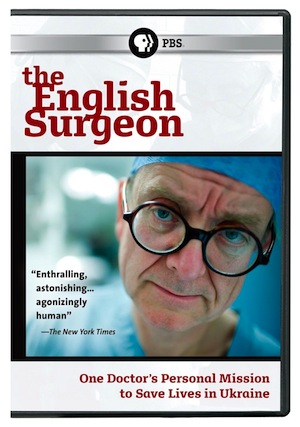
How can we in the West appreciate what is happening to the people living in the conflict zone? One unlikely way is to reconsider Geoffrey Smith’s powerful 2007 documentary The English Surgeon. The film deals with how medicine is practised in Ukraine and puts a personal face on what life (in more promising times, perhaps) is like for Ukrainians.
This film reveals how two dedicated neurosurgeons make do with scarce medical supplies with a goal to improve their patients’ quality of life. In the course of this sophisticated British-produced documentary, viewers become intimately acquainted with the hospital exploits of this medical odd couple: Dr. Henry Marsh, a British neurosurgeon, and his Ukrainian counterpart, Dr. Igor Petrovich Kurilets. Smith’s movie is enlightening and viewers can glean much about Marsh’s point of view. In his experience, performing the surgery itself is not the hard part, it’s knowing when to treat that’s complicated.
Early in the film, Marsh talks about the importance for him of helping other people; he questions what we are if we don’t try to help others. When the movie was filmed, Marsh had already been volunteering in Ukraine for 16 years. He tells us that when he first started his project, he found surgical conditions comparable to those that existed in the West 60 years prior. He was appalled at the misdiagnoses he encountered, and by the stories of patients that could have been helped had they received appropriate medical interventions earlier.
The film exudes irony and humor as viewers get to know Marsh. He explains that he always liked working with machines and using his hands. He also enjoys the sensory aspects of working with wood. At one point, he says that surgeons like blood, and he likens surgery to a kind of sport.
Kurilets displays no less of a quirky wit. For instance, he points out a painting hanging on his wall. In the picture are happy Cossacks sitting around a table. Kurilets thinks there are many similarities between Cossacks and surgeons. He comments that in the painting, the Cossacks could be gathered around an operating room table. He appreciates the Cossacks’ aggressiveness. Actually, his own pro-activeness has gotten him into trouble with the authorities; he later reveals that he was unemployed for two years following repeated run-ins with the Soviet system. Ironically, he currently rents rooms from a hospital run by the KGB, his former nemesis.
Kurilets is still a doer today, albeit perhaps slightly more pragmatic than he once was. He has plans to build a new hospital. He underscores his philosophy of life by explaining that the point is not to just make plans – something that happened a lot in the former Soviet Union – but to actually do, to get things done.
In fact, these two individuals are pragmatism personified. Marsh and Kurilets buy brain surgery tools in the local open-air market. Kurilets’ Bosch drill comes from this market. Marsh also regularly donates equipment to Kurilet’s practice. In an understated way, we learn some of the real costs of surgery in this area of the former Soviet Union versus the West: the 80 Sterling drill bits that Marsh’s hospital uses once will be used by Kurilets for 10 years.
Marsh also confronts deeper issues. He struggles with being able to leave patients with hope, even when there is nothing that surgically can be done.
One patient who can be treated is Marian, a young, rural man of limited financial resources. Marian has a brain tumor that could either leave him severely disabled or kill him. The doctors tell him that the only way they can help is by conducting brain surgery, but without anesthesia. Marian agrees.
The operating room in which this incredible procedure takes place is so small that, at one point, a member of the surgical team has to bend down, almost crawling to get to the other side of the room. Even in this incredibly tense scene, Marsh reveals his wry humor by saying that the healthy section of the brain should look “like a good cream cheese,” not rubber. He does not underestimate the tremendous vitality of the organ on which he operates, however. In surgery, he says, “We are the brain.”
Sharing some of the soul-searching he does in his practice, Marsh humbly admits that he has made some big mistakes. He narrates the painful story of one young Ukrainian patient that he brought to England for surgery. Marsh reveals that both of Tanya’s surgeries went terribly wrong. Even today, he can’t put Tanya’s story aside. He tells Kurilets that he thinks about Tanya a lot. Kurilets agrees that there were lessons to be learned from her case. But Marsh doesn’t just contemplate Tanya; he seeks physical contact with this lost patient. In a haunting moment of tremendous honesty and humanity, he pays a visit to her family members. He reveals to Tanya’s family how nervous he was before the visit.
The English Surgeon is a powerful movie, stunning, but frequently heart-wrenching. It displays not just the truth of the situation in Ukraine, but the truth about people.
Deborah Rubin Fieldsis an Israel-based features writer. She is also the author of Take a Peek Inside: A Child’s Guide to Radiology Exams, published in English, Hebrew and Arabic.
***
A number of organizations are trying to help civilians in Ukraine. Working at opposite ends of the life spectrum are two Jewish charities: the Survivor Mitzvah Project (survivormitzvah.org), which helps elderly Holocaust survivors residing in Ukraine, and Tikva Children’s Home (tikvaodessa.org), whose mission is to care for “the homeless, abandoned and abused Jewish children of Ukraine and neighboring regions of the former Soviet Union.”
***
While many are probably familiar with Jonathan Safran Foer’s book Everything Is Illuminated (which was also made into a film in 2005), the Good Reads website has assembled a list of other books dealing with Ukraine (goodreads.com/places/76-ukraine). The list contains fiction and non-fiction books for children and adults.
Ottawa Jewish Community School’s high school program will be phased out by 2017. (photo from cjnews.com)
A unanimous decision by the Ottawa Jewish Community School’s board of directors will see the city’s only Jewish high school program phased out by 2017.
“An extensive examination by OJCS leadership, which included a study by the school’s sustainability committee, has determined that the high school is not financially viable,” Aaron Smith, OJCS board president, said in a Feb. 10 letter to parents about the decision to close the high school. “Put simply, not enough families are choosing to send their children to grades 9 through 12. This has been a challenge in the high school over [its] 20-year existence.”
In 2006, Ottawa’s Jewish elementary school, Hillel Academy, amalgamated with Yitzhak Rabin High School and the new school was renamed OJCS. Despite having both schools under one roof, the high school continued to struggle to sustain itself. Smith said it would require a minimum annual community subsidy of $250,000, on top of regular operating costs, to avoid a deficit.
“We require a minimum of 50 students to be sustainable given our current cost structure. This year, we have 24 students and, next year, at best, we expect 20 students total enrolled,” Smith said.
Tuition for the high school program for the coming year is about $14,000. Andrea Freedman, president and chief executive officer of the Jewish Federation of Ottawa, said the challenge with the deficit is that it’s ongoing.
“This is not a short-term infusion of cash that is required to save the school. It is an ongoing minimum deficit of $250,000 each and every year. So that means that for every incoming Grade 9 class, to see them through to graduation is $1 million. And there is no obvious source for these funds, despite peoples’ good intentions,” she said. “It was a decision of the school board to close it, but it is a broader community decision to not provide additional deficit funding for the school.”
Smith said OJCS will begin to phase out the high school program next fall. “We are committed to providing the existing Grade 10 and 11 classes with the ability to finish their high school studies and graduate from OJCS,” he said.
The elementary school currently has a student body of about 200.
David Roytenberg, the father of one OJCS graduate and one current OJCS student, hopes he can galvanize Ottawa’s Jewish community to raise the funds necessary to sustain the high school.
“We are trying to raise money to reverse the decision. But they’ve presented it as a fait accompli,” Roytenberg said. “Obviously, we would have some work to do to increase the enrolment…. There wasn’t really a Grade 9 class this year, which was part of the problem. They had one kid come in this past fall, so that leaves a big hole in the school…. But personally I just find it unthinkable that we would close the high school. It is like the cornerstone of the community.”
He added that there are seven OJCS eighth graders who are signed up for Grade 9 next year, and their parents are now faced with a choice about where to send them.
Freedman said the decision to close the school is not one that anyone wanted to make. “The basic challenge is that not enough parents are making the decision to send their child to Jewish day school in general and the high school in particular,” she said, adding that there are about 900 high school-aged Jews in Ottawa, and fewer than two dozen were planning to enrol in the OJCS next year.
“We have a responsibility to meet the needs not only of the 20 students who are projected to enrol in the school next year, but to the 880 other teens in our community,” she said.
Reflecting on why there has been such a significant drop in enrolment from Grade 8 to Grade 9, Freedman said, “I think finances comes into play, but I think it is a priorities question in part, and I think it is a question of socialization. Parents are understandably concerned about sending their child to such a small school.”
Freedman added that although “extraordinarily painful,” it was a decision that had to be made. “We avoided it for as long as possible but, ultimately for the greater good of the community, it is a difficult decision that had to be made.”
Roytenberg said that he’s joined a task force that was set up at an emotional Feb. 12 community meeting at Ottawa’s JCC about the school’s closing.
He added that he’ll keep trying to raise money for a “rescue fund” to save OJCS.
“I’m hopeful that we can raise some significant money and maybe that will help to change their minds,” he said. “Ottawa has about 14,000 Jews. We ought to be able to sustain a high school. We ought to be able to raise the money to keep it going.”
– For more national Jewish news, visit cjnews.com.