Skip to content
  • Home
  • Subscribe / donate
  • Events calendar
  • Business Directory
  • FAQ
  • News
    • Local
    • National
    • Israel
    • World
    • עניין בחדשות
      A roundup of news in Canada and further afield, in Hebrew.
  • Opinion
    • From the JI
    • Op-Ed
  • Arts & Culture
    • Performing Arts
    • Music
    • Books
    • Visual Arts
    • TV & Film
  • Life
    • Celebrating the Holidays
    • Travel
    • The Daily Snooze
      Cartoons by Jacob Samuel
    • Mystery Photo
      Help the JI and JMABC fill in the gaps in our archives.
  • Community Links
    • Organizations, Etc.
    • Other News Sources & Blogs
  • JI Chai Celebration
  • JI@88! video

Recent Posts

  • Legal help for students
  • Revisiting myth of Lilith
  • Wrong person rebuked
  • Canada’s mixed messages
  • Questions for museum
  • Symposium on antizionism
  • Making soccer political
  • CJPAC lauds Pulver’s impact
  • City recognizes Vrba’s legacy  
  • Organ donation saves lives
  • Theodore’s March premiere
  • A healing Shabbaton
  • Supplying healthy food
  • A chime of metal tags
  • Yellowknife seder a first
  • Ishai energizes, unifies
  • A Lag b’Omer to remember
  • Expanding the healing
  • Hannah Senesh – a unique hero
  • Community milestones … May 2026
  • Sharing her testimony
  • Fall fight takes leap forward
  • The balancing of rights
  • Multiple Tony n’ Tina roles
  • Stories of trauma, resilience
  • Celebrate our culture
  • A responsibility to help
  • What wellness means at JCC
  • Together in mourning
  • Downhill after Trump?
  • Birth control even easier now
  • Eco-Sisters mentorship
  • Unexpected discoveries
  • Study’s results hopeful
  • Bad behaviour affects us all
  • Thankful for the police

Archives

Follow @JewishIndie
image - The CJN - Visit Us Banner - 300x600 - 101625

Images

Scouting returns in full force

Scouting returns in full force

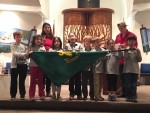
Sholom Cubs leaders Laura Tuan and Isaac Kool with their troops. (photo from Temple Sholom)

Sholom Scouts celebrated their first milestone when they conducted their first investiture ceremony earlier this month at Temple Sholom.

The ceremony is a central part of Scouts Canada, when new members become invested as scouts. New scouts make the Scout Promise to the Scouts leader and, in response, the Scouts troop leader pledges to help the scout do their best to uphold the promise, setting up a bond between them.

It’s the first time since the 1940s that a Jewish Scouts troop has existed in Western Canada. The rise of Sholom Scouts can be attributed to the vision of Temple Sholom Rabbi Dan Moskovitz.

“I moved here to Vancouver 18 months ago and was blown away by the nature beauty and resources of our surroundings,” he told the Independent. “I wanted to experience them with my children but didn’t want to head out camping or hiking on my own. I was a scout briefly as a child and thought it would be a good organization to explore the outdoors with my children.”

So, approximately a year ago, he went to the Scouts Canada house on Broadway and spoke with one of their representatives about how to start a troop. “I explained my desire and also that I was a rabbi and had access to a building to meet in and a network of other Jewish parents that might want the same experience for their children. He said they had been trying to start a Jewish Scouts group in Vancouver for more than 15 years but didn’t know where to begin, so it was bashert. They started helping right away with open house meetings for parents and kids and we got the word out through social media,” he said.

The boy troop now consists of eight beavers (5- to 7-year-olds) and eight cubs (8- to 10-year-olds) with members from across the Jewish religious spectrum. The children meet biweekly, even though, according to Moskovitz, they will be shifting to a traditional weekly program next year. The children have a bimonthly outdoor event, hiking, camping or another such activity. In May, Sholom Scouts will participate in an area-wide family campout with other Scouts groups from the Lower Mainland.

All Sholom Scouts activities are in line with kashrut observance, with a kosher kitchen on site, and are shomer Shabbat, including services as part of the campground experience.

Before the March 5 investiture ceremony, Moskovitz gave a tour of the synagogue to help another troop, Ryerson, obtain their religion and spirituality badge. There was a falafel dinner, at which the rabbi received an appreciation award from Scouts Canada, followed by Cub Car and Beaver Cubby Racing. The investiture concluded the evening.

In his remarks, Moskovitz explained the symbolism of having the first investiture ceremony in the sanctuary. “Though we have members of our Beavers and Cubs from many different synagogues and parts of the larger Jewish community, the synagogue sanctuary is the sacred place in all of Judaism where the Torah is kept and read, where the community gathers, where the eternal light is kept burning. It’s a place where children celebrate through bar and bat mitzvah their entry into adulthood and, tonight, where we celebrate their preparation for adulthood.”

The ceremony was important for other reasons, as well.

Raphy Tischler, Sholom Scouts Beaver leader, linked it to Jewish holidays such as Sukkot and the Zionist value of “Ahavat Haaretz.” “Living on the West Coast, it is only a natural connection to combine scouting and Judaism. I want the Jewish community to recognize the potential of outdoor programming as part of a well-rounded Jewish experience,” he said.
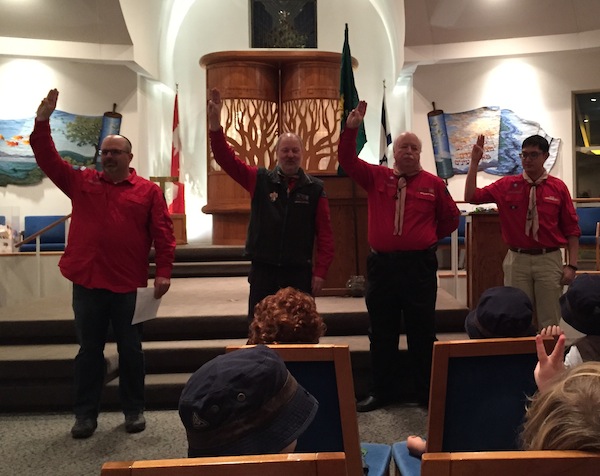
photo - Left to right: Temple Sholom Rabbi Dan Mozkovitz, Ryerson Cubs leader Lawrence Harris, Pacific Spirit Area commissioner Michael Palmer and Pacific Coast Council commissioner Brandon Jonathan Ma.
Left to right: Temple Sholom Rabbi Dan Mozkovitz, Ryerson Cubs leader Lawrence Harris, Pacific Spirit Area commissioner Michael Palmer and Pacific Coast Council commissioner Brandon Jonathan Ma. (photo from Temple Sholom)

And scouting is a great way to reinforce the values of tikkun olam, according to Isaac Kool, Sholom Scouts Cub leader. “We need to start with our own community, including with the natural world.”

Brandon Ma, Pacific Coast Council commissioner for Scouts Canada, pointed out the parent volunteer aspect. “It is one of the only programs that I know of that parents are involved in the programming with their children at the same time, living, working, growing, having fun….”

Sholom Scouts are currently in need of more volunteers. Becoming a volunteer is a multi-step process that includes a personal interview, provision of three personal references and a police record check. Afterward, there is an online training session and mentoring with a local scout leader, where you learn about programming for youth.

Moskovitz believes it is a great way to bring Jewish parents together with their children. “Ninety percent of your Jewish life is lived outside of the synagogue. Scouts helps raise you in the world as a Jew and in the surroundings. It uses the quote, ‘Don’t separate yourself from the community’ … be a part [of it] but be a Jew,” he said.

“I think it will be amazing for our kids and for the hundreds of non-Jewish scouters and families who will join us and perhaps be exposed to outwardly Jewish kids for the first time,” said Moskovitz. “Our people camped in the desert for 40 years, I think we should be able to handle a weekend.”

Gil Lavie is a freelance correspondent, with articles published in the Jerusalem Post, Shalom Toronto and Tazpit News Agency. He has a master’s of global affairs from the Munk School of Global Affairs at the University of Toronto.

 

Format ImagePosted on March 20, 2015March 19, 2015Author Gil LavieCategories LocalTags Brandon Ma, Dan Moskovitz, Isaac Kool, Raphy Tischler, Scouts Canada, Sholom Scouts, Temple Sholom
This week’s cartoon … March 20/15

This week’s cartoon … March 20/15

For more cartoons, visit thedailysnooze.com.

Format ImagePosted on March 20, 2015March 19, 2015Author Jacob SamuelCategories The Daily SnoozeTags goldfish, thedailysnooze.com
A Canadian Haggadah

A Canadian Haggadah

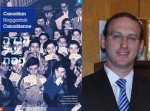
The cover of the new Haggadah, with one of its authors, Rabbi Adam Scheier. (photo from cjnews.com)

A new Haggadah in Hebrew, English and French has been created by Canadians for Canadians and celebrates the Jewish experience in this country.

The Canadian Haggadah Canadienne, compiled and edited by Rabbi Adam Scheier and Richard Marceau, has been published by Montreal’s Congregation Shaar Hashomayim. The authors of the Passover text describe it as the first of its kind, and one overdue for a Jewish community that is not only one of the largest in the world, but has a distinct identity.

All text is equally reproduced in the three languages, but what really makes this book stand out are dozens of historic photos of Canadian Jewish life from the early 20th century culled from the Canadian Jewish Congress Archives and other community archives, including those of the Canadian Jewish News.

The book also includes commentaries from 20 rabbis (and one maharat, the title for ordained female clergy in modern Orthodoxy) from across the country and the denominational spectrum.

The text is traditional, said Scheier, but it’s one he believes is familiar to almost everyone and may be used in full or abbreviated. The language is close to gender neutral.

One small addition is a prayer for Canada, alongside one for the state of Israel: “May the Merciful One bless Canada and its government, and grant fellowship and freedom to all of its inhabitants.”

Marceau and Scheier, who are friends and colleagues in community work, labored on the Haggadah for about five years, in their spare time away from busy professional and family lives. They both enjoy having diverse guests at their seder tables – anglophones and francophones – and felt the lack of a bilingual Passover text. Extemporaneous translation or using two versions proved to be awkward.

They may seem like an odd pair to produce such a proudly Canadian work. Scheier, Shaar Hashomayim’s spiritual leader, is a Rochester, N.Y., native, a fourth-generation American, who came to Canada 11 years ago.

Marceau is general counsel and senior government adviser to the Centre for Israel and Jewish Affairs, based in Ottawa. He is a convert to Judaism, a francophone from Quebec City who was a Bloc Québécois MP from 1997 to 2006. He recounted his journey to Judaism in the 2011 memoir Juif: Une histoire québécoise, which was later translated into English.

“When I came to Montreal, I was struck by the sense of pride Jews had in this country and their history in it,” said Scheier, who notes his wife Abby is Canadian and that they have “produced four Canadian citizens,” to whom he dedicates the Haggadah.

The completion of the project is bittersweet for Marceau. He dedicates the book to his late wife, Lori Beckerman, who passed away without seeing it published, and their two children.

Marceau attended his first seder in 1992 with Toronto native Beckerman’s family and friends. It was his introduction to Jewish ritual, which was totally strange to him, but it was made even more baffling because his English was not strong at the time.

“It was quite a culture shock,” he recalled.

They were married two years later, and Marceau converted in 2004. “Lori was very supportive of the [Haggadah] project. Although she was an anglophone from Toronto, she became fully bilingual, worked in French as a lawyer in Ottawa, and loved the duality of our home and the friends we invited around our table,” he said.

Both editors emphasized that the project would not have been possible without the help of many people, be it with research, proofreading, donations or advice.

“From the outset, we only encountered excitement about this project,” Scheier said. “People really responded to the idea.”

That input helped them find and select an eclectic mix of pictures, some familiar, but many rarely seen today. Some examples are the first religious service held by a Jewish farming colony in Lipton, Sask., in 1906; Philip Adelberg, the first justice of the peace in British Columbia’s Peace River district, taken in 1915; the Cornerbrook, Nfld., synagogue in the 1940s; the founding of Ecole Maïmonide in Montreal in the 1960s by the Sephardi community, the first French-language Jewish school in Montreal; and demonstrations for Soviet Jewry in the 1970s.

Marceau said he and Scheier felt it was important to highlight the relationship between Canada and Israel over the years. There are shots of visiting Israeli leaders from David Ben-Gurion to Shimon Peres in 2012, as well as then prime ministers Menachem Begin and Pierre Trudeau together in 1978. The relationship is represented in the other direction as well, such as an Inuit delegation’s visit to the Jewish state.

The Canadian Haggadah Canadienne, which weighs in at 168 pages, is tablet size in order to make it easy to use at the seder table. “It’s not supposed to be a coffee table book,” said Marceau.

It is being sold on amazon.ca and at synagogues and Jewish bookstores for $20. Any proceeds will go to charity – split 50-50 between Scheier’s and Marceau’s choices.

– For more national Jewish news, visit cjnews.com.

Format ImagePosted on March 20, 2015March 19, 2015Author CJN StaffCategories Celebrating the HolidaysTags Adam Scheier, Haggadah, Richard Marceau
IBD effects and treatments

IBD effects and treatments

(photo from trustedtherapies.com)

Every year, 15 out of every 100,000 Canadians is diagnosed with inflammatory bowel disease (IBD). More concerning are the statistics for Ashkenazi Jews, one of the more at-risk populations for the disease.

IBD is a group of inflammatory conditions that affect the gastrointestinal tract, or the gut, explained Dr. Charles Bernstein, a gastroenterologist working at Winnipeg’s Health Science Centre (HSC) and the University of Manitoba (U of M).

photo - Dr. Charles Bernstein
Dr. Charles Bernstein (photo from Charles Bernstein)

Speaking at the Victoria Inn in Winnipeg at a gala to raise funds for Crohn’s and colitis research, he said, “They’re associated with symptoms of abdominal pain, diarrhea, sometimes weight loss, rectal bleeding … and they’re quite common in young people. The peak age of incidents is in the 20s for Crohn’s, although it can actually present at any age.”

According to Bernstein, these diseases often mean a high burden, especially when they present in teens or young adults. “With ulcerative colitis, there is a rise in the 20s, but [the rate] plateaus. And the incidences are quite similar with every decade of life. And, since there isn’t a high mortality rate associated with the diseases, people carry these diseases throughout their life.”

Although the cause for the conditions remain mostly unknown, the doctor said research has moved forward considerably in the last decade and a half, at least in so far as understanding some of the contributing factors. Research has primarily focused on developing better “Band-Aid” solutions, such as ways to control the body’s response with anti-inflammatory and immunosuppressant drugs. “This, in a sense, allows us to put the genie back in the bottle,” said Bernstein. “In Crohn’s disease, we don’t know what’s causing the act of inflammation, so we don’t have a specific treatment. So, it’s different than taking penicillin for infectious [bacterial] pneumonia. We know we are taking the antibiotic to treat a specific thing and the pneumonia goes away.”

These diseases are more prevalent in Ashkenazi Jews, though they are by no means the only ethnic group affected. For several years, the focus has been on the genetic components to these diseases. Today, however, there is a more research into possible environmental factors, Bernstein said, and these deserve more attention.

“Indians from India are quite unlikely to get these diseases,” he said, by way of example. “Although these diseases are [now] emerging in India, the rates are substantially lower than in a country like Canada. But, when Indians move to Canada, like they do in B.C. in large numbers, they may not, as adults, get IBD while living in B.C., but their children seem to be at a comparable risk as white kids growing up in B.C. It’s an important area of investigation right now, trying to understand what these environmental factors are that drive these diseases to emerge.”

Diet is one area for research. “There’s a great interest in diet and what it is about the diet in the Western world, in particular in Canada, that may impact bugs present in our bowel and the response to them. Also, smokers are more likely to get Crohn’s than non-smokers, but we don’t understand what it is about smoking that impacts the development of the disease.”

The genetic “cure” has proved elusive as yet, even with a great deal of research in that area. “Because of all the work that’s gone into genetic work, we understand that probably most of the genes are associated with Crohn’s. But, we’ve not been able to find some gene switch to treat and, therefore, turn off the disease.”

According to Bernstein, the rate of IBD among Ashkenazi Jews is higher in Canada than Ashkenazi Jews in Israel, which, he posits may be due to the very different environment and, to some extent, different dietary patterns of Ashkenazi Jews living in Israel versus those living in Canada.

“Ashkenazi Jews have the machinery to … develop IBD when confronted with whatever the environmental triggers are, but my suspicion is that the environmental triggers are higher in North America than they are elsewhere.”

“With a rate of approximately 250 cases per 100,000 in the population at any one time, and while the rates in B.C. are slightly lower than elsewhere in Canada, the rates are as high in Canada as anywhere in the world. And the prevalence rates of these diseases amount to about 240,000 Canadians with Crohn’s disease or ulcerative colitis – probably 140,000 have Crohn’s disease and 100,000 have ulcerative colitis.”

The burden to sufferers of IBD is when they are experiencing symptoms that interfere with their work, sports or social life, their quality of life.

“We can get 95 percent of people’s symptoms controlled, so it doesn’t have to have a big impact on their life,” said Bernstein. “There are a small percentage of people with chronic, grumbling symptoms that we can’t control.”

These conditions contribute a significant cost to society, as well, when IBD sufferers are either missing work or are going to work but are not able to function to their full potential. There are also direct costs for managing these diseases via providing doctors, nursing services, medication, hospital coverage, etc.

“For some of the drugs, we use a category called ‘biologicals’ or the antibodies of TNF [tumor necrosis factors],” said Bernstein. “They can cost 30- to 35,000 dollars per year.

“Our centre in Winnipeg has been among the leaders in exploring not just the burden of the disease, but also the psychosocial factors that impact the disease – understanding how stress, anxiety and depression impact the disease and vice versa.”

Dr. Brian Bressler a gastroenterologist at St. Paul’s Hospital in Vancouver, echoes Bernstein’s concern about being too focused on the genetic component of the disease.

IBD issues become problematic when one’s immune system is inappropriately activated and causing damage and inflammation in the bowels, Bressler explained in an interview. “Many genes have been identified as putting people at an increased risk of having these problems and there are environmental influences in the world that, when exposed, can increase one’s risk of their immune system not working properly,” he said. “This doesn’t mean that if you have the gene defects you’re going to get it. It’s more likely than not that you won’t get IBD, which is why we don’t tell people routinely to get checked just because they have the genes.

“The highest risk is having a sibling who has Crohn’s or ulcerative colitis, but even if you have a sibling it’s still likely you’re not going to get it.”

When it comes to getting IBD under control, Bressler said that controlling inappropriate immune system response is key, as this leads to inflammation and to potentially serious bowel damage.

To date, there is no cure, but the focus is on ensuring that the disease is as controlled as possible. “In general, patients present with symptoms and not feeling well because of a multitude of problems,” said the doctor. “While some are able to control symptoms by changing their diet, there’s no diet that has been proven to be effective in managing IBD.”

It is important to try to make adjustments to diet and lifestyle, however. “Sometimes, patients don’t have any symptoms, but they are still having their immune system causing damage. This can lead to permanent problems in the bowel.”

Another option for some cases is surgery. There are four types of surgical procedures used to treat the symptoms of Crohn’s, for example, depending on the specific complication, the location in the GI tract and the severity of the symptoms. Surgical approaches include re-section, colectomy, proctocolectomy and strictureplasty. There is a light on the horizon for future IBD treatment, however. “Newer medical therapies are a little more sophisticated,” Bressler said. “They are a little more specific in targeting certain problems driving the inappropriate immune response. An older therapy, like prednisone [a steroid], is more [about] global control of the immune system. This is sometimes necessary and many times works, but does have a lot of side effects and long-term complications. There are newer therapies that can treat the inappropriate immune response, without leading to so many side effects.”

Rebeca Kuropatwa is a Winnipeg freelance writer.

Format ImagePosted on March 20, 2015April 27, 2020Author Rebeca KuropatwaCategories LifeTags Charles Bernstein, colitis, Crohn’s, IBD, inflammatory bowel
הבניין השלישי בגובהו באזור ונקובר

הבניין השלישי בגובהו באזור ונקובר

בורארד פלייס ישתרע על פני בלוק שלם בין ארבעה רחובות בדאון טאון: בורארד, דרייק, הורנבי ודיווי. (הדמייה של הפרויקט: City of Vancouver via globalnews.ca)

הבניין השלישי בגובהו בוונקובר יבנה בפרוייקט החדש של ג’ים פטיסון בדאון טאון

הבניין השלישי בגובהו באזור ונקובר יבנה במסגרת הפרוייקט הענקי החדש של קבוצת ג’ים פטיסון (מחזיקה ב-40 אחוז בפרוייקט), ביחד עם ‘ריליינס פרופרטי’ (60 אחוז). ‘בורארד פלייס’ ישתרע על פני בלוק שלם בין ארבעה רחובות בדאון טאון: בורארד, דרייק, הורנבי ודיווי. מדובר באחד הפרוייקט הגדולים ביותר באזור, עלות הקמתו כחצי מיליארד דולר והליך הבנייה ימשך כארבע שנים.

‘בורארד פלייס’ יכלול שלושה בניינים גבוהים, מרכז מסחרי בן שבע קומות וחנויות. שני בניינים מיועדים למגורים ויכללו 810 דירות (מתוכן 723 מיועדות למכירה ו-87 להשכרה בלבד). אחד מהשניים יתנשא לגובה 54 קומות ויחשב כאמור לשלישי בגובהו בוונקובר (לאחר מלון דירות שנגרילה ומלון דירות טראפ), והשני לגובה 35 קומות. הבניין השלישי בגובה 14 קומות מיועד למשרדים ומסחר, ושלוש קומות ממנו יוקצו לסוכנות הרכב טויוטה של קבוצת פטיסון. סוכנות טויוטה שכנה במשך לא פחות מארבעים שנים על המגרש, שעליו יבנה ‘בורארד פלייס’. על המגרש נמצאים עדיין שני בתים ישנים מעץ שמיועדים לשימור, והם מוצעים בחינם למי שיפנה אותם למקום אחר. במידה ואף אחד לא יחפוץ בהם, הנהלת הפרוייקט תהרוס אותם ותשלם כשבעה מיליון דולר לגוף שאחראי על שימור בתים בוונקובר.

ג’ים פטיסון ממשיך לעשות חיל למרות גילו הרם (86), והוא נמצא במקום השלישי ברשימת האנשים העשירים ביותר של קנדה. זאת לפי המגזין הכלכלי האמריקני ‘פורבס’. הונו של פטיסון (שהוא היחידי מבריטיש קולומביה בעשיריה הפותחת), מוערך ב-7.5 מיליארד דולר. ברשימת העשירים ביותר בעולם ממוקם פטיסון במקום ה-177. פטיסון שהוא נוצרי אוונגליסט, והוא ביחד עם בניו תורמים כספים רבים לפעילויות ופרוייקטים שונים בישראל (בהם של קק”ל ו”מסע ישראלי מבראשית”).

בקבוצת פטיסון מועסקים 36 אלף עובדים, והיא מתעסקת במגוון רחב של תחומים. בהם: רכב, מדיה, פרסום, הפצה, בידור, חקלאות ואריזות. הקבוצה מחזיקה בזכויות הוצאת השיאים העולמיים של גינס ובחברת ריפלי אנטרטיינמט שמפעילה את רשת המוזיאונים של גיניס.

מסימני העתיד: תשים לי על האש שני שיפודי חרקים מתובלים היטב

לאור הגידול באוכלוסיה בעולם ועלייה מדאיגה בעוני, במקביל למחסור הולך וגדל במזון שמחירו מאמיר, יתכן והעתיד טמון דווקא בחרקים. כך לפחות ממליץ ארגון המזון והחקלאות של האו”ם. לא פשוט לאכול חרקים אך אם מתרגלים לזאת, יש בהם יתרונות רבים. חרקים עשירים בחלבונים שבריאים לגוף, בויטמינים ומינרלים, הם נחשבים למאכל ידידותי לסביבה מאוד עד כמה שזה נשמע מוזר, וניתן להשיגם בשפע כמעט בלתי מוגבל.

קבוצה של סטודנטים מאוניברסיטת ‘מגיל’ שבמונטריאול, נהנים לאכול חרקים כך מסתבר, ועתה הם מנסים לשכנע את הציבור הרחב שזהו מאכל “טעים” ומומלץ. הסטודנטים משקיעים בטיפוח חווה לגידול חרקים. ולהגנתם הם מביאים דוגמא על מאכל אחר שבעבר נחשב ללא אכיל. לדבריהם לפני שלושים שנה דג נא נחשב לדבר נתעב, וכיום רבים אוכלים אותו והוא מוגש כמנה מהודרת במסעדות מפוארות. הסטודנטים מאמינים כי במהלך השנים הקרובות מאכלים מחרקים יתפסו תאוצה. לדברי חברי הקבוצה כשליש מאוכלוסיית העולם (בעיקר באפריקה ואסיה) אוכלים חרקים באופן קבוע. עתה צריך לשכנע את מדינות המערב המפותחות ביתרונות העצומים של המאכל היוצא דופן הזה. “החרקים הם אוכל חכם ואנו מאמינים שבעתיד הקרוב הם יגיעו להרבה מסעדות ולבתים במערב”. אומרים הסטודנטים.

את החרקים ניתן לאכול במספר אופנים שונים. למשל: כמטוגנים, מבושלים, או אפויים. או שניתן אף לטחון אותם לקמח ולעשות בו שימוש למאכלים שונים.

Format ImagePosted on March 16, 2015March 17, 2015Author Roni RachmaniCategories עניין בחדשותTags Burrard Place, food shortage, insects, Jim Pattison, בורארד פלייס, ג'ים פטיסון, חרקים, למחסור הולך וגדל במזון
Elections will hold surprises

Elections will hold surprises

Tens of thousands, at a rally in Rabin Square in Tel Aviv on March 7, call for Prime Minister Binyamin Netanyahu to be replaced in the upcoming elections. The rally, organized by a group called Million Hands, had as its keynote speaker the former head of the Mossad, Meir Dagan. (photo by Ashernet)

Expect surprises in Israel’s March 17 elections, say experts. “If there’s anything we’ve learned over the last decade, it’s that there’s going to be a surprise,” said Yohanan Plesner, a Kadima member of the Knesset from 2007 to 2013 and an aide to prime ministers Ariel Sharon and Binyamin Netanyahu. “Usually the surprise is somewhere in the centre.”

Now president of the Israel Democracy Institute, Plesner was speaking last week at the AIPAC conference in Washington, D.C.

Parties that have defied predictions in recent years include Shinui in 2003, Kadima in 2009 and Yesh Atid in 2013. No commentators are suggesting that any group other than Netanyahu’s incumbent Likud or the coalition of the Labor party and Tzipi Livni known as the Zionist Union will finish first and second. But what happens beneath these two leading contenders will determine who emerges as the country’s next leader.

Kulanu, a brand new party headed by Moshe Kahlon, is one to watch, said Plesner. Kahlon may be poised for a breakthrough because, among other factors, he is renowned for breaking up the cellphone monopoly in Israel, lowering prices for consumers.

The other person to watch, he said, is President Reuven Rivlin. The president may have an extraordinary role this time, despite the fact that the president usually has very little discretion in determining who will form government. But, in 2009, Plesner pointed out, Kadima won more seats than Netanyahu’s Likud, but Netanyahu became prime minister. A similar scenario could happen if the president, in consultation with the smaller parties, concludes that the leader with the second largest number of seats has the greatest chance of forming a relatively stable coalition.

The scenarios are complicated, Plesner said, by the fact that, although Rivlin was seen as the “Likud candidate” for president, Netanyahu did everything to prevent him from becoming president.

Plesner, who served as chief whip of a coalition government, said that “each party has its own hatreds within,” making coalition scenarios unpredictable. Agreements may not fall directly on ideological lines.

A national unity government of the two largest parties, he said, is something both leaders have ruled out which, he joked, means it might happen.

Also in the race is Avigdor Lieberman’s Israel Beteinu party, which began as a largely Russian movement but has expanded to welcome other voters with hawkish views.

Naftali Bennett’s Jewish Home party, which gets most of its support from the national religious movement and settlers, is still something of a force on the right, while Meretz, a dovish left-wing party could take a half dozen seats or so.

Yair Lapid, who leads Yesh Atid, a secularist upper-middle-class movement, is another leader who could benefit from last-minute movement among the 20 percent of voters who remain undecided, most of whom, Plesner said, are in the centre. Plesner senses that Lapid will gain momentum on social and economic issues including the cost of housing.

The ultra-Orthodox parties include United Torah Judaism, which is Ashkenazi, and Shas, which is Sephardi. Yachad, which is trying to unite modern Orthodox and ultra-Orthodox, is viewed as outside the mainstream because it includes members of the ultra-nationalist (Meir) Kahane movement.

In terms of issues, security is significant, but not because of deep divisions.

“There is little if any dispute around most of the security issues of Israel,” Plesner said. Therefore, it becomes mainly a question of competence. “Who do Israelis trust?” he asked. And who can generate trust with international allies?

Another issue is support for “remote settlements” beyond the security barrier, which could prove the dividing line between left and right, he said.

On the issue of a united Jerusalem, Plesner said this is an area of disparity between what politicians think and what they say. Most do not see the issue beyond symbolism, he said, but there is a significant chunk of municipal Jerusalem that is not symbolically significant. After 1967, a conglomeration of annexed neighborhoods far bigger than historical Jerusalem was brought into the municipality beyond the Old City and the “holy basin,” including refugee camps. The municipality now counts 300,000 residents of Israel who are not citizens.

This election, the threshold for getting into the Knesset has increased to 3.4 percent of the vote, meaning parties that do not achieve that level of support will not elect a single member. As a result, the Arab parties have banded together under a single umbrella with the hope that they will get some traction.

Arab Israelis have far lower voter turnout numbers than Jewish Israelis, but if Arabs increase participation, Plesner estimates that the Arab bloc could get as many as 14 or 15 seats, which would tip the balance between the left and right blocs. However, the Arab parties have said they would not join a coalition, though they could help the president select the next prime minister.

Natan Sachs, a foreign policy fellow at the Brookings Institution’s Centre for Middle East Policy, tried to explain the mindset of right-wing and left-wing Israeli voters. In addition to being generally hawkish, he said, the right is acutely aware of the dangers presented by long-term occupation and the potential for control over millions of non-citizen Palestinians, but they are sanguine about time and demography, he said, believing that Israel is getting stronger and there is no need to rush any potential resolution to the occupation. He said the left views the occupation of the West Bank as a crisis and believes something must be done quickly, whether ideal or not, rather than waiting and hoping for an ideal resolution. In general, Sachs said, the more talk there is about foreign affairs, the better it is for the right.

Other issues include the conscription of religious men for service in the Israel Defence Forces, which is “a huge issue of principle,” Sachs said, but also a practical matter of bringing the ultra-Orthodox into mainstream society and the economy.

Israelis vote on March 17, but it could take days (or longer) for a new government to emerge from the mix of results.

Pat Johnson is a Vancouver writer and principal in PRsuasiveMedia.com.

Format ImagePosted on March 13, 2015March 12, 2015Author Pat JohnsonCategories IsraelTags AIPAC, Israeli election, Meir Dagan, Natan Sachs, Yohanan Plesner
Dancing in gratitude

Dancing in gratitude

Serge Bennathan with Erin Drumheller in Monsieur Auburtin, which is at the Dance Centre March 26-28. (photo by Michael Slobodian)

Serge Bennathan’s Monsieur Auburtin is an autobiographical work, which promises to offer “audiences a keyhole through which to rediscover their own childhood dreams, splendidly realized or forgotten through the passage of time.”

Co-presented by the Scotiabank Dance Centre and Chutzpah!Plus March 26-28, Monsieur Auburtin spans Bennathan’s decades-long career, from France to Canada, from student to company artistic director. In addition to being a dancer and choreographer, Bennathan is also a writer and artist. He is known for his collaborations with opera companies, and the projects of the company he founded in Vancouver, Les Productions Figlio, “encompass dance, theatre, music, multi-media, visual art and literary works.”

Among multiple other honors, Bennathan was awarded the 2014 Canada Council Jacqueline Lemieux Prize because of his innumerable “contributions to Canadian dance through his creation work, his performance, his work as a mentor, [and] for his leadership within and beyond his company work. He inspires creativity among those he works with and his impact has been felt in multiple geographical centres and multiple generations.”

JI: Throughout your career, you’ve created personal works, why an autobiographical one at this point?

SB: It came quite organically as a response to a cancer that I was fighting. It made me think about what I love in my life, what made me, the gratitude to be an artist in this world. And how there are a lot of dance works but how we speak rarely about dance with the audience. So, I decided to be a storyteller and talk about how I came to dance and use my life as an artist in dance to talk about other artists that I love and admired. For this, on stage in Monsieur Auburtin, there are with me two dancers, Erin Drumheller and Kim Stevenson, and the composer playing live, Bertrand Chénier.

JI: The last time we spoke was in 2003, about The Invisible Life of Joseph Finch. There, you described your creative process as including up to a year and a half of research before starting to work with the dancers and creative team. How does your process differ, if at all, for a work such as Monsieur Auburtin?

SB: It does not really. It is the same process. I spent a year writing the text for the piece, then another working with the composer Bertrand Chénier. Just talking about life in dance, not talking about choreography but about the essence of dance. Now, here we are, in the studio with two dancers, me and the composer that will be live on stage. The time before is important to create enough stratum, subtext and be able to let go.

JI: From where do you garner the strength/courage to share so much of yourself in your choreography? Does the vulnerability ever scare you? If so, how do you overcome that fear?

SB: We live only once. It is important for me right now to talk to people, and even more important to me in the world we live in, to talk poetically to the audience, through words, movement and music. We all have in us fear, but we also have courage and strength. Doubts are not there to stop us, they are here to make us think deeper. We have to embrace fear to say our truth. And even more when we know that this life is not a dress rehearsal.

JI: [From 1990-2006], you were with Dancemakers in Toronto. What brought you to Vancouver, and how did Les Productions Figlio come to be created?

SB: In 2006, when I stepped down as artistic director of Dancemakers, it was very natural for me to come back to Vancouver. The time that I lived in Vancouver the first time, 1987, ’88, ’89, ’90, defined me as an artist. The people I met at that time became longtime collaborators that continued to work with me through my time at Dancemakers. I loved passionately this community. It is my home in Canada. I created Les Productions Figlio, a production company, to help me create the work I want to create, that is not always dance. I had just come out of 16 years with a dance company and wanted to be lighter as a structure. I create dance, but also theatre and maybe more.

JI: You are also a writer, painter and illustrator. Have you always been interested in these pursuits? What does a typical day or week look like for you, or is there such a thing?

SB: Dance introduced me to these other artistic expressions very organically and I love it. Everything feeds everything. I get up, meditate, write for two hours, paint, continue the day in the studio or the work that I have to do for a creation. Might come back to painting, read, cook, think, dream.

***

Monsieur Auburtin is at the Dance Centre, 677 Davie St., March 26-28, 8 p.m. For tickets ($29/$25/$20), visit thedancecentre.ca or chutzpahfestival.com, or call 604-257-5145.

Format ImagePosted on March 13, 2015March 12, 2015Author Cynthia RamsayCategories Performing ArtsTags Chutzpah!Plus, Dancemakers, Les Productions Figlio, Monsieur Auburtin, Scotiabank Dance Centre, Serge Bennathan
An equal, just society

An equal, just society

Hannah Kehat (photo from New Israel Fund Canada)

A crowd of 100 people – mostly women – filled Temple Sholom’s sanctuary on Feb. 23 to hear Dr. Hannah Kehat, a prominent feminist religious activist in Israel.

Kehat’s Kolech, founded in 1998, was the first Orthodox Jewish feminist organization in Israel. The group’s aim is to create awareness around gender equality and women’s rights in the religious and public spheres, and advancing women’s engagement with Jewish and civic life in Israel.

In her address, which was moderated by Rabbi Dan Moskovitz, Kehat underscored that Israeli women, religious and secular, face different challenges than women in North America.

One major difference, said Kehat, is the lack of separation between religion and state in Israel. All marriages, divorces, conversions and burials go through the rabbinate; their ultimate authority means you cannot have a non-regulated lifecycle event, no matter your level of religiosity. Women may have equality under the Declaration of Independence, she said, but this equality is aspirational in reality. The aim of religious Jewish feminists is to reframe women’s rights for the Orthodox community, but also to integrate the daily concerns of secular women into their fight for representation and legal-halachic equality.

The obstacles to full equality for Israeli women start with being seen and heard in public. In the last several years, women and girls have been systematically erased from advertisements, billboards, books, pamphlets and textbooks, and they have been subjected to segregated seating on buses, enforced modesty codes, street harassment and violence. Meanwhile, there are still people – women and men – who assume feminism and religion to be mutually exclusive.

“We’re tired of apologizing,” said Kehat. “We want to stay religious. Don’t ask us why are you still religious if you are a feminist, and don’t ask me why are you a feminist if you are religious. It was acceptable until maybe the last 20 years that it doesn’t work together, either you’re a feminist or you are Orthodox….

“We say in Israel, ‘gam v’gam.’ It’s very complicated. We know it’s very complicated. It’s hard to hold the both together. It’s very painful because you have all the time to fight and you have a lot of battles in the family, in the synagogue, in the community, but we don’t want to give up any part of our identity…. We knew in the beginning [of the movement] that it’s not halacha that is against feminism…. It’s social power. It’s political….

“We started from the place that we know Torah. We’re all lecturers, rebbetzins, we know Torah; we know the truth that it’s not the problem, that we can have an equal society, even if we’re religious.”

Kehat said that, today, Israeli women are raising their voices and claiming their space, and Israeli courts have been supporting legal challenges to the status quo. Recently, the Supreme Court ruled that it is illegal to harass women on buses or on the street, and those abuses have almost all but stopped, she said. Legal challenges have proved successful and are one major strategy to create institutional change, she added.

Kehat described growing up the daughter of a rabbi in the Jerusalem Charedi enclave of Meah Shearim, a world she consciously left as a young woman so that she could advance her education and follow her own path. She became modern Orthodox, got a PhD in Jewish philosophy from the Hebrew University of Jerusalem, married a rabbi and had six children. She is a lecturer, an academic, a writer, an activist and a Torah scholar. And, while she started her movement from within the modern Orthodox world, she sees more and more Charedi women taking up the feminist mantle – progress that cannot come soon enough.

“Charedi women, I can use the example of myself. To grow up as a Charedi girl, I think it’s the lowest level in Israel. You’re silent, you don’t have any voice. You come to the world just to serve the man since you are very, very young. You can see it in Jerusalem, B’nai Brak, like me, girls, 6, 7, carrying their brothers and the babies and doing all the [house]work. Really, the aim, the mission of [a woman’s] life is to serve the man … the father, the husband. So, Charedi women are still really very depressed. They have a lot of pressure in their lives.

“When I started Kolech … I got a phone call from the minister of health…. He said, ‘I heard about you, the leader of the Orthodox feminist movement. Finally, I have an address to address my problem.’” He told her the alarming statistic that the death rate for Charedi women with breast cancer was 30 percent higher than for other Israeli women. Today, that statistic is even worse, Kehat said, and may be closer to 50 percent higher. The minister continued, “‘Do you know that the expectancy of life of Charedi women is the lowest, the worst in the country?’ It’s unbelievable,” Kehat said. “They did research in B’nai Brak. The Charedi men are in the second level of life expectancy, and the women are [at the bottom]…. Even though Kolech is not a Charedi group, [we] try to raise the consciousness of Charedi women to take responsibility for their health and educate them about resources.”

The main obstacle to women’s equality is the conflation of religion and politics with the rabbinate.

“In Israel, we have another problem – that the rabbinate is a political institution, part of the government. This is really unbelievable and it’s really an historical mistake. The rabbinate became such a political powerful part of government and it’s worse than the government because we are not choosing the rabbis, only the politicians choose the rabbis and we don’t have any influence over who is going to be the rabbi…. Everyone knows that the rabbinate and the chief rabbis are not really the ideal people that we’d like to be our religious leaders, they’re political rabbis, we know that. So, it’s not so hard for us to go out and say, ‘Something is wrong over there, something is corrupt and we have to change it.’”

The visibility of women’s rights activism is growing. “The feminist issues are on the agenda for the religious community all the time. Every seminar, every yeshiva, we have a lot of yeshivot for women … synagogues are much more open to egalitarian ideas. I think there are more than 20 synagogues that are egalitarian…. The last two years, there is a big change. Something is going on in the Charedi community. It’s very exciting.”

One of the bright spots is the number of women joining Facebook groups dedicated to women’s activism. There are groups like “Feminists under the wig” and the group wryly named “I’m also a religious feminist and I don’t have any sense of humor,” both of which have growing membership and provide an online space to share experiences, gain empowerment and strategize.

Kehat was brought to Vancouver by New Israel Fund Canada. NIF in Israel supports at least 800 nonprofit, government-certified organizations with priorities to “strengthen and safeguard civil and human rights, bridge social and economic gaps and foster tolerance and religious pluralism for all its citizens.”

NIFC’s national outreach associate, Atarah Derrick, spoke at the top of the program. “Thirty years ago, NIFC was established in Canada to address Canadians’ desire to address the needs of Israelis in a way that no other charity was doing,” she said. “Every year, Israelis have told us what it is that they need to create the kind of world that they’d want to live in, a place where all Israeli residents are equal, where they have the freedom and the voice to improve their status … regardless of race, gender or ethnicity.”

She added, “I work with New Israel Fund of Canada, with NIF, because I am passionate about making Israel an even better place than it already is and, in my work with New Israel Fund, I get to see firsthand the kind of change that we are able to make when we get together.”

Basya Laye is the former editor of the Jewish Independent.

Format ImagePosted on March 13, 2015March 12, 2015Author Basya LayeCategories IsraelTags Atarah Derrick, Hannah Kehat, Israel, New Israel Fund Canada, NIFC, women's rights
Netanyahu lacks leadership

Netanyahu lacks leadership

At a rally in Rabin Square in Tel Aviv on March 7, calling for Prime Minister Binyamin Netanyahu to be replaced in the upcoming elections, protesters held signs saying “Change Now.” (photo by Ashernet)

This week’s pre-election tempest is over whether Israeli Prime Minister Binyamin Netanyahu supports the concept of a two-state solution. Bibi’s ponderings on the subject led his own party to contradict him – days before the high-stakes Israeli general election.

On the subject of ceding land to Palestinians, a Likud party statement released Sunday read, “Prime Minister Benjamin Netanyahu said that any evacuated territory would fall into the hands of Islamic extremism and terror organizations supported by Iran. Therefore, there will be no concessions and no withdrawals. It is simply irrelevant.”

It’s difficult to know what to make of Netanyahu’s words and actions lately, to determine how much is for consumption abroad, how much is ideological and how much is pure political expedience.

It was, for example, hard for some Israel watchers to disagree with anything he said to the U.S. Congress earlier this month, even if they disagreed with him speaking there. It was enough that he was showing “moral courage” and “true leadership.”

Of course, there were others who could find little right with what the prime minister said to Congress. Meir Dagan, for instance. Dagan, former head of Mossad, called Netanyahu’s congressional speech “bullshit.” Then, on Sunday, the outspoken Dagan addressed a rally in Tel Aviv’s Rabin Square against Netanyahu’s policies, telling the thousands-large crowd, “I am frightened by our leadership. I am afraid because of the lack of vision and loss of direction. I am frightened by the hesitation and the stagnation. And I am frightened, above all else, from a crisis in leadership. It is the worst crisis that Israel has seen to this day.”

In Israel, Netanyahu has refused to participate in debates during the campaign. While he’s not alone in his refusal – Zionist Union leader Yitzhak Herzog, too, has been absent – some have questioned why Netanyahu is willing to speak to the American public but not to his own. They are concerned with what they see as a lack of leadership and statesmanship at home.

With Netanyahu describing his prior support for a two-state solution as no longer relevant, it is unclear whether he intends to prevent the creation of an independent Palestinian state ever, or whether he means only in the current climate of regional (and global) instability. It remains to be seen whether he is just grasping at political straws, trying to convince those on the right to vote for him, or he feels so confident that he can finally say what he truly believes.

No matter who is elected on March 17, the chance of a two-state solution emerging anytime soon is miniscule – neither Netanyahu, his contenders for prime minister, nor the current Palestinian leadership seem ready to take the necessary steps. So maybe his current views are also irrelevant?

Format ImagePosted on March 13, 2015March 12, 2015Author The Editorial BoardCategories From the JITags Binyamin Netanyahu, Congress, Meir Dagan
Apology spoof short-sighted

Apology spoof short-sighted

As election season progresses in Israel, how Israelis are seeking to position themselves is becoming clearer than ever. In its attempt to unseat Bibi Netanyahu, the joint Labor-Hatnua slate is billing itself as the “Zionist Union,” a moniker that rankles many, including prominent Arab-Israeli writer Sayed Kashua in a recent piece in Haaretz. The left-wing Meretz slate, which features a young politico who happens to have proud cousins in the Ottawa Jewish community (disclosure: I am one of them), is taking a different tack, underscoring the degree to which its policies differ from what has come before. “Revolution with Meretz,” its campaign posters declare. Most fascinating to me, though, is one of the ads coming out of right-wing-nationalist Naftali Bennett’s campaign.

In it, Bennett, head of the Jewish Home (HaBayit HaYehudi) Party, is dressed as a bearded hipster. As he makes his way around Tel Aviv, he is afflicted by a comedic apology problem. In a café, the waitress spills coffee; he apologizes. On a narrow residential street, his car gets rear-ended; he apologizes. On Rothschild Boulevard, a fellow denizen makes her way to a rented bicycle after he’s claimed it; he anxiously backs away, apologizing. Finally, he is shown on a park bench, reading the liberal-leaning Israeli broadsheet Haaretz, where he is reading a reprinted column from the New York Times, headlined “Israel needs to apologize.”

“From now on, we’re going to stop apologizing,” Bennett tells the camera, removing his costume. “Join HaBayit HaYehudi now.”

It’s a bit of brilliant campaigning, the message is seeking to appeal to Israelis’ collective core sense of self. No one wants to feel that their very existence requires an apology.

The policy question, of course, lies in whether Israel’s ongoing conflict with the Palestinians entails giving up the country’s core identity, or whether there is something else going on, namely the occupation. It’s an ongoing tension in how we understand the situation. On one hand are contemporary depictions like those in the otherwise excellent series The Honorable Woman (now streaming on Netflix) that suggest that Israelis and Palestinians just need to leave each other alone and peace will prevail. The unspoken truth, though, is that there is a very real overlapping set of territorial claims being cruelly manifested not only by Hamas rockets from Gaza and terrorist attacks from east Jerusalem and the West Bank, but also by the Israeli occupation. There, in the West Bank, day-to-day Palestinian freedom of movement is curtailed by settler-only roads and staffed checkpoints.

As Bennett has made clear in his increasingly vocal policy pronouncements, under his rule, the occupation would not end – it would simply morph into a sort of apartheid-like area in which Israel annexes part of the West Bank, with Palestinians granted autonomy in the others. In other words, no Palestinian state.

Bennett’s ad suffers from another problem: a reluctance to consider the idea that so much mutual pain has been inflicted by both sides – whatever one thinks of his annexation plan – that some conflict resolution measures may need to include mutual apology, just as mutual recognition has been an important currency of Israeli-Palestinian relations.

There is one area where Bennett’s ad does contain some wisdom: in identity politics. But it’s really only half a serving of wisdom. The crux of the Israeli-Palestinian conflict has been that neither side has been willing to truly recognize the material and identity needs of the other. Through riffing on the idea of apology being absurd, for Bennett to imply that Israel has a right to exist, is fine. But unless Israel recognizes the right of the Palestinians to the same, Bennett’s platform will appear to exist in a moral, political and strategic vacuum.

Mira Sucharov is an associate professor of political science at Carleton University. She blogs at Haaretz and the Jewish Daily Forward. This article was originally published in the Ottawa Jewish Bulletin.

Format ImagePosted on March 13, 2015March 12, 2015Author Mira SucharovCategories Op-EdTags HaBayit HaYehudi, Israeli election, Jewish Home Party, Naftali Bennett

Posts pagination

Previous page Page 1 … Page 442 Page 443 Page 444 … Page 494 Next page
Proudly powered by WordPress