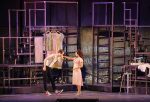
Meghan Gardiner as Marian and Jay Hindle as Harold Hill in The Music Man. (photo by David Cooper)
Few children know what they want to do as a career. Even fewer start on their career goals before they are 10 years old. Yet, having celebrated his bar mitzvah in May, Julian Lokash, 13, has already set a firm foundation for his future. He dreams of running a school for the arts when he is an adult, and he seems to be doing everything right so far to reach that goal.
An irrepressible talent, Julian has focused his life around performing. He has used his summer vacations for the past three years to be a cast member in various productions at Theatre Under the Stars (TUTS) in Stanley Park. Rehearsals take two months and then performances are every other night for the remaining two months of the summer. In TUTS, he has performed in Oliver, Shrek and Beauty and the Beast.
TUTS is interesting because it is performed on a stage that is only two-thirds covered, leaving the front part of the stage, the apron, exposed to the elements. “It’s really fun but when it rains, we get wet and the stage can be really slippery,” said Julian about the challenges of being in an outdoor show in Vancouver. He admitted that some nights he came home covered in mosquito bites. This doesn’t dampen his enthusiasm, however. He plans to try out again for whatever show TUTS decides to present this summer.
Julian Lokash is part of the production’s cast. (photo by Brent Lokash)
Although he had a big smile on his face when describing his role in Beauty and the Beast, where he played Mustard in the ensemble, Julian has played a leading role in a professional production. Last December, he starred as James in James and the Giant Peach at Carousel Theatre.
This year, Julian is once again appearing on stage in a December production, this time at Gateway Theatre in Richmond in the classic musical The Music Man.
Being part of a professional production while going to school is a significant accomplishment and shows the level of dedication Julian has to his craft. Rehearsals for The Music Man began on Nov. 6 and carried on until the show opened on Dec. 8.
“We practise six nights a week and, once we start shows, we only have Mondays off,” said Julian. There are even days in the schedule where there are both a 2 p.m. matinée and an 8 p.m. show. He is pretty much giving up his winter break for the production.
When he was in elementary school, Julian was the only one in his French immersion class who was heavily involved in theatre.
“I had friends but no one else was into what I was. Now that I’m in high school in the [Lord Byng Secondary School] arts program, it’s so much better. Everyone thinks the same way as me, has the same interests,” he said. “Half of my classes now are with kids from the arts program. Social studies, English and science are taught from an arts perspective.”
Julian’s peers are now other singers, dancers and actors, who understand the commitment he has to acting, and his teachers are sympathetic to absences he may have due to his rehearsal or performance schedule.
His dance teacher is also used to him taking off long periods from classes. “I take tap, jazz and ballet at Westside Dance. It’s just a few blocks from my house. When I’m in rehearsal, I just have to miss dance,” said Julian.
Julian occasionally has voice lessons and was recently a guest soloist for the Cantata Choir, a semi-professional choir based in Vancouver. His acting training is from Arts Umbrella and Carousel Theatre for Young People.
With such a busy schedule, Julian acknowledges he could not do it without the support of his parents. He is looking forward to his upcoming performance in The Music Man, and continuing on with the Arts Mini program at Lord Byng.
When asked what he thinks of The Music Man, Julian was enthusiastic.
“It’s a very lively musical. It’s infused with humor and the characters are well developed. They really have their own personalities. I think kids can definitely enjoy it as much as adults do.” He said that anyone who likes music and dancing will love The Music Man.
The Music Man runs until Dec. 31. For tickets, visit gatewaytheatre.com.
Michelle Dodekis a freelance writer living in Vancouver.
Matt Montgomery as Tony and Jennifer Gillis as Maria have a great chemistry and energy on stage. (photo by Tim Matheson)
Love conquers all. Then again, sometimes, it just isn’t enough. Theatre Under the Stars explores the power – and limits – of love in its two productions this year: Beauty and the Beast and West Side Story.
Love’s transformative power plays front and centre in Beauty and the Beast. The story begins at a prince’s castle, where he refuses to help a beggar. It turns out the woman is a sorceress and she puts a curse on the household, turning him into a beast and all the house staff into objects. It’s a slow-acting spell though, so everyone is in a state of transition, which will be complete when the last petal of a rose falls – unless the prince-cum-beast can fall in love and be loved in return.
Meanwhile, Belle lives in a village with her inventor father – the townspeople think he’s crazy and she’s odd, as she rarely has her nose out of a book. But she is beautiful, as her name suggests, and the most-sought-after man in the village, the handsome, muscle-bound and narcissistic hunter Gaston, is smitten. He is determined to have Belle for his wife.
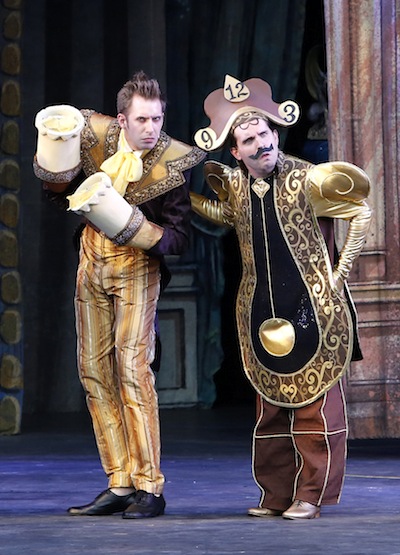
Victor Hunter as Lumière, left, and Steven Greenfield as Cogsworth are a superb comedy team. (photo by Tim Matheson)
In the TUTS production, Jaime Piercy as Belle is the strongest singer by far, though the overall best actor in the show is, hands down – combining acting, singing and dancing – Victor Hunter as Lumière, the slender and bendy maître d’ who is transforming into a candelabra; his comedy partner, Steven Greenfield as Cogsworth, the butler becoming a clock, also stands out.
Dane Szohner as Gaston is hilarious and his singing is energetic and enthusiastic, if not always on key, and Sheryl Anne Wheaton as Mrs. Potts – the cook becoming a teapot – is delightful, her rendition of the title song perfect. Jewish community member Bodhi Cutler does a fine job as Mrs. Potts’ young son, who spends most of the night wheeled around in a tea trolley with only his face seen in the body of the teacup into which his character is transforming. Fellow Jewish community member Julian Lokash shows his dancing skills in a few numbers, including as an unidentifiable household object in “Be Our Guest,” which is wonderfully performed by numerous cast members – and the orchestra, which was great throughout, led by musical director Wendy Bross Stuart, another Jewish community member involved in the production.
While some of the household items are hard to discern – including one talented cart-wheeling rug (?) – and the angry wolves that beset people in the forest look more like black cats, in general, the costumes by Chris Sinosich are spot on, as per the Disney movie on which the musical is based. As Belle comes to dinner in one of the final scenes, adorned in her signature gold ball gown, one young audience member couldn’t contain her excitement, happily exclaiming, “She’s wearing the Belle gown!”
By that point in the opening night show, the Beast, played by Peter Monaghan, had settled into his role. In the first half, with only limited lines, it was hard to tell what Monaghan was trying to do with his character, his grunts and hunched-over movements not scary or funny. In the second half, however, he found his feet and his attempts to woo Belle – with the very amusing help of Lumière and Cogsworth – were well done.
Most of the princesses in the audience – several girls dressed up for the show – enjoyed the over-the-top acting, as did the adults, but there were a couple of frightening moments. At the beginning, Gaston is hunting and a gunshot goes off, which put at least one little girl into tears momentarily. And there was a lot of quiet in the audience much later, when Belle’s father is almost hauled off to an insane asylum by a jilted Gaston. To stop that from happening, Belle shows the crowd the Beast through a magic mirror to prove that her father really had seen a “monster” and isn’t crazy. This sets the mob, led by Gaston – who is now also jealous because he realizes that Belle loves the Beast – to the castle and the ultimate fight between the two men, which leads to a dire end for Gaston and near-death for the Beast. There were audible gasps when the Beast becomes human again, as do all his servants.
There is no such happy ending in West Side Story, of course. On opening night, the Romeo and Juliet-inspired tale of gang rivalries turned deadly was intensely and movingly acted. The reality – as much as can exist in a musical – was increased by having some Spanish-speaking actors who get to reel off several lines in Spanish and, with some exceptions (such as Jewish community member Kat Palmer as Consuelo), having non-white actors playing the Puerto Rican Sharks and their entourage, while the Jets and their friends, as well as the police, are played by seemingly white actors. Normally, color doesn’t matter in casting, but the whole point of this musical is that fear and racism can be fatal, and the visual clues are helpful in sending this message home.
While the acting in this production is top-notch, the only performer who is a triple threat – singing, dancing and acting very well – is Daniel James White as Riff, the leader of the Jets. The Sharks’ leader, Bernardo, played by Alen Dominguez, doesn’t get much chance to sing, but handles himself well in the other two departments.
The doomed romantic duo, former Jets leader Tony (Matt Montgomery) and Bernando’s sister Maria (Jennifer Gillis), have a great chemistry and energy on stage, and they really do seem head over heels in love – and then completely lost and distraught when the rumble between the gangs goes lethally wrong. Montgomery has a lovely tenor voice but some of his notes/words are lost, while Gillis has some beautiful moments – Maria is a hard, high part to sing, and Gillis makes a valiant effort.
On the acting front, Alexandra Lainfiesta, who plays Bernando’s girlfriend and Maria’s confidante, is fabulous and almost steals the show. She plays a range of emotions convincingly, from the genuine joy and mischievousness she has in the song “America” to the defiance and anger she has in the upsetting and disturbing “The Taunting.” (Parental advisory: in this pivotal scene, the Jets’ sexual assault of Anita is more than implied.)
As much as there is heartbreak and horror in West Side Story, there is humor and hope. While cheesily done, this production has a young actress representing hope and her role at the end will choke people up a bit, as will the solo reprise by Daren Dyhengco of the song “Somewhere” for the appropriately subdued finale.
Among the highlights of this production, directed almost perfectly by Sarah Rodgers – the only scene that drags is the one in which Tony and Maria declare their intention to marry – is the choreography by Jewish community member Tara Cheyenne Friedenberg. Off-kilter movements, unique body angles, more use of the hands and shoulders than usual, judicious use of slow-motion (in the scene where Tony and Maria first meet) and other Friedenbergesque touches inject life into the musical, which is heavily dance-based.
Beauty and the Beast and West Side Story run until Aug. 20 on alternate evenings at Stanley Park’s Malkin Bowl. For tickets, visit tuts.ca or call 1-877-840-0457.
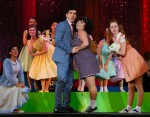
Dustin Freeland as Link Larkin, Erin E. Walker as Tracy Turnblad, Hannah Williams as Penny Pingleton and ensemble members in Hairspray. (photo by Tim Matheson)
When Theatre Under the Stars announced its lineup earlier this year, I was excited. I’d enjoyed the movie Hairspray, but not seen the stage version, and the last (and only) time I had seen Oliver! was at Winnipeg’s Rainbow Stage when I was just shy of 9 years old. The brutality in that production, in particular Nancy’s death at the hands of Bill Sykes, stayed with me, and I was curious to see how TUTS would handle it.
But first, Hairspray. “Good Morning, Baltimore” is one of the greatest songs. So cheerful and optimistic, its driving beat setting the tone and pace of the entire musical. If only we could all carry such confidence and positive energy out into the world. But I digress. The broad expanse of the movie, in which heroine Tracy Turnblad, sings and dances her way to school through the city that she loves is, of course, not possible on stage, and the added sparseness of Brian Ball’s TUTS set – basically tiered, multi-colored stages with the odd extra prop or flourish – took a little adjustment in perspective. But once I scaled my expectations, I came to appreciate the room his choices made for the dancers. And what dancing! Julie Tomaino’s choreography was not only fabulous, but it was professionally executed by the mainly amateur cast.
Many of the cast members are at least triple threats. Starting with the lead, Erin E. Walker does a commendable job as the boundless Tracy, who, in 1962 Baltimore, sets out to be a dancer on The Corny Collins Show despite her relative largesse, and ends up not only winning a spot on the show but getting its Elvis-like heartthrob Link Larkin (perfectly played by Dustin Freeland) to fall in love with her. Oh, and she also inspires significant social change along the way, succeeding in racially integrating her favorite show. And, she convinces her mother – a pleasantly understated performance by Andy Toth – to come out of the house after a decades-long, self-imposed imprisonment out of shame over her weight.
On her mission(s), Tracy is supported by her best friend, Penny Pingleton, played by the obviously talented Hannah Williams, though the accent she chooses for the role makes her sound incredibly stupid. Thankfully, she sings more than talks. I also had a problem with a couple of the other accent choices – Ryan Purdy as Tracy’s dad sounds like a complete moron, rather than the tenderhearted, somewhat nerdy guy he is; and I’m still trying to figure out how a German prison matron made it to 1962 Baltimore.
For the most part, however, director Sarah Rodgers’ pacing and style are spot on; the costumes by Chris Sinosich are colorful and suit the characters and period; and music director Chris D. King, whose orchestra is fantastic, does an excellent job as Corny Collins. And three other standouts cannot go without mention: Cecilly Day as Motormouth Maybelle and, as Maybelle’s children, David Lindo-Reid as Seaweed J. Stubbs and Marisa Gold as Little Inez.
Oliver! is a much more uneven performance. TUTS valiantly tries to evoke 1843 England beyond the stage and, by the time the show starts, kids (and older folk) have had the chance to see a Punch and Judy show, compete in a 20-yard dash, show their strength in a bell-ringer contest and watch some comedic but able strongmen. While the “village fair” is a lot of fun and a great idea in concept, it sets the wrong tone for the musical – poor orphan Oliver, after all, left in a workhouse after his mother dies giving birth to him, does not get to have much fun.
The first few musical numbers also struggle to respect the darkness of the story. At the workhouse, the main “problem” is the portrayal of Mr. Bumble, who is played much too loudly and vulgarly by Damon Calderwood. At the undertaker’s (to whom Oliver is sold), dancing zombies and more overacting detract one’s attention from Oliver’s plight. A rushed rendition of the beautiful ballad “Where is Love” is a lost opportunity to latch on and care for Oliver, who is well-played by Carly Ronning.
It is only when Oliver manages to walk himself to London and find a home with Fagin’s gang of thieves that director Shel Piercy’s vision becomes more uniform and appropriate to the subject matter.
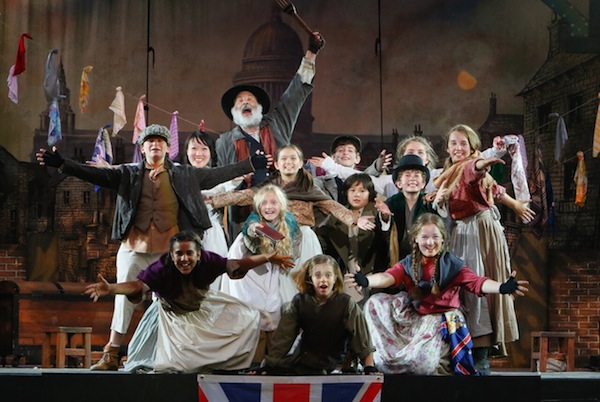
Stephen Aberle as Fagin, Carly Ronning as Oliver (centre, on floor) and the young cast of Oliver! (photo by Tim Matheson)
The young Nathan Piasecki as the Artful Dodger is one of the highlights of this production, as is his boss, Fagin, played by Jewish community member Stephen Aberle. The connection I felt some 36 years ago to Nancy just wasn’t there, however. Calderwood fares better as the evil Bill Sykes than Mr. Bumble, but again without any refinement, so it is hard to understand why Nancy, played ably by Elizabeth Marie West, would love him. She also was dressed quite fancily and seemed like a lady, so it was a wonder that she would be involved with him and Fagin in the first place. I had to stop myself from rolling my eyes during her rendition of “As Long As He Needs Me,” when I should have been sympathizing with her predicament – to be loyal to her (dangerous) man or risk her life to save Oliver. While the character’s death may have semi-traumatized me as a child, I can say this – it was both moving and memorable, neither of which applies as much to this version.
All that said, it is worth repeating that, from the moment Oliver meets the Artful Dodger just over halfway through Act 1, and is encouraged to consider himself part of Fagin’s “family,” TUTS’s Oliver! is a solid, enjoyable production. The ensemble – which includes community members Kat Palmer and Julian Lokash – are an incredibly talented and energetic group well worth seeing and hearing in action. They land the choreography of Keri Minty and Shelley Stewart Hunt and are in perfect tune with the orchestra, led by music director Kerry O’Donovan.
Theatre Under the Stars presents Hairspray and Oliver! on alternate evenings at Malkin Bowl in Stanley Park until Aug. 22 (tuts.ca or 1-877-840-0457).
Left to right: Nathan Piasecki (Artful Dodger), E. Marie West (Nancy) and Stephen Aberle (Fagin) in Theatre Under the Stars’ production of Oliver! Aberle also plays Mr. Brownlow. (photo by Tim Matheson)
Actor Steven Aberle describes Theatre Under the Stars as “a thrilling combination of enthusiastic, amazingly talented youth and, as they say, ‘seasoned’ pros.” In this instance, Aberle – who plays both Fagin and Mr. Brownlow in TUTS’s Oliver! – counts among the seasoned pros, while fellow Jewish community member Kathryn Palmer, who plays Strawberry Seller and is in the ensemble, is one of the talented youth, though Aberle and the other seasoned pros also have plenty of that, of course. The Independent caught up with both actors by email earlier this month.
More than just luck
JI: You’re a relative newcomer to the Vancouver stage. Could you share some of your performing background?
Kathryn Palmer is Strawberry Seller / ensemble in Oliver! (photo from TUTS)
Kathryn Palmer: I have always had a deep-seated passion for music and performing. When my home life started getting rocky, my Auntie Kathryn, who was a professional opera singer, seized the opportunity to get me out of the house for a few hours a week and into her studio for voice lessons. I was hooked and completely inspired! It wasn’t long before I was accepted into the voice program at Canterbury Arts High School, taking Royal Conservatory Exams, singing in choirs, competing in music festivals across Canada and performing in as many musicals as I could.
JI: You’re a graduate of the Canadian College of Performing Arts in Victoria. Are you from Victoria? Can you share some of your personal background, including what role, if any, Judaism or Jewish culture or community has played (plays) in your life?
KP: Born and raised in Ottawa, I moved to Victoria to study at the Canadian College of Performing Arts. I was very fortunate to graduate with about two years of paid theatre work … beginner’s luck, I call it.
At school, we were always told to use what makes us different and unique. One of the things my auntie had taught me was all about Jewish folk music. Being able to sing folk songs in Yiddish and Ladino was definitely something that made me unique but also grounded me. Being Jewish doesn’t exclusively impact the work I choose to do but it definitely infuses it. When I’m doing these musicals that are set in the past, I always wonder that would my life be like a young Jewish woman during this time. I also get excited to perform in shows with a more Jewish theme, like Hodel in Fiddler on the Roof at the Gateway Theatre or Louise Philo in Girl Rabbi at Congregation Emanu-El in Victoria.
JI: What are some of your aspirations regarding a career in performance?
KP: I adore theatre. I love musical theatre. I also love working with kids. I want to go back to school within the next few years and do my ECE [early childhood education]. I’m hoping to one day move back to Ottawa and start a theatre school there. Hopefully, I can inspire children the same way my auntie inspired me.
Not just the beard
JI: You seem to have been very busy on stage in the last couple of years. Can you share with readers some of your performance highlights since the JI last spoke with you in December 2013 about Uncle Vanya?
Stephen Aberle: I have been blessed with busy-ness these past several years, yes, kein ayin hara [no evil eye]. I guess I’m at that stage in my career where, if one remains alive, willing and (unfortunate but still true in today’s theatre) male, opportunities arise. Since
Uncle Vanya, I’ve had the good fortune to perform in Snapshots: A Musical Scrapbook, with music by Stephen Schwartz (of Godspell and Wicked fame) at Studio 1398 on Granville Island last fall. That was an opportunity to work on some amazing material with a wonderful company, including director Chris McGregor and Wendy Bross Stuart as music director.
I’ve been fortunate to perform with Wendy many times, including a couple of shows together at TUTS. We’ll be doing Snapshots again this coming fall [late October, early November], at Presentation House in North Vancouver, this time to be directed by Max Reimer.
I got to be part of a workshop of Hamelin: A New Fable by Leslie Mildiner (another member of the Jewish community) for Axis Theatre, although, unfortunately, scheduling didn’t make it possible for me to be in the touring production. And, earlier this year, I was in What You’re Missing, a lovely new play by Vancouver-born playwright Tamara Micner (she’s now based in London), at the Chutzpah! Festival.
JI: What most attracts you to, and repels you about, the character of Fagin? How are you approaching the role?
SA: Well, Fagin is one of the great characters of 19th-century literature – and, in Dickens’ novel at least, one of the great antisemitic caricatures of all time. That kinda sums up both the attraction and the repulsion: the character and his motives and passions are grand, fascinating, delicious for both performers and audiences; he’s also, let’s not mince words, a brutal travesty – again, as Dickens originally conceived and presented him in the novel Oliver Twist.
I want to rise to the level of the challenges the character offers. He’s big, and I need to honor and own that and, at the same time, find the truths in the character and his situation. Lionel Bart, who was Jewish and who created the musical Oliver!, trod a careful line in dealing with Fagin. There are no explicit references in the play to Fagin’s being a Jew, but Bart wove klezmerish themes into a lot of his music. The late great Ron Moody, also Jewish, who originated the role in London and who played it in the movie, followed that line, playing into Jewish nuances in the music and in the character’s accent.
The story of Oliver Twist and of the musical Oliver! deals with some dark themes – themes that are very much still with us, here and now. Grinding poverty rubbing shoulders with enormous wealth and privilege; love, hatred, loyalty and betrayal; violence against women; criminality, justice and injustice; prejudice; legitimacy and illegitimacy and the arbitrariness of those categories. Our director, Shel Piercy, is not shying away from that darkness, and I’m interested in his approach, his color palette. There can be a tendency, sometimes, for musical comedy to be cutesy, all fun and games and sweetness and light; that’s not the intention with this production. So, I’m looking for ways to explore Fagin’s breadth and depth. He’s devious, avaricious, by turns fearful and bold, can be selfish and brutal; he’s also probably the closest thing to a parent most of his gang of little thieves have ever known. He uses them, but he also feeds them and shelters them and plays with them and teaches them the only way he knows how to make a living, which happens to be thieving.
Shel has made some intriguing casting choices. One actor – Damon Calderwood – plays both Mr. Bumble and Bill Sykes, and Shel has me playing both Fagin and Mr. Brownlow, the kind gentleman who strives to rescue Oliver from Fagin’s clutches. I get to play both the wicked and good father (or grandfather) figures, if you like. A practical consequence of that choice is that I spend a lot of time on stage, so one important goal for me as an actor will be to remain upright. It’s going to be a workout.
JI: You were Buffalo Bill in a prior TUTS season. How did you come to start auditioning with TUTS, and have there been other roles? Does performing on an outdoor stage present unique challenges?
SA: I first worked at TUTS (in those days it was called Theatre in the Park, or TITPark) in the mid-’70s as a carpenter and stagehand, and I’ve had the pleasure of performing there each decade since – in Anything Goes in ’87, as Tevye in Fiddler on the Roof in ’97 and as Buffalo Bill in Annie Get Your Gun in 2008.
I started auditioning for TUTS soon after I graduated from Studio 58, and I keep auditioning there when I’m free and I think there might be a role for me. I love it there. The people are great, a thrilling combination of enthusiastic, amazingly talented youth and, as they say, “seasoned” pros. There’s a lot of love around the place. A special smell pervades the atmosphere, although it no longer carries as much of the whiff of pigeon droppings as it had in the old days. I’ve probably been just about everywhere it’s possible for a human being to get to in that building, including all over way up in the gridwork, where I spent a great deal of my time during those summers in the ’70s.
Playing outdoors presents some curious and inspiring challenges, yes indeed. There are obvious ones, like wildlife, for example. You never know when you might be joined on the stage by a raccoon or a squirrel or a crazed moth, and every actor knows that small children and animals – even insects – are far more interesting to watch on stage than we are because they’re unselfconscious and unpredictable.
We’re playing in Vancouver in the summer and the days are long, so the first half or so of the show is hard to light – you can’t use light to draw the audience’s attention very effectively because it’s hard to compete with the sun. Shel pointed this out to us in rehearsal: “Your movement is my spotlight.” We as performers need to provide focus through our actions, positions, motions and stillnesses. We’re also quite far away from the audience, so we have to use our bodies fully. Someone in the 20th or 30th row may barely be able to make out my features, so I need to release my thoughts and emotions into my body: to smile and frown and laugh and wonder, not just from the neck up but with all of me….
JI: If there is anything else you’d like to share with readers, please do.
SA: Well, there is one other thing. It’s interesting to me that, especially in the last few years, so many of the characters I’ve played have been Jewish. Tevye in Fiddler, Jacob in Joseph … plays at the Chutzpah! Festival, now Fagin. I think I get called to audition for most of the film and TV rabbi parts that come into town.
I guess it’s the beard.
Oliver! alternates evenings with Hairspray from July 10-Aug. 22 at Malkin Bowl (tuts.ca).
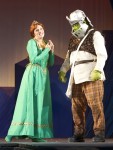
When Fiona (Lindsay Warnock) asks her savior to take off his helmet so that she can meet her prince, Shrek (Matt Palmer) is reluctant. (photo by Milan Radovanovic)
An ugly ogre and a beautiful blonde. You wouldn’t think they’d have much in common, but the similarities stand out when you see Shrek: The Musical and Legally Blonde: The Musical back to back, as the Jewish Independent did this month at Theatre Under the Stars.
In Shrek, the title character was sent out into the world by his parents at age 7. A brave, kind, generous soul, he is feared and harassed (think pitchforks and torches) for his gruesome exterior. He chooses to live in an isolated swamp, alone. But, when Lord Farquaad exiles all the fairy-tale creatures from Duloc – because they are different/special/freaks – they end up in Shrek’s backyard. In need of a hero, they ask for Shrek’s help, which he provides, despite his complaining, because that’s just who he is. Unwillingly accompanied by his soon-to-be best buddy and faithful sidekick Donkey, who is also fleeing Farquaad’s soldiers (because he can talk – and talk he does), Shrek travels to Duloc. There, he makes a deal with Farquaad, who is also in need of a hero – to retrieve Princess Fiona, who has been locked in a dragon-guarded tower by her parents, who assure her that, one day, her prince will come. Farquaad’s intentions are anything but noble, however, and Shrek must ultimately save Fiona from her prince.
Scott Walters as Emmett and Jocelyn Gauthier as Elle Woods work very well together on stage. (photo by Milan Radovanovic)
In Legally Blonde, we have Elle. When the musical begins, Elle has her prince and they are set to live happily ever after; that is, until her prince, Warner, dumps her to go to Harvard Law School, where he hopes to find a more serious and appropriate wife for someone of his station. A smart, caring and optimistic soul, she is ridiculed and discounted for her attractive exterior. Instead of running away, as did Shrek initially, Elle fights back, putting her nose to the books and getting into Harvard so that she can show Warner just how serious she is. While she doesn’t have to fend off dragons and soldiers, she must defend herself against unwanted advances and prove herself worthy, not only to her fellow lawyers but to herself. She, like Shrek, doesn’t have to fight alone, but is supported by a trio of besties from back home (who most often appear as a figment of her imagination, as her own Greek chorus, supplemented by other Delta Nu sorority sisters) and a new friend, Paulette. As must the fairy-tale creatures, Paulette also must find her voice, the confidence to stand up for herself and her rights.
Both age-old stories of finding the courage to be oneself, and proudly so, are creatively and humorously told. Though Shrek drags a bit in parts and Legally Blonde doesn’t quite measure up to last year’s production, both are a lot of fun and the talent of the TUTS actors and crews is clear.
Matt Palmer as Shrek, Lindsay Warnock as Princess Fiona and especially Victor Hunter as Lord Farquaad stand out in Shrek, along with great performances from Ken Overby as Donkey, Sharon Crandall as Dragon and John Payne as Narrator – and, truth be told, the entire cast of fairy-tale misfits. Shrek is a top-notch ensemble work in every sense, with the sets (Brian Ball), costumes (Chris Sinosich) and choreography (Julie Tomaino) almost characters themselves. Sarah Rodgers’ direction keeps things moving when they threaten to lull, and the actors’ comedic timing is brilliant, as are their facial expressions and body language.
Legally Blonde didn’t run as smoothly on opening night and, while Valerie Easton’s choreography is once again energizing – it was hard not to dance all the way back to the car after the show – there were a few scenes that seemed rushed, or ill-timed. Jocelyn Gauthier does a solid job as Elle, and she really is the star of the production, although she too is supported by a fabulous cast, notably the actors reprising their lead roles from last year: Cathy Wilmot as Paulette, Peter Cumins as Warner, Jewish community member Warren Kimmel as Callaghan (who seemed even better this year than last) and Scott Walters as Emmett, though Walters once again overplays the part – no one is that cheery … well, except for Elle, but it works for her, not so much for him. Then there’s Jacob Woike as the walking-porn UPS guy, Kyle – so funny.
There is really no reason not to go to TUTS this year. Two high-quality musicals with grade-A performers in an idyllic setting. Quadruple snaps!
Visit tuts.ca for information on showtimes and tickets.