Skip to content
  • Home
  • Subscribe / donate
  • Events calendar
  • Business Directory
  • FAQ
  • News
    • Local
    • National
    • Israel
    • World
    • עניין בחדשות
      A roundup of news in Canada and further afield, in Hebrew.
  • Opinion
    • From the JI
    • Op-Ed
  • Arts & Culture
    • Performing Arts
    • Music
    • Books
    • Visual Arts
    • TV & Film
  • Life
    • Celebrating the Holidays
    • Travel
    • The Daily Snooze
      Cartoons by Jacob Samuel
    • Mystery Photo
      Help the JI and JMABC fill in the gaps in our archives.
  • Community Links
    • Organizations, Etc.
    • Other News Sources & Blogs
  • JI Chai Celebration
  • JI@88! video

Recent Posts

  • SFU honours Gloria Gutman
  • Lifting people’s spirits
  • Wedding a ray of light
  • Indigeneity and Zionism
  • Rule of law broken: councilor
  • Football and its roles
  • The burden of defence
  • Fish Café returns after fire
  • All right in what goes wrong
  • Nuns & mermaids at TUTS
  • Camp offers holiday retreat
  • Students and mentors inspire
  • Once-in-a-lifetime trip
  • 100 dancers, one heart
  • Money for the sciences
  • What “Jewish food” means
  • Have a cookie, schnitzel too
  • Federation now across BC
  • Israel fighting for its existence
  • Deal strengthens Iran
  • Patriotic belonging diminishes
  • A campaign to engage
  • Upstanders’ first live event
  • Responding to Carney
  • Having your own home
  • Music a family tradition
  • Musical to warm heart
  • Community milestones … June 2026
  • Sharing her passion for Israel
  • Or Shalom reopens its doors
  • JFS from past to future
  • Need holistic approach
  • Sharing stories, advice
  • Journalist shares fears
  • Skills to live together
  • Road to independence

Archives

Follow @JewishIndie
image - CJN box ad Rockowers 2026

Tag: Rosh Hashanah

Foods that babas made

I’m here to boldly encourage you to try something entirely different at your Rosh Hashanah table this year. No, not a pony. A new food. Serve it, to non-vegetarians. And, if anybody asks what they’re eating, confidently tell them it’s a family secret. Don’t forget to mention that, if you tell them, you’ll have to kill them. That generally stops people in their nosy tracks. Let me be perfectly transparent: the food I’m about to suggest is on the meat spectrum. Alright, meat adjacent.

Isn’t it enough that everyone’s oohing and ahhing over the unparalleled tenderness of the dish? The specifics are strictly on a need-to-know basis. And no one needs to know. Except your butcher. OK, enough. It’s beef tongue. You heard correctly. I’m aware it’s not politically correct – after all, some farmer is clearly stifling free speech. Even if it only belongs to a cow. (And, technically, they can’t speak anyway. So moot point.)

Just so we’re clear, beef tongue is definitely not vegan. Or vegetarian-friendly. Not by a New York mile. I’m simply providing you with an alternative to screaming chicken, Coca-Cola brisket and mayo-slathered, onion soup-mix salmon.

I know that beef tongue screams old school (and Council cookbook). But so do I. And, if we’re going to be honest about it, people are still enthusiastically scarfing down ketchup-glazed meatloaf and baked salami filled with French’s mustard. They’re just not yelling it from the rooftops. So, loosen up and try thinking of beef tongue as a distant relative. Second cousin twice removed. Only maybe a little farther. But, still, meat mishpachah.

Before you pooh-pooh it, give it a shot. At least Google it and see what other Jews have to say about it. Most delis sell it pickled. But, believe me, pickled tongue has nothing on the sweet and sour version. Personally, I prefer to just boil it, cool it and eat it in a sandwich. With yellow mustard. On white bread. I can see the lynch mob in the distance.

The cooking part is where it gets tricky. If you’re a man, chances are you can’t relate to what I’m about to describe. You ladies, on the other hand, will understand perfectly. The cooking per se is easy (see recipe below). The next part is where it gets awkward. Once it’s cooked, you need to peel off the rubbery outside skin: think of taking off a pair of too-thick, too-tight pantyhose. That are wet. And it’s a hot, humid day. Not a particularly appealing visual, but it’s fairly accurate hyperbole.

Trust me when I tell you that your family/guests will be drooling all over themselves, demanding the recipe – if they can get past the sordid cooking details. Without further ado, here goes. And don’t be fooled by the simplicity of the recipe. You’re welcome.

SWEET AND SOUR BEEF TONGUE

1 beef tongue
2 onions, peeled and quartered
3 cloves garlic, peeled and halved
2 bay leaves
***
15 oz can of tomato sauce
15 oz water
3/4 cup brown sugar
juice of 1 lemon
1/2 cup sultana or dark raisins
dash of Worcestershire sauce (optional)
salt and pepper

Put the tongue and the rest of the ingredients into a deep pot with enough water to cover it well. Bring to a boil and simmer partly covered for about three-and-a-half hours, until tender when pierced with a fork. As it’s cooking, skim off the shmootz that forms on top. When tender, remove from the water. While it’s still warm, remove the skin (see detailed, gross description above), bones and stem. Slice and serve as is, or slice and serve with the sweet and sour sauce.

At the end of the day, a well-cooked beef tongue is all you need and nothing you don’t. But, I get that some of you are disgusted at the thought of eating tongue. So, for you finicky folks, I offer up another old school recipe – short ribs. This one is decades old and was handed down from my father’s cousin, Bertha Bloom. Nobody said it was diet food, so, if you’re not fussy about calories, go for it. Short ribs are notorious for being fatty, but therein lies most of their charm. Alright, all of their charm. You’ll diet tomorrow. And, hopefully, not die of clogged arteries tonight. But, have your cardiologist on speed dial, just in case.

BERT BLOOM’S BARBEQUE SHORT RIBS

Season two pounds of short ribs with salt, pepper and garlic salt then broil them until brown and half cooked. Transfer them to a covered Dutch oven (or similar deep roasting pan). For the sauce:

1 cup chili sauce
1/4 cup ketchup
4 tsp dry mustard
1/2 cup brown sugar
1 clove garlic, crushed
1 tbsp soy sauce
small tin of crushed pineapple

Mix the ingredients together – including the juice from the pineapple tin, but not the pineapple – put in a pot and bring to a boil. Pour the sauce over the ribs and cook covered at 300°F to 325°F for one-and-a-half to two hours, basting occasionally. Add the crushed pineapple 20 minutes before it’s finished cooking and leave uncovered. Prepare to be awed by the yumminess factor.

For your guests who prefer healthy food, you may want to direct them elsewhere for Rosh Hashanah dinner. Or, if you’re a really nice and accommodating host, make them a marinated tofu mock-roast. Or a Tofurkey. But, for those of you indulging in the short ribs, now might be a good time to loosen your belt or unzip your skirt, and prepare to stuff your belly. It’s Rosh Hashanah. Celebrate with some new arterial stents! Tell Dr. Saul I sent you.

Shelley Civkin, aka the Accidental Balabusta, is a happily retired librarian and communications officer. For 17 years, she wrote a weekly book review column for the Richmond Review. She’s currently a freelance writer and volunteer.
Posted on September 11, 2020September 10, 2020Author Shelley CivkinCategories Celebrating the HolidaysTags beef tongue, cooking, Rosh Hashanah
About the cover art – Rosh Hashanah 2019

About the cover art – Rosh Hashanah 2019

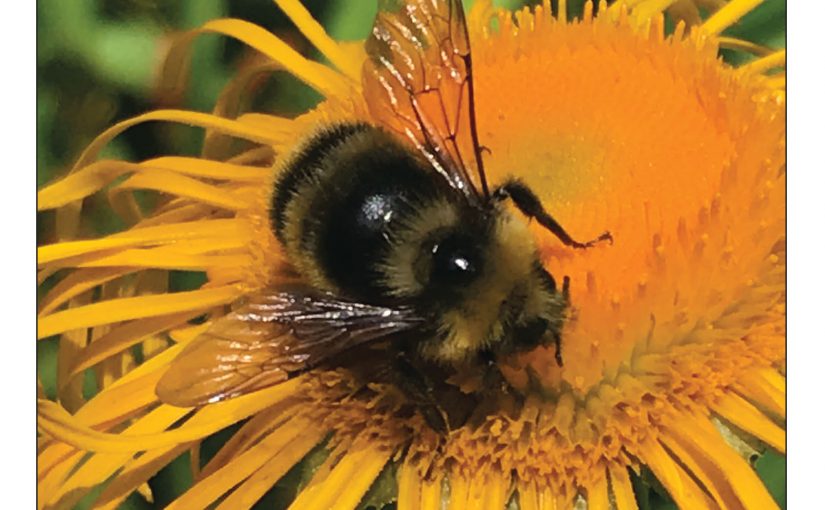
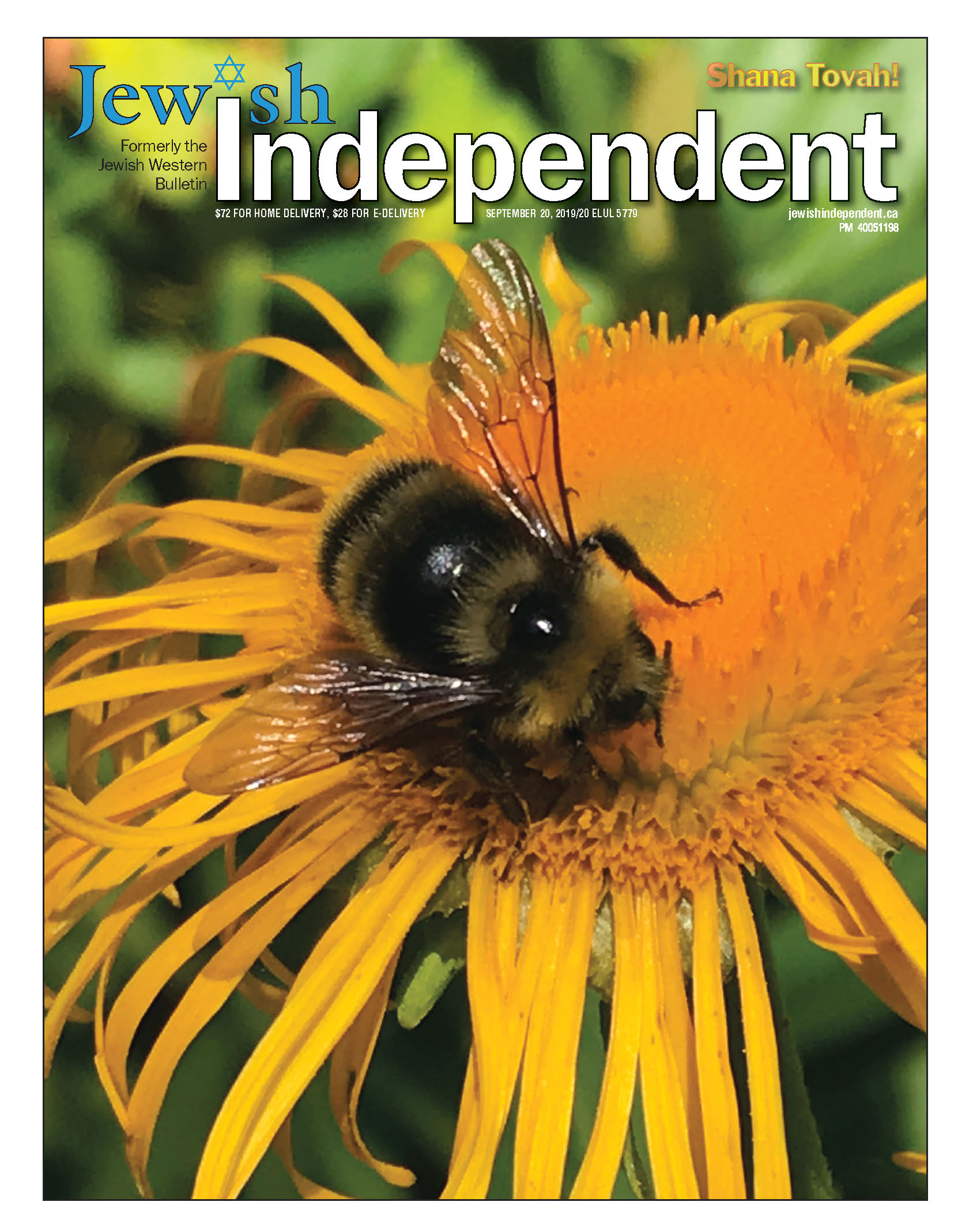
This year’s Jewish Independent Rosh Hashanah cover photo features a bumble bee on a heartleaf oxeye daisy flower – it was taken in Saanich, B.C., by David Fraser. Many native bumble bees are in decline, a concerning trend given the role they play in pollination of plants, including many food crops. Pesticides, habitat loss and introduced bee parasites and diseases are thought to play a role in this decline.

photo - Rosh Hashanah 2019 cover, by David Fraser

Apples are one of the main symbolic foods we eat on Rosh Hashanah, as we wish for a sweet year, with the help of some honey. Apples are the fruit of choice for this wish perhaps because Rosh Hashanah coincides with the sixth day of creation, when humans – Adam and Eve – were created and they ate the fruit (apple) of the Tree of Knowledge in the Garden of Eden. It could also be that apples symbolize the relationship between God and the Jewish people, as poeticized in the Song of Songs, or that the Zohar (kabbalah) describes paradise as a holy apple orchard.

Regardless of the reason for the fruit selection, apple production is dependent on bees and other pollinators. It would be fitting then for us to wish for more than a sweet, fruitful year, when we are dipping our apple slices into honey. We might consider our role in the decline of not only the bumble bee populations but of the environment at large, and what we can do to reverse it.

Format ImagePosted on September 20, 2019February 5, 2020Author The Editorial BoardCategories Visual ArtsTags bees, British Columbia, David Fraser, environment, Judaism, Rosh Hashanah, Saanich
Pot roast for Rosh Hashanah

Pot roast for Rosh Hashanah

There’s no denying that food is an insanely large part of Jewish life. Whether we’re cooking it, eating it or writing about it, our lives inexorably orbit around it. It’s true that most religions celebrate their holidays, at least partially, through food. But we Jews have taken the concept to nosebleed-worthy stratospheric heights. If someone tells you their son is becoming bar mitzvah, our first question is not “Which shul?” but “What are you serving?” A bris? We don’t ask: “What time?” but rather, “What can I make?”

It’s not that modern-day Yiddishkeit revolves around food, but it kinda does. I’m fully aware that we’re supposed to focus on blessing and elevating the food we eat, since it is meaningless on its own. From a religious perspective, food is merely the vehicle to give us the strength to do mitzvahs and study Torah. I get it. But how can you ignore the deliciousness of a rock-star chicken soup or a melt-in-your-mouth brisket?

When you pair Rosh Hashanah and food, what do you get? Pure joy. And maybe a little indigestion, if there’s excess onion and garlic on the guest list. We all know that the High Holidays are a time to relax with family, eat lovingly prepared meals and go to shul. And, while shul is certainly important, for some, the highlight is the food.

From many years of observation, I’ve deduced that there are three main contenders at the Ashkenazi Rosh Hashanah table: matzah ball soup, brisket and gefilte fish. And maybe chicken. Or salmon, if you’re a true Vancouverite. Anything else is considered “alternative.” Seriously, when was the last time someone served tofu or sunomono at Rosh Hashanah dinner? Asked and answered.

Being firmly entrenched in the carnivore camp, I decided I’m going to make a pot roast for Rosh Hashanah this year. Being a pot roast virgin, until recently I knew next to nothing about this cut of meat or how to cook it. How did I get to be 63 years old without knowing these things? Rhetorical question. Anyway, I did what any self-respecting Accidental Balabusta would do – I Googled it. I found a recipe from the Food Network by Ree Drummond, called Perfect Pot Roast! I followed the recipe religiously (OK, minus the sheitel), except I made a mini-roast (one-and-three-quarter pounds) in case I screwed it up. And I used beef blade roast, which is the same as chuck roast, apparently. I cooked it at 275˚F for two-and-a-half hours. It turned out as scrumptious as something a bubbe would make. Only better. Modesty, wherefore art thou?

Over the years, I’ve heard gossip about pot roast: that it calls for a cheap, tough cut of meat (true); that it’s not really a Jewish cut of meat (see Snobbery 101); and that only goyim eat it (see Racism 101). I’m living proof that pot roast is a very Jewish thing. And, excuse me if I brag, but my newfound pot roast is beyond delicious. Or, to use the vernacular, a mechaye.

I feel compelled to mention something a little odd at this juncture. When I brought my first pot roast and took it out of the package, I noticed it had heavy twine wrapped around it. I wondered whether I’d purchased the B&D variety by mistake. Googling the twine part set my mind at ease. I mean, who wants to serve a kinky Rosh Hashanah pot roast?

Call me clairvoyant or, on second thought, don’t (that’s really not a Jewish thing), but I think you might be chomping at the bit for this recipe. Wait no longer. Allow me to introduce you to the Perfect Pot Roast by Ree Drummond. BTW, it calls for a Dutch oven, but any deep, covered roasting pan will do just fine. (Don’t feel bad, I had to Google Dutch oven, too.) Go ahead, cook it and tell me if this doesn’t taste Jewish.

PERFECT POT ROAST

Salt and ground black pepper
One 3-5 pound chuck roast (same as beef blade roast)
2-3 tbsp olive oil
2 whole onions, peeled and halved
6-8 whole carrots, peeled and cut into 2-inch pieces
1 cup red wine (doesn’t need to be anything fancy)
3 cups beef broth
2-3 sprigs fresh rosemary
2-3 sprigs fresh thyme
2-3 potatoes, peeled and cut into pieces

  1. Preheat oven to 275˚F.
  2. Generously salt and pepper the roast.
  3. Heat the olive oil in a large fry pan or Dutch oven over medium-high heat. Add the halved onions to the pot, browning them on both sides. Remove the onions to a plate.
  4. Throw the carrots into the same fry pan or Dutch oven and toss them around a bit until slightly browned. Set aside the carrots with the onions.
  5. If needed, add a bit more olive oil to the fry pan or Dutch oven. Place the meat in the fry pan or Dutch oven and sear it for about a minute on all sides, until it is nice and brown all over. Remove the roast to a plate.
  6. With the burner still on medium-high, use either red wine or beef broth (about one cup) to deglaze the fry pan or Dutch oven, scraping the bottom with a whisk. Put the roast back into the Dutch oven (or deep, covered roasting pan) and add enough beef broth to cover the meat halfway.
  7. Add in the onions and the carrots, along with the fresh herbs. Add potatoes, too (optional).
  8. Put the lid on, then roast it.
  9. The original recipe says to roast a three-pound roast for three hours or a four-to-five-pound roast for four hours. I personally don’t think this is nearly time enough. When I cooked two two-pound roasts in a single roaster at once, it took six-and-a-half hours to cook. The roast is ready when it’s fall-apart tender. I think the longer you cook it, the more tender it gets. It’s hard to screw this up, unless you undercook it.

Important note: don’t get too close to your Dutch oven when you lift the lid during cooking or you’ll get what I call the “pot roast facial.” I’m not sure your pores will appreciate all that meaty steam. But who am I to say? Just don’t blame me if you get third-degree facial burns. Bon appetit! Or, eat it and weep. From joy, that is.

May you all have a happy, healthy, prosperous and peaceful New Year!

Shelley Civkin, aka the Accidental Balabusta, is a happily retired librarian and communications officer. For 17 years, she wrote a weekly book review column for the Richmond Review, and currently writes a bi-weekly column about retirement for the Richmond News.

Format ImagePosted on September 20, 2019September 17, 2019Author Shelley CivkinCategories Celebrating the HolidaysTags Accidental Balabusta, cooking, Judaism, Rosh Hashanah

Need earth-friendly policies

We are now well into the Hebrew month of Elul, which provides an incentive for heightened introspection, a chance to practise teshuvah, changes in our lives, before the Days of Awe, the Days of Judgment, the High Holidays of Rosh Hashanah and Yom Kippur. The shofar is blown every morning (except on Shabbat) in synagogues during the month of Elul to awaken us from slumber, to remind us to consider where we are in our lives and to urge us to consider positive changes.

How should we respond to Elul today? How should we respond when we hear reports almost daily of severe, often record-breaking, heat waves, droughts, wildfires, floods and storms; when July 2019 was the hottest year since temperature records were kept in 1880; when 18 years in this century are among the 19 hottest years and 2014, 2015 and 2016 successively broke temperature records; when polar ice caps and glaciers are melting far faster than projections of climate experts; when climate scientists are warning that we could be close to an irreversible tipping point when climate change could spiral out of control with disastrous consequences, unless major changes are soon made; when we appear to also be on the brink of major food, water and energy scarcities; and when, despite all of the above, so many people are in denial, and almost all of us seem to be, in effect, rearranging the deck chairs on the Titanic as we approach a giant iceberg?

Israel is especially threatened by climate change since, among other dangers, a rising Mediterranean Sea could inundate the coastal plain, which contains much of Israel’s population and infrastructure; and the hotter, drier Middle East projected by climate experts makes terrorism and war more likely, according to military experts.

It is well known that one is not to shout fire in a crowded theatre – except if there actually is a fire. The many examples of severe climate change indicate that the world is on fire today. Therefore, we should make it a priority to do all that we can to awaken the world to the dangers and the urgency of doing everything possible to shift our imperiled planet onto a sustainable path.

We should urge that tikkun olam (the repair of the world) be a central focus in all aspects of Jewish life today. We should contact rabbis, Jewish educators and other Jewish leaders and ask that they increase awareness of the threats and how Jewish teachings can be applied to avert impending disasters. We should write letters to editors, call talk shows, question politicians and, in every other way possible, stress that we can’t continue the policies that have been so disastrous.

As president emeritus of Jewish Veg, formerly Jewish Vegetarians of North America, I want to stress that shifting toward a vegan diet is something that everyone can do right away. It would significantly reduce greenhouse gas emissions and it would be consistent with Jewish teachings on preserving human health, treating animals with compassion, protecting the environment, conserving natural resources, and helping hungry people.

The afternoon service for Yom Kippur includes the book of Jonah, who was sent by God to Nineveh to urge the people to repent and change their evil ways to avoid their destruction. Today, the whole world is Nineveh, in danger of annihilation and in need of repentance and redemption, and each one of us must be a Jonah, with a mission to warn the world that it must turn from greed, injustice and idolatry, so that we can avoid a global catastrophe.

Richard H. Schwartz, PhD, is professor emeritus, College of Staten Island, president emeritus of Jewish Veg and president of Society of Ethical and Religious Vegetarians. He is the author of several books, including Judaism and Vegetarianism and Who Stole My Religion? Revitalizing Judaism and Applying Jewish Values to Help Heal Our Imperiled Planet, and more than 250 articles at jewishveg.org/schwartz. He was associate producer of the documentary A Sacred Duty: Applying Jewish Values to Help Heal the World.

Posted on September 20, 2019September 17, 2019Author Richard H. SchwartzCategories Op-EdTags climate change, Elul, environment, lifestyle, Rosh Hashanah, tikkun olam
Holidays as a child

Holidays as a child

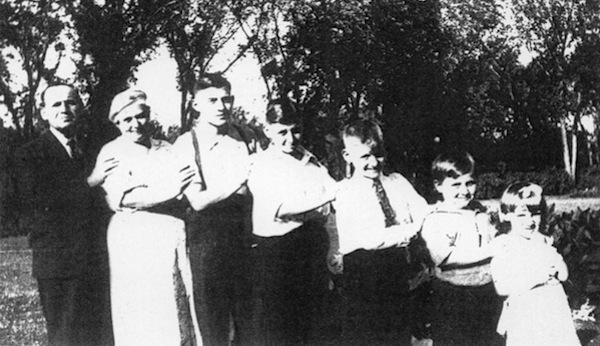
A Klein family portrait. (photo from Libby Simon)

As I get older, I look forward to my childhood memories of the High Holidays with my original family. This year, Rosh Hashanah begins before sundown on Sept. 29 and ends on nightfall Oct. 1, Yom Kippur.

My parents, four older brothers and I had moved to several rental houses after our arrival in Winnipeg’s legendary North End, but the one on Robinson Street is the earliest in my awareness as a preschooler. The neighbourhood was refuge for a host of other immigrant Jewish families who came from the same geographical area and shared the same culture, language and religion. This bond and kinship brought these landsleit together and they congregated around the Talmud Torah Hebrew Free School, where my father taught the children, and the Chevra Mishnayes Synagogue, directly across from our house, giving us the opportunity to attend services in a building that also acted as an unofficial community centre.

Papa attended all Shabbat services at the shul, which was the centre of many family weddings, bar mitzvahs and funerals. Since we observed the Orthodox Jewish religion, women and men did not sit together, so, while the men were seated on the main floor, the women were sequestered in an upstairs oval-shaped balcony overlooking the activity below. Not particularly interested in the liturgy, they tended to talk to one another about their children, their homes and other areas of interest, especially cooking on the High Holidays. This “noise” often interfered with the men as they recited the prayers. At some point, the shamas (the person running the service) would look upward, pound on the podium and shout “Schveig, viber!” (“Quiet, women!”) as if we were all one big family. Things subdued for awhile until the chatter swelled again, requiring intermittent reminders with more pounding, and a commanding, “SHHAA!”

Our old, wood-framed house had a screened veranda where I played and sometimes slept on warm summer nights. Once I was old enough, on Saturday mornings, I was allowed to cross the street to join Papa after a bar mitzvah celebration. There were always treats after the service, and he would prepare a small plate of schmaltz herring and chickpeas for me, and a piece of honey cake for dessert. I loved schmaltz herring and would devour it quickly while Papa looked on with a broad, proud smile.

But clouds of the Great Depression hung heavy over this North End community and there was widespread poverty. Most women did not work outside the home and, like many other men, my father lost his teaching job for a period during the Depression.

When I accompanied Mama to the grocery store or the kosher butcher shop, I didn’t understand why her face flushed and her eyes looked away as she stammered out in Yiddish, “I need food for the children. Can you put this on credit? We will pay you as soon as we can.” Her embarrassment and humiliation collided with my father’s shame, and resulted in many heated arguments between them over money.

The stress was particularly hard on Mama because she wasn’t well and had a large family to care for. She developed a “milk leg” while pregnant with my youngest older brother, Matty. It created a painful swelling of the leg after giving birth, which caused inflammation and clotting in the veins and affects some postpartum women. I vividly recall the too-numerous times when an ambulance came tearing down Robinson Street to our house with wailing warnings. Big men dressed in white would rush in, lift Mama onto a stretcher and take her away amid the shrieking sirens that were now competing with the high-pitched howls of her two frightened preschoolers, Matty and me.

Back then, children were not allowed to visit in hospitals, for fear of transmitting disease, so we could not see our mother for intermittent periods. On one such occasion, my father had enough money to take us to the ice cream store a few blocks away. Holding Papa’s hand on one side, with Matty on the other, I felt safe as we all walked together. And the tears subsided.

Canada declared war on Germany in September 1939 after Hitler invaded Poland, and, although my parents’ family was safe in Canada, their hearts and minds were with the loved ones they had left behind. Yet, our home was filled with joy and laughter.

My mother played happy, lively Russian, Yiddish and Hebrew songs at the black upright piano that held a place of honour among the flowery wallpaper and sagging couches of our living room. The eldest of the five children would lead us in a conga line with me at the other end, and we would dance from room to room, up and down the stairs, and all around the house. Sometimes, he would pick me up, throw me over his shoulder and call out “A zekele zaltz!” like a peddler. “A sack of salt, I have a sack of salt for sale! Who wants to buy my little sack of salt?” Or sometimes I was “potatoes.” Whether salt or potatoes, he would haggle with whichever of my other brothers offered to “buy” me.

Although I was still a preschooler, I knew that Papa was listening to “the news on the radio.” The worry was in his eyes, his face, his body, and his words expressed his extreme concern for our families back in the homeland. But the true catastrophic human saga that was unfolding, even as he listened, would not emerge until the war ended. We would learn much later that most of the relatives left behind, including my maternal grandfather, died in the Holocaust.

Even Papa’s fears could not have fathomed such destruction. The radio had become so much a central focus and source of news that, when the war ended in 1945, I recall asking, “Papa, now that the war is over, will they close the radio?”

“Why do you think they will close the radio?” he asked with a puzzled look.

“Because what else would they have to talk about?”

Libby Simon, MSW, worked in child welfare services prior to joining the Child Guidance Clinic in Winnipeg as a school social worker and parent educator for 20 years. Also a freelance writer, her writing has appeared in Canada, the United States, and internationally, in such outlets as Canadian Living, CBC, Winnipeg Free Press, PsychCentral and Cardus, a Canadian research and educational public policy think tank.

Format ImagePosted on September 20, 2019September 17, 2019Author Libby SimonCategories Celebrating the HolidaysTags family, history, Rosh Hashanah, Winnipeg
Rosh Hashanah’s many foods

Rosh Hashanah’s many foods

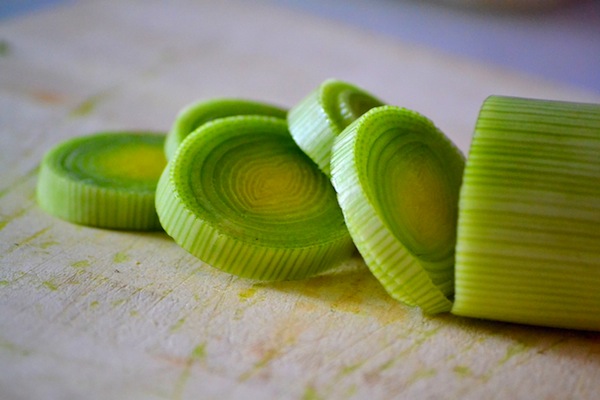
At a Sephardi Rosh Hashanah seder, one of blessings, over leeks (or cabbage) is the request, may “our enemies be destroyed.” (photo from Wikimedia)

Food customs differ among Ashkenazi and Sephardi Jews. For example, whereas Ashkenazim dip apple in honey at Rosh Hashanah, some Sephardim traditionally serve mansanada, an apple compote, as an appetizer or dessert, according to The World of Jewish Desserts by Gil Marks, z”l.

Just as gefilte fish became a classic dish for Ashkenazi Jews, baked sheep’s head became a Rosh Hashanah symbol for many Sephardi Jews, dating back to the Middle Ages. Some groups serve sheep brains or tongue or a fish with head, probably for the same reasons, for fruitfulness and prosperity and wishes for the New Year of knowledge or leadership.

The Talmud mentions the foods to be eaten on Rosh Hashanah as fenugreek, leeks, beets, dates and gourds, although various Jewish communities interpret these differently.

According to Rabbi Robert Sternberg, in The Sephardic Kitchen, Sephardi Jews have a special ceremony called the Yehi Ratsones (Hebrew for “May it be Thy will”), where each food is blessed. There are foods that symbolically recognize God’s sovereignty and our hope He will hear our pleas for a good and prosperous year.

The Hebrew word for gourds is kara, which sounds like both the word for “read/proclaim” and the word for “tear.” When we eat the gourd or pumpkin, there are two possible Yehi Ratzons that can be said. The first one goes: “May it be your will, Hashem, that our merits be read/proclaimed before you.” The other is that the decree of our sentence should be torn up.

The second food mentioned is fenugreek, or rubia, which sounds like yirbu, the Hebrew word for “increase.” Therefore, we say a Yehi Ratzon that contains the request, may “our merits increase.”

The word for the third food, leeks or cabbage, is karsi, krusha or kruv, which sounds like kares, or the Aramaic word karti, to cut off or destroy. The Yehi Ratzon asks, may “our enemies be destroyed.”

The fourth food, beets or beet greens, silka or selek, sounds like siluk, meaning removal, or she’yistalqu, to be removed, or the Aramaic word silki. The Yehi Ratzon requests that “our adversaries be removed.”

The last food is dates, tamri or tamar, which sounds like the Hebrew word sheyitamu and the Aramaic word tamri, to consume. Hence, we say a Yehi Ratzon that asks, may “our enemies be consumed.”

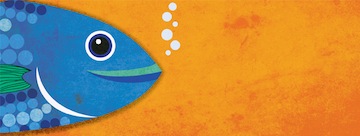
image - For many Jewish cultures, the fish head is a symbol on the Rosh Hashanah table
For many Jewish cultures, the fish head is a symbol on the Rosh Hashanah table. (image from chabad.org)

All of these foods, which grow rapidly, are also symbols of fertility, abundance and prosperity. Among other items that might be on a Sephardi table at Rosh Hashanah, Sternberg includes baked apples dipped in honey or baked as a compote with a special syrup; dates, which were among the seven species found in Israel; pomegranates, which have many seeds, or black-eyed peas, to represent our hoped-for merits; rodanchas, a pastry filled with pumpkin whose spiral shape symbolizes the unending cycle of life; and a fish head, symbolizing a wish to be the head in life, a leader, and not the tail. The main course might feature stuffed vegetables, symbolizing a year full of blessings and prosperity.

Some communities ban sharp, bitter or black foods for Rosh Hashanah, such as black olives, eggplant, chocolate or coffee.

In The Classic Cuisine of the Italian Jews, Edda Servi Machlin, z”l, who grew up in Pitigliano, Tuscany, explains that her father held a seder for Rosh Hashanah around the theme of growth, prosperity and sweetness. On the seder plate were a round challah, a boiled rooster’s head, fish such as anchovies, boiled beets, figs and pomegranates. In the centre was a dried, round, sourdough cake with an impression of her father’s right palm and fingers, and fennel weed growing on each side.

The foods were then blessed – “May we grow and multiply like fish in the ocean, like the seeds of a pomegranate, like the leavening, grain and fennel of the bread. May the year be sweet like beets and figs.”

The meal consisted of soup, fish, salad, chicken and fruit. Italian Jews also often serve at Rosh Hashanah desserts made with honey and nuts; stick or diamond-shaped cookies; strufali, cookies made of fried dough balls in honey; or ceciarchiata, cookies that resemble chickpeas and are made from bits of dough like the Ashkenazi teiglach.

A Greek cookbook writer from Ioannina (Yahnina) wrote that the people of her area made koliva, a thick porridge of wheat berries flavoured with cloves, cinnamon, walnuts and honey for eating on the eve of Rosh Hashanah. According to Marks in The World of Jewish Desserts, wheat berries are unprocessed whole wheat with the outer husk removed, leaving a nutty flavour and chewy texture. Jews of Yahnina also ate kaltsoounakia, a half-moon-shaped cake stuffed with ground walnuts, honey, cinnamon and cloves. For the main course, dishes in Yahnina were influenced by the Turkish occupation and included stuffed tomatoes, stuffed squash and stuffed vine leaves – filled with lamb, rice and parsley, as well as okra stewed with chicken.

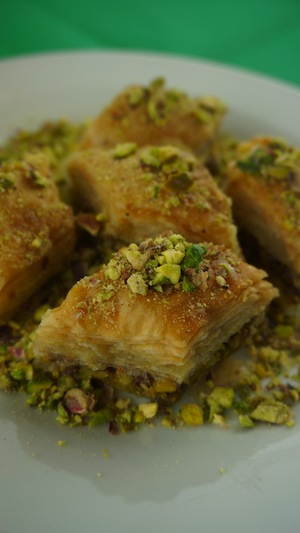
photo - Instead of honey cake, Greek Jews might have baklava for Rosh Hashanah dessert
Instead of honey cake, Greek Jews might have baklava for Rosh Hashanah dessert. (photo from Wikimedia)

Other Jews of Greece have different customs. Nicholas Stavroulakis, author of Cookbook of the Jews of Greece, writes that some people soak apples in honey or eat quince or rose petals cooked in syrup as the New Year sweet. Fish is often the main course and, in place of honey cake for dessert, Greek Jews use almonds or pumpkin in making turnovers, as a symbol of abundance. Other desserts include semolina cake in syrup, pastry triangles filled with nuts or dried fruit, or baklava.

Among Jews of Syria, sugar or honey is substituted for salt at the table, and many families do not serve any dishes that are sour. For the second night Shehechiyanu blessing, the fruit used may be quince, prickly pear, star fruit or figs. Instead of, or in addition to, dipping apples in honey, Jews of Syria often dip dates in honey.

Many Jews from Muslim countries also eat autumn foods cooked with sugar and cinnamon; the food names contain a symbolic allusion to prayers in Aramaic and, through alliteration, are recited over the vegetables and fruits. Syrian Jews use the same prayers but over different vegetables: leek, Swiss chard, squash, black-eyed peas, pomegranate and the head of an animal. This idea of wanting people to be smart, as symbolized by the head or brain, is observed by Jews of Tunisia in their serving of a cake made with chicken and calves brains.

Moroccan Jews take sesame seeds, warm them in the oven and eat them with apple dipped in honey to symbolize that Jews should be fruitful and multiply like the seeds and have the sweet year. They also eat the pomegranate because of its alleged 613 seeds, which symbolize the 613 mitzvot. Moroccan Jews identify the seven autumnal foods as pumpkin, zucchini, turnip, leek, onion, quince and Chinese celery, and sprinkle these with sugar and cinnamon to eat at the beginning of the meal.

Some Moroccan Jews also serve cooked lamb head as an appetizer for Rosh Hashanah. Other lamb dishes served might be lamb with prunes and almonds or lamb intestines filled with rice, meat and tomato, seasoned with cinnamon and cardamom.

Another popular dish served by Moroccans for Rosh Hashanah is couscous, the traditional North African grain, or farina. It is steamed above a stew made with meat or chicken, chickpeas, pumpkin, carrots, cinnamon and raisins. Baked fish with the head, made with tomatoes and garlic, tongue with olives, or meat and rice rolled in Swiss chard are other Moroccan New Year’s dishes. Two soups that may be served are vegetable soup with pastels, a meat-filled turnover similar to kreplach, and potakhe de potiron, a yellow, split-pea and pumpkin soup. The evening may be completed with honey-dipped “cigars,” filled with ground almonds and traditional hot mint tea.

“Cigars” are traditional for Moroccan events and can be made sweet or savoury. The sweet version is a slim roll of Phyllo pastry filled with almonds, pistachio nuts or walnuts, baked or deep fried and sprinkled with confectioner’s sugar. Savoury cigars may be filled with cheese, chicken, meat, potatoes or tuna.

For Rosh Hashanah, Jews of Egypt make loubia, a black-eyed pea stew with lamb or veal, to symbolize fertility.

Jews of Iraq cook apples with water and sugar like applesauce, as a symbol of a sweet New Year. Some also prepare a special, pale-green bottle-shaped squash, which they eat with whole apple jam and sugar. They also make the blessings over leek, squash, dates, pomegranate and peas and place the head of a lamb on their Rosh Hashanah table.

Yemenite Jews, who do not consider themselves Ashkenazi or Sephardi, dip dates in honey instead of apples; others mix sesame seeds and anise seeds with powdered sugar and dip dates in this mixture. They also eat the beet, leek, pomegranate and pumpkin, as well as a salted fish head. The main meal for Yemenites would be a soup made of chicken or meat, carrots, potatoes and the spice hawaj (a combination of black pepper, cumin, coriander and turmeric). Meat stew, cooked chicken, rice, dried fruit and nuts complete the meal.

Whatever your family’s origins, why not try something from another Jewish culture this Rosh Hashanah?

Sybil Kaplan is a journalist, lecturer, book reviewer and food writer in Jerusalem. She created and leads the weekly English-language Shuk Walks in Machane Yehuda, she has compiled and edited nine kosher cookbooks, and is the author of Witness to History: Ten Years as a Woman Journalist in Israel.

Format ImagePosted on September 20, 2019September 17, 2019Author Sybil KaplanCategories Celebrating the HolidaysTags culture, food, Rosh Hashanah, Sephardi

Value of is and ought

Ought is one of the 3,000 most frequently used words in English. We say one ought to do something as an indication that some action is good, proper, expected or owed. The word should carries many of the same implications. In recent years, should and ought have been criticized as being negative words, engendering guilt and removing individual initiative from people. People have begun to say, “I don’t like shoulds” or “Religion is too full of shoulds.”

The contemporary psychological pushback against ought and should is rooted in efforts to help people feel better about themselves. Moreover, it is suggested that, to liberate ourselves from should statements, we must more clearly express what we want and why we want it. It is important to fill in the gap between, “You should take out the garbage,” with the reasons why such an action is desired.

In many ways, the contemporary discussion is based in the work of David Hume (1711–1776), the great Scottish philosopher. He noted that many people make factual observations, describing events or people, and then make a casual transition from statements about what is to claims about what ought to be. In his Treatise of Human Nature, Hume cautioned against using descriptive statements (about what is) as the basis for prescriptive statements (about what ought to be). For example, the observation that locally grown produce is readily available in the market and the claim that one ought to eat local are not connected. What is missing is the explanation of why eating local might be environmentally beneficial, economically justified and morally desirable. The present situation may be described as it is. But if we think that something should (according to our values) be changed, we can begin to think about how to change things that are into what we believe they ought to be.

The claim that there is a smaller Jewish community now because of the Holocaust does not immediately lead to the conclusion that one should financially and politically support the state of Israel. Making the moral claim is not enough. We must be able to give reasons to fill in the gap between the demographic implications of the deaths of so many Jews and the importance of Israel to the continuation and rebuilding of the Jewish people.

Yet ought and should are also ways of thinking aspirationally, articulating what we hope or want to be. My colleague, Rabbi Harold Schulweis, has written about the is/ought dilemma in a way that reminds us of the power and possibility of ought (and should):

“Think ought. Not what is a Jew, but what ought a Jew to be. Not what is a synagogue, but what ought a synagogue to be. Not what prayer is, but what prayer ought to be. Not what ritual is, but what ritual ought to be.

“Focus from is to ought, and our mindset is affected. Is faces me toward the present; ought turns me to the future. Ought challenges my creative imagination, opens me to the realm of possibilities and to responsibilities to realize yesterday’s dream.

“Ought and is are complementary. Without an is, the genius of our past and present collective wisdom is forgotten. Without an ought, the great visions of tomorrow fade. Ought demands not only a knowledge of history but of exciting expectation. Is is a being, ought is a becoming. Ought emancipates me from status quo thinking. Ought is the freedom of spirit.”

The Torah tradition is built around the idea of ought and should. “Barukh atah … Praised are You who commanded us” is a core concept of Judaism, critical to who we are as Jews. This idea is at odds with contemporary sensibilities that seek to discard shoulds and oughts. We recognize responsibilities, obligations, mitzvot, as essential to the building of individual character and collective community. Whether those obligations are interpersonal or directed toward the Holy One, they encourage us to look beyond ourselves to see a greater good.

Many times during the Days of Awe, we will use the words should and ought. Instead of thinking of these words as ways of placing guilt on others, let us try to explain why something – attending shul with the family, marrying within the Jewish community, giving tzedakah – is important. Let’s try to fill in the reasons for our claims of should and ought.

As well, the Yamim Nora’im lead us to see statements of should and ought as moral claims that extend beyond past history. We might hear such comments as indications of our responsible aspirations and our hopeful desires. Then should and ought can be motivational terms. They push us forward toward making the world, our society, our family and our closest relationships a bit better.

Rabbi Baruch Frydman-Kohl is rabbi emeritus of Beth Tzedec Congregation in Toronto and is a rabbinic fellow of the Shalom Hartman Institute of Jerusalem. He is the author of scholarly articles in the area of Jewish philosophy and mysticism. For more articles from the SHI, visit hartman.org.il.

Posted on September 20, 2019September 17, 2019Author Rabbi Baruch Frydman-Kohl SHICategories Celebrating the HolidaysTags Judaism, Rosh Hashanah, tikkun olam
Feminine aspects of repentance

Feminine aspects of repentance

At Rosh Hashanah, the new moon is revealed.

The Zohar, that classic mystical text from the 13th century, describes the High Holidays as a developmental process of female empowerment, which culminates in Yom Kippur.

According to the Zohar, the place we return to when we repent is our supreme mother, the Sephira, and we receive understanding from the Tree of the Ten Sephirot. Returning to our mother means to be gathered to the mother’s womb, a sort of death in order to be reborn, a self-nullification for gaining a new life.

This inversion has to do with the complex relationship between a mother and her children: she gives them life and they establish her motherly essence; she gives them life and they mark the beginning of her end, as “one generation passes and another generation comes.” Children return to their mother to understand their origin, and thus reveal their future.

Thanks to these paradoxical relationships between the generations, the mother has the power to heal, to sweeten and to explain every question and shattering in our lives.

“Returning to the mother” is not always an absolute, unequivocal and affixed teshuvah (repentance). It is a teshuvah that is coming into being, the same way that the world to come is coming into being, and the status of which is always (a world) “to come.”

According to Shaarei Orah by Rabbi Joseph ben Abraham Gikatilla, “the world to come” is also another name of the sephira (kabbalistic attribute) Understanding. Understanding is constantly giving birth to souls and, thanks to her, we are renewed and recreated every day, especially at the beginning of the year, at Rosh Hashanah.

At Rosh Hashanah, the new moon is revealed. The year begins with coverage and concealment, due to a cloud that covers the sun. In the kabbalah, the sun is the male. The moon, which is usually identified as the Shechinah (divine presence) and is also the lowest sephira, called Malchut (kingship), gets her light from him. When the sun is not shining, the Shechinah is hidden as well, and our world is in darkness. How can the light of Genesis be lit? The Zohar says:

“… Through teshuvah and the sound of the shofar, as it is written: Happy the people who know the blast. Then, O YHVH, they will walk in the light of Your presence (Psalms 89:16).

“Come and see: on this day, the moon is covered and does not shine until the 10th day, when Israel turns back in complete teshuvah and Supernal Mother returns, illumining Her. On this day, Mother embarks on Her journey and joy prevails everywhere.

“Thus it is written, Yom ha-kippurim hu, it is the Day of Atonement (Leviticus 23:27) … the verse should read Yamim Kippurim, Days of Atonements … because two radiances shine as one, Upper Lamp illumining Lower Lamp. This day, She shines from the upper light, not from light of the sun; so it is written, ba-keseh le-yom haggenu, on the covering until our festival day.”

The Zohar emphasizes that the only way to cleave the cloud is with the sound of shofar and teshuvah – both mental and supernatural ways to reach the supreme source and attract new life out of it. The Zohar teaches, symbolically, that this task is assigned on every New Year: to cleave the cloud with repentance, to cancel the decree by the voice of the shofar.

Only then, after the 10 days of repentance, will the light illumine Yom ha-Kippurim. It is a double light: that of the supernal mother (Understanding) which illumines her daughter (Shechinah), and the two will reunite into one. That is why this day is called Yom ha-Kippurim, the day of two feminine lights illumining together, without the aid of any masculine light from the outside.

According to another commentary in the Zohar, unlike at Rosh Hashanah, when the masculine God appears, exposing and lifting His left hand in a gesture of sentence and vengeance, on Yom ha-Kippurim, we realize that this same hand is meant to support Shechinah and lift her from the dust, as is written in the first part of Song of Songs: “Let His left hand be under my head.” (2:6) On this day, Shechinah, the female hero, appears as a bride and we all are her bridesmaids, accompanying her to “Mother river” of the sephira Understanding, to immerse in it and clean her from our sins.

Finally, after being atoned, the dance of sephirot culminates in Sukkot, and the celestial couple is united. The second part of the verse – “and His right hand embrace me” – is implemented, and light and happiness fill the world. At Rosh Hashanah and Yom ha-Kippurim, we pray facing Shechinah and Understanding, and their light envelops and shields us after the cloud is cleaved.

***

The Book of Zohar sees King David as “The Hero with a Thousand Faces”: the archetypal sinner, the court jester and, eventually, also the partner of teshuvah herself. In Psalms 130, King David says: “Out of the depths I cry to you, Lord / Lord, hear my voice / Let your ears be attentive / to my cry for mercy / If you, Lord, kept a record of sins / Lord, who could stand? / But with you there is forgiveness / so that we can, with reverence, serve you / I wait for the Lord, my whole being waits / and in his word I put my hope / I wait for the Lord / more than watchmen wait for the morning / Yea, more than watchmen wait for the morning / Israel, put your hope in the Lord / for with the Lord is unfailing love / and with him is full redemption / He himself will redeem Israel / from all its sins.”

This psalm begins with calling to God out of the depth, continues with asking God’s forgiveness, ends with yearning and anticipation that grow out of God’s absolution, and reaches the point of redemption and salvation. There are hidden words of praise to God and, as in other psalms, David’s ability to turn his supplications into poetry and to converse with his soul, so bound up with the divine soul, is outstanding.

According to King David, forgiveness is possible only when we are “with God,” and the mercy and redemption are in Him and “with Him” and, therefore, are in us, when we are attached to Him. The space that enables us to undergo the process of “making teshuvah” is created, and we are able to “return to the place” that is our origin and the root of our soul.

King David is not only a great poet, but also the archetypal sinner who, according to our sages, was born to set up “the yoke of repentance.” The sages deal a lot with David’s sins, justify him and even declare radically: “Whoever says that David sinned is merely erring.” (BT Shabbat 56a)

At one point, a scene is described in which David enters the Beit Midrash during a dispute about the world to come, the scholars taunt him about Batsheva and he reproaches them about a flaw in their morality: “… when they are engaged in studying the four deaths inflicted by beit din [court], they interrupt their studies and taunt me [saying], ‘David, what is the death penalty for he who seduces a married woman?’ I reply to them, ‘He who commits adultery with a married woman is executed by strangulation, yet he has a portion in the world to come. But he who publicly puts his neighbour to shame has no portion in the world to come.’” (BT Sanhedrin 107a)

It is evident that our sages were deeply engaged with questions of evil inclination, reward and punishment and, mostly, they identified with King David’s image. This colourful hero – the fighter, the fallen, the worldly, the dancer, the poet – seems to them the most likely to repent and to be fully pardoned either by men or by God. In fact, it might be said that each generation has its own King David. They see him in a different light and cast upon him their own personal traits, their fractures and their hopes to be redeemed.

The Zohar regards David as the hero with a thousand faces. David of the Zohar is poor and deficient, empty and, therefore, filling up and being a penitent (ba’al teshuvah). He knows how a man’s bruised and low soul can be elevated from the depths to a level of joy and thankfulness.

According to the Zohar, the place we return to when we repent is our Supreme Mother, the Sephira, and we receive understanding from the Tree of the Ten Sephirot. Returning to our mother means to be gathered to the mother’s womb, a sort of death in order to be reborn, a self-nullification for gaining a new life.

And what has King David to do with this feminine process? Surprisingly, the Zohar identifies King David as the Shechinah, the same Shechinah that seemingly has nothing of her own, even though the other sephirot depend on her, and she is the most concentrated and colourful of them all. David is like a hero returning from a voyage, radiating myriad lights collected from all his sins and fractures. Had they remained in the form of fractures alone, darkness would have prevailed in the world. Thanks to Understanding – the mother and the wife – they have turned into a spectacular kaleidoscope of lights.

David refuses to hide his sins. After having confessed, acknowledging his deeds and admitting them, the sin loses its form, returns into its raw essence and finally turns into praise to the Lord. God, on his part, forgives our sin and gathers us to Him. Thus, David turns his soul into a lever of teshuvah out of love. Precisely these factors – his feminine side, his majestic quality and his skill to turn a confession into praise – enable David to ascend to mother Understanding and immerse us in the river of forgiveness.

Dr. Ruth Kara-Ivanov Kaniel is a research fellow at the Shalom Hartman Institute and was ordained as a rabba by the Hartman-HaMidrasha at Oranim Beit Midrash for Israeli Rabbis in 2016. These articles are based on her originals in Hebrew and are meant to be read together. For more articles from the SHI, visit hartman.org.il.

Format ImagePosted on September 20, 2019September 17, 2019Author Dr. Ruth Kara-Ivanov Kaniel SHICategories Celebrating the HolidaysTags Judaism, kabbalah, Rosh Hashanah, women, Yom Kippur, Zohar

Ends and beginnings

As we come to the end of the High Holy Days, we set ourselves on paths of new beginnings. On Simchat Torah, we mark both a beginning and an end. The cycle of Torah reading ends and then immediately begins again. It is said that we read the same passages of the Torah every week, every year, but the meanings change because we are different people year after year, experiencing life and the world with different eyes and, hopefully, with increased wisdom.

The Days of Awe are a time of critical introspection. This period of teshuvah invites us to recognize our shortcomings and commit to improvement. This mission is both individual and collective. As a people, we are obligated to repair the world, and this year calls on us with no shortage of issues to collectively confront: inequality and suffering, environmental degradation, inhumane treatment of animals, the pursuit of justice.

On the latter front, our cousins in the United States are absorbed in a drama around the appointment of the next justice of the Supreme Court and things that he may have done many years ago. The senators considering his nomination heard two irreconcilable narratives last week from the accuser and the accused. The testimony from Dr. Christine Blasey Ford echoes the testimonies of so many people, mostly women but also men, who have felt empowered, motivated or obligated to share their most personal experiences in what has become known as the “#MeToo era.”

Yet the senators’ motivations hinge on more than determining who is telling the truth. Political considerations – advancing President Donald Trump’s second Supreme Court nominee to the bench before the November midterm elections – seem to be the factor front of mind for some elected officials, regardless of Blasey Ford’s testimony. It seems clear that politics may trump justice in this case.

Politics in Canada is not as brash as that in the United States, but populist and exclusionary ideas may be finding a voice here that they did not have before. A new federal political party seems prepared to amplify views that, until recently, were more limited to online discussions and whispered conversations. Meanwhile, the party that won Monday’s provincial election in Québec mooted during the election campaign the idea of throwing out newcomers who do not gain an adequate grasp of the French language within three years of arrival. Unconstitutional as such a policy may be, even voicing such ideas brings us to a new chapter in Canadian public life.

Immigration and refugees are a perennial issue, with the nature of a society at the heart of the discussion. The groups of people at the centre of the discussion – immigrants and refugees – change generation by generation. In this era, Jewish Canadians have an opportunity to bring hard-learned wisdoms to the debate. The federal government is set to formally apologize next month for a most egregious historical example of exclusion: the rejection of the passengers on the MS St. Louis. Indeed, this memory should inform our reaction to the current discussion and the realities for the millions of displaced people and refugees fleeing conflict around the world.

Personal experiences inform our political ideologies. And, through our personal actions, we can affect political affairs. This can be in obvious ways – like showing up to vote in the municipal elections on Oct. 20 or in advance polls – or in more subtle but profound ways, like educating the next generation, modeling the values we hope to advance and creating ripples of goodness across our circles of influence.

In matters of public policy and in the more private ways we behave in our lives, the holy days remind us to take stock of our own role in advancing justice and a better world.

We may feel insignificant in the grand scheme. How can we affect the powers in the White House or in Ottawa or around the world? But Jewish tradition is clear. “It is not your responsibility to finish the work [of perfecting the world], but you are not free to desist from it either,” said the Mishnaic sage Rabbi Tarfon.

Inward reflection is the first and easiest step we can take as individuals to address faults in our world. Based on this reflection, we may choose to move to action. Where it will end, we cannot always tell at the beginning. But it is our job to get the ball rolling.

Posted on October 5, 2018November 20, 2018Author The Editorial BoardCategories From the JITags Judaism, lifestyle, politics, Rosh Hashanah, Sukkot, Yom Kippur

Looking for new Jewish ideas

By the time you read this, our big run of fall Jewish High Holidays will be over. However, I’m still gathering up bits and pieces about it. What did I experience? What worked out and what didn’t? This isn’t a yes or no question, it’s complex. It takes time to process the intensity of what I learned.

Like many parents with kids, I don’t attend a full complement of adult religious services. Even if I didn’t have younger children, we’d still have to find dress clothes for everyone and make sure holiday meals are ready, never mind actually working for a living. Every fall is a juggling act. Will it work out smoothly? Sometimes it is good planning. Sometimes, it’s luck.

This year, I managed to access several sermons, done by various rabbis I know and respect. Some were published to the internet on the day after the holiday. Others were live-streamed.

Via the internet, I read the Rosh Hashanah sermons of a Long Island rabbi with whom I have studied and become friendly over the past year or two. Rabbi Susan Elkodsi shared several of her sermons as blog posts after the holiday. One sermon covered the confluence of 9/11 with the High Holidays. The other talked about how we connect with our ancestors over the New Year period, and how the “who will live and who will die” metaphor becomes alive for many.

For me, both of these topics struck home. My family in New York City and in D.C. lived through 9/11. Also, every time I sing the holiday Kiddush, it is as though I hear my grandfather, z”l, singing it. He sang it at my family’s holiday table, and he taught me to do it as a young adult. On erev Rosh Hashanah this year, I could hear his voice in my ear, although he died long ago. Thanks to those sermons, I have some Jewish historic context for two strong emotional memories.

Elkodsi’s next blog post covered a “water-optional” version of Tashlich, when people gather to throw their sins or breadcrumbs into the water. She described how Tashlich might be the time to clean up or discard the things that are holding us back or for which we can no longer find a use. In a sense, it’s a “KonMari” cleaning method for our lives. This, too, found resonance with me. I used it as unconscious encouragement – my kids and I cleaned up their art shelf, play room and living room toys before Yom Kippur. This mess weighed me down. Together, we cast it off to have a better start to 5779.

This year, even though we didn’t travel there, we heard Kol Nidre, sung in Virginia, and saw my father, as a past president, holding a Torah on the pulpit of my family’s congregation. How did we pull that off?

On erev Yom Kippur, my kids got into their pajamas. We read stories and got ready for bed. At exactly 7:30 p.m. CT, we started live-streaming the Temple Rodef Shalom Kol Nidre late service. My kids worried that the Torah was too heavy for their grandfather. (I did, too.) Later, my mom told me that past presidents on either side of my dad were spotting for him, and that my dad also recognized that this would probably be the last year he could do this. Torahs are heavy. Nobody wants to drop one. We felt the power of connecting with family, seeing my father do a mitzvah, and something difficult, at a big holiday service.

My kids made it until about 8:15, staying up through the Kol Nidre prayer and the first part of the service before they fell asleep. Using headphones, I listened to the rest of the service until, for some reason, I couldn’t access the live-streaming anymore. By then, I’d heard about how we should see teshuvah (repentance) through the eyes of a failing U.S. criminal justice system. It’s hard to balance the needs of victims, cope with crime and also give people who’ve made mistakes a second chance. Rabbi Jeffrey Saxe, a victim of violent crime, gave the sermon. He explained his social action efforts to advocate for reform with an interfaith clergy group that meets with Virginia’s governor.

I’m mentioning the positive things I can fit in one column. Sometimes accessing diverse voices, from every movement, with different Jewish experiences, enriches our observance. There’s no way my body could have been in synagogue in Manitoba, New York and Virginia. The traveling would have been torture, never mind the cost! However, my mind traveled. This helped me think about new things for 5779.

Some say that the High Holidays are the most important days of the Jewish year, but I’d argue that they are the most intense. Shabbat every week is important. All the other holidays have value, too. The thing about rituals, traditions and observance is that they don’t have an on/off switch. If we shift ourselves just a little, attend a different Jewish service, listen to a new sermon or approach things differently, we can have a startlingly new experience.

Most people attend one congregation all the time, hear one or two rabbis’ sermons and rarely see something new. It’s a lot of effort to break routines. Change is hard. However, every day is an opportunity to look up and find new things in our Jewish landscape. Sometimes, a slight shift in how we see our rituals (dog walks, meditations, synagogue services) can change the way we see the whole world. It’s going to take me time to sort through what I learned and what changed. I hope you, too, can take that time to gain something new, to learn something about the Jewish world, through this kind of exploration.

Joanne Seiff writes regularly for CBC Manitoba and various Jewish publications. She is the author of three books, including From the Outside In: Jewish Post Columns 2015-2016, a collection of essays available for digital download or as a paperback from Amazon. See more about her at joanneseiff.blogspot.com.

Posted on October 5, 2018October 3, 2018Author Joanne SeiffCategories Op-EdTags Judaism, lifestyle, Rosh Hashanah, Sukkot, Susan Elkodsi, Yom Kippur Kol Nidre

Posts pagination

Previous page Page 1 … Page 5 Page 6 Page 7 … Page 10 Next page
Proudly powered by WordPress