
Skip to content
  • Home
  • Subscribe / donate
  • Events calendar
  • News
    • Local
    • National
    • Israel
    • World
    • עניין בחדשות
      A roundup of news in Canada and further afield, in Hebrew.
  • Opinion
    • From the JI
    • Op-Ed
  • Arts & Culture
    • Performing Arts
    • Music
    • Books
    • Visual Arts
    • TV & Film
  • Life
    • Celebrating the Holidays
    • Travel
    • The Daily Snooze
      Cartoons by Jacob Samuel
    • Mystery Photo
      Help the JI and JMABC fill in the gaps in our archives.
  • Community Links
    • Organizations, Etc.
    • Other News Sources & Blogs
    • Business Directory
  • FAQ
  • JI Chai Celebration
  • JI@88! video

Recent Posts

  • BGU fosters startup culture
  • Photography and glass
  • Is it the end of an era?
  • Taking life a step at a time
  • Nakba exhibit biased
  • Film festival starts next week
  • Musical with heart and soul
  • Rabbi marks 13 years
  • Keeper of VTT’s history
  • Gala fêtes Infeld’s 20th
  • Building JWest together
  • Challah Mom comes to Vancouver
  • What to do about media bias
  • Education offers hope
  • Remembrance – a moral act
  • What makes us human
  • המלחמות של נתניהו וטראמפ
  • Zionism wins big in Vegas
  • Different but connected
  • Survival not passive
  • Musical celebration of Israel
  • Shoppe celebrates 25 years
  • Human “book” event
  • Reclaiming Jewish stories
  • Bema presents Perseverance
  • CSS honours Bellas z”l
  • Sheba Promise here May 7
  • Reflections from Be’eri
  • New law a desecration
  • Resilient joy in tough times
  • Rescue dog brings joy
  • Art chosen for new museum
  • Reminder of hope, resilience
  • The national food of Israel?
  • Story of Israel’s north
  • Sheltering in train stations

Archives

Follow @JewishIndie
image - The CJN - Visit Us Banner - 300x600 - 101625

Tag: Marie Doduck

Recalling heroism, Holocaust

Recalling heroism, Holocaust

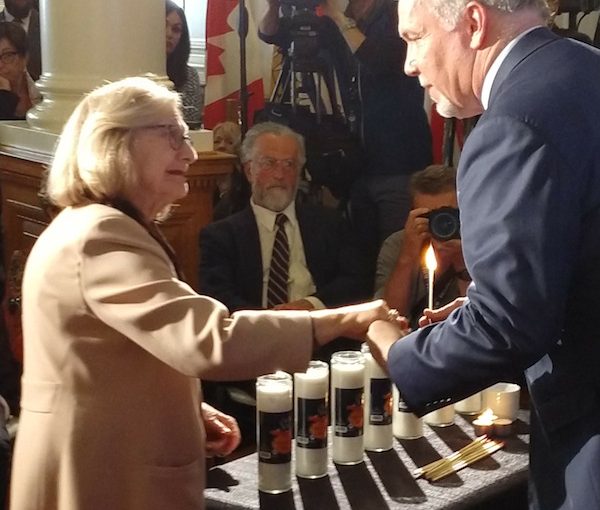
Holocaust survivor Rita Akselrod and Premier John Horgan at the Yom Hashoah commemoration that took place at the British Columbia legislature May 2. (photo by Pat Johnson)

The history of Jewish tragedy in the Holocaust – but also the heroism of Jews and non-Jews – was commemorated last week in moving ceremonies in Vancouver and Victoria.

Yom Hashoah, Holocaust Remembrance Day, occurred May 2 this year, coinciding with 27 Nissan in the Jewish calendar, the anniversary of the Warsaw Ghetto Uprising. A community commemoration convened by the Vancouver Holocaust Education Centre (VHEC) took place on the evening of May 1 at the Jewish Community Centre of Greater Vancouver. The following day, Holocaust survivors and others gathered in Victoria at the British Columbia legislature with the premier of the province and many elected officials in what has become an official annual commemoration.

Premier John Horgan assisted survivors and representatives of other targeted groups – people with disabilities, LGBTQ+, Roma – to light candles of remembrance.

“We need to remember that, if we do not stand together – Christians, Jews, Muslims, those who have no faith at all – if we do not stand together when hate raises its head, we will have failed not only those that have lost their lives so many decades ago in the millions, but folks who will come after us,” said Horgan. “We acknowledge the murders in San Diego and the tragic loss of life in Pittsburgh … in a synagogue there. We acknowledge the loss of Christian lives in Sri Lanka and the loss of Muslim lives in New Zealand. But, on this Yom Hashoah, we must always remember, in the presence of those who survived those horrors, that today we stand with you, tomorrow we will stand with you and forever we will remember the impacts of your lives and the consequences that you have lived for so many decades.”

Marie Doduck, a Holocaust survivor who lives in Vancouver, shared some of her life story with the audience at the legislature.

“Living in Brussels, Belgium, I was only three-and-a-half years old when my life was suddenly ripped apart and irrevocably changed by hate, by Nazism,” she said. “In 1939, our family, which was made up of 10 children – three were already married at the time with children of their own – were all separated by the scourge of war. We were all put into peril by the fact of our Jewishness – a crime under the rule of Nazis in Europe. We were marked for death by the accident of being born Jewish.”

She was hidden in a succession of non-Jewish homes and even in a Catholic convent.

“We had to run and to vanish in order to survive,” she said. “We became the children of silence. No talking, no crying, no disturbance – a blank mind with no feelings and no future. We lived only in the moment, felt nothing except hunger. Feelings like loneliness were a luxury. It was better not to feel. People and the world did not care. We were nothing – just Jews.

“This frightened little girl, Mariette, saw her beloved family disappear. My mother, Channah Malka, whom my firstborn is named after, and my brother, Albert, were deported to Auschwitz, where they were murdered. I saw my mother and brother being loaded into trucks…. That was the last time I saw either of them alive. Another brother, Jean, who was in the French Resistance, was hung by the Gestapo in the city square. Another brother, Simon, like hundreds of thousands, died three weeks after the war from the mistaken kindness of American and Canadian soldiers who liberated the camps and fed the fragile, thin and starving prisoners food that they could no longer digest.”

Like many survivors, Doduck’s experience is filled with close calls and fortunate near-misses.

“In order to survive, I jumped off moving trains and high buildings, was thrown into a sewer and was even hidden in a barn, where I took shelter in a bale of hay. I still bear the scar of being impaled by the pitch fork of a Nazi soldier searching there for Jews,” she said. “I lived mostly in darkness – literally – in dank cellars and other dark hiding places where the Nazis could not find me. When I returned to Brussels years later, I could not recognize the city in daylight, for my Brussels was a place of darkness.

After the war, Doduck immigrated to Canada as part of the War Orphans Project, the youngest of 1,123 Jewish children admitted to Canada in 1947 through an agreement between Canadian Jewish Congress and the federal immigration department.

“I arrived in Vancouver on Jan. 3, 1948, at age 12 and was taken in by a foster family,” said Doduck. “While I was warmly welcomed by the Jewish community and Canadian society – and grew up to be a proud Canadian – not everyone received a warm welcome when attempting to flee Nazi Germany. It was indeed the policy of many countries not to accept those seeking refuge.

“This is the important message that I share with students when I speak – that no society is immune to the dangers of discrimination and racism; and that we must work together to stand up when we see injustice in the world around us.”

B.C. Education Minister Rob Fleming, who emceed the event, noted the startling increase in antisemitic incidents in recent years and called for vigilance.

“Today also requires us to acknowledge the role that apathy and indifference played in enabling these atrocities to happen, the thousands of Jewish refugees turned away at our Canadian borders and the borders of other countries, the people who stood by and said nothing while their neighbours were hunted down in their homes because of their faith and identity,” said Fleming. “We come together to say never again.”

While mourning the atrocities, Fleming said, it is necessary to also remember the heroism of survivors and others who took the most dangerous risks to resist the dystopia of Nazism.

“They teach us that standing up for others, standing up for the values of tolerance and inclusiveness is how we can stop hate crimes, it’s how we can maintain and protect the peace that we are privileged to enjoy in our country.”

MLA Nicholas Simons played Kol Nidre on the cello to open the ceremony.

The evening before, the heroism of survivors was the topic of remarks from a member of the second generation. Carla van Messel, a board member of the VHEC, reflected on the lessons imparted by her father, Ies van Messel, who was a 5-year-old in Rotterdam, in the Netherlands, at the start of the war.

“Throughout my life, my father has demonstrated to me how to transform tragic memories into the strength to do good,” she said. “He taught my family that our Jewishness doesn’t make us evil or other and, therefore, by the same reasoning, neither should someone’s Germanness or Polishness or Arabness. He taught me that, if we don’t want something like the Holocaust to happen again, we have to continue to be better than the Nazis, and better than the nations who stood idly by. We have to actively protect all people … despite the history, despite the wounds, despite the deaths.

“As a second-generation survivor, I am energized by the examples of the survivors among us. They have inoculated us with their strength and resilience, with their will to turn bad into good. I want our survivors to know that they are leaving their memories, their essence, in good hands. Among the second generation are upstanding citizens of today’s very complicated world. They have taken the pain of their family’s personal history and transmuted it into the positive energy of tikkun olam. They continue to translate the hate of antisemitism into a hate of injustices: of racism, of bigotry, of sexism, of the demonization of otherness, of discrimination in all its many, many forms.”

The keynote address at Vancouver’s JCC was delivered by Lillian Boraks-Nemetz.

“Not a day passes when I don’t ask myself: Why did I survive when six million perished?” she said. “When 1.5 million [of the murdered] were children and, among them, my 5-year-old sister. And I survived. Why? When every European Jewish child was automatically sentenced to death by Hitler. I wonder: Was my survival a miracle? A twist of fate? The will of God? Why me?”

She detailed the series of close calls and fortunate happenstances that allowed her to survive, in part due to the persistence of her parents to do anything within their powers to save their two daughters.

The family was relocated into what would become the Warsaw Ghetto, sharing shelter with 20 other people in a three-room flat.

“Eventually, the ghetto grew more and more crowded – up to about 480,000 bodies in the small space of 1.3 square miles … with the lack of hygiene and medication, we were quarantined for typhus. Most of the boys and girls I played with died of the disease. Young children were dying on the streets; if not from illness, from starvation. Shabby and haunted people would simply pass by, powerless to help them,” she said.

“As 1942 approached, things got worse and worse. People out of desperation stole food from each other. I saw a woman carrying a bowl of soup when a man grabbed it. It spilled onto the pavement and the man fell to the floor licking the broth off the stones. All morality ceased to exist in an immoral, murderous universe of Nazi domination.”

As things in the ghetto deteriorated, Boraks-Nemetz’s parents bribed ghetto guards to allow young Lillian to escape. Her grandmother, who never entered the ghetto, had bought a little house in a nearby village, which she promised to give to a Catholic man who, in exchange, would let her live under his Polish name, ostensibly as siblings.

Boraks-Nemetz joined her grandmother and the man at the home.

“One night in the spring of 1943 we were outside in the yard, looking with horror at a blood-red sky above Warsaw,” she said. “We knew from a friend that it was the Warsaw Ghetto leveled to the ground by fire ordered by Hitler, after the courageous stand of the ghetto fighters against Nazi soldiers.”

Only after the war did she discover the fate of her sister.

“I found out that she was informed on by a Polish neighbour as a Jewish child and murdered by an unwilling Polish policeman who was commanded to do so, or else, by the Gestapo. The policeman found a ball lying on the street and threw it, telling my sister to run after it, then shot her in the back.”

While the Russians liberated her and her parents, Boraks-Nemetz said, the reality was not liberating.

“While adults worked to reestablish their lives, we children were left to grow up alone carrying the burden of experiences that nobody wanted to know about.… I was always told to forget and to let go by people who didn’t have a clue what was on my mind and in my soul. This was not a physical wound that results in a bruise or scab, which then falls off and mostly disappears. This was a branding on the Jewish soul with fire caused by man’s inhumanity to man, woman and child.

“It took me a long time after the war to realize myself as a human being who deserves to live and to be a Jew,” she said.

Philip Levinson, president of the VHEC board, introduced the procession of Holocaust survivors who lit candles in memory of the six million Jews murdered in the Holocaust. Cantor Yaakov Orzech chanted El Maleh Rachamim and survivor Chaim Kornfeld led Kaddish. Under music director Wendy Bross Stuart, violinist Nancy di Novo and the Yom Hashoah singers performed songs in Ladino, Yiddish and Hebrew. Sarah Kirby-Yung, a Vancouver city councilor, brought greetings from the city and read a proclamation. The evening ended as it does every year with the singing of “Zog Nit Keynmol,” “The Partisan Song.”

Format ImagePosted on May 10, 2019May 9, 2019Author Pat JohnsonCategories LocalTags British Columbia, Carla van Messel, history, Holocaust, Lillian Boraks-Nemetz, Marie Doduck, Rob Fleming, VHEC, Yom Hashoah
CHILD Foundation honours Marie Doduck

CHILD Foundation honours Marie Doduck

Marie Doduck, left, receives the CHILD Foundation Inspiration Award from the foundation’s Mary McCarthy Parsons. (photo from CHILD Foundation)

On May 2, the Foundation for Children with Intestinal and Liver Disorders hosted their annual fundraising fashion show and luncheon for 250 guests at the Fairmont Hotel Vancouver. The CHILD Foundation (child.ca) raises much-needed research funds for pediatric Crohn’s disease, ulcerative colitis and liver disorders such as biliary atresia.

On presenting Marie Doduck with the CHILD Foundation Inspiration Award, Mary McCarthy Parsons, president and chief executive officer, recounted that Doduck is an active volunteer in many organizations, who has given so much back to her community. As a founding member of the Vancouver Holocaust Education Centre and, being a Holocaust survivor, the CHILD Foundation was very pleased to honour Doduck, an extraordinary ambassador of hope and courage in our world – a true inspiration.

McCarthy Parsons remarked, “You cannot underestimate Marie’s message to young people. When my children were in school, I had to take them out of school to experience hearing about significant world history. Now, because of Marie and the Holocaust Education Centre, speakers travel to schools every day. In this day and age – yes, in 2018, when some governments seem to want to rewrite history, it is important and incumbent upon us to take in and to recommit to Marie’s message of community inclusion, of education and of volunteerism.”

The CHILD Foundation Inspiration Award was presented to Doduck, “who inspires us all to become better, more involved citizens through her dedicated efforts on behalf of children and the warm, uplifting consideration she extends to everyone she meets.” Congratulations!

Format ImagePosted on May 25, 2018May 24, 2018Author CHILD FoundationCategories LocalTags colitis, Marie Doduck, philanthropy, volunteerism
Yom Hashoah ceremony includes survivors and next generations

Yom Hashoah ceremony includes survivors and next generations

Marie Doduck, third from the left, with her family. (photo by Cynthia Ramsay)

“Although the sheer number of Jews who perished in the Holocaust, six million, is seemingly beyond human comprehension, we must remember that each life snuffed out belonged to a person, an individual with a past, present and a promise of the future, a human being endowed with feelings, thoughts and dreams. Tonight, we light candles in memory of the six million Jews, one and a half million of whom were children … and in memory of the millions of other victims – we commemorate them as persons, as individuals.”

Ian Penn of the Second Generation set the tone, as master of ceremonies, for Vancouver Holocaust Education Centre’s Yom Hashoah commemoration on Monday, April 28. A standing-room-only crowd at the Jewish Community Centre of Greater Vancouver’s Wosk Auditorium attended.

Survivors from the local community lit candles in memory of all those who died. Chazzan Yaacov Orzech (Second Generation) chanted El Maleh Rachamim and survivor Chaim Kornfeld, the Kaddish. Dr. Moira Stilwell, MLA, spoke on behalf of the province.

“Those who cannot learn from history are doomed to repeat it,” she reminded the audience. “Yom Hashoah is not just about learning from history, but about passing those lessons on to the next generation. Today, we honor the six million voices that were silenced during the Holocaust, we mourn them, we remember them, and by remembering them, we pledge to never let genocide happen again. Today, we join together and speak for them.”

Penn spoke briefly, but movingly, of his mother, Lola, who died in January, just shy of her 92nd birthday. She survived the Holocaust but, as with most, not without sustaining great losses and witnessing much horror. Addressing his peers, he said, “We grew up with physical comforts but some strangeness and confusion, with marginal understanding and appreciation of the difficulty of becoming normal. Our parents, like Lola, clung to their traditions, confronted the modern, the world they were jettisoned into, their escape route, as best they could, and drove us forward to fulfil their stolen dreams…. Our parents, your parents, were, perhaps, no less complicated than Lola, at times positive and resilient, loving and strategic. And, just as likely, suspicious and threatening, ever vigilant and occasionally hyper-vigilant…. They had to create and re-create themselves, their fears, their terrors, opaque to us, whilst we, their prized possessions, were shepherded with passion … they were survivors in every sense of that word.”

Survivor Mariette Doduck spoke. “The person you see before you is Marie Doduck, a mother, a grandmother and a community volunteer. But there’s another me, Mariette Rozen. A frightened little girl, a tough kid, an enfant sauvage who lived through a lost childhood.” She was only three and a half years old, living in Brussels, when her “life was suddenly ripped apart and irrevocably changed by Nazis.”

In 1939, her family – she was the youngest of 11 – was separated. “We were put into peril by the fact of our Jewishness, a crime under the rule of Nazis’ Europe…. My mother had made a fatal mistake of following orders and registering us at the police station as of Jewish descent. She was told that, if she did, she would not be [taken] … nor would any of us. We had to run and vanish in order to survive. We children were separated and put into different homes. We became the children of silence, like robots, no talking, no crying, no disturbance, a blank mind, with no feelings and really no future. We lived in the moment, we felt nothing except hunger, feelings like loneliness were a luxury.”

Her mother and her brother Albert were murdered in Auschwitz. Doduck saw them being loaded into the trucks. “I had come out of hiding to celebrate my seventh birthday. I hadn’t seen my mother since I was three and a half years old. That was the last time I saw my mother and my brother alive.” Her brother Jean, part of the French Resistance, was hanged by the Gestapo; her brother Simon died three weeks after liberation – “after eating, from the mistaken kindness of the American and Canadian soldiers who liberated the concentration camps and fed the fragile, thin and starving prisoners food that they could no longer digest.”

To survive, Doduck hid with non-Jewish families and in orphanages, took refuge in storm sewers, cellars, as well as in a hayloft, from which she bears a scar from a pitchfork wielded by a Nazi soldier looking for Jews. “I lived mostly in darkness, literally.” When she returned to Brussels years later, she said, she couldn’t recognize it in the light.

“I became tough and streetwise and, because of my young age and my unusual photographic memory, I was used as a messenger in the French Underground. I was even smuggled into a prison to pass a message into my sister Sarah…. Like a fugitive, I lived in fear and confusion in more than one country…. The people I lived with often beat me, and often treated me like a slave … even though they were paid by my family to keep me in hiding. There were also those that risked their lives to save me.” Among them, a convent’s mother superior and a German friend of Doduck’s brother.

Doduck recalled a friend’s death. Savagely beaten, the girl died in her arms. “If I had not forgotten to make my bed and, therefore, been forbidden to go outside [the convent],” said Doduck, she, too, would have been killed.

Doduck also experienced illness, one in which pustules covered her whole body; her skin had to be scrubbed with sulfur. “Despite this sickness and all of the physical and mental anguish, I, like millions of others, did survive, not unscarred, and, in a sense, wise for it. In a perverse way, perhaps, one could even say that I was fortunate because I have seen both sides of humanity.”

“It was only with great pressure from the Jewish community … [that, eventually] 1,123 Jewish orphan children and young adults were brought out of wartorn Europe to make a new life in Canada.”

Reading the book None Is Too Many, Doduck said she had to put it down often, so angered was she that such attitudes existed in Canada as well, “attitudes that nearly kept me, my brothers and sisters out of Canada. People like Prime Minister Mackenzie King and his sidekick Mr. [Frederick] Blair, then director of immigration, did everything in their power at that time to keep Jews out of Canada, even orphan refugee children. It was only with great pressure from the Jewish community,” she said, that, eventually, “1,123 Jewish orphan children and young adults were brought out of wartorn Europe to make a new life in Canada.”

Doduck was one of those children. “When I first started to tell people what had happened to me, they said, ‘Forget about the past.’ But I say to you, I learned from my experiences, both good and bad. Whatever we experience in life contains a message. God provides these vehicles, however painful. It is up to us to interpret and accept them. This we can choose to do either positively or negatively. Without sounding immodest, I had the courage, even as a child, to go on despite the feeling of mistrust, fear, pain and loathing. These lessons are in a significant way responsible for who I am today.”

Doduck arrived here in 1947, 12 years old and, once again, “plunged into a world of strangers.” Here, she said, “I saw goodness in people that I shall never forget, and that’s my adoptive family, Joe and Minnie Satanov and many other wonderful families that took in children of the Holocaust across Canada.”

The Satanovs raised Doduck as their daughter. They bought her first bike, her first pair of skates and many other such things. “You’ve got to understand, we survivors had no toys to play with, we had no blanket to hold on to, we had nothing…. Through their patience and love and understanding, they brought me back to my Jewishness and gave me back my humanity.” But it wasn’t easy, and she ran away from home many times in the first year. “How can you understand how angry, hurt, lonely I was, missing my own mother, brothers, sisters?”

With the Satanovs’ love and support, Doduck graduated high school. “I entered the business working world and eventually met my husband, whom they liked and, as good parents would do, they paid for our wedding. They are both at rest now, but the memory of them is forever ingrained in my heart and in my daughters’, who loved them as grandparents.”

Although encouraged to hide her Jewish identity during the war, between her brother’s reminders that she must remain Jewish and memories of her mother, for example, lighting Shabbat candles (her father died when she was a toddler), Doduck said, “My Jewishness was always part of me…. Now, I take pride in passing this on to my children and grandchildren, unafraid and unabashed, to show and teach them what it is to be … proud of their heritage. Yet, the future is not assured for them. What happened to me and to millions of innocents could happen again … we have the obligation to tell the world the horror of the Holocaust, to teach our children, and they to theirs, so that the past will not repeat itself.”

The hurt will never go away, but life for her has been “a step-by-step process, not something to take for granted, but to fight for. We turned out, survivors, we turned out [to be] decent people that help other people. We are involved in whatever is good: fighting hatred, fanaticism and racism. Although our childhood has been robbed from us – look what we have achieved.”

“I read that the truth is not only violated by falsehood, it may be equally outraged by silence. And I refuse to be silent. Future generations must know and learn. This must be done, however painful. It is our sacred duty – prejudice, hatred, racism, antisemitism have no place in our society.”

She warned, however, that there “are many who are now denying the Holocaust and so we must bear witness…. Because we survived, we have a duty, an obligation, to see to it that these truths are not forgotten…. I read that the truth is not only violated by falsehood, it may be equally outraged by silence. And I refuse to be silent. Future generations must know and learn. This must be done, however painful. It is our sacred duty – prejudice, hatred, racism, antisemitism have no place in our society.

“Tonight, we meet to mark Yom Hashoah, presented by Vancouver Holocaust Education Centre, of which I’m a founding member. I have spoken to countless groups of students about my experiences as a Holocaust survivor. Not everyone can understand how extremely painful it is for me, for us, to remember things I would rather forget. But we do it, I do it, regardless of the sleepless nights that follow. I do it because I know that education is the only key to prevention.”

Doduck concluded, “When I speak to young people, I speak as a child, Mariette; tonight, to you, as a peer, Marie. Yet, standing here before you, I find that I cannot separate the two so easily. But maybe these two different people, one that witnessed the horrors of the Holocaust and the other an active citizen in our community, are essential in the present day: essential to the remembrance of the Shoah and essential to working to ensure that it will never happen again.”

Throughout the evening, musical selections were performed by Claire Klein Osipov or members of an ensemble that included Gil Ashkenazy, Megan Emanuel, Samantha Gomberoff (Fourth Generation), Maya Kallner, Sasha Kaye, Jared Khalifa; Kathryn Rose Palmer, Brian Riback, Talya Kaplan Rozenberg, Ayla Tesler-Mabe and Lorenzo Tesler-Mabe, all of the Third Generation. Wendy Bross Stuart, who produced the evening with husband Ron Stuart, was on piano, Eric Wilson on cello. The organizing committee was Cathy Golden, Ethel Kofsky and Rome Fox, all of the Second Generation.

Format ImagePosted on May 9, 2014May 9, 2014Author Cynthia RamsayCategories LocalTags Marie Doduck, Vancouver Holocaust Education Centre, Yom Hashoah

Posts pagination

Previous page Page 1 Page 2
Proudly powered by WordPress