Case for a positive rethink

When speaking to Jewish audiences about advocacy, I often refer to my own background as a Jewish convert in making the point that we sometimes have to apply a fresh perspective – and have a collective “out-of-body” experience – to understand the reality of our own circumstances. Sometimes, we are too close to the situation to evaluate it with clear eyes and objectivity.

Among the many things that make me proud of my father is the fact that, early in his career, he chose to serve the public as a police officer. I have heard it said that police disproportionately interact with the most challenging and marginal elements of society, perhaps just five percent of the public, on a regular basis. Just as one in such a role knows their daily encounters are not representative of broader society, we as Jews – who understandably take notice of antisemitism and anti-Zionism – must be cautious not to attribute these toxic manifestations to the majority of Canadians.

I could write an entire series of columns on how we as a community have far more allies in the non-Jewish world than we often appreciate. Instead, I’ll offer two factors internal to the Jewish world that suggest pro-Israel advocates should be optimistic.

1. There is far greater unity of purpose – and welcoming of diversity – in the Jewish world these days. In the past, there was significant disagreement between Jews on the best means to secure the future of the Jewish people in an often hostile world. The community was split along various lines: between Zionists and non-Zionists, assimilationists and Orthodox Jews, socialists and capitalists.

Today, post-Shoah and post-1948, the overwhelming majority of Jews are Zionists in that they believe the state of Israel should exist and thrive as a democratic Jewish homeland. Among Zionists, there is extraordinary diversity: we are Labor and Likud, religious and secular, social activist and academic alike.

There is ceaseless debate over how Israeli policies can best secure the ideals of Zionism and how Diaspora Jews can engage Israel in a meaningful way. This is all healthy. We wouldn’t be Jews if we didn’t subject these issues to serious thought and debate.

But this occurs within a strong consensus that Israel’s existence is fundamentally just, a blessing to the Jewish people and the entire world, and, ultimately, the centrepiece of our collective future just as it is our ancestral homeland. These aren’t just clichés; they are ideals brought to life every time a young Jewish Canadian boards a plane for Birthright, challenges anti-Zionism on Facebook, downloads the latest Israeli music, or volunteers for the Israel Defence Forces.

2. Despite facing serious challenges, Israelis are far more successful, happy and optimistic than we might think.

While Israelis have suffered in every generation from war and terrorism, none of this detracts from the fact that the IDF has proven its capacity to provide Israelis with secure borders and an astonishingly high level of public safety. This is no mean feat in the Middle East, let alone for a country smaller than Vancouver Island.

At the same time, Israel has seen remarkable economic and technological success. From 1992 to 2013, Israel-China trade skyrocketed from $50 million to $10 billion annually. Israeli exports to Europe have nearly doubled since the boycott-divestment-sanctions movement was launched in 2005. Trade with emerging markets like India has likewise increased. Outside Silicon Valley, Israel now has the highest concentration of high-tech firms on the planet.

Success at a macroeconomic level doesn’t mean there aren’t serious challenges. The cost-of-living, for example, continues to be a burden for many Israelis. But, with each passing generation, Israel grows stronger economically and Israelis are afforded greater opportunities to learn, work and engage the world.

Israelis also enjoy a remarkably high quality of life. Israelis have the same life expectancy as Canadians (81) and Israel boasts a universal health-care system that typically beats Canada in international performance rankings. According to the OECD’s 2015 Better Life Index, which measures various social and life factors, Israel is the fifth happiest country in the world – ahead of Canada, the United States and most of Europe.

What would early Zionist thinkers like Theodor Herzl and his contemporaries say if they could read these statistics and walk the streets of Jerusalem or Tel Aviv today? How often do we forget how far we have come as a people?

I had the honor this February of leading a group of Canadian master’s-level students on a public policy study trip to Israel, one of many fact-finding missions we organize. (CIJA annually takes some 200 Canadians to Israel.) The students, all of whom are non-Jewish, were amazed at the innovation, diversity and vitality shown by Israelis despite living in the world’s most unstable neighborhood. They saw what we should never lose sight of: a country and a people from whom we can learn so much.

Indeed, Israel embodies so much of what’s right in the world today – and it is on this basis that we should share all that Israel has to offer with the world around us.

Steve McDonald is the deputy director of communications and public affairs, Centre for Israel and Jewish Affairs.
A glimpse of new Israel

Participants in the Central Conference of American Rabbis’ annual convention, which took place in Jerusalem and Tel Aviv in February. (photo from Dan Moskovitz)

Among the approximately 400 Reform rabbis who gathered in Israel in the last week of February for the 127th annual convention of the Central Conference of American Rabbis (CCAR), which is the rabbinic leadership organization of Reform Judaism, were Temple Sholom’s Rabbi Dan Moskovitz and Rabbi Carey Brown.

Of the rabbis who attended, about 100 of them were from Israel and Europe, the rest from North America. Moskovitz traveled from Vancouver, while Brown was in Israel at the time on her rabbinic sabbatical.

“It’s important for Reform rabbis to have a presence in Israel, to show that we are committed to an Israel that is based on our shared the values of democracy, pluralism, peace and inclusivity,” said Moskovitz in a press release before the convention. “This valuable on-the-ground experience in Israel, including with Israeli leaders, will enable me to share the insights I gained with my community and deepen our ongoing learning and relationship with Israel.”

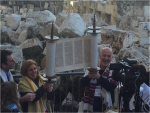
“The highlight of our time there, for me, was the egalitarian Torah service at the new prayer space, Ezrat Israel, at the Western Wall,” Moskovitz told the Independent after his return. “We had the privilege of being present at the first official Torah service, which was officiated by Rabbi Ada Zavirov of Israel and Rabbi Zach Shapiro of Los Angeles.” That the Torah service was led by a woman and a gay man increased its poignancy for many. Rabbi Rick Jacobs, the head of the Reform movement, addressed the crowd after the service.

Moskovitz also participated in a fact-finding mission about poverty and women’s rights in the Orthodox community. They met with Hamutal Guri, chief executive officer of the DAFNA Fund: Women Collaborating for Change, a group that works on a broad spectrum of issues facing women in Israel. They also met with Efrat Ben Shoshan Gazit and Liora Anat-Shafir, who are both leaders in the ultra-Orthodox community. Their contacts highlighted many of the unseen struggles that women face in order to succeed in Israeli society, and the many issues they face in the ultra-Orthodox world in particular.

Gazit led the successful No Voice, No Vote Campaign, which told Orthodox men that unless women can run in Orthodox political parties they will not vote for Orthodox political parties. Anat-Shafir was instrumental in banning tzniyut (modesty) squads, which policed how women dressed in her community of Beit Shemesh.

In Hebron, Moskovitz met with members of the Jewish community. Hebron, traditionally a spiritual destination for religious pilgrims, is now a divided city. Israel Defence Forces checkpoints, barbed wire and fences restrict Palestinian movement and protect the Jewish population and holy sites. The rabbis arrived minutes after a terror attack that killed one Israeli soldier at a checkpoint outside the city. “As our bus arrived, the carnage and crime scene were right before our eyes,” said Moscovitz.

On a more positive note, Brown met with representatives of the Israel Religious Action Centre to discuss racism and incitement in Israel, and studied an IRAC project that examines locations in Israel where there is a high level of coexistence between Arabs and Jews in order to find patterns of success for the future. “One particular area of focus is the health-care field,” she said, “one area which serves as a wonderful example of Arabs and Jews working together in Israel.”

Knesset members representing eight different political parties addressed more than 300 of the Reform rabbis at a special meeting of the Israeli-Diaspora Knesset Committee on Feb. 25. MK Isaac Herzog (Zionist Union and leader of the opposition) told those assembled: “I congratulate all of you for the recent decisions on the Kotel to create an egalitarian and pluralistic prayer space and the Supreme Court decision giving rights to Reform and Conservative converts to use state-sponsored mikvaot. The decisions of the Israeli government and the High Court of Justice are not acts of kindness. They are based in Jewish responsibility and democratic principles, which is what the state of Israel is meant to advocate. Religion in the state cannot be monopolized by the ultra-Orthodox. You in the Reform movement are our partners and will always be our partners.”

Similar statements came from MKs Tamar Zandburg (Labor), Tzipi Livni (Tenua), Amir Kohana (Likud), Rachel Azariah (Kulanu), Dov Khanin (Arab List), Michal Biran (Labor), Nachman Shai (Labor), Michal Michaeli (Meretz), Michael Oren (Kulanu) and others.

The convention wasn’t all meetings. To support Reform Judaism in Israel, CCAR rabbis participated in the Tel Aviv Marathon (running or walking five or 10 kilometres). Everywhere they went, they were warmly welcomed and cheered on, said Moskovitz, and the rabbis saw the marathon as a chance to promote the benefits of the Reform movement to Israeli society.

“The Reform Movement in Israel, which is growing daily, aims to create an Israel that is democratic, pluralistic and inclusive,” stressed Moskovitz. “Those are values which many Israelis strongly identify with.”

Both Moskovitz and Brown were impressed with the growing profile of Reform and Masorti (Conservative) Judaism in Israel, and the increasing strides being made for religious liberty and pluralism. Since the rabbis’ return to Vancouver, the agreement on the egalitarian prayer space has hit some roadblocks, but the momentum seems clear. The extreme statements coming from ultra-Orthodox politicians – such as Meir Porush of United Torah Judaism’s recent call to throw the Women of the Wall “to the dogs” – are likely an indication of a growing desperation in the face of a loss of power to dictate the course of Judaism in Israel.

“Every day we were there,” said Moskovitz, “we were vilified in the press by ultra-Orthodox rabbis and politicians. I was happy to see that: if they’re not talking about you, you’re irrelevant.”

Matthew Gindin is a writer, lecturer and holistic therapist. As well as teaching holistic medicine, Gindin regularly lectures on topics in Jewish and world spirituality, and has a particular passion for making ancient wisdom traditions relevant in the modern world. His work has been featured on Elephant Journal, the Zen Site and Wisdom Pills, and he blogs at Talis in Wonderland (mgindin.wordpress.com) and Voices (hashkata.com).

Kids4Peace keeps growing

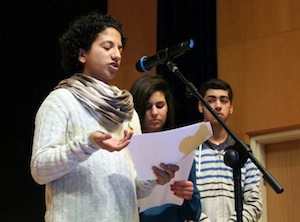
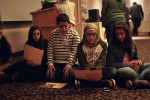
Kids4Peace youth present religious items to friends at an interfaith session. (photo from Kids4Peace)

Kids4Peace (K4P) started in 2002 as a two-week summer retreat/camp in the United States for 12 kids: four Muslim, four Christian and four Jewish. It is now a global movement that works year-round to “break down stereotypes and foster supportive, mature friendships rooted in spiritual values of equality and respect.”

K4P was the brainchild of a Vermont Christian, Dr. Henry R. Carse, who, at 18, left the United States, not wanting to be drafted into the Vietnam War. He moved to Israel and became a citizen. Having done his mandatory service in the Israel Defence Forces (IDF), he served in the IDF during the First Intifada (1987-1993). By the time of the Second Intifada (2000), he had been in Israel for about 30 years, was married and had four children. He wanted things to change so, with the help of some American friends, he created K4P, and the first camp took place in the States though Carse lived in Israel.

In 2004, Yakir Englander joined the organization as a volunteer. He did so for a few reasons.

A student at the time, Englander had grown up in Israel’s Bnei Brak area in a modern, Chassidic family. However, he left the Orthodox community at the age of 22.

“I decided to leave my community with a lot of love … some criticism, but mostly with love, and a huge desire to find more ways to be connected to spirituality and the divine,” he said.

When he left orthodoxy, he was drafted into the IDF, serving in an educational capacity, later spending most of his reserve time in a unit that had to identify dead bodies.

In his first month of studies at Hebrew University, in Jerusalem, in 2002, a bomb exploded and he found himself carrying the bodies of students, some of whom were American. He said that he felt lost, as did “many other Israelis,” feeling that the way toward change was through meeting with Palestinians.

“I went to a few meetings with different organizations,” he told the Independent, “but what I felt was that there’s this huge criticism of Israel in words and language that blames me. Yet, I didn’t have an opinion…. I didn’t know. It wasn’t just because I was Orthodox in the past. At the end of the day, there are many things we don’t know and also life is much more complicated.

“Another thing is that religion is always blamed as the reason for the conflict. For me, my religion was a source of love, a source that gave me energy, a source that gave me courage to go meet with Palestinians.”

When Englander heard about K4P, he joined as a Jewish advisor, and then later as a director until 2012.

Englander found it intriguing that two-thirds of K4P participants are Palestinians, both Muslim and Christian. “The fact that they are the majority in K4P, in a way, gives them the first opportunity to be in the majority,” said Englander. “This created new sets of power of dynamics, which are very interesting.”

About K4P’s goal, he said, “I think, today, when we hear the word ‘Islam,’ some people hear ‘ISIS.’ When some hear the word ‘Judaism,’ some people think ‘settlements.’ We want to change that.”

The transition is difficult, however, said Englander. He said some of the kids lose their bearings after the experience. “They no longer knew what to do or how to act, as they no longer hated Israelis or Palestinians,” he said.

photo - Kids4Peace youth speak at annual Kids4Peace winter event
Kids4Peace youth speak at annual Kids4Peace winter event. (photo from Kids4Peace)

In 2006, K4P changed to a year-round model. Throughout his time there, Englander continued his studies, culminating with a PhD in gender studies, sexuality and Jewish theology. His schooling led him to Northwestern University. He became a Fulbright scholar, and spent a year as a visiting professor at Harvard Divinity School.

“During these years, I served as a vice-president for K4P International, working a lot on creating connections with many moms, rabbis, priests, government people, and doing a lot of lectures all over North America, including Canada,” said Englander.

Last year, Englander, together with the board, decided to end his term as vice-president to instead lead K4P graduates. Englander created a new program for 18-to-25-year-olds, working with them to shift from a dialogue-only model to a dialogue-to-action one.

“The idea with the kids and teenagers is we do a lot of dialogue and volunteering and other things in between, but we can’t put them at risk,” said Englander. “But, if you really want to create change, you must take some risk. So, dialogue-to-action is an answer for these needs.”

Children join K4P in Grade 6 for a six-year program with summer camps along the way. “It’s amazing to have two weeks together, but they work all through the year for six years, so it’s a very long process,” said Englander. “Because of this, it lets us dig deeper with them, step by step, in the conflict.”

For now, the program in Israel only operates in Jerusalem, due to financial constraints.

“Last year, the U.S. Institute for Peace gave us a very nice amount of money, so we have enough now for all the families who join K4P,” said Englander. “When the kids have a meeting, the parents, too, must come.

“We now have chapters in eight or nine cities around the world, with some [others] in the process of establishing chapters. Each one has two therapists, Israeli and Palestinian, who do the full journey with the parents and kids. So far, Toronto is the only Canadian chapter, but we also have [groups] in Houston, Seattle, New Hampshire, Vermont, Atlanta and a new one in Lyon, France.”

The Israeli chapter currently has about 150 kids, with the capacity to add another 65 new kids and their families this year.

“Hopefully, by next year, we’ll grow by 80 new families,” said Englander. “But, we also need to take into account that we are building a new program for 18-to-25-year-olds, with 15 amazing, serious young people. Some of them are graduates from K4P and some have parents who would never [have] consider[ed] sending them for K4P – settlers who grow up in settlements – [but] something very deep broke in them last year.

“It’s important for us that people will see Palestinians and Israelis together, hand in hand, helping in hospitals. But now, with the young adults, we want to take it further.”

Englander said that, in today’s situation, Israelis and Palestinians do not generally mix in public places. But, on Feb. 29, he said, K4P challenged that reality, having these young adults meet in a public space in Jerusalem.

“So, this group of people with a lot of courage decided they [were] going to do it,” said Englander. “Half of the meetings are going to happen in public spaces … that we choose very carefully … spaces where normal people from east Jerusalem and west Jerusalem are going to see them in their public space – Palestinians and Israelis together, body next to body, and dealing with the crucial, most important questions.

“We are planning to record and share these meetings,” he continued. “It’s very important to bring the voices and pictures to the world, to see how Muslims are opening themselves, how Jews are opening themselves – so they can see that it’s not just shalom/salaam, they care about their Jewish identities, their Muslim identities, their Christian identities … though they struggle with that, they still decide to work for peace.

“It’s a huge responsibility,” he said, “And, I will be honest and say that we feel a failure sometimes, thinking why didn’t we reach out to all the kids of Jerusalem and offer them this opportunity.”

Rebeca Kuropatwa is a Winnipeg freelance writer.

Restoring ritual of tea

“The mini cube is our modern interpretation of the traditional ceremonies of ancient cultures,” say Cérémonie Tea’s Elli and Efrat Schorr. (photo from Cérémonie Tea)

From the professions of law and psychology, Elli and Efrat Schorr turned to tea. And, from the Israeli market, they are expanding worldwide. Cérémonie Tea can be bought in several locations in the Lower Mainland, for instance, but the Schorrs’ connections to Vancouver are deeper.

“Efrat’s enduring memory of Vancouver is of the hospitality and openness that she and her family experienced in their time in B.C.,” Elli told the Independent. “For me, Cérémonie Tea is an opportunity to return the warmth to the

Vancouver community, sending the best flavors that Israel has to offer back home, along with our friendship.”

Elli was born in Washington, D.C., and Efrat was born in New York. She lived out east for her earliest years, but then the family moved to the West Coast, living in Vancouver for two years and then in Richmond for another two years. Her father, Rabbi William Altshul, was the principal of Vancouver Talmud Torah from 1979-83 and Efrat worked at VTT, with kindergarteners through Grade 3s. Her father helped found Richmond’s Eitz Chaim Congregation.

From Vancouver, Efrat’s family moved to D.C., which is where she met Elli. They were high school sweethearts, marrying in 1995. Raised in strong Zionist homes and inspired by their experiences in post-high school yeshivah programs in Israel, they made aliyah in 2005 after they completed their graduate studies.

Elli was a lawyer, graduating from Georgetown University, and Efrat has a PhD in developmental psychology from the University of Maryland, College Park. After working in their respective fields for several years, they decided to go into business in 2012.

“After sharing 20 years of marriage and five children,” reads Cérémonie’s website, “these childhood sweethearts decided to look for their next adventure together.” They bought Cérémonie Tea from the founders in February 2013.

“We were looking for a business opportunity and explored coffee, even visiting Ethiopia, the birthplace of coffee,” Elli told the Independent. “Along the way, we encountered Cérémonie Tea, with its striking design and delicious products and fell in love. We worked in partnership with the founders for about a year and then purchased the company from them, undertaking management of the company since then.”

The company is based in Migdal Haemek in the northern part of Israel. The Schorrs live in Gush Etzion, in the town of Alon Shevut, which is about a two-hour commute. “We are enjoying the learning experience of working in a different environment, far away from our English-speaking bubble!” said Elli.

Established in 2003, the Schorrs have expanded the company’s reach internationally since taking over, beginning in Italy in 2014 and the Netherlands in 2015. The ingredients – whole tea leaves, along with spices, herbs and flowers – come from around the world, and the tea bag material is imported from Japan. “Presently,” said Elli, “we are not using compostable materials, but are exploring such options for the future.”

Cérémonie Tea offers a range of products, including mini cubes, pyramid tea bags and loose tea blends.

Bringing “their American style of customer service and entrepreneurial spirit to the traditional world of tea,” the Schorrs are trying to return people to the “ritual of serving tea.”

“The mini cube is our modern interpretation of the traditional ceremonies of ancient cultures,” explains their website, “innovative in our style of serving but classic and timeless in our taste.”

Currently, Cérémonie Tea can be found in Richmond at Save-On-Foods at Ironwood Plaza, Loblaws City Market and Superstore, as well as at Superstore in Vancouver on Marine Drive and Save-On-Foods South Point in Surrey. There is always the option of buying online, of course, at ceremonietea.com.

Supportive of Shalva

A 6-year-old Shai Gross with his family in 1976, after the successful Entebbe Operation. (photo from Shalva)

Seeing is believing. At first, it sounds like another cliché, another pat answer to brush off an unwanted question. But, sometimes in life, we are put in situations where our power to overcome must be seen to be believed. Last month, guests at the Shalva 26th anniversary dinner in Israel were able to see for themselves how the human spirit can overcome unbelievable odds.

The youngest of the hostages in the 1976 Entebbe Operation, Shai Gross, stood before the guests at the dinner. His presence itself was a testament to the power of human beings to do the unbelievable.

“When I was 6, my parents and I were among the hostages,” he said. “For a full week, we sat, captives in Entebbe, with pistols and grenades threatening our lives. The terrorists separated the children into business class [on the captured plane] to avoid parents acting up in defence of their children. My mother, however, was able to hide me under her seat. I was only 6 yet I remember asking her, ‘Does dying hurt?’”

The Entebbe Operation is forever marked in the collective Jewish consciousness. On June 27, 1976, four terrorists hijacked Flight 139 en route from Tel Aviv to Paris. They were armed with pistols and a grenade with the pin removed, which they held as insurance against being attacked by the passengers. The flight was diverted to Entebbe, Uganda, where the government supported the hijackers. All non-Jewish passengers were released while more than 100 Jewish passengers were held, fearing for their lives.

The horrifying ordeal came to an end on July 4, when the Israel Defence Forces launched a rescue mission. In what is still considered by many to be the most daring hostage rescue mission of all time, a group of Israeli commandos stormed the complex.

Gross recounted the last few moments before they were rescued, “All we heard were gun shots. I was paralyzed with fear. At the time, the only possible explanation to the insanity was that they were coming to finally end our lives. How could it even enter anyone’s mind that the IDF had made it all the way to distant Entebbe?!”

The rescue that was underway seemed totally unbelievable until Gross saw it with his own eyes. “After a few moments, we realized that we were being rescued by the IDF. That dramatic rush from desperation to salvation … that is a joy I will never forget.”

Nonetheless, Gross acknowledged, “This traumatic experience left its mark on me. I was emotionally disabled.”

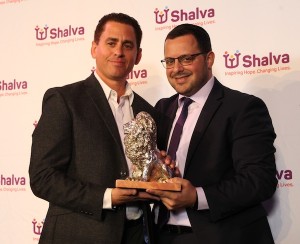
photo  - Shai Gross, left, receives the Shalva Spirit of Hope Award from Avi Samuels, deputy director of Shalva
Shai Gross, left, receives the Shalva Spirit of Hope Award from Avi Samuels, deputy director of Shalva. (photo from Shalva)

Having personally experienced how a child can overcome challenges that would try an adult, he has added empathy for the children of Shalva, where he volunteers. He contributes to Shalva in an effort to give back to Israel, and in memory of the soldiers who gave their lives to save his.

The moment when the unbelievable happens before your very eyes, when the darkness is suddenly transformed to light, is a familiar occurrence in the Shalva centre in Jerusalem. For 26 years, Shalva has been helping children with special needs move beyond their limitations. Shalva programs and services are designed to provide individual treatment for the child while also strengthening the fabric of the family. Providing services for more than 500 infants, children and young adults, Shalva accompanies each child from birth to adulthood. Individually tailored programs are designed to help participants reach their full potential and integrate into the community.

As a volunteer, Gross sees how Shalva’s approach helps kids meet their challenges. “Shalva doesn’t see children with disabilities,” he said. “No. They see superheroes that just need to conquer some challenges. After volunteering at Shalva myself, I have come to realize that we’re all the same: potential heroes trying to overcome our struggles.”

Gross has moved past the scars of his experience in Entebbe. He married and is the father of four children. He named his youngest son Yoni in memory of Yoni Netanyahu, the rescue team’s commander and the older brother of Prime Minister Binyamin Netanyahu, who was killed in the raid.

At the Shalva dinner, Gross was awarded with the Shalva Spirit of Hope Award in recognition of how he has met his personal challenges and used that experience to help others.

To learn more about the work of Shalva, visit shalva.org.


A loveless family saga

A powerful family saga, The Beauty Queen of Jerusalem (Thomas Dunne Books, 2016) by Sarit Yishai-Levi is brutally honest. It starts with the narrator, Gabriela, talking about her childhood in 1950s Jerusalem. Her relationship with her mother, Luna, is strained at best; more accurately, a mutual aversion. Luna is a dismal mother and a horrid wife, a cold, spiteful woman. Disliking her immensely, I wanted to know what happened to Gabriela, but the book didn’t go in that direction.

book cover - The Beauty Queen of JerusalemInstead of moving the action forward, the author goes back in time, almost to the banishment of the Jews from Spain. From there, she follows several generations of the Ermosas, a family of merchants in Jerusalem. The story that emerges is an anatomy of animus, a fictional dissertation on the topic of what happens to people who deny love – because they all deny it.

Rafael doesn’t love his wife Mercada. He married her at the behest of his mother, an obedient Jewish son doing his duty, while his heart belonged to another for all of his life. He doesn’t allow himself even to acknowledge his torn soul, but his unloving marriage poisons the family for generations to come. Some describe it as a curse, and Mercada becomes a bitter, hateful woman.

When Mercada and Rafael’s sunny-natured son Gabriel falls in love with a woman not approved by his family, his mother punishes him by marrying him off to the worst bride she can find. She ruthlessly ruins her son’s life and never regrets it.

The curse passes on to Rosa, Gabriel’s wife and one of the few nice characters in the book. Rosa is not beautiful or educated. Poor and orphaned when she was young, she took care of her younger brother from the age of 10. She is kind, with a heart full of emotions she doesn’t know how to express. She would have loved Gabriel, if he were even a little bit willing, a tad more tolerant of her faults, but instead, Gabriel despises her. No matter how hard Rosa tries, Gabriel doesn’t accept her, and his antipathy fills his life with venom and sadness.

Of course, their daughter Luna, born of such a union, doesn’t know how to love at all. The most beautiful woman in Jerusalem, the beauty queen of the title, Luna is frigid and uncaring. She adores clothing and makeup but the only person she truly loves is herself. Repulsed by her husband’s touch, she hates his sexual advances. She doesn’t even try to understand his pains or his interests, and her treatment of their young daughter is cruel. She is a horrible character but, for some reason, the author dedicates most of the book to her. Perhaps she was exploring Luna as the embodiment of self-absorption, but there is little or no pleasure in reading these ruminations.

Only in the last fifth of the book does the story return to Gabriela, showing how hard it was for her to break the curse, to learn to love. Forgiveness, like love, is something the Ermosa family lacked, too, and it takes Gabriela years of self-hatred to even grasp the concept.

Overall, none of the major players in the tale is likable, and it’s difficult to understand their stubborn resistance to love. This difficulty colored my perception of the novel as a whole, and I didn’t enjoy the jumps back and forth in time either. They made the story feel like a jigsaw puzzle, and even when I assembled the entire picture, the squiggly lines between the tiles were blurry.

Fortunately, the Ermosa family drama unfolded on the background of Israeli history, and the historical aspect of this book was fascinating. The Turkish rule of Palestine and the British Mandate, the Zionist movement and the Declaration of Independence, the war of 1948 and the siege of Jerusalem by the Arabs – the Ermosa family lived through it all.

They lived through the Holocaust, never even noticing it. While Jews died by the millions in Europe, the Ermosas’ petty concerns focused on their small shop and their unloving spouses. While the Etzel (aka the Irgun) unleashed bloody terror on the British, with constant bombings and shootings, the Ermosas only cared about their personal safety and their neighbors’ approval.

Some of the younger generation, Luna’s sisters in particular, try to participate, but never Luna or her parents. Gabriel forbids his daughters anything nontraditional, and filial obedience was mandatory in this family of narrow-minded people who didn’t know how to love.

The Beauty Queen of Jerusalem was originally published in 2013 in Hebrew. The English version was translated by Anthony Berris.

Olga Livshin is a Vancouver freelance writer. She can be reached at olgagodim@gmail.com.

A fresh look at Israel

David Decolongon participated in the first-ever mission organized by the Centre for Israel and Jewish Affairs designed exclusively for young people who originate, or whose families came from, East Asia. (photo from David Decolongon)

A Vancouver student who recently returned from Israel says he has a better understanding of the nuances of the Israeli-Palestinian conflict – and other realities of life in the region – after participating in a mission for young leaders of East Asian descent.

David Decolongon is a student at Regent College, on the University of British Columbia campus. He graduated from UBC last year in political science with a minor in philosophy, and is considering whether to pursue a full master’s degree or complete a graduate diploma in Christian studies.

He was chosen to participate in the first-ever mission organized by the Centre for Israel and Jewish

Affairs designed exclusively for young people who originate, or whose families came from, East Asia. Decolongon, who was born in Vancouver, is of Filipino heritage.

“I connected with this trip in three major ways,” he said. “Number one, religiously. I’m a practising Christian and so being able to go to a place where a lot of this history took place was big enough for me. But also, over the summer, I was involved in a startup and so being able to connect with Israel through a startup team was big with me. But also to connect with it politically was big for me because I’m involved in politics, I work and volunteer for a political party right now.”

Though he said it is a “cop-out” to say the entire trip was a highlight in itself, he does identify a number of instances that stand out when he recalls the trip, which took place in February.

“Being able to go over to Ramallah and meet the Canadian attaché to the Palestinian Authority and to be able to go up north to see the Lebanese border and to learn the history of that area and to go to a lot of those places that you hear about a lot in the news is probably the significant highlight for me in this trip,” said Decolongon.

Though he had been to Israel before, on a church-organized trip, the variety of perspectives he witnessed on this occasion, combined with the diversity of fellow participants from across Canada, opened his eyes and mind, he said.

“When it comes to thinking about a hot topic such as Israel, people tend to use a lot of political rhetoric and they tend to take very pro- and anti-, very extreme, stances. I think when you’re on the ground and you see how these things affect people on a daily basis, whether they be Jewish-Israeli, Arab-Israeli, Palestinian, it becomes more real and, once you’re on the ground, the solutions that you bring to the table tend to be a lot more common sense, a lot more feasible and a lot more geared toward achieving peace for all groups,” he said.

Being pro-Israel, he added, does not mean being anti-Palestinian.

“You can take a pro-Israeli stance while at the same time wanting to push the well-being of Palestinians. People think it’s an either-or answer but when you’re on the ground and you get to see what really happens, you’re more interested in pushing forth the betterment of life for both groups,” he said.

People everywhere have the same desires for their children, said Decolongon.

“They want to make sure that their children can grow up in safety, that their young people have jobs coming out of college and university,” he said. “We come at it recognizing that both sides have common interest and it’s going to be messy and it’s going to be complex, but I think the solutions are attainable once you realize that both sides are human and that both sides can come to the table and either side may not get 100% of what they want but we can certainly make it livable for both sides.”

Decolongon was the only British Columbian among the eight participants, though the mission was led by Sarina Rehal, an employee in CIJA’s Toronto office who is from here and who graduated from UBC. The group met with a wide range of people, including an Arab-Israeli journalist, a leader in the region’s vibrant startup sector who thinks economic opportunity is the antidote to Islamic extremism, as well as political, military and academic experts.

The newly established East Asian Student Leaders program was created by CIJA as an experiential learning initiative for students of East Asian heritage or origin who demonstrate leadership in the areas of politics, journalism or campus activism.

Nico Slobinsky, director for the Pacific region of CIJA, said it is important to engage young leaders.

“It’s an ongoing dialogue and opportunity we are forging with these young leaders as they continue to engage in their communities, with our community, with civil society in Canada, in the years ahead,” said Slobinsky. “As they progress in their leadership, in their careers, into their life, they will continue to engage and that’s why we do this.

“In the case of this mission in particular, we were looking at emerging leaders in the pan-Asian communities,” he said.

Our sons, daughters

What happened last month in Hebron is heartbreaking. A young soldier is being vilified for killing a terrorist who had come for the sole purpose of murdering Jews. He is now facing charges of manslaughter.

One of the most difficult things about our decision to make aliyah was knowing our four children would have to serve in the Israel Defence Forces. After all, it was our decision, not theirs, to leave the safety, security and comfort of their birthplace, Australia, to make a new life in Israel.

That was in 1971, two years before the Yom Kippur War erupted. But we stayed, and they grew up here knowing that it was a duty, even a privilege, to set aside their ambitions temporarily and devote a few years to serving their country. They became Israeli gradually and, by the time they were 18, regarded army service as a natural rite of passage.

Nevertheless, as a mother, I found it hard. I will never forget the trauma of standing on the beach at Palmachim (near Ashkelon) with the other parents and watching our younger son make his first parachute jump. Forty young paratroopers jumped that day. Because of the altitude of the planes, it was impossible to see our sons’ faces until they almost landed. We watched breathlessly to see the parachutes open, one by one. I thought each one was my son and, finally came to the realization that they were all my sons.

The years passed. Our sons and daughters enlisted, with one son fighting in Lebanon. They went to university, married, had children of their own. It was lovely to be grandparents of babies, toddlers and then young children. But now, most of them are grown up and following in their parents’ footsteps. Some have completed army service, some are currently serving and some will soon reach that significant age of 18.

We have attended numerous ceremonies where we have watched hundreds of boys take an oath of allegiance. We sang “Hatikvah” with that catch in the throat one gets at moments of high emotion. We laughed as they threw their caps in the air, signaling the end of the formal proceedings. We were so proud of them, and so afraid of what they might be called to do, what decisions they would have to make.

Just like the young soldier in Hebron.

To every parent whose children have served in the IDF, how can our hearts not go out to this young soldier’s family?

Every soldier is our son, our daughter.

Dvora Waysman is a Jerusalem-based author. She can be contacted at dwaysman@gmail.com or through her blog dvorawaysman.com.


Possibility of a better future

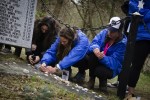
Teens light candles on March of the Living. (photo from March of the Living Canada)

In April 2015, a group of 80 teens, under the guidance of three chaperones and a Holocaust survivor, arrived in Poland for a two-week journey exploring Poland’s tragic events and followed by the joy of celebrating the birth of the Jewish state on Yom Ha’atzmaut.

The mission of March of the Living is to pass the torch of Holocaust memory to new generations. The experience provides young people with an opportunity to bear witness to the Holocaust and to the stories of survivors, so that this important part of our collective history is never forgotten. It is also a unique opportunity to strengthen our children’s Jewish identity and to strengthen their connection to Israel.

The march itself took place on Yom Hashoah, and we marched from Auschwitz to Birkenau with nearly 10,000 other young people. The march commemorates the death marches that the last surviving prisoners were forced to take, where many perished, but a few survived thanks to the liberation by the Allies. It is the most powerful event imaginable, and one that unites all young Jewish and non-Jewish people across the world.

By the end of the trip, these beautiful young people were so open in their expression of their deepest and most profound insights and emotions. They were no longer afraid to show their vulnerability, because the support they received from each other throughout the trip was absolutely unconditional. It was a beautiful experience and a privilege to be a part of.

The commitment to Judaism and Israel that the participants acquire on this trip is so clearly represented in the following statements by March of the Living participant,

Barbie Clark:

“For me, March of the Living created an emotional connection to my tradition, enabling me to understand and appreciate the importance of remembering our history.

“During the trip, we witnessed firsthand the magnitude of mass destruction that occurred during the Holocaust. As we traveled around the country, we were constantly reminded of these horrors in every city, town and community that we visited. At the height of Auschwitz’s productivity, it was able to murder and cremate up to 12,000 Jews a day – a number greater than the mass of us who were able to complete the walk. To realize that every single one of us participating in the march could have been destroyed in the space of one day, defies understanding and description. Also, at Majdanek, we were witness to a horrifying monument containing ashes and bones of … 20,000 Jews killed in the Nazi’s Fall Festival of 1943. This monument is alarmingly large, reiterating the magnitude of what occurred. I found this terrifying and incomprehensible.

“The horrors witnessed in Poland are to be contrasted with what I experienced in Israel,” continued Clark. “While in Israel, I had the unique privilege to witness both Yom Hazikaron – Israel’s Remembrance Day for its soldiers – and Yom Ha’atzmaut, Israel’s birthday. On Yom Ha’atzmaut, the entire country is in celebration – the euphoria is palpable. Despite the sadness one is left with after [bearing] witness, I was left with contagious optimism and hope. Hope for a future without enemies; hope for the Jewish people and the Jewish nation surviving despite all previous oppression.

“The entire experience created for me a new sense of being connected to Judaism, in a way I never thought possible…. The trip symbolized for me all [the] adversity, intolerance and persecution of Jewish people, yet at the same time creating a sense of survival and the possibility of a better future, for not just the Jewish people, but for all mankind.”

Charlotte Katzen, co-chair, March of the Living committee, was a chaperone on the 2015 trip. This article was originally published in Jewish Federation of Greater Vancouver’s Yachad. More information about March of the Living, click here. For information on the adult program – which is new this year – click here.


Iran dominates AIPAC talks

Republican presidential hopeful Donald Trump upset AIPAC organizers when he criticized President Barack Obama. (photo by David Zam)

There were clear signs of discord in Washington, D.C., as representatives of AIPAC publicly rebuked presidential hopeful Donald Trump after he harshly criticized the sitting president.

At the pro-Israel organization’s policy conference last month, in front of some 18,000 attendees, visibly upset AIPAC president Lillian Pinkus admonished Trump on stage for his remarks a day earlier.

“Whatever policy disagreements we may have, we must not condemn the sitting president on stage,” she said. “There are people in our AIPAC family who were deeply hurt last night and, for that, we are deeply sorry.”

Chairman of the board Robert A. Cohen said that booing and clapping speakers when they attack another person was unacceptable at the event, and that “AIPAC doesn’t pick sides.”

Trump, who was cheered wildly for noting that it was President Barack Obama’s last year in office, said that “Obama rewards our enemies” and “Hillary was a total disaster as secretary of state…. Obama and Hillary have been very bad to Israel. Obama may be the worst thing to happen to Israel.”

Every major party candidate for president spoke at the dais, except the senator from Vermont, Democrat Bernie Sanders, who is Jewish. All candidates who spoke placed heavy emphasis on Iran.

GOP frontrunner Trump didn’t mince words. He called the Iran deal brokered by the P5+1 – the United States, China, Russia, France and the United Kingdom plus Germany – “awful” and “bad for Israel, the Middle East and the world.”

The $150 billion channeled to Iran in the agreement, by his reckoning, was “unbelievable” with “nothing in return,” and that the Islamic Republic will have a nuclear bomb within several years.

As president, Trump said he would “stand up to Iran’s aggression” because “I know how to deal with aggression and that’s why I’ll win.”

The Middle East’s terror activity has Iran’s fingerprints all over it, he continued, including Hezbollah in Lebanon, Hamas in Gaza, reward money for Palestinian terrorists, and influence in at least two dozen other countries.

“I will dismantle Iran’s global terror network,” Trump said. “We will enforce this deal like you’ve never seen a contract enforced before.”

The New York billionaire mogul and reality TV host took aim at two other threats to Israel, the United Nations and Palestinian terror activity.

“The UN is incompetent and no friend of Israel,” he said. “A [peace] agreement imposed by the UN would be a total disaster. And the U.S. must use our veto, which I will use 100%.”

The Jewish state, he said, has always been willing to strike a deal with its neighbors, noting that prime minister Ehud Barak in 2000 offered nearly the entire West Bank as a Palestinian state, but the offer was dismissed by then-PLO leader Yasser Arafat. Other times, he said, “Palestinian leadership has rejected very good offers.”

Trump noted that, under his purview, the U.S. embassy would move “to the eternal capital of the Jewish state, Jerusalem.”

Texas Senator Ted Cruz, trailing a distant second to Trump in GOP delegates, began his speech, “America will stand with Israel and defeat Islamic terror.”

He spoke about his three trips to Israel as senator, including a visit to Israeli hospitals that treated Syrian refugees. He noted that he had proposed legislation to ban the Iranian ambassador to the UN from entering the United States since he was involved in the 1979 Iranian hostage crisis. It passed in both the Senate and House.

Taking a jab at the Obama administration, he said it was “unjust” for them to impose a travel ban on Israel in the summer of 2014. He further called out Democrats for boycotting Israeli Prime Minister Binyamin Netanyahu’s speech last year at AIPAC.

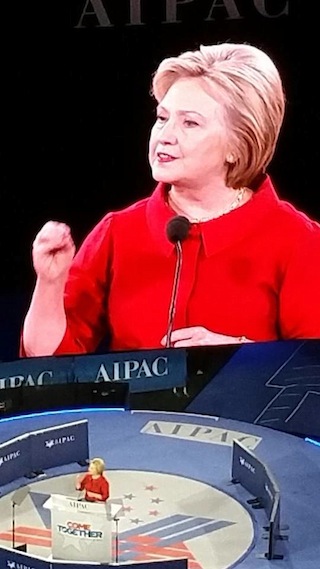
photo - At AIPAC, Democrat frontrunner Hillary Clinton advised a three-pronged approach to global security, focusing on Iran, extremism and the attempts to delegitimize Israel
At AIPAC, Democrat frontrunner Hillary Clinton advised a three-pronged approach to global security, focusing on Iran, extremism and the attempts to delegitimize Israel. (photo by David Zam)

Hillary Clinton, the Democratic presidential frontrunner, was taken to task for saying that Hamas fires rockets from civilian areas because Gaza is tight for space. “Rather,” said Cruz, “it’s because Hamas are beasts who use human shields.”

As for the “fundamentally immoral” Iran deal, Cruz said he will “rip it to shreds on the first day,” since the Islamic Republic won’t follow it anyway.

“Hear my words Ayatollah Khomeini: If I am president and Iran launches a missile test, we will shoot that missile down,” said Cruz. “And, in January 2017, we will have a commander-in-chief who says under no circumstances will Iran be allowed to acquire nuclear weapons: either you will shut down your nuclear program or we will shut it down for you.”

Cruz compared the Iran deal to the failed 1938 agreement between British prime minister Neville Chamberlain and Adolf Hitler, which led to the Third Reich’s takeover of Czechoslovakia and allowed its continued military build-up.

If elected president, Cruz said he would move the U.S. embassy from Tel Aviv to Jerusalem, yank federal funds from schools that boycott Israel and veto any UN unilateral declaration of a Palestinian state.

Governor of Ohio John Kasich, running third in the GOP delegate count, noted his 35-year support for Israel and his role in helping erect a Holocaust monument in his state.

He called for the suspension of the Iranian nuclear deal, particularly after recent test missiles in contravention of international treaties. As president, he would “defeat ISIS and stop arms flows to Hezbollah.”

He also spoke out against the boycott, divestment and sanction movement, and antisemitism on campus. On Israel, he noted the “culture of death that the Palestinian leadership has promoted for decades,” and that “Palestinians cannot continue to promote hatred.” In sum, he called Jerusalem the eternal capital of Israel.

When she took to the stage, Clinton noted that the “the ideological gap between the parties has increased, but there’s still common agreement on Israel.”

She took a three-pronged approach to global security: Iran’s aggression, the growing tide of extremism, and efforts to delegitimize Israel. “The deal with Iran is making the world safer, including Israel,” she said. “The supreme leader still calls all the shots in Iran, but we should support voices who want to bring change in Iran.”

Regarding other parts of the region, she said that “ISIS must not be contained; it must be defeated.”

On the issue of Israel, she noted that Palestinian leadership has to stop inciting violence. “Children should not be taught to hate in schools,” she said, adding that she would oppose any attempts to “push a [unilateral two-state] solution,” including in the UN. “Palestinians should be able to govern themselves in their state,” she said, while adding that Israeli “settlements are not helpful to peace.”

She condemned BDS and said, “we have to fight against it” because “antisemitism has no place in American society.”

Meanwhile, U.S. Vice-President Joe Biden took a risk mentioning to the 18,000 attendees at the policy conference that Israeli “settlements are a barrier in the way of a two-state solution.” That risk was welcomed by a chorus of boos – despite attendees being cautioned by AIPAC leadership to not do so.

Biden insisted that, notwithstanding political differences, the United States is “united in our unwavering commitment to the Jewish state of Israel.”

However, “violent acts of retribution must stop,” he continued, “terror is terror is terror … and it must be stopped.”

The White House “stands with Israel against delegitimization” and believes that “Israel is stronger today because of the Obama-Biden administration,” he said.

Biden touted last year’s Iran deal as a “success,” explaining that many “Iranian facilities are dismantled and destroyed” and that “Iran is further away from the possibility of being nuclear. If Iran violates [the deal] there will be consequences.”

Speaking by video link from Israel, Netanyahu both criticized, and suggested salvaging, the U.S.-brokered Iranian nuclear deal.

“Those who worked for the deal and against the deal can work together to ensure that the deal is followed,” he insisted, noting that, in March, Iran tested a missile that posed a threat to Israel.

“The writing isn’t just on the wall; it’s on the missile,” said Netanyahu.

He said that Israel is singled out for condemnation at the UN and said he hopes the United States will continue its moral voting record at the Security Council.

With regard to Israel’s neighbors, he said Palestinian children are taught to hate, and showed a video of television broadcasts that illustrate his point.

“We cannot compromise with terror and must defeat it,” he said. “We need a two-state solution with a demilitarized Palestinian state.… We are ready for negotiations anywhere and anytime without preconditions.” But, he said, Mahmoud Abbas, the leader of the Palestinian Authority, “isn’t ready or willing to come” to the negotiating table.

David Zam has covered political, cultural and historical events for Landmark Report, including the 50th anniversary of the Selma to Montgomery voting rights march as White House-approved press, two AIPAC policy conferences and several other political conventions. He has degrees in history and law.