Gillerman: “call a spade a spade”

Dan Gillerman addresses the audience at Jewish National Fund Pacific Region’s Tu b’Shevat event Feb. 3 as emcee Geoffrey Druker looks on. (photo by Robert Albanese)

A former Israeli ambassador to the United Nations heaped praise on Canada and excoriated the United States during a candid speech here last week.
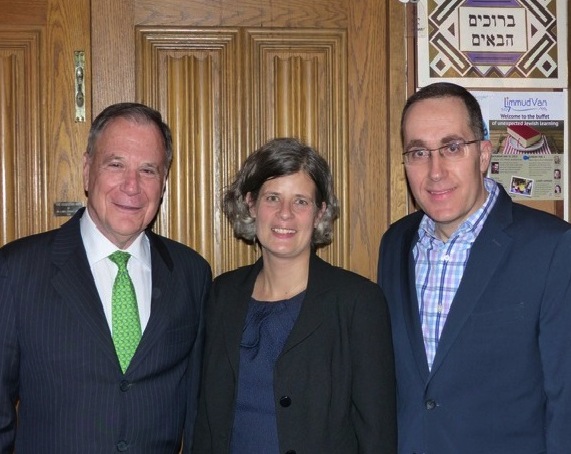
photo - Left to right, former ambassador to the United Nations Dan Gillerman, Mayor of Victoria Lisa Helps and JNF Pacific Region shaliach Ilan Pilo
Left to right, former ambassador to the United Nations Dan Gillerman, Mayor of Victoria Lisa Helps and JNF Pacific Region shaliach Ilan Pilo. (photo by Julie Elizabeth)

Dan Gillerman, who led the Israeli delegation at the UN from 2003 to 2008, was filling in for current Ambassador Ron Prosor, whose obligations kept him in New York. The occasion was the Jewish National Fund of Canada’s Tu b’Shevat event at Beth Israel on Feb. 3. He also spoke in Victoria at Emanu-El for JNF the next day.

Gillerman, who acknowledges that he has a penchant for political incorrectness and is now a private citizen free to speak his mind without the constraints of a diplomatic post, received a strong ovation when he called Canada “by far, the greatest friend Israel has in the world” and when he heaped praise on Canada’s Prime Minister Stephen Harper as “probably the greatest leader in the world.”

His perspective on the United States was not nearly as positive.

“I think that what we are witnessing today is at least a perception, hopefully a wrong perception, of a weak America and a weak American president,” Gillerman said. Even a whiff of American weakness is a dangerous thing in the world, he said, with America’s enemies feeling that they can get away with murder and America’s allies believing that they cannot rely on the superpower.

Gillerman equates the contemporary situation of the United States with the advent of the First World War a century ago, which he says was due in part to perceptions of British weakness under Prime Minister H.H. Asquith. Gillerman contended that Russian dictator Vladimir Putin would not do what he did in Ukraine and other countries would not do what they are doing elsewhere if they thought the United States would intervene.

On dangers facing Israel, Gillerman said that the most serious threats are not Hamas or Hezbollah, and not even Iran, which is pushing for nuclear capability. “They are not our most dangerous threats, because we can take care of them,” he said. “The two most dangerous phenomena we face today are appeasement and being politically correct.”

Trying to appease terror and the Iranian regime, as the world is doing today, Gillerman said, is very dangerous.

About political correctness, he said the world is “trying to find other words to explain what is happening,” other than identifying it as Islamic extremism and terrorism. “We have to call a spade a spade,” he said. “There is evil in this world. There is terror in this world. It threatens your country and every country in the world.”

On Iran, Gillerman characterized nuclear negotiations as “a weak America and a weak American president who wants an agreement at any cost.”

Gillerman said he had a conversation with UN Secretary-General Ban Ki-Moon, who is South Korean. Gillerman said that the global powers dithered while North Korea prepared for nuclear weaponry then one day the world woke up to a nuclear North Korea. Gillerman said Ban told him that Iran is much more dangerous than North Korea.

“North Korea sought nuclear weapons out of desperation,” Gillerman quoted Ban as telling him. “While Iran is seeking them out of aspiration.”

Gillerman spoke of his close relationship with the late former Israeli prime minister Ariel Sharon, who appointed him ambassador to the UN. Gillerman’s background is not in politics or diplomacy, but business, and he was chairman of the Israeli Chamber of Commerce before his ambassadorial appointment.

He said Sharon warned him that the appointment to the UN would leave him lonely and facing hostility, but Gillerman said he later told the prime minister that he had been wrong. As Israel’s representative at the world body, Gillerman said, he operated on the knowledge that he represented a country that “is far, far better than most other member countries of the United Nations.”

Despite Israel’s isolation at the UN, one of Gillerman’s achievements during his time as ambassador was the proclamation of International Holocaust Remembrance Day every January. It was the first time that an Israeli-sponsored resolution was passed by the General Assembly.

Gillerman was speaking on the day that Canadian foreign minister John Baird announced his resignation from cabinet and politics. Gillerman said that he had spent several days with Baird recently in Davos, Switzerland, and had no indication that Baird was planning a major change.

“I think it’s a loss for Canada and a loss for Israel, but I wish him well,” Gillerman said, before once again praising Canada’s leaders.

“I think you have in Stephen Harper one of the greatest leaders in the world. Probably the greatest leader in the world and definitely the best friend Israel has in the world,” he said.

While the bulk of the former ambassador’s speech was ominous and pessimistic, it didn’t conclude that way.

“Despite all that, I am optimistic about the future of Israel,” he said near the end of his remarks. “I believe that the world is waking up.”

In the Arab world, he said, the fight between extremists and moderates will lead moderates to recognize that Israel is not the enemy. Comparatively moderate Arab states are as afraid of Iranian extremism and nuclear capability as Israel is – possibly more afraid – he said, and a regional agreement will emerge from shared interests.

“I believe we can reach a fair and lasting settlement with the Palestinians,” he said, adding that leadership is needed on both sides, and in the world, and that it must go beyond bilateralism. He predicted what he calls a “23-state solution,” an agreement between Israel and Arab countries that leads to lasting peace.

He went on to say that if the Palestinian issue were settled, Arab states could calm their streets and become partners with Israel.

To those who say that the United Nations is a failed, useless organization, Gillerman described it as simply a building on First Avenue in Manhattan that is only as good as its tenants. Blaming the UN for the faults of its member-states is like blaming Madison Square Garden when the Knicks lose, he said. “It’s not the UN as an organization, it’s the world we live in.” The UN General Assembly has a “built-in immoral majority,” he said.
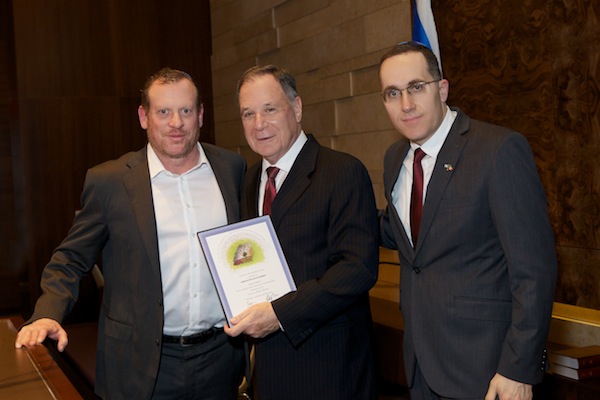
photo - Left to right, Frank Sirlin, president of Jewish National Fund Pacific Region, former ambassador to the United Nations Dan Gillerman and JNF Pacific Region shaliach Ilan Pilo
Left to right, Frank Sirlin, president of Jewish National Fund Pacific Region, former ambassador to the United Nations Dan Gillerman and JNF Pacific Region shaliach Ilan Pilo. (photo by Robert Albanese)

Prosor, the ambassador who was originally slated to attend, provided a video message that was screened at the beginning of the event. Singers from Vancouver Talmud Torah sang a song for Tu b’Shevat and King David High School students sang the national anthems. The event was emceed by Geoffrey Druker, Rabbi Jonathan Infeld welcomed visitors to the new Beth Israel building and Diane Switzer, board chair of the Jewish Federation of Greater Vancouver, introduced Gillerman. Frank Sirlin, president of JNF Canada Pacific Region, spoke about this year’s Tu b’Shevat campaign, which will see trees planted along roads in Israel that are within range of gunfire from the Gaza Strip. The “green barrier” will help green the desert while shielding drivers and passengers from sniper fire. The JNF campaign includes two telethon sessions, on Feb. 15 and 22.

Pat Johnson is a Vancouver writer and principal in PRsuasiveMedia.com.

Israel-China economic ties keep growing

A senior delegation from Shengjing visits JVP in Jerusalem. (photo by Yael Rivkind, JVP, via israel21c.org)

Fiona Darmon, a partner at JVP, one of Israel’s most successful venture capital funds, was recently in China at a meeting with a large investor. She sat in his office for more than an hour, chatting with him about everything but business. Only then, she said, did he nod to his subordinates, and Darmon was taken into another room, where the business discussions began.

“The mindset in China is that if we’re going to do business and I’m going to entrust you with my capital, let’s see if we have a personal rapport before I even move to the next step,” Darmon told this reporter. “It’s about you as a person, first.”

Israelis are not known for their patience, and that can be a challenge, said Ilan Maor, a managing director of Sheng-BDO (Business Development Organization) and a former Israeli consul in China. Yet economic ties are “booming,” he said.

“The most important aspects of the commercial cooperation are gradually moving from buying and selling toward the main pillars of the future of technology and investment,” Maor explained. “China is taking its place gradually as a strategic player in the Israeli market.”

As an example, the Chinese company Bright Star is on the verge of buying a majority stake in Tnuva, Israel’s iconic dairy company. The company is so central to Israel’s image of itself that, on leaving Israel, the last thing you see on the way to duty free is the logo of Tnuva’s cottage cheese container made out of flowers. If the sale goes through as expected, China and Israel’s kibbutz cooperative movement will share ownership of the dairy company.

More and more Chinese business people are visiting Israel looking to invest and to learn from Israel’s entrepreneurs.

“Israel is not only the ‘startup nation,’ it is also the ‘innovation nation,’” said Xueling Cao, director of the Shengjing Group, who was in Israel when she spoke with this reporter. “China is a huge consumer market and Israel is a huge source of innovation and technology, and we can match the two together.”

Read more at themedialine.org.

Clues to the end game

On Jan. 28, Israeli soldiers in the northern Mount Dov region are pictured after an Israel Defence Forces patrol came under anti-tank fire from Hezbollah terrorist operatives. The Hezbollah attack killed two Israeli soldiers and injured seven others. (photo by Basal Awidat/Flash90)

Who was behind the Jan. 28 attack on northern Israel that killed two Israeli soldiers and wounded seven others? The easy answer is the Lebanon-based terrorist group Hezbollah, which claimed responsibility for the attack. But the wider view suggests Hezbollah’s state sponsor: Iran.

Dr. Ely Karmon, a senior research scholar at Israel’s International Institute for Counterterrorism, said that Hezbollah’s actions represent “an attempt to change the strategic rules of the game.” According to Karmon, Iran and Hezbollah have been working for months to take advantage of instability in Syria in order to create a forward military position against

Israel in Syria’s Quneitra region, close to the triple Syria-Lebanon-Israel border.

“This is actually an Iranian project,” Karmon told this reporter. “They have around 1,500 people on the ground in Syria, most of whom are counseling or training Syrian militias, and they have Hezbollah providing military support.”

On Jan. 28, Hezbollah fired five Kornet guided anti-tank missiles at an Israeli military convoy approximately 2.5 miles inside Israel’s border with Lebanon. A day earlier, less sophisticated mortars were fired from southern Syria into Israeli territory, with no damage reported.

In response to the Jan. 28 attack, Israeli Prime Minister Binyamin Netanyahu said, “Whoever is behind today’s attack will pay the full price.” Netanyahu – like Karmon – stressed that the attack points back to Iran, adding, “with the assistance of Hezbollah, Iran has been for some time trying to open another front against Israel on the Golan Heights. We are acting with force and determination against these attempts.”

“Because of the weakness of the Syrian regime, the Iranians are now permitted to have a foothold directly on Israel’s border, which until now they didn’t have,” Karmon explained.

Israel is widely believed to be responsible for a Jan. 18 airstrike against that foothold in southern Syria, which killed six Hezbollah operatives and six Iranians, including notorious Hezbollah commander Jihad Mughniyeh and Iranian general Mohammad Ali Allahdadi.

Karmon believes the airstrike “was a message sent by Israel” to forewarn Iran and Hezbollah not to continue their military efforts in Syrian territory.

The retaliatory attacks by Hezbollah following the deadly airstrike were widely expected. That the more sophisticated Kornet anti-tank missiles were fired from Lebanon and not Syria provides a strong indication that the Syrian position is not as well-stocked with weaponry as southern Lebanon – a zone that was supposed to remain completely demilitarized under United Nations Security Council Resolution 1701, which arranged for the cessation of hostilities following the Second Lebanon War of 2006.

“Resolution 1701 calls for complete disarmament in southern Lebanon and, yet, Hezbollah, instead of disarming, they have amassed some 80,000-90,000 missiles,” Karmon said.

“Now, they want to achieve the same equation in southern Syria. If Israel does not stop them, and there are two to three years with relative quiet, with only occasional penetrations of our border and sometimes mortar fire and so on, a kind of ‘war of attrition,’ then all of a sudden we will find ourselves staring at 5,000-10,000 missiles,” he said.

Read more at jns.org.

An accord for the ages

Here’s a scenario to consider: What if Prime Minister Binyamin Netanyahu came to the Knesset with a peace accord, approved by all its neighbors, that provided for the cessation of war, the recognition of the state of Israel, land swaps to create coherent borders and the dismantling of settlements?

What if Netanyahu said the final decision on the agreement would be up to the Knesset and he would remain on the sidelines, campaigning neither for nor against the agreement? Would the Knesset endorse the deal?

At first blush, such a scenario sounds farfetched, it could never happen. But, 35 years ago, that is exactly what occurred.

Former prime minister Menachem Begin came to the Knesset with a peace agreement with Egypt. He was reluctant to abandon settlements in the Sinai, but he let members of the Knesset vote on the agreement and did not campaign against it. They endorsed the deal.

The 1979 Camp David Accords proved to be more durable than many expected, surviving the assassination of Egyptian president Anwar Sadat, the Lebanon war, the Gaza conflicts and the Arab Spring. Also, the accord laid the foundation for an agreement with Jordan that is now marking its 20th anniversary.

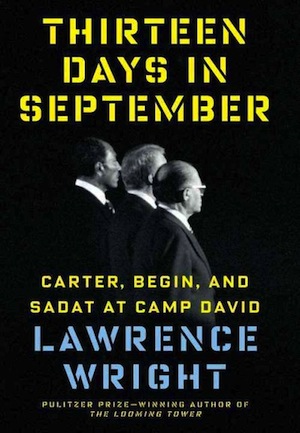
image - Thirteen Days in September book coverIn Thirteen Days in September: Carter, Begin and Sadat at Camp David (Alfred A. Knopf, 2014), New Yorker staff writer and Pulitzer Prize-winner Lawrence Wright goes back to the difficult negotiations in September 1978 that led to the reluctant handshake between Sadat and Begin, and the signing of the accord on the White House lawn in March 1979.

U.S. president Jimmy Carter brought the Egyptian president and the Israeli prime minister together after Sadat took the first courageous step toward peace – a visit to Jerusalem in 1977. The three leaders and some of their most senior aides met at Camp David, a secluded country retreat about 100 kilometres outside Washington, D.C. They stayed for almost two weeks, stepping away from the whirlwind of day-to-day events to focus exclusively on a framework for peace.

A playwright and screenwriter, Wright effectively recreates the moments of high drama during the talks, weaving personal histories, sacred mythologies and past events into a detailed account of the bare-knuckle bargaining session. He also fleshes out the secondary characters, the members of the Israeli, Egyptian and U.S. bargaining teams who played a role in reaching an agreement. In the acknowledgements, Wright says he initially wrote a play about the negotiation, but he could not squeeze all the interesting characters into a 90-minute play.

The evocative portrayal of Moshe Dayan – the Israeli-born warrior who came to personify the country’s most spectacular military accomplishment in 1967 as well as its most significant loss in 1973 – is especially memorable. Dayan is described alternately as a cold-blooded, calculating fighter and the government’s most creative thinker in pursuit of peace.

The book offers a rare glimpse inside the world of high-pressure international negotiations and sheds light on the difficult relationship that Carter continues to have with Israel. That alone would make the book worthwhile. Yet Thirteen Days is more than just an historical account. Delving into how the Camp David Accords were reached inevitably fires up the imagination to think about what is possible.

Could these achievements ever be repeated again?

Wright shines a spotlight on some extraordinary aspects of the negotiations. The U.S. president, who was prepared to dedicate an inordinate amount of time to grappling with the competing interests in the Middle East, had come to the table with little more than a biblical understanding of the issues and virtually no experience in foreign policy. Yet, he shared with the Egyptian president a similar upbringing, religious devotion and commitment to service in the military. An easy rapport evolved between the two men.

Carter had a more difficult time finding a personal connection with Begin, who was scarred by the Holocaust and hardened by his experiences fighting British authorities in Palestine before the establishment of the state.

The isolation of Camp David allowed negotiators to work creatively and take risks that might not have been ventured in the public eye, Wright writes. But being forced together also had negative consequences. The intimacy at times fed hostility, rather than creating trust, and almost torpedoed the talks.

The process of negotiating, ridded with cultural misunderstandings and political miscalculations, was particularly challenging. Sadat and Begin had significantly different approaches to the talks. Sadat came with an agenda of unrealistic demands, but was willing to compromise. Begin came to listen and react. For several days, he adamantly refused to concede anything.

In his naïveté, Carter expected the two warring sides to reach an accord on their own. His opening gambit was to just bring the two sides together and step back. He assumed they would resolve their historic differences once they met and shared their history, their suffering and their dreams. How wrong he was.

Their response at critical moments was a study in contrasts. Where Sadat, a visionary, would become emotional when his idealism was challenged, Begin would become colder and more analytical. Begin kept his eye on details, meticulously dissecting every nuance in anticipation of what could be lurking around the corner. “Both desired peace,” recalled Ezer Weizman, who was Israel’s defence minister at the time. “But Sadat wanted to take it by storm and Begin preferred to creep forward inch by inch.”

Carter eventually realized he had to take the lead. But it was not until the sixth day of negotiations that he introduced a framework for peace that was to be the springboard for negotiated compromises and a final deal.

Despite the hurdles, somewhere there was magic. They reached an agreement.

Wright suggests that domestic political considerations played a significant role. The political cost for all three leaders increased as the negotiations stretched on. Carter, who staked his reputation on bringing the conflict to an end, threatened to break relations with Sadat or Begin if either leader walked away. The threats kept the two wily politicians at the table, despite their personal animosities.

Another pivotal issue was how the three leaders responded to matters related to the Palestinians. Sadat was their self-appointed representative at the talks. But, at a crucial moment, he pushed their interests aside. It was a decision that cost him his life. At the time, however, the prospect of regaining full sovereignty over the Sinai Peninsula was just too tantalizing; leaving the Palestinians on the sidelines enabled the accords to be signed.

Wright observes that there has not been a single violation of the terms of agreement, but he leaves the impression that the Camp David Accords offer little to guide those now searching for more peace. The accords have saved lives and defused tensions in a volatile neighborhood, but the agreement appears to be a unique set of circumstances in history at a time of powerful personalities that probably will not be replicated in our times.

Media consultant Robert Matas, a former Globe and Mail journalist, still reads books. Thirteen Days in September is available at the Isaac Waldman Jewish Public Library. To reserve it, or any other book, call 604-257-5181 or email library@jccgv.bc.ca. To view the catalogue, visit jccgv.com and click on Isaac Waldman Library.

Bibi, Obama: Grow up

Iran’s propaganda machine Press TV on Monday reported that U.S. President Barack Obama had “unfriended” Israeli Prime Minister Binyamin Netanyahu on Facebook.

Predictably, it turned out the report was a hoax. Iran’s humorless propagandists reported as fact a joke from an Israeli satire site. And yet, despite the big journalistic oops (as if they care), the Iranian voice box made a legitimate point. The two men, ostensibly leading figures in world diplomacy, have in recent weeks been behaving like sulky teenagers.

Netanyahu unwisely accepted an invitation from the speaker of the U.S. House of Representatives, John Boehner, to address Congress, specifically to pressure the Americans to increase sanctions on Iran. The fact that this visit would take place at the height of the Israeli election campaign has been criticized by some, with others noting that former president Bill Clinton hosted Shimon Peres during an election cycle. The fact that the invitation came from the speaker of the house, rather than from the president, whose responsibilities include being the country’s foremost voice on foreign affairs – and its head of state and commander in chief – is a significant protocol breech, but a deliberate one.

We are becoming almost inured to successive hyperbolic assertions that bilateral relations between the United States and Israel are at their lowest ebb. But this time, it seems true, although a result of such foolishness that it seems almost comical, as well as tragic. These two men, whose seeming dislike for each other they are not even mature enough to hide or deny, are submerging the best interests of the relationship, shootings spitballs at each another across the divide.

Critics of Obama’s motivations allege that he does not pass the “kishkes” question; that his commitment to Israel’s security, such as it may be, is based a political imperatives or strategic demands, rather than a personal commitment to the idea of the Jewish state. To many others, these criticisms don’t hold water.

But what of Netanyahu? What on earth is he thinking, deliberately provoking his country’s most important international ally by inserting himself squarely into a constitutional tight spot, pitting the executive and legislative branches of the U.S. government against each other? Especially when Israel’s own intelligence service, the Mossad, has made clear that it is in Israel’s interest to allow negotiations with Iran to proceed, rather than to undermine them with additional immediate sanctions.

We are driven to ask, does Netanyahu know something we don’t? Does he know something the Mossad does not? Or is he driven merely by the hawkish demands of his domestic political constituency?

And why does he think that picking a fight – a very public, nasty and juvenile fight – with the president who was reelected with the support of 70 percent of American Jewish voters, would be a wise strategic or ideological move?

Greater minds can dissect the realpolitik motivations of these two strong figures. Wise figures in the think tanks of Washington and Tel Aviv are dissecting the nuance and nonsense the two leaders have displayed recently.

From where we sit, however, their behavior simply looks like they are putting their immature dislike for each other as individuals ahead of the interests of their countries. And, there is Speaker Boehner, ready to take political advantage.

Barrels of ink are being spilled this week on this topic, with the best minds of our generation advising both these men how to proceed. Our advice is simple, but it should be said: Just grow up.

Why is media Israel obsessed?

More senseless violence has hit Jerusalem in recent months, with the brutal murder of four worshippers at a synagogue in the Har Nof neighborhood late last year and multiple stabbings and car attacks. Some folks, while on the one hand wanting to ensure the world learns of these heinous acts, will, on the other hand, continue to ask why the media is so obsessed with Israel.

I was reminded of this question not too long ago via a short CNN video clip with journalist Matti Friedman in which he discusses an article he wrote for Tablet last summer that’s taken on a new life online. To make his case that the media is unfairly biased against Israel, Friedman cites the 2013 death toll in Jerusalem compared to Portland (more deaths in Portland), and the century-long Arab-Israeli conflict toll compared to the ongoing carnage in Syria (more lives lost in Syria). He adds that, in the overall reporting on the Israeli-Palestinian saga, Israel is unfairly portrayed as the aggressor while the Palestinians are cast as victims rather than as agents of their own fate.

The question of presumed agency is a key one in the conflict: how the conflict actors themselves see it, and how others can serve to reinforce these roles. It’s a fair point.

However, to truly understand why individuals, media markets, foreign policy actors and international organizations devote so much time and energy to the Israeli-Palestinian nexus, we’d need some in-depth research to really understand their motivations. For now, here are several plausible reasons that seek to raise the discussion beyond the reductionist assumption that there is a “media bias against Israel” and the related, if unspoken, accusation that the world simply hates the Jewish state.

Perhaps most importantly, American taxpayers provide a significant annual sum of money to Israel, via the $3 billion in annual U.S. aid granted to Israel. It’s natural that the government and the voters in that country at least would disproportionately concern themselves with the region.

Second, the Israel-Palestine core is the heartland of the three main monotheistic religions. The role of religious symbolism in Western art, literature, film and culture in general is significant. The region, in short, has long captured the imagination of many.

Third, Israel – unlike Syria – is a democracy. Citizens of democracies tend to hold other democracies to democratic standards. That means that violence committed in the name of democratic values – for better or worse – sometimes gets more airtime.

Fourth, as others have written before, Israel is seen by many as a colonial transplant. There are very good arguments against a simplistic understanding of Israel as a colonial project. (There is no core state to which settlers send extracted resources, for example.) But there is no getting around the fact that Israel’s birth was precipitated in part by Europe’s carving up of the region into mandate territories after the First World War. The shred of the colonial shadow succeeds in galvanizing a certain political consciousness that other conflicts, especially civil ones within non-democracies, simply don’t, unfortunately perhaps.

Fifth, once Israel came into existence, it was seen by many as a plucky state surviving against all odds. It’s a narrative that Israel and the engines of Diaspora Jewry have themselves succeeded in promoting. That the world continues its fascination with Arab-Israeli geopolitics, played out now partly through the Palestinians, is, therefore, not surprising.

Sixth, Jews tend to punch above their collective weight in many aspects of popular culture: entertainment, the arts, literature and so on. That the Jewish state and its goings-on figure so prominently in the media can be seen as a benign extension of this. Add to this the fact that some of the players in the contemporary Israeli-Palestinian saga also hold American citizenship (three of the victims of the Har Nof synagogue attack held dual Israeli-U.S. citizenship, while the fourth was British Israeli) and the effect is magnified.

Finally, as for Friedman’s comparison between the disproportionate attention given to death and destruction in Israel compared to, say, in Portland, one could say that political violence naturally garners more international concern – again, sadly for those who are ignored – than death caused by typical urban ills such as poverty, petty crime, drugs or traffic accidents.

In sum, I’ve suggested seven plausible reasons why the world might be “obsessed” with Israel, none of them having to do with base hatred of the country or of Jews. Of course, there’s nothing saying that any of these possible reasons obviate the need to look antisemitism in the eye wherever it genuinely appears, or to spend more time analyzing the Palestinian part of the equation. But let’s at least consider the array of possibilities out there before we assume that the world is against us.

Mira Sucharov is an associate professor of political science at Carleton University. She blogs at Haaretz and the Jewish Daily Forward. A version of this article was originally published on haartez.com.


Fruits, nuts, traditions

Tu b’Shevat, the New Year of the Trees, coincides with the flowering of the almond tree in Israel. (photo from en.wikipedia.org/wiki/Shevat)

Tu b’Shevat, which falls this year on Feb. 3-4, marks the end of the rainy season in Israel. Buds are beginning to appear on the trees, and the blossoming almond trees, the harbinger of spring, have begun to dot the landscape. So, on the 15th day of the Hebrew month of Shevat, we celebrate the yearly cycle for the growth of trees in Eretz Israel.

According to Jewish mystical tradition, Tu b’Shevat is the day when G-d renews sustenance and the “life-cycle” of the trees, when the sap starts to rise.

There are many customs to remind us of the meaning of this day, including a Tu b’Shevat seder, not unlike the ritual meal we have on Passover.

On Tu b’Shevat, fruit trees were measured for growth in order to calculate the annual tithe to the Temple. Even long after the Temple was destroyed, this seder was a new way to reaffirm the spiritual bond with the land in celebration of the approach of spring and the fruit of the earth.

This ancient tradition was developed in Safed, the seat of kabbalistic studies in the 16th century. Traditionally, we eat nuts and the fruits for which the Torah praises the Land of Israel, including grapes, figs and pomegranates, olives and dates. The table is set with a snowy white tablecloth, candles, fruit and nuts, and the sharing of prayers, readings and songs.

It is traditional to enjoy four cups of wine, like on Passover. Those glasses of wine can be paired with a corresponding fruit and divided into ascending levels of spirituality.

The first cup, therefore, is often white wine, symbolizing winter, accompanied by a fruit that needs a protective covering, such as oranges or almonds.

The second cup is white wine mixed with a small amount of red, signifying spring, the budding of new life. This glass is served with olives, apples, peaches and dates: the outer layer is eaten, yet the heart is protected and has within it the seed of new life.

The third cup is red wine with a small amount of white mixed in. This is the symbol of summer and a perfect world in which nothing is wasted. With this, fruits such as figs, grapes and berries are eaten. These are considered to symbolize the highest level of spiritual openness.

The fourth cup is red wine only, representing fertility and the bounty of the autumnal crops.

What else happens on Tu b’Shevat? Very little religiously, but a lovely ritual has arisen in Israel, one that’s now been adopted all over the Jewish world. It is a popular observance to plant trees, one of the greatest mitzvot we can perform.

Trees have great significance in Judaism. This Tu b’Shevat, however, we are still in a Shmita (jubilee) year in Israel; the land is resting, so no plantings will take place.

Trees hold a special place in Judaism. It is written in Deuteronomy: “When you besiege a city for many days to wage war against it to seize it, don’t destroy its trees….” In the Midrash Shmuel on Pirkei Avot 3:24, it is written that man is like a tree in that his good deeds are his produce, his “fruits,” and his arms and legs the “branches,” which bear these fruits. He is, however, an “upside-down tree,” for his head is rooted in the heavens, nestled in the spiritual soils of the Eternal, and nourished by his connection to his Creator.

At the end of the Hasmonean dynasty, there lived a holy man named Honi, known as the circle drawer, Honi HaMa’agel, and we read his story in Talmud Ta’anit 23a. One day, Honi sees a man planting a carob tree and asks him, “How many years does it take for the carob tree to bear fruit?” The man replies, “Seventy years.” Honi asks, “Do you think you will live another 70 years and reap its fruit?” The man responds, “I am planting the tree not for myself, but for my grandchildren.”

Although the world may not regard Jews as being tied closely to the land, the truth is that Judaism has close ties to agriculture and ecology. The midrash teaches us that man’s life depends on the tree, and we are forbidden to live in a city that has no gardens and trees. They are so important that Rabbi Yohanan Ben-Zakai declared, “If you hold a sapling in your hand and are told, ‘Come look, the Messiah has arrived,’ plant the sapling first and only then go and greet the Messiah.”

Happy Tu b’Shevat!

Dvora Waysman is the author of 13 books, which are available through Amazon, or from the author at ways@netvision.net.il. Her website is dvorawaysman.com.

Israel launches campaign to discredit inquiry

Palestinian Authority President Mahmoud Abbas at the United Nations General Assembly in September 2014. (photo from UN photo/Amanda Voisard)

The Israeli government has launched a public diplomacy campaign to discredit the legitimacy of the International Criminal Court’s recent decision to start an inquiry into what the Palestinians call Israeli “war crimes” in the disputed territories.

According to ICC prosecutor Fatou Bensouda, the inquiry – which was initiated after a request by the Palestinian Authority – is not a formal investigation, but rather “a process of examining the information available in order to reach a fully informed determination on whether there is a reasonable basis to proceed with an investigation pursuant to the criteria established by the [ICC’s] Rome Statute.”

Palestinian Authority President Mahmoud Abbas recently signed the Rome Statute in order to join the ICC after failing to get a UN Security Council resolution passed that called for Israel’s withdrawal from the disputed territories by 2017.

Israel’s campaign against the ICC inquiry will focus on the fact that the because the charges were filed by the PA, which is not a state, the court has no authority to act. In addition, the campaign will point out the court’s bias against Israel – a country on the frontline of the war against terrorism that makes sure to abide by international law by way of an independent legal system.

The Israeli government decided to launch the public diplomacy campaign at an emergency meeting in response to the ICC decision that was convened by Prime Minister Binyamin Netanyahu. The meeting, which took place at Netanyahu’s office, was attended by Israeli security, legal and diplomatic officials.

The ICC’s decision to launch the inquiry into Israeli actions is “the height of hypocrisy and the opposite of justice,” Netanyahu said on Sunday at the start of this week’s cabinet meeting, two days after the court announced the inquiry.

“During my years of public service, both as UN ambassador and as prime minister, I encountered these kinds of events, but this decision by the [ICC] prosecutor is in a league of its own,” Netanyahu said. “It gives international legitimacy to international terrorism.”

The prime minister said Israel would fight the ICC’s decision with every means it has available, including the enlistment of its allies. Along those lines, Israel is lobbying member states of the ICC to cut funding for the tribunal, Israeli Foreign Minister Avigdor Lieberman said on Sunday. Israel, which like the United States does not belong to the ICC, hopes to dent funding for the court that is drawn from its 122 member states in accordance with the size of member states’ economies, said Lieberman.

“We will demand of our friends in Canada, in Australia and in Germany simply to stop funding it,” Lieberman told Israel Radio.

Read more at jns.org.

Baird’s visit to Israel, Ramallah

Canada’s Foreign Minister John Baird, left, meets with Israeli Prime Minister Binyamin Netanyahu earlier this week. (photo by Kobi Gideon/GPO)

After a hostile greeting by protesters in the Palestinian Authority capital of Ramallah, who pelted his convoy with shoes and eggs, Canadian Foreign Minister John Baird returned to Jerusalem to meet with Israeli Prime Minister Binyamin Netanyahu, Foreign Minister Avigdor Lieberman and President Reuven Rivlin.

According to reports, Ramallah activists carried signs reading “Baird you are not welcome in Palestine.” Baird has opposed the PA’s bid for war crimes charges against Israel and other moves by the PA at the United Nations. Ottawa has also been vocally supportive of Israel during Stephen Harper’s tenure.

The foreign minister’s visit came on the anniversary of Harper’s tour of the region in 2014. Baird hoped to reaffirm Canada’s commitment to the strategic partnership and agreements forged on that visit. “Canada deeply values its close ties with Israel,” Baird said prior to his trip.

Baird traveled to Ramallah Sunday morning to meet with PA Foreign Minister Riyad al-Maliki. At that meeting, which Baird called “cordial and constructive,” Baird and Maliki discussed Canada’s “desire for a future of peace and prosperity, stability and security for both Palestinians and Israelis.”

Baird said Canada considers itself a “friend” to both Israel and the Palestinian Authority. “As friends, we have candid and frank exchanges on areas where we differ in opinion,” he said, adding that he asked Maliki to “strongly reconsider the consequences of moving forward with any action that may be counterproductive to a negotiated solution with the state of Israel.”

Last week, the PA brought war crimes charges against Israel at the International Criminal Court in The Hague, along with ongoing efforts to seek sanctions at the UN. Baird said these moves, “will not contribute to peace and security in the region.”

As Canadians, said Baird, “we strongly support Israel’s right to defend itself, and we will play our part to defend Israel from international attempts to delegitimize it.”

“Canada believes strongly in a two-state solution between Israel and the Palestinian Authority,” Baird said prior to the trip. “Negotiations provide the only viable path to lasting peace.”

Returning from Ramallah Sunday afternoon, Baird met privately with Lieberman.

Lieberman has earned scorn with his plan to annex Israeli Arab villages to the PA. Under Lieberman’s plan, only those Arab citizens who moved to Israeli-controlled areas and pledged loyalty to the state of Israel would retain their current citizenship. Once considered a contender for prime minister, Lieberman’s chances have been diminished considerably by recent corruption allegations.

The ministers jointly signed four memoranda of understanding and agreements, including a declaration of solidarity and friendship, and a declaration on trade that Baird said aims “to double the value of our [countries’] commercial relationship.”

Baird said that with the rise of worldwide terrorism, including October’s attack on the Parliament buildings in Ottawa, “the relationship between Canada and Israel is stronger than ever been, and getting stronger every day.”

Business development between the two countries will be targeted specifically in the area of defence, security and cyber security, Baird said.

Canadian Ambassador Vivian Bercovici and other official representatives from both countries remained after Baird’s departure for award presentations to the 10 finalists of Grand Challenges Israel (GCI). Inspired by Grand Challenges Canada (GCC), which is led by chief executive officer Peter Singer, who received the Order of Canada in 2011, GCI rewards entrepreneurs for advances in affordable health care for the developing world. Finalists, chosen from more than 100 entries, presented innovations in water purification, disease diagnosis and an affordable wheelchair for children. Worldwide, the Grand Challenges initiative was launched by the Bill and Melinda Gates Foundation in 2003.

Baird’s trip to the region included a stop in Egypt, which he visited prior to the Israel leg of his trip. There, he met with Foreign Minister Sameh Shoukry but failed to ensure the release of Canadian-Egyptian journalist Mohamed Fahmy, convicted for being a member of the Muslim Brotherhood, a group that is now banned in Egypt.

A year ago, on Jan. 20, Harper became the first Canadian prime minister to speak in the Knesset. His remarks about Israel’s right to exist and defend itself received a standing ovation, along with jeers and catcalls from Israeli Arab MKs who walked out in protest. On that visit, Harper pledged millions of dollars in increased support for the PA. Although Harper’s visit was well received by the Israeli media, the Canadian press was critical of Harper’s large delegation and “rigid” pro-Israel stance.

Baird’s Israel agenda originally included stops at the Dome of the Rock and the Al-Aqsa Mosque, both atop the Temple Mount area behind the Western Wall in Jerusalem. No reason was given for the decision to cancel visits there. Harper canceled a similar visit a year ago.

Baird met Netanyahu on Monday afternoon before leaving Israel. He continued to Davos, Switzerland, to attend the 2015 World Economic Forum from Jan. 21-24.

– For more national Jewish news, visit cjnews.com.

The word “Palestine”

Does Palestine exist? A blogger on the often-provocative website JewsNews doesn’t think so. A package of dates marked “Palestine” must be “magic,” he says, since there’s no such country. And this echoes Moshe Arens’ trotting out of the old canard that Palestine doesn’t exist, but Jordan – the real Palestinian state – already does.

There are at least two issues at stake for Israelis: legitimacy and security. Yet a closer look reveals that neither concern is quite what it seems.

Part of the reason that many Jews have been allergic to the word Palestine is that it has long been used to negate the legitimacy of Israel. In this view, the land between the Mediterranean Sea and the Jordan River (or west of that, to the Green Line, depending on one’s view) is like a blue and white transparent film revealing a red, white and green film, containing a different narrative beneath. Since time is linear and space is finite, there seems to be room for only one people and one narrative on that tiny slice of Middle East territory. One cannot reverse the flow of the sands of time. Israel exists, so Palestine, the logic goes, cannot.

But, surprise! Those who would wish to roll back history and replace Israel with Palestine, as the Palestinian national movement claimed to want to do for decades, have now indicated – at least via their official leaders – that they will be satisfied with a mere 22 percent of the land they originally claimed as theirs. A state of Palestine, in other words, need no longer negate the symbolic right of Israel to exist.

Complicating all of this, though, is the one little word one often hears from Israeli officials, and which every state and all people deserve: security. For example, Bibi Netanyahu, in a video posted Dec. 27 to the Prime Minister of Israel’s Facebook page, contained an address to an enthusiastically nodding U.S. Senator Lindsey Graham.

In the span of a few seconds, Bibi managed to call out Palestinian negotiator Saeb Erekat’s rhetorical hyperbole (Erekat’s comparison of ISIS’s Islamic state desires with Bibi’s Jewish state utterances), while associating the Palestinian negotiator’s “incitement” with the throwing of a firebomb on an Israeli girl in the West Bank. The kicker: the folly of the Palestinians seeking to bring to the United Nations Security Council a proposal – a “diktat” Bibi calls it – containing provisions that “seek to undermine our security.”

The trouble with the security discourse is that, just as stating “there is no Palestine” (or “there is, but it’s in Jordan”), it tends to serve as a rhetorical trump card. We all deserve security but we also know that full and total security is ultimately elusive. Where security threats were traditionally measured solely in terms of territory, now security experts also think in terms of environmental safety, immigration and contagious diseases. There are always new threats on the horizon. All the while, we must recall that conventional security threats never really disappear – for anyone.

On top of all this we must ask whether the little girl who was tragically burned by the act of terrorism in the West Bank was in fact more secure by Israel holding onto that territory and moving its population there. Counterfactual reasoning is never foolproof, but one could certainly make the argument that occupying a hostile population for decades on end is itself a security liability, rather than a security guarantee.

Many have indeed made this argument. More than 100 retired Israeli generals, other high-ranking officers, Mossad officers and police chiefs have even told their prime minister as much, writing a letter last November urging him to “adopt the political-regional approach and begin negotiations with moderate Arab states and with the Palestinians (in the West Bank and in Gaza, too), based on the Saudi-Arab Peace Initiative.”

Obviously Israel wants security. So do the Palestinians. When it comes to the nasty world of international politics, there are no absolute security guarantees – but there are calculable risks. For starters, peace treaties tend to hold better than wishing that an occupied people will sit on their hands for decades. With 59 internal checkpoints in the West Bank, not counting the 40 near the entry to Israel at B’Tselem’s last count, I would even suggest that hoping that your own civilian population can move freely and safely within the occupied territory where an enemy population resides is where the magical thinking really lies.

So, as for that blogger and those dates, I would advise him to take a bite out of the dried fruit. I doubt that those dates are magical, but there is indeed a sweet spot that reveals the best chance for peace between two peoples vying for security and independence. And it doesn’t involve keeping the status quo going, unhappily ever after.

Mira Sucharov is an associate professor of political science at Carleton University. She blogs at Haaretz and the Jewish Daily Forward. A version of this article was originally published on haartez.com.