Time to truly celebrate

This month – and in this issue – we celebrate Israel. Few regular readers would disagree with the assertion that the state of Israel represents a modern miracle. For whatever criticisms are fairly and unfairly leveled at Israel and its governments, this tiny country, populated mostly by refugees and their children, has accomplished and built one of the greatest societies in the world in what is, by historical standards, a blink of an eye.

There are so many quantitative examples of Israeli achievements: per capita numbers of Nobel prizes and other recognitions of achievements, world-leading academic publishing, number of businesses launched and successes reached, diverse and life-altering scientific breakthroughs and exceptional contributions across almost every discipline of human endeavor.

Then there are the incalculable measurements that are what strike so many of us when we visit Israel – or when we are visited by Israelis. In just the coming weeks alone, we are offered numerous samples of the cultural richness of the country.

The community-wide Yom Ha’atzmaut celebration on April 22 features Micha Biton, whose music is an example of the beauty that can emerge even in places and times of challenge, he being a part of the music scene in Sderot. A week-plus later, we will be treated to Ester Rada, an actress and singer who just emerged on the international scene.

These are just two of the most immediate examples of Israeli culture offered to local audiences year-round, including an embarrassment of riches during festivals like Chutzpah!, the Jewish book and film festivals, and during regular programming at the J. Israeli artists and photographers are regularly featured, as are speakers on diverse topics, brought here by local affiliates of Israeli universities and institutions.

To say that we – even 10,000 kilometres away – are enriched by the abundance of culture and knowledge that defines Israel is to underestimate the blessing it is to us. But this is not a one-way relationship. There is a greatness, too, in the way our community has mobilized for seven decades to help Israelis flourish. These bilateral connections are deep and important. From the moment the state of Israel was proclaimed 67 years ago, Vancouverites have been integrally involved with Israel in countless ways.

Before intercontinental travel became commonplace, stories appeared in the pages of this newspaper about locals traveling to Israel – as tourists, as volunteers, as dreamers seeking to see in their lifetimes the reality of a revived Jewish nation. More common still was the plethora of organizations emerging to assist in the nurturing of Israel through acts of tzedaka and volunteerism here at home. Women’s groups, youth movements, Zionist agencies of all stripes, “friends” of universities and hospitals, and so many other great institutions popped up, mobilized by the passion local community members felt for the rebirth of the Jewish nation.

Though these connections have changed, they have not diminished. Thanks to improved technologies and transportation, our community sends athletes to meet and compete with their Israeli cousins – and welcome Israelis here in return. We continue to support so many projects and institutions in Israel that “Vancouver” and local family names proudly adorn countless buildings, facilities, medical machinery, ambulances and other resources in Israel.

In a world that sometimes seems mad to us (as well as mad at us), there are few in our community who take for granted the blessing that Israel is to us and to the world.

As we celebrate Yom Ha’atzmaut this year, marking Israel’s 67th anniversary, let’s make a commitment to ourselves, a new year’s resolution of sorts for Israel’s new year.

Let’s be even more conscious of our relationship with Israel. Let’s go out of our way to buy Israeli products and support Israeli initiatives. Find an Israeli cause you haven’t yet supported – there are plenty of advocates right here in town for universities, charities and other great projects – and make it one of your causes. Take more of the opportunities offered to us throughout the year as Israeli speakers, performers and artists visit. Head to the Isaac Waldman Jewish Public Library and learn about an aspect of Israel that’s new to you. Watch more Israeli film. Take Hebrew lessons. The options are endless without even leaving the comfort of your hometown.

If you can, of course, travel to Israel. An “on-the-ground” education is invaluable. One of the best ways to express your curiosity, and support Israel is to spend time there, meeting Israelis, investigating for yourself aspects of Jewish history and culture, experiencing new tastes, sounds, smells and sights. And, while you’re there, open your heart and mind to the realities of this great country; pledge to learn more about the land, its people, its creatures, its ecology, the good, as well as the more challenging aspects that could use some work. Pack up the family, join a community mission or grab a backpack and head over on your own – the mishpacha is waiting for you.

Happy birthday Israel and moadim l’simcha.

Family’s tale of immigration

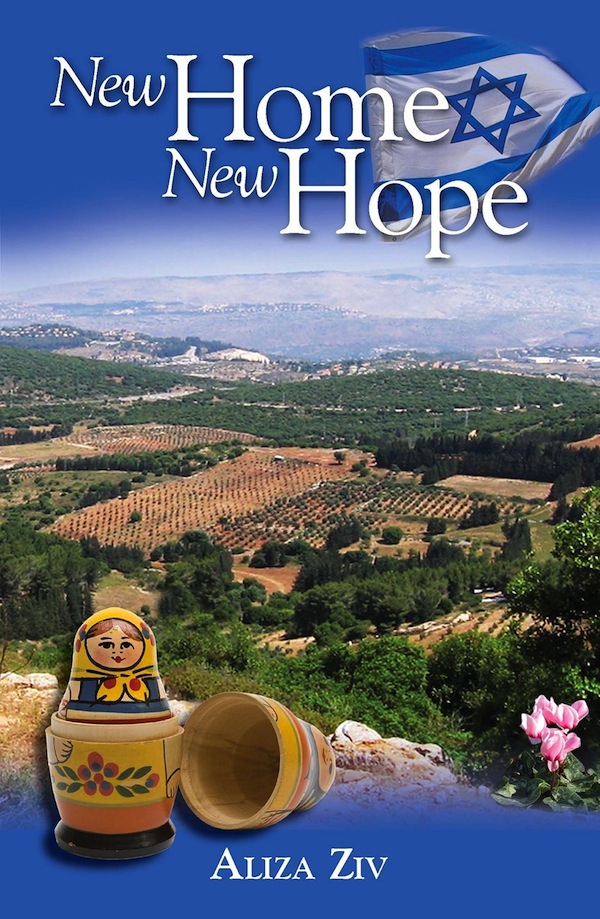
New Home, New Hope edutains on aliya and the Soviet Union.

With the themes of Passover still reverberating, I read Aliza Ziv’s book New Home, New Hope (Contento de Semrik, 2014). About a single mother making aliya from the Soviet Union with her two young children, the book is about freedom, being strangers in a new land, becoming part of a community, respecting the past while trying to create a more promising future.

book cover - New Home New HopeThe story centres on Marina, Boris, 9, and Tanya, 4, and their experiences integrating into Israel from 1985 through 1995. It is both a specific and universal tale about immigration, and the challenges and opportunities new immigrants face anywhere in the world. However, the specificity is what most intrigued me. Ziv writes with authority and in detail about both the absorption process in Israel at the time and the political situation there and in Russia during that decade.

“This book was written on the basis of my vast experience teaching new immigrants who came to Israel (olim hadashim),” wrote Ziv in an email to the Independent. “These immigrants had to face a new culture, language, values, and had to adapt themselves to their new homeland.”

Ziv explained that she first published the novel in Hebrew in 2002 with the title Difficulty Beyond Words. “Later on, my husband Joe and I decided to translate it into English. It was published in October 2014, with a new name, New Home, New Hope.”

“The book is also based on what we had to face when we and our three children made our aliya in 1967,” added her husband in a separate email. “Aliza was a shlicha, sent to teach modern Hebrew using the ulpan method. She taught in Halifax, Toronto and, finally, in Vancouver at the Talmud Torah.”

While Aliza was born in Jerusalem, Joe grew up in Vancouver, went to VTT and King Edward High School, and graduated from the University of Alberta. “I was active in Young Judaea, one of the first organizers of Habonim, and one of the founders of Camp Miriam,” he said of his local connections.

The Zivs’ personal experience with immigration comes through in Aliza’s writing. She doesn’t sugarcoat the difficulties of leaving an established life, family and longtime friends and integrating into a new country, having to learn another language, find a home, (re)start a career, build relationships, etc., etc., all the while worrying about those you’ve left behind. And your new fellow citizens must also get used to your presence in their country – immigrants seem threatening to some people, to their job security, their traditional way of life, and Ziv also tackles these issues in her novel.

One particularly interesting scene is a party on a moshav at which the more established Israelis are playing old Russian songs, wondering why the new immigrants aren’t joining in. One of the Israelis explains how the chalutzim (pioneers) “came to build the Jewish homeland, and within them was an integration of socialist and even communist values and concepts. And so they established cooperatives, kibbutzim and moshavim…. We grew up with lots of love of the Russian culture, its music and especially its songs. It is really in our blood.” The new immigrants are not convinced, and one points out that many of these songs “not only have a romantic base but also have an antisemitic and militaristic, murderous one. About Bogdan Khmelnsiky, Simon Petliura, have you heard of them?” The debate continues, and it is these parts of New Home, New Hope that I found the most compelling. (I have since looked up both of these men online.)

From a literary perspective, New Home, New Hope is not one of the best books I’ve ever read, and the formatting and editing is not as clean as it would be if it had been put out by a conventional publishing house, but it is one of the more interesting books I have ever read. Ziv is a good writer and she is a fount of knowledge on topics that many readers would profit from – and enjoy – learning about.

New Home, New Hope is available in both digital (Kindle) and printed formats through Amazon.

Cookbook resurfaces

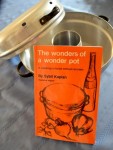
Having received letters asking for copies of her 40-year-old cookbook, the author has had it reprinted, and it is available for purchase. (photo by Barry A. Kaplan)

In the 1970s, when I made aliya, I discovered that Israel was a bit behind the United States and, when renting an apartment, chances are you would not find a stove but, rather, two burners instead. Many of my friends rented apartments with the same problem, and one of them introduced me to a gadget that looked like an angel food cake pan with a lid and holes to release the heat; it had a base to place over a burner and the lidded pot went on top. It had been used in Israel for years. It was called a “wonder pot.”

I soon wrote a cookbook called The Wonders of a Wonder Pot: Cooking in Israel Without an Oven. To my surprise, it became a bestseller among students, new immigrants and people on sabbaticals, as well as those who loved the nostalgia.

In recent years, it somehow resurfaced, and I began receiving letters asking for copies of the 40-year-old cookbook. After depleting the supply my husband Barry and I brought with us, I decided to have it reprinted. Anyone in the United States or Canada who would like a copy can now have one for $25 including postage; those in Israel can have one for 100 NIS. For more details, email me at syb1023@aol.com.

Sybil Kaplan is a journalist, foreign correspondent, lecturer, food writer and book reviewer who lives in Jerusalem. She also does the restaurant features for janglo.net and leads weekly shuk walks in English in Jerusalem’s Jewish food market.

Unique taste of Israel

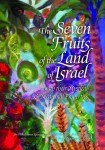
Chana Bracha Siegelbaum is founder and director of the Midreshet B’erot Bat Ayin: Holistic Torah for Women on the Land. Located 20 minutes south of Jerusalem in the Gush Etzion community since 1994, its programs include monthly seminars for English-speaking women, experiential weekends and holiday studies based on a curricula emphasizing women’s spiritual empowerment through traditional Torah values. The rebbetzin also tends an orchard of 50 fruit trees, and she has recently published The Seven Fruits of the Land of Israel (Menorah Books, 2014).

Danish-born Siegelbaum wrote this cookbook over 17 years, and it features more than recipes – it includes the mystical and medicinal properties of the seven species. For each of the species, mentioned in Deuteronomy 8:9-10, there are other biblical sources. Siegelbaum offers for each species an attribute, character trait, holiday, weekday, world, body parts, shepherd, prophetess, numerical value, how often it is mentioned in the Bible and the meaning of its Latin name. After this are nutrition facts, medical associations, kabbalah references, recipes, a story and general references.

The book is compiled and expanded from the rebbetzin’s yearly workshops, and “the Torah teachings carry the main weight of the book, as Torah is [her] passion and training.”

Siegelbaum writes that the seven fruits of Israel affirm the G-d of Israel, the people of Israel and the land of Israel. Wheat is soft and sweet; barley, tough and hard; grapes are succulent and deliciously juicy; figs are plump and fleshy; pomegranates are tangy, vibrant and crunchy; the bitterness of olives contrasts with the honeyed sweetness of the dates.

After completing the text of the book, which took more than 15 years, Siegelbaum then spent a year working with the graphic artist and fine-tuning it. Jessica Friedman Vaiselberg, who created the illustrations, is originally from Kentucky; she studied at the Memphis College of Art and graduated from the University of Louisville. She and her family live on Long Island, where she has a home studio.

Not only is The Seven Fruits of the Land of Israel a fascinating book, but there are 162 color photographs to enhance the work, a summary chapter, three appendices and essays about the author, the artist and the Midreshet, as well as numerous illustrations and paintings.

Special touches to the book include border illustrations of each species, color-coded to match the species – for example, the use of a grape color for the grape chapter, green for barley, etc. Additional illustrations are on the bottom of each page.

There are 67 recipes, many unique, including wheat burgers, wheat-germ brownies, baked barley, barley beet salad, chocolate grape leaves, Rambam’s charoset, fresh fig spread, quinoa pomegranate almond delight, anti-wrinkle pomegranate-feel facial cream, flavored olive oil, Moroccan-inspired cooked olives, dream of date balls and guilt-free chocolate mousse pie.

Even though the rebbetzin leaves out the number of servings, her styling includes the things that I always find most useful – a little comment, numbered instructions and a separation of ingredients from instructions, in this case, in a shaded box.

The Seven Fruits of the Land of Israel was awarded the 2015 Gourmand World Cookbook Award in the best Jewish cuisine category and in the best cookbook fruits category. Here are a couple of recipes from it.

TENDER POMEGRANATE TABOULI

1 cup cracked wheat (bulgur)
1 bundle finely chopped parsley (about 2/3 cup)
1 bunch finely chopped mint or 1/2 cup dry
1/2 cup finely chopped green onions or scallions
1/2 cup pomegranate arils
1 finely chopped cucumber
juice of 2 lemons
2 tbsp olive oil
sea salt to taste
freshly ground black pepper to taste
allspice to taste

1. Pour boiling water over cracked wheat.
2. Soak cracked wheat in water for at least one hour. Pour out extra water.
3. Soak the parsley, green onions and mint in natural soap water for three minutes. Rinse.
4. Process parsley, green onions and mint in a food processor until very fine.
5. Mix finely chopped herbs and onions with the soaked bulgur.
6. Add the pomegranate arils and chopped cucumber.
7. Pour juice of the lemons on the tabouli and add the olive oil, salt, pepper and allspice.

OLIVE WALNUT SPREAD

1 can of pitted green olives (1/4 pound)
4 garlic cloves
1/2 to 1 cup walnuts
1/4 cup extra virgin olive oil

1. Puree olives, garlic, walnuts and olive oil in a food processor. Serve as a dip.

Sybil Kaplan is a journalist, foreign correspondent, lecturer, food writer and book reviewer who lives in Jerusalem. She also does the restaurant features for janglo.net and leads weekly shuk walks in English in Jerusalem’s Jewish food market.

Israeli election scenes

Left to right: Winnipeg transplants Miriam, Ronit, Dor and Bruce Brown. (photo by Bernie Bellan)

Rehovot, Israel

Once again, Election Day has come and gone and the world continues to spin; albeit slightly more rightward for Israel.

I went to sleep the night before the recent election a bit more excited than usual – I love the hoopla of an Israeli Election Day – and a bit more apprehensive than usual – I was still not sure who to vote for.

Election Day in Israel is a holiday, and we had a fun day ahead of us. My son was set to participate in our democratic process. My wife and I were set to vote – well, almost, as I was still undecided. We had a family lunch date with friends. And I was looking forward to watching the exit polls at home.

My son – still too young to vote but not too young to hold an opinion – was manning a party booth outside the local polling station. Dressed in a party hat and T-shirt and armed with colorful brochures, he was out of the house by 7 a.m., surprising, since we can barely get him out of the house on a school day, which starts an hour later!

As opposed to the sterile polling environment of Canada, Israel’s polling stations are last-minute electioneering grounds. Every party has a booth with party hacks or students for hire (such as my son) vying for last-minute votes. And multiple cars covered with party posters and carrying huge loudspeakers on their roofs compete for sound waves by blaring political jingles – a classic Israeli balagan. The scene is lots of fun and a great place to catch up with neighbors and friends to debate Iran, the religious, the economy, last summer’s war and who to vote for and who not to vote for.

I think the last time I voted in Canada was in the 1998 election when I cast my vote for Brian Mulroney. Oops – should I have written that? In Israel everyone knows not only what you earn and how large a mortgage you have, but also how well you get along with your mother-in-law and who you vote for. We are a very open and argumentative society, so voting preferences are common water cooler and Friday night dinner table talk.

Anyway, by mid-morning my wife, daughter and I – and even our dog – went to visit my son and to cast our votes. With our identity cards and a falafel in hand (a not unusual text message arrived from my son a few minutes before we left the house: “I’m hungry”), off we went to the polling station.

It was more crowded than usual and we actually had to wait in line – or what counts for a line in Israel – to reach the ballot box. My wife confidently cast her vote. And I – in a last-minute decision (no doubt influenced by a quick chat with a party faithful just outside) – cast my lot for a pure centrist party. OK, there were two of them, but being a good Canadian (!) I will keep my specific choice secret.

Afterwards, we drove to Tel Aviv where we met friends at an excellent Persian restaurant, an appropriate choice given some of the election issues. For sure the talk was about the elections but also about other things just as in any normal country. And Israel, in its own special way, is a normal country … even on Election Day.

Towards mid-evening, I popped my microwavable popcorn and relaxed in front of the TV to watch the exit polls. Since it appeared to be a virtual tie, I went to sleep around 11 p.m. believing a national unity government was inevitable. True to form for Israel – where the unexpected should be expected – I woke up the next morning to a strong right-wing lead, with the overwhelming likelihood of another four years of Netanyahu rule, with a strong tilt to the religious right.

Good? Bad? With Election Day come and gone, one thing is clear: the Israeli beat goes on.

Bruce Brown is a former Winnipegger now living in Israel. This article was originally published in the Jewish Post and News and is reprinted with permission.

Rock pioneer plays at Chan

Micha Biton headlines the community’s Yom Ha’atzmaut celebrations April 22. (photo from Micha Biton via Jewish Federation of Greater Vancouver)

Seven years in the making, Laura Bialis’ documentary Rock in the Red Zone premièred last October at the Haifa Film Festival, and has since enjoyed several other prominent screenings in Israel. Less than a kilometre from the Gaza Strip, Sderot has been a favorite target of Hamas rocket fire for the last decade and a half – but it has also been the birthplace of a unique style of rock music, producing more than its share of popular bands and singers. One of the rock pioneers featured in the documentary steps off the Israeli silver screen and into Vancouver’s Chan Centre for the Performing Arts on April 22 to lead our community’s Yom Ha’atzmaut celebrations – Micha Biton.

JI: Your stop in Vancouver is part of a North American tour for Like Water. Are you traveling with a band? If so, who and what instruments?

MB: Exactly a year ago, my fifth album, Kmo Mayim (Like Water), was released in Israel and we performed a series of concerts around the country in celebration of the release – a tour that was very successful and drew attention from radio, television and media outlets. Subsequently, I performed in both San Francisco and New York and realized that, despite the fact that over half of the audience does not understand Hebrew, the music touched the hearts of those who heard it. For this concert in Vancouver, I am coming with five amazing musicians: Yossi Shitrit (electric guitar), Shir Yerushalmi (electric guitar), Hillel Shitrit (keyboards), Itamar Abohasera (drums), Shai Zrian (bass).

JI: In which other cities are you performing on this tour? For how long are you here?

MB: We are coming directly from Israel, and Vancouver is the first city on our tour. After Vancouver, I will perform in Los Angeles and San Francisco. I’ll be in North America for less than two weeks. Due to my heavy performance schedule in Israel, I couldn’t carve out more time to tour on this trip, but I always manage to make a little time to take in the atmosphere of the cities in which I perform. This is not my first time in Vancouver – last year, during the war between Israel and Gaza, I brought my whole family to Vancouver to visit my wife’s family and I fell in love with your beautiful city and people. I’m excited that on my second trip to Vancouver I will get to perform for the wonderful people that I met in Vancouver.

JI: Like Water is your fourth solo recording?

MB: Kmo Mayim is my fourth solo recording, but it is my fifth album. In 1997, I produced my first album, Tanara, with a group of talented musician and it received critical acclaim in Israel. Soon after, I became a solo artist and, over two decades, I recorded four albums of original music. For me, Kmo Mayim is a very personal album that I wrote about relationships – friendships, love, connection with God. Every song tells a different story, and every story has an open-ended moral attached to it. I’m very proud of this album and I’m happy that my audiences like it.

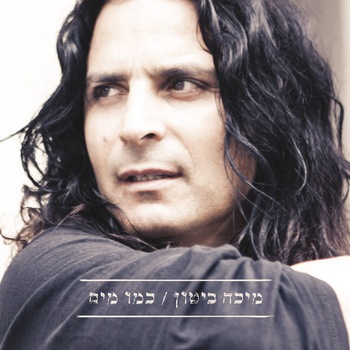
image - Kmo Mayim cover
Micha Biton’s latest CD is Kmo Mayim.

JI: You are one of the pioneers of the renowned rock music scene in Sderot. Could you share a bit about its development, how it has changed over the years?

MB: In the 1990s, I created a band called Tanara, a period that saw an incredible explosion in the Israeli music scene, especially in Sderot. Bands like Tippex, Knesiyat Hasechel and ours developed a new sound that was special and unique to Sderot, combining rock music with the Moroccan/ethnic sounds of our neighborhoods and our childhoods. In those early days, Sderot was underdeveloped and family-oriented. We didn’t have much to do, so music became our lives and we played and composed in the bomb shelters all of the time. (In those days, we used the shelters for writing music and rehearsing for concerts. Today, unfortunately, they are used as shelters from the rockets fired from Gaza.) In addition, it was a town where everyone knew everyone – there was no such thing as a stranger in our town, and the warmth created by this strong community significantly influenced our ability to create something unique musically.

JI: How about your own style? How would you describe it now versus when you first started out?

MB: My musical style hasn’t really changed much over the years. I’ve been very successful continuing to write ethnic rock in the style that I helped to create and I am lucky that my audience appreciates my style and my sensitivity. While my roots are strongly planted in Sderot, I am different than most of my fellow musicians from the area. At the age of 10, after my father died, I left my Moroccan biological family and was fostered by an Ashkenazi family in Jerusalem. From that early, tender age, I started to live between two cultures, understanding the beauty of each, and using both of them to influence the way I compose and the way I live. It turns out that my foster mother, Galila Ron-Feder, was a modestly successful author in Israel who shortly after my arrival chose to write an entire book based on my life and my journey (and I was only 10!). This book, El Atzmi (To Myself), became her most successful book. It became a series of books, and then a movie. It has been translated into 27 languages. The influence of Galila and her world, and the world of my parents together, helped me to create a new world of my own. My music and the lyrics that I write are very connected to the fact that I have lived most of my life straddled between these two worlds.

JI: A 2007 New York Times article refers to “Biton’s anthem for Sderot,” which was “I don’t leave the town for any Qassam.” What is it like living in Sderot these days? Are you hopeful for the future?

MB: In the quiet days of peace, we love living in this area. My nine brothers and sisters and their families live in Sderot, and my family and I live on the border between Sderot and Gaza in Netiv Haasara, a moshav where we can see Gaza from our backyard. This is my home, and we are very drawn to this place. For the past 10 years, we have lived with the reality that at any moment, day or night, the sirens will start and we have 15 seconds to run to our bomb shelters. Our children have grown up with the feeling that life is beautiful but uncertain. This past summer, and several times in the past, we have been forced to leave our homes and our community because of the imminent danger that the conflict caused. Rockets fell on our yard. A rocket hit my wife’s parents’ home, who live a block away from us, destroying precious family heirlooms. For every rocket that fell last summer, there are hundreds of rockets that have landed around us in the past 10 years that go unreported but, for us, they are very real. When we came to Vancouver last summer, my 4-year-old son looked at me and asked, “Abba, why don’t they have tzeva adom (warning sirens) here in Vancouver?” and I explained to him that not everyone has to deal with rockets falling on their heads all of the time. It was a very sad moment for me.

In 2007, when I wrote the song ‘I don’t leave the town for any Qassam,’ I felt that people were deserting Sderot and all of her beauty because of the situation. I wanted to give them strength and remind them that it was critical to stay and to fight for our hometown. Less than a year later, I wrote HaTzad HaMuar (The Lighted Side) from the same place in my heart. Despite all of the pain, I wrote, don’t forget the light, the hope, the optimism. Because that is really what Sderot is all about. Not a place where rockets fall, but a place of warmth and love and peace.

JI: In the same article, you speak about Hagit Yaso as a star almost certain to rise to the top. She has, of course. And she played here in Vancouver last year for Yom Ha’atzmaut. Are there any current young Sderot musicians for whom we should be keeping watch?

MB: Hagit is an amazing singer and an extraordinary human being. I’m proud to stay that she was one of my most talented students when I taught music and theatre in Sderot. I am so happy for her success and that she represents a new generation of musicians that has emerged from Sderot. The wonderful thing about this young generation is that they are succeeding to continue the tradition of Sderot, bringing exciting new musical projects to Israel and to the world. During one of my tours, I invited her to the stage to sing with me, and it was a really beautiful moment of connection between the pioneers of the music scene and the young musicians of this generation.

One of the new, talented musicians climbing up the ladder at the moment is my cousin Tzafrir Yifrach, who concentrates on world music. He has exceptional talent and is performing quite a bit these days around Israel, and musicians from all over Israel love coming to his recording studio in Sderot to work on their own projects with him. Another rising talent is Nir Vaknin, who is in the process of finishing his debut album.

JI: If there is anything else you’d like to add, please feel free.

MB: During the time that I was in production for Kmo Mayim, I started another project with a musician from the U.S., Lisa Tzur, who was the executive producer of Kmo Mayim. I’ve traveled a lot in North America and have performed at synagogues where the singing was so beautiful that I never forgot it. I wanted to be a part of that somehow. Taking words from the prayer service and from Psalms, as well as a few original texts, we recorded a project that is different than anything else that I have recorded. The idea was to create music that was accessible and singable by audiences that were not necessarily Israeli. Lisa comes from that world (as a lifelong member of the Reform Jewish movement and as an ordained rabbi) and together we created something very special that will be released this summer both in Israel and in the world.

The April 22 festivities at the Chan start at 7:30 p.m. For tickets ($18) and more information, visit jewishvancouver.com/yh2015.

Biggest improbability?

In September of 1978, U.S. president Jimmy Carter was at his wit’s end after 12 days of face-to-face negotiations between himself, Egyptian president Anwar Sadat and Israeli prime minister Menachem Begin.

Neither party was at all inclined to make peace, both had legitimate grievances with the other nation, advisors were telling them peace was not possible and that the leader and the nation each man represented could not be trusted. Things got so heated that all three parties had packed their bags and prepared statements that the talks had failed. Cars were idling in the Camp David driveway and Marine One, the presidential helicopter, was being readied to return Carter to Washington empty-handed.

Failure then, in the midst of the Cold War, would have meant an opening for the further arming of Egypt by the USSR and the nuclearization of the Middle East, where ultimately the fanatical forces that were then lurking in the shadows could very well force the Superpowers into a feared nuclear standoff. This was much like what was happening in East and West Germany at the time, only in the hot desert sands of the Middle East, it was far more likely that tempers would boil over.

These were the stakes at Camp David. The proposition was that Israel give back the Sinai Desert, land it had captured in the Six Day War, land that served as their saving buffer zone in the Yom Kippur War just five years earlier. Land that contained settlements of Israeli citizens that Begin had pledged on his life never to abandon. To do all of that in exchange for a piece of paper that promised peace, signed by three men who did not trust each other.

No one thought it probable or possible, not between these three men, Begin and Sadat, who had spent a lifetime fighting each other, and Carter, who lacked power at home and credibility abroad.

And, yet, they signed a lasting peace treaty. Israel had been at war with Egypt in one form or another for literally millennia, since the days of Pharaoh. They have not been at war since and, next to Jordan, Egypt is Israel’s closest ally in the region today.

Mark Twain said, “History doesn’t repeat itself but it often rhymes.” No two eras or events are the same, but many if not all have similarities.

Three years before Camp David, president Gerald Ford had announced that the United States would be reevaluating its relationship with Israel because of Israel’s power play, along with France, in the Suez Canal. A crisis, if you recall, that nearly, like the Cuban Missile Crisis, was only a series of missteps away from another nuclear confrontation between the United States and the USSR.

You could not have had Camp David if you had not also had the sobering realization of the Suez Canal Crisis. Carter could not have pressured Begin to do the good and hard thing for the future of Israel if Ford had not created enough daylight between the United States and Israel for Begin to see the light at the end of the endless wars with Egypt tunnel.

“History doesn’t repeat itself but it often rhymes.” I am neither a politician, nor a political scientist – though in truth I have a degree in the latter and every rabbi must ultimately learn the skills of the former. I am a student and teacher of history, the history of our people both in the land and yearning for the Land of Israel – and in all that has happened in these past many years, really since the assassination of Yitzhak Rabin (alav ha’shalom), I hear the rhyme of history.

Call it “darkest before the dawn,” but while I am filled with worry, the seriousness of the matter gives me hope that it can no longer be ignored or put off. That the pressure of absolutes that made Camp David possible has returned to make peace between the Israelis and Palestinians possible, though still improbable once again.

The region and its people are under near-bursting pressure. But pressure such as faces Israel also clarifies priorities. The greatest achievements of diplomacy have often come in the face of the most extreme pressure or, as Carl von Clausewitz wrote, “War is diplomacy by other means.”

Let’s examine the pressures in play.

In Israel, the status quo between Israelis and Palestinians is set to devolve into a third intifada. Meanwhile, there is a seismic schism between the Jews in Tel Aviv who voted overwhelmingly for the left and the Jews in Jerusalem who voted overwhelmingly for the right. Israelis on left and right are living two different realities, and they want two different futures for themselves and for the Palestinians.

In the Arab world, the forces of fundamentalism have shaken what little remains of the nation-states from their complacency with and tolerance for radicalization. Arab armies are mobilized against radicalism and terror. Yes, there is a vacuum of leadership throughout the Arab world, including among the Palestinians – but that also creates space for a leader to emerge.

Outside of the Middle East there is a fundamental disagreement between Western democracies that want Israel to act more like them, and Israel that wants the West to see that the terrorist threat confronting its democracy today is coming to their shores tomorrow. And for much of Europe tomorrow is today.

Jews are under attack around the globe. Antisemitism has come out of hiding once again. Much of antisemitism is ignorance and, yet, where do we find it? Most shockingly in our institutions of higher learning, where, in the most distorted and twisted forms, they equate Jews with Nazis. We see this happening particularly in the BDS campaigns that are sweeping across North American university campuses and right here at the University of British Columbia. These same antisemites defend terrorists as “heroes,” inviting them as speakers on campus. The Talmud says, “olam hafouch,” the world is upside down. Indeed, bigotry masquerades as fairness.

The pressure is not only external; it is internal, as well. The relationship between Jews in the Diaspora and Jews in Israel is becoming a dysfunctional marriage. It’s not headed for divorce but maybe separate bedrooms, as each tries to focus on things they love about the other, even when they are disappointed in the other.

It seems hopeless, I know, this election result whether you are left or right – the winner of the election was “hopelessness” itself. As Binyamin Netanyahu declared, in his view, there will never be a Palestinian state while he is prime minister. Those who voted for him believe that to be true and those who voted against him believe that to be true. That is the very definition of being without hope.

There is no solution to this conflict in this neighborhood, in this region, in this time. And, with no Palestinian leader who can do the same, it’s just not possible.

And, yet, we said the same before Camp David. We never thought Rabin would shake Arafat’s hand or make peace with Jordan. That Sharon, who built the settlements in Gaza would dismantle them, and that it didn’t lead to civil war.

Begin, Rabin, Sharon. These were not peace seekers, these were warriors, evolved Hawks.

We are not ready for another Camp David today; Netanyahu is not anywhere near ready, and there is no leader on the other side who can be a Sadat or a King Hussein of Jordan, a warrior who has the credibility to make peace.

By the same token, the only one in Israel right now who has the credibility to make peace with the Palestinians is Netanyahu. If he signs off on it, the people will believe it.

We are in a dark period and it may get darker. The pressure on Israel will only increase. The choices the country will have to make are impossible to understand right now. Our own solidarity both with Israel and with each other as fellow Jews will be tested, and there will be cracks. But that is nothing new for us, or for Israel. We don’t always agree, as Jews here or there, past or present, we seldom agree. In the end, however, what we have always done is survive. There’s the biggest improbability of all: that we are still here.

Israel is 67 years old. By comparison, it took the United States 150 years to reconcile slavery, a process that included a civil war, incomprehensible social disorder and civil unrest. And the United States, which is almost 200 years older than Israel, is still not yet resolved on the issue of race, as Ferguson – among many other events – reminds us.

Canada could say some of the same about true reconciliation with First Nations. We are not yet there.

This election was part of the growing pains of a nation and, in the age of nations, Israel is barely a teenager. Israel is the bat mitzvah girl who stands proudly, if not ironically, before the congregation and declares, “Today, I am a woman!” And we all smile and say to ourselves, “Not yet, but today you gave us a glimpse of the woman you will one day be. It would be more accurate to proclaim, “Today, I will no longer act like a child.”

“The arc of history is long,” Martin Luther King Jr. preached, “but it bends toward justice.” That’s the history of the world and it’s the story of our people, a story we are telling again around our seder tables this week.

What do you take away from the seder? That Pharaoh was cruel? That slavery was terrible? Yes, but also that we were redeemed; that the pressure on Pharaoh ultimately helped him see the light.

La’yehudim hayta orah” we sang just recently on Purim and every week, as we end Shabbat with Havdalah. “The Jews enjoyed light and gladness, honor and joy. May we, too, experience these same blessings.” In another dark time, when all hope appeared lost, there was light. Let there be light once again!

Dan Moskovitz is senior rabbi of Temple Sholom in Vancouver.

Folk music in the Holy Land

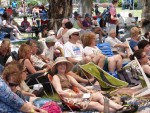
The author enjoying a day of folk music from around the world at Israel’s Jacob’s Ladder festival. (photo from Miri Garaway)

I have always been a folk music aficionado, so when I heard about the Jacob’s Ladder Music Festival in Israel, I planned a trip there entirely around the idea of attending the festival. Not only was it a phenomenal event, it exceeded all my expectations and was the highlight of our month’s stay.

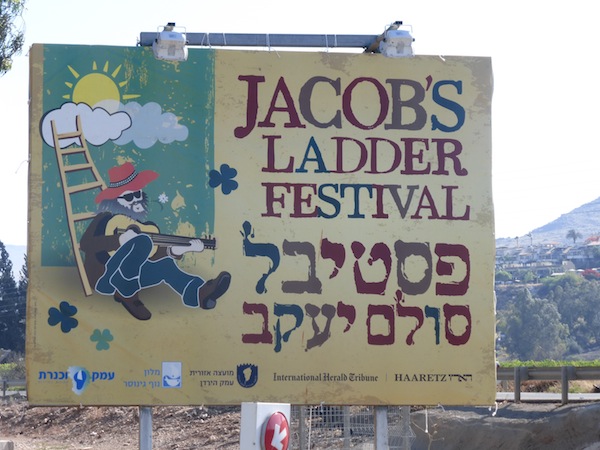
photo - Jacob's Ladder Festival sign
(photo from Miri Garaway)

Established in 1976, Jacob’s Ladder (Sulam Ya’akov) is held twice a year, in May and December, with the spring festival on a larger scale. It is billed as “Israel’s friendliest musical and social event, a unique bluegrass, folk, country, blues, Irish and world music extravaganza.” That it was.

With the venue on the grounds of Kibbutz Nof Ginosar on Lake Kinneret, nine kilometres north of Tiberias, the setting could not be more beautiful and the atmosphere is very relaxed, “green” and peaceful. Approximately 4,000 people attend the spring festival, yet it did not feel crowded or overwhelming.

How wonderful to be able to attend a two-and-a-half-day event and know that there is free camping on site, in addition to the pleasant Hotel Nof Ginosar. From the moment we entered the site, on a Thursday afternoon in May 2014, we could feel the energy of the special event that was about to take place.

The organizers have registration down to a science. We bought our tickets upon arrival, received our fluorescent wristbands and joined the throngs of festival goers entering the site. Considering the volume of people arriving, we were amazed that we only had to wait a short time in the line-up for tickets. Pre-festival online tickets helped to ease any congestion.

And, perhaps only in Israel would they provide free agalot, large wheely carts in the parking lot so you can carry all your belongings into the grounds. I found this so civil and convenient and it was fun to watch the hordes of people streaming in with their tents, barbecues, bicycles, chairs, strollers, blankets, duffle bags, food coolers and other camping paraphernalia.

This is a festival that everyone can enjoy: young families, teenagers, baby boomers, aging hippies and young-at-heart seniors. While it originated as more of an anglophone festival, today, many non-anglophone Israelis and tourists attend, too.

The festival is extremely well organized, with activities such as free early morning outdoor yoga and tai chi classes, holistic treatment kiosks, a craft fair, children’s handicraft workshops, a children’s puppet-making workshop, storytelling, juggling, Irish, tap and square dancing workshops. Food booths are also set up on site with pre-purchased tickets to be used throughout the festival.

We chose to stay at the kibbutz guesthouse, Hotel Nof Ginosar. Although the hotel is fully booked for the festival from year to year, the reservations clerk suggested we put our names on the waitlist (this was in October) with a good chance that a room would become available closer to the date of the festival. In the interim, we booked a nearby bed and breakfast to ensure that we had some accommodation in place. We were fortunate that space at the hotel did open up a couple of months before the festival.

It was convenient to stay on site rather than commuting. The hotel is basic, but clean and comfortable and every room has a fridge. The bountiful and delicious Israeli breakfast, included in the room rate, gave us a great start to the day.

While exploring the grounds, I met my Israeli cousin from a nearby moshav, who promptly invited us to his tent for a communal Shabbat dinner. Suddenly, we were among family and friends for a feast. This unexpected rendezvous was indeed a treat.

Jacob’s Ladder is easy to navigate. The main stage is a huge expanse of grass where you can put down blankets, towels or low chairs to reserve a spot for the entire weekend. This is unheard of at most festivals, since you usually have to collect your things at the end of the day and race for the coveted spots each day. It is an unspoken rule at Jacob’s Ladder that if you are not using your space, anyone can sit in your place until you return. The whole area is covered by an enormous see-through tarp, so the sun does not beat directly down on you. Once you are settled in, it is pure joy to sit back, relax and enjoy the outstanding talent and the incredible music. On many occasions, people are moved to get up and dance. You also get to know your neighbors and it feels like a community within a community. It is interesting to make connections with the people who are around you.

There is also the lawn stage, a smaller space with chairs set up on the plaza outside the hotel lobby. Another music venue within the hotel is Hermon Hall, an indoor auditorium, as well as the balcony stage and the sports hall for music and dance workshops.

The performers are often available to meet right after the concert, at a table beside the stage, where they sell their merchandise.

In addition to Israeli artists, musicians come from all over the world to perform at the Jacob’s Ladder. A sampling of some of the stand-outs for 2014 included the Jammin Divas; Maya Johanna, Shay Tochner and Yonatan Miller in a tribute to Pete Seeger; the Slocan Ramblers; and a variety of singers who belted out a moving medley of the songs of Janis Joplin, Joni Mitchell, Eric Clapton and Ray Charles. From the strumming of the Ukeleles for Peace Children’s Orchestra to the lilting sounds of Nava Tehila singing Jewish world music for Kabbalat Shabbat, this was a festival that moved and energized me.

The hotel kindly allows jamming sessions in the lobby and bar areas and people bring guitars, banjos, violins, flutes, clarinets, harmonicas, drums and an assortment of other instruments to showcase their talent. What a wonderful hive of activity and a delight to hear music wafting throughout the hotel. There are also pop-up jamming sessions on the grounds, away from the stages. People-watching is an activity unto itself.

If you want to take a break, there is a swimming pool, as well as the lake beach of the Kinneret, but we came for the music and it was truly an exceptional experience.

Miri Garaway is a freelance travel writer.

Israel issues travel warnings

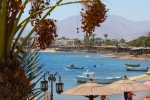
A view of shore from a dive shop in Dahab, South Sinai, Egypt. (photo by B. Simpson via commons.wikimedia.org)

During the upcoming school holidays of Passover, followed by the summer months, many Israelis travel abroad. Europe is only a few hours away by plane, and the beaches of Cyprus and Greece are even closer. Vacations abroad, even including the flight, are often cheaper than local getaways because of the high price of Israeli hotels. However, the Israeli government has issued travel warnings for 41 countries, including Europe and Asia.

“Recent terrorist attacks by Islamic extremists in Belgium, Canada, Australia, France and Denmark raise concerns over additional attacks against Western targets, including Israeli and Jewish targets, by veterans of the fighting in Syria and Iraq who are affiliated with global jihad (including Islamic State) and by local elements inspired by the terrorist organizations.”

The travel warning, issued by the National Security Council Counter-Terrorism Bureau, noted that is illegal for Israelis to travel to “Syria, Iraq (including Iraqi Kurdistan), Iran, Lebanon, Yemen and Saudi Arabia.”

The warning comes amid a spate of attacks on Western and Jewish targets including the Charlie Hebdo magazine and the Jewish supermarket in Paris, the shooting in Denmark and, just this weekend, an attack on a synagogue in London.

Israeli terrorism experts say Israelis do not seem to be the primary target of these attacks.

“Until now there have been two main targets – governmental targets in Western countries and Jewish institutions,” Reuven Ehrlich, a terrorism expert, explained. “Israelis have not been the target, but I cannot tell you what it will be in the future.”

However, the warnings do not seem to be affecting travel plans. Israelis have one of the highest rates per capita of travel abroad, taking two million trips a year, although there are no statistics about how many of them are travelers who fly several times a year. Israeli travel professionals say they are telling their clients to maintain a lower profile.

“We are asking our passengers to be a little quieter, which is a good thing no matter what,” said Mark Feldman, chief executive officer of Ziontours in Jerusalem. “Israelis tend to be loud and raucous and call attention to themselves. We have several groups going to Europe in the next few weeks and we have told them not to congregate in the lobby, not to speak in loud voices and, if possible, not to speak in Hebrew.”

Read more at themedialine.org.

An extremist war on women

A small Israeli ultra-Orthodox newspaper in Israel became the target of international ridicule earlier this year after blotting out the faces of three women from a prominent photo of 40 world leaders.

Heads of state were marching through the streets of Paris to demonstrate solidarity with France, opposition to terrorism and support for freedom of expression after Islamic State sympathizers murdered journalists at the satirical magazine Charlie Hebdo and Jewish hostages at a kosher market in a Paris suburb.

HaMevaser, which serves an insular Israeli community indifferent to modernity, seems to have missed the point of the march. HaMevaser editor Binyamin Lipkin defended the altered photo, insisting a photo in the newspaper that included German Chancellor Angela Merkel, Paris Mayor Anne Hidalgo and European Union official Fedrica Mogherini would “desecrate” the memory of the 17 people who were killed.

The incident once again drew attention to the fanaticism of the ultra-religious community in Israel that demands the complete removal of all photos of women in public spaces, tight restrictions on the role of women in public life and severe limits on education for both boys and girls.

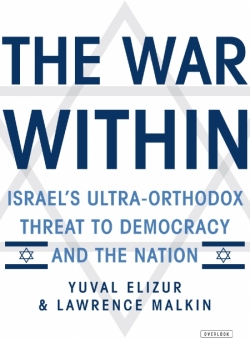
book cover - The War Within: Israel’s Ultra-Orthodox Threat to Democracy and the Nation by Yuval Elizur and Lawrence MalkinTwo books, written in a conversational style, came out recently that shine a glaring light on recent controversies sparked by the ultra-Orthodox in Israel. Reading them together provides a broad understanding of the issues.

The War Within: Israel’s Ultra-Orthodox Threat to Democracy and the Nation (Overlook Press, 2013) by journalists Yuval Elizur and Lawrence Malkin, looks at several flashpoints that, the authors say, will invariably turn into even more difficult social, economic and political problems as the ultra-Orthodox population grows.

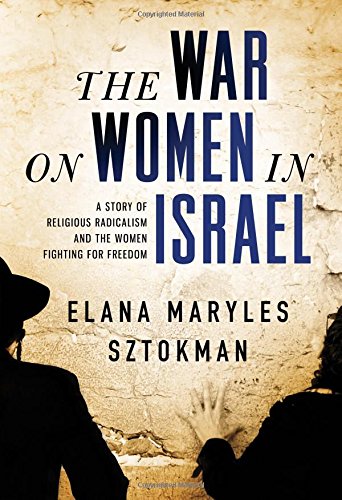
The War on Women in Israel: A Story of Religious Radicalism and the Women Fighting for Freedom (Sourcebooks Inc., 2014 ) by feminist activist Elana Maryles Sztokman, is an unrelenting assault on Israeli society for accepting blatant discrimination against women in almost every aspect of their lives. At times, the book reads like a social activist’s pamphlet demanding justice.

Israel ranks near the bottom among world democracies on the right to religious freedom. The books are reports from the frontlines in the fight for equality, and will be disturbing for those concerned about civil rights in Israel. The writers leave the impression that radical religious voices are shredding the fabric of the country.

Both books offer portraits of the ultra-Orthodox communities and a brief account of the historical context that led to the current problems. The perspective is clearly that of outsiders who have little patience for the ultra-Orthodox way of life. Nevertheless, it is difficult to ignore what they say.

Roughly 10 percent of the country and one-third of Jerusalem are ultra-Orthodox. Those numbers will likely explode within a generation, if current trends continue. The birthrate within the ultra-Orthodox community is twice the national average. As the children grow up, the impact of the ultra-Orthodox community will be felt in many different ways throughout Israeli society.

Students in ultra-Orthodox schools spend their day studying religious texts, paying scant attention to core subjects of English, math and science. Elizur and Malkin say that most students complete their formal schooling without the education or skills to work in a modern economy.

Several ultra-Orthodox schools go further, refusing to allow girls to write final exams in core subjects in order to ensure the girls do not leave school with a high school diploma.

Meanwhile, the economic life within the ultra-Orthodox community is grim and will likely degenerate even further as their numbers increase. The Taub Centre for Social Policy Research, in a report released in December, pegs the poverty rate in the ultra-Orthodox community at 66 percent in 2013, an increase from 60 percent in the previous year. The ultra-religious have the lowest participation rate in employment in the developed world.

And it’s not just a Jerusalem phenomenon. Ultra-Orthodox communities are scattered across the country. In the ultra-Orthodox community of B’nei Brak, half of all children live in families below the poverty line.

Both books provide an account of the historical roots for these circumstances. The ultra-Orthodox communities have relied almost entirely on national subsidies since the creation of the state in 1948. At that time, the rabbis argued that studying Torah and praying had ensured the survival of the Jewish people through centuries of wandering and persecution.

The founders of the state wanted to maintain the Jewish nature of the state. Religious authorities were given unqualified control over marriage and divorce. David Ben-Gurion agreed to exempt the ultra-Orthodox from military service and pay them to spend their days studying in a yeshiva. In exchange, he expected to receive their support in the Knesset.

The arrangement was a trade-off endorsed by most Israelis for more than 50 years. But demographics have shifted. In 1948, 4,000 students were studying in a yeshiva. Today, around 120,000 students study full-time and are dependent on allowances from the government. Many Israelis now are not so comfortable with the arrangement.

The trade-off has also meant that Israel does not have a constitution guaranteeing individual rights and freedoms. The ultra-Orthodox at that time refused to support a constitution, mostly to prevent shifts in the status of women, the journalists say.

The country’s founders forged practical arrangements without any long-term vision, say Elizur and Malkin. It was a colossal mistake. Successive governments have maintained the status quo, in effect placing huge barriers for those fighting for changes.

As women have asserted their right to be treated equally, religious zealots have escalated their tactics, moving from bullying and shouting to spitting, shoving and throwing rocks.

image - The War on Women in Israel: A Story of Religious Radicalism and the Women Fighting for Freedom by Elana Maryles Sztokman book coverThe ultra-Orthodox succeeded in pressuring Israeli public and private companies to ban female faces on transit ads and force women to sit at the back of the bus. Weak protection for secular values, coupled with liberal tolerance for diversity, enabled the ultra-Orthodox to push bus companies in Israel to segregate 150 bus lines across the country, Sztokman writes.

The arrests of women who sing, wear a tallit or pray at the Western Wall have been widely reported. These books provide numerous anecdotes about the confrontations on many fronts, including some outrageous instances of the struggles that some women face in obtaining a Jewish divorce from a vengeful husband. Around 10,000 women in Israel are in limbo, unable to obtain a get (a divorce decree) from the religious courts.

Elizur and Malkin also look at the government-funded rabbinic councils that operate under a minimum of oversight and with their jurisdiction only loosely defined. They assert control over everything from certifying pensions funds to ensuring that water is kosher.

Women disproportionately feel the impact of the institutions run exclusively by males. None of the judges in the religious courts are women. Until recently, even all the supervisors of the mikvehs were male.

The lack of accountability and vagueness over roles has cleared the way for the rabbinical authorities to attempt to expand their control over the lives of all Israelis. Imprecise boundaries have led to recent flare-ups over matters of division of property, child custody, alimony, child support and education. The army is struggling to find a compromise for ultra-Orthodox who are now enlisted. A battle over jurisdiction over circumcision was recently in an Israeli court.

The power of the religious authorities is on display in the most unexpected places. A produce market has separate shopping hours for men and women. Women’s voices disappear from the radio. A women’s health conference excludes accomplished women researchers and prominent women doctors from its program. Young girls cannot sing in public. Daughters are not allowed to stand by the grave of their fathers to say Kaddish.

Despite the dark portrait of the religious divide, both Sztokman and journalists Elizur and Malkin find reasons to be hopeful. Restrictions on seating on buses have been lifted on some lines; women’s faces are returning to some billboards on the street. Even the Women of the Wall can claim some victories.

Momentum is clearly on the side of the ultra-Orthodox. However, a backlash against the most extreme measures has begun to undo some excesses. The authors also find some members of the ultra-Orthodox community are working to change the system from within. Sztokman, for example, finds hope for religious pluralism in Israel from the work of an emerging alliance of Orthodox feminists and secular activists who are pushing for a more egalitarian country.

Robert Matas, a Vancouver-based writer, is a former journalist with the Globe and Mail. This review was originally published on the Isaac Waldman Jewish Public Library website and is reprinted here with permission. To reserve this book or any other, call 604-257-5181 or email library@jccgv.bc.ca. To view the catalogue, visit jccgv.com and click on Isaac Waldman library.