Good for Jews not good read

Washington Post columnist Richard Cohen came under a barrage of criticism in 2006 for writing that Israel was a mistake. Almost a decade after the controversy, he has come back with Israel: Is It Good for the Jews? (Simon & Schuster, 2014), in which he acknowledges that “mistake” may have been the wrong word and explains what he intended to say.

book cover - Israel: Is It Good for the Jews?Cohen admits that he could not think of another word to reflect the missteps in Israel’s history. He believes that early Zionists were mistaken to think the creation of a Jewish homeland in Palestine was the answer to antisemitism. Also, Israel in its 67 years has made mistakes; for example, he believes it was a blunder not to banish all Palestinians in 1948, and that it was a huge error to become an occupying power after 1967.

Those are hot topics to debate, especially after the recent election in Israel. But how are they related to the provocative question posed by the title? Cohen never makes a connection. He pays little attention to contemporary Israel and its relationship to Jews around the world. The title does not reflect the book that he wrote.

A provocative book title may be good for promotion and sales. It’s disappointing for readers who are familiar with his reputation and expect more from his book. Cohen is a syndicated columnist who has received awards for his investigative reporting. Israel: Is It Good for the Jews? was nominated for a Jewish Book Council award.

So, let’s ignore the title and look at the book for what it is. Cohen has written a brief history of antisemitism leading up to the creation of the state, an account of the early days of Israel and a quixotic account of some current events. He includes an 11-page index of books about Israel and the Jewish world that provide the anecdotes and profiles for his work.

However, even here, Cohen stumbles. With a deft pen, he fills the page with clever turns of phrases but, at times, his comments seem simply glib. His sweeping statements do not always make sense. He occasionally drifts sideways, making it difficult to follow what he is saying as he weaves his way through history.

At the outset, he makes it clear that he is not questioning Israel’s right to exist when he voices criticism of the country. He offers his credentials as a staunch supporter of Israel who loves and admires the country. He then begins his journey through the vitriolic world of antisemitism, paying special attention to leading figures who are not normally considered to be antisemites, and to the diabolical attacks against Jews in Europe that stretched far beyond Nazi Germany.

No one will challenge Cohen when he says that those who thought a Jewish homeland would end antisemitism were wrong. Creating a nation of Jews in the midst of Arab Muslim countries has produced a century of warfare and terrorism. Hatred of the Jews persists. He provides ample evidence that shows how the antisemitism of medieval and 20th-century Europe, with its pogroms and death camps, has morphed into aggressive anti-Zionism, spreading like an unruly virus throughout the Arab Muslim countries.

Cohen also shows how mistaken early Zionists were when they assumed that the Arab Middle East would politely make way for European Jews.

He writes that the Zionist dreamers meant no harm to the Arab residents. They intended to bring a European way of life to their new homeland. They sometimes thought, innocently, that the new country would benefit the Arabs as well as the Jews. Cohen says they were mistaken. But, as he notes, Palestinian resentment of Jewish immigration has been vocal and often violent since the 1930s.

Despite the harsh reception, the early immigrants came with their European morals. Ethnic cleansing and massive population shifts were common in other countries at that time, but founding father David Ben-Gurion and others refused to accept the expulsion of all Palestinians. The Palestinians became “collateral damage” to the fight for a new country. Cohen contends that the harm done to Palestinians was necessary, if the state was to be built, and could have been far worse.

He refers to the expulsion of 14 million ethnic Germans from their homes in countries outside Germany. The world shrugged as they were sent back to their ancestral homeland. The transfers were uncontroversial government policy in several European countries at that time. Similarly, in India and in Russia. He maintains that Israel could have done something similar.

Cohen links the decision to leave most Palestinians in their homes inside the country to the current situation, where Israel is now “two nations in one land.” He says that the occupation of the West Bank territories has further weakened the country. The occupation is “lighting the slow-burning demographic fuse that ensures that Jews will not be the majority in the Jewish homeland.”

He is extremely pessimistic about the country’s future. “To say Israel should survive is to accept ethnic cleansing,” he writes with a tone of despair.

Viewing the country from a left-wing perspective, Cohen contends that Israel has lost its purpose. The withering Jewish populations in Europe and the Islamic world have diminished the necessity of a safe haven for Jews. Meanwhile, Jews in North America are increasingly assimilated or indifferent to the country.

Israel has also lost its moral compass and “cannot distinguish the bell of reasonable criticism from the bell of hateful antisemitism,” he writes.

Cohen predicts things will only get “worse” for Israel. War or the constant threat of war will degrade Jewish Israel; secular Jews will leave Israel. The country – a land for a hated people and a despised religion – will become a gated community in the Arabian Desert. Time is not Israel’s ally. Echoing Israeli journalist Ari Shavit, Cohen believes that, sooner or later, the Jews will run out of miracles.

Robert Matas, a Vancouver-based writer, is a former journalist with the Globe and Mail. This review was originally published on the Isaac Waldman Jewish Public Library website and is reprinted here with permission. To reserve this book or any other, call 604-257-5181 or email library@jccgv.bc.ca. To view the catalogue, visit jccgv.com and click on Isaac Waldman library.
Canada is not referee: Baird

Canada is not a referee in the game of geopolitics, said John Baird, Canada’s former foreign minister, it’s a player.

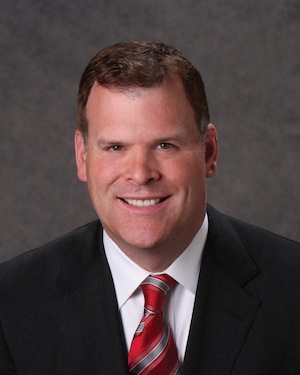
photo - John Baird
John Baird (photo from Jewish National Fund)

Baird, who will be honored at the Jewish National Fund’s Negev Dinner in Vancouver on June 7, spoke of his admiration for Israel and Canada’s close connections with that country in an interview with the Independent Sunday.

Responding to criticism that Canada has lost its place as a middle power or neutral broker, Baird insisted that is not Canada’s role in the world.

“We are a player,” he said. “We are on the liberal democratic team. We make no apologies for that.”

He cited the Conservative government’s role opposing Iran’s drive for nuclear weapons and regional dominance. The impact this has had in the Arab world is misunderstood by many Canadians, he said.

“Our standing in the Arab world today is stronger than it has ever been,” said Baird, speaking from Ottawa. “When I was foreign minister, we built good relations with the new government of Egypt, with the government in Iraq, with the UAE, the Saudis, the Bahrainis. We are widely respected among the political leadership. Yes, we have an honest difference of opinion with respect to our position on Israel. But when it comes to the Muslim Brotherhood, when it comes to Hamas, when it comes to Hezbollah, when it comes to Iran’s nuclear program, Iran’s material support for terrorism, when it comes to the Iranian-backed advance in Yemen … Saudi Arabia, Israel, Canada: we all share the same view. That’s not understood very well in this country.”

Baird said Canada is a world leader on child and maternal health, opposing forced marriages of girls, and supporting the rights of sexual minorities. Opponents of the government may have difficulty squaring their ideas of how a Conservative administration should behave with the record of the current Canadian government on issues of gender and sexual equality, but Baird says, “Look at the facts.”

“Prime Minister [Stephen] Harper personally has championed child and maternal health,” he said. “We’ve seen record investments not just in Canada but around the world because of his leadership. If you look at the leadership that I undertook with respect to young girls being forced into marriage, we became a leader in that. Canada followed the United Kingdom’s lead on sexual violence in conflict, not just on policy but on programming. When you look at [United Nations’ projects supporting] women, peace and security, we’ve taken a big role in North Africa. So, if you look at the facts, it’s undeniable, particularly on the issue of women and girls. The Day of the Girl resolution was championed by Canada at the UN.”

Advancing the rights of women worldwide is both a human rights matter and a determinant of societal health, Baird said.

“It’s in our own interest to do so,” he said. “It’s not just about human rights. The stronger role that women can play in government, in parliament, in civil society, the more we can combat extremism and promote pluralism.”

Reminded of a comment he made several years ago that, were he to leave politics he would probably go work on a kibbutz in Israel, Baird explained his respect for the Jewish state.

“I just have a passion for Israel, for its people, its culture, its history,” Baird said. “For everything the Jewish people have accomplished in the last 67 years. It’s really remarkable.”

What the Jewish people have built from the ashes of the Holocaust, he said, is admirable.

“The strength and ingenuity of the Jewish people, what they’ve accomplished in science, technology, agriculture, the huge history, it’s a remarkable accomplishment. What they’ve accomplished politically – a liberal democratic state in a pretty dangerous part of the world. The values that underpin the state of Israel, it’s just a remarkable, remarkable achievement.”

While Canada’s foreign policy, particularly under Baird, has turned Canada into what is frequently called Israel’s best friend in the world, the global attitude toward Israel remains highly negative, Baird acknowledged.

“We see far too much moral relativism,” he said. “It has stunned me the amount of criticism that Israel gets in so many international arenas, whether it’s the UN in New York or in Geneva … the UN Human Rights Council … others. On occasion it can be disappointing. It can be difficult to stand up against the rest of the crowd but it’s important to do what’s right. Canadians can be very proud that their government’s taken the path less traveled. We’ve never been afraid to stand up and support our liberal democratic friends.”

The former minister, who left politics earlier this year, speculated on where the animosity toward Israel comes from.

“I don’t think everyone who is against Israel is an antisemite,” he said. “But all antisemites are against Israel. I have great concern that we’ve seen, instead of people targeting the individual Jew, they’re targeting the collective Jew, the Jewish state. These things cause us great concern.”

Although he is moving into the private sector – he is working as a member of Barrick Gold’s advisory board and last week was elected to the board of Canadian Pacific – Baird promises to continue to be an outspoken supporter of Israel and a critic of Iran’s nuclear program and its support for terrorism.

Asked if he might return to public life as a candidate for the Conservative leadership when Harper retires, Baird deflected the idea with a flat “no” and refused, with a laugh, to elaborate.

Ilan Pilo, shaliach and executive director of Jewish National Fund, Pacific region, called Baird “a man of integrity and a true friend to Israel.”

“JNF is grateful to honor him for his leadership on the world stage, for years of devoted service to the citizens of Canada, his dedication to the Jews of Canada and to the state of Israel,” said Pilo. “Thanks to Baird’s outstanding leadership, Canada has become Israel’s most unwavering ally.”

Baird returned the compliment.

“Canadian supporters of JNF can be very proud of the work they’ve done over the years,” said Baird.

This year’s Negev Dinner, which takes place at the Four Seasons Hotel, supports a project in the city of Sderot, adjacent the Gaza Strip. The city has been under bombardment by Hamas missiles for the last several years. The park and fitness facility will enhance life for the citizens and provide a “green lung” for the city.

Pat Johnson is a Vancouver writer and principal in PRsuasiveMedia.com.

Consider the maps we use

I always enjoy seeing my kids bring home assignments from Hebrew school, and last week was no exception. On a map of Israel were labeled five major cities whose names the students had to write in Hebrew. For my part, I delighted in reminding my son that we have relatives or friends in Jerusalem, Tel Aviv and Haifa, and near Be’er Sheva. There was only one problem with the map, I noticed. There was no Green Line. So, to the untrained eye, it looked like Israel’s borders span from the Mediterranean Sea to the Jordan River.

As I often do when I want to tease out a political conundrum, I took to social media. On my public Facebook page, I offered to donate $36 to charity for the first person who can show me a Green-Line-indicated map of Israel currently being used in any Jewish educational setting. Laurie MacDonald Brumberg wrote that a Washington, D.C., Jewish day school has a National Geographic map containing the Green Line hanging in the classroom. Karin Klein of Chicago showed me a Green Line map she said was used at a Schechter day school. And from Gabriel T. Erbs I learned that J Street U has launched an initiative to circulate Green Line maps to educational institutions. Apparently, URJ President Rabbi Rick Jacobs has agreed to champion this among URJ camps and Hebrew schools, according to a March 22 article published on JewSchool by David A.M. Wilensky. Gila Miriam Chait added that Yachad, a pro-Israel, pro-peace group in the United Kingdom, is following suit.

What is at stake in the mapping debate? We all know that Middle East maps are heavily invested with the symbolism of legitimacy and delegitimization. The Palestinians have long been accused of erasing Israel from their school maps of Palestine – both from the Palestinian Authority and from Hamas. An article in the current online Jewish virtual library makes precisely this point. It’s clearly ironic that we are doing the same thing we accuse our adversaries of doing.

Some might argue, however, that since the Green Line is an armistice line, not a border, that there is no need for Israel to include it. It is true that it is not a border, but neither does Israel’s international territory extend eastward from Jerusalem all the way to the Jordan River. The point is, the West Bank is under occupation – whether one sees the occupation as justified or not – and maps should reflect this geopolitical reality.

Now, beyond simply making more accurate and, therefore, educationally useful maps, what might a more politically informed Israel curriculum entail? From my kids, I have heard about the ingenious ways that Israel foiled the Egyptian invasion of 1948, including placing stones in irrigation pipes to create noise simulating artillery. My 8-year-old was impressed. I know that for Yom Ha’atzmaut, their Hebrew school served falafel, and I hoped and expected that my kids will learn some Israeli folk songs. Some folk dancing would be great, too. What I remain less certain about, however, is how much complexity about Israel’s future our kids’ schools are willing to impart. Will kids learn who the “Palestinians” are? I know that I am guilty of frequently muttering to them about “Israel and the Palestinians” without proper context. While narratives of inter-state war can be much simpler to impart, when it comes to the Palestinian civilian aspect of Israel’s founding, and the current military occupation over millions of Palestinians, it’s difficult to know where to begin.

When we learn about the past, it’s equally important to consider the future. In fact, no one knows more about the importance of historical memory in shaping today’s collective political outlook as the Jewish community. As Wilensky writes in the context of the maps, “it’s unpleasant for many to hear, but the final status of a two-state solution – if such a thing can ever be achieved – is going to rely heavily on the Green Line. Putting visual depictions of that reality before the eyes of American Jewry will go a long way toward showing them the somewhat unpleasant truths that will help build a more absolutely pleasant future.”

As for the J Street U’s map initiative, given that Jacobs has pledged to roll them out at Reform schools, I hope he will make Ottawa’s very own Reform Judaism supplementary school an early stop.

Mira Sucharov is an associate professor of political science at Carleton University. She blogs at Haaretz and the Jewish Daily Forward. This article was originally published in the Canadian Jewish News.

The anniversary of liberation

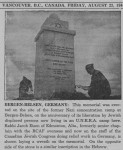
This photo and caption appeared in the Jewish Western Bulletin, Aug. 23, 1946.

May 5, 1945, is firmly etched in my “child’s” mind for that was the day of my family’s liberation or, more accurately, what remained of my family. The German occupation had been brutal and, with the collaboration of thousands of Dutch Nazis, 108,000 Dutch Jews had been deported and nearly all were murdered. Of those sent to Auschwitz and Sobibor, approximately 4,500 survived. Of Holland’s total prewar Jewish population of 140,000, fully 80% were murdered.

I had survived with my Christian hiders, Albert and Violette Munnik, and my “sister” Nora, their 12-year-old daughter. When I was reunited with my parents who had miraculously survived also, I had come to love the Munnik’s as my own family, and I was Robbie Munnik, not Robbie Krell. But I was given back, not without protest, a Jewish child who had no experience with Judaism but was nevertheless hunted for being a Jew.

In Nazi-occupied countries, 93% of Jewish children were murdered. Some escaped just before the war, a few thousand during the war through clandestine operations. But overall, no more than one in 10 survived. That is the nature of genocide. Murder the children.

Holland has somehow managed to maintain a reputation of comparative decency during the war years. Some of this good will emanates from the story of Anne Frank who left behind a diary written during her days in hiding in an attic in Amsterdam. The Frank family did in fact receive heroic assistance from Miep Gies, as did I from the Munniks and my father from the Oversloot family.

But of roughly 14,000 Dutch Jewish children in hiding, over half were betrayed. And, of course, so were the Franks. That adorable, intelligent adolescent Anne and her family were deported on the second to last train from Westerbork to Auschwitz on Sept. 3, 1944, three months after D-Day! She died an agonizing death of hunger and typhus in Bergen-Belsen. Only her father survived.

I write this piece on the 70th anniversary of liberation, a gift of 70 years of life. Who could imagine it? During the war, death had been a close companion, confirmed shortly after the war by the chilling reports that came our way from the few survivors that returned and from the photos that formed part of the news. I heard the descriptions of torture and murder from eyewitnesses. They were there. They had seen and suffered. And their lives and ours had been destroyed. No grandparents, no aunts or uncles. Two other children in our family survived, one also spared in hiding, the other, smuggled into Switzerland. That was it.

And what have I learned over these 70 years? The Holocaust imprint never leaves and no day passes without reminders. Had we tried to forget, it would have proved impossible. From the moment that the world discovered what had been done, the antisemites began their effort to deny what happened. Holocaust denial followed the campaign of murder with the effort to murder memory.

No wonder. Nearly everyone had blood on their hands. The British Mandate of Palestine was closed to Jewish immigration, preventing European Jewish refugees from fleeing. Canada and the United States had closed their doors. The Jews of Europe were trapped and murdered with technological efficiency, aided and abetted by Jew-hating collaborators in almost every country dominated by the Nazi invaders. The only way to be freed from guilt would be for the Shoah not to have happened. But the perpetrators were unable to erase the evidence. The Holocaust is the best-documented massive crime of murder and theft in human history.

Over the years, I have also learned of the systematic betrayal of visionary Jewish leadership who fought for the reestablishment of a Jewish nation-state in what is now Israel from the 1890s. No, Israel is not the result of the genocide inflicted upon European Jewry. If it were, Jews would not have had to fight the British colonialists in 1945-1947 to achieve freedom. And Holocaust survivors trying to reach Palestine would not have been incarcerated in camps in Cyprus.

The victory over the Ottoman Empire led to the establishment of a number of Arab states. Only the British promise of the 1917 Balfour Declaration’s intent to establish a home for the Jewish people went unfulfilled. The 1920 San Remo Conference affirmed that intent, only to witness the British carve off 80% of the territory known as British Mandatory Palestine to create the Emirate of Trans-Jordan. To add insult to injury, it was decreed that no Jew could settle there. This travesty resulted in the remaining 20% to be contested by Jews and Arabs to this day.

I was in Israel in 1961. The Western Wall of the Temple, the holiest site in Judaism, was controlled by Jordan and Jews were forbidden access. During Jordan’s illegal occupation from 1948-1967, all the synagogues in east Jerusalem were destroyed. Nor had Jordan advanced the cause of their Arab brethren or established a Palestinian state in the territories held.

I was at the Eichmann trial. I saw the architect of the annihilation of my people. Over time, it appears that a great deal of European posturing over Israel and its policies are an attempt to deflect attention from the horrendous misdeeds of the European past. There is a concerted effort to make Israel look like a nation with a brutal bent and whose activities, even those in self-defence are painted with the brush of Nazi and/or apartheid terminology. How offensive! How cruel! Its practitioners deny antisemitism for they have found a new outlet for Jew hatred, anti-Zionism. Israel has become the Jew of nations.

It is disconcerting, indeed, to witness the dawn of liberation 70 years ago descend into a night of renewed hate. I seek a measure of comfort in the words of Martin Luther King, Jr., and Eric Hoffer, the longshoreman philosopher. Dr. King wrote, “Israel is one of the great outposts of democracy in the world and a marvelous example of what can be done, how desert land can be transformed into an oasis of brotherhood and democracy. Peace for Israel means security, and that security must be a reality.” And Hoffer, “I have a premonition that will not leave me; as it goes with Israel so will it go with all of us. Should Israel perish, the Holocaust will be upon us all.”

I have to hope that antisemitism will be opposed and extinguished wherever it flourishes and that Israel’s right to exist will be protected. Then our liberation will have acquired meaning.

Robert Krell, MD, is professor emeritus of psychiatry at the University of British Columbia, and founding president of the Vancouver Holocaust Education Centre.

JDC delivers aid, relief

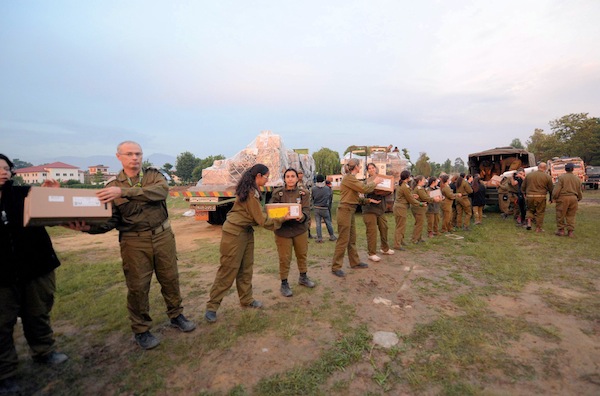
Israel is contributing to efforts to aid and assist the Nepalese government to reach, rescue and treat injured victims of the recent earthquake. The IDF has set up a comprehensive field hospital and also has flown out emergency rations and tents. (photos by IDF via Ashernet)

After Nepal was hit by the biggest earthquake in 80 years, the American Jewish Joint Distribution Committee (JDC) is aiding thousands of survivors through its relief efforts with partners on the ground, and is dispatching its disaster relief team from Kathmandu to remote villages to deliver aid and assess emerging needs in hard-hit areas. The team is assisting in the delivery of first-aid and shelter supplies, hygiene items, oral re-hydration solution, food packages and other supplies to 1,400 families over the coming days.

“Even while we’re helping survivors to heal throughout Nepal, we know more must be done and urge the public to continue its generous support of critically needed relief in this devastated country,” said Mandie Winston, director of JDC’s International Development Program. “Millions of Nepalese are facing harrowing conditions and the need for their immediate care, recovery and reconstruction efforts is required to secure Nepal’s future. Our efforts are focused on that path and to ensure the dignity of every human life along the way.”

photo - JDC disaster response team delivers aid in NepalTo date, JDC has operated on three fronts in Nepal: the deployment of its expert disaster relief team on the ground; the support of locally based partners to ensure medical care and relief supplies within days of the quake; and the packing and shipping of medical and humanitarian supplies from the United States. These efforts have ensured life-saving medical treatment, food, clean water and shelter for Nepalese victims still reeling from the disaster. It has also enabled the assessment of needs and delivery of aid in real time, in tandem with changes on the ground, and the coordination of JDC’s network of local and international non-governmental partners working in Nepal.

These partners include the IDF Field Hospital, Tevel b’Tzedek, UNICEF, the Afya Foundation, the All India Disaster Mitigation Institute, Sarvodaya – Teach for Nepal, Heart to Heart International and Magen David Adom.

JDC has provided immediate relief and long-term assistance to victims of natural and man-made disasters around the globe, including the Philippines, Haiti, Japan and South Asia after the Indian Ocean tsunami, and continues to operate programs designed to rebuild infrastructure and community life in disaster-stricken regions.

JDC’s disaster relief programs are funded by special appeals of the Jewish Federations of North America and tens of thousands of individual donors to JDC. JDC coordinates its relief activities with the U.S. Department of State, USAID, Interaction, the Israeli Foreign Ministry, Israeli agencies and the UN coordination mechanism OCHA.

To contribute to the Nepal relief efforts, contact Jewish Federation of Greater Vancouver at 604-257-5100 or visit jewishvancouver.com/nepal-relief-fund.


בלקברי עושה עלייה מובטחת

בפועל בלקברי רכשה את חברת הסטארט-אפ הישראלית וואצ’דוג. (צילום: Kārlis Dambrāns via wikimedia.org)

בלקברי עושה עלייה מובטחת: תיפתח לראשונה מרכז פיתוח בישראל

חברת הסמרטפונס הקנדית בלקברי (שהמטה שלה נמצא בווטרלו אונטריו) תיפתח לראשונה מרכז פיתוח בישראל. המרכז בפתח תקווה ויועסקו בו כמאה עובדים. זאת במסגרת הרחבת פעילותה ונסיונותיה לשפר את הטכנולוגיה ואבטחת המידע שלה, ולהגדיל את נתח השוק במגזר העסקי שבשוק הסמרטפונס.

בפועל בלקברי רכשה את חברת הסטארט-אפ הישראלית וואצ’דוג, לפיתוח טכנולוגיה לאבטחת מסמכים וקבצים. הגוף שמשתמש בטכנולוגיה שלה יכול לשלוט טוב יותר במידע ובקבצים שלו. הוא יכול לדעת היכן נמצאים הקבצים שלו בכל רגע נתון, ולהשמיד אותם מרחוק במקרה הצורך. בלקברי תצטרף את הטכנולוגיה של וואצ’דוג לשירותי הפורטפוליו שלה, למיגון מערכות ההפעלה.

עלות רכישת וואצ’דוג על ידי החברה הקנדית מוערכת בין מאה למאה וחמישים מיליון דולר. וואצ’דוג הוקמה ב-2008 ולצורך פעילותה גוייסו השקעות בסדר גודל של כ-30 מיליון דולר.

יו”ר ומנכ”ל בלקבריי, ג’ון צ’ן, הצליח לעצור את הידרדות החברה שכמעט והביאה לסגירתה. הוא פיטר עובדים, שיפר מערכות והתייעלות, והתמקד בתחום התוכנה הארגונית. תחת ניהולו יוצאים מכשירים שמעניינים את השוק לשם שינוי, בהם ‘פספורט’. 200 אלף מכשירי ‘פספורט’ נמכרו ביום אחד, עת הדגם יצא לשוק בספטמבר אשתקד. והמלאי הראשוני שלו אזל בתוך עשר שעות בלבד. בעיון בדוחו”ת הרבעוניים של בלקברי שפורסמו בסוף מרץ עולה כי החברה הצליחה לבלום את את הצניחה בהפסדיה, ורשמה לראשונה לאחר שנים רווח נקי (של 28 מיליון דולר).

בהודעה להוציא לעיתונות הסביר צ’ן מדוע בלקברי רכשה את וואצ’דוג: “בלקברי ממשיכה כל העת להגדיל את מעטפת אבטחת המידע, כך שהיא תוכל לאפשר שיתוף מידע יותר מאשר הגבלתו. רכישה זו היא צעד נוסף קדימה בהפיכתה של בלקברי לפלטפורמה המובילה לתקשורת סלולרית, תוכנה וישומים מאובטחים, התומכת בכל מכשיר ובכל מערכת. הודות לרכישת סקוסמרט אשתקד, השותפות שלנו עם סמסונג, מאמצעי הפיתוח שלנו והרכישה הזו של וואצ’דוג, אנו יכולים כעת לספק תקשורת מאובטחת מקצה לקצה הכוללת שיחות קוליות, הודעות טקסט, תקשורת נתונים וכעת גם שיתוף קבצים מסוכרן”.

ועוד חדשות בנוגע לבלקברי: הסכסוך עם טי-מובייל האמריקנית הסתיים לאחר כשנה, והאחרונה תחזור למכור מכשירים של בלקברי.

קסדה עם שני ראשים: חייל שאיבד אותה לפני 70 שנה ציווה להחזירה למי שמצא אותה

ג’ורדן צ’יאסון (21) מהעיר מונקטון שמזרח המדינה הוא אספן של ציוד צבאי ישן. לפני כשנה הוא רכש בחנות מקומית לציוד צבאי ישן קסדה ב-30 דולר. לאחר שבדק את הקסדה מקרוב מצא שחרוט עליה השם גו’רג’ ג’ונסטון ומספרו האישי. הוא חיפש מידע על ג’ונסטון ומצא שהוא עדיין חי ואפילו גר באותה עיר. צ’יאסון החליט להביא את הקסדה לג’ונסטון בן ה-93, והמפגש עימו ועם אשתו אנני היה מרגש ביותר. הזקן לא האמין שיתאחד מחדש עם הקסדה שלא ראה במשך עשרות שנים.

ג’ונסטון הצעיר לחם עם הכוחות הקנדיים במלחמת העולם השנייה בבלגיה, הולנד, צרפת ובריטניה. הוא השתמש בקסדה במשך שש שנים, לדבריו היא הצילה אותו לא פעם. עם סיום המלחמה ופתיחת החגיגות הגדולות הקסדה אבדה. ג’ונסטון חזר הביתה למונקטון ושכח ממנה.

ג’ונסטון נפטר לפני מספר שבועות בגיל 94 ולפני מותו ציווה להחזיר את הקסדה לצ’יאסון. אלמנתו מסבירה מדוע: “בשנת חייו האחרונה בעלי וצ’יאסון הפכו לחברים קרובים. בעלי חשב שרק צ’יאסון יוכל לשמור על הקסדה היקרה הזו”. צ’יאסון מוסיף: “עם סיום הלוויה משפחת ג’ונסטון ניגשה אליה ומסרה לי את הקסדה למשמרת. אני בכיתי וכולם בכו”.

A more realistic future

Ari Shavit speaks at Winnipeg’s Shaarey Zedek Synagogue. (photo by Rebeca Kuropatwa)

As part of the Jewish Heritage Centre of Western Canada’s Annual Sol and Florence Kanee Distinguished Lecture Speaker Series, leading Israeli columnist and writer Ari Shavit addressed a packed room of 300 people on the topic Is Peace Dead? The talk took place April 19 at Shaarey Zedek Synagogue in Winnipeg.

Shavit, who described himself a “diehard peacenik,” said he is more comfortable referring to what some call “the Arab Awakening” as “the Arab Chaos.”

He explained, “We were hoping for an Arab Spring. It turned into something else and the result is the Arab Chaos. The old order that ruled over the Arab world has collapsed, but it was not replaced by any liberal democracy. It was replaced with more tribalism, more fanaticism and much more violence. We now see a human catastrophe engulfing a large part of the region and the acute situation of instability. I care about my fellow humans and we have to be saddened that we have such a terrible human catastrophe.”

Even worse, in Shavit’s view, “There is no more chance in the upcoming years to have the old kind of peace we hoped for,” he said. “I don’t think we can have the kind of peace agreement like with Egypt or Jordan in the coming years, because those were peace agreements that were signed with tyranny.”

Shavit used Syria as an example, saying that, back in the 1990s and in early 2000, he very much supported a peace agreement with Syria. But, he said, “Now, there is no one to make peace with.

“The good news is the more clear division within the Arab community. Many Arab moderates are now terrified by Iran, by ISIS, by the Islamic Brotherhood, by Al-Qaeda, by extremists, [so] they actually are closer to Israel than they ever were in the past. So, there is a kind of interesting potential within this sad, tragic, acute situation.”

According to Shavit, the road to peace today begins with the understanding that we cannot reach a two-state solution with the Palestinians in the coming months or years.

“We won’t have the comprehensive peace we hoped for,” said Shavit. “But, on the other hand, we should not accept the status quo. And, I think we should launch a two-state dynamic, which would lead to a two-state state to start with, and eventually lead to a two-state solution.”

Regionally, Shavit stressed the need for Israel to work much more closely with Egypt, Saudi Arabia, the Gulf countries and Jordan, as, he said, “They are closer to Israel than they ever were.”

Though Shavit conceded that the likelihood of signing a new formal peace agreement may not currently be in the cards, he encouraged “building a kind of peace based on economic interests, mutual interests and strategic interests.”

What Shavit envisions is “the kind of peace agreement [Israel] had with Jordan before the 1994 peace signing. There were no embassies, there were no Nobel Prizes, no White House ceremonies, but we had a very close, intimate relationship – quite a lot of the time – better than after the formal signing. That should be an example of what can be done in this new chaotic situation.”

Shavit sees potential for “cooperation as opposed to a utopian peace.” Potential partners for this cooperation, Shavit suggested would include “the major Arab Sunni nations led by moderate people…. [People who] are not deeply concerned or interested in human rights or democracy, but they don’t want extremists. Saudi Arabia and the other Gulf States fall into that category. So, the strategic game now is pretty much controlled by two non-Arab countries – Israel and Turkey – and, I would say, Egypt and Saudi Arabia.”

As to whether or not these partners are interested in just cooperation or a more lasting peace, Shavit said, “I think they want to live and they want stability. Therefore, if we promote this new peace concept, I think there’s a chance of having a better relationship. I think many of them see Israel as a partner in that.

“It’s not that they are going to have a religious conversion…. I don’t see a kind of relationship that France and Spain have or Canada and the U.S. do, but, I do see a kind of Middle East-style relationship – the ability to create a structure that can be formed again if we endorse the right ideas.”

Regarding Israel’s recent elections, Shavit feels that the left lost more than the right won. “The lack of a peace plan of action had a lot to do with that. Even the left-wing part[ies] were not very aggressive at promotional peace. The peace talked about in the national community is a kind of peace that is totally detached.”

Shavit is hopeful that Israelis will open their hearts to peace, in the case where “a kind of new peace, a concept that is more realistic, comes around. As long as the community talks about European-style peace, when we have a kind of evil political reality in a large part of the Middle East, Israelis will not buy into that.”

International support is critical to any potential peace progress and, while Shavit loves Canada in many ways, he said, “I appreciate that Canada is supportive of Israel, when there aren’t many that support Israel in such a way. [But] obviously, the real relevant player is the United States.

“I hope that America will endorse a new kind of peace policy and then build a wide coalition – first of all with Canada, then with the European powers and then with the moderate Arabs and Israelis – addressing the issues in a realistic way.”

Shavit believes that the “dysfunctional relationship” of Binyamin Netanyahu and Barack Obama is not advancing the situation. “I hope I can be successful in encouraging an intellectual process to be helpful in bringing some change to that,” he said.

Shavit, like many others in Israel and around the world, is waiting to see what kind of Israeli government will be formed. “If we do have a right-wing government, with [Avigdor] Lieberman being the centre, I worry that we will have unpleasant legislation that will alienate the Arab minority even more and jeopardize the fragile relationship with them. If it will be more moderate in the centre, there is less danger.

“I think the last six months were very troubling, with unprecedented legislation or attempts [to discriminate], though most failed. I hope and pray that our power will not go back to that kind of approach. I think it will endanger Israel’s soul in a serious way.”

Shavit is hopeful that minority rights will not be trampled, as “the tradition of the historic Israeli right always combines nationalism with liberalism, with a deep respect for democracy. I really hope we will not see dark forces in Israel rising to power.”

Rebeca Kuropatwa is a Winnipeg freelance writer.

The future to imagine

In the past several weeks, we have celebrated liberation and redemption on Passover. On Yom Hashoah, we mourned the victims of Nazism and the generations that never were. On Yom Hazikaron, we honored the brave defenders of Israel who gave everything for the dream of the Jewish people’s right to live as a free people in our own land. Then we joyously celebrated the realization of that dream on Yom Ha’atzmaut.

These four commemorations are drawn together in many ways by rabbis and thinkers. We are mere journalists, but if you give us a moment, we, too, have some thoughts that may be worthy.

There is a troubled narrative connecting the Holocaust and the creation of the state of Israel, a connection that is sometimes misunderstood and often deliberately misrepresented.

Critics have called Israel a “reparations payment” given to the Jews as recompense for the Holocaust. This formulation is a desecration, because there could be no recompense for the Holocaust. More to the point, it is false history. Israel was not given to the Jewish people. The Partition Resolution, significant as it was as a fulcrum for historical events, turned out to be another hollow United Nations vote. Israel came into being only because the Jews of Palestine, some from the Diaspora and a small group of idealistic non-Jews from abroad fought – some to the death – for the dream of a Jewish homeland.

The connection between the Holocaust and the creation of the state of Israel is not, as the popular narrative has it, because the world felt sympathy. If anything, the world wanted to create a place for the surviving remnant so that they wouldn’t have to take responsibility for them.

Where the genuine connection lies between the tragedy of the Holocaust and the joy of independence is in the realization that the Holocaust was a direct result of Jewish statelessness. Had Israel come into being a decade earlier, there may have been no Holocaust, or its magnitude would have been much diminished. That is one connection.

Another is the psychological effect the creation of the state had on Jewish people individually and collectively, in Israel and in the Diaspora.

After the Holocaust, the Jewish people worldwide could have been expected to plummet into individual and collective despair. Instead, Israel gave hope – and a future to imagine and to build after the collective future was almost destroyed. Whether Jews made aliya – or even visited – or not, Jewish Canadians helped build the state of Israel through a million acts of philanthropy and volunteerism.

Israel is many things to many different Jews. It is a resolution to 2,000 years of statelessness, the fundamental fact that was at the root of our tragedies. It is the culmination of the quest for sovereignty and freedom and, while Israel is not perfect by any stretch, we endeavor to work toward that ideal. Israel is the dream for which so many have given so much, as well as a complex, thrilling, sometimes infuriating, always cherished reality.

In the context of millennia of Jewish civilization, the comparatively new state of Israel is a part of all of us and we are all, in some way, a part of it.

Rada brings Israeli soul here

Ester Rada is at the Imperial on May 2 and McPherson Playhouse on June 19. (photo from Ester Rada)

Ester Rada’s most recent recording, I Wish, was released in March. The EP features Rada’s interpretation of four of her “favorite songs of the great Nina Simone”: “I Wish (I Knew How It Would Feel to be Free),” “Sinnerman,” “Four Women” and “Feeling Good.” Rada takes these classic songs made famous by an iconic singer/songwriter and makes them her own. Chutzpah, in the best sense of the word – which makes it fitting that Rada is being presented in Vancouver by Chutzpah!Plus. She plays the Imperial on May 2.

Rada was born in Kiryat Arba, just outside of Hebron, a year after her parents and older brother immigrated to Israel from Ethiopia as part of Operation Moses in 1984.

“Childhood is an amazing period of time because, as a kid, you see only the good in life, and there is a lot of good growing up in a small town, so life was great,” Rada told the Independent about her younger years. “Only when I look back I realize how strange and unnatural it is to grow up between fences and soldiers and fear from your neighbor.”

Raised in a religious household, Rada was exposed mainly to religious music, as well as Ethiopian, of course. Her mother’s decision to move the family to Netanya when Rada was 10 (her parents had divorced many years earlier) turned out to be pivotal.

“Netanya is a bigger, non-religious city near the sea, no fences and borders,” said Rada. “Drawn to this freedom, I allowed myself to enter the secular world. At the age of 12, MTV and VH1 were the platforms I could get music from, and there I was exposed to Stevie Wonder and Babyface, Boyz II Men, Lauryn Hill, Erykah Badu, D’Angelo; their souls entered mine.”

Rada composes, sings and plays multiple instruments. When asked to highlight some of her musical training and/or performing background, she said, “At the age of 10, I was part of Sheba Choir. At the age of 15, my brother bought me my first guitar and I taught myself how to play. At 18, I was recruited to the army as a singer for two years.”

She has lived in Tel Aviv since the age of 21. “It is the best place in Israel,” she said. “The culture and art, music and beauty, freedom and love are the things that took me there.”

Joining Habima Theatre, Rada’s acting career took off before her singing career. She has performed on stage, on television and in film. While she still works in both arts, she admitted, “It’s getting harder combining the two. Last year, I was still acting in the theatre, but when I started touring I had to quit. I still get offers, but I’m not going to do theatre soon – but I’m shooting a movie this summer.”

While she speaks more than one language, Rada sings mainly in English. Her full-length record, Ester Rada – which includes the four songs on her debut solo recording, the EP Life Happens – features all English songs, with the exception of “Nanu Ney.”

“The music I listen to is mainly in English, the first song I wrote at the age of 13 was in English – also, I want to share my love with the whole world and I feel English is an international language,” she explained.

Her music has been described as a fusion, “gracefully combining Ethio-jazz, urban funk, neo-soul and R&B”; “her own blend of ska, reggae, world music, dance beats and jazz.” But Rada told the Independent, “I don’t like to describe it, as there is no one definition. I’m a mix of a lot of things and so is my music. Also, I’m changing all the time, so I believe that the ‘Ester Rada sound’ will change as well.”

Her look certainly has changed over the years, and one can’t help but remark on her unique, keen sense of fashion.

“I’ve always loved beauty,” she said of her style. “I remember myself as a kid wearing my mom’s shoes, clothes and makeup. I love that by wearing different clothes I can become something else.”

And much of her music celebrates such freedom, encouraging listeners to have the courage to explore, to not be afraid, to experience life and to enjoy it. Rada’s musical adventures tell us that she definitely practises what she preaches.

Ester Rada’s 19+ show at the Imperial, 319 Main St., on May 2 starts at 8 p.m. Tickets are $36 (students $25), plus GST and service charge, from chutzpahfestival.com or 604-257-5145. She also is scheduled to perform in Victoria at the McPherson Playhouse (rmts.bc.ca or 1-888-717-6121) on June 19, 7:30 p.m.; tickets are $45/$53.

Israeli-inspired innovations

The Eureka Project, a Winnipeg business incubator is as innovative about its own financing and growth as it teaches future entrepreneurs to be. And, with the leadership of businessman Gary Brownstone, some of its partner companies are seeing returns in the tens of millions.

“The Eureka Project mandate is to help what I like to call ‘passionate creators’ of technology or widgets commercialize their inventions,” Brownstone told the Independent. Clients include scientists, engineers and computer programmers who have developed or are developing some kind of new technology. Typically, clients have little or no business experience, which is where Brownstone and his team come in.

photo - Gary Brownstone
Gary Brownstone (photo from winnipeg.startupweekend.org)

Brownstone gets involved in small, fledgling startups and manages them through the initial growth phase. “Our team has expertise with taking this technology to market: finding customers and helping the founder build companies around technology,” he said.

“There are unique challenges in commercializing technology that make it different from other sectors, involving how to finance an idea, how to finance a company with no fixed assets (no buildings, land or equipment), which Canadian investors or bankers are really used to.”

When Brownstone finished his schooling, he realized he had unique experience in working with companies undergoing rapid growth, growth that could be so extreme that it had the capacity to kill the company. Anticipating the potential in companies on the verge of major growth, Brownstone’s approach was to step in to provide the professional management required to shepherd them through that phase. Once a company had managed to get through that period of growth, Brownstone would exit onto the next one. Brownstone has successfully been doing this for more than 20 years now.

“When I was recruited into this position, I saw the opportunity to do that over and over and over again – to help small companies through that first phase of growth, help get them on some solid footing for the future,” said Brownstone.

About five years ago, he started becoming more aware of how Israelis have successfully built a knowledge-based economy.

Someone gave him the book Start-Up Nation by Dan Senor and Saul Singer, and Brownstone, who had spent a year in Israel after high school some 30 years ago, was confused. “I read the book and I thought, ‘Are you sure it’s Israel they are talking about? Now they are a tech powerhouse?’” he said.

Brownstone has, since that time, made an annual trip to Israel and is still amazed by what he sees. On those trips, Brownstone meets with people in Israel who run incubators like his, those in government, policy makers and academics, as well.

“I definitely have a strong respect for what they have accomplished in Israel,” said Brownstone. “We’ve tried to bring a lot of those practices back here. I’ve gone there with senior government people both from Canada and from Manitoba to sort of open up their eyes to what some of the possibilities are if you take a similar approach.”

Since then, Brownstone has used his understanding and connection to Israel to try and bring what he calls “some best practices and good policy advice” back to Canada.

“Ideas are easy and execution is difficult,” he said. “So, a lot of companies, for a variety of reasons, will not succeed in actually commercializing their technology or not commercializing it to a degree that it’s a viable business.”

When someone comes to the Eureka Project with an idea, Brownstone asks three questions to determine whether or not they would make good clients. First, is the technology real? Second, is the individual (or team) capable? (Do they have enough talent? Are they coachable in terms of their own capabilities/capacity? What are their skill sets and backgrounds?) Third, he assess whether or not there is an identifiable market.

“In our line of work, because of the background of the people coming in the door, that’s the question that they most overlook,” said Brownstone about ensuring that there is an actual market for the product or technology. Many companies “look at the world as ‘technology push’ instead of ‘market pull,’” he explained. “We try to turn that conversation around really early on. If you were to come in the door, we’d go through the three questions and satisfy ourselves that the answers are yes, yes and yes.”

In terms of payment, Brownstone has developed a sliding scale wherein, at the beginning, clients can pay as little as a couple hundred dollars a month. “We really want to remain accessible to those that have the best likelihood of becoming [successful],” he said. “In order to do that, we try to keep our fees as low as possible, so that money isn’t really a barrier for them working with us. So, we offset a lot of the costs of delivering services to our clients, because we build a very strong, broad base of support. We get financial help from the province of Manitoba [and] we get some financial help from the U of M. We’ve built a very broad sponsorship program, so that the corporate community supports us and our clients.”

As the companies gain access to some financing and begin to grow, they hire on staff and gradually start paying more of the real cost as their finances allow. “It kind of puts the pressure on us to deliver what we promise we deliver when they come in the door,” explained Brownstone. “If we are able to help them finance and grow their companies, they should be able to pay us a little bit more for what we do.”

He said, “If someone from Vancouver called me and was looking for space, mentorship and local coaching, I might see if they would like an introduction to someone there who does what

we do, so they could have proximity.” He added, “But the short answer is yes,” to taking on Vancouver clients.

“Success begets success, so as people find out about the things that we do … a company we helped launch five years ago will probably do something in the neighborhood of a hundred million dollars in revenue this year,” said Brownstone. “In Canada, that’s a big deal. People from other regions hear about what we are doing and we find more and more we are getting approached from outside Manitoba. We don’t want to turn anyone away, so we had to find ways to help those people.

“We don’t use Manitoba taxpayer dollars to support other companies, but we do have partners and systems in place where we can deliver those services to other province’s companies.”

He added, “In a couple of instances, we’ve had companies who have relocated to Manitoba in order to work with us. There’s a great ecosystem in Manitoba for these young companies in terms of government grants and tax credits, and organizations like ours that can support them.”

The Eureka Project has developed an extensive network of companies and individuals across the United States, China, Singapore, South America, Mexico and as many as 30 other countries.

Rebeca Kuropatwa is a Winnipeg freelance writer.