Dire new poll results?

A new report suggests potentially alarming trends in support for Israel among Americans.

Frank Luntz, a Republican consultant produced a poll, sponsored by the Jewish National Fund, of the country’s “opinion elites” – highly educated, very active political operatives – and found sharply divergent views between advocates for each party.

“Israel can no longer claim to have bipartisan support of America,” Luntz asserted.

Among the Democrats Luntz polled, 76% of those responding said that Israel has “too much influence” on U.S. foreign policy. Among Republicans, the number who affirmed that position was 20%.

Asked if Israel is a racist country, 40% of Democrats said it is, while 13% of Republicans agreed.

As to whether Israel wants peace with its neighbors, 88% of Republicans contended that it does, while just 48% of Democrats said so.

Questioned whether they would be more likely to vote for a politician who supports Israel and its right to defend itself, 76% of Republicans said yes, but only 18% of Democrats concurred. Seven percent of Republicans said this would make them less likely to support the candidate, while 32% of Democrats said so.

Asked whether a politician who criticizes Israeli occupation and “mistreatment of Palestinians” would get their vote, 45% of Democrats said yes, while six percent of Republicans agreed.

One-third of Democrats and 22% of Republicans said that they were upset that “Israel gets billions and billions of dollars in funding from the U.S. government that should be going to the American people”

On the choice of whether the United States should support Israel or the Palestinians, 90% of Republicans said Israel and two percent said Palestinians. Among Democrats, 51% said Israel and 18% said Palestinians. Asked to self-identify, 88% of Republicans and 46% of Democrats called themselves “pro-Israeli,” while 27% of Democrats and four percent of Republicans said they were “pro-Palestinian.”

Half of Democrats and 18% of Republicans said that “Jewish people are too hypersensitive and too often labeled legitimate criticisms of Israel as an antisemitic attack.”

The numbers look bad at first glance. But first glance is about all Luntz has given us. As other commentators have noted, the entirety of the poll’s methodology and results have not been made public, and the term “elites” suggests the interviewees may have been more “activist” than the average voters – read: “more liberal” in the case of Dems and “more conservative” in the case of Republicans.

As well, we would like to point out that asking someone if they support Palestinians or Israelis is a “false choice,” almost akin to asking which of their children they support. Such simplistic dichotomies are yet another example of the weakness of polling.

However, regardless of the specifics of the poll and its merits, Luntz had some common sense suggestions about pro-Israel messaging to which Americans, especially Democrats, respond well: messages of encouraging more communication and cooperation, and more diplomacy and discussion, not less, for example. The boycott, divestment and sanction movement, for instance, is opposed to these things and that is an Achilles’ heel for them.

Emphasizing the equality of women and freedom of religion, he found, were effective at increasing sympathy for Israel, while less successful were messages emphasizing the need for Jewish sovereignty after the Holocaust, claims to the Holy Land and depicting Israel as a “startup nation,” said Luntz.

Though the extent of the “crisis” may not be as severe as Luntz implies – Democratic nominee-apparent Hillary Clinton is striking an unambiguously pro-Israel tone in her campaign, for example – no one doubts that there are frictions in the Israel-U.S. relationship that are stronger on the Democratic side.

Certainly the petulant relationship between U.S. President Barack Obama and Israeli Prime Minister Binyamin Netanyahu has not made things better.

There is also the fact of 15 years and counting of concerted anti-Israel mobilization on the left, especially on American university campuses, and in the burgeoning online media world.

Some of the unfriendliness may reflect simple political differences between a Democratic administration in the United States and a Likud government in Israel.

Despite the right-wing government in Israel, though, it remains ideologically consistent for people on the left and centre-left to remain committed to Israel because of its inherent liberal values. That is a message that needs to be more emphatically expressed by Israel activists on this side of the ocean. It won’t solve every problem, but it will be a start.

Canada, in this as in other things, differs. In Canada, the trajectory may well be the opposite, with the federal government’s pro-Israel position dragging the opposition parties and some of the public closer to Israel.

In both Canada and the United States, pro-Israel activists should be careful to tend all sides of our gardens. We need to ensure that people of all political persuasions understand that the existence, security and thriving of Israel is not a partisan matter, but one that, in addition to all the other reasons, makes the world a better place.

Investing in our futures

Left to right are Stephen Gaerber (Jewish Federation of Greater Vancouver board chair), Mayor Ilan Orr of Yesod Hamaaleh, Mayor Rabbi Nissim Malka of Kiryat Shmona, Mayor Giora Saltz of Galil Elyon, Vancouver Deputy Mayor Andrea Reimer, Mayor Binyamin Ben-Muvchar of Mevoot Hahermon and Ezra Shanken (Federation CEO). (photo by Rhonda Dent courtesy of JFGV)

One of the goals of the Jewish Federation of Greater Vancouver is to strengthen the community’s partnership region in Israel, Etzbah HaGalil (the Galilee Panhandle). The efforts of Federation are combined with five other Jewish communities across Canada (Atlantic Canada, Ottawa, Winnipeg, Calgary and Edmonton). Known as the Partnership2Gether (P2G) Coast-to-Coast initiative, this is the framework on which relationships between the people of Etzbah HaGalil and these communities of Canada are built and strengthened. The relationships foster a love of Israel and a long-term commitment to Jewish peoplehood, promoting the growth and health of each community involved.

The P2G Coast-to-Coast’s partnership is governed by a joint steering committee comprised of representatives from five Israeli and six Canadian partner cities, and Federation recently hosted the committee’s biannual meetings from June 15-17. Representatives from the local community included Stephen Gaerber, national chair of the Coast-to-Coast partnership; Karen James, chair of the Israel and overseas committee and P2G; and Pam Wolfman, chair of the local Gesher Chai (Living Bridge) committee. The meetings were an opportunity for representatives from Israel and across Canada to review funded projects together and explore potential investments in Etzbah HaGalil’s ongoing progress in three key areas: youth and education, the Gesher Chai program (which includes people-to-people exchanges between the two countries) and capacity building (social programming and regional development).

Etzbah HaGalil is geographically, economically and politically isolated. Residents often miss out on the social, educational and employment opportunities available to those living in central Israel. Through P2G, Federation strategically invests funds to reverse the north’s overall vulnerability by laying foundations for community resilience, emergency preparedness and economic growth.

One of the many projects in which Federation is investing is a new initiative called Green Farms, which develops and supports organic farming in the region. Through a partnership with the Centre for Sustainable Food Systems at the University of British Columbia Farm, two professors mentor and work closely with Israeli farmers; they have been to Israel and will be going again. During the recent P2G meetings, committee members visited UBC Farm to see their environmentally responsible farming project. Committee members were surprised to discover such a beneficial program in our own backyard. “I was impressed by the extent of the farm, the diversity of plants grown, and how they are mentoring some Israeli farmers,” shared James. The goal of the program is to build a healthier, more sustainable food system in northern Israel. Program like this are a key focus of the partnership and of Federation’s investment.

Ben-Gurion the leader

The story is told that the idea of building a modern city in Beersheva came from David Ben-Gurion, Israel’s first prime minister. He appointed a committee of experts to examine the idea. The committee reported back that it could not be done. When Ben-Gurion was asked how he wanted to respond to the report, he replied, “Appoint a new committee.”

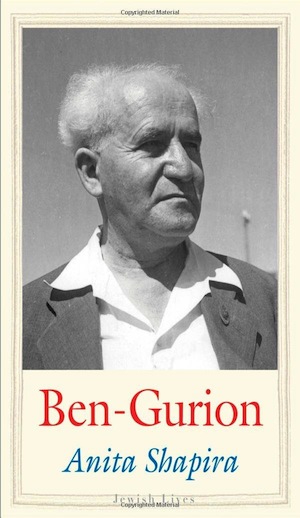
image - David Ben-Gurion, Father of Modern Israel by Anita Shapira book coverAccomplished Israeli historian Anita Shapira recounts the apocryphal anecdote in David Ben-Gurion, Father of Modern Israel (Yale University Press). Shapira, whose book Israel: A History won the National Jewish Book Award in 2012, presents Ben-Gurion as the person who did more than anyone else to establish the state. He inspired a nation of idealists and wartorn refugees to achieve the impossible. But does your overcrowded bookshelf need another Ben-Gurion biography? I can think of three strong reasons to recommend Shapira’s book.

Although not the definitive biography, Shapira offers a fresh perspective on Ben-Gurion’s life based on newly available files of the Israel Defence Forces and extensive work in the archives at kibbutz Sde Boker, where Ben-Gurion lived. She sets out his considerable accomplishments through colorful anecdotes and well-crafted prose.

As well, despite the passage of years, Ben-Gurion remains a central figure in contemporary debates, a touchstone for politicians from all parties. He is invariably quoted during heated arguments over Israel’s relations with Germany, its borders with its neighbors and its treatment of the Palestinians. He is often cited for his work in forging a partnership with the religious communities in the 1930s. Shapira offers solid scholarship for those who wish to reflect on his work.

And, for those with big ambitions, the new biography offers a vivid portrayal of how he scaled the heights of domestic and international politics. His biography may not be a roadmap to glory but aspiring leaders could pick up a few tips.

Shapira writes in detail about the years after the state was declared in 1948, and especially about Ben-Gurion’s role leading up to the Sinai campaign. However, the most engrossing part of this book is about his unlikely development as a leader. With a knack for telling stories, Shapira effectively tracks how the unexceptional youngster, not particularly well liked by his peers, developed pragmatic organizational skills, sharp elbows and incisive political instincts that propelled him into the forefront of the Zionist movement.

Ben-Gurion, born in 1886, grew up in Plonsk, a backwater shtetl three hours outside of Warsaw. Shapira found nothing in his birthplace, his lineage or his education that hinted at his future role in history. She sees no notable qualities in his personality that foreshadowed his destiny.

His mother died in childbirth when Ben-Gurion was 11. He quit school after his bar mitzvah, although he had a lifelong love of learning.

By 14 years old, he had embraced the Zionism of his father, who had been swept up in Theodor Herzl’s dream of a Jewish homeland in Palestine. However, Ben-Gurion was not in a rush to make aliya. At 18, he moved to Warsaw with the intention of becoming an engineer. The engineering schools rejected his applications.

Here is where destiny steps in. He happened to be in the city at a crucial moment in history. He was swept up in the heady events of the days before the Russian Revolution.

He joined Poalei Zion (Workers of Zion), a party that combined his newfound enthusiasm for Marxist socialism with Zionism.

Although his grasp of Marxism was considered shallow, he rose to a leadership position, recognized as a strong debater and speaker.

He finally immigrated to Palestine in 1906, but his early years in Palestine were not particularly auspicious. He often said one thing and did another.

He firmly believed that Jews would reclaim Palestine only by working the land. He said the land would belong to the Jews only when the majority of its workers and guards were Jewish.

He worked in the fields at Petach Tikva and then in the Galilee but he was frequently sick and, when he was healthy enough to work, he was miserable, Shapira writes. Throughout the following decades, he described himself as an agricultural worker while, in reality, he was doing other work in and outside of Palestine.

He had a strained relationship with his father and, according to Shapira, a distant relationship with his wife, who was the mother of his three children. He was excluded from clandestine groups and collectives in Palestine that were forming in those years.

Also, he misunderstood political realities. He was convinced that the Turks would remain in control of Palestine, never anticipating the British Mandate.

Ben-Gurion’s rise to prominence began slowly after the First World War. He expanded the Histadrut, the national federation of trade unions, into one of the most powerful institutions in the country. Elected leader of the World Zionist Organization and the Jewish Agency in 1935, he became the recognized leader of the Jewish community in Palestine. By the mid-1940s, he was exactly the type of leader that was required for the state of Israel to be born. Shapira shows that, from these ambiguous beginnings, a giant of history was formed.

The book has little to say about the lasting significance of some of his initiatives. She writes about his authorization of the forced expulsion of some Arabs, his reluctance to define Israel’s borders and, despite his secular lifestyle, his partnership with the religious community, but does not mention the social and political tensions arising from these initiatives. Shapira does not hold him accountable for creating conditions that led, although unintentionally, to many of the difficulties now confronting the country.

Regardless, Ben-Gurion’s accomplishments overshadow everything else. He transformed armed militias that were focused on fighting the British into a military force that could stand up to the armies of neighboring Arab countries. He ensured that tanks, artillery and aircraft were available to defend the land and its people. He hammered together a provisional government from the fiercely competing factions among the Jewish people in Palestine.

In sharp contrast to prominent Zionists of his era, Ben-Gurion advocated for a Zionism of practical achievements and put little faith in diplomacy and international proclamations. He demanded that Hebrew names be given to every aspect of government-related activity. He ensured that the religious community became partners in this ambitious nation-building project. He also had a hand in shaping the cultural, religious and intellectual character of the new country right from the start.

Shapira says that Ben-Gurion liked to argue that history was made by the masses, not individuals. She shows that, beyond a doubt, his role was decisive.

Robert Matas, a Vancouver-based writer, is a former journalist with the Globe and Mail. This review was originally published on the Isaac Waldman Jewish Public Library website and is reprinted here with permission. To reserve this book or any other, call 604-257-5181 or email library@jccgv.bc.ca. To view the catalogue, visit jccgv.com and click on Isaac Waldman library.

Radio host visits Israel

U.S. radio host Dr. Joy Browne discusses the post-traumatic physical and psychological challenges of terrorism at OneFamily. (photo from OneFamily)

American syndicated radio host and clinical psychologist Dr. Joy Browne had a meeting with victims of terrorism at the headquarters of OneFamily during her first-ever visit to Israel earlier this month.

Hosted by Chantal Belzberg, chief executive officer of OneFamily, Browne met with former residents of the United States, Canada and the United Kingdom who were dealing with physical and emotional wounds in the aftermath of terror attacks across Israel over the past few years. She interviewed Cheryl Mandel, Kay Wilson, Steve Bloomberg and Rebecca Fuhrman, as well as some of OneFamily’s psychologists and therapists for a future segment on her program.

“After experiencing the aftermath of 9/11, we all share a common echo and I am impressed with the resilience of the people here who have worked or who are working to transcend fear and are getting on with their lives,” said Browne.

Mandel, a native of Toronto, who made aliyah nearly 25 years ago, lost a son, Daniel, who was killed during an Israel Defence Forces anti-terrorism mission in Nablus (Shechem) in 2003. Mandel, in tears, told Browne, “Our entire family, including myself, lives life to the fullest and I am an optimistic person by nature, but one never is prepared for the shock that comes with the death of a son, whom I never thought twice about sending to the army.”

Browne’s trip to Israel was sponsored by the Office of the Prime Minister and America’s Voices in Israel.

JNF park named after Baird

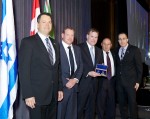
Left to right: Josh Cooper, Frank Sirlin, John Baird, Avi Dickstein and Ilan Pilo. (photo from Jewish National Fund, Pacific Region)

On June 7, the Jewish National Fund, Pacific Region, hosted the 2015 Negev Dinner at the Four Seasons Hotel in honor of Canada’s former minister of foreign affairs, John Baird.

In his speech, Baird summed up Israel and Canada’s friendship, saying, “Canada doesn’t stand behind Israel, but rather, walks shoulder to shoulder with Israel.”

Ilan Pilo, JNF Jerusalem emissary and executive director of JNF-PR, said, “Mr. Baird is a man of integrity and a true friend to Israel. JNF was grateful to honor him for his leadership on the world stage, for years of devoted service to the citizens of Canada, his dedication to the Jews of Canada and to the state of Israel. Thanks to John Baird’s outstanding leadership, Canada has become Israel’s most unwavering ally.”

photo - Left to right: Rafael Barak, John Baird and Josh Cooper
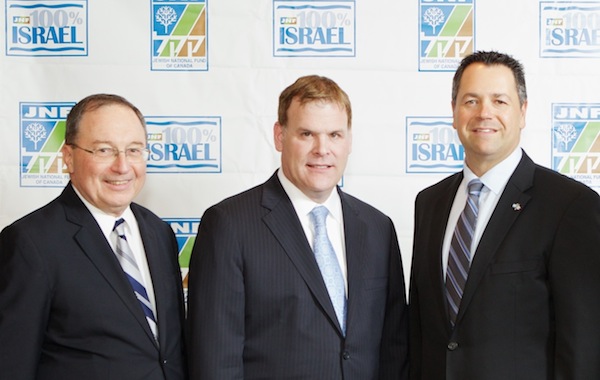
Left to right: Rafael Barak, John Baird and Josh Cooper. (photo from Jewish National Fund, Pacific Region)

Among the 350 guests at the dinner were Minister of Justice Suzanne Anton, representing the province, representatives of major Jewish institutions, as well as many community rabbis. Also in attendance were Rafael Barak, Israel’s ambassador to Canada; Josh Cooper, chief executive officer of JNF of Canada; and Avi Dickstein, executive director of the research and development division of KKL-JNF. All three dignitaries spoke of the uniquely warm relationship between Canada and Israel.

Proceeds from the dinner will support the creation of the Sderot Memorial Park in Israel, which will be named after Baird. This multi-functional urban park will host sports, leisure and recreation activities, as well as community events, and will provide children and their families with playground and fitness facilities. The new park will lift the morale of the residents of the city, which has been the ongoing target of rocket attacks from the Gaza Strip since 2001, as well as provide a venue for community activities and contribute to improving the quality of life for residents.

עשרים שנות פעילות בישראל

אייר קנדה שבסיסה במונטריאול מפעילה קו יומי בין הערים טורונטו ותל אביב. לאחרונה מופעל בקו זה מטוס הבואינג החדיש (הדרימליינר). (צילום: CNW Group/Air Canada)

 אייר קנדה מציינת עשרים שנות פעילות בישראל

חברת התעופה הלאומית של קנדה אייר קנדה מציינת בימים אלה עשרים שנות פעילות עניפה בישראל. לאור זאת החברה הקנדית קיימה אירוע חגיגי בנמל תל אביב בהשתתפות כמה מאות אורחים. בין האורחים: מנהלת אייר קנדה בישראל, רות בן צור ובכירים של החברה שהגיעו במיוחד מקנדה.

אייר קנדה שבסיסה במונטריאול מפעילה קו יומי בין הערים טורונטו ותל אביב, שנחשב לעמוס במיוחד (ואילו חברת אל על מפעילה שתי טיסות בשבוע בין תל אביב לטורונטו). לאחרונה מופעל בקו זה מטוס הבואינג החדיש 787-9 (הדרימליינר). לישראלים שנוחתים בטורונטו יש אפשרות לבצע טיסות המשך עם אייר קנדה ליעדים נוספים בקנדה, ליותר מחמישים יעדים בארצות הברית וכן למרכז ודרום אמריקה.

קנדה וישראל חתמו בראשית השנה על הסכם תעופה חדש שיביא לגידול במספר הטיסות בין שתי המדינות, במסגרת לידידות המתפתחת ביניהן בשנים האחרונות. בהתאם להסכם אייר קנדה ואל על יוכלו להגדיל את מספר הטיסות (של נוסעים ומטען) לשתיים עשרה בשבוע, ולאפשר לחברות הבנות שלהן גם כן לטוס בין המדינות. ההסכם כולל אף הגברת שיתוף פעולה בנושאי אבטחה.

רשות שדות התעופה של ישראל מציינת כי אשתקד טסו כ-148 אלף נוסעים בין קנדה לישראל. מדובר על גידול של כחמישה אחוזים לעומת שנה קודם לכן.

ועוד חדשות מקבוצת אייר קנדה: חברת הבת לטיסות לאו קוסט רוג’ החלה להפעיל טיסות ישירות, בקו מונטריאול ונציה. מדובר בהפעלת שתי טיסות בשבוע (באמצעות מטוסי בואינג 767) בין שתי הערים, עד אמצע חודש אוקטובר. הטיסות ממונטריאול יוצאות בימים חמישי ושבת בערב (9.30), ונותחות למחרת לפני הצהריים (11.40) בוונציה. ואילו הטיסות מוונציה יוצאות בימים שישי וראשון אחר הצהריים (1.25), ונוחתות במונטריאול גם כן אחר הצהריים (4.25).

צרות של עשירים שזכו בלוטו: זוכה ב-50 מיליון לא רוצה ששמו יתפרסם וזוג שזכה ב-1.6 מיליון לא מפסיק לריב

סוף סוף נמצא הזוכה מבריטיש קולומביה בהגרלת ה-50 מיליון דולר, שהתקיימה לפני שנה. הזוכה המאושר המתין שנה שלמה לאסוף את זכייתו, ועתה לאחר שהגיע למשרדי בריטיש קולומביה לוטו קורפוריישן, הוא דורש ששמו לא יתפרסם. בקורפוריישן מציינים כי בהתאם לתנאי המשחקים שמם של הזוכים יפורסם ברבים, והנושא עבר להתדיינות משפטית.

זוג מהעיר ספרוס גרוב שבאלבטרה הסתבך בצרה איומה. הם זכו בכ-1.6 מיליון דולר בהגרלת הלוטו, ומאז לא מפסיקים לריב. הזוג הסכים להתארח בתוכנית “ד”ר פיל” של הפסיכולוג ד”ר פיל מק’גרו.

אדווין ורקארק זכה עם חברים בעבודה ב-50 מיליון דולר, כשחלקו של כל אחד מהעובדים עומד על כ-1.6 מיליון דולר. מאז החיים שלו ושל אשתו ג’ודי הפכו לסיוט גדול.

ג’ודי טוענת שמאז הזכייה בעלה הפך לאדם כועס וחשאי, והוא שומר מרחק ממנה. אדווין טוען מצידו שהכסף שלו והוא יחליט מה לעשות בו, בו בזמן שהיא רוצה להיות שופתה מלאה בהחלטות. ג’ודי ביקשה שירכשו בית ובעלה העביר לה חצי מיליון דולר לשם כך, אך הפסיק לשלם את החשבונות השוטפים והכל נופל עליה.

אדווין טוען מצידו שאשתו ממשיכה לשמור על מסגרת הנישואים רק בגלל הזכייה בכסף. הוא התחיל לשתות לאחרונה כדי להימנע מהנידנודים של ג’ודי, שיש לה לדבריו “אובססיה לכסף עם סימנים של דולר בעיניים”. הוא העביר לג’ודי חצי מיליון דולר לרכישת הבית, אך הכסף נעלם והיא לא מסוגלת להסביר לאן. אדווין מדגיש שהוא זכה בכסף ויש לו את הזכות הבלעדית להחליט מה לעשות בו.

The trouble with Gaza repairs

Germany’s foreign minister was in Gaza the other day, surveying the miserable conditions there, including the lack of repair to the thousands of homes and other buildings damaged or destroyed during the Gaza War last summer – Operation Protective Edge, as it is formally called by Israel.

Frank-Walter Steinmeier, the German diplomat, was one of a steady stream of Western representatives who have trudged through the Hamas-controlled enclave since the end of major hostilities last year. He said the success of repairs to Gaza requires that Israel open the borders to the free flow of materials required for the project – and he’s right.

But, he also made the case very clearly that Israel cannot be expected to live up to that part of the bargain as long as missiles keep falling into Israel from Gaza-based terrorists. And, of course, he was right again.

While much of the world seems to think that Israel’s policies toward Gaza are spite-motivated efforts to drive the residents of that place into despair, they are actually founded on legitimate defence requirements. Materials intended for civil reconstruction in Gaza – not just since last year, but since Hamas seized the Strip and even before – have been misappropriated and turned into weaponry, tunnels and other infrastructures for further terrorism. Steinmeier, however, is one of too few among world leaders who recognize, or at least publicly acknowledge, this reality.

After Operation Protective Edge, nations gathered in Cairo to pledge funds to restore the civilian infrastructure of Gaza. In sum, $5.4 billion was pledged by countries worldwide. However, a new report says that barely one-quarter of the pledges made in Cairo have been realized.

The Association of International Development Agencies (AIDA) released a report last week titled Charting a New Course: Overcoming the Stalemate in Gaza. It set out the results of the top seven donor countries and their record of delivering.

The most generous pledge – $1 billion – came from Qatar. The amount received to date from that country is $102 million.

The second-place European Union pledged $348 million and has handed over $141 million.

The United States comes closest to their pledge, having delivered $233 million on their $277 million pledge.

Oil-rich Kuwait and the United Arab Emirates, which each pledged $200 million, have delivered nothing.

Turkey, whose leader has made grandstanding theatrics around Gaza a cornerstone of his country’s foreign policy, has likewise delivered not a dime of the $200 million pledged, according to the report.

Seventh-place Saudi Arabia, which pledged $500 million, has given just $48.5 million.

In their defence, the idea of throwing good money after bad in Gaza could reasonably lead donor countries to hesitate. There has been precious little evidence that funds flowing into Gaza will be applied to the projects for which they are intended rather than being used by Hamas warlords to strengthen their own fiefdoms or launch new assaults against Israel (not that the latter concerns some of the donor states).

However, while some voices, like the new United Nations Middle East peace envoy Nickolay Mladenov, acknowledge that the Gaza terror regime needs to lay down its arms, he and others most vocally blame Israel’s blockade for all the problems facing the people of Gaza.

The AIDA report, for example, outlines actions deemed necessary to alleviate the misery of Palestinians in Gaza that seem to recognize that there is plenty of blame and room for improvement all around. But at the top of the list were things Israel needed to do, such as “lift the blockade and open all crossings into and out of Gaza” and “allow free movement of Palestinians across the occupied Palestinian territory,” as if there were no legitimate security concerns behind the unfortunate policies that prevent the free movement of people and goods in and out of Gaza.

The first step to resolving a problem is acknowledging its root. There are numerous reasons why the people of Gaza continue to suffer, and Israel’s policies are among them. But they are neither alone among the reasons nor the lynchpin upon which resolving the problem rests.

Drought stress takes toll

A July 2014 Planet Labs satellite image of a reservoir in California’s Lake County that supplies water to nearby Yolo County. In a non-drought year, according to Planet Labs, the visible water would cover roughly twice the area as it does in this picture. (photo from Planet Labs via Wikimedia Commons)

California headlines this month scream “water shortage” – but the shortage is not limited to the western United States. According to a recent report by the U.S. Environmental Protection Agency, while the demand for freshwater resources is increasing, the supply remains constant and many regions are starting to feel the pressure. The report states that water managers in 40 of 50 states expect water shortages in some portion of their states within the next 10 years.

Amid this grave prognosis, a new Israeli research project might make the Jewish state an important part of the solution.

In what is arguably one of the most innovative water research consortiums to date, researchers from Ben-Gurion University of the Negev (BGU), Technion-Israel Institute of Technology, Hebrew University of Jerusalem and Australia’s Monash University are working to develop “water-sensitive cities.” The description for the project, which is funded by the Jewish National Fund (JNF), says that water-sensitive cities adopt and combine decentralized and centralized water management solutions to deliver water security. The data gathered from the project may be used to support development of urban master plans in cities in Israel and around the world.

Researchers are grouped into teams, each focusing on a different aspect of creating water-sensitive cities.

Eran Friedler, senior research fellow and head of the Water Forum Project at Technion, leads a team whose objective is to develop a holistic vision for water-sensitive cities in Israel encompassing scientific, economic and societal aspects, and accounting for the potential effects of global warming on temperatures and rainfall regimes. The analysis seeks to quantify the effect of urbanization and changing urban texture on storm water harvesting potential.

Evyatar Erell, a professor in the Bona Terra Department of Man in the Desert at BGU, is responsible for water-sensitive urban planning and design. He explained that his role is to examine conventional hydrological planning of cities and to see how it can be improved. This means reducing impermeable surfaces (sidewalks, parking lots, driveways, etc.) in favor of more permeable surfaces, sometimes innovative ones, such as green roofs or the infusion of small bits of garden along footpaths.

“We are trying to determine how to use water as effectively as possible, to maximize its benefits to pedestrians, reduce energy consumption by our buildings, and ensure environmental sustainability,” said Erell.

Read more at jns.org.

Young talent gives all

Growing up going to Hebrew school at a Conservative synagogue in Vancouver’s North Shore was a good start for Leo Robinovitch.

While Congregation Har El initiated his exploration into his Jewish identity and connection to Israel, it was a year after Robinovitch’s bar mitzvah that he really delved deeply into Judaism.

“It was then that I started attending Camp Miriam, a progressive, labor-Zionist summer camp affiliated with the youth movement Habonim Dror,” said Robinovitch, who will be returning to Israel this summer.

photo - Leo Robinovich
Leo Robinovitch will be joining Birthright Excel this summer. (photo from Leo Robinovitch)

“Habonim Dror machanot (summer camps) provide children ages 8-17 with a unique camping experience,” the movement’s description reads on its website. “Based on the model of a kibbutz, each machaneh (camp) creates a close-knit community based on Jewish ideals of collective responsibility, respect, equality and friendship…. Campers grow physically, emotionally and intellectually in a creative, open and caring environment. Habonim Dror has been providing a machaneh experience since 1932.”

In the summer of 2009, Robinovitch spent five weeks with Habonim Dror in Israel and later participated in Habonim Dror’s gap year program (from 2011 through to 2012), living in the north of Israel and teaching English in largely Arab cities in the region.

Camp Miriam and Habonim Dror personalized and solidified Robinovitch’s “connection to the Jewish people and our shared fate surrounding Israel, as well as prioritized the formation of a just, equitable, and democratic Israel over all else.”

Robinovitch has always been a technology and engineering enthusiast, an apple that definitely did not fall far from the tree with his father working as a biomedical engineering professor at the University of British Columbia.

“My sixth birthday party was engineering themed,” recalled Robinovitch. “My dad helped me set up a pulley and created a bunch of ping pong ball catapults, much to my own and my tiny friends’ delight.

“I’ve known that I would complete a degree in engineering from a very early age. And, now that I’m more than halfway through my mechanical engineering degree at UBC, I remain passionate about the future of technology and its connection to society, politics and the economy.”

On his most recent trip to Israel this past December, Robinovitch heard about a Birthright Israel Excel program through a few folks he met on the trip. “They were Excel alumni from a couple years ago,” said Robinovitch. “They were all extremely bright, motivated people who I shared many passions with.”

The alumni encouraged Robinovitch to apply for the program, as it had helped focus their careers and exposed them to a world of intelligent, hard-working people.

After looking further into the program, Robinovitch found it to be the perfect way to combine his commitment to Israel with his passion for technology, as well as gain necessary entrepreneurial skills for technology-related business endeavors he envisioned for himself in the future.

For 10 weeks this summer, Robinovitch will be working at a high-profile company in Tel Aviv, living with around 40 peers from across North America interested in commerce, finance, technology, medicine and venture capital (VC).

“I’ve spoken with the Excel staff extensively about my interests, and I’ll be finding out my placement in the coming weeks,” said Robinovitch. Possible internships include R&D for Microsoft, market analysis for General Motors, high-profile VC firms (such as Innovation Endeavors) and cyber-security firms.

During his stay in Israel, Robinovitch will also be traveling through the country and speaking with a number of prominent Israeli leaders over the summer, interacting with a number of Israeli peers with similar interests, and broadly experiencing Tel Aviv life.

Robinovitch is looking forward to further experiencing Israel and contributing to its affairs. “It’s very important for me to connect my passions for technology and Israel, and I look forward to doing so for the first time this summer,” he said.

Robinovitch anticipates that this Excel experience will help him decide which industry he wants to pursue, as well as build a diverse array of Israeli and North American partners with whom he will work well into the future.

While Robinovitch’s previous time in Israel was centred on social justice work and education, he is eager to play a larger role this time around in creating change.

“While this work [social justice and education] is still important to me – unquestionably some of the most important work to be done in Israel – I highly value this opportunity to experience Israel’s thriving tech and startup scene,” said Robinovitch. “It’s a side of Israel I’ve never been able to experience before and I believe that I will be able to tie in this summer’s experience with social justice projects in the future.”

As a student at UBC, Robinovitch has experienced some negative social justice campaigns aimed at Israel, like the recent BDS referendum (boycott, divest and sanction Israeli firms and products) and he is aware of how hot button an issue it has been this year at his university – in particular among the Jewish and Palestinian communities on campus.

“While I feel strongly that the Palestinian people deserve their own land in which to actualize themselves politically, culturally, religiously, etc., I cannot support the BDS movement because of its ultimate goal of the destruction of the Jewish state,” said Robinovitch. “Voting ‘no’ on the referendum, however, seems highly insubstantial compared to the work I will be doing this summer and in the future to contribute to a better Israel.”

Robinovitch encourages those invested in Israel at UBC and further afield “to take action beyond shooting down the BDS movement in order to strengthen Israel and create a more just reality for Palestinians.

“Additionally, I feel strongly that more Jewish youth should experience Israel and Judaism. I have been extremely lucky to be able to explore Jewish peoplehood through the opportunities that I’ve had the privilege of experiencing.”

For those in the community interested in discussing opportunities to experience Israel and Judaism through specialized programming, Robinovitch would be happy to help and can be contacted via e-mail at leorobinovitch@gmail.com.

Rebeca Kuropatwa is a Winnipeg freelance writer.

Committed to translating Israel

What someone writes clearly says a lot about a person. And so do the books one chooses to translate. For Israeli books that make it abroad to an English-speaking audience, an important and sometimes overlooked subset of Israeli literary society is the translators themselves.

Himself an accomplished author based in Chicago (his newest book is a young adult novel called Me Being Me is Exactly as Insane as You Being You), as a translator, Todd Hasak-Lowy sees it as his mission to bring excellent and innovative literature to English speakers. Motti by Asaf Schurr (which also includes an afterword by Hasak-Lowy) is a good example. “You could change 30 words of it and you wouldn’t know it’s an Israeli book. It challenges what people think of about Israeliness. That’s a book I want Americans to read because it’s great Hebrew literature, someone who’s a product of that society, but it’s not Amos Oz.”

As an American who never made Israel his permanent home, Hasak-Lowy spent a year in Israel after high school, took some Hebrew in college, and then pinned himself to a seat in the library in graduate school deepening his Hebrew knowledge, before spending some additional time in the country. “When I graduated high school, I knew around 300 Hebrew words from summer camp; when I got to grad school, I was able to crawl through an early [A.B.] Yehoshua novel over 30 months,” and now he’s a sought-after translator who thinks carefully about which projects he seeks to take on.

Haim Watzman is a translator’s name I had long known, staring at me from the inside front page of some of the most formative books I read about Israel when I was younger, including David Grossman’s first two non-fiction books, The Yellow Wind and Sleeping on a Wire. The first in-depth look at the Palestinian experience of being under Israeli military occupation, The Yellow Wind brought the Palestinian narrative to an Israeli – and then to a worldwide – audience; Grossman’s follow-on treatment of Palestinian citizens of Israel was similarly path-breaking.

Watzman and I spoke by Skype, as he and his wife, Ilana, prepared to celebrate their 30th wedding anniversary with a trip to the Netherlands. In talking to Watzman about politics, style, culture and translation, there are some technical points I was reminded of. First, English translations of Hebrew books tend to run about 30% longer. The economics of this for publishers can be daunting, so sometimes translators suggest editorial cuts. Second, because of the gendered nature of the language, Hebrew can afford both more passive tense and longer, meandering sentences. As Hebrew writers have become accustomed to using the passive voice that English writers now eschew as being a bad habit, translators have to take on an editing role: fact-checking and at times asking the writer “who” did what, exactly? And as for long, drawn-out sentences, English readers prefer theirs short and breezy.

About The Yellow Wind, Watzman describes it as his “rookie” assignment, which he was fortunate to land. As an undergraduate at Duke University, Watzman had written a thesis on Palestinian citizens of Israel, and as a correspondent for the Chronicle of Higher Education covering Palestinian colleges in the West Bank, he felt it important to bring the Palestinian story abroad. And while he’s careful to insist that these are the author’s works, not his own, today he says he’d do some things differently in the translation. Though he thinks “the translation came out fine – the public loved it; the editors loved it,” he says he “was more deferential then. I’d probably be more demanding of the author today, in terms of needling him for clarifications and suggestions.” Stylistically, he pushed to change Grossman’s present tense to the past, and he chose to keep some Arabic terms in the English translation.

It wasn’t until years later and subsequent translation gigs – including Grossman’s (and other authors’) political petitions published in newspapers – that Grossman finally asked him whether he agrees with the thrust of his political messages. For the most part, Watzman does.

I couldn’t help but be intrigued by the fact that Watzman leans left-liberal while being Orthodox in his religious outlook. (His Twitter profile photo, for example, is a sketch of Grossman working with Watzman, the latter’s kippa dominating the foreground.) Watzman explains that he came to religious observance “gradually,” having been “very taken by Shabbat and the intellectual component, including the debate over texts.” Two things “didn’t work for him,” however: orthodoxy’s attitude towards women, and the tendency within the Orthodox community towards right-wing politics. “I wasn’t going to give up my political principles for religion.” In Jerusalem’s Baka neighborhood, Watzman eventually found a like-minded community called Kehilat Yedidya.

And, while Watzman is committed to liberal democracy and human rights, he is no pacifist. Having tragically lost his son Niot in a military accident four years ago, Watzman tells me how he understands the military to be a necessity. Yet, while “Israel has to be vigilant and defend itself,” the country should be searching for peace through “accommodation and understanding.” He believes that “you can be both a Jewish nationalist and a liberal humanist. Not only is it possible, it is essential.” One could say that reading Israeli books, including new literature as well as the kind of searing non-fiction works that Grossman, Tom Segev and others have produced, captures this dualism perfectly: a nation committed to writing in its own land in its own language, while keeping tough questions in the foreground.

Mira Sucharov is an associate professor of political science at Carleton University. She blogs at Haaretz and the Jewish Daily Forward. A version of this article was originally published on haartez.com.