Skip to content
  • Home
  • Subscribe / donate
  • Events calendar
  • News
    • Local
    • National
    • Israel
    • World
    • עניין בחדשות
      A roundup of news in Canada and further afield, in Hebrew.
  • Opinion
    • From the JI
    • Op-Ed
  • Arts & Culture
    • Performing Arts
    • Music
    • Books
    • Visual Arts
    • TV & Film
  • Life
    • Celebrating the Holidays
    • Travel
    • The Daily Snooze
      Cartoons by Jacob Samuel
    • Mystery Photo
      Help the JI and JMABC fill in the gaps in our archives.
  • Community Links
    • Organizations, Etc.
    • Other News Sources & Blogs
    • Business Directory
  • FAQ
  • JI Chai Celebration
  • JI@88! video

Recent Posts

  • עשרים ואחת שנים בוונקובר
  • Supporting the Iranian people
  • The power of photography
  • A good place to start
  • When boundaries have shifted
  • Guitar virtuosos play
  • Different concepts of home
  • Broadway’s Jewish storylines
  • Sesame’s breadth and depth
  • Dylan Akira Adler part of JFL festival
  • Mortality learning series
  • A new strategy to brighten up BC
  • Sharing latkes and light
  • Johnson awarded for human rights work
  • Cherished tradition ensured … Silber Family Agam Menorah
  • Nothing as lovely as a tree
  • Camp welcomes new director
  • Popular family camp expands
  • A life-changing experience
  • Benefits of being a counselor
  • Camper to counselor
  • האלימות בישראל מורגשת בהרבה מגזרים
  • טראמפ עוזר דווקא לנושא הפלסטיני
  • New rabbi settles into post
  • A light for the nations
  • Killed for being Jewish 
  • The complexities of identity
  • Jews in time of trauma
  • What should governments do?
  • Annie will warm your heart
  • Best of the film fest online
  • Guitar Night at Massey
  • Partners in the telling of stories
  • Four Peretz pillars honoured
  • History as a foundation
  • Music can comfort us

Archives

Follow @JewishIndie
image - The CJN - Visit Us Banner - 300x600 - 101625

Tag: cookbook

Teaching young chefs

Teaching young chefs

Deborah French’s children – Henry, Elisheva, Amariah and Rafaella – about to enjoy the fruits of their labor, having made their first chocolate cake. French published The Cookbook for Children with Special Needs in 2015. (photo from Deborah French)

Deborah French’s rollercoaster ride began on June 14, 2004, when she gave birth to her second child, Amariah, who unexpectedly had Down syndrome. “Up until that point, we had absolutely no experience with special needs and never considered we ever would,” said French.

Growing up in northwest London, French made aliyah with her husband Johnny and their first two children in 2007. French chose to become a stay-at-home mom with the birth of Amariah. A year later, the couple’s eldest child, Henry, who was 2 years old at the time, was diagnosed with high-functioning autism.

“We felt incredibly alone and found those years extremely difficult,” French told the Independent.

Once a meticulous planner, these days, French finds that if she thinks too far ahead, she gets filled with anxiety and concern about how they will manage and how their children will fare in the future. “I don’t have the answers, so we don’t have expectations,” said French. “We take everything day by day, one step at a time…. We both only want our children to be happy and fulfilled.”

Going against the advice of many experts who said Henry could not concentrate on a single task for longer than five minutes and that he had poor motor skills, French set about baking cookies with her son one day when he was 4 years old.

“In the kitchen, his fine motor skills were excellent,” she said. “Henry worked solidly for an hour and, as freshly baked cookies with recognizable shapes came out the oven, I knew I was on to something. Being in the kitchen calmed Henry, channeled his energy and gave him a huge confidence boost, as he was able to provide food for others.”

French was asked if she would consider taking other kids into her kitchen. This paved the way for her cooking classes and, eventually, led to her compiling a comprehensive cooking course for children with special needs.

French, who is now the mother of five, has become an expert via life experience.

“After bringing my children into the kitchen, I saw firsthand the effect cooking had on their self-esteem and confidence,” she said. “I believe that any child suffering with learning or emotional difficulties will improve and develop their abilities at a faster rate if they are relaxed and participating in an activity that does not feel like therapy. This type of environment allows them to give of themselves to others and stimulates their creativity, giving them more chance to overcome their challenges.”

French is an advocate for families and their children with special needs in Israel. As well, she and her husband co-created the Chai on Life organization, which provides opportunities for such families to participate in regular activities while educating the wider community about children with special needs.

“We believe that education breaks down barriers and paves the way for acceptance and inclusion – a concept that benefits all children,” said French. “Our Mazal Le Chaim program takes children from mainstream to special needs schools to activities and events to encourage integration, teaching them to confront their fear of the unknown and embrace it.”
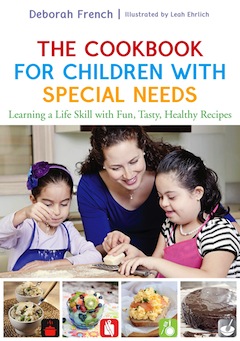
book cover - The Cookbook for Children with Special NeedsFrench’s first foray into writing was a memoir, A Brief Moment in Time (ASD Publishing, 2013), which won honorary mentions at Paris and New York book festivals. Her most recent publication is The Cookbook for Children with Special Needs (Jessica Kingsley Publishers, 2015).

French’s greatest pleasure comes from seeing how much Henry enjoys helping others who are struggling. “Many children with special needs are very in tune with the feelings of those around them,” she said. “And it is a wonderful feeling when my son notices that I’m tired and he responds by declaring, ‘Don’t worry, Mommy, I’m making lunch for everyone today. You sit down.’ Being able to help me in that situation gives him great satisfaction.”

Her cookbook is 200 pages and is geared toward children and young adults with special needs, their parents, caregivers and guardians. In essence, it is a cooking course to be followed from levels 1 through 3, with each level introducing additional foods, techniques and recipes.

Within each of the three levels, there are 10 recipes, seven of which are savoury and three of which are sweet. “The focus on savoury dishes reinforces the importance of moderation in our diet, ensuring that our primary foods are healthy ones, but that our indulgent foods are exactly that,” said French.

In the cookbook, she writes: “I was angst-ridden the day I allowed Henry to use a kitchen knife. After a month of continuously baking cookies, I took a giant leap of faith and watched as Henry followed my careful instruction and prepared a salad. There was not a chopped finger in sight! Henry sliced cucumbers, pepper and tomatoes. He was calm and attentive throughout. It was so exciting to see his elation after preparing the final dish. We ate salad for weeks after that day whether we wanted to or not!”

Said French, “Learning how to cook is an essential life skill that boosts self-confidence and develops individuality and creativity in all who try it. Those with special needs are no exception and proficiency in the kitchen will play a key role in their independence as adults.”

Rebeca Kuropatwa is a Winnipeg freelance writer.
Format ImagePosted on March 4, 2016March 10, 2016Author Rebeca KuropatwaCategories IsraelTags Chai on Life, cookbook, Deborah French, Israel, special needs
Cooking for all the seasons

Cooking for all the seasons

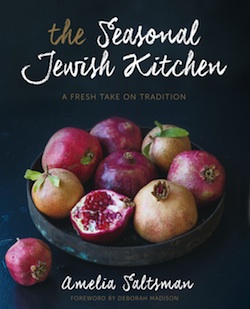
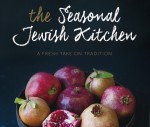
Amelia Saltsman’s background makes for an interesting source for her cookbook The Seasonal Jewish Kitchen (Sterling Epicure, 2015). Her mother is Romanian and her father is Iraqi; they met in the Israeli army and then immigrated to Los Angeles, where Saltsman was born and grew up. She and her family live in Santa Monica.

Saltsman is a regular contributor on food in the media. One day, while cooking and sharing her ideas on various social media and her blog, the responses were so overwhelming, she realized “that a new generation of cooks was looking for a fresh approach to Jewish food.” Thinking about her heritage led her to explore her family’s culinary roots more deeply.

book cover - The Seasonal Kitchen cover

When she divided the year into two-month microseasons, she saw how foods meshed with the holidays occurring during those times. The result is 146 recipes plus 135 beautiful, enticing color photographs. Within each two-month section is the description of a holiday, the background image for which is a piece of Arab embroidery. And each two-month section contains recipes connected to the holiday, from starters, salads and soups, to side dishes, main courses and desserts.

There are essays on what comprises Jewish food, as well as explanations for how to use the cookbook, ingredient essentials, kitchen fundamentals, helpful kitchen tools and seven basic recipes. There are two special indexes – recipes by course and by kosher category – a bibliography, information on the holidays, a resource guide, acknowledgments, more about the author and a regular index.

Saltsman said in an interview with KQED Food, “We often overlook today … the innate seasonality of Jewish food, from the late-summer/early-fall pomegranates, apples and quince of Rosh Hashanah and the etrog (citron fruit) of Sukkot, to the spring lamb and herbs of Passover. That Jewish food can be reframed through the lighter, brighter lens of how we eat today while still being true to its traditional roots.”

This is not a kosher cookbook, but the recipes are labeled as meat, dairy, pareve (neutral) and fish, as well as vegan or gluten-free. “The food philosophy is that you should use well-raised, whole, real foods,” she said. “There are no artificial ingredients used in any recipes.”

Weights are given in imperial and metric measures. One of my favorite aspects of a cookbook is anecdotes on each recipe, which Saltsman includes, and which make for a very warm and personal read. One of my other favorite features is numbering of instructions, which is not used in this cookbook.

Recipes are from Tunisia, Morocco, Germany, Syria, Yemen, Persia, Bulgaria, Hungary, Eastern Europe and, of course, Romania and Israel. Some of the recipes I found particularly interesting include autumn slaw with beets, carrots and kohlrabi; Syrian lemon chicken fricasse; braised beef with semolina dumplings; apples in nightgowns; rustic almond-orange macaroons; rice with almonds and raisins; bulgarian cheese puffs; and whole fish with preserved lemons and herbs.

For Chanukah, here are two of her recipes.

BEST POTATO LATKES
(makes 24; pareve or dairy)

2 pounds peeled starchy potatoes
1 small onion
2 heaping tbsp unbleached all-purpose flour or potato starch
1 tsp kosher salt
1/2 tsp baking powder
freshly ground black pepper
2 lightly beaten eggs
mild oil (grapeseed, sunflower or avocado)
sea salt

Using the large holes of a box grater or a food processor fitted with the grating disk, grate the potatoes (about five cups).

Grate the onion on the large holes of the box grater or use a food processor.

In a large bowl, stir together potatoes, onion, flour, salt, baking powder and a few grinds of pepper. Stir in eggs.

Line two or three sheet pans with paper towels. Place the prepared pans, the latke batter, a large spoon and a spatula near the stove.

Heat one or two large skillets over medium heat. Do not use more than 1/4-inch oil. When the oil is shimmering and a tiny bit of batter sizzles on contact, start spooning in the latke batter, making sure to add both solid and liquids Using the back of the spoon, flatten each spoonful into a circle three to four inches in diameter. Do not crowd the latkes in the pan. You will get four or five latkes in a 12-inch skillet.

Cook the latkes, flipping them once until golden on both sides, five to six minutes total.

Transfer the latkes to the prepared baking sheet. Cook the remaining batter in the same way, stirring the batter before adding more to the pan and adding oil as needed at the edge of the pan.

Arrange the latkes on a warmed platter, sprinkle with sea salt, and serve with applesauce or sour cream.

ROASTED SMASHED APPLES AND PEARS
(3 cups; pareve/vegan)

3 pounds medium-size apples and pears
a few sprigs thyme (optional)
2 to 3 tbsp water, fresh lemon juice, calvados, pear brandy or eau-de-vie, hard cider or dessert wine
ground cinnamon or nutmeg (optional)

Preheat the oven to 375˚F.

Halve the pears and apples through the stem end, then core them and place the halves, cut side down, on one or more sheet pans, spacing them one to two inches apart. If using the thyme, scatter it among the pears and apples. Cover the pan tightly with aluminum foil.

Bake the apples and pears until tender when pierced with a knife tip (30 to 40 minutes). When they are cool enough to handle, slip the fruits from the skins and back into the pan, scraping any pulp from the skins. Discard skins and thyme stems.

Mash the apples and pears with a fork, stirring in enough water or other liquid to help scrape up any brown bits from the pan bottom and lighten the texture of the fruit.

Scrape the mixture into a bowl and serve warm, at room temperature or cover and refrigerate up to a day ahead and serve cold.

This can also be made with all pears or all apples.

Sybil Kaplan is a journalist, foreign correspondent, lecturer, food writer and book reviewer who lives in Jerusalem. She also does the restaurant features for janglo.net and leads weekly walks in English in Jerusalem’s market.

Posted on December 4, 2015December 3, 2015Author Sybil KaplanCategories Celebrating the HolidaysTags Amelia Saltsman, Chanukah, cookbook, Sephardi
From simple to spectacular

From simple to spectacular

Food writers are privy to a lot of recipes, and many of them, sadly, are repeats of ones already widely familiar, with small variations in ingredients. Infrequently, though, we get access to a compilation of recipes by a skilled author with an innovative eye and a dash of culinary talent, and the result is nothing short of inspiring.

That’s Daniella Silver’s The Silver Platter (Artscroll, 2015) in a nutshell. Silver has none of the accolades of a celebrity chef – she doesn’t call herself a professional and she never spent a day in culinary school. Still, what she lacks in education she more than makes up for in passion and ingenuity in her work. Her recipes take common, easily obtained ingredients and put them together in spectacular new ways that highlight their flavor and versatility. Lay your hands on The Silver Platter and you feel an urge to get into the kitchen and start cooking.

A mother of kids with allergies, Silver is sensitive about gluten and notes whether each of her recipes is pareve, gluten-free, freezable and if substitutions could make it appropriate for Passover. She collaborated with Norene Gilletz to write this book and adds “Norene’s Notes” at the end of each recipe. That’s great because Gilletz is a no-mess, no-fuss chef who offers great tips on food storage, easy cleanup tricks, uses for leftovers and substitution possibilities.

Each recipe has a color image of the prepared dish on the facing page and all look incredibly tempting. I have a weakness for salads and vegetarian dishes, so I loved the panko-topped bok choy with edamame, the shaved corn and asparagus salad, and the kale salad with roasted sweet potatoes. Eye candy abounds and, in almost every recipe, the ingredient list adds new flavors to old staples. For example, lentil cranberry salad; mango chicken with leeks; parsnip latkes; and roasted squash with red onion and pears.

The Silver Platter is eye candy in the best sense of the word. This is a recipe book that will earn its chefs heaps of praise as they create easy dishes with ingredients that are mostly kitchen staples. That means no hunting the grocery stores for that odd ingredient you’ve never heard of before. Nutritional information for each dish is listed in the appendix and more than half of the 160 recipes, which cover fish, meat, poultry, desserts, appetizers and soups and salads, are gluten-free and Passover-friendly.

This book is a keeper on the recipe shelf. Kudos to Silver on her winning combinations in a recipe book that will inspire even long-dormant chefs to get cooking. Here is but one example, straight from The Silver Platter.

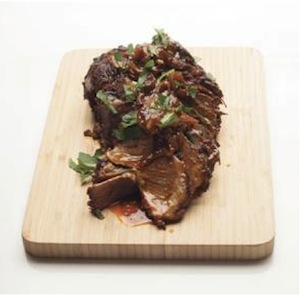
BALSAMIC-BRAISED BRISKET
(meat, Passover, gluten-free, freezes well, yields eight to 10 servings)

photo - Balsamic Braised Brisket from The Silver Platter1 beef brisket (4-5 lb /1.8-2.3 kg)
2 tsp kosher salt
1 tsp black pepper
1 tbsp onion powder
1 tbsp garlic powder
2 tbsp olive oil
3 large onions, thinly sliced
1/4 cup chopped fresh parsley
1 can (6 oz/170 g) tomato paste
2 tbsp honey
3 bay leaves
1/2 cup balsamic vinegar
3/4 cup dry red wine or water

  1. Coat a large roasting pan with nonstick cooking spray. Add brisket; sprinkle with salt, pepper, onion powder and garlic powder. Rub brisket with spices to coat on all sides.
  2. In a large nonstick skillet, heat oil over medium heat. Sauté onions for five minutes, until softened. Stir in parsley, tomato paste, honey, bay leaves, vinegar and wine. Simmer for five minutes, stirring occasionally. Let cool.
  3. Pour sauce over, around and under the brisket. Cover and marinate in the refrigerator for at least one hour or overnight, turning occasionally.
  4. Preheat oven to 325°F. Bake, covered, for three to three-and-a-half hours or until meat is fork-tender. Calculate 45 minutes per pound to determine the cooking time. Discard bay leaves. Let cool.
  5. Refrigerate several hours or overnight. Discard hardened fat from gravy. Trim excess fat from brisket. Slice against the grain to desired thickness.
  6. Reheat, covered, in pan gravy at 350°F for 25-30 minutes.

Norene’s Notes

  • Slow cooker method: season brisket and prepare sauce as above; add to slow cooker insert coated with nonstick cooking spray. Marinate overnight in the refrigerator. Place insert into slow cooker; cook on low for eight to 10 hours.
  • Ask your butcher to cut a very large brisket (8 lb/3.6 kg) in half. Total cooking time will be the same as for one 4 lb/1.8 kg brisket.
  • Brisket should be cooked “low and slow,” with lots of onions. The internal temperature should not rise above 180°F on a meat thermometer; after it reaches 200°F, the brisket will become dry.

Lauren Kramer, an award-winning writer and editor, lives in Richmond, B.C. To read her work online, visit laurenkramer.net.

Format ImagePosted on December 4, 2015December 3, 2015Author Lauren KramerCategories Celebrating the HolidaysTags cookbook, Daniella Silver, Norene Gilletz, Silver Platter

Add holiday sweetness

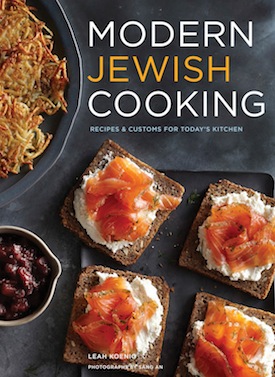
When my husband opened the package with Modern Jewish Cooking: Recipes and Customs for Today’s Kitchen by Leah Koenig (Chronicle Books, 2015) in it, he remarked, “This one you’re going to like!” And he was right.

Koenig is a writer and the author of The Hadassah Everyday Cookbook. When she is not living in Brooklyn, she is traveling around the country leading cooking demonstrations. Her philosophy is keeping a “loving eye on tradition … infusing history with … a sense of innovation … making the Jewish kitchen vibrant, exciting and ever-evolving.” She has written Modern Jewish Cooking “for the next generation of Jewish cooks.”

image - Modern Jewish Cooking book coverAfter an introduction on Jewish cuisine and keeping kosher, Koenig suggests how you should stock your kitchen and provides some how-tos. Then, she dives in with 11 chapters, from breakfast to dinner and desserts – 167 recipes – plus holiday essays and menus. These are enhanced by 57 color photographs and 11 essays. As well, Koenig includes all three elements I love in a cookbook: anecdotes or stories about each recipe, ingredients in bold or standing out in some way, and numbered directions.

The subtitle is “Recipes and Customs for Today’s Kitchen.” This is exhibited in the recipes’ wide variety of origins, including North Africa, Spain, Eastern Europe (including Ashkenazi), Ethiopia, Hungary, Italy, Germany, Bukharia, Romania, Egypt, Israel, Sweden, Iraq, Persia and the Mediterranean. For Rosh Hashana, I highlight three of Koenig’s recipes:

APPLE AND HONEY GRANOLA
(six to eight servings, suggested for an Ashkenazi menu)

1/3 cup honey
1/4 cup vegetable oil
2 tbsp light brown sugar
2 tsp ground cinnamon
1 tsp ground ginger
1/2 tsp kosher salt
2 1/2 cups old-fashioned rolled oats
1 cup roughly chopped walnuts
1/2 cup roughly chopped unsalted almonds
1 cup chopped dried apples
1/2 cup golden raisins

  1. Preheat oven to 375˚F. Line a large rimmed cookie sheet with parchment paper.
  2. Whisk together the honey, vegetable oil, brown sugar, cinnamon, ginger and salt in a small bowl.
  3. Combine the oats, walnuts and almonds in a large bowl. Drizzle with the honey mixture and stir to completely coat.
  4. Spread the granola on the prepared baking sheet. Bake, stirring occasionally until deep golden brown and tasty smelling, 20-25 minutes.
  5. Remove the baking sheet from the oven, add the apples and raisins and stir to combine. Set the baking sheet on a wire rack to cool completely. Store in an airtight container for up to one week.

 
RED WINE AND HONEY BRISKET
(serves eight to 10, suggested for a Sephardi menu. Moroccan Jews customarily serve couscous topped with seven vegetables on Rosh Hashana, as the holiday falls in the seventh month of the Jewish calendar)

4- to 5-pound brisket
salt and ground black pepper
1 tbsp vegetable oil
3 large thinly sliced yellow onions
8 sprigs fresh thyme
8 thinly sliced garlic cloves
2 bay leaves
1 1/2 cups dry red wine
3 tbsp balsamic vinegar
1/4 cup honey
1 tsp onion powder
1 tsp garlic powder
1 cup chicken broth

  1. Preheat oven to 325˚F. Generously sprinkle both sides of brisket with salt and pepper.
  2. Heat vegetable oil in Dutch oven or large pot. Add brisket and cook over medium heat, turning once until browned on both sides, eight to 10 minutes total.
  3. Remove brisket and set aside. Add onions, thyme, garlic, bay leaves, 1/2 cup wine and the vinegar. Cook until onions soften slightly, about five minutes.
  4. Whisk together one cup wine with honey, onion powder, garlic powder, broth and one teaspoon salt in a bowl. If using a Dutch oven, lay brisket atop onions. If using a pot, transfer onion mixture to a roasting pan and top with brisket. Pour wine mixture over the top. Cover tightly with foil and transfer to oven.
  5. Cook for two hours. Remove from oven, uncover and turn meat to other side. Re-cover and continue cooking two to 2.5 hours more, until meat is fork tender.
  6. Remove from oven, transfer to cutting board. Cover with foil and let rest 10-15 minutes. Slice brisket, remove thyme and bay leaves. Remove onions and arrange around brisket. Spoon pan juices over brisket and serve hot.

 
COUSCOUS WITH WINTER SQUASH AND CHICKPEAS
(serves six to eight)

1/4 cup extra-virgin olive oil
2 thinly sliced yellow onions
4 cored, seeded, chopped ripe plum tomatoes
2 finely chopped garlic cloves
1 tsp ground cinnamon
1 tsp ground ginger
1/2 tsp ground cumin
1/2 tsp ground coriander
1 tsp sweet paprika
1/2 tsp red pepper flakes
15 ounces drained chickpeas
3 cups cubed, peeled butternut squash
2 peeled 1/2-inch chunked carrots
1/4 cup golden raisins
salt and freshly ground black pepper
2 1/2 cups vegetable broth
2 1/2 cups water
2 cups couscous
roughly chopped fresh cilantro or flat leaf parsley

  1. Heat olive oil in saucepan over medium heat. Add onions and cook until lightly browned, seven to 10 minutes. Add tomatoes and cook until soft, about five minutes. Add garlic, cinnamon, ginger, cumin, coriander, paprika and red pepper flakes, and cook one to two minutes.
  2. Add chickpeas, squash, carrots, raisins, broth and one teaspoon salt. Turn heat to low, cover and simmer about 15 minutes. Uncover and continue simmering, stirring occasionally until very slightly thickened, about five minutes.
  3. Bring water to boil in saucepan on high heat. Turn off heat and stir in couscous. Cover pan and let stand five to 10 minutes, until liquid is absorbed.
  4. Uncover couscous and fluff with a fork. Mount couscous onto a large platter. Make a well in the centre and fill with vegetables and chickpeas. Spoon a generous amount of liquid over couscous and sprinkle with cilantro. Serve immediately.

 
Sybil Kaplan is a journalist, foreign correspondent, lecturer, food writer and book reviewer who lives in Jerusalem. She also does the restaurant features for janglo.net and leads weekly walks in English in Jerusalem’s market.

Posted on September 11, 2015September 9, 2015Author Sybil KaplanCategories Celebrating the HolidaysTags cookbook, Leah Koenig, Modern Jewish Cooking, Rosh Hashana
Unique taste of Israel

Unique taste of Israel

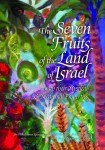
Chana Bracha Siegelbaum is founder and director of the Midreshet B’erot Bat Ayin: Holistic Torah for Women on the Land. Located 20 minutes south of Jerusalem in the Gush Etzion community since 1994, its programs include monthly seminars for English-speaking women, experiential weekends and holiday studies based on a curricula emphasizing women’s spiritual empowerment through traditional Torah values. The rebbetzin also tends an orchard of 50 fruit trees, and she has recently published The Seven Fruits of the Land of Israel (Menorah Books, 2014).

Danish-born Siegelbaum wrote this cookbook over 17 years, and it features more than recipes – it includes the mystical and medicinal properties of the seven species. For each of the species, mentioned in Deuteronomy 8:9-10, there are other biblical sources. Siegelbaum offers for each species an attribute, character trait, holiday, weekday, world, body parts, shepherd, prophetess, numerical value, how often it is mentioned in the Bible and the meaning of its Latin name. After this are nutrition facts, medical associations, kabbalah references, recipes, a story and general references.

The book is compiled and expanded from the rebbetzin’s yearly workshops, and “the Torah teachings carry the main weight of the book, as Torah is [her] passion and training.”

Siegelbaum writes that the seven fruits of Israel affirm the G-d of Israel, the people of Israel and the land of Israel. Wheat is soft and sweet; barley, tough and hard; grapes are succulent and deliciously juicy; figs are plump and fleshy; pomegranates are tangy, vibrant and crunchy; the bitterness of olives contrasts with the honeyed sweetness of the dates.

After completing the text of the book, which took more than 15 years, Siegelbaum then spent a year working with the graphic artist and fine-tuning it. Jessica Friedman Vaiselberg, who created the illustrations, is originally from Kentucky; she studied at the Memphis College of Art and graduated from the University of Louisville. She and her family live on Long Island, where she has a home studio.

Not only is The Seven Fruits of the Land of Israel a fascinating book, but there are 162 color photographs to enhance the work, a summary chapter, three appendices and essays about the author, the artist and the Midreshet, as well as numerous illustrations and paintings.

Special touches to the book include border illustrations of each species, color-coded to match the species – for example, the use of a grape color for the grape chapter, green for barley, etc. Additional illustrations are on the bottom of each page.

There are 67 recipes, many unique, including wheat burgers, wheat-germ brownies, baked barley, barley beet salad, chocolate grape leaves, Rambam’s charoset, fresh fig spread, quinoa pomegranate almond delight, anti-wrinkle pomegranate-feel facial cream, flavored olive oil, Moroccan-inspired cooked olives, dream of date balls and guilt-free chocolate mousse pie.

Even though the rebbetzin leaves out the number of servings, her styling includes the things that I always find most useful – a little comment, numbered instructions and a separation of ingredients from instructions, in this case, in a shaded box.

The Seven Fruits of the Land of Israel was awarded the 2015 Gourmand World Cookbook Award in the best Jewish cuisine category and in the best cookbook fruits category. Here are a couple of recipes from it.

TENDER POMEGRANATE TABOULI

1 cup cracked wheat (bulgur)
1 bundle finely chopped parsley (about 2/3 cup)
1 bunch finely chopped mint or 1/2 cup dry
1/2 cup finely chopped green onions or scallions
1/2 cup pomegranate arils
1 finely chopped cucumber
juice of 2 lemons
2 tbsp olive oil
sea salt to taste
freshly ground black pepper to taste
allspice to taste

1. Pour boiling water over cracked wheat.
2. Soak cracked wheat in water for at least one hour. Pour out extra water.
3. Soak the parsley, green onions and mint in natural soap water for three minutes. Rinse.
4. Process parsley, green onions and mint in a food processor until very fine.
5. Mix finely chopped herbs and onions with the soaked bulgur.
6. Add the pomegranate arils and chopped cucumber.
7. Pour juice of the lemons on the tabouli and add the olive oil, salt, pepper and allspice.

OLIVE WALNUT SPREAD

1 can of pitted green olives (1/4 pound)
4 garlic cloves
1/2 to 1 cup walnuts
1/4 cup extra virgin olive oil

1. Puree olives, garlic, walnuts and olive oil in a food processor. Serve as a dip.

Sybil Kaplan is a journalist, foreign correspondent, lecturer, food writer and book reviewer who lives in Jerusalem. She also does the restaurant features for janglo.net and leads weekly shuk walks in English in Jerusalem’s Jewish food market.

Format ImagePosted on April 17, 2015April 16, 2015Author Sybil KaplanCategories IsraelTags Chana Bracha Siegelbaum, cookbook, Israel, Midreshet
Cooking to fill others’ tables

Cooking to fill others’ tables

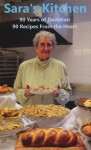
Mere days before heading to Israel for a couple of weeks, Sara Ciacci, 90, called the Jewish Independent to make sure that I had received her new cookbook, Sara’s Kitchen: 90 Years of Devotion, 90 Recipes from the Heart (Gateway Rasmussen, 2015), and that I had all the information I needed about the Jewish Food Bank. For Ciacci, food and tzedaka are inextricably connected with life and community.

“Sara Ciacci is the beating heart of Temple Sholom’s kitchen,” reads the cookbook’s introduction. “From her kiddush lunches to the Sisterhood catering committee, second seders, women’s seders and the annual Yom Kippur break-the-fast, Sara has made a mission of nourishing her congregation since its earliest days. She is queen of all hamantashen, blintzes and latkes, and, every year, she and friend Leonor Etkin produce challot by the dozen for Temple Sholom’s High Holiday celebrations. Sara also makes the Vancouver Jewish Food Bank her priority, and all the hungry in our community will be the beneficiaries of all the money raised from the sale of Sara’s Kitchen.”

The Jewish Food Bank supports close to 400 Jewish individuals each year, according to its 2013-2014 report. Ciacci shared with the Jewish Independent an email she wrote to the Jewish Family Service Agency, which co-funds the food bank with Jewish Women International-B.C. and community donors. In it, she traces her memories of the service agency back 80 years, to the Depression era, when, like many families in the Jewish community, she writes, “my mother, two sisters and I needed help. I also remember Theresa Blumberg, the social worker who came to our home and found a reason to look in the food pantry, to talk with me and ask about school. She also found time to visit me during the 18 months that I was in the children’s preventorium for tuberculosis. It was Miss Blumberg who made sure that I had proper shoes and school supplies. My only possession from childhood is an 11th birthday book inscribed, ‘To my dear Sara, from Theresa Blumberg.’…

“My adult association with the Jewish Food Bank started in 1984 when our president, Jean Cohen, was helping a Jewish senior and found canned cat food in her cupboard. She did not have a cat. Jean brought the idea of a food bank for seniors and immigrants to our board. We then approached the Jewish Family Service Agency (JFSA) and an unofficial partnership was born. B’nai B’rith Women (now JWI-BC) would be responsible for collecting food and JFSA counselors chose the recipients. Hampers were provided based on a list that identified recipients only by a numbered card that specified their specific needs.”

Organized for a number of years by “two wonderful women who are no longer with us,” Renee Lifchus for BBW (now JWI-BC) and Isabel Lever from JFSA, “We packed the first hampers … in Safeway paper bags on the workbench in Carol Fader’s basement…. Hampers contained non-perishable food items that our members donated or collected from friends and family.”

In this tradition of community, several recipes in Sara’s Kitchen are Ciacci’s “by way of being begged, borrowed, copied, changed or invented.” The sources of these recipes are acknowledged, which adds to the community feel of this cookbook.

There are three chapters, starting with most everyone’s favorite meal: dessert. The second chapter comprises Passover recipes, the third, “and everything else.” There is an index for quick finds, a page on which to note your favorite recipes and their page number for easy reference, as well as a couple of pages to write in a few of your own recipes. Each section is headed by a full-color page of some of the treats waiting to be made.

The desserts section starts with a few tips, such as the need to chill cookie dough for at least an hour. Ginger snaps, blueberry drop cookies, and apple and honey cake bread pudding with butterscotch sauce are among the 36 pages of desserts to try after Passover.

In addition to the Passover conversion table – offering substitutes for flour and Graham cracker crumbs, for example – there is a spice guide, and pieces of advice offered throughout, such as how to ripen avocados more quickly and how to make radish roses. Appropriately, on page 90, is “Sara Ciacci’s Recipe for a Rich Full Life,” featuring nine wise ingredients.

Since I’m reviewing this cookbook in the Jewish Independent’s Passover edition, the recipes I tested are all kosher for the holiday: spinach vegetable kugel, red cabbage and almond crisps. Everything turned out according to plan, except the almond crisps, which were golden brown in about half the suggested time. I will remember this next time I make them because they are so good and easy to make, there will be a next time.

SPINACH VEGETABLE KUGEL

3 large carrots
10 oz package frozen spinach, thawed
1 medium onion
2 stalks celery
1 cup chicken [or vegetable] bouillon
3 eggs
3/4 cup matza meal
salt and pepper to taste

Preheat over to 350˚F. Grease an eight-inch square pan.

Cut up and grate carrots. Set aside. Chop spinach, onion and celery. Place in a two-quart saucepan. Add grated carrots and bouillon. Cook over medium heat for 15 to 20 minutes until vegetables are soft.

Place the eggs and matza meal in a mixing bowl. Stir in cooked vegetables. Season with salt and pepper. Spread the mixture evenly in the baking pan. Bake, uncovered, for 45 minutes. Cut into squares before serving.

RED CABBAGE

1 medium onion
1 average-size red cabbage
4 medium apples
1/4 cup canola oil or butter
1/2 cup water
3 tbsp (or more) red wine vinegar
3 tbsp sugar
1 tsp salt
3 or 4 whole cloves
1 tsp caraway seeds (optional)

Slice onion and sauté in oil/butter until translucent. Shred cabbage. Peel, core and slice up apples. Place cabbage in a pot and top with the sliced apples. Add water and remaining ingredients. Place on medium-low heat and simmer one hour (or longer), stirring occasionally until cabbage is tender.

Adjust vinegar/sugar to taste. Some lemon juice can be substituted for the vinegar.

ALMOND CRISPS
Perfect for Passover, these cookies also make a great gluten-free option at any dessert buffet.

3 cups sliced almonds with skins, lightly toasted
1/2 cup sugar
2 egg whites. at room temperature
1/2 tsp vanilla (optional)

Preheat oven to 350˚F. Line cookie sheet with parchment paper.

In a large bowl, mix (do not beat) egg whites with sugar. Add vanilla. Stir in almonds.

Using a tablespoon, make mounds of mixture on cookie sheet and flatten into thin rounds with your fingers dipped in cold water or with the back of a spoon. Bake for 20 minutes or until golden brown.

Turn off the oven and leave cookies in the oven with door open for 10 more minutes.

Makes 20 to 22 cookies.

For copies of Sara’s Kitchen, contact Darcy Billinkoff at [email protected].

Format ImagePosted on March 27, 2015March 26, 2015Author Cynthia RamsayCategories LocalTags cookbook, Passover, recipes, Sara Ciacci, Temple Sholom

Posts pagination

Previous page Page 1 Page 2
Proudly powered by WordPress