Josh Epstein raises a glass to toast lyubov (love) in recognition of the theme of the hit play Onegin, in which he plays a jealous lover. In a rare opportunity, theatre-goers are actually encouraged to bring their drinks with them into the auditorium in order to join the cast when they toast. Onegin, which is a musical with comedic overtones, has been brought back to the Arts Club after a successful showing in 2016 and runs until Dec. 31 at the Granville Island stage. For tickets and more information, visit artsclub.com.
In Bittergirl, Cailin Stadnyk, Katrina Reynolds and Lauren Bowler play women who have just been dumped by their boyfriends – maybe they can get back their men if they lose some weight? (photo by Emily Cooper)
Have you ever taken part in an aerobics class and wondered how many of the women in it were trying to lose weight to get a boyfriend back? The sad truth is, there are probably many, eagerly trying anything to return to the way things were, even if the way things were wasn’t all that great.
Bittergirl: The Musical takes aim at countless breakup truisms from the perspectives of three different women, reminiscent of the sharp wit in Mom’s the Word and the relationship charades of Sex in the City. Their varied responses to being dumped are hilariously insightful.
The progress of the play loosely follows the five stages of death: denial, anger, bargaining, depression and acceptance. The stages of the breakups are denial (he made a mistake), second-guessing (I could have done something differently), manipulation (I’m going to make him love me), reflection (I should have seen the warning signs) and acceptance (I’m over him, I’ve moved on).
The three women – played by Lauren Bowler, Katrina Reynolds and Cailin Stadnyk – are known only as A, B and C, as though these trials and tribulations are those that belong to every woman, not a specific person. Jewish community member Josh Epstein plays D, all three of the dumpers – the husband who wants to join the RCMP, the live-in partner who just “has to go” and the boyfriend who’s lost his “magic.”
Epstein delivers the stereotypical reasons why he needs to get out of each relationship: “I feel trapped,” “I can’t give you what you want” and the ridiculous “We’ve got to be birds flying higher.”
The lame rationales elicit howls of laughter at the familiarity, especially when one of the women initially thinks that the “talk” her boyfriend wants to have will lead to a proposal.
Not surprisingly, the women stand there, stunned into silence, not demanding further explanation, but meekly mumbling things like, “I understand,” even though they don’t – another conventional reaction it is sadly not surprising to see depicted.
After their men leave, the women think about what they might have done differently to save their relationships – “Maybe if I wore plum eyeshadow,” “Maybe if I didn’t talk to my mother so much” and “Maybe if I worked out more.” This last statement segues into an hysterical scene of the three women working out with various gizmos and in different types of classes in a desperate bid to get in shape and win back their men.
Katrina Reynolds and Josh Epstein in Bittergirl, at the Arts Club Granville Island Stage until July 29. (photo by Emily Cooper)
The women also reflect on the warnings signs they missed. He wears socks with sandals. He cries at Celine Dion songs. He growls during sex.
Especially comical is a scene where the women run into friends and they are forced to admit they were dumped. The standard, “You’re better off without him” or “If you guys couldn’t make it work, what chance do the rest of us have?” hit the mark on how insensitive people can be, much to the enjoyment of the audience. The rapid-fire delivery of the lines, the women playing off each other brilliantly, is a sight to see and hear.
As the musical progresses, classic girl-group songs of the 1960s and ’70s complement the dialogue. Thinking about their first dates leads into “And Then He Kissed Me.” The initial breakups prompt a rendition of “Mama Said There’d Be Days Like This.” When the women hope they’ll have a chance to renew the relationship, they sing “When Will I See You Again?” And who hasn’t felt the difficulty of moving on because there’s “Always Something There to Remind Me”?
The strength of the play is in how the writing spotlights those moments we all know so well and that sound so absurd when depicted one after the other. Being reminded of one’s own failed relationships, watching the play is like watching a good comedian – often funny and, despite being cringeworthy at times, you want to stay to the finale.
As with the different stages of death, the women finally accept their situations and move on with their lives, singing such lyrics as “you don’t really love me; you just keep me hanging on,” there are “too many fish in the sea” and “I will survive.”
Bittergirl is actually an autobiographical play written by three Toronto actresses who had, indeed, just gotten dumped by a husband, live-in boyfriend and short-term partner. The positive reaction to the play led to the 2005 book Bittergirl: Getting Over Getting Dumped. After that, the writers added the songs, accompanied by an all-female band onstage, and the musical was born.
Besides the sharp, insightful writing, these women (and Epstein) can all belt out a tune, making the performance a hit from the beginning to the (not so) bitter end.
Bittergirl runs at the Arts Club Granville Island Stage until July 29. For tickets and more information, visit artsclub.com.
Baila Lazarusis Vancouver-based writer and principal media strategist at phase2coaching.com.
Nolan Fahey plays the title character in Arts Club’s Billy Elliot. (photo by David Cooper)
There are no big surprises in Billy Elliot, no bizarre twists or jaw-dropping turns of events, no mistaken identities or star-crossed lovers. But what you do get is class struggle, a feel-good story and exceptional singing, dancing and acting all with high-octane energy from start to finish.
Given that the musical is based on the 2000 movie of the same name, most people will already know the story. But even if you haven’t seen the film, you’ll likely figure out beforehand that Billy Elliot traces a coming-of-age-dusting-off-the-dirt-of-this-town tale of a young boy wanting to be a dancer. He sees an audition in London as a way out of the coal-mining misery that has made up the lives of his father and brother.
Living in England’s County Durham, 11-year-old Billy stumbles across a ballet class when he’s supposed to be taking boxing lessons. The 50p his father gives him to learn jabs and upper cuts goes instead to Mrs. Wilkinson to teach him pliés and pirouettes.
Meanwhile, his father, brother and neighbors, part of the National Union of Mine Workers, are struggling to make ends meet as they head out on strike protesting the closure of the coal mines during Margaret Thatcher’s reign in the 1980s.
The contrast of the gruff, angry, mob-like miners, the police at the picket lines and the young girls and Billy in their dance outfits illustrates how far apart their worlds are. One of the best dance numbers brings these three groups together to sing “Solidarity,” with the ballet dancers flitting in between the rows of men as they stomp about the stage.
As Billy moves between these two worlds, he has to conceal his desire for dance, for fear of reprisals and embarrassment.
Warren Kimmel, left, Nolan Fahey and Caitriona Murphy in Billy Elliot. (photo by David Cooper)
When Billy’s father – played by Jewish community member Warren Kimmel – finds out where his son has been spending his afternoons (and his money), he’s furious. Even though Billy’s teacher thinks her young student has a chance to get into the Royal Ballet School, Billy’s family has other plans.
In the end, Billy’s dad has to choose between earning money as a scab in order to send Billy to his audition, or support his brothers on the picket line.
Throughout the play, the scenes shift between the lighthearted dancing and the sombre mood in Billy’s home and on the picket line. With Kimmel front and centre as Billy’s father, his despondent singing is evocative of his performance of the policeman Javert in Les Misérables last year and, indeed, the storyline – and songs – of class struggle in Billy is reminiscent of the same in Les Mis.
On the dancing side, Billy has touches of the studio work and audition of Flashdance and the off-the-wall anger dancing of Footloose, while tap-dancing men in drag bring a bit of humor to the show.
All in all this play flies by. The level of performance of Nolan Fahey as Billy, Caitriona Murphy as the dance teacher Mrs. Wilkinson and Kimmel as the dad, along with a strong cast that can shuffle and slide as well as they croon, makes this a standout production.
Billy Elliot – with music by Elton John and lyrics by Lee Hall – debuted in London’s West End in 2005, garnering critical acclaim, winning four Laurence Olivier Awards in London, followed by 10 Tony Awards in New York.
The work is not John’s first foray into musical theatre. In the 1990s, he and Tim Rice collaborated to produce the soundtrack for The Lion King, for which they won Academy and Tony awards, including best musical. Then, in 2000, they collaborated on Aida, which won them each a Grammy.
Billy Elliot runs at the Stanley Industrial Alliance Stage until July 10. Tickets can be purchased from artsclub.com. Parents wanting to take their kids should note that the show includes a lot of swearing.
Baila Lazarusis a freelance writer and media trainer in Vancouver. Her consulting work can be seen at phase2coaching.com.
Daniel Doheny and Kerry Sandomirsky in The Valley, which tackles the subject of depression. (photo by Emily Cooper)
As The Valley opens, a young man addresses the audience with the words, “Encounters with the police No. 1.”
It’s a stark opening, as the character – Connor – stands in a spotlight on a circular stage, with the three other actors behind him in the shadows. The monologue represents both the beginning and end to the play. It establishes a sense of the past – about what brought the characters to their current situation – as well as the present, when they are revealing themselves in a healing circle. Each of the players eventually gets to speak directly to the audience in turn, and the drama of the performance unfolds between the monologues.
Essentially, the play is about the effect of depression in two different families – a police officer (Dan) and his wife (Janie), who has just given birth and has a history of depression; and a mother (Sharon) and son (Connor), who has an episode when he’s 18. Amazingly, all the action takes place within the circular stage – a relevant choice for the performance.
“The show is a very intimate show, though the Granville Island stage is not considered intimate,” set designer Amir Ofek explained. “We wanted it ‘in your face,’ not hiding behind a proscenium arch.”
When faced with the decision of whether to use a more literal interpretation of the play for the set design, Ofek said he wanted to avoid switching between the staging of homes of each family, the police station, the Skytrain and other locations in order to keep the intensity going.
“As a designer, I have to delve into the play to find a unique way of doing things,” he said, adding that he tried in the design to convey the protagonists’ characteristics of intensity and fragility by having part of the set jut out of the stage, as though it might fall on the audience any minute.
“There’s a sense of brutality in the play, as well,” Ofek said. “It’s reflected in the edginess of the material of the set.”
Intense, brutal and fragile are perfect words to describe the characters. When Connor quits university after wanting to go for so long, his mother Sharon is at a loss. She tries so hard to change his mind – pleading, cajoling, trying logic and guilt. She is helpless against an illness that has yet to even reveal itself. When an “incident at Joyce Station” takes place, her lament to the audience is heartwrenching: “What to expect at 18 years, three months – your child will break in two.”
In the other household, Dan struggles to be supportive of his wife when she is having depressive episodes, but he has his own demons to bear from being a police officer.
“Every holiday you’ve ever looked forward to – they’re all on our s–t list,” he says, referring to the increase in crime and misdemeanors around holiday time. “Hookers, jumpers, pushers, junkies, racers, strippers – hundreds of things you don’t want to hear about.”
Ironically, it was through his work that Dan met his wife, helping get her clean and off the street. Their struggle is particularly disquieting to watch as it’s so clear how much they love each other, but seem to be always living on the edge of a breakdown.
When Dan arrests Connor in the “incident at Joyce Station,” there’s a struggle that sends Connor to the hospital and results in months of being housebound in his depression, unable or unwilling to listen to his mother, who is constantly on him to do something.
Eventually, Dan and Janie get an invitation to a healing circle to help Connor deal with the aftermath of the incident. But, like his refusal to pay attention to his wife’s bouts of depression, Dan refuses to hear anything about a healing circle. Janie goes on her own and is able to connect with Connor because she shares his ailment and understands what he’s going through. Through Janie, Sharon finds out something that allows her to let go of her own anger.
This play is not easy to watch but it’s an important one to see, if only to get a bit more understanding of how people suffer with despair and hopelessness – sometimes for months or years at a time. It’s estimated that 10% of adults in Canada will experience a serious depressive episode in their lifetimes.
The Valley stars Daniel Doheny as Connor, Kerry Sandomirsky as Sharon, Pippa Mackie as Janie and Robert Salvador as Dan. It’s directed by Mindy Parfitt, with lighting by Itai Erdal, and runs at the Arts Club (artsclub.com) Granville Island stage until May 7.
Baila Lazarusis a freelance writer and media trainer in Vancouver. Her consulting work can be seen at phase2coaching.com.
Colleen Wheeler and Scott Bellis in Good People. (photo by Emily Cooper)
It’s always a treat to see Colleen Wheeler on stage, as her performances never disappoint. And she keeps the track record going in Good People at the Arts Club. However, the overall feel I came away with after the play didn’t match the level of enjoyment I had for the acting.
Wheeler plays Margaret, a feisty, mile-a-minute talker who can finagle her way into anything, except work.
Living in South Boston, a dense, lower-class neighborhood, Marg blames her situation on bad luck – growing up without the guidance of parents, not being able to go to a better school or get a better job. She fears she will end up like former classmate Cookie McDermot, an alcoholic living on the street.
As the play opens, Marg is being fired from a cashier’s job at a dollar store after coming late several times. The single mother is often late because she has to tend to a daughter who has mental health issues – a daughter for whom she gets no child support and who may or may not be the child of a former high school flame.
She commiserates about life over McCafés in bingo parlors with her friend Jeanne (Jenn Griffin), former supervisor Stevie (Ben Elliott) and landlord Dottie (Patti Allan), who is supposed to watch Marg’s daughter but often forgets to show up. One day, Jeanne mentions that she ran into Mike, an old boyfriend of Marg’s who has become a doctor, so Marg sets out to talk her way into a job.
Within minutes of walking into Mike’s office, she profanely insults his secretary and comments on her physical appearance. She insults Mike himself, saying he’s not a “Southie” anymore, that he now lives “lace curtain.” And she passive-aggressively follows up every abuse with the disclaimer, “Awww, I’m just bustin’ your balls.”
Despite all of this, her mastery at twisting Mike’s words and actually making him feel guilty for the altercations get her invited to an upcoming party. When Mike calls her later that week to cancel because his daughter is sick, Marg begins to think he doesn’t want her to attend – and goes anyway. It is in this scene where Marg, Mike and his wife, Kate, face one another that the skeletons of the past are unleashed.
It starts out as a respectful interaction, with Kate being the gracious host, despite Marg’s rough demeanor and colorful language.
“How’s the wine?” Kate politely asks.
“How the f–– should I know?” Marg retorts, almost laughing at the ridiculousness of the question.
But the discussion deteriorates, as expected, as Mike tries desperately to get Marg to leave. When details of past affairs and questions of “Who’s the baby’s father?” come up, Marg pulls out the claws and tries to tear strips off Mike, lashing out at him for having had the luck he needed to rise out of the South End, the luck to have parents who pushed him, the luck never to have to really struggle.
In much of the play, we are listening to people arguing, complaining and name-calling, which gets tedious. At one level, Marg is a likeable, even inspirational, character. Consider how often we pretend to be aficionados of art or wine or food, just to be accepted. Marg makes no apologies for not knowing how wine should taste.
But, for most of the play, Marg is insufferable. Her constant stream of talking is exhausting. She resorts to, “I’m just bustin’ your balls,” to cover up insults based on her true feelings. And she is stuck blaming everyone and everything around her for her situation. We should be provoked into asking ourselves, how much does luck actually play in success in life? The problem was, I didn’t care by the end, and I think it’s because I just disliked Marg.
However, I did like the set. Wonderfully thought out and detailed, the modular rooms rotate into, out of and around the stage, with beautiful precision. You could hear the audience’s “oohs” and “aahs” as the curtain rose on the second act.
Good People was written by David Lindsay-Abaire and is directed by Rachel Ditor. It runs until April 24 at the Stanley (artsclub.com).
Baila Lazarusis a freelance writer and media trainer in Vancouver. Her consulting work can be seen at phase2coaching.com.
In a Blue Moon tours the Lower Mainland, and beyond. (photo by Barbara Zimonick)
From the première of Strange Bedfellows on Broadway in 1948 to today’s Skylight, audiences have enjoyed the plots of mismatched individuals thrown together who somehow weave a life for themselves.
Similarly, In a Blue Moon, the latest work of playwright Lucia Frangione and dramaturg Rachel Ditor, brings together the unlikely duo of Ava, a widow, and Will, the brother of Ava’s late husband, Peter. The play takes place in British Columbia, where Ava and 6-year-old daughter Frankie move to a cottage near Kamloops that Ava inherited. On arrival, they find Will living there between jaunts around the world to practise his photography.
Though Frankie takes a shine to her uncle, Ava’s and Will’s differences keep the two adults apart. Will is the charming, adventurous, carefree spirit enjoying life’s carnal pleasures, while Ava is a yoga-practising vegetarian with a “tsk-tsk” attitude, whose goal is to live healthily and set up an Ayurveda clinic. Her move to Kamloops is based loosely on the life of Frangione’s own uncle, who was a farmer who decided to become a massage therapist late in life.
Life in the rural cottage focuses on discussions between Ava and Will – their different views of life, their memories of Ava’s husband – and the presence of Frankie, whose emotions alternate between happy-go-lucky precociousness, enjoying time with her uncle, and confused anger around the death of her father.
Over time, the three become close, like their own small family, and it seems that Ava and Will might have a future together, but when Will’s former girlfriend enters the picture, that future looks like it will change irreversibly.
This play delves into some interesting dynamics between the lead characters, who seem to have an unbridgeable gulf between them, made worse by the different ways in which they reacted to the death of Peter, who had suffered from diabetes. Will didn’t know the extent to which Peter had ignored doctors’ warnings, even going so far as to stop taking medications and drinking and eating what he wasn’t supposed to. Ava admits she had lost respect for her husband because he had given up on staying healthy. As the severity of the disease worsened, Ava had to watch painfully as her husband slipped away.
Despite the gravity of the subject matter, there are many light-hearted moments in the writing, such as when Frangione pokes fun at some stereotypical holistic healing references (Ava tells her daughter that she has “undigested emotion”) or when Will tries a few yoga poses – and fails miserably.
Unfortunately, what could have been a solid, thought-provoking play is weakened by some less-than-stellar directing. Will delivers a performance of gruff indifference, where practically every line sounds like it should be punctuated with a grunt. Even when he’s reflecting on an old rolling pin that he’s kept over the years, his voice is more angry than nostalgic and he almost barks how the red handles please his sense of esthetic.
Ava’s delivery is quite flat, as well, with practically no raw emotion showing up until the second act, when her jealousy of Will’s ex causes her to drown her sorrows in alcohol.
The biggest redeeming aspect of the play is the set design, in which photographs are projected on a large circular backdrop that starts as a giant moon, but later looks like a massive window overlooking the cottage surroundings. Images of the actors enjoying the countryside together are also projected on this backdrop in short sequential bursts, making it seem as though these actors are real people outside of the play. It’s quite a unique and clever way to add another dimension to the activities on stage and was enjoyable to watch throughout the performance.
In a Blue Moon is an Arts Club on-tour show. It runs at Surrey Arts Centre until Jan. 23 (604-501-5566), Clarke Theatre in Mission Jan. 25 (1-877-299-1644) and at Evergreen Cultural Centre in Coquitlam Jan. 26-30 (604-927-6555). Contact artsclub.com or 604-687-5315 for more information.
Baila Lazarusis a freelance writer and media trainer in Vancouver. Her consulting work can be seen at phase2coaching.com.
Kyra Zagorsky as Emily and Patrick Sabongui as Amir in Arts Club’s Disgraced. (photo by David Cooper)
Politics and religion generally are considered taboo topics for discussion. But, sometimes, they can’t be avoided. This is the case in Ayad Akhtar’s Disgraced, now playing at the Stanley.
Akhtar puts four Manhattan 30-somethings – secular Muslim corporate lawyer Amir, his upwardly mobile artist Caucasian wife Emily, his African American female colleague Jory and her Jewish art gallery curator husband Isaac – together for what is intended as a celebratory meal with cocktails, fennel and anchovy salad, and designer dessert.
The progression to the fateful dinner starts rather innocently. The curtain rises on a very well- but half-dressed Amir (Patrick Sabongui) posing for Emily (Kyra Zagorsky, Sabongui’s real-life spouse) as she paints his portrait based on her inspirations from Middle Eastern art. The cozy domestic scene is interrupted by Amir’s nephew, Abe (Conor Wylie), previously known as Hussein Malik – he ditched his name to make life easier.
Abe entreats his uncle to assist a local imam who has been jailed, accused of helping finance Hamas. Amir, a self-declared apostate and proud of his apparent assimilation into Western society, wants no part of it, avowing his disdain for Islam and its culture. However, Emily and Abe pressure him into attending the court hearing, where his presence is noted by the media. Amir’s reported connection to an accused terrorist does not bode well for his partnership track at his firm of Leibowitz, Bernstein and Harris. Strike one.
As well, his law partners discover that he has misrepresented himself by saying that he was born in India instead of Pakistan and by giving his name as Kapoor instead of Abdullah. Strike two.
Marci T. House as Jory and Robert Moloney as Isaac in Disgraced. (photo by David Cooper)
The fading chance of a partnership for Amir provides the background for the dinner party. The conversation starts with discussions about Emily’s new works that will be exhibited in Isaac’s gallery, the Whitney, but soon disintegrates into heated arguments over Islam. Emily defends the religion and culture while Amir declares it to be tribal, violent and totalitarian. He calls the Koran, “one long hate mail letter to humanity” and yet, in the next breath, he admits he felt some pride during the 9/11 attacks because it showed that, “we were finally winning.” Oh, oh, shades of an identity crisis … and strike three soon follows.
The play is very much a Greek tragedy with the hero’s downfall and the destruction of his “American dream.” Director Janet Wright noted in a media release that it “really hits you in the gut emotionally and leaves you questioning your own ideas and how you fit into our complicated society.”
All of the actors are very good. Sabongui is a standout as the suave, initially confident protagonist. Zagorsky develops her character from one of naivety to understanding with ease. Marci T. House and Robert Moloney provide some comic relief – and other food for thought – as Jory and Isaac, and Wylie competently portrays the confusion of a conflicted teen. The set is a swanky Upper East Side apartment with a view of the New York skyline – the mood lighting and easy music complete the effect. All in all, Disgraced is 80 uninterrupted minutes of intelligent, thought-provoking theatre that literally packs a mean punch.
Akhtar was brave to have written this critical piece, which appears to be somewhat autobiographical, and his courage and tough-minded approach have been rewarded with the play enjoying successful Broadway and West End runs and garnering the 2013 Pulitzer Prize for drama. Now, it is here for us to see, ponder and discuss – maybe over Shabbat dinner.
Disgraced runs until Oct. 18. For tickets and more information, visit artsclub.com or call 604-687-1644.
Tova Kornfeldis a Vancouver freelance writer and lawyer.
Warren Kimmel as Javert in Arts Club Theatre’s Les Misérables. (photo by Ross den Otter)
This October will mark the 30th anniversary of one of the most adored, reproduced, translated and recorded performances of our time.
If you are one of the few who has not seen Les Misérables, take the opportunity now and head down to the Arts Club presentation, which is on at the Stanley Industrial Alliance Stage until Aug. 16. Even if you have seen Les Mis before, this production is worth catching for a number of reasons, not the least of which is seeing Warren Kimmel display his musical prowess on stage.
Les Mis opened in London with the Royal Shakespeare Company in 1985 and has been seen by more than 70 million people worldwide. In the Arts Club version, Kimmel stars as the policeman Javert who has committed his life to capturing prisoner Jean Valjean. Kimmel reveals on his website that he is surprised that this is the role he ended up in, but happy to be finally doing the show.
“It was the thing to see when I was leaving school and going to university … and, when I graduated from drama school, it was top of my list,” he writes. “For one reason or another, I have either declined, missed or chosen not to be a part of many productions. All of those decisions were mistakes in my opinion but I have finally been sucked into the vortex. And, to boot, I am playing the last character I ever imagined I would be. Great hat though!”
The award-winning Kimmel is one of a stellar cast of singers who hardly have a fault among them, and their performances are stirring – from the mournful “I Dreamed a Dream” to the rousing “Do You Hear the People Sing?” to the plaintive “Bring Him Home.” (I dare you not to shed a tear during this heartrending rendition by Kieran Martin Murphy.)
Even a tiny bit by ensemble member Kevin Michael Cripps as Bishop Myriel stands out as a memorable performance. And Kimmel’s interpretation of “Stars” certainly holds its own against that of any of the other Javerts in the musical’s history.
Many people think that Les Misérables was written about the French Revolution of 1789. In fact, the story centres on a lesser-known republican rebellion that took place in 1832. Like a fire that appears to have been squelched but comes back to life after a time, the 1832 insurrection was a reigniting of leftover anger from a larger rebellion in July 1830 that saw the overthrow of the Bourbon monarchy.
The story’s author, Victor Hugo, was on his way home when he was caught in the crossfire in 1832, stuck in an alley behind the barricades that are a key element in the musical. Though originally a staunch monarchist, he became a republican supporter and, 30 years after his experience, he wrote the novel, which is still required reading in many French schools.
So popular has this story been that the musical has been translated into 22 languages. For a taste of some of these, including songs in Swedish, Japanese, Polish and Norwegian, watch “Do you hear the people sing: Sung by 17 Valjeans from around the world” on YouTube.
Though it’s normally performed in large theatres with the capacity for several thousand, the production translates very well onto a smaller stage, and I think the intimate location makes for an even better experience. It has been six years since it played at the Arts Club, and who knows when it will be back? Don’t miss the opportunity.
Baila Lazarus is a freelance writer and media trainer in Vancouver. Her consulting work can be seen at phase2coaching.com.
Aubrey Joy Maddock as John the Baptist, left, Andrew Cohen as Judas and Jennifer Copping as Jesus in Arts Club Theatre’s Godspell. (photo by David Cooper)
Before I attended Godspell, I was not familiar with the story or with the parables of the Gospel of Matthew, from which much of the content is taken. I did, however, know what a parable was, I knew that the play has been extraordinarily successful and I recognized the name of at least one song – “Day by Day” – so I assumed I had nothing to worry about.
I was wrong. By the end, I still didn’t get why this play has been so popular.
Godspell is essentially a series of vignettes that draw analogies between Matthew’s words and day-to-day life. It includes lessons such as, “Judge not, lest ye be judged,” “He that is without sin among you, …” the Prodigal Son, etc. Jesus relates these didactic stories to a group consisting of nine people that include a police officer, a waitress, an architect and a vamp. Judas and John the Baptist round out the cast of 12.
In each presentation of Godspell, the setting of the play, the costumes and some of the characters change. Updated scripts allow for the inclusion of cultural or geographic references that are familiar to the audience.
In the Arts Club production, the cast meet in a train station and the play unfolds as a game show where contestants participate based on the color of the shoes they’ve been given. Gospel analogies are acted out using modern story lines, including characters from Star Wars or rap songs.
To me, the play came across as a bunch of children’s shows that had been stitched together. I felt like I was back in elementary school, only instead of Smokey the Bear talking about forest fires, it’s Jesus and he wants you to avoid being stoned to death.
I found some of the skits infantile. In one case, the cast sing and talk like goats; in another scene, an audience member is pulled up to participate on stage resulting in some bad improv. And don’t get me started on the slapstick.
Godspell was an instant hit. It went from being a college student performance at Carnegie Mellon University to an experimental theatre production in Greenwich Village to being re-scored and opening off Broadway in 1971. John-Michael Tebelak originally wrote the play for his master’s thesis, having become enamored with the Gospels. Stephen Schwartz, a Carnegie Mellon alumnus was brought in to score. The award-winning Schwartz has become famous for his work in Wicked, as well as Enchanted and The Prince of Egypt. Tebelak was actually named most promising director of 1971 by the New York Drama Desk, but passed away at age 35 of a heart attack.
The show ran for five years off Broadway with an astounding 2,100 performances. The 2015 run in Vancouver is its sixth revival.
It had a particularly famous yearlong run in Toronto in 1972 with a cast that included Victor Garber, Gilda Radner (in her stage debut), Martin Short, Paul Shaffer, Eugene Levy, Andrea Martin and Dave Thomas. When I read about this production, I thought what an amazing show it must have been – staged at the Royal Alexandra Theatre, with that magnitude of talent. Maybe a show about the Bible needs a venue of biblical proportions, along with fire-and-brimstone effects that stun the audience with shock and awe. Perhaps the performance at the Arts Club was just too small.
Either way, despite my lack of interest in this particular telling of the parables, I have to tip my hat to the high calibre of quadruple-threat talent (singing, acting, dancing and, in many cases, playing an instrument) on stage. Andrew Cohen in particular stands out in his supporting role of Judas.
Godspell runs at the Arts Club Granville Island stage until Aug. 1 (artsclub.com).
Baila Lazarusis a freelance writer and media trainer in Vancouver. Her consulting work can be seen at phase2coaching.com.
Luc Roderique as Usnavi and Sharon Crandall as Abuela Claudia in Arts Club’s In the Heights. (photo by David Cooper)
Even before the musical starts, the set draws you in. Then the music, the lighting, the actors, the choreography. It’s not that any one of these aspects is better than the other in Arts Club’s In the Heights, now playing at the Stanley Industrial Alliance Stage. This is merely their order of appearance.
Ted Roberts has created three storefronts and an apartment with a backdrop of the George Washington Bridge. The sun comes up – thanks to Marsha Sibthorpe – as a graffiti artist plies his trade. He’s listening to music, but it takes awhile to realize that there’s a live band “living” above the bodega – directed by Ken Cormier, the music is such a part of the scene that you don’t really notice it until you find yourself moving to it, or the actors start to move to it. Enter Lisa Stevens’ choreography. It, too, is subtle, occurring in bits and bursts with a few professionally trained dancers who raise the quality across the board.
While other critics have found the music and lyrics by Lin-Manuel Miranda and book by Quiara Alegría Hudes (who, according to the program, is of Puerto Rican and Jewish descent) wanting, I don’t need to be intellectually challenged when I go the theatre, and I don’t generally expect musicals to portray gritty realism, so I thoroughly enjoyed In the Heights. It was a refreshingly different cultural setting from other musicals and plays I’ve seen in Vancouver, and that made it easier for me to lose myself in it. While I’ll admit to drifting a bit near the end of the first half, the predictability of the story was a comfort, rather than an obstacle to my enjoyment.
There are two main plotlines. One centres around the bodega owner, Usnavi. He is a reluctant entrepreneur, having taken over the business when his parents died. He dreams of returning to the Dominican Republic, but feels duty-bound to keep the bodega going, and he’s also got to think about his sidekick cousin, the wise-cracking Sonny, who helps him out at the store. Not only that but (of course?) he’s torn about leaving, as he is madly in love – but too shy initially to approach – Vanessa, who works at next door’s soon-to-be-closing hair salon.
The other plotline focuses on Nina. Returning home to Washington Heights from Stanford University, she is the pride of the neighborhood, yet she has fallen short. Having to work two jobs has caused her grades to fall and she’s lost her scholarship. Her parents’ car-service business is barely keeping afloat, so there’s no money to be had there. In addition to the tensions that arise when Nina tells her parents the truth about her school situation, there is the not-so-small matter of her being in love with Benny, who, while trusted by her parents, for whom he has worked for years, is not Hispanic.
There is also a heat wave, a blackout and a death, and poverty, gentrification and other social issues are hinted at, however, none of these underlying elements rises to the foreground. In the Heights is light, fun fare and I, for one, won’t complain about that. The actors all do a great job at spitting out their lyrics clearly, staying on key and dancing in step; the musicians hit all the right notes. I left the Stanley in a better mood than I arrived, and that, to me, means it was a musical worth seeing.
In the Heights is on stage until June 7. For tickets and information, visit artsclub.com.
From the JI pages
JWB, 1987
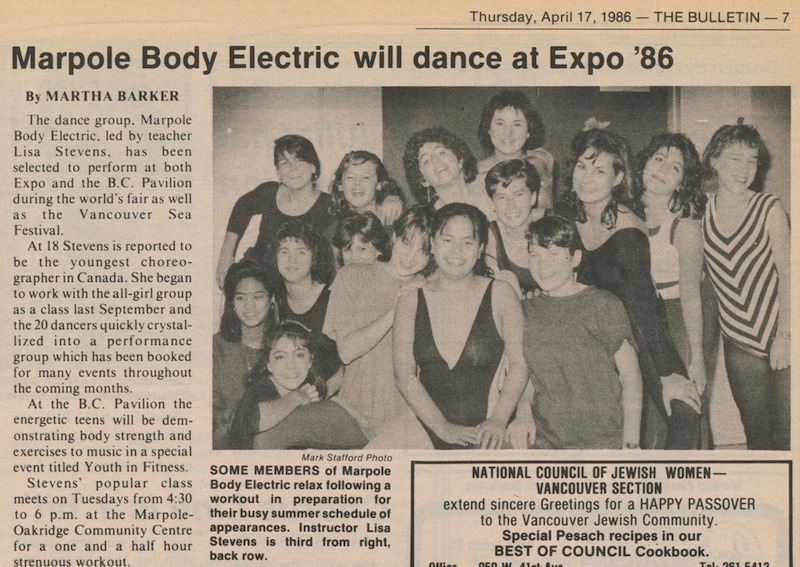
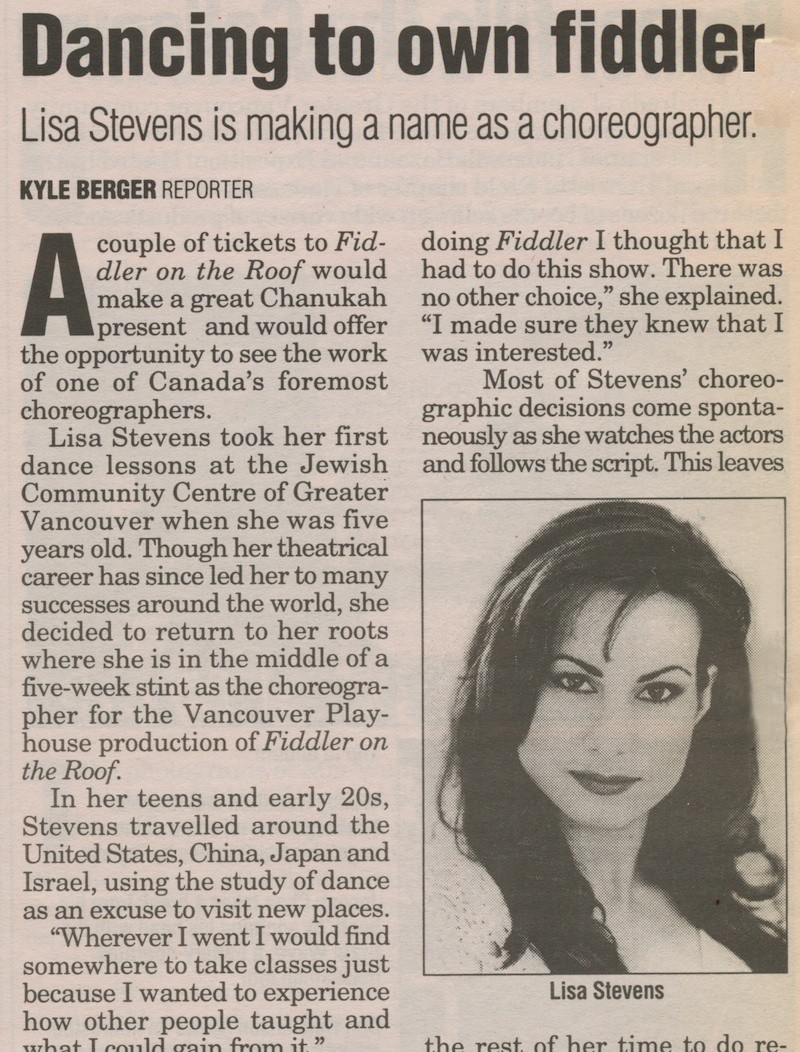
Lisa Stevens, the choreographer and assistant director of In the Heights, grew up in Vancouver, and readers of the Jewish Independent / Jewish Western Bulletin have followed some of the highlights of her career, even her pre-career.
She was part of the Grade 1 classes being fêted at the Shalom Yeladim celebration led by Rabbi Wilfred Solomon and Dr. Sheldon Cherry that welcomed the young students enrolled at Beth Israel School and Talmud Torah in 1973, and she shared her bat mitzvah on May 30, 1980, at Beth Israel with Lisa Goldman. She was winning dance competitions by 1977 and teaching by 1986, when she was reported to be “the youngest choreographer in Canada,” at age 18.
JWB, 2002
Stevens opened her own dance studio in 1987 and her students were winning awards by 1992. In 1993, two of them “beat out 3,000 dancers to win the national finals (duo category) of the Sega Video Dance Contest.”
Off to London, England, in 1996, the JWB also caught up with her once she’d moved to New York. Stevens returns regularly to Vancouver to work on productions here and, no doubt, to visit family and friends. On more than one occasion, she’s taken time to chat with the paper and for that, we are appreciative.