The Centre for Israel and Jewish Affairs is alerting Holocaust survivors and their families not to be taken in by an “odious” scam that promises to unlock Swiss bank accounts in exchange for personal information.
CIJA became aware of a campaign that appears to be targeting the Jewish community and which in one case advised a Calgary resident that one of their relatives killed during the Holocaust had left $75 million in a Swiss bank account. The letter bears the name of a consulting firm, a New York address and phone number. Sara Saber-Freedman, CIJA executive vice-president, said she contacted the letter writer by phone, but when she refused to give him her cell number, he hung up on her.
In the letter, copies of which were sent to others in Canada, the writer claims he is able to access the funds if the recipient of the letter provides extensive personal information. Saber-Freedman said, “It’s exactly like every other one of those scams that you read about and you get by email all the time.”
While frauds of this type prey on people’s trusting nature, this particular fraud “is revolting,” she said. “To use the Holocaust in this context is just vile.” Survivors are elderly and can be vulnerable to this sort of pitch, she added.
Sidney Zoltak, co-president of the Canadian Jewish Holocaust Survivors and Descendants, said similar “sick kinds of operations” have come up before, promising survivors they could recover funds on insurance policies and properties in Poland. He advised survivors and their families to pursue claims through reputable organizations. While the current campaign did not ask for money up front, Zoltak said, “this is the beginning. Once you get to speak to someone who is really smooth, they can talk you into a lot of things.” They prey on the vulnerable and they’re ready “to take away their last savings and leave them penniless. They don’t care as long as they score,” he added.
Saber-Freedman said she has informed U.S. law enforcement and the Canadian Anti-Fraud Centre about the letters.
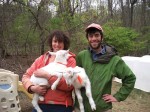
Adamah Dairy co-managers Glenn Katz and Steve Sherman tending to new goat kids last year. (photo from Hazon)
More than five months after the Pew Research Centre’s A Portrait of Jewish Americans survey drew widespread pessimism over rising intermarriage and assimilation, as well as declining connection with synagogues and other institutions, proponents of a newly released study believe they may have the antidote for what ails the Jewish community.
On March 10, the Jewish nonprofit Hazon and six funders released Seeds of Opportunity: A National Study of Immersive Jewish Outdoor, Food and Environmental Education (JOFEE), whose findings drew from a mixture of focus-group data, a survey of 800 people age 18 and older, and review forms submitted by 41 programs. All programs examined were what the study called “immersive” experiences of four days or longer that fall under the umbrella of JOFEE. The acronym, although coined specifically for the purpose of the study, is lingo that the report’s supporters hope will grow to define a movement and become part of the Jewish vernacular.
With the defeat of the Parti Quebecois in Monday’s Quebec provincial election, Canada as a whole dodged a bullet. Yes, one could say the bullet we dodged was the risk of Quebec separatism and a third in the series of referendums that threaten to tear the country apart. Many commentators are saying that the PQ’s devastating loss represents the end of separatism as a force for a generation or more. But, according to opinion polls, most Quebeckers – anglo-, franco- and allophone – were already opposed to both a referendum and to separation. The bullet we dodged was more immediate.
While the threat of a sovereignty referendum is probably what led to the PQ’s defeat, the more immediate issue was the PQ government’s Charter of Values, which would have almost certainly become law had the results turned out differently Monday. The proposed charter would have prevented government employees, and perhaps recipients of government services, including students at public universities, from exhibiting prominent displays of religious affiliation. The draft charter was the latest in decades of struggle in Quebec to preserve the majority French language and culture.
Quebec has always been the place in Canada where preservation of the majority culture (in Quebec’s case, most exemplified by the French language) has been of greatest priority. But a large proportion of Muslims in Quebec come from French-speaking North Africa and, therefore, the “values” that the charter would protect were no longer solely associated with linguistic assimilation. Marois’ PQ identified a broader range of defining characteristics under the umbrella of “secularism.”
The rhetoric around the proposed charter overwhelmingly centred on Muslims and Muslim practices, but we have, in Canada, concepts of equality that encourage us to treat in ways that are alike people who are different. So, rather than addressing whether there is a qualitative difference between, say, a full-face-covering veil and a turban, the charter attempted a sort of equal-opportunity bigotry. Even in distinct-from-the-rest-of-Canada Quebec, a law that would discriminate against people based on observant religious identity would have to discriminate equally. Crucifixes, turbans, kippot and other “ostentatious” evidence of religiosity would have been restricted under the charter along with Muslim head and face coverings – but with notable exemptions for certain symbols related to Christianity in public spaces and government buildings.
In his speech after resoundingly defeating Marois, Liberal leader and premier-elect Philippe Couillard addressed Quebec’s diverse citizens. “We share the values of generosity, compassion, solidarity and equality of men and women with our anglophone fellow citizens who also built Quebec and with our fellow citizens who came from all over the world to write the next chapter in our history with us,” he said. “I want to tell them that the time of injury is over. Welcome, you are at home here.”
These inclusive words suggest the miserable, unnecessary social divisions sewn by Marois and the PQ will no longer have sway within the government. Yet, while the PQ exploited and exacerbated social conflict with demagogic intent, the root fears, concerns and prejudices that allowed them to do so remain.
PQ or no PQ, Canada will continue to address the role not only of religion in the public sphere, but the impact on society of immigration. Successfully for the most part, Canadians have struggled over the generations to respond to successive waves of immigrants – and newcomers have struggled to respond to the demands made of them in a diverse country of immigrants. We have integrated new Canadians who believe in different gods, or no god, who speak hundreds of different languages and practise myriad distinct rituals and cultures, and the debate over degrees of accommodation is continuous. In the absence of a PQ government in Quebec, hopefully it will proceed with more nuance, subtlety and intelligence.
Richard Newman and Pippa Mackie in The Grandkid. (photo by David Cooper)
Former community member John Lazarus is a very interesting man. Dubbed by the media as one of Canada’s best-known playwrights,” his fertile mind has spawned the likes of Babel Rap, The Late Blumer and his award-winning Village of Idiots, which evolved from a play through a CBC Radio mini-series to a National Film Board animated short. His latest work, The Grandkid, the intergenerational story of Julius Rothstein and his granddaughter, Abby, opened at Richmond’s Gateway Theatre this week.
Montreal-born Lazarus graduated from the National Theatre School of Canada in 1969. The call of the West lured him to Vancouver, where he worked for 30 years as an actor, director, critic, broadcaster, playwright, screenwriter and teacher – including a stint at Studio 58, one of Canada’s leading theatre schools. For the past 14 years, he has been an associate professor of drama at Queen’s University in Kingston, Ont. Now, his newest creation brings him back to the West Coast.
The two-character play tells the story of an aging film professor, Rothstein, grieving over the recent loss of his wife, when his 19-year-old freshman granddaughter decides to move in with him to attend university. This leads to an intriguing social experiment and a new twist on BFF (best friends forever), as Julius and Abby become roommates and grapple with the timeless issues of youth and aging.
In a telephone interview with the Independent, Lazarus talked about his inspiration for the show. “I had friends where that living arrangement came up, their daughter moved in with Grandpa, and I listened with interest to their conversations about what was going on in the relationship. I was intrigued by the concepts of old age and youth and the stereotypes surrounding these two groups. I look around and see both people my age and young adults behaving very differently than depicted in the media and I wanted to write something to show how we can transcend the age differences and get along as a family.”
Developing strong characters is always essential, but especially so in a “two-hander,” as they have to hold the attention of the audience for the entire show. Lazarus believes that he has created two very likeable ones: “Julius is a hip old guy, easy-going, artistic, who is generally happy, but we see him when he is saddened after the death of his wife. He is an observant Jew and a liberal thinker, except when it comes to Israel, who he staunchly supports. He is tired of his career and he hopes that, with his granddaughter coming to live with him, she will inject a ray of sunshine into his life – and she does.” As to Abby, said Lazarus, “She is very idealistic, smart and wants to make a difference in the world. While the two love each other very much, they do clash over generational-gap kind of things.”
“My father, an insurance salesman, was a great storyteller and had a great sense of humor and irony. I remember thinking after listening to one of his stories, what a wonderful thing to do – to make people laugh.”
Lazarus often uses Jewish themes and characters in his repertoire. “I was brought up in a Jewish home and, while not observant, I feel culturally Jewish,” he explained. “My father, an insurance salesman, was a great storyteller and had a great sense of humor and irony. I remember thinking after listening to one of his stories, what a wonderful thing to do – to make people laugh. While I started off as an actor, writing became my passion. Although I don’t think of myself as strictly a writer of comedies, even in my serious plays humor sneaks in. To me, that is the Jewish essence of it, putting humor into every situation.”
Family and friends often provide ideas for his work and the needed conflict for the narrative. “When I was writing The Grandkid, I asked my wife what I could put into the story that would drive Julius crazy. She told me to give Abby a Palestinian boyfriend. I did not want to go there because I thought some might label the story racist so, instead, I gave her an Israeli boyfriend who has views on Israel that are diametrically opposed to those of Julius – that leads to some interesting dialogue.”
Some have suggested that the play is autobiographical. Lazarus laughed, “Definitely not. Yes, there are similarities between Julius and himself. Both of us are Ontario university professors, he film, me drama, but we differ in our views of politics and religion. I think, if we could sit down and have coffee together, we would have a very heated, but respectful, conversation.”
When asked why people should see the play, Lazarus reflected, “It makes you feel good about family and relationships. I guess you could call it a love story of sorts. It highlights the best parts of being young and being old, and how different generations can learn from one another. It will appeal to all age groups. Also, you could not ask for a better cast – Richard Newman, who I first worked with in the seventies, and Pippa Mackie, who I met in 2013 and encouraged to audition for the play because I thought she would be perfect for the part – and a terrific director, Natasha Nadir. It is good for a few laughs and you don’t have to be Jewish to enjoy it.”
In anticipation of being at the theatre on opening night, as the interview took place before the play opened, Lazarus said, “It is a culmination of a dream, to come to Vancouver and say, ‘Hello, here I am, I am back and here is my new play. I hope you enjoy it.’”
The Grandkid runs at the Gateway until April 26. For more information, visit gatewaytheatre.com or call the box office at 604-270-1812.
Tova Kornfeld is a Vancouver freelance writer and lawyer.
Russel Crowe is Noah in Darren Aronofsky’s latest film. (photo from Paramount Pictures)
An earnest amalgam of free-association Bible story, dire disaster movie and family melodrama, Noah is a more thoughtful and provocative movie than one has any right to expect. Sure, it’s ludicrous and ponderous at times and embellished with gratuitous special effects, but it also succeeds in prodding the viewer to reflect on his or her behavior toward others and relationship to God.
Darren Aronofsky, a Brooklyn Jew by birth and upbringing, has concocted a sporadically inspired film with enough fodder for a month of sermons. It’s a compelling saga up until the great flood, when key plot elements collide with enough force and absurdity to sink an ark. Metaphorically speaking, that is. After all, the species (plural) must go on.
In terms of contemporary resonance and relevance, the film’s depiction of religious absolutism pushed to the point of tyrannical self-righteousness – in the name of God, of course – neatly undercuts the inclination by zealots of any faith to claim Noah as gospel.
I remember Noah as a mild-mannered super-carpenter and reluctant zoologist in my Hebrew school classes of yore, but you don’t cast Russell Crowe to play a guy grappling with internal and existential dilemmas. His Noah is a decisive survivalist who doesn’t hesitate to kill to protect his family or to fulfil God’s plan.
Aronofsky’s Noah can only infer and deduce that plan from the occasional wondrous sign or disturbing dream, aided by his sage, Merlin-esque grandfather, Methuselah (Anthony Hopkins). Aronofsky and co-writer Ari Handel resist the temptation – and the arrogance – of having God speak directly to Noah.
We have no doubt, though, that Noah is the last true believer in the Creator, as the Lord is referred to throughout the picture. Indeed, he has a real talent for channeling God’s merciless fury. In this regard, Noah is reminiscent of Moses, who was up to the task of meting out vengeance – or justice, in the vernacular of the film – when the time came.
That association aside, Aronofsky’s most Jewish picture remains his mystical black-and-white debut, Pi, in which Handel has a cameo as a kabbalah scholar. It is much more difficult to discern a Jewish sensibility in Noah than it was (to summon another biblical adaptation) to detect Mel Gibson’s deep-seated antisemitism in The Passion of the Christ.
Noah’s Ark, pictured here with its master builder and his son, is based on interpretations of what the biblical vessel may have looked like. (photo from Paramount Pictures)
The most jarring element in Noah from a Jewish perspective is the presence of angels, called “Watchers” and manifested as angry, hulking, walking, talking rock piles. Punished by God for trying to intervene on behalf of Adam and Eve, the Watchers decide to help Noah – and, by extension, serve their Creator – build the ark and then repel the hordes who desperately attempt to board when the hard rain starts a-fallin’.
At a crucial moment, the Watchers are redeemed for their sacrifice and return to the heavens like Roman candles. Polls report that a majority of Americans believe in angels, so for some viewers this sequence will mark the emotional high point of the movie.
Amid the concessions to visual effects-driven miracles, Noah manages to convey the nasty, brutish world of the Bible. At the same time, it demolishes Noah’s cloak of absolute good to demonstrate that no person is devoid of flaws and fallibility.
The film does not, alas, evoke the strength and power of the Bible’s matriarchs, for its female characters – Noah’s wife Naameh (Jennifer Connelly) and a young girl (Emma Watson) saved and raised by the family who grows up to be Shem’s love interest – are given little to do in the second half except cry, shriek and sob.
The biggest obstacle to a visual rendering of Noah’s mythic saga, though, is that we know how the reboot of civilization turned out. We’re living it. So the optimistic rainbow at the end of Noah has all the credibility and gravitas of a Hallmark commercial.
Whether we see the modern world as the inevitable manifestation of human nature in all its glories and depravities or as a technologically supercharged Sodom, Noah makes us ponder the fate of the world as a function of our interdependence as well as our individual morality. Should we fear God’s anger and another flood, or (as the movie hints) is a self-inflicted die-off from environmental destruction just as likely? Either way, Noah represents a powerful admonition to humankind.
What’s intriguing about a repeat apocalypse is that it would be a communication from a God who’s been silent for centuries. The power of Noah, one could say, is to remind us that every cloud has a silver lining.
Michael Fox is a writer and film critic living in San Francisco.
This year, Pesach begins at sundown on Monday, April 14, and continues through to Tuesday, April 22. The Exodus from Egypt was ordained by G-d to take place in the month of spring. Moreover, the Torah has ordained that special care should be taken to ensure that Pesach always occurs in spring, as it is written: “Observe the month of spring and keep the Passover unto G-d your G-d, for, in the month of spring, G-d your G-d has brought you out of Egypt by night.” (Deuteronomy 16:1)
To ensure that Pesach should indeed occur in spring, in view of the fact that our calendar is based on the moon and the lunar year is about 11 days shorter than the solar year, while the four seasons are determined by the sun, our calendar provides a “leap year” once every two or three years with the addition of a whole month, Adar II, as it did this year. In this way, the lunar year is “reconciled” with the solar year, and Pesach always occurs in the spring. All of the other months of the year, and all our festivals, are regulated accordingly, so that they, too, occur in their due season.
The circumstance of the Exodus from Egypt having been in the spring is explained by our sages as a special Divine benevolence in taking the Jews out of Egypt during the best time of the year. Pesach falls in the middle of the month of Nissan, when nature reveals its greatest powers. We can see and smell blossoms on trees, watch fruit appearing from buds and hear the song of the red-breasted robin.
In fact, there is a special blessing that the rabbis composed for Nissan, for the coming of springtime, that is to be recited when seeing a fruit tree bearing fruit: “Blessed are you, Lord our G-d, King of the Universe, who has made nothing lacking in His world, and created in it goodly creatures and goodly trees to give humankind pleasure.”
The blessing is said just once a year, preferably in Nissan, but if one didn’t get a chance to say it then, it can also be said in Iyar, the next Hebrew month. Our relatives in South Africa recite this blessing in the months of Elul and Tishrei, as that is when their spring occurs.
The great descriptions that appear in King Solomon’s Song of Songs (Shir Hashirim) include “the times of the rain are passed, the time of the songbird has arrived, the blossoms of the trees are seen throughout the land.” This refers to the Land of Israel, where springtime is warm but not summer hot, and the threat of rain all but gone for the year. The smell of spring and renewed life fills people’s souls, and this season in the holy land of Israel is the beloved partner of Pesach, the holiday of renewal and redemption, optimism and hope. Pesach weather carries with it special blessing and encouragement.
When we were taken out of Egypt by G-d’s outstretched arm, we became a nation. In fact, G-d loves us so much that He came down and took our ancestors out Himself, instead of sending an angel to perform the task. As it is written in the Haggadah, in the portion beginning with “Avadim hayeenu,” “We were slaves,” it says, “We were slaves to Pharaoh in Egypt and
G-d our G-d took us out of there with a strong hand and with an outstretched arm. If the Holy One, blessed be He, had not taken our fathers out of Egypt, then we, our children and our children’s children would have remained enslaved to Pharaoh in Egypt.”
Here in Canada, and indeed in so many places, spring arrives with Pesach, however the weather isn’t necessarily springlike. As a child in Toronto, I remember one Pesach having to be carried by my father during the holiday over snow-covered sidewalks. As a teenager in Florida, we were able to have guests over during Pesach and sit outside for our seder. Having lived in Vancouver for more than 30 years, I have experienced Pesach in pounding rain, as well as in sunshine and warmth.
Pesach is, of course, celebrated by Jews the world over. Our dear daughter and her husband, as emissaries for Chabad, will be hosting more than 30 people in their small apartment in Turin, Italy, for the seders, for example. I wish you and your family a very happy and kosher Passover wherever you will be this Pesach – and whatever the weather. Enjoy!
Esther Tauby is a local educator, writer and counselor.
Passover is soon upon us, and many Jews will celebrate by singing rounds of their favorite classic Passover songs. “Chad Gadya” is a song that ensnares the singer in an increasingly complex chain of causality. Starting with one’s father who buys a goat that gets eaten by a cat that is bitten by a dog that is beaten by a stick, etc., etc. But “Chad Gadya” is not simply an incredibly fun shanty, it is also a great lesson in food chain ecology.
A food chain describes the complex interconnections that occur in nature from different organisms that eat each other. At the start are plants that absorb energy from the sun. The plants are then eaten by herbivores, that are then eaten by predators, that are then eaten by higher-level predators and so on. Each step up the food chain is called a trophic level, from the Greek word trophikos, meaning food.
One phenomenon documented by ecologists is called a trophic cascade. When you remove a key species from the food chain, say from the top, the effects will cascade down the food chain, affecting every organism along the way. One classic example involves the sea otter, a charismatic marine mammal that lived off the coasts of North America as far south as California. Unfortunately, the sea otter was once prized for its lovely fur and, by the early 20th century, they had become extinct south of Alaska.
Sea otters happen to eat a lot of sea urchins. Sea urchins eat a lot of kelp. When the sea otters disappeared, the effect cascaded down the food chain. Sea urchin populations skyrocketed, and began feasting on the kelp. Entire forests of kelp began to disappear, only to be replaced by barren underwater fields full of spiky urchins. This spelled trouble for the many fish and other animals that depended on the kelp forests for shelter and food. Bald eagles, for instance, would normally eat fish hiding in the kelp forests. Without those fish, the eagles had to search elsewhere for food.
Fortunately, sea otter hunting was banned, and populations from Alaska were shipped in. Those new immigrant sea otters have begun to repopulate our coasts, restoring the kelp forests and returning balance to the ecosystem.
Understanding how ecosystems work can be very helpful. For instance, in Israel, on Kibbutz Sde Eliyahu, they grow many useful crops, such as alfalfa and oats. But voles (a type of rodent) can be a huge pest problem. Thousands of burrow openings can accumulate per hectare, causing severe damage to their crops. Poisons are expensive, can be dangerous for consumption and for other animals, and are often ineffective anyway because more voles can just immigrate from nearby fields. Barn owls eat voles, but they only nest in pre-existing cavities, so farmers began putting up nesting boxes to encourage the owls. The strategy worked, the owls keep the voles under control, and they end up being more cost effective than poisons. Manipulating ecological systems for pest management in agriculture – known as biocontrol – is an increasingly common strategy used around the world to improve yields.
So, when sitting down for your Passover seder, eating your favorite foods, reclining and singing your beloved songs, take a moment to reflect on the complex chains of events that brought that food to your table.
Ben Leyland is an ecologist at Simon Fraser University, a musician and an Israeli-Canadian resident of Vancouver.
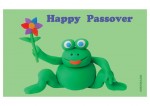
In anticipation of the Jewish holiday of Passover, Curly Orli and I are making cute froggies. It is true that frogs were one of the Ten Plagues, but frogs are also believed to be the bringers of spring! These days, they are happily hopping around in parks and forests after a long winter slumber. Now, you can have one of them at home … a Plasticine one, that is.
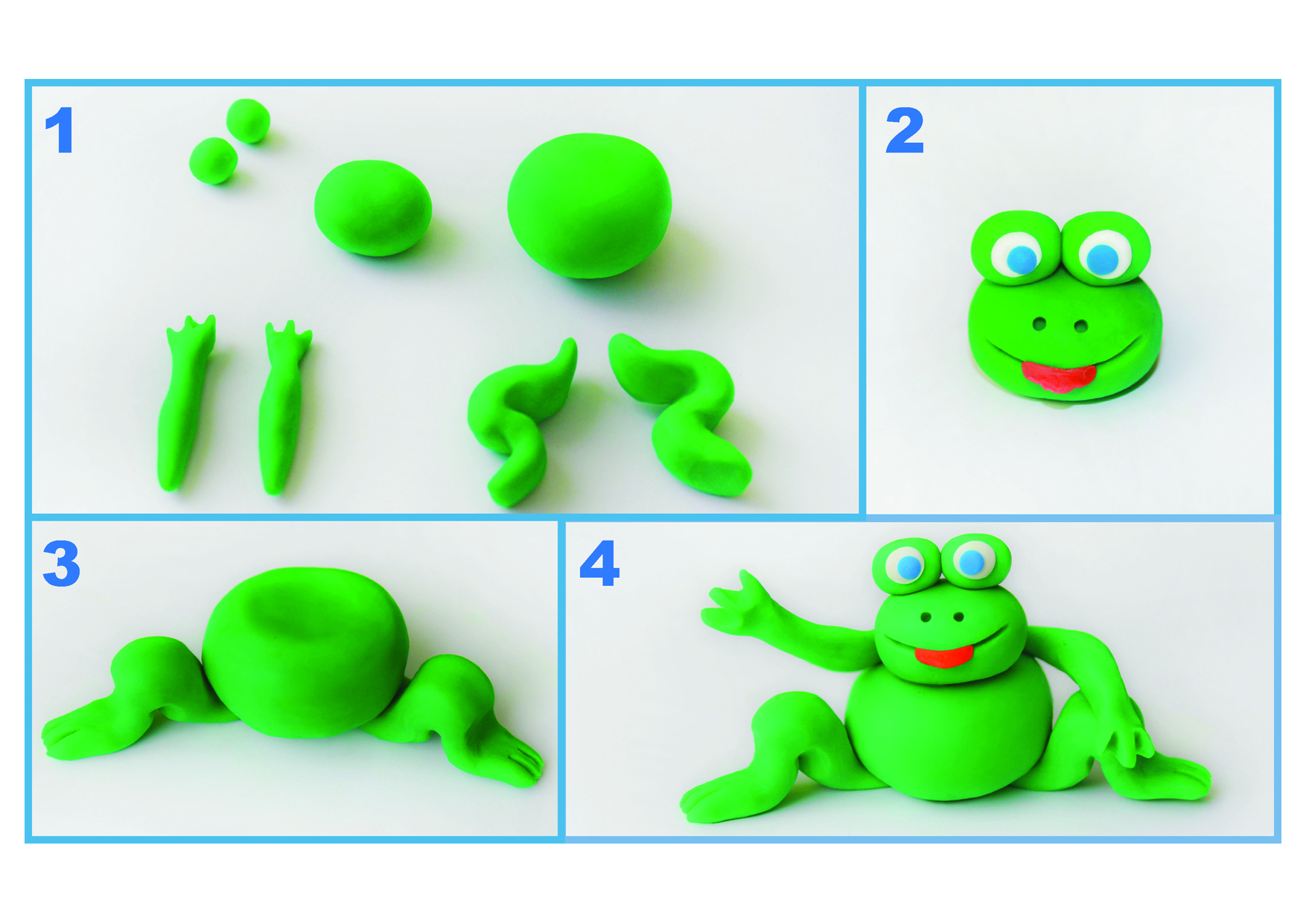
Steps 1-4 of making a Passover Plasticine froggie.
1. Prepare green Plasticine. Separate it into pieces for different body parts: eyes, head, torso and two pairs of legs.
2. Using white and blue Plasticine, make eyes. With the help of a toothpick, make a nose by poking two holes, then a mouth and, finally, add a red tongue.
3. From earlier prepared pieces, let’s make a lower part of the body and legs. Attach them together.
4. Connect upper and lower body. The froggy is ready!!!
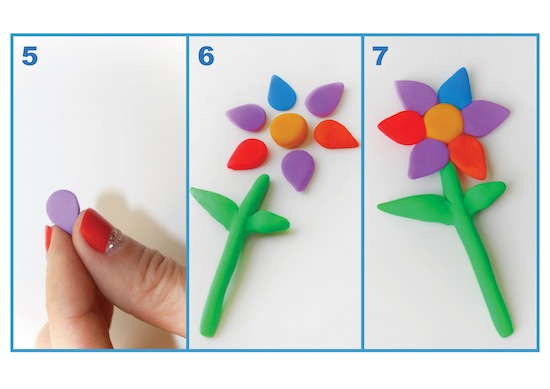
Steps 5-7: making a flower for our Passover Plasticine froggie.
5-6. Our froggy is festive and joyous, so let’s give him a beautiful flower. We can make petals from various small and round colorful Plasticine pieces by making them pointy at the end.
7. Let’s add petals to the flower and connect them to the stem.
8. Now, we will give this flower to the froggy. Our creation is complete.
Happy Passover to all the readers of the Jewish Independent! We wish you peace, joy and new creative adventures.
Lana Lagoonca is a graphic designer, author and illustrator. At curlyorli.com, you will find more free lessons, along with information about Curly Orli merchandise.
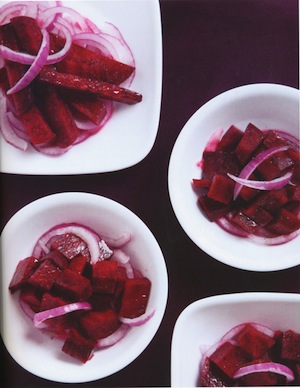
Beet salad from Gluten-Free Goes Gourmet. (photo by Ruchy Schon)
At least three times a year – Rosh Hashanah, Chanukah and Passover – I liven up my dinner menus by trying out some new recipes from recently published cookbooks. I don’t keep a kosher kitchen, I’m not gluten or dairy intolerant, nor am I diabetic or allergic to corn, yet I ventured this spring to try Vicky Pearl’s Gluten-Free Goes Gourmet (Moznaim Publishing Co.), which actually came out last September. While many of the recipes may be appropriate for Pesach meals, many are not chametz-free, particularly in the dessert section – but they’ll make for delicious treats after the holiday.
There are more than 100 recipes in Gluten-Free Goes Gourmet; most are easy-to-follow and quick to make (even without a mixer), but others require a few hours (preparation plus cooking time), so make sure to plan ahead and carefully read through the recipes before setting about to make them. Everything I tried in Gluten-Free Goes Gourmet turned out just like the photos (which are lovely) and, with the exception of the kugel – which, for some reason, I couldn’t get to the quite the right consistency and which had too much salt for my liking – everything tasted great. There was one typo in the book that I came across: the oatmeal chocolate chip cookie recipe makes almost four-dozen cookies, not 18, as indicated.
Gluten-Free Goes Gourmet contains useful information on many of the ingredients used in the recipes, including their nutritional benefits. It has numerous sections: dips and drinks, salads, soups, meat and poultry, fish, mock dairy, side dishes, breads, desserts, and cakes and cookies. It would have been nice to experiment with these last chapters more, as the cookies I made were so delicious – and all indications are that the other gluten-free desserts and breads will be just as tasty.
The following recipes will give readers an idea of how good “free” eating can be. Enjoy!
BEET SALAD
Try to buy beets that are uniform in size, since they’ll cook more evenly. As an added bonus, smaller beets are sweeter.
Beet salad from Gluten-Free Goes Gourmet. (photo by Ruchy Schon)
10 beets, peeled 1 red onion
Dressing: 1/2 cup liquid from cooked beets or water 1/3 cup vinegar or freshly squeezed lemon juice 1/4 cup agave, xylitol or granulated sugar 1/4 cup oil 2 tsp kosher salt 1/2 tsp freshly ground pepper
Place beets in an eight-to-10-quart pot (depending on size of beets); cover with water. Bring to a rolling boil over high heat. Cook for one or two hours, maintaining a rolling boil, or until beets are tender enough that the tines of a fork meet with little resistance. Reserving 1/2 cup of cooking water, remove beets from water. Cool slightly. Slice beets according to your preference.
Place beets in a serving bowl; add onions. In a separate small bowl, mix together dressing ingredients. Pour dressing over vegetables, tossing gently until well coated. For best results, cover with plastic wrap and refrigerate overnight. Bring to room temperature before serving.
Yields eight to 10 servings.
CREAM OF ZUCCHINI SOUP
5 large zucchinis, scrubbed clean, washed and cut into thirds 3 large potatoes, peeled and cut into quarters 1 large onion, halved 1/4 tsp freshly ground black pepper 1-2 tbsp (heaping) kosher salt
Place all ingredients into an eight-quart pot. Fill three-quarters full with water and bring to a boil over high heat.
Reduce heat to medium; cook, with lid slightly ajar, for half an hour.
Place immersion blender in pot; blend until smooth.
Makes eight to 10 servings. Freezes very well for up to six months: chill before freezing and thaw in refrigerator.
Preheat oven to 350°F. In the bowl of an electric mixer, cream together eggs and oil. Change paddle attachment to a dough hook.
Add sesame seeds, salt, flour, potato starch, onion and garlic to bowl; mix well.
Divide dough in half. Working with one piece at a time, roll out between layers of parchment paper to 1/16th of an inch thickness.
Remove the top parchment paper; transfer the dough with the parchment paper still under it to a cookie sheet. Cut into one-by-three-inch rectangles. Repeat with the remaining dough.
Bake in preheated oven 14 to 16 minutes or until golden.
Allow crackers to cook on parchment paper on rack.
Yields 60 crackers and the crackers freeze well for up to two months. They will store well in an airtight container at room temperature for up to two weeks.
SHOULDER STEAK
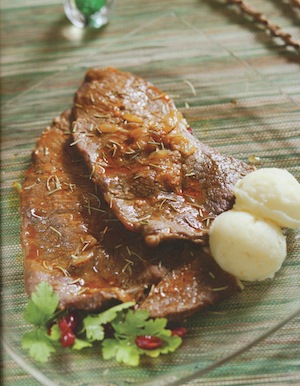
Shoulder steak. (photo by Ruchy Schon)
1/4 cup oil 3 cloves garlic, minced 3 large onions, sliced thinly 1 lb shoulder steak or pepper steak, or 4 pieces minute steak 1 cup semi-dry red wine 1 bay leaf 1 tsp kosher salt 1/2 tsp dried minced garlic 1/4 tsp dried rosemary leaves (optional) 1/8 tsp freshly ground pepper
Heat oil in a large skillet set over medium heat. Add garlic; brown for about one minute. Add onions; sauté until translucent, three to five minutes.
Add steak, wine, bay leaf and spices. Increase heat to high; bring to a boil. Add five cups water; return to a boil. Reduce heat to medium; cook, covered, for two to two-and-a-half hours or until meat is tender. Remove bay leaf before serving.
Makes four servings. Freezes very well for up to six months.
POTATO KUGEL
5 large eggs 1 cup oil 2 tbsp (heaping) kosher salt 10 large Idaho/russett potatoes (about 5 lbs), peeled and cut in half lengthwise 1 large onion, peeled and cut in half
Preheat oven to 450°F. In a large bowl, whisk together eggs until lightly beaten. Whisk in oil and salt.
In a food processor fitted with the blade with tiny holes and working in batches, process potatoes and onion until almost smooth. Transfer potato mixture to bowl, blending well with egg mixture.
Pour mixture into a parchment-paper-lined nine-by-13-inch baking pan.
Bake in centre of preheated oven for one hour or until top is browned. Reduce heat to 350°F. Bake for two hours.
Yields 12 generous servings.
OATMEAL CHOCOLATE CHIP COOKIES
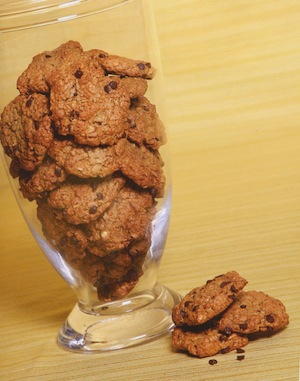
Oatmeal chocolate chip cookies. (photo by Ruchy Schon)
1 cup peanut butter 1/4 trans-fat-free margarine, room temperature (1/2 stick) 3/4 cup agave 1/2 cup xylitol or granulated sugar 2 large eggs 1 1/4 tsp baking soda 3 cups old-fashioned rolled oats 2/3 cup chocolate chips (sugar-free, if you prefer)
Preheat oven to 350°F. Line two baking sheets with parchment paper. Set aside.
In an electric mixer, cream together peanut butter, margarine, agave and xylitol (or sugar). Add eggs and baking soda. Mix well.
Stir in oats and chocolate chips until well combined.
Use a tablespoon to drop spoonfuls of dough onto prepared baking sheets. Bake in centre of preheated oven for 11 minutes or until golden yet soft. Do not overbake. Remove to rack to cool completely.
Veganism is about much more than dietary choice. It is an ethical philosophy based on the belief that other animals are not ours to use. Like humans, animals are sentient: they experience pain and pleasure, they suffer and they form deep emotional bonds with others in their families and communities. Vegans do not use animals for food, clothing, entertainment or animal experimentation regardless of taste, pleasure or tradition. Being a vegan is also much more commonplace today, as is following a vegan diet for health reasons. This means it might not be unusual to find a vegan at your table on Passover.
For the fourth year in a row, my wife and I will be hosting an all-vegan Passover seder, or “veder,” as we call it. We started this tradition after a group of Jewish vegan friends expressed how alienating it can be to celebrate the holiday in the traditional way. As ethical vegans, it is difficult to sit at a table laden with the body parts of the nonhuman animals that we are working to protect and rescue. Many had stopped attending their family dinners, and one friend was no longer invited simply because others felt uncomfortable when she passed up most of the food on the table. But our hunger for the Jewish tradition of Passover remained.
The Passover seder commemorates our liberation from Pharaoh and the larger issue of the immorality of slavery. As Jews, we have a long history of suffering, oppression and slavery and, as animal activists, this has informed our choices to work to help others end their own oppression – including animals. It’s no wonder Jews have played key roles in other movements such as civil rights, women’s rights, gay rights and animal rights. The liberation of animals is another social justice movement for which the Jewish community should naturally feel empathy. Jews and vegans share common values such as justice, fairness, equality and compassion.
How we as animal activists celebrate the meaning of the Passover seder is to remember the evils of the past and to expand our circles of compassion and justice so that no group, human or nonhuman, need experience the suffering and exploitation of being different or unequal. Passover is a great opportunity to reflect on how we can create less suffering for all those who are oppressed through our personal behaviors and choices.
Simply adding vegan foods and vegan versions of traditional dishes to the table is a way of making a statement that we include the most vulnerable and innocent among us when we celebrate this holiday. These days, it’s as simple as Googling “vegan [whatever dish] recipe,” vegan or “vegan Passover recipes,” and thousands of animal-free options will magically appear. At our veder, we serve all of the traditional dishes we grew up eating – matzah brie, brisket, gefilte fish, potato latkes, matzah ball soup, kugel, macaroons – in veganized versions without meat, dairy or eggs.
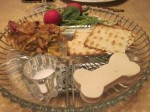
With a little effort and creativity, your entire seder dinner can be made vegan. We even have an animal-friendly seder plate. Instead of a lamb shank bone, we use a dog cookie-cutter to make a playful bone-shaped piece of tofu. Instead of an egg, we use a small dab of commercial “egg replacer” used in vegan baking. I encourage all Jews to embrace the meaning and tradition of the holiday while also incorporating new traditions that reflect values of justice, ethics and compassion. When we can celebrate the holiday without doing any harm to others, why wouldn’t we?
VEGAN CHOPPED LIVER
Adapted from The Jewish Vegetarian Year Cookbook by Roberta Kalechofsky and Roda Rasiel (Micah Publications, 1997).
1/2 lb brown lentils 1 large onion, diced 2 tbsp olive oil 1 cup walnuts salt and pepper to taste
1. Put lentils in a two- or three-quart pot and cover with water. Bring to a boil, partially cover and simmer until tender, about 30-40 minutes. Check occasionally to make sure water has not boiled off, and add water as needed.
2. Sauté onions in olive oil until golden and tender. Allow to cool slightly.
3. Drain lentils and blend, along with the walnuts and onions, in a food processor until homogenized, but leave some of the texture intact.
4. Add salt and pepper to taste. Chill about two hours.
Gary Smith, co-founder of Evolotus, a PR agency working for a better world, blogs at thethinkingvegan.com and has written for many publications. He and his wife are ethical vegans and live in Los Angeles with their cat Chloe and two beagles rescued from an animal testing laboratory, Frederick and Douglass.
(Editor’s note: Some vegan recipes will contain ingredients that are not strictly kosher for Passover. For those who are less strict, the options abound. For more strict kosher diets, incorporate dishes that are heavier on fruits and vegetables, and avoid using legumes, like lentils, or products that contain wheat or gluten. Also, only certain egg substitutes are kosher for Passover, and many Ashkenazi Jews abstain from eating kitniyot on Passover; tofu is made from soybeans, and is considered to be kitniyot.)