Was the Last Supper a seder?

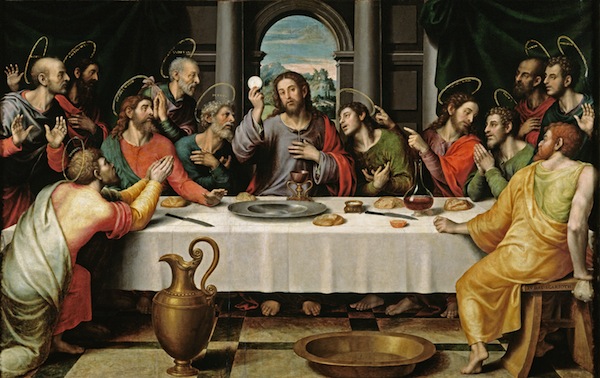
“The Last Supper,” by Juan de Juanes (also known as Vicente Juan Masip), circa 1562, housed in Prado Museum. (photo from Wikimedia Commons)

Nearly every year around the time of the Jewish holiday of Passover and the Christian holiday of Easter, theologians and historians start to ask the same question. Was Jesus’ Last Supper a Passover seder?

“It is all very mysterious,” said Rabbi Raymond Apple, rabbi emeritus of the Great Synagogue in Sydney, Australia.

Let’s start with the facts. There are four accounts in the New Testament that refer to the Last Supper with reference to the Passover holiday. They are Mark 14:12-31, Matthew 26:17-30, Luke 22:1-19 and John 13:1-30. But Mark, Matthew and Luke are synoptic Gospels, which means they are closely related and best studied together, making the three Gospels – according to Jonathan Klawans, a professor in Boston University’s department of religion – “one testimony, which was then copied twice.”

“Mark … fashioned and inserted a single ‘Passover’ paragraph (14:12-16) … between what we identify as 14:11-17,” explained author Michael J. Cook, a professor of Judeo-Christian studies at Hebrew Union College-Jewish Institute of Religion. “So, the entire problem resides with Mark’s text.”

According to Mark’s text, Jesus prepared for the Last Supper on “the first day of Unleavened Bread, when they sacrificed the Passover lamb.”

We know that the Passover lamb was sacrificed on the 14th day of the Hebrew month of Nissan, and consumed by Jewish families either on that night or the onset of the 15th day of Nissan.

Klawans notes that there are those who can cite no fewer than 14 parallels between the account described in Mark and the modern-day Passover seder. These include the bread and wine, the hymn or blessings that were recited and the reclining diners. Jews at their seders discuss the symbolism of the Passover meal; Jesus at his Last Supper discussed the symbolism of the wine (“This is the blood of my covenant”) and the bread (“Take, eat; this is my body”).

Nonetheless, scholars Klawans, Apple and Cook all do not believe that Jesus’ Last Supper was a Passover seder, for several reasons.

For starters, the parallels that can be drawn seem to be those that are general, rather than decisive. It would not be uncanny for Jesus to eat a meal with his disciples in Jerusalem. During that meal, they would have reclined, broken bread, drank wine and possibly even sang a hymn.

“Such behavior may have been characteristic of the Passover meal, but it is equally characteristic of practically any Jewish meal [at the time],” said Klawans.

Some key Passover elements are missing from the Last Supper: the Passover lamb, references to matzah (unleavened bread), the bitter herbs, charoset, the four cups of wine, the recitation of the Four Questions and the narrative retelling of the Passover story.

Moreover, the parallels drawn between the Last Supper and the Passover seder ritual we celebrate today assume that the seder as we know it was celebrated in Jesus’ day. But this is not the case. Nearly all scholars agree that the modern Passover Haggadah and the rabbinic accounts of Passover traditions all emanate from after the destruction of the first Jewish Temple in the year 70 CE. The Gospels date Jesus’ ministry from around 26 CE to early 37 CE, with Jesus’ death coming between 30 and 33 CE.

“At that time, the core element of the Passover observance had been Jerusalem’s sacrificial cult, from 621 BCE up until 70 CE,” said Cook. “Jewish families brought lambs for sacrifice on the Temple altar as biblically prescribed.… For the ceremony, the kohanim (Jewish priests) conducted the sacrificial rite. Then families retrieved and consumed their meat as part of their Passover meal, which also included unleavened bread and bitter herbs. The Passover meals Jesus experienced in his lifetime would have had to be along these Temple-centred lines.”

Klawans said many people assume that Jesus ate matzah at his Last Supper because Catholics eat wafers as their Eucharist bread. The custom of using wafers, however, does not date back as far as one might think, but rather only to medieval times. The oldest customs in Orthodox Christian churches involve bread, and the New Testament describes bread, not unleavened bread.

“There is no reason to think the bread was matzah unless that was specified,” Klawans said.

Additionally, Klawans said it is impractical for Jesus’ crucifixion to have taken place on Passover, as the Sanhedrin (Jewish High Court of 70 elders) would not have worked on the yom tov, which was already one of the Israelites’ most important pilgrimage festivals.

Read more at jns.org.

Mystery photo … March 25/16

Pioneer Women meeting for the Hadassah Bazaar, 1958. (photo from JWB fonds, JMABC L.12594)

If you know someone in this photo, please help the JI fill the gaps of its predecessor’s (the Jewish Western Bulletin’s) collection at the Jewish Museum and Archives of B.C. by contacting archives@jewishmuseum.ca or 604-257-5199. To find out who has been identified in the photos, visit jewishmuseum.ca/blog.

Holiday in which God hides

Purim is, by any account, a strange holiday. Jews dress up in costumes, get shickered to the point that they can’t discern a hero from a villain, and read one of the two books of the Torah where God doesn’t figure in the narrative. One might think that the point of the day is to “eat, drink and be merry” and celebrate the fact that an ancient Jewish heroine outwitted the Persians. It seems like the classic “they tried to kill us, they failed, let’s eat” holiday. But under its surface of masks lies something deeper.

Rebbe Nachman of Breslov taught that Purim prepares us for Pesach (Likutey Moharan 2.74). The connection is that Purim is about hidden miracles and Pesach is about revealed miracles. As winter begins to turn to spring around Purim, the powerful life hidden under the cold exterior begins to blossom and rise; around Pesach, spring is in full bloom and the smell of freedom is in the air.

Traditionally on Purim most people dress like characters from the story, as opposed to Batman or Darth Vader. The story of Purim is our story, after all. God’s name is never once mentioned in the Book of Esther because God is behind the whole story, a story of sequential coincidences leading to God’s presence and activity being revealed.

The Purim story has a series of reversals: the Jews go from helpless victims to warriors; Haman goes from powerful to powerless; Mordechai goes from weakness and danger to strength and security.

Esther, of course, whose very name means hidden (hester) goes from entrapped woman whose Jewishness is secret, to free, triumphant, openly Jewish heroine. All of these reversals are about God’s reality breaking into ours.

The message of the story is that God works in hiddenness. Our daily lives seem mundane only when our eyes have become jaded. As Rabbi Abraham Joshua Heschel said with characteristic beauty in Man is Not Alone: “The ineffable inhabits the magnificent and the common, the grandiose and the tiny facts of reality alike. Some people sense this quality at distant intervals in extraordinary events; others sense it in the ordinary events, in every fold, in every nook, day after day, hour after hour. To them, things are bereft of triteness; to them, being does not mate with nonsense.”

Purim is a celebration of the revelation of God in the overturning of what appears to us to be reality. What seems to be random (pur, a lottery) is shown to be anything but; what seems to be God’s absence is actually his presence. Often the only way for us to see God’s presence is to put aside our own opinions about what is good and what is bad in order to see deeper. Purim nods at this truth with its famous injunction to drink until we can’t tell the difference between Haman and Mordechai – an injunction, by the way, which most rabbis argue is better acknowledged with a symbolic wee drink rather than actually getting sloshed.

Rebbe Nachman’s point is that when we see God’s presence in the mundane details of our lives, then we will be prepared to see God in a way that is not hidden. When we see God’s presence in everything, then we are liberated min ha meitzar, from the narrow places that constrict us and weigh upon us. As Leonard Cohen writes in the song “Born in Chains,” we are “out of Egypt, out of Pharaoh’s dream.”

Matthew Gindin is a writer, lecturer and holistic therapist. As well as teaching holistic medicine, Gindin regularly lectures on topics in Jewish and world spirituality, and has a particular passion for making ancient wisdom traditions relevant in the modern world. His work has been featured on Elephant Journal, the Zen Site and Wisdom Pills, and he blogs at Talis in Wonderland (mgindin.wordpress.com) and Voices (hashkata.com).

Mystery photo … March 18/16

Eitz Chaim students enjoy the dressing-up festivities of Purim, 1989. (photo from JWB fonds, JMABC L.10948)

If you know someone in this photo, please help the JI fill the gaps of its predecessor’s (the Jewish Western Bulletin’s) collection at the Jewish Museum and Archives of B.C. by contacting archives@jewishmuseum.ca or 604-257-5199. To find out who has been identified in the photos, visit jewishmuseum.ca/blog.

Mystery photo … Feb. 26/16

Pioneer Women meeting, circa 1960. Cissie Eppel is sitting second from left. (photo from JWB fonds, JMABC L.12598)

If you know someone in this photo, please help the JI fill the gaps of its predecessor’s (the Jewish Western Bulletin’s) collection at the Jewish Museum and Archives of B.C. by contacting archives@jewishmuseum.ca or 604-257-5199. To find out who has been identified in the photos, visit jewishmuseum.ca/blog.