Skip to content
  • Home
  • Subscribe / donate
  • Events calendar
  • News
    • Local
    • National
    • Israel
    • World
    • עניין בחדשות
      A roundup of news in Canada and further afield, in Hebrew.
  • Opinion
    • From the JI
    • Op-Ed
  • Arts & Culture
    • Performing Arts
    • Music
    • Books
    • Visual Arts
    • TV & Film
  • Life
    • Celebrating the Holidays
    • Travel
    • The Daily Snooze
      Cartoons by Jacob Samuel
    • Mystery Photo
      Help the JI and JMABC fill in the gaps in our archives.
  • Community Links
    • Organizations, Etc.
    • Other News Sources & Blogs
    • Business Directory
  • FAQ
  • JI Chai Celebration
  • JI@88! video

Recent Posts

  • Eby touts government record
  • Keep lighting candles
  • Facing a complex situation
  • Unique interview show a hit
  • See Annie at Gateway
  • Explorations of light
  • Help with the legal aspects
  • Stories create impact
  • Different faiths gather
  • Advocating for girls’ rights
  • An oral song tradition
  • Genealogy tools and tips
  • Jew-hatred is centuries old
  • Aiding medical research
  • Connecting Jews to Judaism
  • Beacon of light in heart of city
  • Drag & Dreidel: A Queer Jewish Hanukkah Celebration
  • An emotional reunion
  • Post-tumble, lights still shine
  • Visit to cradle of Ashkenaz
  • Unique, memorable travels
  • Family memoir a work of art
  • A little holiday romance
  • The Maccabees, old and new
  • My Hanukkah miracle
  • After the rededication … a Hanukkah cartoon
  • Improving the holiday table
  • Vive la différence!
  • Fresh, healthy comfort foods
  • From the archives … Hanukkah
  • תגובתי לכתבה על ישראלים שרצו להגר לקנדה ולא קיבלו אותם עם שטיח אדום
  • Lessons in Mamdani’s win
  • West Van Story at the York
  • Words hold much power
  • Plenty of hopefulness
  • Lessons from past for today

Archives

Follow @JewishIndie
image - The CJN - Visit Us Banner - 300x600 - 101625

Category: Arts & Culture

Imagination in full blooms

Imagination in full blooms

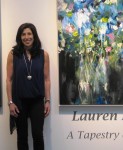
Lauren Morris (photo by Linda Lando)

Local artist Lauren Morris loves every aspect of her art form. “I even like the smell of paints,” she said in an interview with the Independent. “When I come to my studio, the smell jolts me into work. It’s like a kick-start to my imagination.” She added, “I didn’t start painting until I immigrated to Canada. I’m a graphic designer by education.”

Upon graduating as a graphic designer in her native Cape Town, she worked in her chosen field for awhile and then decided to see the world. She backpacked through Europe. “In Israel, I met an American girl in ulpan. We became friends, and she invited me to come to America. I thought I would only travel there for a few months but I stayed for five years. I found a job there as a magazine graphic designer. I also took some part-time art classes in Washington, D.C.”

Afterwards, she returned home and worked as a graphic designer for the book and magazine industry. She also started a family. Unfortunately, the political situation in South Africa was becoming increasingly unstable. Concerned about their growing children, the family decided to emigrate. They arrived in Vancouver in 2000.

“When we came,” Morris remembered, “I couldn’t find work as a graphic designer, so I started painting at home.”

Like any artist, she wanted to display her work, wanted people to see it and perhaps even buy it, but she was new in town, didn’t know anyone and had no connections in the local art community.

“I started hanging my paintings in coffee shops,” she recalled. “Some shops in Vancouver want to display and sell art, so they advertise on Craigslist. I looked for such ads, applied and my paintings sold very well in many of them. I wasn’t a snob. I would accept any offer. Most of my paintings sold not even through a coffee shop but through a fish and chips place in Kerrisdale.”

The sales were encouraging, so she rented a studio. “I wanted to be more professional,” she said with a smile. “But a studio cost money. To pay the rent, I started teaching.”

She still offers art workshops and she teaches mostly adults. “I love showing people what they can do. Some say: ‘Oh, I don’t know how to paint.’ They are wrong. Everyone can paint. They just need someone to guide them. Afterwards, they are amazed and awed by their own works. This is the most satisfying part of teaching – when my students discover things about themselves. It makes them happy and it makes me happy.”

Making people happy seems to be a requirement in her artistic approach: in her workshops, in the classes she taught at the Louis Brier Home and Hospital, and in her own personal art. That’s why flowers play such an important role in her creative output.

“Flowers make people happy,” she said. “When a painting of flowers hangs on a wall, it changes the feel and mood of a room, brightens it.”

Her flowers are not photographic. In fact, some of her paintings bear only a remote resemblance to real-life blooms. Her images lean towards the abstract, like symphonies of colors and shapes. Light and reflections, movements and shadows weave into interlacing harmony in her pictures, while flowers provide an inspiration.

“I don’t like to be too literal in my art,” she said. “Art is my imagination. It always springs from somewhere, from a point of reference, a photo I took or found online, or an idea I see in another artist’s work. Then I take my paintbrush and start building colors. Most of my paintings are color compositions. When I paint, I let my paintbrush take over. It’s like putting together a colorful puzzle, but I’m guided by my unconsciousness.”

Not only the colors but also the shapes of flowers attract Morris because they are so versatile.

“People see different shapes in my flowers,” she said. “Sometimes they see something I didn’t even know was there.”

Because of the expressionistic ideas of her paintings, she rarely works outside. “I tried,” she explained with a chuckle. “But I paint on the floor, on my knees, with the canvasses against the wall. It’s not convenient outside.”

Often, her process resembles a gym exercise, very physically taxing, so she doesn’t work for more than a couple of hours at a time. But she loves every minute of it. “When I see a painting unfolding, going in a certain direction, when my imagination flows, it’s the best moment for me.”

She enjoys listening to classical music while she paints, and the melodies seem to transfer to her canvasses. The different paints and hues splash and chase each other, like notes of a melody. The combined arrangement is invariably richer than its component parts, and the same is true for Morris’ paintings. Since her first coffee shop exhibit in 2001, her recognition in Vancouver has grown considerably. In the last few years, she has participated in Artists in Our Midst and the Eastside Culture Crawl. She has displayed her paintings in several group shows. And now her art is featured at the Sidney and Gertrude Zack Gallery. Her solo show, A Tapestry of Flowers, opened on March 18 and is on until April 12. For more on Morris’ work, visit lmdesignsstudio.com.

Olga Livshin is a Vancouver freelance writer. She can be reached at [email protected].
Format ImagePosted on March 27, 2015March 26, 2015Author Olga LivshinCategories Visual ArtsTags Lauren Morris, Tapestry of Flowers, Zack Gallery
Hard-earned wisdom

Hard-earned wisdom

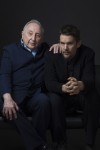
Seymour Bernstein, left, and Ethan Hawke. (photo from Ramsey Fendall/Risk Love LLC)

Two kinds of people will fall under the spell of Seymour: An Introduction, Ethan Hawke’s respectful and affectionate study of virtuoso pianist, composer and teacher Seymour Bernstein. Fans of classical music, of course, who will savor this ode to the beauty and craft of solo piano as 81 minutes of heaven. The other audience is anyone who ever wrestled with the pursuit of ambition, the hollowness of material success and the double-edged sword of uncommon talent.

Bernstein had all those things, but commercial pressures and the anxiety of going on stage whittled away the pleasure of playing concerts. At 50, he retired from public performance to compose and teach.

He had been aware for awhile, however, that he was unable to harmonize his career with the experience. After his celebrated 1969 performance at Alice Tully Hall in New York, he told the friend hosting the reception, “If you love me, you’ll never let me play in public again.”

To his friends, Bernstein is a mentor, philosopher and guru of how to attain satisfaction amid the vicissitudes of a life spent creating ephemeral art. Presumably that’s why Hawke, an actor and novelist, was moved to expose Bernstein’s hard-earned wisdom to a wider audience (without adding much in the way of inspired and/or distracting artistic flourishes).

Seymour: An Introduction opened March 20 for what will likely be a short run. That shouldn’t be interpreted as further evidence of the death of civilization, mind you, for classical compositions haven’t been America’s popular music since Elvis left Memphis.

Most of the film’s running time is devoted to the longtime Manhattan resident working with students and engaged in conversation, notably with the New York Times architecture critic and pianist Michael Kimmelman.

Bernstein is an astute teacher, and he’s exceedingly articulate on the subjects of music, discipline and education. But somewhere past the midpoint of the film he begins to seem less avuncular and more pedantic.

That stems, in part, from his willingness to talk about certain things – that we sense he’s expounded on countless times – while avoiding other subjects. There’s a clear limit to how much he’s going to reveal about himself, and how vulnerable he’ll be in front of the camera. He likes being revered, but on his terms.

All Bernstein says about his New Jersey upbringing is that there was no music in the house, and that his family didn’t own any records. He still bridles at the memory of his father’s perennial joke – “I have three daughters and a pianist” – as evidence that his old man couldn’t relate to him.

Perhaps it is this separateness, imposed on great talents by mere mortals, that pained Bernstein throughout his decades as a concert pianist. If so, why doesn’t this lifelong bachelor mention a single romantic relationship? Isn’t that an important element of living a satisfying life?

The one person who does merit his affection is the late, great English-Jewish pianist Sir Clifford Curzon, with whom Bernstein studied. That recollection has a self-serving coda, though, namely that Bernstein wrote a letter out of the blue to Queen Elizabeth that presumably contributed to Curzon receiving a knighthood.

That said, Bernstein is the teacher that everyone covets – knowledgeable, experienced, appreciative, precise, encouraging and invested. If you’re still recovering from the bark and bite of J.K. Simmons’ Oscar-winning turn in Whiplash, Seymour: An Introduction is the perfect balm.

Seymour: An Introduction is rated PG for some mild thematic elements.

Michael Fox is a writer and film critic living in San Francisco.

Format ImagePosted on March 27, 2015March 26, 2015Author Michael FoxCategories TV & FilmTags Ethan Hawke, Seymour Bernstein
Preserving the music of film

Preserving the music of film

New Budapest Orpheum Society ensemble, from left to right: Danny Howard, Iordanka Kissiova, Mark Sonksen, Ilya Levinson, Don Stille, Philip Bohlman, Stewart Figa and Julia Bentley. (photo from Cedille Records)

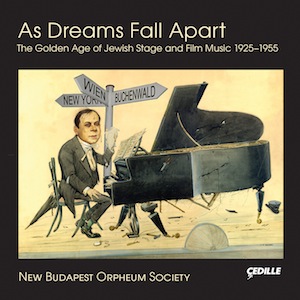
A different type of “soundtrack” has recently been released: New Budapest Orpheum Society’s As Dreams Fall Apart: The Golden Age of Jewish Stage and Film Music 1925-1955 (Cedille Records, 2014).

NBOS is an ensemble in residence in the humanities division at the University of Chicago. The group has released three CDs: Dancing on the Edge of a Volcano: Jewish Cabaret Music, Popular and Political Songs, 1900-1945 (Cedille Records 2002) and Jewish Cabaret in Exile (Cedille Records 2009), as well as a CD to accompany the book Jewish Musical Modernism, Old and New (University of Chicago Press 2008), which is edited by NBOS artistic director and narrator Philip V. Bohlman.

Bohlman is the Mary Werkman Distinguished Service Professor of the humanities and of music at the University of Chicago. According to his bio, “The study of Jewish music in modernity has provided a primary focus for his research for 35 years and, since 1998, has provided the context for his activities as a performer…. His work in historical performance has been recognized with the Noah Greenberg Award from the American Musicological Society and the Donald Tovey Prize from Oxford University.”

CD cover - As Dreams Fall Apart by New Budapest Orpheum Society As are their previous CDs, As Dreams Fall Apart is both an esthetic and academic effort. The CD booklet includes a lengthy and fascinating essay by Bohlman on sound in film, which, of course, has as its origins the stage. Bohlman takes it to the Jewish cabaret stage specifically.

“In history’s very first synchronized sound film, Alan Crosland’s 1927 The Jazz Singer, the title character, Jakie Rabinowitz takes to the stage as Jack Robin, enacting and envoicing the struggle between Jewish tradition in Samson Raphaelson’s original play, The Day of Atonement, and the dreams of stardom awaiting him in the jazz clubs and vaudeville stages of New York City,” writes Bohlman. “The (real life) jazz singer’s musical transition from stage to film formed at the confluence of real-life transitions for European Jews at the beginning of the 20th century – migration from rural shtetl to urban ghetto, immigration from the Old World to the New – and of allegorical transitions – from religious orthodoxy to modern secularism, from diaspora to cosmopolitanism. As the old order of European empire collapsed in the wake of World War I, the Jewish musical traditions that had metaphorically represented its political and ideological boundaries … gathered new metaphors: those of modernity and modernism, ripe for the tales that would move

from the skits of the cabaret stage to the scenes filling the frames of sound film.”

As Dreams Fall Apart features the work of numerous composers, including Hermann Leopoldi, Hanns Eisler and Friedrich Holländer. The melodies and lyrics range from lively and humorous to sombre and serious. The songs take listeners from a traditional world to dreams of a better future through the tragedy of the Holocaust and, finally, to a more tempered hope in the aftermath of the war.

“Yiddish film musicals were the product of musicians and music on the move, a process of triangulation that witnessed the journeys of actors and directors from the United States, and musicians from Vienna and Berlin, all of whom would gather in Poland for the filming and production of films in the Yiddish studios of Warsaw and elsewhere in Poland and Lithuania,” writes Bohlman. And this movement is reflected in the CD, which starts with a section called On the Shores of Utopia, and the song “Die Koschere Mischpoche” (“The Kosher Family”) – the “opening verse of the original street song in Viennese dialect.” Dream sections follow, with songs like “Wir Ladies aus Amerika / We Ladies from America” and “Composers’ Revolution in Heaven” (which has Chopin, Wagner, Beethoven and Bizet in heaven, angry about all the people on earth making money from their music), before dystopia sets in (“Theresienstadt Potpourri – Aus der Familie der Sträusse / From the Strauss Family”), to be replaced by dreams of Hollywood that quickly fade, to the 10th and final section, From the Ruins of Dystopia, which features three songs by Holländer – and famously sung by Marlene Dietrich – in the Billy Wilder film A Foreign Affair (1948), which was set in Berlin.

Mezzo soprano Julia Bentley and baritone Stewart Figa deliver solid performances on As Dreams Fall Apart, capturing the cabaret style. They are skilfully accompanied by Danny Howard (percussion), Iordanka Kissiova (violin), Ilya Levinson (music director/arranger/piano), Mark Sonksen (bass) and Don Stille (accordion).

Format ImagePosted on March 27, 2015March 26, 2015Author Cynthia RamsayCategories MusicTags As Dreams Fall Apart, Friedrich Holländer, Hanns Eisler, Hermann Leopoldi, New Budapest Orpheum Society, Philip V. Bohlman, University of Chicago

A journey through war, love

The first time I met Gina Dimant and her husband Sasha was in 2000 at the opening of my exhibition Evidence of Truth at the Sidney and Gertrude Zack Gallery. The exhibition was dedicated to all victims of Nazi concentration camps, which included my grandfather, who survived Auschwitz, only to be killed in the Flossenburg-Leitmeritz concentration camp. Years later, when I joined the Janusz Korczak Association of Canada, I met Gina again. She was the president of the association. I also met there Olga Medvedeva-Nathoo, the association’s co-founder.

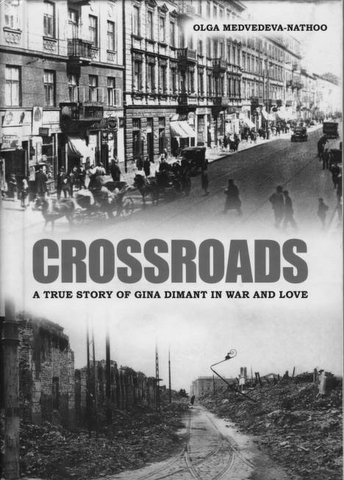
I felt quite honored when Gina asked me to write a review of Medvedeva-Nathoo’s new book, Crossroads: A True Story of Gina Dimant in War and Love (K&O Harbor, 2014). Written originally in Russian, the English edition is translated by Richard J. Reisner and Medvedeva-Nathoo. It was launched on Jan. 11 of this year at the Zack Gallery.

book cover - Crossroads: A True Story of Gina Dimant in War and Love Crossroads is truly an inspired and absorbing account. Born Hinda Wejgsman into a Jewish family in pre-Second World War Warsaw, Gina’s carefree life fell apart when the Nazis invaded Poland. Almost overnight she lost her safe home and, with her parents and sister, had to leave behind extended family, never to see them again.

Crossroads follows the Wejgsmans family, their extraordinary journey in a cattle car from the eastern border of Nazi-occupied Poland to the Union of the Soviet Socialist Republics, and of their fight for survival there. The cold in the car was intolerable, and the Wejgsmans slept on straw, bodies side by side, trying to keep warm. They traveled for more than a month. They were sent to Leninogorsk in northeastern Kazakhstan, near the Altai Mountains, where temperatures dropped to minus 41˚C in winter.

After their arrival, Gina did not go to school because local authorities considered her an adult at 14 and gave her a construction job carrying bricks, four at a time. Gina reflects: “… my main memory from Leninogorsk is not what we ate there, but how terribly hungry we always were. With the feeling of hunger, you couldn’t even fall asleep and, if you fell asleep, then it was with night dreams of food until you woke up with the same daydreams…. In winter evenings when the frost was absolutely intolerable and it was inconceivable even to attempt lying in bed, so as not to freeze to death, we would pace the room in circles, single file.”

The Wejgsman family survived six years in Leninogorsk. Medvedeva-Nathoo points out that it was exactly 72 months, slightly more than 2,000 days.

The postwar return of Gina and her family to Poland necessitated resettling, as Warsaw was in ruins. There was also some serenity, however. In her new town, in Szczecin, Gina’s son from her first marriage, Saul Seweryn, was born. There, she also met her true love, Sasha, and became Gina Dimant.

The Polish 1968 political crisis, known in Poland as the March Events, resulted in the suppression and repression of Polish dissidents and the shameful antisemitic, “anti-Zionist” campaign waged by the Polish Politburo, followed by forced mass emigrations of Polish Jews. Gina remembers: “Poland rejected us unfairly and unjustly. A deep-seated pain lived in us for years…. We were … convinced constantly: there are Poles and there are Poles. Those who were corrupt and added to corruption, and those who sympathized with us … those who gloated over other’s misfortunes and those who were outright angry at our departure.”

Gina, with her husband and son, was displaced again. Looking for a place to settle, they chose Canada because it was a country far away from Europe that accepted new citizens. They arrived here in 1970. Despite their bitter farewell to Poland, their home here was always open to Poles, Jewish and non-Jewish: “A good human being – here was the only essential criterion taken into consideration.”

In Vancouver, in 1999, Gina co-created the Janusz Korczak Association of Canada. In 2013, she was awarded the Gold Officer Cross of the Order of Merit of the Republic of Poland for strengthening relations between Poles and Jews.

Medvedeva-Nathoo writes: “Tragic Polish-Jewish relations notwithstanding, Poles and Jews lived side by side through the centuries and, regardless of what isolationists like to say, their history cannot be separated. The Dimants would always say: ‘… in the years of war, some Poles, obsessed with hatred, denounced Jews, while others risked their own lives to rescue them at a time when Poland was the only occupied country in which the death penalty was in force for anyone who hid the Jews or in some manner helped Jews.’” In the book, Gina reflects that there are many good and bad examples, pointing with triumph to Irena Sendler, a Pole who saved 2,500 Jewish children.

In Crossroads, Medvedeva-Nathoo has chosen to emphasize the battle of the individual and the will to survive set against the backdrop of three different cultures. It is a steadfast piece of writing that presents the stark facts of Gina’s life, set chronologically, starting with the description of her childhood in prewar Warsaw, followed by their postwar experiences, concluding in 2013.

At times, Medvedeva-Nathoo’s book is translated from Russian to English too literally, not taking into account the cultural context of the language into which she is translating. For example, when describing the usefulness of the newspaper Pravda in the USSR as toilet paper, the author translates it as a “nude-paper,” which makes sense only in Polish or Russian. Readers would also benefit from a map illustrating Gina’s journeys.

Crossroads is an historically accurate chronicle and a meticulously researched story that provokes discussion about the hardships and consequences of war, and the survival of one extraordinary family. It can be purchased from Gina Dimant at 604-733-6386.

Tamara Szymańska is a visual artist and a columnist for the Takie Zycie, the Polish biweekly magazine for Western Canada. She lives in Vancouver with her husband and their dog.

Posted on March 27, 2015March 26, 2015Author Tamara SzymańskaCategories BooksTags Gina Dimant, Holocaust, Janusz Korczak Association, Olga Medvedeva-Nathoo, Wejgsman
Tsabari gives voice to place

Tsabari gives voice to place

Ayelet Tsabari’s short stories win Rohr Prize. (photo from @AyeletTsabari)

One of the best contemporary works of fiction I’ve read in the last few years has been Israeli-Canadian Ayelet Tsabari’s The Best Place on Earth, her 2013 debut collection of short stories. The characters and settings draw the reader in effortlessly. The conflicts are both internal and situational, and they feel urgent and real. The writing is intelligent, sexy and restrained. The judges of the prestigious Sami Rohr Prize for Jewish Literature clearly thought so, too, as the book is the newest winner of the $100,000 US award.

I recently caught up with the Toronto-based Tsabari by phone in Israel, where she was visiting family and friends. She is insightful, thoughtful and articulate, as well as warm and humble – she told me she was “shocked” when she heard the news of the prize. We spoke about identity, the short story form, her favorite summer spot, what makes a novel Canadian and Israeli, and how to write a decent sex scene.

One of the first things that comes to mind in Ayelet’s writing is the ethnicity of the characters: almost all are Mizrahi, a label with which she herself identifies. “It was really important to me to have Mizrahi characters who go about their lives, and not having their Mizrahi [identity] be an issue. That’s never questioned when you have stories about Ashkenazis; that’s the default. I wanted to shatter that, to break the pattern.”

Some of Tsabari’s stories are set in Canada. There is a memorable one set on Hornby Island – the tiny B.C. oasis whose peacefulness Ayelet found she was mentally contrasting with the intensity of Jerusalem – and another in Toronto. Most are set in Israel, though, revealing important themes about life, love and loss set against the background of physical insecurity. Ayelet wrote the book in Canada, was mentored by another Canadian author, Camilla Gibb, and acknowledged that others have told her the book possesses a Canadian sensibility.

Ayelet confided that she tried to avoid writing a conventionally “political” book. “I didn’t want to write about the war, about conflict. What I’m interested in is people’s lives…. But I wanted to set it against that backdrop. This is how I grew up; it’s always there, the conflict, that sense of menace.”

Still, she did have what she considers a political aim. She wanted to give voice to a place that is often better known to outsiders through the media. She wanted to “complicate things,” she told me, to “focus on the lives of one family … and one person, rather than the mass of people you see when you watch the news.”

Why the short story form?, I asked her. While she is currently working on a couple of longer-form projects, she told me that she “love[s] the brevity of [short stories]; I love imagining a life in a short span; I love the idea of a collection.” She added, “It’s kind of like traveling…. You get to know people, you really feel like they’re a part of you, you forge what you think are lifelasting relationships, then you move on. And because so many of the characters [in the book] are transient and nomads, immigrants, and travelers, I felt that the container fit….”

As for how to write a good sex scene, Ayelet explained that writers should provide as much detail as they would for any other type of scene, include it only if it advances the plot and, above all, avoid euphemisms. It’s good advice, really, that could be applied to most everyday interactions: as we encounter one another, we should strive to understand the inner lives of people as they really are. And, as readers, we can be grateful for glimpses of our country’s fine new voices helping us understand other places at the same time as we are able to discover new truths about ourselves.

Mira Sucharov is an associate professor of political science at Carleton University. She blogs at Haaretz and the Jewish Daily Forward. This article was originally published in the Canadian Jewish News. For an Oct. 11, 2013, interview with Tsabari (“Making a home in Canada”) about The Best Place on Earth, visit jewishindependent.ca.


Posted on March 27, 2015March 26, 2015Author Mira SucharovCategories BooksTags Ayelet Tsabari, Sami Rohr Prize

Meet Chani Kaufman

Community and faith can both comfort and oppress. A well-defined environment with clear expectations and rules can allow one to flourish, knowing one’s proper place and purpose in the world, or it can stifle one’s individuality, creativity and spirit, knowing that what is and what is to come is more determined by others than oneself. Self-realization and other universal themes, such as family, love and loss, are explored with a sensitive heart and a deft hand by Eve Harris in The Marrying of Chani Kaufman (Anansi Press Inc., 2014).

book cover - The Marrying of Chani Kaufman by Eve HarrisSince the Jewish Independent received its advance reading copy of Harris’ debut novel, which was first published in England by Sandstone Press Ltd. in 2013, The Marrying of Chani Kaufman was long-listed for the Man Booker Prize. It has received many positive reviews, and this one will be no different in that respect. The novels characters are likeable and relatable; even the most intransigent of them has their understandable reasons for their views and actions. There are no malevolent people in this non-specific Charedi community living in Hendon and Golders Green, in the northwest part of London, England – although some do push moral boundaries in their efforts to get what they want, what they feel is right.

To write a novel that is simultaneously critical of and sympathetic to a community takes skill. Harris writes about religious people, not a religion per se, and she writes about these people with respect and knowledge, humor and pathos. She succeeds in telling a story about people living in a world that will be foreign to most readers and explaining it without becoming stilted or lecturing.

The Marrying of Chani Kaufman centres on four people: the bride and the groom, Chani and Baruch; the rebbetzin; and the rebbetzin’s son, Avromi, who is good friends with Baruch. It starts at Chani and Baruch’s wedding in November 2008 and goes back in time – several months for Chani and Baruch, when he first sees her; to 1981 for the rebbetzin, when she met her husband and began her journey to orthodoxy; and to 2007 for Avromi, when he met and fell in love with Shola, a non-Jewish fellow student at university. When the novel begins, Chani and Baruch are about to start their “real life,” as Chani describes it, the rebbetzin is well into her crisis of faith and Avromi’s double life is becoming difficult to maintain.

By the time the matchmaker arranges for Chani, 19, and Baruch, 20, to meet, at his insistence to his mother – who does not approve of the match for a few reasons, most notably the Kaufmans’ lower economic status – both had been on several arranged dates with other potential mates, to no avail. They both don’t quite fit the mold of the perceived ideal Charedi wife or husband, and both are unwilling to settle.

At school, when she was 15, Chani’s “garrulousness had got her into trouble,” she “was considered audacious but gifted,” “everything interested her – the little she could get her hands on.” She “had learned to walk and not run…. She had longed for freedom of movement but had been taught to restrict her gait.” In agreeing to be married to Baruch, “She hoped that the bell jar might finally be lifted. Or at least she would have someone to share it with.”

That latter hope, at least, does seem possible, as Baruch, too, thought his “life felt narrow: the pressure to succeed, to be a rabbi, to please his father. His quick analytical mind was to be harnessed to the Talmud. The English degree he longed to study remained a blasphemous secret buried in his heart.” As did Chani, he acted out in small ways, listening to rock music or reading novels that were not permitted. So, perhaps together they will be able to negotiate a Jewish life that feeds more of their being and soul. Perhaps there will be a happily ever after for them. Their parents seem reasonably content, albeit with their respective – and not insignificant – problems.

The future well-being of the rebbetzin and her family is also left to readers’ imaginations, the rebbetzin’s questioning seeming to have more far-reaching implications than her son’s transgression. Sparked by a miscarriage – a devastatingly described incident in which the emotional distance between her and her husband becomes apparent – the rebbetzin begins to deal with long-latent grief from a much-earlier tragedy. This process, at least initially, separates her from her family, her community, her faith. Where it takes her is not revealed.

As much as The Marrying of Chani Kaufman offers readers a glimpse into the lives of others, it offers the possibility of finding out more about ourselves and our own place in the world.

Posted on March 27, 2015March 26, 2015Author Cynthia RamsayCategories BooksTags Charedim, Eve Harris

Unique fictional viewpoint

As far as books go – especially books about the Holocaust – The Jewish Dog by Asher Kravitz (Penlight Publications, 2015), published in Hebrew in 2007, is certainly unique. The novel was awarded a citation by the Israeli Publisher’s Association and it is easy to understand why.

Kravitz is a Jerusalem-born physics and mathematics professor and photographer of wildlife. He has written three earlier books: two whodunits and a book about an Israeli soldier in an anti-terrorist unit. The narrator of this novel is a 12-year-old Jewish dog raised by a single mother (a dog, that is) in 1930s Germany.

book cover - The Jewish Dog by Asher KravitzWhen he is born, his mother lives with the Gottlieb family. Despite the family conflict about keeping any of the puppies, when the dog finds the afikoman at the seder, Herschel, the family’s son, declares that the prize is allowing the dog to stay. They name him Caleb.

Caleb is an exceptional animal. He learns to decipher human speech and can read the moods of the adults.

As the story continues, Caleb witnesses the rise of Nazism and the laws being forced upon the family – the housekeeper prevented from working for the Jewish family; the children prohibited from attending school; and Jews forbidden to own a dog.

Caleb is given to a Christian family, where the wife mistreats him, and the story follows his adventures joining a pack, his training as a facility guard dog at Treblinka, and more. All the while, we read Caleb’s philosophical commentaries and are given a great deal of food for thought on human and animal behavior.

Kravitz has produced a well-written novel that is poignant and compelling. Some might say The Jewish Dog is for young adults, but anyone wanting to read a distinctive presentation of the pre-Holocaust and Holocaust period will find this book absorbing.

***

After reading and reviewing this most unusual book, I was prompted to ask the author some questions about this work. When I asked him what prompted him to this type of novel, Kravitz recalled that, as a high school student, he participated in an international quiz about the Second World War, which focused on the Holocaust. One of the anti-Jewish laws enacted by the Nazis was that “raising a dog is prohibited for Jewish families.” He also remembered the images of the signs posted on restaurant and coffee shop doors, “No entrance for dogs or Jews.”

“This is almost a built-in symbol of the Holocaust that connects dogs and Jews,” he said.

Kravitz also related a conversation that he had with an elderly survivor of Auschwitz, who had a deep understanding of dogs and had been a dog feeder in the camp.

The novel began its life as a short story, which Kravitz then expanded. It took more than four years to complete. He said that he studied “the behavior of my own two dogs in order to learn their mannerisms and reactions so that The Jewish Dog would narrate as realistically as possible as a dog.”

Kravitz did not expect the novel to become so popular. “I attribute [its success] to the responsibility I felt for the seriousness of the subject matter and also to the aid I received from the editor who worked with me throughout the writing process,” he said.

Another writer and director adapted the book into a one-man play, which ran in Tel Aviv for almost three years, and The Jewish Dog is now required reading for high school matriculation exams in literature. It has been translated into French, Turkish and English.

Sybil Kaplan is a journalist, foreign correspondent, lecturer, food writer and book reviewer who lives in Jerusalem. She also does the restaurant features for janglo.net and leads weekly shuk walks in English in Jerusalem’s Jewish food market.

Posted on March 27, 2015March 26, 2015Author Sybil KaplanCategories BooksTags Asher Kravitz, Holocaust

An extremist war on women

A small Israeli ultra-Orthodox newspaper in Israel became the target of international ridicule earlier this year after blotting out the faces of three women from a prominent photo of 40 world leaders.

Heads of state were marching through the streets of Paris to demonstrate solidarity with France, opposition to terrorism and support for freedom of expression after Islamic State sympathizers murdered journalists at the satirical magazine Charlie Hebdo and Jewish hostages at a kosher market in a Paris suburb.

HaMevaser, which serves an insular Israeli community indifferent to modernity, seems to have missed the point of the march. HaMevaser editor Binyamin Lipkin defended the altered photo, insisting a photo in the newspaper that included German Chancellor Angela Merkel, Paris Mayor Anne Hidalgo and European Union official Fedrica Mogherini would “desecrate” the memory of the 17 people who were killed.

The incident once again drew attention to the fanaticism of the ultra-religious community in Israel that demands the complete removal of all photos of women in public spaces, tight restrictions on the role of women in public life and severe limits on education for both boys and girls.

book cover - The War Within: Israel’s Ultra-Orthodox Threat to Democracy and the Nation by Yuval Elizur and Lawrence MalkinTwo books, written in a conversational style, came out recently that shine a glaring light on recent controversies sparked by the ultra-Orthodox in Israel. Reading them together provides a broad understanding of the issues.

The War Within: Israel’s Ultra-Orthodox Threat to Democracy and the Nation (Overlook Press, 2013) by journalists Yuval Elizur and Lawrence Malkin, looks at several flashpoints that, the authors say, will invariably turn into even more difficult social, economic and political problems as the ultra-Orthodox population grows.

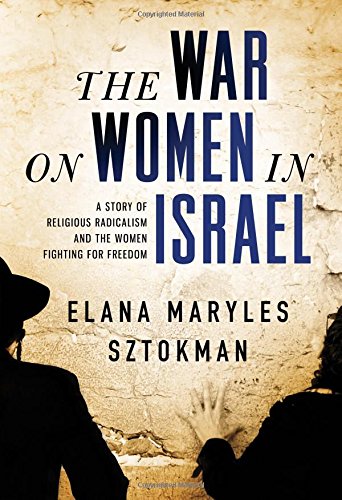
The War on Women in Israel: A Story of Religious Radicalism and the Women Fighting for Freedom (Sourcebooks Inc., 2014 ) by feminist activist Elana Maryles Sztokman, is an unrelenting assault on Israeli society for accepting blatant discrimination against women in almost every aspect of their lives. At times, the book reads like a social activist’s pamphlet demanding justice.

Israel ranks near the bottom among world democracies on the right to religious freedom. The books are reports from the frontlines in the fight for equality, and will be disturbing for those concerned about civil rights in Israel. The writers leave the impression that radical religious voices are shredding the fabric of the country.

Both books offer portraits of the ultra-Orthodox communities and a brief account of the historical context that led to the current problems. The perspective is clearly that of outsiders who have little patience for the ultra-Orthodox way of life. Nevertheless, it is difficult to ignore what they say.

Roughly 10 percent of the country and one-third of Jerusalem are ultra-Orthodox. Those numbers will likely explode within a generation, if current trends continue. The birthrate within the ultra-Orthodox community is twice the national average. As the children grow up, the impact of the ultra-Orthodox community will be felt in many different ways throughout Israeli society.

Students in ultra-Orthodox schools spend their day studying religious texts, paying scant attention to core subjects of English, math and science. Elizur and Malkin say that most students complete their formal schooling without the education or skills to work in a modern economy.

Several ultra-Orthodox schools go further, refusing to allow girls to write final exams in core subjects in order to ensure the girls do not leave school with a high school diploma.

Meanwhile, the economic life within the ultra-Orthodox community is grim and will likely degenerate even further as their numbers increase. The Taub Centre for Social Policy Research, in a report released in December, pegs the poverty rate in the ultra-Orthodox community at 66 percent in 2013, an increase from 60 percent in the previous year. The ultra-religious have the lowest participation rate in employment in the developed world.

And it’s not just a Jerusalem phenomenon. Ultra-Orthodox communities are scattered across the country. In the ultra-Orthodox community of B’nei Brak, half of all children live in families below the poverty line.

Both books provide an account of the historical roots for these circumstances. The ultra-Orthodox communities have relied almost entirely on national subsidies since the creation of the state in 1948. At that time, the rabbis argued that studying Torah and praying had ensured the survival of the Jewish people through centuries of wandering and persecution.

The founders of the state wanted to maintain the Jewish nature of the state. Religious authorities were given unqualified control over marriage and divorce. David Ben-Gurion agreed to exempt the ultra-Orthodox from military service and pay them to spend their days studying in a yeshiva. In exchange, he expected to receive their support in the Knesset.

The arrangement was a trade-off endorsed by most Israelis for more than 50 years. But demographics have shifted. In 1948, 4,000 students were studying in a yeshiva. Today, around 120,000 students study full-time and are dependent on allowances from the government. Many Israelis now are not so comfortable with the arrangement.

The trade-off has also meant that Israel does not have a constitution guaranteeing individual rights and freedoms. The ultra-Orthodox at that time refused to support a constitution, mostly to prevent shifts in the status of women, the journalists say.

The country’s founders forged practical arrangements without any long-term vision, say Elizur and Malkin. It was a colossal mistake. Successive governments have maintained the status quo, in effect placing huge barriers for those fighting for changes.

As women have asserted their right to be treated equally, religious zealots have escalated their tactics, moving from bullying and shouting to spitting, shoving and throwing rocks.

image - The War on Women in Israel: A Story of Religious Radicalism and the Women Fighting for Freedom by Elana Maryles Sztokman book coverThe ultra-Orthodox succeeded in pressuring Israeli public and private companies to ban female faces on transit ads and force women to sit at the back of the bus. Weak protection for secular values, coupled with liberal tolerance for diversity, enabled the ultra-Orthodox to push bus companies in Israel to segregate 150 bus lines across the country, Sztokman writes.

The arrests of women who sing, wear a tallit or pray at the Western Wall have been widely reported. These books provide numerous anecdotes about the confrontations on many fronts, including some outrageous instances of the struggles that some women face in obtaining a Jewish divorce from a vengeful husband. Around 10,000 women in Israel are in limbo, unable to obtain a get (a divorce decree) from the religious courts.

Elizur and Malkin also look at the government-funded rabbinic councils that operate under a minimum of oversight and with their jurisdiction only loosely defined. They assert control over everything from certifying pensions funds to ensuring that water is kosher.

Women disproportionately feel the impact of the institutions run exclusively by males. None of the judges in the religious courts are women. Until recently, even all the supervisors of the mikvehs were male.

The lack of accountability and vagueness over roles has cleared the way for the rabbinical authorities to attempt to expand their control over the lives of all Israelis. Imprecise boundaries have led to recent flare-ups over matters of division of property, child custody, alimony, child support and education. The army is struggling to find a compromise for ultra-Orthodox who are now enlisted. A battle over jurisdiction over circumcision was recently in an Israeli court.

The power of the religious authorities is on display in the most unexpected places. A produce market has separate shopping hours for men and women. Women’s voices disappear from the radio. A women’s health conference excludes accomplished women researchers and prominent women doctors from its program. Young girls cannot sing in public. Daughters are not allowed to stand by the grave of their fathers to say Kaddish.

Despite the dark portrait of the religious divide, both Sztokman and journalists Elizur and Malkin find reasons to be hopeful. Restrictions on seating on buses have been lifted on some lines; women’s faces are returning to some billboards on the street. Even the Women of the Wall can claim some victories.

Momentum is clearly on the side of the ultra-Orthodox. However, a backlash against the most extreme measures has begun to undo some excesses. The authors also find some members of the ultra-Orthodox community are working to change the system from within. Sztokman, for example, finds hope for religious pluralism in Israel from the work of an emerging alliance of Orthodox feminists and secular activists who are pushing for a more egalitarian country.

Robert Matas, a Vancouver-based writer, is a former journalist with the Globe and Mail. This review was originally published on the Isaac Waldman Jewish Public Library website and is reprinted here with permission. To reserve this book or any other, call 604-257-5181 or email [email protected]. To view the catalogue, visit jccgv.com and click on Isaac Waldman library.

Posted on March 27, 2015March 26, 2015Author Robert MatasCategories BooksTags discrimination, Elana Maryles Sztokman, Israel, Lawrence Malkin, ultra-Orthodox, women, Yuval Elizur
Dancing in gratitude

Dancing in gratitude

Serge Bennathan with Erin Drumheller in Monsieur Auburtin, which is at the Dance Centre March 26-28. (photo by Michael Slobodian)

Serge Bennathan’s Monsieur Auburtin is an autobiographical work, which promises to offer “audiences a keyhole through which to rediscover their own childhood dreams, splendidly realized or forgotten through the passage of time.”

Co-presented by the Scotiabank Dance Centre and Chutzpah!Plus March 26-28, Monsieur Auburtin spans Bennathan’s decades-long career, from France to Canada, from student to company artistic director. In addition to being a dancer and choreographer, Bennathan is also a writer and artist. He is known for his collaborations with opera companies, and the projects of the company he founded in Vancouver, Les Productions Figlio, “encompass dance, theatre, music, multi-media, visual art and literary works.”

Among multiple other honors, Bennathan was awarded the 2014 Canada Council Jacqueline Lemieux Prize because of his innumerable “contributions to Canadian dance through his creation work, his performance, his work as a mentor, [and] for his leadership within and beyond his company work. He inspires creativity among those he works with and his impact has been felt in multiple geographical centres and multiple generations.”

JI: Throughout your career, you’ve created personal works, why an autobiographical one at this point?

SB: It came quite organically as a response to a cancer that I was fighting. It made me think about what I love in my life, what made me, the gratitude to be an artist in this world. And how there are a lot of dance works but how we speak rarely about dance with the audience. So, I decided to be a storyteller and talk about how I came to dance and use my life as an artist in dance to talk about other artists that I love and admired. For this, on stage in Monsieur Auburtin, there are with me two dancers, Erin Drumheller and Kim Stevenson, and the composer playing live, Bertrand Chénier.

JI: The last time we spoke was in 2003, about The Invisible Life of Joseph Finch. There, you described your creative process as including up to a year and a half of research before starting to work with the dancers and creative team. How does your process differ, if at all, for a work such as Monsieur Auburtin?

SB: It does not really. It is the same process. I spent a year writing the text for the piece, then another working with the composer Bertrand Chénier. Just talking about life in dance, not talking about choreography but about the essence of dance. Now, here we are, in the studio with two dancers, me and the composer that will be live on stage. The time before is important to create enough stratum, subtext and be able to let go.

JI: From where do you garner the strength/courage to share so much of yourself in your choreography? Does the vulnerability ever scare you? If so, how do you overcome that fear?

SB: We live only once. It is important for me right now to talk to people, and even more important to me in the world we live in, to talk poetically to the audience, through words, movement and music. We all have in us fear, but we also have courage and strength. Doubts are not there to stop us, they are here to make us think deeper. We have to embrace fear to say our truth. And even more when we know that this life is not a dress rehearsal.

JI: [From 1990-2006], you were with Dancemakers in Toronto. What brought you to Vancouver, and how did Les Productions Figlio come to be created?

SB: In 2006, when I stepped down as artistic director of Dancemakers, it was very natural for me to come back to Vancouver. The time that I lived in Vancouver the first time, 1987, ’88, ’89, ’90, defined me as an artist. The people I met at that time became longtime collaborators that continued to work with me through my time at Dancemakers. I loved passionately this community. It is my home in Canada. I created Les Productions Figlio, a production company, to help me create the work I want to create, that is not always dance. I had just come out of 16 years with a dance company and wanted to be lighter as a structure. I create dance, but also theatre and maybe more.

JI: You are also a writer, painter and illustrator. Have you always been interested in these pursuits? What does a typical day or week look like for you, or is there such a thing?

SB: Dance introduced me to these other artistic expressions very organically and I love it. Everything feeds everything. I get up, meditate, write for two hours, paint, continue the day in the studio or the work that I have to do for a creation. Might come back to painting, read, cook, think, dream.

***

Monsieur Auburtin is at the Dance Centre, 677 Davie St., March 26-28, 8 p.m. For tickets ($29/$25/$20), visit thedancecentre.ca or chutzpahfestival.com, or call 604-257-5145.

Format ImagePosted on March 13, 2015March 12, 2015Author Cynthia RamsayCategories Performing ArtsTags Chutzpah!Plus, Dancemakers, Les Productions Figlio, Monsieur Auburtin, Scotiabank Dance Centre, Serge Bennathan
Family’s little white lie

Family’s little white lie

Lacey Schwartz celebrates her bat mitzvah with her parents, Peggy and Robert. (photo from littlewhiteliethefilm.com)

From Hollywood films like Next Stop Greenwich Village and Reversal of Fortune to documentaries like The Times of Harvey Milk, hyper-verbal Jews are practically a movie cliché. Name the last film that featured a Jew at a loss for words. It’s a stumper, because the silver screen stereotype of Jews is emotionally candid, unabashedly frank and unfailingly articulate. The rare exception to that rule, Lacey Schwartz’s Little White Lie deserves a place in the record books for that reason alone.

The first-person documentary follows the 30-something filmmaker’s effort to learn the identity of her biological father and, more importantly, force her parents to acknowledge and confront a painful secret. At the critical juncture, however, they become unexpectedly tongue-tied.

A fascinating modern mystery that paradoxically chooses not to explore the most interesting aspects of identity and race, Little White Lie airs nationally on March 23 as part of PBS’s Independent Lens series.

Schwartz grew up in Woodstock, N.Y., with doting parents. Her mother, Peggy, married at 21, sticking to a path her parents had instilled.

“We didn’t think outside of the box,” Peggy recalls. “And sometimes it was easier that way.”

Going with the flow seems to have been Peggy and husband Robert’s credo. After Lacey was born in 1977, and relatives or friends would observe that she was darker-skinned than her parents, Robert would point to a photograph of his swarthy, Sicilian grandfather by way of explanation.

Schwartz offers numerous childhood pictures of herself, and it’s obvious to the viewer that one of her parents could be black. Was she adopted? That would make sense, and certainly wouldn’t be a shanda, but no, there’s a photo of a very pregnant Peggy. Did Peggy have an affair? If so, neither she nor Robert ever said a word about it while they raised Lacey like any other white and Jewish girl.

“I wasn’t passing,” Schwartz tells us, referring to the practice of becoming regarded as a member of another racial or ethnic group. “I actually grew up believing I was white.”

One of the odder aspects of this bizarre saga is that Peggy and Robert seemingly never anticipated that one day Lacey would have questions and demand answers. It wasn’t until Lacey started high school – in a neighboring town with African American students – that she began to experience serious cognitive dissonance. The black kids assumed she was black, even though she thought she was white.

Schwartz gives the impression that in the ensuing years, through college and into adulthood, she had to work out her identity issues on her own with little to no help from her parents.

The perfectly titled Little White Lie eventually clears up the paternity mystery but, along the way, the emphasis shifts to Schwartz’s ongoing confusion, frustration and insecurity. In its weaker moments, the film becomes a therapeutic record of, and a vehicle for, her rocky process of acceptance.

Peggy and Robert’s inability to take responsibility for the messy secret at the family core deprives Lacey of the catharsis she seeks, and Little White Lie of a poignant climax.

More regrettable, though, is Schwartz’s disinterest in pursuing a deeper discussion of identity, and the comparative influences of genetics and upbringing. The film operates on a relentlessly personal level that perhaps precludes a broader perspective, but it is, therefore, baffling that Schwarz never talks about which Jewish and African American practices and traits she maintains and cherishes.

Schwartz’s wedding partially addresses this oversight. The filmmaker joins in the hora circle and is lifted with her husband on chairs; a bit later she dances to an African American rhythm. The scene doesn’t have the feel-good power it aspires to, but that’s a minor quibble.

The greater disappointment is that Little White Lie squanders a unique opportunity to bring Jewish culture and values to a wide audience, and African American culture and values to a Jewish audience.

Michael Fox is a writer and film critic living in San Francisco.

Format ImagePosted on March 13, 2015March 11, 2015Author Michael FoxCategories TV & FilmTags Lacey Schwartz, Little White Lie

Posts pagination

Previous page Page 1 … Page 140 Page 141 Page 142 … Page 160 Next page
Proudly powered by WordPress