Skip to content
  • Home
  • Subscribe / donate
  • Events calendar
  • News
    • Local
    • National
    • Israel
    • World
    • עניין בחדשות
      A roundup of news in Canada and further afield, in Hebrew.
  • Opinion
    • From the JI
    • Op-Ed
  • Arts & Culture
    • Performing Arts
    • Music
    • Books
    • Visual Arts
    • TV & Film
  • Life
    • Celebrating the Holidays
    • Travel
    • The Daily Snooze
      Cartoons by Jacob Samuel
    • Mystery Photo
      Help the JI and JMABC fill in the gaps in our archives.
  • Community Links
    • Organizations, Etc.
    • Other News Sources & Blogs
    • Business Directory
  • FAQ
  • JI Chai Celebration
  • JI@88! video

Recent Posts

  • Zionism wins big in Vegas
  • Different but connected
  • Survival not passive
  • Musical celebration of Israel
  • Shoppe celebrates 25 years
  • Human “book” event
  • Reclaiming Jewish stories
  • Bema presents Perseverance
  • CSS honours Bellas z”l
  • Sheba Promise here May 7
  • Reflections from Be’eri
  • New law a desecration
  • Resilient joy in tough times
  • Rescue dog brings joy
  • Art chosen for new museum
  • Reminder of hope, resilience
  • The national food of Israel?
  • Story of Israel’s north
  • Sheltering in train stations
  • Teach critical thinking
  • Learning to bridge divides
  • Supporting Iranian community
  • Art dismantles systems
  • Beth Tikvah celebrates 50th
  • What is Jewish music?
  • Celebrate joy of music
  • Women share experiences 
  • Raising funds for Survivors
  • Call for digital literacy
  • The hidden hand of hate
  • Tarot as spiritual ritual
  • Students create fancy meal
  • Encouraging young voices
  • Rose’s Angels delivers
  • Living life to its fullest
  • Drawing on his roots

Archives

Follow @JewishIndie
image - The CJN - Visit Us Banner - 300x600 - 101625

Byline: Zach Sagorin

Better access to education

Better access to education

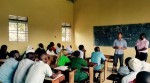
Aaron Friedland at Semei Kakungulu High School in Uganda. Friedland has written the book The Walking School Bus, both as a first reader but also as a means to generate funds for students to access education. To get it published, he has started an Indiegogo campaign. (photo from Aaron Friedland)

During high school and elementary, “it was too easy for me to miss school,” said Aaron Friedland, currently a master’s in economics student at the University of British Columbia. In other parts of the world, children walk great distances to attain an education.

“Five years ago, I wrote a children’s book called The Walking School Bus,” Friedland told the Independent. It was “written with the realization that students in North America really take access to education for granted.”

It was on a trip to Uganda and South Africa, he said, when he really began to understand “the distances students had to walk to obtain an education and it was startling.”

Data from the Uganda National Household Survey Report 2009/2010 indicate that 5.5% of children aged 6-12 do not attend school because it is too far away, and the average high school-aged student must walk a distance of 5.1 kilometres to the nearest government school, more than 10 kilometres every day.

“I wanted the book to serve a purpose and the purpose was twofold. I wanted it to raise awareness … that students have to walk,” Friedland said about The Walking School Bus. “But I also wanted it to be a means to generate funds for students to access education and so, in that case, I’d say the school bus itself is metaphoric and it represents access to education.

“I submitted my manuscript to a publishing house just under a year ago and it was well received, so we started moving forward. But, in order to really have a book come to fruition, it costs quite a bit of money.”

On Nov. 9, Friedland started an Indiegogo campaign to raise $15,000 to cover the costs of publication, “everything surrounding the book,” which includes editors who specialize in children’s books and the illustrations. The campaign runs for 60 days.

The Walking School Bus has the capacity to “act as a first reader and, while it does have a picture book component, I’d also like it to serve as a coffee table book and a symbol for interfaith collaboration,” said Friedland.

Friedland’s concern about and involvement in interfaith work began in 2010, when J.J. Keki, a member of the Ugandan Abayudaya Jewish community and founder of the Delicious Peace fair-trade coffee cooperative, was invited to King David High School. Many students, including Friedland, “formed a pretty special bond with him.”

A bond that continued for Friedland. “When I was in first year [university] – while all my friends were going to Mexico and hilarious holidays – I went to Uganda with my family,” he said. “It was an amazing experience for us. We benefited so much more than the ‘recipient’ community. I recognized quite quickly that our aid had been negligible, but what it did for me was it provided me with a clear trajectory, which guided me for my four years at McGill.… At McGill, I started working with the Abayudaya community in Uganda, specifically with Delicious Peace…. What most amazed me – and my rationale for getting involved – was that they employed an interfaith collaboration model in which they united these previously disparate communities, the Muslim, Christian and Jewish communities, and formed one solid frontier in which they collaborated. In collaborating, there were a variety of positive spillover effects … you see higher levels of economic prosperity in that region on Nabagoya Hill than you do in comparable areas, you see how there is much more religious tolerance.”

About his experience in Uganda, Friedland, who has worked with UN Watch, said, “I have only seen the us-against-them mentality, and this is one of the first times I have ever seen this collaboration.”

About his most recent trip to Uganda, Friedland said, “Essentially, I have been working with three schools there as well as King David over here, kind of empowering their educational sector in the interfaith forum. And the three interfaith schools I’ve been working with are the three I’m the most motivated to help provide school buses.”

While interviewing students in Uganda, he said, “One of the girls that really stood out to me was a girl named Miriam, a lovely Jewish girl from [Semei Kakungulu] high school, an 18-year-old. She was telling me that, when she walks to school, she walks six kilometres in either direction. And, in extreme rainfall events, which is pretty much all of the rainy season, she will cross a river to school and, when she goes back, the river is often flooded and she cannot cross back, so that night she’ll spend at a friend’s.”

Friedland added, “When I think about the struggle that our counterparts make to go to school and we do not – we don’t have that drive. That is something I’d like to impress on people in North America. I’m not saying you have to feel bad, just appreciate your access and your ease in getting an education and take it seriously.”

The website thewalkingschoolbus.com was created by Friedland to support the book and bus project, and sales of T-shirts and various other merchandise go towards his efforts to increase access to education. He said, “I think, as a Jew in Vancouver, in a more liberalized society, that this is the model that we should be going for … we should be supporting interfaith.”

Friedland has most recently worked with a team to connect King David’s Marketing 12 class with the entrepreneurship class at Semei Kakungulu. About his master’s degree, he said he will likely be writing his thesis on “the positive economic spillover effects from interfaith collaboration and employing interfaith collaboration, as an economic development growth model in other places, particularly Israel.”

Zach Sagorin is a Vancouver freelance writer.
Format ImagePosted on November 13, 2015November 11, 2015Author Zach SagorinCategories WorldTags Abayudaya, education, KDHS, King David High School, Semei Kakungulu, tikkun olam, Uganga, Walking School Bus
Sometimes innocent jailed

Sometimes innocent jailed

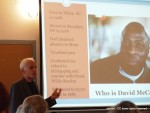
Ken Klonsky speaks on “Freeing David McCallum: A Story of Exoneration” at the Outlook fundraiser and social event Sept.27. (photo by Winnifred Tovey)

“Number one, never talk to the police.” The first tip Ken Klonsky gave when asked by the Jewish Independent for the best advice to avoid getting wrongfully convicted by the police. Klonsky – Vancouver author and director of Innocence International, which focuses on righting wrongful convictions produced by false confessions – spoke at Outlook magazine’s annual fundraiser and social event on Sept. 27, which was held at the Peretz Centre for Secular Jewish Culture.

The event began with refreshments. During the initial schmoozing, Faith Jones, a member of the Vancouver Outlook collective, explained that people attending were “from various Jewish activist communities, such as Independent Jewish Voices,” as there is an “overlap with IJV and the Peretz community and the new UBC club, the PJA” (Progressive Jewish Alliance at the University of British Columbia), with topics ranging from food security to Yiddish-language activism.

Jones included that “many other people read Outlook because it offers a voice they don’t hear often” and, within the community, there is a “strong sense that words can change the world.”

Amid stories of the joys of being Jewish and various community and activist involvements, the crowd of about 25 people entered the downstairs room at the Peretz Centre scattered with foldout tables and a slide projecting: “Freeing David McCallum: A Story of Exoneration.”

Klonsky explained “the fraudulent case” of David McCallum, with which he became involved after receiving a letter from McCallum, who had read an interview Klonsky had done for The Sun Magazine with Dr. Rubin Carter, the founder of Innocence International, who passed away April 20, 2014.

“David McCallum was in prison for 19 years when he saw this. What he saw was a friend was reading it somewhere in the library of the prison. He was able to read it, and saw my name connected to it. He wrote to The Sun, asking for my address and he wrote me a letter asking if I would help him with his case. I had nothing to do with the law at that point in my life. I was just basically an observer…. But the letter was so poignant that I decided I was going to get involved.”

When referring to the McCallum confession, Klonsky noted: “We never see the interrogation. If you have a videotape confession, the purpose of it was to get a conviction because the jury sees a videotape confession.”

Klonsky explained, “The police say, when they are in private, they say, and I’m using their language, the reason people talk to us is because they are stupid and they love to tell their stories and that’s how we get them. Now, I know young people, the reason they talk to the police is they think, ‘Well, I haven’t done anything wrong and I’m going to tell them the truth, the truth is going to protect me’… but your truth might not be the truth of the next person they talk to. McCallum and [the late Willie] Stuckey… they were both told, your friend has told us you shot Nathan Blenner, but we know you didn’t do it, we know it was him.”

Elaborating on the mindset of the interrogated individuals, Klonsky said, “Well, I’m going to go home because all I’m saying is what my friend did … neither David nor Willie confessed to the crime. They said they were witnesses to somebody else doing it. They didn’t realize, being children, that if you’re along for the ride, you are an accomplice and it doesn’t matter. You are going to get charged.”

McCallum was exonerated last year, after nearly 29 years in prison.

Klonsky is currently working towards proving the innocence of Atif Rafay and Sebastian Burns. He called the situation “the greatest tragedy I’ve ever ran in to” because “there is no evidence linking them to the actual crime” and, he alleged, their “false confession … was engineered by the RCMP. Sebastian and Atif were the youngest people that have ever been victimized by this routine.” Klonsky continued, “It is a very dangerous thing to do … they know how to set up a young person.”

In responding to a question of the number of wrongful convictions in the United States, Klonksy said, “A minimum of 35,000, that is 1.5% of the 2.3 million people who are in prison in the United States.… This is the mechanism of an oppressive state. I don’t want to paint an unnecessarily dark picture, but it really is pretty dark.” Klonsky added that he considered this a low estimate, as “The New Yorker says five percent, that is, over 110,000 wrongly convicted people. There are only 70 innocence projects in the United States.”

Throughout the talk, comments and questions were shared by the crowd, ranging from experiences in the 1970s of interrogation regarding the activist work of individuals on the way to an anti-apartheid conference, to questions regarding the motivations of police officers pushing these charges and using such tactics.

Gyda Chud, emcee of the event, spoke after Klonsky and highlighted one of his quotes of the evening: “The opposite of evil is not good, it is truth.” She continued to say that, “for truth to prevail, people like yourselves [Klonsky] and those involved in the innocence project work … we must thank you for righting these wrongs.”

Klonsky told the Independent about “a case in Louisiana, a football player, African-American kid. He was accused of writing false banknotes, forged banknotes, and the handwriting didn’t match and we were able to get him off.” The “kid” is now married with four children, said Klonsky. “Sometimes, you do things that you don’t have any idea of the effect you are going to have.”

A fundraising speech by Marion Pollack concluded the event. “Outlook has a strong and proud history of voicing dissenting opinions…. It shows that there is an amazing and wondrous reality of Jewish voices,” she said.

Outlook editor Carl Rosenberg said, “The presentation was good, people seemed to enjoy it…. I think it went well.”

Outlook publishes six times a year and offers both a socialist and humanist lens of social justice, Yiddishkeit, ethical humanism and other issues. For more information, visit outlookmagazine.ca.

Zach Sagorin is a Vancouver freelance writer.

Format ImagePosted on October 23, 2015October 22, 2015Author Zach SagorinCategories WorldTags Atif Rafay, Carl Rosenberg, David McCallum, Faith Jones, Innocence International, Ken Klonsky, legal system, Outlook, Sebastian Burns
Training Haitian physicians

Training Haitian physicians

Dr. Neil Pollock, second from the left, in Haiti. (photo from Neil Pollock)

Vancouver-based Dr. Neil Pollock has recently returned from a mission to Haiti, where he trained surgeons in newborn male circumcision to help fight against HIV.

Among other benefits, “circumcision reduces AIDs transmission by 60 percent and that would reduce a man’s risk of acquiring HIV. The reason is, the foreskin has receptor cells that selectively bind the HIV virus and promote its uptake into the body. So, by removing the foreskin, you remove the portal of entry for the virus,” explained Pollock, who specializes in circumcision and adult vasectomy.

Pollock was approached to lead the Haiti mission by Dr. Jeffrey Klausner, a medical doctor and professor of medicine at UCLA, specializing in infectious disease. Klausner volunteers with GHESKIO, a nongovernmental organization run out of the Centre for Global Health at Weill Cornell Medical College in partnership with the Haitian government.

In a phone interview with the Independent, Klausner said that, around 2007/08, “evidence became very clear that circumcision was a highly effective prevention intervention for HIV and the first priority was to get adolescents and young men circumcised. And, over time, we scaled up progress for newborns.”

After moving from South Africa to Los Angeles, Klausner started working in various countries. It was in Haiti in March 2012 that he connected with GHESKIO. He said it was one of the first NGOs to respond to the AIDs crisis in the early 1980s. Through GHESKIO, he was introduced to Haiti’s first lady, Sophia Martelly, in Washington, D.C., at the International AIDs Conference. Klausner said that, when talking to Martelly about the prospect of introducing newborn circumcision to Haiti, she said, “Absolutely, we’d love to do that, but we don’t have the resources, we don’t have the technical expertise, so we really need to rely on people like you to help us.”

Klausner returned to GHESKIO and worked to organize “a physical place, the proper clean procedure room … certain types of equipment and supplies and autoclaves, sterilized surgical equipment, and the tab was running into tens of thousands, about $50,000…. Once we had the supplies and materials, then the next step was to get the training, and I’m not a surgeon. I contacted the head of circumcision programs in Kenya, a guy named Robert Bailey.”

Bailey directed Klausner to Pollock. Klausner said he was “encouraged by [Pollock’s] enthusiasm and … set up a training program for May 2014.” (see jewishindependent.ca/vancouver-doctor-will-train-doctors-in-haiti-in-circumcision) However, the mission had to be postponed to November, as just days before they were set to depart, an “outbreak of chikungunya fever hit, which is a rare [virus] that causes fever, joint pain, and about one of 100 people can get lifelong arthritis.” In addition, “there was a fire in a supply room and we lost some of the tables we had bought and one of the autoclaves,” and “a box of supplies went missing.”

Despite these and other challenges in organizing and executing the mission, such as difficulties in communication due to power outages and poor internet connections, Klausner said, “I have been doing international work, research and programs for 25 years now and [obstacles are] par for the course. This actually went smoother than many other projects [in which] I have been involved.”

For the Haiti mission, said Klausner, “We had to make sure there were at least 200 parents and babies that were already pre-examined, pre-consented, pre-educated and prepared” because for “a training program like this to be successful you really need to do between 50 to 100 [surgeries] a day in a short period with a lot of cases to make sure the people you are training learn, and learn effectively so they can go on and do this independently and confidently.”

Pollock said he had “arranged to train two surgeons, in case one of them did not have the aptitude to succeed – in the end, one did not, and it was difficult of course to tell him that, but it was clear that it would not be safe to pass him and enable him to operate on patients.”

With the use of the technique he taught in Haiti, said Pollock, recovery time will be reduced compared to current Haitian practices “because there is so little trauma caused during surgery.”

Klausner offered three measures for the mission’s success. “One is the actual conduct of safe, well-done circumcision on the babies that Dr. Pollock and his colleague Pierre Crouse did. That’s an achievement in itself: they did over 100 infants in two and a half days. The second part is that the surgeon and the teams that were trained, they continue to do it themselves, so they have done an additional 100 since we left. And then the third piece is that we have trained the trainers, and now other teams are being trained” to perform the surgery.

Klausner’s and Pollock’s efforts in combating HIV and AIDs received notice from some high-profile celebrities. “I was quite surprised to get a text from Sean Penn on the day after we landed in Port-au-Prince that he wanted to come down and meet and observe what myself and my team were doing and discuss synergies between our global interests in promoting health care,” said Pollock. Penn was joined by Charlize Theron, “who was also interested in discussing collaborative efforts in association with her foundation helping improve health care for the people in her native country of South Africa.”

Klausner said, “I have been working in eastern South Africa, KwaZulu-Natal province … with the public health leaders there to introduce a similar effort where we would train surgeons, create a permanent resource, such as a training program, to expand the number of trained doctors or medical officers in newborn circumcision.” In that province, he said, “40 percent of people have HIV infection” and “75 percent of women aged 30 have HIV. So, right now, that part of South Africa … is in a complete, out of control, HIV epidemic. I helped introduce adult circumcision there, but I think, to have greater impact in the long term, we need to introduce newborn circumcision.”

He added, “I believe Dr. Pollock had a very positive experience [in Haiti] and I suspect he is optimistic about the possibility to go and do it again elsewhere.”

Zach Sagorin is a Vancouver freelance writer.
Format ImagePosted on February 6, 2015July 2, 2020Author Zach SagorinCategories WorldTags AIDS, circumcision, GHESKIO, Haiti, HIV, Jeffrey Klausner, Neil Pollock
Join Kosher Lust revolution

Join Kosher Lust revolution

Rabbi Shmuley Boteach will speak at the Rothstein Theatre on Jan. 17. (photo from Shmuley Boteach)

Rabbi Shmuley Boteach will be in Vancouver later next week to talk about his most recent book, Kosher Lust: Why Love is Not the Answer. Boteach, a rabbi, author, television host, pundit and in-demand speaker who has been called “America’s Rabbi,” is being presented by the North Shore Jewish Community Centre/Congregation Har El with support from the Jewish Federation of Greater Vancouver. His talk will be followed by a Q&A and a meet and mingle over refreshments.

Boteach described Kosher Lust as “a revolutionary book,” in an interview with the Jewish Independent. “Most books about marriage, about sex or about romance, are about how you can create love in a relationship, how you can increase love. This book argues that love has been the problem all along. Why do we have such a high divorce rate? Why, if [marriages] do work, they work on a practical level but not on a level of deep desire? And my book argues the reason is that love has always been the problem.” He stressed, “The foundation of a marriage is supposed to be lust and desire, rather than love and friendship.”

In recognizing that “we live in a modern world where marriage as an institution is in common decline,” Boteach said he is “trying to make arguments for sustaining, enhancing and promoting marriage.” The bestselling author said his newest book “gives us three rules of lust. Number one, unavailability; number two, mystery; number three, sinfulness.” The book “teaches couples how to bring the three rules of erotic lust into their marriages and relationships.” These three rules of lust are from the Song of Solomon on which, he explained, the book itself is based.

Untangling the first rule, Boteach said that unavailability is “what we call erotic obstacles, erotic impediments [or] things which frustrate desire.” These include “things that get in the way of desire … that actually increase desire,” he said.

A problem with modern marriage “is that there is no mystery,” he said. “Marriages today are based on openness and a lack of mystery, and constant availability…. I actually argue a different kind of marriage.”

When asked how an ideal marriage would look, Boteach said, the “whole belief that marriage is about this constant openness and constant availability is incorrect.” Jewish law, he suggested, argues instead “for ‘sinful’ marriages. Notice that husband and wife become forbidden to each other for a period [of time] every month [during niddah]. Then, you have the element of sinfulness under the laws of modesty that are all about things being concealed, mysterious, covered, not just always available.”

Are there dangers or limitations to lust? “From a Jewish perspective, all things in life are neutral, and it really depends on their application as to whether they are positive or negative,” he said.

“There is unkosher lust,” Boteach added, “like what a husband will feel towards a woman who is not his wife. Unkosher lust is the kind of lust that is generated by pornography and the objectification of women and demeaning women.” Kosher lust, however, “like the desire that a husband has for his wife and that a wife has for her husband, is a beautiful thing and a ‘kosher’ thing.”

His book contends that “women are as lustful as men are,” Boteach explained. “One of the central arguments in my book is that women are much more sexual than men, and female sexuality has been belittled in our time and prior to our time.” Women “lust in a uniquely feminine way … in a much deeper more emotional way,” Boteach suggested, while men “lust in a uniquely physical way, that is often very two-dimensional, very predictable, very monotonous and very boring.”

The book has received several positive reviews in mainstream media, but also a critical review in Haaretz, Boteach said. In his opinion, this is “no coincidence … because Jews are the ones who always have an issue with a rabbi giving them advice about sex, because so often we belittle our own religion.”

Boteach continued, “I am not looking to write specifically to a Jewish audience. I am writing to a mainstream audience…. Jews have to learn how to assert their Jewishness in the midst of a multicultural society. And that’s what I do … I’m promoting Jewish identity, which can be affirmed and asserted anywhere and everywhere. We can’t create ghettoized Judaism that is only affirmed in the presence of other Jews. But I also believe that the universal teachings of Judaism are universally applicable and, therefore, it’s not just for Jews.”

The prolific author – he has published 30 books to date – will continue to focus his writing on relationships, but he is also continuing his foray into television with a new pilot for a show to be broadcast in Canada on Vision TV.

Boteach will speak Jan. 17, 7 p.m., at the Norman and Annette Rothstein Theatre. Tickets are available online at harel.brownpapertickets.com.

Zach Sagorin is a Vancouver freelance writer.
Format ImagePosted on January 9, 2015January 8, 2015Author Zach SagorinCategories LocalTags Har El, Kosher Lust, Rothstein Theatre, Shmuley Boteach
Narrowing the housing gap

Narrowing the housing gap

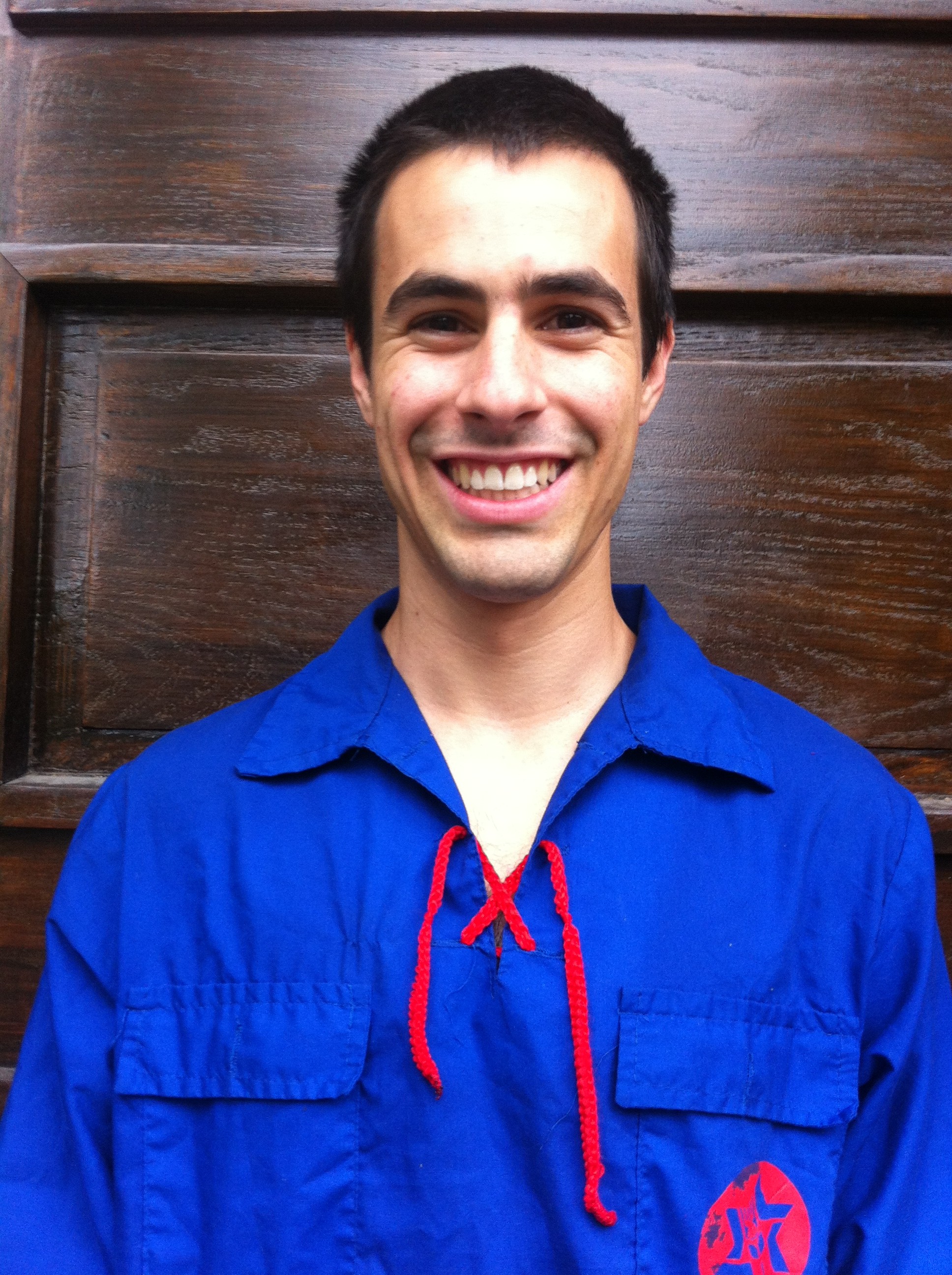
Gil Gan-Mor of the Association of Civil Rights in Israel will be one of the speakers at Gimme Shelter on Nov. 20. (photo from Gil Gan-Mor)

A condominium used to be a potentially affordable alternative to a home for buyers in Vancouver, but condo prices are now so high that the vast majority of Vancouverites cannot afford them.

The most recent Strategics’ Vancouver Condo Report, released last week, noted that, in Vancouver, “The average low-rise project … asking price is $632,000, which eliminates many of the young couples and single buyers in this market.” Other reports using other factors have come to similar conclusions. And housing affordability is not just a problem facing this city.

On Nov. 20, New Israel Fund of Canada is hosting the event Gimme Shelter: Closing the Middle Class Housing Gap in Israel and Canada, co-sponsored by Temple Sholom, Generation Squeeze and Tikva Housing Society. It will feature speakers Gil Gan-Mor of the Association of Civil Rights in Israel (ACRI), Dr. Penelope Gurstein of the University of British Columbia and Dr. Paul Kershaw, founder of Generation Squeeze.

Gan-Mor, an attorney, will talk about the situation in Israel and provide an update on the government’s actions there since the social protests that took place in 2011. He spoke with the Independent in anticipation of his visit.

According to Gan-Mor, ACRI is the only human rights organization in Israel “that engages with the full spectrum of human rights and civil liberties.” A nonprofit, it is funded through donations and grants, but receives no financial support from the government. Its goals, Gan-Mor said, “are to protect and promote human rights in Israel through a combination of litigation, policy advocacy and public outreach. Specifically, in the Right to Housing Project, our goals are to ensure equal access to housing, fight housing discrimination, protect the right to affordable housing, promote inclusionary policies in housing and reduce segregation, combat homelessness and protect the rights of homeless people.”

Gan-Mor began working with ACRI during his second year of an NIF fellowship for graduates of its Civil Liberties Law program. He was “given the opportunity to develop a new project in ACRI,” he said, “the Right to Housing Project, which fit in with ACRI’s efforts to increase its involvement in social and economic rights.” He “didn’t expect at that time that, four years later, the right to affordable housing would be at the centre of the social protests that drew hundreds of thousands of Israelis to the streets.”

About the current situation, he explained, “In Israel, housing affordability is a big issue, because of two processes. First, in the last two decades, the governments in Israel dramatically withdrew from their past involvement in the housing market, leaving the role of providing housing to private market forces…. The second process is the dramatic increase in housing prices, which were already expensive…. These two processes led to a growing inequality in Israel,” as “more and more families must spend an increasing share of their income to ensure decent housing at the expense of other basic needs,” as well as “a growing polarization of residential neighborhoods, which are becoming increasingly separated on a socioeconomic level.”

Gan-Mor added, “We in ACRI view those aspects with great concern and are acting to force the government to become more active in realizing the right to housing, a right which cannot be ensured only through private market forces.”

The Gimme Shelter event will give attendees an opportunity “to question how Israel expresses the values of human rights in its domestic policy, and how they as international supporters of Israel can participate in this dialogue on building a more just society inside Israel,” said Gan-Mor. And it will offer a similar opportunity for Vancouverites to participate in the dialogue about how to build a more just society here, too, at least as far as housing is concerned.

Gimme Shelter will take place at Temple Sholom on Nov. 20, 7 p.m. For more information about the speakers and to register for the event, visit nifcan.org/our-events/upcoming.

Zach Sagorin is a Vancouver freelance writer.


Format ImagePosted on November 14, 2014November 13, 2014Author Zach SagorinCategories LocalTags ACRI, Association of Civil Rights in Israel, Generation Squeeze, Gil Gan-Mor, Gimme Shelter, housing, New Israel Fund of Canada, NIFC, Paul Kershaw, Penelope Gurstein, Temple Sholom, Tikva Housing Society

Habonim Day Camp helps alleviate strike stress

Habonim Dror Camp Miriam madrichim (counselors) partnered with Temple Sholom during the recent teacher’s strike, with the formation of a Habonim Day Camp.

photo - Lior Bar-El
Lior Bar-El (photo from Lior Bar-El)

Lior Bar-El, a madrich at Camp Miriam and Habonim Day Camp, and a University of British Columbia student, explained, “We thought it was important to support both the parents and the teachers during the strike by providing affordable child care to whoever needs it.”

Camp Miriam and Habonim Day Camp madricha Carmel Laniado, also a UBC student, explained, “The purpose of Habonim Day Camp is to create a space where children can be supervised and enjoy activities of experiential education [by donation]. We are not replacing teachers or school, but rather offering an alternative while the strike [is on].”

Talking to the JI while the camp was still ongoing, Laniado said that the day camp was open to all children, “regardless of association with Camp Miriam or religious background.”

“At different times of the day, different age groups do sports, music, arts and crafts, and experiential education on a topic of the counselor’s choice,” Bar-El said. “There is also an hour for lunch and half an hour for recess.” He added that the camp was “available to anyone grades K-11” and that more than 30 children had registered.

photo -Carmel Laniado
Carmel Laniado (photo by Sydney Switzer)

Yossi Argov, Habonim Dror Camp Miriam shaliach, shared that his “favorite part has been seeing how … so many people mobilized for the mission. The madrichim came with the idea, the camp committee [supported them] and we start[ed the ball rolling], and [we received] more help and support from the Jewish community. Temple Sholom gave us their building every day, while parents sent supplies and items like books and board games with their kids.”

Starting this initiative “was exciting and nerve-racking,” said Bar-El. “I’ve never had as much support in starting a project from so many dedicated people…. There was a lot to do – emails, advertising, lesson plans, registration, schedules – and everyone took on what they could, and made it all happen.”

Habonim Day Camp included the involvement of “a little over 20 counselors that came in at different times of the day,” Bar-El shared. “Everything was structured in hour blocks to allow us to coordinate times” because many of the madrichim “are full-time university students with varying schedules, when one of us [needed] to go to class, someone [would come and take] your place.”

photo - Yossi Argov
Yossi Argov (photo from Yossi Argov)

Melody Robens-Paradise, a member of the Camp Miriam personnel committee and mother of four Camp Miriam campers, shared, “I think it is amazing how Temple Sholom offered its space for this idea. What a collaboration. It is a sign of true community, and it is so inspiring to see the mutual support of the parents, the kids, the counselors, the Temple, the youth movement.”

She added that Habonim Day Camp “has been such a relief.” Speaking to the Independent when her kids were still attending the camp, she said, “My kids are safe and happy, engaged, and the level of stress caused by the strike is greatly reduced. My colleagues who have school-aged children were completely blown away by the innovation and generosity and [support] of the Habonim Dror counselors. They kept asking me, ‘What camp is that?’ No one could believe that Grade 12 and university-age counselors would volunteer their time to support their community in that way. It is so admirable.”

The students responsible for starting this initiative are all members of Habonim Dror, which, Bar-El explained, is “a worldwide Jewish socialist labor Zionist youth movement whose main focus is youth empowerment and collective responsibility and decision-making…. We believe that equality and social justice are intrinsic values of Judaism, and we strive to do tikkun olam (repairing the world) wherever we see a need.”

During the year, Habonim Dror and Camp Miriam are involved in both the local Jewish and social justice communities. Bar-El elaborated, “We run something called the Ken (‘nest’ in Hebrew), where we run activities twice a month for different age groups throughout the year. It’s a great opportunity for kids who are nervous about jumping straight into a three-week session in the summer to try out Camp Miriam, and to make friends with other kids who will also be there.

“We also run free tutoring at the JCC [Waldman Library] on Tuesdays and Wednesdays from 4:30-6 p.m., and three weekend-long seminars during the school year, and we are members of the Metro Vancouver Alliance (MVA). If you want your child to get involved in Camp Miriam and the Vancouver Ken, please contact Yossi Argov at [email protected].”

Zach Sagorin is a Vancouver freelance writer. He is involved with Habonim Dror in various capacities.

Posted on October 3, 2014October 1, 2014Author Zach SagorinCategories LocalTags Camp Miriam, Carmel Laniado, Habonim Dror, Lior Bar-El, teacher's strike, Yossi Argov

At foundation of My Rabbi is friendship

After a successful run in Edinburgh, Scotland, the play My Rabbi, from Sum Theatre, has arrived in Victoria. It comes to Vancouver next month.

The playwrights and performers are Kayvon Kelly from Vancouver and Joel Bernbaum from Saskatoon. Their co-creation is billed as a “comedic drama about faith, friendship and fathers” by taking “a look at old world politics through the eyes of two young guys in a pub.”

My Rabbi follows a pair of Canadian best friends that take on divergent spiritual journeys. Arya is a Muslim who searches for cultural identity in the Middle East, while Jacob is a Jew who goes on to become a rabbi.

photo - Kayvon Kelly
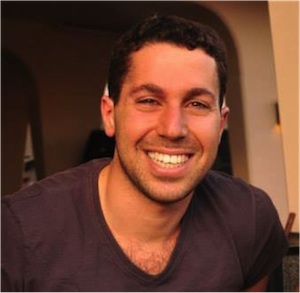
Kayvon Kelly (photo from Sum Theatre)

“The play is about the connection between two boyhood friends but, at its heart, it is about Canadian identity and how that relates to the battle between old world politics and religious boundaries,” Kelly told the Jewish Independent in an email interview.

The friendship between Arya and Jacob is based on that shared by Kelly and Bernbaum.

“We used our friendship as a springboard for the story. The base of the friendship is ours,” Bernbaum explained.

“Our sense of humor with each other is strongly reflected in these characters,” added Kelly.

Kelly said the inspiration for My Rabbi came from his and Bernbaum’s cultural backgrounds – Kelly is half Irish and half Iranian, while Bernbaum is Jewish.

“We have always found these differences vibrant and positive,” said Kelly. “But, we also acknowledged that, for a great deal of the world, these differences cause the greatest conflict. We wanted to explore why it is this way with [so] many,” but not with others.

Both Bernbaum and Kelly have been involved in theatre since a young age, and Kelly explained the origins of their theatre company.

“After we graduated from the [Canadian Centre for Performing Arts],” he said, “we both took advice from our mentor to heart, which was to ‘make your own work.’ Both of us have always wanted to play a role in the shaping of the Canadian theatre community, and establishing our voices from within it. Forming Sum Theatre is one of the ways we have found to do that.”

photo - Joel Bernbaum
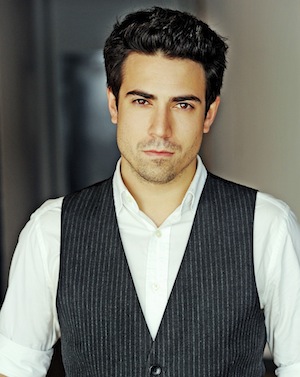
Joel Bernbaum (photo from Sum Theatre)

About My Rabbi, Bernbaum said, “Politics, religion and family are all parts of this play, but they are not the focus; they are factors that impact the friendship. We see this play as an opportunity to challenge our audiences to work towards peace and understanding.”

Kelly added, “Whether this platform enables conversation into the Israeli conflict, so much the better, but we are not making any direct political comments with this play. We are only asking questions, and making an attempt to boil the immense and often immeasurable global situation into a conversation between friends.”

Bernbaum said that, after a performance of My Rabbi “at the Edinburgh Fringe, an audience member came up … and told us that the play made him ask more questions, as opposed to giving him answers. This was great to hear.”

He continued, “Art has the ability – and the responsibility – to take people a little further down their path of engaging with the world around them.”

Kelly explained that the play “reflects who we were six years ago, who we are today and what we think we ‘could’ look like in some version of the future.” He and Bernbaum share much of their personal lives in My Rabbi and hope that audiences will be encouraged to do so also. “The live theatre experience creates a community, a group of people who have agreed to gather in one place. They bear witness, and thereby are able to feel involved – and culpable,” said Kelly.

“From pub humor to the spiritual journeys to the guys’ relationships with their fathers, there is something for everyone,” said Bernbaum.

Zach Sagorin is a Vancouver freelance writer.
***

My Rabbi is in Victoria at Belfry Studio A until Sept. 28 (belfry.bc.ca/tickets) and runs in Vancouver at Firehall Arts Centre (604-689-0926 or firehallartscentre.ca) from Oct. 7-18 before heading to Saskatoon. For more information about the play, visit sumtheatre.com.

Posted on September 19, 2014September 17, 2014Author Zach SagorinCategories Performing ArtsTags Belfry Studio A, Firehall Arts Centre, Joel Bernbaum, Kayvon Kelly
Much new at Hillel BC

Much new at Hillel BC

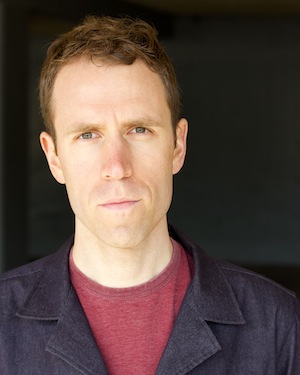
Rabbi Philip Bregman (photo from students.ubc.ca)

Rabbi Philip Bregman is a longstanding leader in the Jewish community. He served as senior rabbi at Temple Sholom for 33 years and is still connected with the congregation as rabbi emeritus. He is co-founder of the Rabbinical Association of Vancouver, maintains an active role on the University of British Columbia chaplaincy and serves as co-chair for Vancouver’s Jewish-Christian Dialogue group. He joined Vancouver Hillel Foundation during its transition period and is now the executive director of the organization, which officially became Hillel BC Society last month.

Hillel has been a centre for Jewish life on campus at UBC since 1947. Bregman would like to expand on its foundation, diversifying the programming and making it more available to young Jewish adults throughout the Lower Mainland.

The purpose of Hillel BC Society, explained Bregman, “is to help facilitate the growth of young Jewish souls and minds, socially, mentally, gastronomically, intellectually, politically. To understand what does it mean for you to be a Jew in the world today…. We are trying to grow young Jewish adults and start from wherever they are starting and give them a sense that this is a home, this is a safe space and, for some, a continuation of their Jewish journey and, for others, a beginning of their Jewish journey.”

As in most Jewish homes, food plays an integral role at Hillel BC. Noting that Hillel provides “some of the best food in the city in terms of good, nutritional, tasty, delicious food, kosher food,” Bregman said, “A lot of our programs operate around food as a way of getting individuals into the building. Then, once we have them in the building, we have other programs to offer them as well. For example, a barbeque may very well be the thing that brings the individual into the building, but we also may happen to have a faculty member here from Jewish studies who will be teaching Talmud” or, “on Friday mornings, come for the most phenomenal shakshuka, but what comes with the shakshuka is also a discussion about Israel, social, political, religious discussions.”

Hillel BC’s reach extends beyond the Jewish community of UBC. “We do a lot of collaboration,” said Bregman. “We have done collaboration with the synagogues, we have done collaboration with the Vancouver Holocaust Education Centre, we do collaborations with CIJA, the Centre for Israel and Jewish Affairs, and so we are giving educational opportunities…. We teach Hebrew, we have Judaism 101 courses, and we have the opportunity to engage in dialogue programs with different Muslim student associations, with the Pakistani student association … aboriginal student organizations on campus and various Christian groups, as well.”

Hillel offers many students leadership opportunities because a lot of programming comes “from a collaboration between the programs’ staff and the Hillelniks, so some things are initiated by us and some things are initiated by the students themselves.”

Young Jewish adults at Hillel BC have the opportunity to get “involved in tikkun olam, in helping to repair the world…. We make peanut butter and jam [sandwiches] with the Ismaili Students’ Association. The sandwiches get taken down to the Downtown Eastside.” There are also various clothing drives or food bank drives, he said. Additionally, Hillel offers many students leadership opportunities because a lot of programming comes “from a collaboration between the programs’ staff and the Hillelniks, so some things are initiated by us and some things are initiated by the students themselves.”

Bregman is moving Hillel towards more diverse programming and events, “so a person can come into this building and see we are involved with a multiplicity of ideas.” This approach is reflected in the organization’s recent rebranding. “We are no longer Vancouver Hillel Foundation, we are Hillel BC Society and this came from the staff,” Bregman explained. “The idea of being Vancouver Hillel was too centrist and too isolating…. [It] makes no sense when one of our places we are dealing with is Burnaby or one of the places we are dealing with is Victoria and wherever else that I hope to open up in the next little while.”

Hillel BC is working to engage young Jewish adults in new ways because “the old paradigm of how to deal with things doesn’t hold anymore … you cannot depend on Jewish identity if you are only planting two trees, [focusing only on] Israel and [the] Holocaust. Are they important? Of course, they are. But so is social integration and Jewish identity in terms of what it means today, and so is asking, ‘How do I live in this world?’… So, the challenges are to provide the opportunities to individuals to see Hillel as a springboard for many other things.”

“Our major issue is around funding, it is around finance. There is a statement in the Talmud, ‘Ein kemach, ein Torah.’ Without wheat, referring to the substance, the money, if there is no money, there is no Torah and, if there is no Torah, there is no money….”

Bregman said, “Our challenges are not in the areas of programming, and I’m pleased to say not in the areas of staffing. I have an absolutely magnificent staff.” He said, “Our major issue is around funding, it is around finance. There is a statement in the Talmud, ‘Ein kemach, ein Torah.’ Without wheat, referring to the substance, the money, if there is no money, there is no Torah and, if there is no Torah, there is no money…. We are providing the Torah, the programming,” but “what we need, of course, is the financial means to continue this and that’s the greatest challenge.”

Bregman is positive about the future of Hillel BC Society. “This year, my first year, I came in and we were serving three campuses. We now serve five because I opened up Langara and I opened up Emily Carr,” he said. “Now, I’m looking to see what else needs to be opened up in the Lower Mainland, where we think there is some type of Jewish presence, because what has happened at Langara and Emily Carr has been tremendously successful.”

He emphasized, “I want Hillel there as a torchbearer and as an or l’goyim, a light unto the nations, to let people know that when you come into Hillel, you have a multiplicity of opportunities to meet all sorts of individuals, politicians, social activists, philosophers, individuals with unbelievably great hearts and souls.”

Zach Sagorin is a Vancouver freelance writer. He is on the board of the Jewish Students’ Association.
Format ImagePosted on June 20, 2014June 18, 2014Author Zach SagorinCategories LocalTags Hillel BC, Rabbi Philip Bregman
Project Sustenance is the Jewish Food Bank’s second food drive

Project Sustenance is the Jewish Food Bank’s second food drive

Debbie Rootman, community developer and program coordinator for the Jewish Food Bank.

On Sunday, June 1, from 1-4 p.m., the Jewish Community Centre of Greater Vancouver will be the site of Project Sustenance, a major food drive in support of the Jewish Food Bank. Community members, who are encouraged to bring non-perishable food items to donate, will be treated to live entertainment, a kosher barbecue and a kids-oriented crafts table hosted by Vancouver Talmud Torah. The drive is organized in partnership between the Jewish Family Service Agency (JFSA), Beth Tikvah Synagogue, Jewish Women International (JWI) and the JCCGV.

The idea for the drive came from Beth Tikvah’s Francie Steen and Shelley Ail, who is the lead food bank volunteer, said Debbie Rootman, community developer and program coordinator for the Jewish Food Bank. Steen and Ail are event co-chairs.

This is the first year of Project Sustenance, but JFSA “hopes to have it annually, because hunger is 365 days a year,” Rootman told the Independent. In an average month, she said, the Jewish Food Bank provides meals for 250 people, 65 of whom are children. “On top of helping so many people in the community,” Rootman said, “on special times of the year, like Passover and Rosh Hashanah, we distribute hampers to another 170 clients of Jewish Family Service Agency.”

Project Sustenance is meant to be the second food drive of the year for the Jewish Food Bank, which organizes Project Isaiah each High Holiday season with the help of local synagogues. Rootman and her colleagues had “always talked about doing another one in the spring, but haven’t had the time or volunteer power to do it,” she said. In fact, by about January every year, the food bank has usually run out of the goods donated in the fall. Typically, after January, the food bank has had to largely rely on cash donations, “so that way we can buy food, which we do bi-weekly for fresh vegetables and fresh bread and other things that we need,” she added.

“It was started as a temporary measure, but we’ve still got it today. So, it has grown. Many of the reasons [for that growth] are because Vancouver is very expensive, so some of the people we see are working poor … disabled people, elderly people, people on fixed incomes we are helping, as well as people going through tough times … everybody has challenges in their life, so we are here to help for those times.”

The Jewish Food Bank “was started 33 years ago by two women,” Rootman said. “It was started as a temporary measure, but we’ve still got it today. So, it has grown. Many of the reasons [for that growth] are because Vancouver is very expensive, so some of the people we see are working poor … disabled people, elderly people, people on fixed incomes we are helping, as well as people going through tough times.” She added, “everybody has challenges in their life, so we are here to help for those times.” Her personal philosophy, she said, is that “charity begins at home.”

The Jewish Food Bank operates out of the Peretz Centre for Secular Jewish Culture every other Thursday and is organized and staffed by volunteers. Elaborating on the scope and value of those contributions, Rootman said, “The Jewish Food Bank could not operate without the many volunteers.” She said there is always a need for volunteers to drive goods to clients who lack mobility, to organize food at the bi-weekly food banks and to sort Project Isaiah food donations in the fall. Right now, they are hoping that more volunteers will step forward to help with “set up and take down on June 1, as well as sorting” the donations.

The Jewish Food Bank is a community-wide effort, and Project Sustenance is no different. Aside from Steen and Ail, JWI’s Sara Ciacci has been involved in Project Sustenance through “major fundraising for the Jewish Food Bank,” said Rootman, and the JCCGV has donated the space for the June 1 drive. Some of the other major sponsors include Broadway Moving, which has donated a truck to transport the donated food, Omnitsky’s Kosher, which is providing kosher hot dogs, and Signarama Richmond.

Project Sustenance follows Beth Tikvah Synagogue’s presentation of A Place at the Table, a film that screened on May 13 to raise awareness about hunger in the community. The documentary explores the various issues surrounding hunger and the means to solving this serious problem. The screening was followed by a panel discussion, which included Rootman, who said she found the film to be “very powerful,” and Alex Nixon from the Richmond Food Bank. The panelists connected the information in A Place at the Table to Canada and the local Jewish community.

For those who are unable to attend on June 1, “food donations can be dropped off at any synagogue, Jewish school, the JFSA office or the JCC,” Rootman said. Community members can also make a cash or credit card donation by calling JFSA at 604-257-5151.

Zach Sagorin is a Vancouver freelance writer.
Format ImagePosted on May 23, 2014April 13, 2016Author Zach SagorinCategories LocalTags A Place at the Table, Alex Nixon, Beth Tikvah Synagogue, Debbie Rootman, Francie Steen, JCCGV, Jewish Community Centre of Greater Vancouver, Jewish Family Service Agency, Jewish Women International, JFSA, JWI, Peretz Centre for Secular Jewish Culture, Project Isaiah, Project Sustenance, Richmond Food Bank, Sara Ciacci, Shelley Ail

Posts pagination

Previous page Page 1 Page 2
Proudly powered by WordPress