
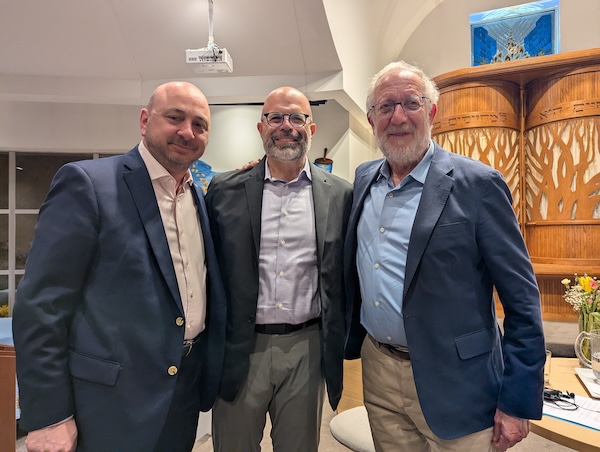

Left to right: Jewish Federation of Greater Vancouver chief executive officer Ezra Shanken, Temple Sholom Senior Rabbi Dan Moskovitz and commentator and author Yossi Klein Halevi. (photo by Pat Johnson)
The special relationship between the United States and Israel is at its greatest peak, according to American-Israeli thinker and commentator Yossi Klein Halevi. The bad news is, he predicts, it’s all downhill from here.
In conversation with Temple Sholom’s Rabbi Dan Moskovitz, Klein Halevi warned that, whoever succeeds US President Donald Trump, it is almost inevitable that the next American leader will be less supportive of Israel.
“After Trump, the deluge,” said Klein Halevi. “There really is this sense of this moment as bittersweet. We have never been in a closer alignment with the United States than now.… This is really the culminating moment of the special relationship, that it doesn’t get any better than that.”
Were Vice-President J.D. Vance, a Republican, to become president, Klein Halevi warned, the US-Israeli relationship would almost certainly deteriorate.
“If it is just about any Democrat, it’s not going to be good,” he said. “In some cases, it would be extremely negative. So, there’s a sense that this is sort of the final play.”
Change is inevitable in Israeli politics, as well, he argued. Klein Halevi emphatically believes Netanyahu will not be reelected. The only question, he said, is whether someone else can cobble together a workable majority.
Klein Halevi is scholar-in-residence at Temple Sholom and the event April 23 was presented in cooperation with the Jewish Federation of Greater Vancouver.
Klein Halevi is a senior fellow at the Shalom Hartman Institute, and one of Israel’s most influential and widely read public intellectuals, exploring Israeli identity, Jewish peoplehood, faith and the moral complexities of power. His books, including Letters to My Palestinian Neighbour and Like Dreamers, have shaped critical conversations across the Jewish world, according to Karen Kollins, the institute’s director of Canada, who introduced him.
Kollins described her organization as a leading Jewish think tank and educational centre working in Israel and across North America to “help the Jewish people engage thoughtfully and courageously with the most complex moral, religious and political challenges of our time.”
Klein Halevi co-hosts, with the institute’s president, Donniel Hartman, the think tank’s award-winning weekly podcast For Heaven’s Sake, which focuses on the moral aspects of issues affecting Israel, world Jewry and Zionism.
The stresses of living in Israel, always intense, have been unprecedentedly exacerbated in recent years, said Klein Halevi in his conversation with Moskovitz.
“This has been Israel’s longest war,” he said, noting that reservists have been called up for very long tours, upending families, businesses and society at large. “I think that we’re going to start seeing the cracks in the next generation.”
Even as new olim (immigrants) are arriving from France and elsewhere, he said, more and more Israelis are questioning whether they and their children have a future in the country.
“At what point do Israelis start to say, I – we – can’t do this anymore?” Klein Halevi asked.
Disenchantment is further aggravated by widespread dissatisfaction with the government.
“We’ve never had a government in wartime that more than half the country doesn’t trust,” he said. “When you combine that with the endless pressure, there’s this sense that I think many young Israelis have of, What’s the future here right now?”
In contrast, the post-Oct. 7 societal unity, while fraying over time, remains a uniquely enveloping Israeli phenomenon.
Moskovitz asked if the war with Iran has been successful.
“I think the question is, What were the realistic expectations going into this war?” Klein Halevi replied.
He accused Prime Minister Binyamin Netanyahu of prioritizing his own political interests ahead of those of the country, as well as raising expectations of not only eliminating Iran’s nuclear threat but deposing the Islamic regime.
“So, he was plugging this idea of total victory,” said Klein Halevi. “There’s not going to be a total victory.”
Setting back Iran’s nuclear ambitions has been successful, but regime change in Iran will come only from internal forces, he said.
From that perspective, he believes that, in the near to medium term, the Iranian regime is finished.
“When you lose the legitimacy of your people or, to put it more strongly, when you massacre tens of thousands of your own citizens, there’s no recovery from that,” he said. “You’ve decisively lost your legitimacy.”
Klein Halevi said that Israel, for decades, has fallen into Iran’s trap, engaging with Iran’s proxies – Hamas, Hezbollah, the Houthis – instead of confronting the source of the conflict, which is Iran.
“This war will be resolved not in Lebanon, and not in Gaza,” he said. “It will be resolved in Tehran.”
Responding to critics of Israel, Klein Halevi said he has high standards for Israeli morality, but all things have context.
“[Israel] was never an exemplar of democracy in an absolute sense,” he said, “but it was very much an exemplar of a democracy in conditions of extremity. No democracy anywhere has experienced the kind of sustained opposition – war, terrorism, siege, diplomatic boycott – that Israel has known since literally the day of its birth. The fact that we have managed to sustain an imperfect democracy is extraordinary.… And then when you bring in wave after wave of traumatized refugees who themselves come from countries with no democratic [traditions] – 90% of Israelis do not come from the West; they come from the Middle East or Eastern Europe, and yet we have managed to sustain a credible democracy. That, to me, is really the glory of Israeli democracy.
“If you strip away the context, which is what the critics of Israel do … they just leave the fact that, well, Arab Israelis don’t have full rights – and that’s true. And, for me, that’s a scandal,” he said. “But it’s also a scandal that I understand, because I can’t think of another more complicated minority/majority dynamic than having as your main minority people who are culturally and even to some extent politically aligned with the enemy you’re fighting.”
Moskovitz asked how Israeli media covers antisemitism in the diaspora and whether Israelis are conscious of the extent of the crisis.
“It is reported the way the Israeli media would cover an Israeli crisis,” said Klein Halevi. “It’s very much seen as a major Israeli story. That’s good news and bad news. It’s good news that the Israeli public really cares about the diaspora more so than in the past.”
Conversely, he said, the traditional Zionist mindset toward the diaspora tends to assume that, if Jews around the world are not making aliyah en masse, the situation they are facing worldwide can’t be that bad.
Since Oct. 7, Klein Halevi said, there has been an upsurge of spirituality and Jewish observance, as well as a resurgence of creativity in music and art. He also noted a shift within some components of the ultra-Orthodox, with “a whole new ideological stream called Israeli Haredi,” that is, ultra-Orthodox who want to be more integrated into society while maintaining the differences that matter most to them.
Amy Frankel, Temple Sholom president, welcomed the packed sanctuary and said that the program and others like it would not be possible without the generosity of the late Jack Lutsky, whose wife, Susan Mendelson, and brother, Peter Lutsky, recently established Temple Sholom’s scholar-in-residence endowment fund as a perpetual benefit to the congregation and the broader community.
Ezra Shanken, chief executive officer of the Jewish Federation of Greater Vancouver, thanked Klein Halevi.



