Londres foresaw fate of Jews

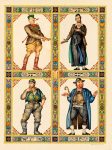
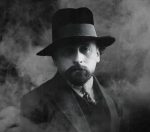
Albert Londres was a Parisian journalist born in 1884. He became an international reporter who chose to chronicle human suffering and expose injustice and cruelty. He denounced inhuman conditions in mental asylums, the ordeals of black workers, conditions in a penal colony. His journalistic philosophy: “our profession is not to give pleasure nor to do harm; it is to twist the pen into the wound.”

Why was I drawn to Londres’ The Wandering Jew Has Arrived (Gefen Publishing House, 2017)? For one, I had spotted it in Israel and it was produced by Gefen, a familiar name in the publishing world. Its founder, Murray Greenfield, his late wife, Hana, and I once visited Terezin together and his son, Ilan Greenfield, published a book about the Buchenwald boys I co-wrote with Judith Hemmendinger back in 2000.

Secondly, I quickly read the introduction by Rav Daniel Epstein. He described Londres as a non-Jewish Parisian reporter with an insatiable curiosity. He wanted to inform his French readers, “nurtured for centuries on a teaching of contempt and antisemitic clichés,” about the world of Jews, a world he also did not understand. So he learned. He observed. He made a brief visit to Poland in 1926 and was exposed to the reality of pogroms and ghettos (his word for shtetls). Who would not want to join him on his journey?

In 1929, he began to familiarize himself with the London Jewish community of Whitechapel. Then he traveled to Poland, Russia and Romania. He described observant and secular Jews, Zionists and anti-Zionists, Torah scholars, yeshivah students. From all that he observed and experienced, Londres concludes “the passion for learning is uniquely Jewish,” and links this passion as “undoubtedly the real mystery of Israel and the secret of its survival.”

He discussed the dangerous circumstances of Jews living among hostile nations in 1929. “The Jew,” he writes, “is guilty of one crime; that of being Jewish.” He elaborates, “A Pole or Russian chases a Jew from a pavement as though the Jew who is passing by, is stealing his air.” Londres travels as well to Palestine to witness and observe a “metamorphosis: the cowering Jew of the ghetto now holds his head high … he finds the wandering Jew in Jerusalem.”

Londres’ translator, Helga Abraham, writes, “Still widely read in France, the book came to my attention when the Hebrew translation was published in 2008 (Nahar Books). Surprisingly, I discovered that no English translation was available. An English translation had been published in 1932 but soon was out of print. I use the word surprisingly because it is hard to read this work without being arrested by its enormous significance – as a unique eyewitness account by a non-Jew of a pivotal period in Jewish history, as a major literary work in itself and as a masterful example of journalism at its best.”

Let me take you through some of his journey. In the opening chapter, “A Bizarre Personage,” he describes meeting in London the Jew who would squire him on his journey – a Polish Galician rabbi on a fundraising mission in London.

Londres wrote, “But I had to begin in London. Why? Because England, 11 years ago, had proclaimed to the Jews the same words that God, sometime before, had proclaimed to Moses on Mount Horeb,” assigning him the land of milk and honey.

This time the proclamation had come from Lord Balfour. Londres records both proclamations adding, “England knew how to defend its interests better than God His: God had given Palestine and Transjordan in one stroke. Lord Balfour kept Transjordan.”

image - The Wandering Jew Has Arrived book coverLondres writes of the 1917 Balfour declaration as well as the betrayal of the Jews following the declaration, because, although the San Marino conference legalized the promise, by 1922, 78% of the British Palestine mandate was severed from becoming a potential Jewish area. And, only 10 years later, in 1939, unbeknown to Londres, who died in 1932 in a fire that broke out on the boat returning him from Shanghai, the slaughter of Europe’s Jews began.

It is all forecast by him, as he describes Jewish history to that time and modern Jewish history from the days of Theodor Herzl (1860-1904). Herzl became a journalist in Paris, where he witnessed the Dreyfus Affair. He wrote a book called The Jewish State. He was particularly shocked by hearing the cry, “Death to the Jews” in Paris, particularly in France where, “if the suspicion that rested on an individual (Alfred Dreyfus) was projected onto all, it meant that a Jew, even in this privileged country was not in his own home.”

Herzl set out to convince monarchs and leaders to establish a home for the Jews. He visited heads of state, royalty and philanthropists, and reunited Israel as a nation, in Basel, for the First Zionist Congress. In London, 10,000 Jews came to hear him. In Vienna, another 10,000.

His schedule was hectic, his leadership challenged and he succumbed to illness at age 44. Londres notes: “Herzl is dead. His dream lives on!” Londres writes, “Three thousand two hundred forty-seven years after Moses, he succeeded Moses.” And, “He awoke a people that had slumbered for nineteen centuries.”

And so, Londres embarks on his mission to describe “the state of the Jews in the world to the French.” In London, he speaks with immigrant Jews and recognizes that, in countries like Poland and Romania, due to antisemitism, “A Jew over there is always a Jew. He may be a man, but he is neither a Romanian nor a Pole. And if he is a man, he must be prevented from growing.”

Londres places into historical perspective the Lord’s designation of Abraham as the patriarch and assigning to him the land of Canaan around 1920 BCE, and the assignation of the land at the San Remo conference, also in 1920, but CE. At San Remo, the Supreme Allied Council gave England the mandate to establish a “Jewish national home” in Palestine. Londres notes wryly that from 1920 BCE to 1920 CE, “the Arabs have not stopped creating an uproar. They deny that Palestine is the cradle of the Jews.”

Londres describes the development of Jew-hatred; the loathing of Jewish adherence to the laws of the Torah, followed by the birth of Christianity and then dispersion to hostile nations. They were ghettoized, marked with yellow badges, forced to give up Judaism in Spain and blamed for cholera in Germany, whereupon they moved to Poland followed by Chmielnicki, the leader of Ukrainian Cossacks, who “passed through all the ghettos to massacre 300,000 Jews.”

The French Revolution led to greater acceptance of Jews, less so in Vienna. But Londres was familiar with the Jews of the West. He wanted to see those in the East, and journeyed to Prague and followed others to Mukachevo, in Subcarpathian Russia. Jews were driven from their homes in Moravia, Poland and Russia into misery and poverty, all described by Londres, the roving journalist.

Even in Prague, in a more civil society in the heart of Europe, he notes, “Chased, beaten, mocked, unable to leave their concentration camp, accused of witchcraft, sorcery, illnesses, their garments marked with a yellow badge, they walk stooped, pale and thin, beards flowing, down the little alleys of yore, with big strides, heads bent, toward this old synagogue. It was their sole homeland.”

What is the vision that prompts him to use the words “concentration camp” for the Jewish area they cannot leave and the yellow badge to mark them, in the year 1929?

The reader will soon enough discover what Londres began to envision. For he discusses as well the absence of Jewish rights, their lack of political power combined with the ever-increasing torment of pogroms, forced conscription and soul-destroying laws. Londres emphasizes that Jews without a land of their own create a space in which to worship and temporarily escape the travails of their wretched lives. He knows there is no future for these Eastern European Jews who happen to number six million, without including those in Germany, France and the Netherlands.

He describes the pogroms of Kishinev in 1903 and the great pogrom of 1918-1920 in Ukraine and eastern Galicia, where 150,000 Jews were murdered and 300,000 wounded. Londres notes there is no particular reason for pogroms except one: “the fundamental cause of pogroms is loathing of Jews. Then come the pretexts.” In Bessarabia, he meets a chalutz (pioneer) from Palestine urging Jews to leave their misery. Alter Fischer had survived a Cossack pogrom and fled to Palestine. Now a proud Palestinian Jew on a mission, he attempts to inspire the Jews of Kishinev. At one point, he rages, “By dint of waiting for him [the Messiah], they will all end up slaughtered. They are like the inhabitants of Stromboli, waiting for the volcano to erupt.”

In contrast to “the wild Jews of the Marmarosh Mountains, the frightened Jews of Transylvania, of Bessarabia and of Bukovina, the begging, beaten Jews of Lwow” stands Warsaw, which is, in Londres’ words, “the Jewish queen of Europe.” Three hundred and sixty thousand Jews – but living in a country where, “One of the main pillars of Poland’s political program is to ‘crunch the Jews.’ A Jew cannot work for the government, or the army, or a university.”

Londres’ descriptions of the depth and intensity of Jewish life reflect an admiration of the commitment to study and education. But, he worries. His travel companion from Prague, Ben, offers these words, “The Jews of Russia? They know they are enjoying a truce now. Bolshevism has brought them peace. But every regime that follows Bolshevism will bring them war. And they will pay the price. It will be even worse than Petliura’s pogroms. Everyone knows this and it will be ghastly. In Poland? The situation is worse than it’s ever been. In Romania, the antagonism is blatant. In Czechoslovakia, there is neutrality but also neglect. That’s the picture. Who wouldn’t want to get out?” Ben adds, “All of us here are not at home. But we are no more than guests wherever we live.” It is 1929.

Londres travels to Palestine on a vessel, the Sphinx. He exclaims, “Here is the sun! I left Warsaw in the year 5690” (on the Hebrew calendar). “Now I enter year 10” (roughly a decade after the Balfour declaration). Londres exults in the discovery of “Herzl Street! Edmond de Rothschild Boulevard! Max Nordau Street! The synagogue, the main monument in the process of being completed, seems to say it all. It is like a flag, floating over a camp. The sole, unrivaled flag. No crosses in its shadow, no minarets in its radius. Just as when the Temple dominated Jerusalem, before the Church of the Holy Sepulchre and the Mosque of Omar.”

In discussing the defeat of the Ottoman Empire and its 400-year occupation, Londres states simply, “Victory came. England puffed its cheeks and exhaled. The Arab kingdom vanished. Israel took its place.” He writes, “There is no point labouring over historical texts. Whether the settlement of the Jews in Palestine is called a ‘national home’ rather than a ‘Jewish state’ does not alter the fact. And the fact is this: this time, the Jews were arriving not as beggars, but as citizens. They were no longer asking for hospitality – they were taking possession of the land. They would no longer be a tolerated people, but equal.”

Londres’ remarkable work – of a period of time wedged in between two world wars, the latter resulting in the destruction of European Jewry – deserves a wide readership. Londres, the journalist, captures the essence of Jewish life and foreshadows what is to come through his awareness that Jewish survival is not possible and that the wandering Jew is destined to return home.

Dr. Robert Krell is professor emeritus, department of psychiatry, University of British Columbia, distinguished life fellow of the American Psychiatric Association and founding president of the Vancouver Holocaust Education Centre.

Tranquility and restoration

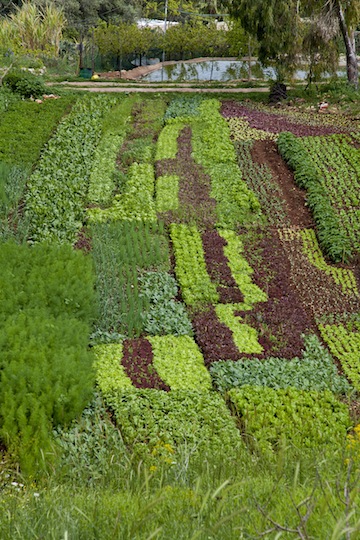
The Upper Galilee’s Mizpe Hayamim is a beautiful place. (photo by Karen Ginsberg)

Unless you are one of the lucky Canadians who lives in the Okanagan Valley or the Niagara Peninsula, chances are that most of the “fresh food” that you buy – particularly fruits and vegetables – travels some distance before it reaches your table. On a recent trip to Israel, my husband and I experienced how very splendid it would be to live adjacent to a 35-acre organic farm that produces everything from its own olive oil and soaps to bountiful dairy products, as well as every fruit, vegetable, grain and herb one could imagine. We enjoyed all of this at Mizpe Hayamim Spa Hotel, located on Mount Canaan, near the town of Rosh Pina, in Israel’s Upper Galilee.

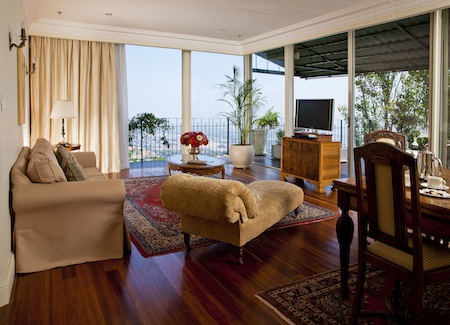
photo - Mizpe Hayamim Spa Hotel, located on Mount Canaan, near the town of Rosh Pina, is adjacent to a 35-acre organic farm
Mizpe Hayamim Spa Hotel, located on Mount Canaan, near the town of Rosh Pina, is adjacent to a 35-acre organic farm. (photo from Isrotel)

The history of the 96-room hotel dates back to 1921, when a German internist, Dr. Erich Yaroslovsky (later shortened to Yaros), bought the acreage now known as Mizpe Hayamim. Yaros’ vision was to build a convalescent home based on a vegetarian diet and natural treatment methods, which he felt would best serve the rehabilitation needs of his patients. The doctor was particularly drawn to the quality of the air and the tranquility of the setting. The land was originally owned by Baron de Rothschild, who had also been captivated by the beauty and tranquility of the area.

Before realizing his dream, Yaros encountered a series of setbacks, including receiving only a modest water allotment from the town of Rosh Pina, which was developing rapidly; the need to return to Germany for several years to support aging parents; the failure of promised positions as a physician in nearby communities to materialize; and a stint in Tel Aviv serving as its only homeopathic doctor. There was also a construction prohibition order from the British army, which was then planning fortifications in the area to protect against possible Nazi invasion through Lebanon.

Notwithstanding the long series of delays, by 1968, Yaros had the building authorities, financing and his personal determination to develop Mizpe Hayamim, albeit on a more limited scale. He built his first home at the location where the current Mizpe Hayamim now stands. It included a dining room, kitchen, bedrooms for his family and 12 guest rooms for the first of his patients. In later years, he was able to expand.

photo - view from a room at Mizpe Hayamim
(photo from Isrotel)

In English, mizpe hayamim means a view between two bodies of water, in this case, the Sea of Galilee and the lakes of the Hula Valley. The view from the highest and most expansive terrace at the hotel includes the town of Rosh Pina just below and to the left, an Israeli military base in the middle and the tip of the Sea of Galilee to the right. Small Jordanian villages dot the horizon and were barely visible in the mist of an October morning. At the time of our visit, the “mizpe” was only partially green. We were told that, with each teef, toof (bit of winter rain), the surrounding lands would become greener and that, before long, the whole of the Upper Galilee would be lush and vibrant.

A year before he died, in 1984, Yaros sold Mizpe Hayamim to Sammy Chazzan, an Israeli who shared Yaros’s commitment to the healing powers of organic food and tranquil surroundings. For more than 35 years, Chazzan led every dimension of the development of Mizpe Hayamim – hotel and farm – until 2016, when he sold the hotel portion to the Israeli chain Isrotel. He retained stewardship of the farm.

The organic farm was the first-of-its-kind in Israel and employs nine workers. From the time he was 14, Chazzan has had an interest in organic farming – a rather unusual passion for a young man but a passion he has sustained. Until the recent sale to Isrotel, Chazzan’s daily schedule started at 4 a.m., when he would draft the day’s orders for the hotel staff and then walk over to the adjacent farm to work at whatever needed to be done there. At 8 a.m., he would return to manage the hotel and then finish the day with a few more hours spent on the farm.

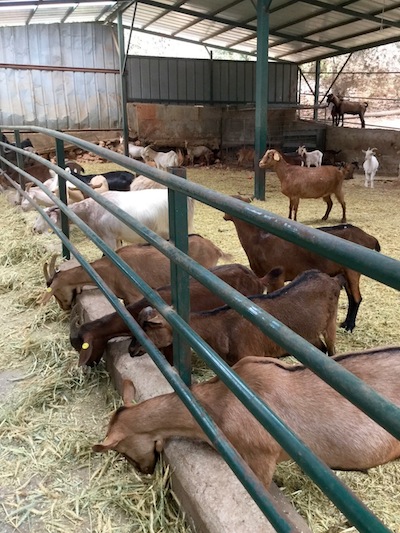
The achievements of his 35 years of agricultural experimentation are truly remarkable. The farm now includes nine large vegetable, herb and flower gardens, a herd of dairy cows and goats whose milk helps create about 40 individual dairy products – milk, yogurts, ice cream and cheeses. The animals are cared for in the most pristine of settings, feeding on grasses and able to roam about freely. Should they fall ill, they are cared for by a holistic veterinarian practitioner.

photo - Mizpe Hayamim goats
(photo by Karen Ginsberg)

Manure is recycled to fertilize the gardens, and the fruit and nut trees and flowers grow in abundance. Years of trial and error have helped establish which flowers or herbs planted alongside which vegetables reduce insect infestations, eliminating the need for pesticides of any kind. Several times a day, ripened produce is brought to the Mizpe Hayamim kitchen and finds its way to the dinner or breakfast buffets with the sort of haste that most Canadians can hardly fathom. Natural soaps are made on the farm for sale and for use in the hotel. In addition, there is a bakery and small retail outlet that sells some of the produce to guests and members of the public.

At the hotel, there is a full range of spa services for guests. Our casual conversations with other guests suggest that many Israelis come here, seeking a reprieve – nourishment and rest – from the tensions and high activity levels of city life. Guests can enjoy a coffee and tea bar all day long, with many of the farm’s fresh herbs – lemongrass, hyssop, chamomile, spearmint – available to enrich their beverages. Daily exercise classes, an art studio and evening entertainment are optional for guests and help sustain the goal of total relaxation and rejuvenation.

Isrotel plans to refurbish and update some of the hotel rooms but the essential philosophy underpinning this unique endeavour will remain the same. And Chazzan intends to continue his life’s work of building a knowledge base about organic farming and its impacts, through small-scale experimentation.

Long after their visit, guests fortunate enough to enjoy some time at Mizpe Hayamim will continue to benefit from the tranquility and beauty of the area, the organic vegetarian diet, as well as the various spa treatments on offer. For more information, contact Liad Nudelman, reception manager at Mizpe Hayamim, at liadn@isrotel.co.il, or visit isrotel.com.

Karen Ginsberg is an Ottawa based travel writer.

Unexpected Barbadian find

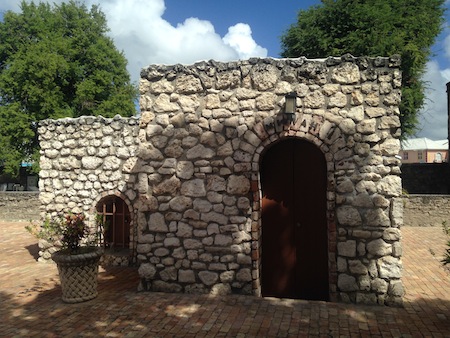
Nidhe Israel Synagogue is a UNESCO World Heritage Site. (photo by Tasha Nathanson)

One of the oldest synagogues in the Western Hemisphere is in Barbados. I was living in Barbados, working on a Canadian agricultural development project, when I tripped over this unexpected fact. I knew that the real estate agent who helped me find housing – and who, not coincidentally, became my neighbour – was Jewish, but I had assumed he was an anomaly here, in the most eastern island of the Caribbean. This was not the place I had anticipated a Jewish story to unfold.

The neighbour, Steven Altman, is reasonably well known in this small place where everyone seems to know most everyone. But many of the islanders I met inserted the comment, “he’s Jewish” into any mention of him, which reinforced my impression that being Jewish was unusual here. The Barbados I encountered in the seven months I lived there is a place that runs according to racial categories and everyone seems to be categorized according to skin colour and place of origin. Even though I’m half-Jewish, I was the white Canadian woman at work.

Curiosity prompted me to board a crazy ZR van headed into Bridgetown one day to find out more about Nidhe Israel Synagogue. ZR vans are semi-unregulated transport vehicles built to seat about 10 passengers, though I’ve been in them packed with more than 20 fellow travelers. People squish in, pressing up against each other with infinite stony-faced endurance. The soca music is generally blaring and often the driver has the flag of some neighbouring island pinned to the front, indicating where he lived before ending up in Barbados driving the public bus route in a private vehicle. The cost is always exactly two Barbadian dollars to ride and the experience is totally worth it.

The Synagogue Historic District is a UNESCO World Heritage Site in the Barbados capital city of Bridgetown. Originally built around 1654, it was destroyed by an 1831 hurricane, rebuilt in 1833 and restored from 1987 through 2017. Constructed by Sephardi Jews fleeing Recife, Brazil, after that colony passed from Dutch to Portuguese hands, these arrivals sought the relative safety of British-controled territory. The Jewish community was able to practise their faith openly here even before they regained that right in England.

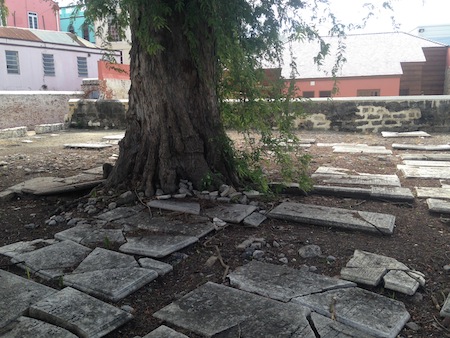
photo - The synagogue grounds include a cemetery
The synagogue grounds include a cemetery. (photo by Tasha Nathanson)

The refugees settled into housing on Jew Street (now Swan Street) and brought with them knowledge and experience of the sugar cane industry. For this, I raise a glass of fine Barbadian rum, as this accident of history resulted in a terrific local finished product. By the mid-1700s, the Jewish community was 800 strong, which was the peak of Jewish settlement.

The hurricane in 1831 was a disaster that destroyed more than just the synagogue, resulting in an exodus to the United Kingdom and the United States. By the 1920s, only one Jewish resident, Edmund Baeza, remained, holding the keys to the building. When he, too, left, the synagogue was sold and deconsecrated.

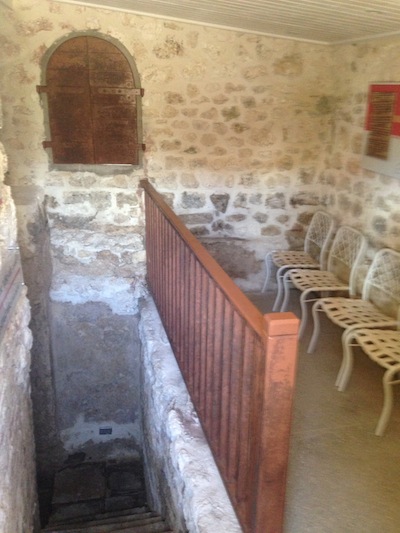
photo - The mikvah wasn’t open to the public, but the inside could be seen from the window
The mikvah wasn’t open to the public, but the inside could be seen from the window. (photo by Tasha Nathanson)

By the 1980s, the building was dilapidated, in use as a warehouse and destined for demolition, when a renewed Jewish community stepped in to begin the process of restoration. The synagogue officially reopened in April 2017, and it is a gorgeous, tranquil and instructive space.

When my neighbour Steven boasted that it was his family that was responsible for the resurgent Jewish community in Barbados, I filed away his comment with a few of his other questionable statements, such as when he had appealed for my company on the basis of needing someone to wash his laundry. Steven wasn’t even aware that I might take offence. Standards of male expression and behaviour are one of the more dubious cultural differences for a Canadian woman living temporarily in Barbados.

photo - The inside of  the mikvah
The inside of the mikvah. (photo by Tasha Nathanson)

Despite my skepticism, however, the Altmans were indeed a primary element of the reconstruction effort and are longstanding pillars of the community, according to the plaques at the synagogue. Steven, when asked, wistfully described the tight-knit community of his childhood, drawn together to play games, fundraise for charity and visit each other’s homes, in addition to worshipping together. I grew to enjoy hearing Steven’s voice trailing out the windows of his home and through the tropical evening heat when he practised the prayers for services; it became a pleasant part of my experience of Barbados.

The second wave of Jewish Barbadians was Ashkenazi, mainly fleeing Europe, starting to arrive shortly after Baeza’s departure. My tour guide at the synagogue museum, curator Celso H. Brewster, described desperately seasick travelers bound for South America with skeins of cloth and other mercantile goods to start anew, stumbling out onto the solid ground of Barbados and refusing to go any farther. They set up shop in Bridgetown instead of continuing their journey.

As for Celso himself, he informed me that he was Baha’i but that he did have some Jewish roots as well. Those roots travel through his family line via a version of what was once a Jewish name, bestowed on a born-out-of-wedlock ancestor via a certain plantation holder with, shall we say, quite liberal application of his affections. I’ve heard various versions of this story from other Barbadians. Jews were not only merchants, but there were some Jewish pirates and, sadly, Jewish slave owners.

Nidhe Israel Synagogue and its grounds – which include the original mikvah, which was uncovered in 2008 to reveal a still-flowing spring; an extensive cemetery, as well as a museum – is a beautiful oasis for thoughtful reflection and learning.

The Synagogue Historic District is located on Synagogue Lane, Bridgetown, Saint Michael’s, Barbados. The museum is open weekdays, 9 a.m. to 4 p.m. It is free to enter the courtyard to look around; the entrance fee to the museum is $25 BDS (about $16 Cdn). To find out more, visit synagoguehistoricdistrict.com. Better yet, visit the synagogue.

Tasha Nathanson recently returned from a stint in the eastern Caribbean as gender equality and youth empowerment advisor on a World University Service of Canada project.

Gerrer Rebbe’s “tent”

Gerrer Chassidim consider the burial place of Rebbe Avraham Mordechai Alter and his son, Rabbi Pinchas Menachem Alter, a holy site in Jerusalem. (photo by Gil Zohar)

Among the many events this spring marking 70 years of Israel’s independence is the yahrzeit of Rebbe Avraham Mordechai Alter, known as the Imrei Emes, who served as the fourth admor (rabbinic sage) of the Gerrer Chassidim from 1905 until his death in Jerusalem on June 3, 1948, during Shavuot.

Since the capital of the nascent Jewish state was under siege during the War of Independence, the rebbe’s disciples were unable to bury their sage in Mount of Olives Cemetery, where the pious have been laid to rest since biblical times. Unwilling to bury their master in the city’s improvised graveyard in the abandoned Palestinian village of Sheikh Bader (today Givat Ram), they instead turned his shtibl (small house of prayer) on Yehosef Shwartz Street near the Machane Yehuda food market into a mausoleum.

The Sfas Emes Yeshiva, which Alter founded in 1925 during a visit to Palestine, and where he lived from 1940 – after escaping Nazi-occupied Poland when his followers paid an enormous bribe to gain his release – has today evolved into one of the most unusual shrines in Jerusalem. His son, Rabbi Pinchas Menachem Alter, the seventh Gerrer Rebbe, also resided in the yeshivah complex and was buried alongside his father in 1996. On the yahrzeits of the two rebbes, thousands of Gerrer Chassidim – who distinguish themselves from other Chassidic groups by placing their peyot (sidelocks) into their skullcaps and tucking their pants into their socks, called hoyzn-zokn – flock to the pilgrimage site.

photo - A garden lies to the side of the ohel, and the façade of the adjoining building recalls the original Ger yeshivah in Góra Kalwaria, Poland
A garden lies to the side of the ohel, and the façade of the adjoining building recalls the original Ger yeshivah in Góra Kalwaria, Poland. (photo by Gil Zohar)

The decision to entomb Pinchas Alter, known as the Pnei Menachem, beside his father sparked opposition from the Jerusalem municipality, but the funeral went ahead. A red-brick ohel (tent) was erected over their twin graves, turning the courtyard into a holy site for the Gerrer Chassidim, who constitute the largest such ultra-Orthodox group in the country, numbering more than 100,000 members, who are concentrated in Jerusalem, Bnei Brak and Ashdod.

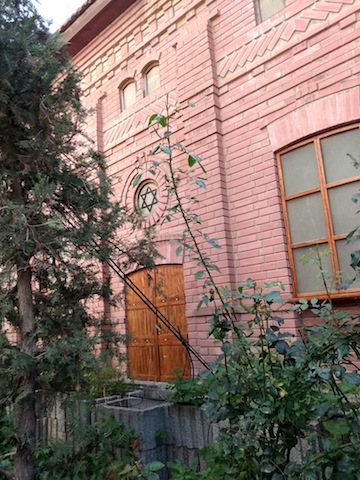
The ohel includes separate men’s and women’s sections. A garden lies to the side of the ohel, and the façade of the adjoining building recalls the original Ger yeshivah in Góra Kalwaria, Poland – a small town on the Vistula River, 25 kilometres southeast of Warsaw. A partially open roof above the ohel permits ritual impurity from the dead to exit so that kohanim (Jews of the priestly caste) may visit the gravesite.

Toronto businessman and philanthropist Daniel Goldberg wants to build on the fame of Jerusalem’s Gerrer shrine to secure and restore the sect’s historic home in Góra Kalwaria. The name means Mount Calvary or Skull Hill in Polish, explained Goldberg, whose mother’s family came from the area. But the town, called Ger or Gur in Yiddish, was also called Nowa Jerozolima (New Jerusalem), reflecting its holiness for both Jews and Christians.

Goldberg, who together with other Canadian donors has supported the preservation of several historic synagogues in Hungary, views the restoration of Jewish landmarks in Góra Kalwaria as critical to combating antisemitism and acknowledging Poland’s complex role in the Holocaust.

“I am visiting Poland after Pesach and will be meeting with various people from our Jewish community there,” he said. “I have been in contact with the different leaderships, including in Gur. So many communities were wiped out during the war. It is vital that we support our history in such places.”

In 1802, Góra Kalwaria’s “de non tolerandis Judaeis” law prohibiting Jewish settlement was annulled, and Jews became the predominant ethnic group in the town, Goldberg noted. Between 1852 and 1939, the Jewish population tripled, from 1,161 (half of the town’s population) to around 3,600, as Góra Kalwaria became an important Chassidic centre.

When the Nazis invaded Poland in September 1939, they immediately targeted Góra Kalwaria’s Jews. The town’s ethnic German mayor Ewald Jauke banned Jewish residents from engaging in trade, crafts and pigeon breeding. Jews were also forbidden from listening to radio broadcasts. A group of 100 Jews was conscripted daily in front of the town hall for forced labour.

In the spring of 1940, some 400 Jews from Lodz, Pabianice, Aleksandrow, Sierpc, Wloclawek and Kalisz were deported to Góra Kalwaria. That June, a ghetto was established with 3,500 residents. The ghetto was liquidated Feb. 25-26, 1941. About 3,000 Jews were deported to the Warsaw Ghetto, and ultimately murdered in the summer of 1942 in the Treblinka death camp. Only 35 of Góra Kalwaria’s residents survived the war. The Jewish community was never reconstituted after liberation.

For Goldberg, the coming 70th yahrzeit of the Imrei Emes and the controversial amendment to Poland’s 1998 Act on the Institute of National Remembrance by the country’s ruling Law and Justice party, criminalizing the words “Polish Holocaust,” offer an opportunity to celebrate Jews’ deep roots in the country.

Goldberg wants to preserve the physical remains of Góra Kalwaria’s Jewish community. These include the 1903 synagogue building at ulica Pijarskiejj, now used as a shop. Across the street is a metal gate at the yard that marks the home and house of prayer of Rabbi Yitzhak Meir Alter (1798-1866), the founder of the Gerrer dynasty, known as the Chiddushei HaRim, after his primary rabbinic tome by that title. Above the entrance, one can still see the Magen David rosette window depicted in the Gerrer Jerusalem mausoleum.

“I am continuing my efforts [in Góra Kalwaria and elsewhere] despite the discomfort it always causes politically with the local municipalities. No town or city likes to admit to antisemitism,” said Goldberg.

Gil Zohar is a journalist based in Jerusalem.

Israeli horses’ ancient links

In 2016, under the supervision of Prof. Jodi Magness of the University of North Carolina at Chapel Hill, archeologists excavating at the fifth-century CE Huqoq synagogue found a mosaic floor on which there is an image of an Egyptian soldier and his horse floundering in the Red Sea. (photo by James Haberman)

Who doesn’t have some mental picture of the crossing of the Red Sea? Now, you can check how your subjective image matches the “facts on the ground,” as it were. In the summer of 2016, under the supervision of Prof. Jodi Magness of the University of North Carolina at Chapel Hill, archeologists excavating at the fifth-century CE Huqoq synagogue in Israel’s Lower Galilee found a stunning mosaic floor. Of relevance to the soon-to-be-upon-us Pesach holiday is an image of an Egyptian soldier and his horse floundering in the Red Sea (see Exodus 14:28). The Egyptian has separated from his horse and is about to become a large fish’s dinner.

The horse is not one of the animals that immediately comes to mind when thinking of both ancient and modern Israel. Most people would probably think of camels, donkeys, goats or sheep, rather than horses. Yet, the horse and Israel “go way back.” This history possibly starts at Ubeidiya, a location close to the southern end of the Sea of Galilee. There, Israeli archeologists found a horse bone dating back to the Lower Paleolithic Period. At the Hayonim Cave in Israel’s Galilee region, Israel Antiquities Authority archeologists discovered an image of a horse engraved in limestone, a find that dates back to the Upper Paleolithic Period.

From these and other digs, we can assume Israel’s ancient inhabitants were familiar with the horse. This is confirmed, for example, in the City of David, where archeologists uncovered a horse figurine from the Iron Age II. Indeed, there is concrete evidence that, thousands of years ago, people had already domesticated horses and were using them as a means of transportation. Thus, during the first millennium BCE, the horse was transformed from a yoked animal pulling some kind of wagon or cart to an animal that could be mounted. Archeologists discovered another horse-and-rider pottery set at the Tel Erani excavation in southern Israel, near Kiryat Gat, which dates to the Persian Period. Furthermore, an Achziv (located along Israel’s northern Mediterranean coast) discovery of a clay horse and rider, also dating back to the Iron Age II, indicates that the horse was already being used in battle, as the rider is holding a round shield.

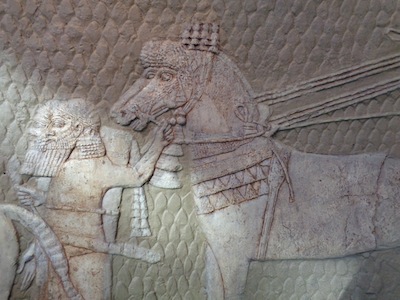
A visual depiction of the Assyrian destruction of the town of Lachish in 701 BCE – the original relief is housed at the British Museum while a copy hangs at the Israel Museum – clearly shows that the conquerors used warhorses. Also at Lachish, archeologists dug up an even older piece crafted from gold. This piece is a plaque from the 13th century BCE, the Late Bronze Age. It depicts a naked goddess, probably Astarte or Anat, standing on a horse.

While on the subject of conquests of ancient Israel and pagan gods, the Hebrews returning from Egypt were instructed not to raise horses nor to return to Egypt to obtain horses (Deuteronomy 17:16). In the later period of the kings, King Josiah took away the horses of the kings of Judah, as “they had given them to the sun.” (II Kings 23:11)

Horses are also mentioned in early administrative documents of ancient Israel. Hence, at Arad in southern Israel, archeologists recovered a list written in ink on pottery. This fourth-century BCE list supposedly details items to be given to a particular person named Qos. The list includes a horse.

photo - A copy of panels depicting the Assyrian destruction of Lachish, part of Israel Museum’s archeology collection. The original panels date to the Late Iron Age, First Temple Period, 1000-586 BCE, and are housed at the British Museum
A copy of panels depicting the Assyrian destruction of Lachish, part of Israel Museum’s archeology collection. The original panels date to the Late Iron Age, First Temple Period, 1000-586 BCE, and are housed at the British Museum. (photo by Deborah Rubin Fields)

Moving to northern Israel, archeologists in the Dan region discovered a unique Aramaic inscription, which was part of a monumental basalt stone slab. (In the ancient world, Aramaic was, for a time, the Near East’s lingua franca of commerce and trade.) The writing, which dates to the ninth-century BCE, commemorates the military victories of Hazael, king of Aram. In the text, the king claims he killed 70 kings who harnessed thousands of chariots and thousands of horsemen (horses).

Probably the earliest literary reference to horses is found in the Book of Genesis (47:17), where it says that, during a famine in Egypt, Pharaoh’s right-hand man, Joseph, gave “bread in exchange for horses.” And, from the report in I Kings 10:26, it seems King Solomon had 400 chariots and 12,000 horsemen. Moreover, there is a legend, possibly originating with the Bedouins, which states that the Queen of Sheba presented King Solomon with a mare named Safanad. All Arabian horses are supposedly descended from this mare. As it happens, Israel’s Arabian Horse Association is today made up of both Jews and Arabs, and the organization’s bilingual website is indicative of the members’ cooperation.

Later rulers of the divided kingdoms of ancient Israel likewise used horses. Thus, at Tel Meggido, the remains of King Ahab’s (869-850 BCE) stables have been discovered. Evidence, however, of ancient stables does not end there. Rock-hewn Crusader stables and water troughs from 1140 CE are still visible at the Tomb of Samuel the Prophet (also called Kever Shmuel ha-Nevi, Nebi Samwil or Mont de Joie). It stands to reason that, instead of returning to their European (or Asian) home countries, the Crusaders and later conquerors of the Holy Land acquired local horses when they needed to resupply their armies.

The horse has continued to importantly figure in Israel’s more modern period. For political and religious reasons, in 1898, Kaiser Wilhelm II (the last German emperor and king of Prussia) presented himself in Jerusalem on a white horse. Less than 20 years later, after the Ottomans had been defeated, Britain’s General Edmund Allenby dramatically rode on horseback to Jerusalem’s Jaffa Gate (but then purposely entered the Old City on foot).

At the end of October 2017, some 200 visiting members of the Australian Light Horse Association reenacted at Beersheva River Park the charge of the Australian Light Horsemen. In this battle, mounted Allied soldiers helped take Beersheva from the Ottomans. In the 100-year commemoration, original First World War uniforms were worn.

Israel’s horse connection continues to this day. Although it is an expensive pleasure, some Israelis ride for enjoyment. Therapeutic riding schools exist for people with special needs. And Israeli police use horses for crowd control.

How to summarize Israel’s long interest in horses? With this Song of Songs (1:9) quote: “I have compared you, my love, to a company of horses in Pharaoh’s chariots.”

The documentary Lachish the Epic was released earlier this year. It can be found on YouTube.

Deborah Rubin Fields is an Israel-based features writer. She is also the author of Take a Peek Inside: A Child’s Guide to Radiology Exams, published in English, Hebrew and Arabic.

Genetics or lifestyle?

Study brings hope for improving our health.

The question of nature versus nurture extends to our microbiome – the personal complement of mostly friendly bacteria we carry around with us. Study after study has found that our microbiome affects nearly every aspect of our health; and its microbial composition, which varies from individual to individual, may hold the key to everything from weight gain to moods.

Some microbiome researchers have suggested that this variation begins with differences in our genes, but a large-scale study conducted at the Weizmann Institute of Science challenges this idea and provides evidence that the connection between microbiome and health may be even more important than we thought.

Indeed, the working hypothesis has been that genetics plays a major role in determining microbiome variation among people. According to this view, our genes determine the environment our microbiome occupies, and each particular environment allows certain bacterial strains to thrive. However, the Weizmann researchers were surprised to discover that the host’s genetics play a very minor role in determining microbiome composition – only accounting for about two percent of the variation between populations.

The research was led by research students Daphna Rothschild, Dr. Omer Weissbrod and Dr. Elad Barkan from the lab of Prof. Eran Segal of the computer science and applied mathematics department, together with members of Prof. Eran Elinav’s group of the immunology department, all at the Weizmann Institute. Their findings, which were published last month in Nature, were based on a unique database of around 1,000 Israelis who had participated in a longitudinal study of personalized nutrition.

Israel has a highly diverse population, which presents an ideal experimental setting for investigating the effects of genetic differences. In addition to genetic data and microbiome composition, the information collected for each study participant included dietary habits, lifestyle, medications and additional measurements. The scientists analyzing this data concluded that diet and lifestyle are by far the most dominant factors shaping our microbiome composition.

If microbiome populations are not shaped by our genetics, how do they nonetheless interact with our genes to modify our health? The scientists investigated the connections between microbiome and the measurements in the database of cholesterol, weight, blood glucose levels and other clinical parameters. The study results were very surprising: for most of these clinical measures, the association with bacterial genomes was at least as strong as, and in some cases stronger than, the association with the host’s human genome.

According to the scientists, these findings provide solid evidence that understanding the factors that shape our microbiome may be key to understanding and treating many common health problems.

“We cannot change our genes,” said Segal, “but we now know that we can affect – and even reshape – the composition of the different kinds of bacteria we host in our bodies. So, the findings of our research are quite hopeful: they suggest that our microbiome could be a powerful means for improving our health.”

The field of microbiome research is relatively young; the database of 1,000 individuals collected at the Weizmann Institute is one of the most extensive in the world. Segal and Elinav believe that, over time, with the further addition of data to their study and those of others, these recent findings may be further validated, and the connection between our microbiome, our genetics and our health will become clearer.

Elinav’s research is supported by the Adelis Foundation; Andrew and Cynthia Adelson; the estate of Bernard Bishin; Valerie and Aaron Edelheit; the European Research Council; Jack N. Halpern; the Leona M. and Harry B. Helmsley Charitable Trust; the Bernard M. and Audrey Jaffe Foundation; the Else Kroener Fresenius Foundation; the Park Avenue Charitable Fund; the Lawrence and Sandra Post

Family Foundation; the Rising Tide Foundation; Vera and John Schwartz; Leesa Steinberg; and Yael and Rami Ungar. Elinav is the incumbent of the Sir Marc and Lady Tania Feldmann Professorial Chair.

Segal’s research is supported by the Adelis Foundation; Judith Benattar; the Carter Chapman Shreve Family Foundation; the Crown Human Genome Centre, which he heads; the European Research Council; Jack N. Halpern; the Else Kroener Fresenius Foundation; Donald and Susan Schwarz; and Leesa Steinberg.

For more on the work being done at the Weizmann Institute, visit wis-wander.weizmann.ac.il.

What is freedom?

“Israel in Egypt” by Edward Poynter, 1867. (photo from Wikimedia Commons)

There is a certain inherent ambivalence when we think of the meaning of freedom and its association with the holiday of Pesach. One of the essential features of the liberation story is our freedom from human subjugation: “Yesterday we were slaves to Pharaoh, today we are free men and women.”

This freedom, however, did not come about as a result of a revolution instigated by the Jewish people but, rather, as the biblical story relates, through the redemptive hand of God. As a result, this physical redemption is often connected with a religious duty: “I am the Lord your God, who brought you out of Egypt, out of the land of slavery; you shall have no other gods besides me.” (Exodus 20: 2-3)

What is the nature of this connection? Is it an obligation or an opportunity? Is our commitment to God and the Torah a price we pay for the Exodus, or is it a gift – a gift made possible by our physical freedom, but one that we may choose whether or not to receive? The question we as Jews ought to reflect on this Pesach is whether the freedom from Egypt is limited to liberation from physical servitude, or does it include freedom of conscience and faith.

Historically, Jews did not engage extensively in questions of personal autonomy; at most, they spoke about what Isaiah Berlin referred to as “positive liberty” (Berlin, Two Concepts of Liberty). As opposed to the simple, more intuitive concept of negative liberty – “the freedom from” constraints or compulsion, positive liberty is “the freedom to” – the freedom to be all one ought to be, to do that which is the fullest expression of one’s potential. The notion of positive liberty is clearly present in the rabbinic tradition, in such statements as, “There is no free person but he or she who studies Torah.” (Avot 6:2) Freedom, for Jews, has traditionally meant “the freedom to” – the ability to achieve complete self-realization, through a firm, unwavering commitment to God and His word.

Standing alone, however, positive liberty is an extremely precarious concept. We need look no further than the 20th century, when different fascist leaders established their rule on a promise of positive liberty (the freedom to live in a stable society, the freedom to attain financial prosperity, the freedom to fulfil one’s destiny as a member of the master race), to appreciate the danger it harbours: the creation of oppressive, totalitarian regimes, violently trampling the rights of their citizens in the name of freedom. Without the underlying basis of negative liberty, positive liberty means nothing more than the freedom to do that which others determine you ought, to fulfil what others have decided to be your potential.

This question becomes all the more pointed in the context of the state of Israel. So long as Jews lived in Western liberal democracies, they vicariously inherited the value of negative liberty and functioned within its confines. But an essential question facing the modern state of Israel, the only Jewish democracy, is what concept of liberty does it officially espouse? Is Israel a “free state” that dictates the forms of Judaism that are most appropriate? Or does it guarantee its citizens the right and conditions to determine their own individual Jewish path?

If Pesach is going to be not simply a liberation story of our past but a modern, continuous liberation story “in every generation,” we must recognize that positive liberty is an incomplete liberty, that the freedom from Egypt – indeed, our very existence as a free people in our own country – must be accompanied by a commitment to religious freedom and the diversity it will engender.

The spirit of Pesach requires a national pledge to free Israeli society of all and any vestiges of religious coercion, including the manipulation of public funds in order to constrain spiritual choices. In the spirit of Pesach, we must commit ourselves to speaking only in the language of education, and never in the language of indoctrination and coercion.

One of the great paradoxes of Israeli society is that those who function in the name of positive liberty actively limit the actualization of the spiritual potential of Jews. Consequently, the state of Israel is one of the only places in which non-Orthodox Jews can barely receive a Jewish education. Religious coercion and legislation hasn’t furthered our marriage with God; rather, it has created an ever-increasing rift and divorce.

The freedom of Pesach has multiple dimensions. It is our responsibility to ensure it is understood and employed as a catalyst for progress, as a basis for assimilating the broadest notions of negative liberty within our religious language and values. Just as we reject being enslaved by Pharaoh, so, too, must we reject the subjugation of our minds and souls to any authority. In the end, if God is to be the God of the Jewish people, if Judaism and its values are to shape our lives, it will not be because we owe God for our redemption from Egypt, but because we choose a life with God as free men and women.

Rabbi Dr. Donniel Hartman is president of the Shalom Hartman Institute and author of the 2016 book Putting God Second: How to Save Religion from Itself. Articles by Hartman and other institute scholars can be found at shalomhartman.org.

Pesach’s lessons for today

Israel’s Escape from Egypt, illustration from a Bible card published in 1907 by the Providence Lithograph Company. (photo from Wikimedia Commons)

We begin Passover – which starts this year on the night of March 30 – with two seders, and invite family, friends and guests to celebrate the holiday with us. At both seders, we eat matzah, to recall the swiftness of our ancestors’ departure from Egypt, maror (horseradish) to commemorate the bitterness of the slavery in Egypt and charoset, which resembles the mortar our ancestors were forced to use to build pyramids for Pharaoh. The 15 steps of the seder (order) are our way of retelling the tale.

G-d Himself rescued His beloved children from their bitter situation. As written in the Haggadah, “Vayotzeeaynu Hashem Mimitzraim, lo al yiday malach, v’lo al yiday saraf, v’lo al yiday shaliach, ela haKadosh Baruch Hu bichvodo uviatzmo” – “G-d brought us out of Egypt, not through an angel, not through a fiery angel and not through a messenger, but it was the Holy One blessed be He, He Himself in His glory.”

The Israelites had spent 210 years in Egypt, which was an agricultural country, where the soil was fertile, irrigated by the Nile. Our commentaries teach that Pharaoh didn’t want anyone to see him taking care of his bodily functions, so he would go to the Nile early in the morning then return to the palace. He guarded his power with brutality. We recall the birth of Moses and his early life in a basket on the Nile, saved by Pharaoh’s daughter, Batya (the daughter of G-d) and his rise to life in the palace of Pharaoh.

One of the most striking features of the Exodus was the Israelites’ faith in the promises of G-d. They were an entire nation, men, women and children, numbering several million, who willingly left a prosperous and well-settled country, whose pagan values had already left their impression on them, to venture on a long and dangerous journey without provisions, but with absolute reliance on the word of G-d, as spoken to Moses.

Even more, they didn’t follow the familiar and shorter route through the land of the Philistines, which, although it involved the risk of war, was far more attractive than the prospect of crossing a vast and desolate desert. In war, there is a chance of victory and, even in defeat, there is the chance of escape, but, in a desert, with no food or water, nature allows no chance of survival. Yet they followed this route, disregarding rationality and trusting in the word of G-d.

Why did they do this?

This question is echoed in every generation. In the contemporary, materialistic and competitive world, where we all struggle for economic survival, how can we exempt ourselves from its values? How can we adhere to a code of precepts that restricts our actions? The answer lies in the Exodus from Egypt.

In that time, when Jews responded to the call of G-d, disregarding what seemed reasonable, breaking with the values of their Egyptian environment, it transpired that the path they took was the path of true happiness, spiritually in receiving the Torah and becoming G-d’s Chosen People, and materially, in reaching the Promised Land, flowing with milk and honey.

So it is today and always. Through the Torah – the Torat Chayim, the Law of Life – and the mitzvot (good deeds or commandments), a Jew attaches themselves to the creator of the world, and frees themselves from all “natural” limitations. This is still the way of happiness.

Wishing you a happy, kosher and enjoyable Passover, wherever you find yourself in the world. If you find yourself traveling, or even here in Metro Vancouver without a place to celebrate, there are Chabad Houses where you can commemorate our ancestors’ freedom from Egypt at a joyous and meaningful seder. Chag kosher v’sameach.

Esther Tauby is a local educator, writer and counselor. She wrote this article using excerpts from the letters of the Lubavitcher Rebbe.

A few Pesach songs’ origins

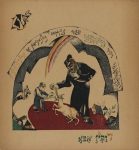
An illustration by Russian artist El Lissitzky in the book Had Gadya, 1919. (photo from getty.edu)

We sing them every year, but from where did Passover songs such as “Chad Gadya” originate?

Chad Gadya” or “One Little Goat” is a playful cumulative song in Aramaic and Hebrew, sung at the end of the seder. According to Wikipedia, the melody may have its roots in medieval German folk music. It first appeared in a Haggadah printed in Prague in 1590, which makes it the most recent inclusion to the traditional Passover seder liturgy.

The Haggadah was a project that was initiated by the anshei Knesset Hagedola, the members of the Great Assembly, the supreme council of sages that ruled during Temple times in Jerusalem. They were the first to compile and canonize many of the texts that we have today. The Haggadah, however, was only started during that era – it was not completed until much later.

“Chad Gadya” also only found its way into the Haggadah at a much later date. This is because the song was written in Aramaic, which was the vernacular of the Jews of Babylon, and not in Hebrew – at least not in Hebrew for the most part. The slaughterer, angel of death and Holy One Blessed Be He in the song are referred to in Hebrew.

Some suggest that “Chad Gadya” was written by Rabbi Eliezer Rokeach in the 12th century.

According to some modern Jewish commentators, the song may be symbolic. One interpretation is that “Chad Gadya” is about the different nations that have conquered the Land of Israel: the kid (goat) symbolizes the Jewish people; the cat, Assyria; the dog, Babylon; the stick, Persia; the fire, Macedonia; the water, the Roman Empire; the ox, the Saracens; the slaughterer, the Crusaders; the angel of death, the Turks. At the end, God returns to send the Jews back to Israel. The recurring refrain of two zuzim is a reference to the two stone tablets given to Moses on Mount Sinai, or refer to Moses and Aaron.

Versions of the song exist in Ladino, Judeo-Italian and Judeo-Arabic.

***

We know that the “Avadim Hayinu” (“We Were Slaves”) section was written by Rabbi Eliezer Hagadol in the second century). It is an introduction to the formal narration of the Exodus from Egypt, based on the views of Samuel. Passages of unknown origin supplement the narration, stressing its importance.

***

Echad Mi Yodea” (“Who Knows One”) is another cumulative riddle with versions in Hebrew and Yiddish. The song relates the 13 basics of Judaism. After relating God’s wonders and kindness and the events of the Exodus, it demonstrates how everything can and should relate to God.

According to Encyclopedia Judaica, this song is first found in Ashkenazi Haggadot of the 16th century. It is believed to have originated in Germany in the 15th century, possibly based on the German folk song “Guter freund ich frage dich,” which means “Good friend, I ask you.”

***

Dayenu” is a Hebrew song, traditionally sung during Passover. The word itself essentially means, “It would have been enough for us.” Day is the Hebrew word for “enough” and the suffix enu means “our.”

This traditional up-beat Passover song is more than 1,000 years old. The earliest full text of the song occurs in the first medieval Haggadah, which is part of the ninth-century Seder Rav Amram.

The song goes through a series of gifts believed granted by God to the Israelites, such as Torah and Shabbat, proclaiming that any of them alone would have been sufficient. It is 15 verses long, sequentially recounting each divine intervention in the story of the Exodus. After each divine act, the chorus “[If God had done only this,] it would have been enough for us” is sung.

Canadian journalist, author and social activist Michele Landsberg wrote “The Women’s Dayenu”:

“If Eve had been created in the image of God and not as a helper to Adam, dayenu.

“If she had been created as Adam’s equal and not been considered a temptress, dayenu.

“If Lot’s wife had been honoured for compassion for looking back at the fate of her family in Sodom, and had not been punished for it, dayenu.

“If our mothers had been honoured for their daughters as well as for their sons, dayenu.

“If our fathers had not pitted our mothers against each other, like Abraham with Sarah and Hagar, or Jacob with Leah and Rachel, dayenu.

“If the just women in Egypt who caused our redemption had been given sufficient recognition, dayenu.

“If Miriam were given her seat with Moses and Aaron in our legacy, dayenu.

“If women had written the Haggadah and placed our mothers where they belong in history, dayenu.

“If every generation of women together with every generation of men would continue to go out of Egypt, dayenu.”

***

Adir Hu” (“Mighty is He”) is a hymn naming the virtues of God in the order of the Hebrew alphabet, expressing hope that God will rebuild the Holy Temple speedily.

The tune of “Adir Hu” has undergone several variations over the years, but the origin is from the German minnesinger period. The earliest extant music for the song is from the 1644 Rittangel Haggadah, the second form was in the 1677 Haggadah Zevach Pesach, and the third version can be found in the 1769 Selig Haggadah. In the Selig Haggadah, “Adir Hu” is also referred to, in German, as “Baugesang” (the song of the rebuilding of the Temple).

There are 24 short, simple lines, each beginning with an attribute of God. Most of the virtues of God are adjectives – for instance, holy (kadosh) – however, a few are nouns, “Lord is He.”

There is also a feminist variant of the song by Rabbi Jill Hammer of the Academy for Jewish Religion in Yonkers, New York. In it, God is feminine (She) and, quoting Hammer, the song “emphasizes God’s sharing in human joys and griefs, and God’s ability to renew life through the strength of the earth.”

Sybil Kaplan is a journalist, lecturer, book reviewer and food writer in Jerusalem. She created and leads the weekly English-language Shuk Walks in Machane Yehuda, she has compiled and edited nine kosher cookbooks, and is the author of Witness to History: Ten Years as a Woman Journalist in Israel.

Contending with contradictions

“The Four Sons,” Arthur Szyk, 1934. According to Wikimedia, Szyk “originally intended his Passover story of persecution and deliverance (told through the traditional text of the Haggadah) to be a strong statement against the Nazis, but no publisher in his native Poland dared take on a project with strong anti-Nazi iconography. He ultimately found a publisher in England. This image of the Four Sons … depicts the Wicked Son as an assimilated German complete with porkpie hat and Hitler mustache.” (image from From Arthur Szyk Society, Burlingame, Calif.)

The significance of the seder’s Four Questions should not be confined to being a concrete educational tool for the purpose of teaching historical information to children having a limited sense of abstraction and who bore easily. The questions are a characteristic of the adult intellectual culture during the time of the rabbis.

In the Mishnah, the child is the one who asks and the parent teaches, but, in the Talmud, another source is quoted that requires the adult to ask questions of him or herself: “Our rabbis taught: if his child is intelligent he asks him, while if he is not intelligent his wife asks him; but if not, he asks himself. And even two scholars who know the laws of Passover ask one another.” (Babylonian Talmud, Pesachim 116a)

Here the point is not to recount the story of the Exodus to children, but rather to create a dialogue of questions and answers among adults. The questions of the wise child may be thought-provoking to his or her parents; similarly, the questions of one colleague would be of interest to another. Someone who knows all the laws of Pesach is still required to ask questions, and scholars on their own at the seder are required to ask themselves questions. Why?

At a certain level, the questions serve as an external pretext to refresh the memory in order to raise the level of consciousness concerning the Exodus, even for those who have passive knowledge of the information. At another level, someone who asks himself or herself questions and then answers them, can delve deeper and discover new aspects of knowledge.

This is the educational method practised in the Lithuanian yeshivot – two students on the same level study the text by asking each other questions, raising hypotheses and debating the issues, without hearing lectures from a teacher “who knows the answers.”

This is common practice in universities, where a researcher finding himself or herself at an impasse takes a walk alone while conducting an internal dialogue, which may culminate with new insights into a subject with which s/he is very familiar. The question is a powerful tool for the advancement of the thinking of both the one who asks and answers it.

The rabbis identified a particular type of question, known as a kushiya. A kushiya queries a practice that contains an internal contradiction or which runs contrary to other authorized sources. Unlike the kushiya, an ordinary question generally begins with the word “what,” for example, “What time is it?” It is as if the object of the question has something, information, that the one asking the question needs, and that the one asked “lends” out (literally, sh’ayla, in Hebrew).

The formulation of the kushiya is more sophisticated: “One would expect that such a thing would happen or be written, but why has something else, something unexpected happened or been written?” The poser of the kushiya comes equipped with information and expectations for a certain world order, and this makes him or her aware of deviations, contradictions and the disappointment of expectations. “How is this night different from all other nights – on all other nights we eat leavened bread and matzah, but on this night we eat only matzah?”

The one posing the kushiya sees the whole picture and has expectations of a rational world order. That is why any contradiction requires a rational explanation. We might expect that the more one learns, the fewer questions s/he might ask, after all, s/he already has so much information. But the true intellectual will pose ever more kushiyot, because s/he is all the more aware of the complexity of the world, which is arranged according to so many principles. Curiosity is increasingly aroused and that is why the wise child is the one who asks the kushiyot of his or her own volition, while the younger children need the help of the parent to ask even the simplest question.

Paradoxically, the search for rationality is sustained by the unusual and not by the regular orderly routine. People do not query that which can be taken for granted, even if the explanation is unknown. For example, based on the experience of many Pesachs and seder nights, to the adult Jew, the youngest child asking the Four Questions is taken as a matter of course. But as soon as s/he discovers a different version of the questions, such as the one we saw in the Mishnah, s/he asks “Why do we ask these questions and not others? What is the reason?” or “Why does the Mishnah say the parent says Ma Nishtanah rather than the child?”

The search for rationality in our familiar world is sustained by the ability to imagine alternatives to the existing order. There is a set introduction to the midrashei halakha, homiletic interpretations and inferences of the rabbis (in the Mekhilta). It involves the raising of a hypothetical question, as in this example from the Haggadah. The rabbis wondered:

“You shall tell your child on that day: ‘It is because of this, that the Lord did for me when I went free from Egypt.’” Could this verse mean that you should begin to tell the story at the beginning of the month (in which the Exodus occurred)? No, for the verse explicitly states “on that day” (of the Exodus). Could that mean that we start when it is still daytime? No, for the verse explicitly states: “because of this.” “This” refers to matzah and maror laid before you (only on seder night) (Mekhilta).

“This” implies that the parents must point at the matzah and maror, and use them as visual aids to tell the story (Rabbi Simcha of Vitri).

“Could this verse mean” introduces an imaginative, alternative hypothesis based on the biblical text. “No, for the verse explicitly states that” is a strict construction of the meaning of the existent version of the text that neutralizes the feasibility of an alternative suggestion.

Indeed, the midrashei halakha ask even when no additional version has been found, and only an imaginative person could envisage other reasonable possibilities. There is no attempt here to undermine the accepted text or religious practice, but rather to understand what lies behind it.

If so, then the study method of the rabbis is seemingly founded on a paradox. In order to understand the reasons for the existing order of the customs or the words of the biblical text, we must be able to conceive of another order based on alternative logic. Only that which is not self-explanatory and is not accepted blindly as tradition can lead to a process of thought and discovery of the rationality it contains. The ideal scholar in the culture of the rabbis is not an authoritative figure acting on the basis of a simplistic faith who accepts basic premises without question.

Noam Zion has been a senior research fellow at the Shalom Hartman Institute since 1978, and he teaches in Hartman Institute rabbinic programs. He also works with the Muslim Leadership Institute, the Hevruta gap-year program for Israeli and American Jews, and the Angelica Ecumenical Studies program in collaboration with the Vatican University Angelicum in Rome. He has developed study guides on Bible, holidays and rabbinic ethics, has numerous publications to his credit and lectures worldwide. Articles by Zion and other Hartman Institute scholars can be found at shalomhartman.org.