
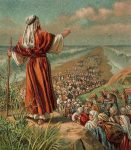
Israel’s Escape from Egypt, illustration from a Bible card published in 1907 by the Providence Lithograph Company. (photo from Wikimedia Commons)
We begin Passover – which starts this year on the night of March 30 – with two seders, and invite family, friends and guests to celebrate the holiday with us. At both seders, we eat matzah, to recall the swiftness of our ancestors’ departure from Egypt, maror (horseradish) to commemorate the bitterness of the slavery in Egypt and charoset, which resembles the mortar our ancestors were forced to use to build pyramids for Pharaoh. The 15 steps of the seder (order) are our way of retelling the tale.
G-d Himself rescued His beloved children from their bitter situation. As written in the Haggadah, “Vayotzeeaynu Hashem Mimitzraim, lo al yiday malach, v’lo al yiday saraf, v’lo al yiday shaliach, ela haKadosh Baruch Hu bichvodo uviatzmo” – “G-d brought us out of Egypt, not through an angel, not through a fiery angel and not through a messenger, but it was the Holy One blessed be He, He Himself in His glory.”
The Israelites had spent 210 years in Egypt, which was an agricultural country, where the soil was fertile, irrigated by the Nile. Our commentaries teach that Pharaoh didn’t want anyone to see him taking care of his bodily functions, so he would go to the Nile early in the morning then return to the palace. He guarded his power with brutality. We recall the birth of Moses and his early life in a basket on the Nile, saved by Pharaoh’s daughter, Batya (the daughter of G-d) and his rise to life in the palace of Pharaoh.
One of the most striking features of the Exodus was the Israelites’ faith in the promises of G-d. They were an entire nation, men, women and children, numbering several million, who willingly left a prosperous and well-settled country, whose pagan values had already left their impression on them, to venture on a long and dangerous journey without provisions, but with absolute reliance on the word of G-d, as spoken to Moses.
Even more, they didn’t follow the familiar and shorter route through the land of the Philistines, which, although it involved the risk of war, was far more attractive than the prospect of crossing a vast and desolate desert. In war, there is a chance of victory and, even in defeat, there is the chance of escape, but, in a desert, with no food or water, nature allows no chance of survival. Yet they followed this route, disregarding rationality and trusting in the word of G-d.
Why did they do this?
This question is echoed in every generation. In the contemporary, materialistic and competitive world, where we all struggle for economic survival, how can we exempt ourselves from its values? How can we adhere to a code of precepts that restricts our actions? The answer lies in the Exodus from Egypt.
In that time, when Jews responded to the call of G-d, disregarding what seemed reasonable, breaking with the values of their Egyptian environment, it transpired that the path they took was the path of true happiness, spiritually in receiving the Torah and becoming G-d’s Chosen People, and materially, in reaching the Promised Land, flowing with milk and honey.
So it is today and always. Through the Torah – the Torat Chayim, the Law of Life – and the mitzvot (good deeds or commandments), a Jew attaches themselves to the creator of the world, and frees themselves from all “natural” limitations. This is still the way of happiness.
Wishing you a happy, kosher and enjoyable Passover, wherever you find yourself in the world. If you find yourself traveling, or even here in Metro Vancouver without a place to celebrate, there are Chabad Houses where you can commemorate our ancestors’ freedom from Egypt at a joyous and meaningful seder. Chag kosher v’sameach.
Esther Tauby is a local educator, writer and counselor. She wrote this article using excerpts from the letters of the Lubavitcher Rebbe.