Skip to content
  • Home
  • Subscribe / donate
  • Events calendar
  • Business Directory
  • FAQ
  • News
    • Local
    • National
    • Israel
    • World
    • עניין בחדשות
      A roundup of news in Canada and further afield, in Hebrew.
  • Opinion
    • From the JI
    • Op-Ed
  • Arts & Culture
    • Performing Arts
    • Music
    • Books
    • Visual Arts
    • TV & Film
  • Life
    • Celebrating the Holidays
    • Travel
    • The Daily Snooze
      Cartoons by Jacob Samuel
    • Mystery Photo
      Help the JI and JMABC fill in the gaps in our archives.
  • Community Links
    • Organizations, Etc.
    • Other News Sources & Blogs
  • JI Chai Celebration
  • JI@88! video

Recent Posts

  • Legal help for students
  • Revisiting myth of Lilith
  • Wrong person rebuked
  • Canada’s mixed messages
  • Questions for museum
  • Symposium on antizionism
  • Making soccer political
  • CJPAC lauds Pulver’s impact
  • City recognizes Vrba’s legacy  
  • Organ donation saves lives
  • Theodore’s March premiere
  • A healing Shabbaton
  • Supplying healthy food
  • A chime of metal tags
  • Yellowknife seder a first
  • Ishai energizes, unifies
  • A Lag b’Omer to remember
  • Expanding the healing
  • Hannah Senesh – a unique hero
  • Community milestones … May 2026
  • Sharing her testimony
  • Fall fight takes leap forward
  • The balancing of rights
  • Multiple Tony n’ Tina roles
  • Stories of trauma, resilience
  • Celebrate our culture
  • A responsibility to help
  • What wellness means at JCC
  • Together in mourning
  • Downhill after Trump?
  • Birth control even easier now
  • Eco-Sisters mentorship
  • Unexpected discoveries
  • Study’s results hopeful
  • Bad behaviour affects us all
  • Thankful for the police

Archives

Follow @JewishIndie
image - The CJN - Visit Us Banner - 300x600 - 101625

Month: October 2017

Climate a Jewish issue

The World Health Organization has labeled climate change “the greatest threat to global health of the 21st century.” As a physician, it is difficult to ignore such a dramatic statement.

Climate change is real. The sea levels are rising, temperatures are increasing, more violent storms are becoming the norm. As Canadians, we are seeing consequences of climate change even more than other countries. Last year, Fort McMurray in Alberta was almost destroyed by a massive forest fire. This year was the worst year in British Columbia’s history for forest fire damage. (While climate change is not the sole cause of these events, it is known to be a contributing factor.)

Our glaciers are shrinking, as anybody who has visited the Athabasca Glacier in the Rockies can confirm. Temperatures in the Yukon and Northwest Territories are rising faster than in most other parts of the world. Traditional indigenous life in the north is being made much more difficult by the shortening of winter and the melting of the permafrost.

Climate change is also a Jewish issue. When the environment is changing so dramatically that human lives and well-being are at stake, Jewish values tell us that we must take action.

Pikuach nefesh (the saving of a life) is a fundamental Jewish principle. Climate change is believed to share some responsibility for present-day wars and loss of life, including the conflict in Syria. The World Health Organization predicts that 250,000 people will die each year between 2030 and 2050 due to the effects of climate change. Is it not incumbent upon us as Jews to try to mitigate these effects in line with the pikuach nefesh principle?

Climate change is a complex issue. Many people find it too complicated and too overwhelming, such that they are paralyzed into inaction. So what we can do about it?

In line with Jewish practice, the first response should be educating ourselves about the issues. There are many articles and books about the subject. One of the most compelling authors for me is Bill McKibben. He has written a book called Eaarth (Henry Holt and Company, 2010) in which he describes how the earth is changing, such that it is becoming a new and unfamiliar place.

Fossil fuels are the main culprits. Weaning ourselves off coal, oil and natural gas is paramount. Substituting sources of renewable energy such as solar, wind, tidal and geothermal is crucial.

On a society level, we can try to prevent further construction of oil and gas pipelines, and further development of the LNG (liquified natural gas) industry in northeast British Columbia. We can elect members of the Legislative Assembly and of Parliament who share our concerns.

On a personal level, we can drive less, fly less, use hybrid or electric vehicles, and support public transportation. We can eat less meat, as the cattle industry is a major contributor to increased greenhouse gases. We can consume less, recycle more and compost more.

Everybody can do something to help mitigate the effects of climate change. Doing nothing is no longer an option.

I take inspiration from the talmudic Choni, otherwise known as the Circle-maker.

One day, Choni was walking on the road and saw a man planting a carob tree. Choni asked the man, “How long will it take for this tree to bear fruit?”

The man replied, “Seventy years.”

Choni then asked the man, “And do you think you will live another 70 years and eat the fruit of this tree?”

The man answered, “Perhaps not. However, when I was born into this world, I found many carob trees planted by my father and grandfather. Just as they planted trees for me, I am planting trees for my children and grandchildren so they will be able to eat the fruit of these trees.”

This week, as we are sitting in the sukkah, let us contemplate the fragility of our planet, and strive to make the earth a more secure place for our children and grandchildren.


Larry Barzelai is a Vancouver-based family physician, who has a special interest in geriatrics. He administers the annual Public Speaking Contest organized by the Jewish Federation of Greater Vancouver. He is a member of the board of CAPE (Canadian Association of Physicians for the Environment).
Posted on October 6, 2017October 5, 2017Author Larry BarzelaiCategories Op-EdTags climate change, environment, health, Judaism

Jewish routines help us cope

At 7 a.m., I came downstairs on a school morning and discovered that one of my 6-year-old twins was busy. He’d filled up a container with water so he could watch his expandable water toys grow – again. After the toys grow enormously in the water, we dump out the water. We let them dry and shrink and put them away for a month. This is a frequently repeated ritual in our house. Any good science experiment is one worth repeating, right?

Good teaching requires frequent repetition. Life, it seems, is also probably the best teacher. I’ve been thinking about how to cope with and learn from the repetition of the Jewish calendar as it applies to life’s ups and downs.

One of our dogs, Harry, has been very ill with lymphosarcoma. By the time you read this column, Harry, aged 13 and a half, may no longer be with us. For people who have animals, you know how hard this transition can be. Yes, there are all sorts of veterinary interventions for pets now, but this cycle of life and death can’t be avoided. Although, historically, some Jews have lived in cities, away from animals, Jews have also lived, worked and loved animals on farms, in villages, towns and cities. The Talmud teaches us that we must feed our animals before we eat. More generally, Jewish tradition teaches that we must treat animals humanely, and cannot allow an animal to suffer unnecessarily. (This applies even in kashrut, to animals we eat.)

Harry’s illness requires our kids to be careful. Our dog is very sore, and cries out sometimes at night, which wakes up the little boys. We’ve been slowly introducing the topic of dying at odd moments, when we sense our kids need to talk. Jewish tradition has supportive rituals for illness, death and burial. While these aren’t necessarily applicable to our bird dog, it’s a useful way of remembering that our tradition gives us help during times of illness, death, and in mourning.

The timing of all this has also hit my husband and me. When we pray to be inscribed in the Book of Life, both of us recall relatives who passed away around the time of the High Holidays in years past. If you keep track of the Jewish calendar (as well as the secular one), you may connect Jewish holidays with your personal history, such as associating, as I do, Kol Nidre with the death of a great-uncle, who was walking home from shul when it happened.

Tying our lives to the Jewish calendar and to these mourning rituals helps us connect to generations of Jews who came before us, who mourned people (and animals) and who made an effort to live with joy as best they could.

Recently, my husband and I became Canadian citizens. We juggled our citizenship ceremony with three trips to the vet in one day. At the ceremony, the official suggested we would always remember the date. Instead, I wondered if I could forget Harry’s medical needs while we were at the ceremony.

When we got home, we chose to celebrate becoming Canadian. Friends came over. They’d planned to meet our kids after school if we were late getting back from the ceremony, but we all gathered together instead. My husband got us a cake from Eva’s Gelato, and Marcello, one of the (Jewish Argentine) owners, insisted on a big cake – because our citizenship was a big thing! (Thank you, Eva’s!)

As Sukkot and Thanksgiving occur, we have this opportunity to reflect, with gratitude, on the amazing things we have. We can be thankful for plentiful harvests and food, for the opportunity to celebrate outside with our families and friends before winter hits, and for our good times, together.

Watching those silly toys expand in the water generated memories of other holidays and happy occasions. When we lived in Kentucky, we were fairly isolated and did not have many Jewish friends nearby. However, we mail-ordered a lulav and etrog, and we built our sukkah on a brick patio in our backyard.

Over the years, we had some big Sukkot dinner parties there. We lit candles, as it was dark in the sukkah, and we would eat a fancy meal with some (non-Jewish) friends to celebrate. Meanwhile, in the yard, just beyond the sukkah, the fancy table setting outside and the lights, I saw that our bird dogs, Harry (the setter mix) and Sally (the pointer mix), were doing every kind of rambunctious (and embarrassing) and loud dog play. Our guests were biology professors, like my husband. They laughed, making jokes about how to observe and understand dog behaviour, before returning to enjoying their meal and time outdoors. Harry the dog stopped roughhousing so he could chase crickets as they hopped about on the bricks.

We use ritual and holidays to mark time passing, and to observe our traditions in many ways. The Jewish calendar can help us embrace both the hard times and the sweet and memorable happy ones.

Harry the dog has been a laidback, playful, loving and opinionated part of our household, much like his movie namesake in When Harry Met Sally. I’m hoping to hold onto the dancing lights, those fall sukkot and the young, cricket-chasing dog. I’m remembering the frolicking while doing my utmost to ease the last days of an elderly, sick dog.

Chag Sukkot sameach.

Joanne Seiff writes regularly for CBC Manitoba and is a regular columnist for Winnipeg’s Jewish Post and News. She the author of the book, From the Outside In: Jewish Post Columns 2015-2016, a collection of essays available for digital download or as a paperback from Amazon. See more about her on joanneseiff.blogspot.com.

Posted on October 6, 2017October 5, 2017Author Joanne SeiffCategories Op-EdTags family, Judaism
Three Vets closes this month

Three Vets closes this month

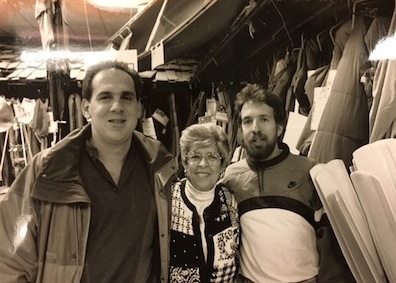
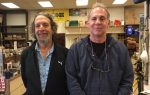
Jerry, left, and Keith Wolfman. (photo by Matthew Gindin)

I’m vacillating between anxiety and bliss,” said Jerry Wolfman. After 50 years of working alongside his younger brother Keith in what was once their father’s store, Vancouver’s Three Vets is coming to an end.

“The anxiety comes from thinking about what happens the day after the doors close,” Jerry explained to me from behind one of the two cash registers at the front of the store. “The bliss comes from the freedom that will follow.”

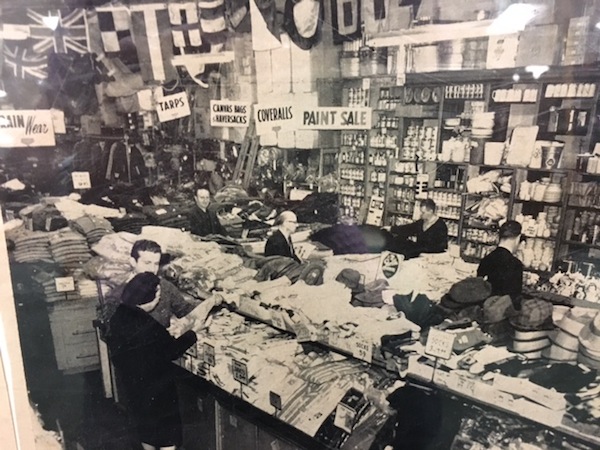
photo - Three Vets has always been bustling
Three Vets has always been bustling. (photo from the Wolfmans)

The camping equipment and military surplus store first opened its doors 70 year ago, at Prior and Main streets. The building of the Georgia Viaduct forced the store’s move to its current location, on Yukon Street at 6th Avenue, which will close Oct. 29. A giant banner over the front door announces, “Closing Out Sale: Up To 70% Off!”

Inside, the shelves are still littered with camping goods, gadgetry, clothing and hunting equipment. Through a small door on a side wall, First Nations masks and decorated wooden paddles can be glimpsed, belonging to Jerry’s other business, selling indigenous arts and crafts, which, he said, he plans to continue.

Keith is a little more sanguine about the future, at least on the surface. “What am I going to do? I’m going to take a chair yoga class and go swimming at the JCC.” He said he might also help members of his family with their business or kibitz around with other side projects.

Both Keith and Jerry grew up helping in the store, which was founded by their father, Bill Wolfman, and two other army veterans. Wolfman senior began the business with the idea of ending a shortage of bedding in logging and mining camps by using military surplus.

Keith and Jerry’s early trajectories seemed to point away from involvement in the business. Jerry went to college to study anthropology but didn’t see a future in it. Keith went traveling, at one point backpacking overland from Istanbul to Kathmandu through Iraq, Iran and Pakistan. Both brothers made their way back to their father’s store in their 20s, however, and haven’t left.

photo - Keith, left, Jerry and their mother Esther in years past
Keith, left, Jerry and their mother Esther in years past. (photo from the Wolfmans)

Jerry said it was their love of camping and the outdoors that resulted in the expansion of the store from a military surplus provider to “the great outdoor store” their sign declares them to be. Eventually, their range of merchandise expanded even further, to include housewares, emergency preparedness supplies, rain gear, travel accessories and other odds and ends that struck the brothers’ fancies. They also offered repairs for lanterns and stoves. The business often served police officers, firemen, ambulance personnel and film crews.

Some years ago, Keith and Jerry were approached by a land developer to sell the store, but they refused. The next offer they received was too good to turn down.

Other factors influencing their decision to close up shop, said Jerry, was the increase in big-box competitors, the growth of the online marketplace and increasing property taxes.

Earlier this year, on April 24, Three Vets announced the closure on its Facebook page. “It has been an absolute pleasure helping all of you with your outdoor needs,” said the statement. “We have enjoyed helping you get ready for camping trips, hiking treks, summer camp and other outdoor activities and we loved hearing about your adventures when you returned home. We can’t thank you enough for all the support you have offered us over the years.”

The Wolfman brothers have not just received support but given it in abundance, supporting a number of causes and organizations in the Jewish and general communities.

Matthew Gindin is a freelance journalist, writer and lecturer. He writes regularly for the Forward and All That Is Interesting, and has been published in Religion Dispatches, Situate Magazine, Tikkun and elsewhere. He can be found on Medium and Twitter.


Format ImagePosted on October 6, 2017October 5, 2017Author Matthew GindinCategories LocalTags business, Jerry Wolfman, Keith Wolfman, Three Vets
“M” magicians will mystify

“M” magicians will mystify

Illusionist Vitaly Beckman can make people’s images disappear from their driver’s licences. Beckman will take part in “M” – The Magic Show at Michael J. Fox Theatre Oct. 21. (photo from eveningofwonders.com)

Vitaly Beckman can make objects levitate. He can transport the image of a person in a photograph to another photograph. And he can predict the future. I know this because I’ve seen him do all those things, and more.

In 2014, the Jewish Independent participated with Beckman in what he would probably call an illusion, but what seemed magical to me. On March 21, 2014, at Havana restaurant, he locked his predictions of what the news would be a few weeks hence – and what I and co-witness Mia Zimmerman, a radio and TV host, would be wearing – in a small box. I held the key to the box, which remained chained up in public view at the restaurant. At Beckman’s April 10 show, the vast majority of his predictions were proven correct, including my and Zimmerman’s chosen outfits.

Beckman is a consummate performer, and his busy schedule and numerous accolades are proof of that. But the best proof is to see one of his shows. He uses humour and charm to involve as many audience members as possible, and even the shy among the crowds seem to want to join in, though many may not get the chance at his next show, just for its sheer size – and that he’ll be one of five performers.

At “M” – The Magic Show on Oct. 21 at Michael J. Fox Theatre, Beckman will be sharing the stage with four other acclaimed and award-winning magicians: Kel, Wes Barker and the team of Trevor and Lorena Watters. The promotional material assures “cutting-edge illusions, mystery, music, comedy, audience participation (you’ve been warned!) and precision sleight of hand.”

It’s not very often that there’s a performance of this magnitude, Beckman told the Independent. “We all have our own shows but this is the first time we have a chance to collaborate,” he said. “Each of us has a different style and it’s exciting to combine into one show.”

In addition to the illusions already mentioned, Beckman’s An Evening of Wonders show includes “Super Vision,” where he reads books and newspapers from a 50-feet away. He writes all of his material and has invented all of his tricks.

“The latest illusion involves turning back time, as an old branch becomes young and fresh again, while I become old,” he shared.

Beckman has been practising magic since the age of 14, when he was inspired, he said, “by a David Copperfield special and started performing for friends and family, and inventing my own illusions. I felt like magic brings out all of my strengths and talents and that I can express myself in the best possible way by creating and performing illusions, by bringing my imagination to life and sharing it with an audience.”

However, notes his bio, it would only be years later, that Beckman “would abandon a career in engineering to focus on rebuilding people’s childlike sense of wonder and bridging the gap between dreams and reality.”

“I am naturally an optimist but also a realist,” he told the Independent. “I believe in good news but also stay grounded. Every new idea I conceive seems impossible at first, but then I can find a way to achieve it. I think that makes me think that it can be true for anything and, with effort and imagination, anything is possible.”

Partial proceeds from “M” – The Magic Show will be donated to the YMCA; funds will go to helping people of all ages access community programs, including swimming, childcare and education. “M” starts at 8 p.m. on Oct. 21 and Michael J. Fox Theatre is at 7373 Macpherson Ave., in Burnaby. Tickets are $39 (plus tax and service charges) from vtixonline.com or 604-241-7292.

Format GalleryPosted on October 6, 2017October 5, 2017Author Cynthia RamsayCategories Performing ArtsTags illusionist, magician, tikkun olam, Vitaly Beckman, YMCA
Magic to amaze and educate

Magic to amaze and educate

Partial proceeds of Randy Charach’s Oct. 14 show at the Rothstein will be donated to the Canadian Mental Health Association. (photo from Randy Charach)

Anyone who has seen Randy Charach perform will swear he can read people’s minds. He certainly is attuned and sensitive to his audience, and those brave and lucky enough to become part of his high-energy, humour-filled show, which he will be bringing to the Rothstein Theatre Oct. 14, at 7 and 9 p.m.

“It has been five years since I’ve done a public show in Vancouver,” Charach told the Independent. “Most of my work is in the United States, as a corporate speaker and entertainer. The performances I’ll be doing at the Rothstein Theatre on Oct. 14th is my newest show. I’ll be blending my life’s work as a comedian, mentalist, magician and hypnotist. I’m looking forward to providing a memorable experience for my Vancouver audience.”

According to the press material, Charach has been entertaining people since he was 5 years old, “inspired by his uncle, a Las Vegas magician.” He has performed around the world, including on major television networks and even in film. A certified practitioner of neuro-linguistic programming and a certified hypnotist, Charach invites people to join him on stage: “As the excitement grows, the crowd watches in amazement as other audience members enter a hypnotic state and become stars of the show.”

“I love to amaze people,” said Charach about what he enjoys most about performing. “The art of magic has been a passion since childhood, and something I see as analogous to life. As a society, we constantly thrive to have our expectations met. When we are surprised, delighted and amazed, we often become elated. This feeling occurs in performance, in personal interactions and in business. When we surprise people, we become memorable.

“I write of this in my latest business growth book on Amazon, Client Centric,” he said. “I teach it in the book and at my corporate presentations, All Business is Show Business and All Life is Show Business. When we continue to amaze others by exceeding their expectations, it’s not magic, but it works like magic. This is an example of how art imitates life and my analogy of how magic is present in all our lives.

“Performing magic has evolved for me to the point where I have taken my interpretation of the art to a new level. While on stage, I am in a heightened state of consciousness, which I am unable to replicate any other way. Magic is present in every aspect of my life, and it pleases me to share it during my performances.”

Despite this love of entertaining, Charach said there were years when he didn’t perform at all.

“My decision to return to the stage,” he said, “was made at a group event hosted by Rabbi Yechiel Baitelman of Chabad in Richmond. The rabbi stated we must share our talent with others. It was at that moment I looked at my wife Chana and said I would be performing again. I suppose it’s in my blood. Entertaining and educating is part of my life’s purpose.”

Partial proceeds of the Oct. 14 show will be donated to the Canadian Mental Health Association.

“Mental illness is prevalent in our society, and I don’t feel this condition receives the attention it requires,” said Charach. “I’ve personally dealt with depression over the years, and am aware I am not alone. I do my best to raise awareness and plan to do more. I hope the stereotypes, prejudice and discrimination stop.”

For more information, videos and to reserve your seats at one (or both) of the Oct. 14 shows at the Rothstein, visit randytickets.com or call 1-800-838-3006. Tickets are $36 (plus service charge).

Format ImagePosted on October 6, 2017October 5, 2017Author Cynthia RamsayCategories Performing ArtsTags CMHA, magician, mental health, Randy Charach, tikkun olam
Relatable dysfunction

Relatable dysfunction

The Beacham family. Back row, left to right: Seth Little as Guy, Nick Beacham’s partner; Jordon Navratil as Nick; Mia Ingimundson as Norris Beacham, the daughter; and Chris Walters as Kevin, Norris’ husband. Seated are Howard Siegel as the patriarch of the family, Glen, and Anna Hagan as the matriarch, Bonnie. (photo by Ellie O’Day)

Homeward Bound by Elliott Hayes is about death and relationships. And family dynamics. Jewish community member Howard Siegel plays the father, Glen Beacham, in Western Gold Theatre’s production that opens today, Oct. 6, and runs until Oct. 29 at Pal Studio Theatre.

Set in 1990, Glen and Bonnie Beacham have invited their adult children (a son and a daughter) and their respective partners for dinner – and an announcement, publicist and Jewish community member Ellie O’Day told the Independent. Homeward Bound “is a dark comedy,” she said, “but also plays with the ways we talk to each other but don’t always really listen.”

“Every family has a time when they get together. Ours was Shabbat,” said Siegel. “No matter where we were or how busy our week was we had to be home Friday for dinner. We ate at the dining room table instead of our usual place in the kitchen, and talked, or argued, but that was our family time. If there was chicken soup, we were having roast chicken; if it was vegetable soup, it was brisket. While the Beachams are getting together on a Sunday and it may not be as regular as my childhood was, dinner with the family is no less important and the news of the week is going to change all their lives.”

Of the plot, O’Day added, “Dad, who happily distracts himself with crossword puzzles, is apparently not well…. Mother distracts herself by constant chatter (where will they go on their next holiday? Dad is totally noncommittal)…. Meanwhile, the gay son’s partner is late for this Sunday dinner … and the daughter is trying unsuccessfully to hide the deterioration of her marriage.”

Siegel described the character of Glen as a “glib, funny, highly educated” man who “has provided a substantial middle-class standard of living for his family.” He said, “My father aspired to these qualities, but it was his struggle, so I wasn’t able to model Glen after my dad. However, finding the love for his family that perhaps isn’t so clear in the text is important to me and to the play. That was very apparent in my experience in my parents’ home.”

He added about the Beachams, “This is a family like so many families we know or grew up in. The parents have to accept choices their children make whether they like or understand them; they accept them out of love and perhaps duty. The kids bicker, but would defend their sibling to anyone if push came to shove. Deep in this family’s dysfunction is a connection that we all should be able to understand.”

Homeward Bound runs Oct. 6-29, Tuesday-Saturday, 7:30 p.m.; Saturday-Sunday, 2 p.m.; and Oct. 19, 2 p.m., at Pal Studio Theatre, 581 Cardero St. Tickets are $32/$27 from 604-363-5734 or homeward. brownpapertickets.com.

Format ImagePosted on October 6, 2017October 5, 2017Author Cynthia RamsayCategories Performing ArtsTags Ellie O’Day, family, Howard Siegel, theatre
Help finish new thriller

Help finish new thriller

Richard Harmon stars in Crypto, written and directed by Jon Silverberg. (photo from Red Castle Films)

Enjoy watching a psychological thriller? Well, now you can help make one. At least, finance one. Starring Vancouver actor Richard Harmon – most recently John Murphy in the Warner Brothers series The 100 – and written and directed by local Jewish community member Jon Silverberg, the feature film Crypto has been shot but needs funding for the finishing touches.

“Crypto is my first feature film, and has been a struggle to complete on personal and private resources so far – this is why we’re now turning to crowdfunding to help finish it!” wrote Silverberg in an email to the Jewish Independent.

“We’ve shot and edited the film, but need the completion funds for VFX [visual effects], sound design and our festival and marketing rollout,” he said in an interview. “We have some really awesome perks to give back to fans in exchange for their donations – from a production diary, to merchandise, to an advance screening gala planned for early 2018.”

The film is described as “a psychological thriller, which follows drug-addicted photojournalist Jake (played by Harmon) who, after taking a job at a wilderness lodge, sets up a darkroom where the photos he develops begin to reveal unsettling apparitions of the future.”

“I enjoy watching lighter films, but the stories that I revisit in my mind long after I watch them are the ones that explore the darker more mysterious aspects of life – especially inside the human mind,” said Silverberg. “In Crypto, we explore the effects of isolation on an already troubled soul, and even the fantastical elements of the story are as much an allegory for the main character’s internal struggle,” as they are entertaining.

The crowdfunding press release talks about the film being Harmon’s “passion project,” but it is also Silverberg’s. “It’s been a longtime goal of mine to direct a feature film and I felt strongly about developing my own material,” he said. “I had been writing the script for Crypto for nearly three years by the time the cameras started rolling.”

Filming took place in Port McNeil, on Vancouver Island, over 11 days in February 2017, with a crew totaling 16, said Silverberg. “My producer, Andy Hodgson, was the other main driving force behind the film, and also served as cinematographer and camera operator on set.”

In the press release, Hodgson notes, “We need about $20,000 to finish the film and get it out to international festivals, which, comparatively speaking, is a very small amount in a world of multimillion dollar movies.”

Born in Montreal and raised on Vancouver Island, Silverberg moved to Vancouver in the early 2000s for film school, “and also for the overall film industry infrastructure. There wasn’t much happening for film on Vancouver Island at the time,” he said.

Silverberg is co-owner of Red Castle Films with producer/cinematographer Hodgson and business manager Nolan Smith. His bio on the site notes that he “grew up fascinated by cinema, and began to shoot photos and develop them in the darkroom by age 6. He attended Capilano University’s film program in 2003, and went on to shoot hundreds of episodes of internationally broadcast documentary television – from the waters of Alaska to the jungles of Mexico – before he settled in Metro Vancouver. More recently, Jon premièred his short film Disappeared at the 2015 San Francisco Indie Fest and is currently preparing to shoot his first feature film Crypto, a sci-fi/thriller set in the Haida Gwaii.”

Silverberg shared with the Independent that, not only was he raised in a semi-observant Jewish home, but that his company’s name, Red Castle Films, and its logo “was chosen in honour of the regional flag of my family’s former home in Poland.”

Crypto is scheduled for release in 2018 through festivals and other distribution. To see a trailer of the film, visit redcastlefilms.com/project/features-crypto. For more information and to donate – perhaps becoming a producer yourself – visit crypto-movie.com.

Format ImagePosted on October 6, 2017October 5, 2017Author Cynthia RamsayCategories TV & FilmTags Andy Hodgson, Crypto, Jon Silverberg, Red Castle Films, Richard Harmon, thrillers
Poetry inspired by abstract art

Poetry inspired by abstract art

On Sept. 25, a group of writers gathered to write and share poems sparked by the paintings of Waldemar Smolarek, now on display at Zack Gallery. (photo by Olga Livshin)

Poetry events at the Sidney and Gertrude Zack Gallery have become a regular feature in the last few years. Every couple of months, writers of Pandora’s Collective meet at the gallery to read their poems inspired by the art. They held their latest gathering on Sept. 25.

The abstract paintings currently on display at the Zack seem to have been created to inspire poetry. Waldemar Smolarek’s work is known to gallery patrons. Smolarek’s first show at the Zack, in 2012, was posthumous – he died in 2010 – but his art is alive, infused with vibrant colours and the artist’s unique frenetic energy.

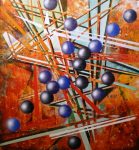
Smolarek, a proponent of purely abstract compositions, filled his canvasses with dynamic currents. His lines, in every imaginable hue, fly like arrows. His multicoloured balls dance like polka dots. His vivid splashes of blue and peach flow into each other, seemingly at random, but there is logic in the twists and turns of the artist’s brush. His art invites people to delve into their own psyche, and the poets of the evening responded to the paintings’ visual challenge with a wide variety of works: long and short, light-hearted and lamenting. Some poems were inspired by one specific painting, while other rhyming flights of fancy encompassed the entire gallery.

As the event was a collaboration between the Zack Gallery and the Isaac Waldman Jewish Public Library, Helen Pinsky, the head librarian, gave a short introduction before passing the microphone to Leanne Boschman, the host of the evening.

Although it was her first time as host, Boschman has participated in the Zack Gallery poetry evenings twice before. “The first time, the exhibition included the artist’s journal and sketches, and I found it fascinating to see the artistic journey in progress,” she told the Independent. “The second time, it was a show of abstract photographs…. I like abstract art in connection to my poetry. I can play loosely with colours and shapes and words. It’s harder when the art shows specific people or places. With abstract art, the poet is free to follow her own associations. Sometimes, it’s a story; sometimes, a feeling or a question.”

Most of the participating poets agreed with her assessment, and Smolarek’s art was a rich source for many pieces. The audience, although not large, was extremely generous in support of anyone at the mic, both the listed readers and the brave volunteers who took part in the open mic portion of the event. The friendly atmosphere, combined with the bright paintings and Boschman’s humorous but factual introductions of every reader, made the evening a joyful celebration of colours and words.

The first poet who read, Suzy Malcolm, has been writing poetry since she was a teenager. “It’s my fifth time at the Zack,” she said. “I prefer abstract art for my poetry. It feels like a gift to write about colours and shapes.” She writes poetry for children as well as adults, and her poems at this event reflected both sides of her poetic endeavours.

Eva Waldauf, the next reader, started writing poetry when she was around 40. “I’m a visual artist,” she said. “Once, I had to write a poem for a class, and I liked it. I thought it was fun; thought, ‘I could do it,’ so I began writing poetry.” Her poems were not written on the spot. “I visited the gallery last week to see the paintings, so I would have time to write and edit my poems. I like to come prepared.” Although she admitted to always being nervous before reading her poems, one wouldn’t have guessed it from her performance. Her reading, relaxed and expressive, enhanced by expansive gestures, revealed a good actress as well as an original poet.

The next presenter, David Geary, staged his poems as letters to Smolarek. His presentation was comical. As if playing a game, he strode around the gallery and enrolled everyone in the audience and all the paintings as his willing and laughing playmates.

As a counterpoint to his irreverent show, Sita Carboni’s poetry resonated with mournful tunes. One of the co-founders of Pandora’s Collective, Carboni noted that, with art like Smolarek’s, a poet is free to explore in any direction. Her poetry, contemplative and deep, included a goodbye to someone she lost recently, and she couldn’t finish her reading because of the tears that choked her.

Warren Dean Fulton also prefers abstract art for his poetry. “Abstract art allows you to project your own feeling and emotions. It is speaking to your subconscious. The poet is much less free with portraits or landscape.”

Fulton has participated in the poetry readings at the Zack before. “It is interesting to hear how the same paintings could inspire such different interpretations,” he mused. As he likes to improvise with his poetry, he hadn’t seen Smolarek’s work before that evening.

The last poet of the night, Amanda Wardrop, is also an experienced writer and reader. A schoolteacher, Wardrop said she finds poetry everywhere: in her interactions with students, in figurative art and in abstract art. “Different poetry, that’s all,” she said. “Figurative art often results in a narrative, while abstract art pushes one to a more emotional response.” She did her research before coming to the reading that night, and her poetry touched on the artist’s technique: layers and textures, as they related to our lives.

The night concluded with a lively musical performance by Kempton Dexter, who played his guitar, sang and joked to the delight of the audience.

Olga Livshin is a Vancouver freelance writer. She can be reached at [email protected].

***

Balls collide and come apart,
Lines zigzag and soar,
Feeding moxie to my heart
Fields awash with colour.

Reds and blues and greens explode
Shards and doodles frolic,
Polka dots in quirky mode,
Joyful and symbolic.

– Olga Livshin, inspired by the artwork of Waldemar Smolarek


Format ImagePosted on October 6, 2017October 5, 2017Author Olga LivshinCategories Performing Arts, Visual ArtsTags abstract art, Pandora's Collective, poetry, Waldemar Smolarek, Zack Gallery
Spotlight on the Sylvia

Spotlight on the Sylvia

Advah Soudack and Anna-Mae Wiesenthal rehearse the song “Building a Dream” for Two Views from the Sylvia, which runs Nov. 8-12. (photo by Adam Abrams)

With the upcoming theatrical production of Two Views from the Sylvia, author Diana Stevan interviewed Sue Cohene, a founder of the show’s producers, Kol Halev Performance Society. The new play, based on the Sylvia Hotel, runs Nov. 8-12 at Waterfront Theatre on Granville Island.

DS: What inspired you to do the play?

SC: The answer is insanity.

DS: Tell me more about that. How did you get the idea?

SC: About five years ago, I was attending one of our monthly Jewish psychology network meetings. During our introductions, welcoming new attendees, I did a quick version of my background as a psychotherapist and the latest news about Kol Halev. After the introductions, Marsha Ablowitz, another psychotherapist, who I had known for many years, came up to me and said, “Do you want to do a story about my aunt?”

My response was, “Your aunt?”

She said, “Yes, my Aunt Sylvia.”

Not particularly keen, I replied, “Your Aunt Sylvia?”

“Yes, Aunt Sylvia of the Sylvia Hotel.”

I was hooked and said, “Tell me more.”

DS: So she told you the story of her aunt. Was there anything you were surprised about?

SC: Yes, but you have to come see the play to find out. But, I have to say, the Jewish Vancouver backstory is quite fascinating. I’ll tell you one tidbit. There was a connection between Sylvia Goldstein Ablowitz and another legendary Vancouver figure, Joe Fortes, the lifeguard at English Bay.

DS: Interesting. I’ve heard about him. I understand from the title of your play, that there are two views from the Sylvia. Can you tell me more about that?

SC: One view is from the outside, from English Bay, looking in; the other is from the inside, looking out. And those are just the literal views I’m talking about.

DS: I understand there’s some music. Is this a musical?

SC: We have two one-act plays. The first one, named Sylvia’s Hotel, is a musical about the building of the hotel by the family and the obstacles they found. The second one-act play, named The Hotel Sylvia, is a play with music, focusing on the period of time after the hotel was built.

DS: I heard that the Jewish Museum and Archives of British Columbia showed an interest.

SC: Yes, the Jewish Museum is one of our partners in this project. They will be presenting a historical photography exhibit at the theatre.

For tickets ($28) to Two Views from the Sylvia, visit kolhalev.ca or tickets.theatrewire.com.

Diana Stevan is a writer, who previously worked as a family therapist, teacher, model, actress and freelance writer broadcaster for CBC TV’s Sports Journal. Her novels – A Cry from the Deep, a romantic mystery/adventure, and The Rubber Fence, psychological fiction – and her coming-of-age novelette, The Blue Nightgown, draw on both her experience and imagination. This interview was published by Theatrewire.

Format ImagePosted on October 6, 2017October 5, 2017Author Diana StevanCategories Performing ArtsTags Kol Halev, musical theatre, Sylvia Hotel
Memorial inaugurated

Memorial inaugurated

An artist’s rendering of the newly inaugurated National Holocaust Monument in Ottawa. (photo from holocaustmonument.ca)

On Sept. 27, Prime Minister Justin Trudeau inaugurated the National Holocaust Monument in Ottawa. The monument serves to honour the victims and survivors of the Holocaust, and the important lessons it so painfully taught us.

The Holocaust was the mass extermination of more than six million Jews and millions of other victims, and one of the darkest chapters in human history. The National Holocaust Monument commemorates the millions of people who suffered such atrocities at the hands of the Nazi regime, and pays tribute to those whose stories must never be forgotten.

The monument also stands as a testament to the resilience and courage of Holocaust survivors. Many found a home in Canada, and profoundly shaped our country and society.

In honouring the victims of the Holocaust, we recognize their humanity, which no human act can erase. The National Holocaust Monument reminds us that it is our collective and vital responsibility to stand against antisemitism, racism and hatred, and to bring meaning to the solemn vow, “never again.”

The monument is located at the corner of Wellington and Booth streets in Ottawa, near the Canadian War Museum.

“This monument, so close to our Parliament and Supreme Court, is a reminder of the devastating cost of allowing hatred and tyranny to overcome openness, inclusion and freedom,” said Trudeau. “Today, we reaffirm our unshakeable commitment to fight antisemitism, racism, xenophobia and discrimination in all its forms, and we pay tribute to those who experienced the worst of humanity. We can honour them by fighting hatred with love, and seeking always to see ourselves in each other.”

“This monument is a powerful tribute to the millions of Jewish men, women and children and other victims whose lives were extinguished during one of the darkest chapters in human history,” added the Hon. Mélanie Joly, minister of Canadian Heritage. “As we reflect and honour their memory, we also pay tribute to the courage and strength of the survivors who came to Canada following the Holocaust. Their stories are a powerful reminder of our responsibility to stand against antisemitism and prejudice in all its forms and to never allow intolerance and hate to take root in our communities. We will never forget.”

The design of the monument, entitled “Landscape of Loss, Memory and Survival,” was developed by Team Lord of Toronto and depicts a stylized star, created by the confluence of six triangular shapes, or “volumes,” that are organized around a large gathering space for ceremonies. The design uses architecture, landscaping, art and interpretation to communicate the hardship and suffering of victims, while conveying a powerful message of humanity’s enduring strength and survival. For more information, visit holocaustmonument.ca.

Format ImagePosted on October 6, 2017October 5, 2017Author Prime Minister’s OfficeCategories NationalTags Holocaust, monuments, Ottawa

Posts pagination

Previous page Page 1 … Page 3 Page 4 Page 5 Next page
Proudly powered by WordPress