Men take centre screen

In Love, Theft and Other Entanglements, Sami Metwasi plays Mousa, a likable but unlucky car thief. (photo from Vancouver International Film Festival)

Men in turmoil. If there were a common theme between the films the Jewish Independent reviewed in anticipation of this year’s Vancouver International Film Festival, which opens Sept. 24, it would be that. It also seems to apply to the other few movies in the festival with Jewish- and/or Israel-related content.

Of the films reviewed, Love, Theft and Other Entanglements (Palestine Territories) was the most engaging, though it was slow in its pacing. This was likely done purposefully to reflect aspects of the main character and his milieu, but the movie – which is described by director Muayad Alayan as “a drama, a thriller and a fairytale” – would have been more intense if several lengthy shots had been trimmed even by a few seconds. We don’t have to see a car drive from Point A to Point B to know that it went from A to B, for example.

That being said, Love’s Mousa, is a likable “hero,” and this makes viewers want to stick with him to the end. The choice to film the movie in black and white was made, says Alayan on the film’s website, to minimize “the visual noise that detracts from the story” and reduce “the temptation to examine the setting of the film against the hyper-realistic images of Palestine common in TV reports and documentary films. I wanted the place to be a context that serves the story and not a point of interest in and of itself.” In this, he succeeds. While the film includes evident commentary about Israeli and Palestinian societies, as well as the conflict between them, it is Mousa – representing anyone who has made some bad choices in life – who is at the centre of the narrative; and the desert landscape accents his scarce hope.

Walking out on a job that his father arranged for him with some effort, Mousa steals a car – not his first. Unfortunately, this one has valuable cargo in the trunk and Mousa becomes a man of interest – and use – to both Israeli intelligence and Palestinian militia. Adding to his self-made burden is an affair with a married woman.

Mousa desperately wants to flee from it all. When he tells his father he is leaving, his father responds, “A man who doesn’t solve his problems in his own country, won’t be any different in another country. You’re just running away.” By the end of the film, Mousa is no longer running.

***

Hockney is a flattering documentary by Randall Wright (United Kingdom/United States) of British artist David Hockney. It portrays a creative, innovative man who lived his life publicly, not only explicitly wrestling with his homosexuality in his artwork, but filming many moments of his life, some of which are very intimate and, one would think, private.

By turns flippant (deciding to become a blond after seeing a Clairol commercial that claimed blonds have more fun), sad (mourning with every aspect of his being the end of his relationship with Peter Schlesinger) and serious (continually pushing artistic boundaries and learning new techniques), Hockney is a fascinating person.

Wright’s documentary features interviews with Hockney, 77, as well as Hockney’s family and friends, fellow artists, subjects of his paintings and others. For the film, Hockey – who still works in the studio every day – provided Wright with access to his photographs and “home” movies. Hockney was a documenter not just of what he saw around him in people and nature, but of himself. “I always wanted to see more,” he says about why he always wanted to sit on the top level of the bus on the way home from the pictures – he describes himself as almost being raised with Hollywood, though he was born and raised in Bradford, England. After several stints in Los Angeles, he moved there in 1978.

The documentary serves as an interesting and visually stimulating, if uncritical, introduction to Hockney and his work. The VIFF screenings mark its Canadian première.
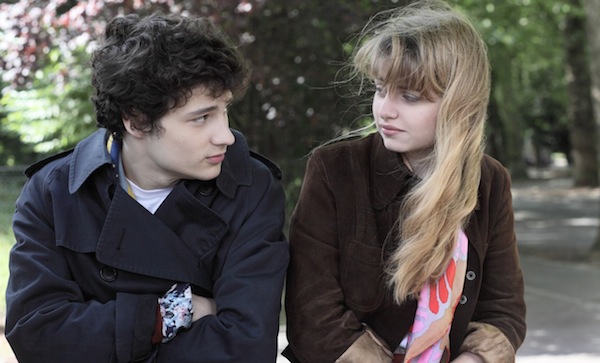
photo - Quentin Dolmaire et Lou Roy-Lecollinet in My Golden Days. Dolmaire is scheduled to attend the film’s première at the Vancouver International Film Festival
Quentin Dolmaire et Lou Roy-Lecollinet in My Golden Days. Dolmaire is scheduled to attend the film’s première at the Vancouver International Film Festival. (photo from VIFF)

Another national première is My Golden Days, directed by Arnaud Desplechin (France). Actor Quentin Dolmaire, who plays the young adult Paul Dédalus, is scheduled to attend the screening.

Called Trois souvenirs de ma jeunesse in its original French, the film begins with the adult Paul in bed with a lover, saying goodbye, set to return to France to take a position with the foreign ministry. His first souvenir (memory) is of his childhood: to understate matters, he doesn’t get along with his mother, who is ill, and, after she dies, his father never recovers and fades into the background of his children’s lives.

Paul’s second memory – and the most interesting part of the entire film – is triggered when he is stopped at customs. Apparently, another Paul Dédalus exists in Australia, with Paul’s same birth date, etc. How can that be?

It goes back to the 1980s and a high school trip to Minsk. Not Jewish himself, Paul helps his friend Marc Zylberberg smuggle documents and money to refuseniks. He is asked, not pressured, to “lose” his passport when he meets with them, which he does.

The strength of character Paul displays at 16 in Russia escapes him upon his return. The third and final memory of his youth takes up more than half of the two-hour film. Despite including some violence, lots of emotional chaos and a few sex scenes, the romance between Paul and Esther is, not to mince words, boring. Though well-acted, the characters are not compelling or sympathetic, and it is hard to care what happens to them and their relationship.

***

The Jewish Independent is sponsoring the Canadian première of Tikkun, directed by Avishai Sivan (Israel). Among other awards, it won top honors at the Jerusalem Film Festival.

When Haim-Aaron, an ultra-Orthodox scholar, collapses and is resuscitated by his father after being declared dead by paramedics, he completely changes personality. While he struggles with that and his new lack of faith, his father is fearful that God is angry for having His will (that Haim-Aaron die) denied.

Among the other films of Jewish interest is Son of Saul, directed by László Nemes (Hungary), which takes place in Auschwitz, where Saul is forced to help the Nazis kill his fellow Jews. In doing so, he sees the corpse of a boy he believes to be his son. He decides to save the body, intent on giving the boy a proper burial.

And there is A Nazi Legacy: What Our Fathers Did, a documentary by David Evans (United Kingdom). Another Canadian première at VIFF, the film follows Niklas Frank and Horst von Wächter, both the sons of Nazis responsible for thousands of deaths, on a trip to Poland and Ukraine. The men have completely different opinions about their fathers’ actions during the war, and “human rights lawyer Philippe Sands investigates the complicated connection between the two men, and even delves into the story of his own grandfather who escaped the same town where their fathers carried out mass killings.”

VIFF runs from Sept. 24-Oct. 9. The full program can be found at viff.org.
Israelis connect with locals

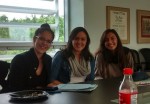
Left to right, shinshiniot Ophir Golumbek, Tomer Tetro and Lian Swissa are volunteering with various organizations in the Greater Vancouver Jewish community. (photo from Jewish Federation of Greater Vancouver)

For the first time, Vancouver is participating in the Shinshin program through the Jewish Federation of Greater Vancouver (JFGV) in conjunction with the Jewish Agency for Israel.

Shinshin is an acronym for shnat sherut, meaning year of service, which is exactly what the three 18-year-olds who arrived on Aug. 31 are here to provide the Vancouver Jewish community.

The project, which is co-funded by JFGV and the beneficiary agencies, is an outreach program created by the Jewish Agency to give exceptional Israeli youth a meaningful gap-year experience that furthers the objectives of the Jewish Agency for promoting goodwill and education about Israel. According to Vancouver’s shinshin coordinator, Lissa Weinberger, the program has been wildly successful and popular among the Jewish communities that have had the chance to host Israeli teens in the past. JFGV had planned to begin hosting Shinshinim in 2016 but because of the enthusiasm of participating agencies, they fast-tracked the program and made it happen this year.

Shinshin has been embraced by communities in England, the Netherlands, South Africa, North America and South America, growing from 54 participants last year to 100 this year. The Israeli youths volunteer with young people in schools, synagogues, Jewish community centres and other Jewish organizations to build awareness and give access to a teen perspective on Israel. According to Weinberger, the program has been so effective at building relationships between Israeli and Diaspora Jewish youth that there is a plan to grow it to 300 Shinshinim within five years.

Weinberger said that the young women in Vancouver – Ophir Golumbek, Tomer Tetro and Lian Swissa – will be working six days a week for the next nine months, with a few weeks off spread over that time.

“When we were discussing their schedule, we were told to keep them busy. They were coming to give back, not sit around,” Weinberger said.

The Shinshiniot (feminine plural) will be hosted by local families during their stay, a different family every three months. The host family experience is crucial to the program as it gives the youths a soft landing here in Vancouver, in a family environment.

Jennifer Shecter-Balin will be hosting one of the Shinshiniot for the first term. She spoke for her family when she said, “We are excited for the experience. I have been communicating with Ophir via email and I have been thoroughly impressed by her maturity, enthusiasm and introspection.”

In an interview with the Jewish Independent the day after their arrival, the three young women were indeed bubbling with energy and enthusiasm. Golumbek will be working primarily with students at Vancouver Talmud Torah (VTT), with the Temple Sholom Sunday school as her Sunday job. Tetro will divide her time between the Jewish Community Centre of Greater Vancouver and Congregation Beth Tikvah. Swissa will be working with King David High School, Congregation Beth Israel and Richmond Jewish Day School.

Each one of the Israelis comes with a history of volunteerism and leadership, as well as an impressive command of English. None of them comes from an English-speaking home in Israel but all are eloquent and clear in their goals for their year of service in Vancouver.

Golumbek explained why she applied to the Shinshin program. “I have family in the U.S., third cousins, and they all went on Birthright and I saw how it made them [connected to] Israel. Some came back to study and one made aliya. Each one of my cousins told me about a person who influenced them to love Israel and I wanted to build that connection for people here.”

Swissa echoed Golumbek’s interest in building connections with local Jews and added, “I believe that Jewish people have a shared history and we should create a shared present and future. We are here to learn about Vancouver and Judaism outside of Israel, as much as we are here to share our love of being Jewish in Israel.”

It’s not surprising that 18-year-olds who can express these types of ideas when jet-lagged were selected from the 1,700 applicants to the Shinshin program. Swissa and Tetro have leadership experience and a strong basis in working with other Jewish teens from a two-year program they did in high school called the Diller Teen Fellowship, which brought them to Chicago and Baltimore, respectively, when they were in grades 10 and 11. Their experience working within a pluralistic Jewish environment has prepared them for their work in Vancouver. Golumbek participated in a special program of her Scouts called Seeds of Peace in Maine, which brought together Israeli, American, British, Palestinian and Egyptian teens to work on building relationships and tackling issues of conflict.

When asked how they feel about being away from their families, they all teared up slightly. Swissa is the youngest of seven children, so it’s a shock for her to be without family here, while Tetro will miss her 5-year-old sister. Golumbek has a brother who is finishing his army service this year and, while she said she will miss her family, she looks at this year as an opportunity to get ready for being away when she goes into the army, while making an impact and making new connections. She said, “Our host families will be like a new family … we are grateful for the chance to come here, to make a mark. Thank you is a small word for what everyone has done for us so we could be here.”

Tetro spoke for all three volunteers when she explained what they hope for the year to come. She said, “We are so excited because this is a brand new program and nobody knows what to expect, but we are also stressed because we want to make the best impression. We want to build a really good base for next year so all of the kids will be eagerly waiting for the next Shinshinim to come.”

Michelle Dodek is a freelance writer living in Vancouver.

Memorials to millions

Ian Penn’s exhibit at the Zack Gallery, Pole, “isn’t happy but it’s genuine.” (photo by Olga Livshin)

The poignant tale behind Pole, Ian Penn’s new multimedia exhibit at the Zack Gallery, is a bleak travelogue detailing his recent journey to Poland.

Although Penn’s family came from Poland – his parents were lucky to have escaped the Holocaust and settled in Australia – he never wanted to visit the country of his ancestors. “My mother said she would never set a toe in Poland,” he told the Independent.

Growing up in Australia, Penn moved to Vancouver, where he worked as a cardiologist for many years. He is mainly retired now but still teaches at the University of British Columbia and works as a medic with the emergency-response ski patrol in Whistler.

“When I retired, I enrolled in Emily Carr,” he said. “I graduated in 2010 with a bachelor’s in fine arts but I’ve always kept a visual diary, since university. I have hundreds of little albums at home. Wherever I am, wherever I go, I draw and write in them. It’s how I explore the world.”

He paints regularly, landscapes and figurative images. “For me, painting is a way of telling a story, one of many. There are other ways, too: words, sculpture, video, photography. I used the multimedia approach for this show because I wanted to bring all those ways together, see how they fit. The show is a story of Jewish soul.”

Penn found his subject in Poland. He had resisted making the trip for a long time, until a couple years ago. “My daughter said to me then, ‘It’s time to visit your history,’ so I made the decision to go,” Penn explained. “I have a friend in Australia. We have known each other for a long time. He is a Pole, he speaks Polish, and he wanted to take me. He said we should both read a few books first to prepare ourselves, books about the plight of Jews in Poland during the war, but written by Poles, not Jews. We didn’t want to go as tourists. We wanted to understand.”

Nonetheless, Poland shocked him. “There are almost no Jews left there, and the ones who remain don’t know anything about Jewish culture. I went to a synagogue and I had to say Kiddush because nobody there could speak Hebrew. But the Poles – they exploit Jewish history. They charge 23 euros for a trip to Auschwitz. They have those happy golf carts all around Krakow and they take you to the Schindler’s factory and to the ghetto. They sell Jewish souvenirs, but who made them? Not Jews. This is not how you engage in history. They made a commodity out of our tragedy, of the Jews killed by the millions. It’s like Horror Disneyland. I couldn’t stay there more than one week.”

Penn found most of the Jews of Poland in the cemetery. “There, every stone has a name written on the tombstones, remembered, while those who died in Auschwitz are just dust. I learned that Nazis burnt 1,000 people an hour in the ovens in Auschwitz. I tried to wrap my head about the number. That’s why I did this show. It’s about those thousands of souls.”

All of the works displayed in the show bear the same name, “1000 Marks.” By creating the paintings, Penn wanted to visualize his non-memories, remember something he had never witnessed. Five paintings are similar: dead trees, brown and dreary, wooden poles striving to reach the sky, one pole for every Jewish soul that didn’t have their name written somewhere. Together, they form a memorial.

A couple other paintings have a subtitle: “From the Village to the Ramp.” They are painful to view, powerfully evoking the horrors of the Holocaust. So does the entrance to the gallery, decorated with two real wooden poles, with bark still on in some places, unpolished and branchless. The “Welcome Back” mat underneath them doesn’t look particularly welcoming either. There was a sign at the entrance to Auschwitz, too, and the correlations reverberate in the air.

“This show isn’t happy but it’s genuine,” said Penn. “It’s my response to the entertainment industry they made of the catastrophe. Their tourist trips have nothing to do with our dead families.”

The show also includes a few short videos, two of them filmed at the Jewish cemetery. The screens are mounted to the walls like paintings, continually running loops of footage. “I shot them myself,” said Penn. “There is serenity at the cemetery. And lots of greenery, living trees. I saw a man restoring the text on one of the tombstones and filmed him. I didn’t talk to him, didn’t ask him anything. He was doing a holy job. That was enough.”

A few more wooden poles, also part of the exhibition, are placed outside of the Zack Gallery. They are suspended above the atrium, where the stairs lead down to the Vancouver Holocaust Education Centre.

“They are uprooted, like all of us whose parents left Europe,” said Penn. “The poles come from the UBC Endowment Lands and from the Whistler area. They remind me of the trees in the Jewish cemetery but they are also my connection to this place, to Canada.”

The show Pole opened on Sept. 10 and continues until Oct. 11.

Olga Livshin is a Vancouver freelance writer. She can be reached at olgagodim@gmail.com.

Building relationships

East Side Jews observes Shabbat at Trout Lake. (photo from Carey Brown)

When Rabbi Carey Brown and her family moved to Vancouver in 2011, they made their home in East Vancouver.

“We settled down in East Van and really loved the neighborhood,” Brown told the Independent. “Slowly, as I became familiar with more people, I realized there was a growing need for additional places for people to meet and connect with their roots.”

photo - Rabbi Carey Brown
Rabbi Carey Brown (photo from Carey Brown)

This realization was the inspiration for East Side Jews, a group that Brown founded about a year ago, and which she co-directs with Lisa Pozin. Brown is associate rabbi at Temple Sholom, and Pozin is the synagogue’s program director.

“We started with Rosh Hashana on Main Street, we invited people to join us and taste honey cake and hear a story at Solly’s, learn about honey at the Honey Shoppe, and sing songs and hear the shofar at a local park. We didn’t know how to reach people, so we posted notes in coffee shops and community centres around the area. To our surprise, the turnout was amazing. We decided to create one event every month. We hosted a tikkun olam event at the PriceSmart food store [now a Save-On] on King Edward Avenue and Knight Street, we did a Havdala under the stars at Trout Lake, and shared Shabbat dinners in local community centres. People really liked our events, a group was formed. We were really happy and excited.”

Elaborating on the tikkun olam event, Brown said it was a “scavenger hunt we called Project Feed. We gave the families a list of specific food items that JFSA [Jewish Family Services Agency] told us were needed by the Jewish Food Bank and PriceSmart told us would be on sale. The families made a donation to participate and then used their lists to fill their carts. After finishing the shopping, we met at Or Shalom to sort the food and hear a short presentation from JFSA about the food bank. People learned a lot about the food bank and realities of hunger in our community. The kids were very into the experience and the parents really appreciated having a hands-on opportunity to engage with their kids in tikkun olam.”

Brown grew up in Minneapolis, went to Northwestern University, which is near Chicago, and then studied at Hebrew Union College in Jerusalem and in New York City. After her ordination, she was a rabbi at Temple Isaiah in Lexington, Mass., for six years. That community’s approach to community outreach influenced her and, when she and her husband – Dr. Gregg Gardiner, assistant professor and Diamond Chair in Jewish Law and Ethics at the University of British Columbia – brought their family (they now have two children) to Vancouver, she incorporated it into her own approach.

“The federation in Boston (CJP, Combined Jewish Philanthropy) invested a lot of time and effort in reaching out to interfaith couples. Every event, every meeting, every holiday, they always emphasize the fact that the invitation is open to interfaith couples, that they are welcome to join in, that it will be in a nonjudgmental atmosphere, that everyone will accept them and encourage them to connect to the Jewish community. I saw how meaningful that was to families and that it really impacted their participation in Jewish life. I wanted to make sure that families in Vancouver were hearing this supportive message as well.”

And it seems that the message is indeed being heard – and appreciated. East Side Jews now has some 200 names on its mailing list, it receives support from the Jewish Federation of Greater Vancouver and has recently been honored by the Union for Reform Judaism. The East Side Jews initiative garnered Temple Sholom one of URJ’s 2015 Belin Outreach and Membership Awards, which recognizes congregations from across North America “that have developed programs to actively welcome and integrate those new to Judaism, created relationship-based membership engagement models, or developed new, innovative ways to engage and retain members.”

“We really try to use the events to establish personal relationships with our new friends, to go for a coffee, to meet in smaller groups, to build a connection following the public events,” explained Brown about what makes East Side Jews unique. “We learned that there are many people out there who are eager to live a meaningful Jewish life, but they are having a hard time finding the right place for them. We create a Jewish experience that is very approachable, very friendly and accepting. There are many Jews who grow up here and they have a very small connection to the community. They would love to have more, but they don’t know where or when or how. We help these kinds of people get engaged and involved and find their own path to design their own Jewish life…. It’s working very well so far and our group is growing at a surprising pace.”

Next on East Side Jews’ calendar is a field trip to Fraser Common Farm/Glorious Organics in Aldergrove on the morning of Sept. 27 with Temple Sholom congregants, religious school kids and others. If you would like to catch the 9:10 a.m. bus from Temple Sholom, register at info@templesholom.ca or 604-266-7190. For more information, visit templesholom.ca/sukkot-on-the-farm.

For anyone wanting to know more about East Side Jews, visit eastsidejews.ca.

Shahar Ben Halevi is a writer and filmmaker living in Vancouver.

Gender equality lacks

Political parties are sometimes accused of pandering to blocs of voters, especially at election time. The Conservative government’s vocal support for Israel, for example, is seen by some as a slick means of grabbing Jewish votes. (Jason Kenney, the minister of defence and multiculturalism, responds to this claim in this week’s story, “Kenney discusses priorities.”)

But it would be nice if, every now and again, a government was accused of pandering to the biggest bloc of votes of all – women – because it might mean someone is actually paying attention to their issues.

This is slippery terrain, because all issues are “women’s issues.” Women care about the economy and foreign affairs, as well as domestic affairs and social issues. Yet government actions (or inaction) and societal norms still play negative, detrimental and sometimes fatal roles in the lives of women and girls.

We are now more than halfway through the longest federal election campaign in living memory. This Sunday – a month less a day before the Oct. 19 election – has been dubbed a National Day of Action on Gender Equality. The day, initiated by women in Canadian film and television, is intended to “stimulate more public dialogue on gender equality,” especially on social media.

Women and men all across Canada who support gender equality are being asked to get active on social media on Sunday, especially between the hours of 10 a.m. and 1 p.m. Pacific, using the hashtags #WomenVote, #elxn42 and #cdnpoli.

The day of action has been in the planning for some time, but the timing is particularly providential, not just because the election is approaching – that was obviously planned – but because of a shocking and damning report just made public about the place of women in Canadian society.

An internal federal government report marked “secret” was obtained by the CBC under the Access to Information Act. Obviously not intended to be made public, particularly at the peak of election season, the report by Status of Women Canada paints a largely dismal picture.

Canada has one of the developed world’s biggest pay gaps between men and women, below average support for child care and parental leave, and our Parliament ranks 57th in the world in terms of female representation. Poverty among single elderly women and female-headed households is increasing.

Perhaps most damningly, Canada does not have a national strategy on violence against women. Rural and immigrant women are at particular risk of being victims of violence – and aboriginal women are 450% more likely than other Canadian women to be murdered.

With the refugee crisis making front-page news daily, foreign affairs has taken an outsized role so far in this election campaign. Moreover, for many in our community, the foreign policy positions of the various parties already figure prominently in our calculations as we ponder our democratic options.

It is worth reminding ourselves that, as rough as things may be elsewhere in the world, we still have an imperfect country here and these are also things we should be addressing with those who seek our votes.

Burger with a side of Elvis anyone?

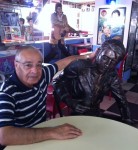
Uri Yoeli, left, at the Elvis Inn, his restaurant/convenience store/gas station in Neve Ilan. (photo by Deborah Fineblum Schabb)

To appreciate how much Israelis love Elvis Presley, you just have to hear three generations of the Mizrachi family of Rehovot crooning, “Wise men say only fools rush in … but I can’t help falling in love with you.”

The Mizrachis – mom Aliza, sons Asaf and Yehoram, and granddaughter Kahila – had just downed some American-style burgers at the Elvis Inn, a restaurant, convenience store and gas station that proudly claims to be the only Israeli institution devoted to “the King.” And they were busy inspecting the impressive Elvis memorabilia and tchotchke collection on the premises.

Drivers passing through this corner of the hills surrounding Jerusalem often do a double take from the car window when they spot not one, but two way-more-than-life-sized statues of Elvis. Unless, of course, they’re among those who, like the Mizrachis, make a special pilgrimage to the Elvis Inn, located in the small hillside town of Neve Ilan.

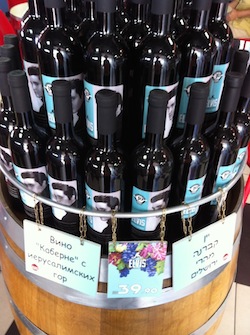
photo - Elvis-themed bottles of wine on sale at the Elvis Inn
Elvis-themed bottles of wine on sale at the Elvis Inn. (photo by Deborah Fineblum Schabb)

Where else can Israelis hear all Elvis, all the time, piped into a 1950s-style diner while they feast on burgers and fries? Where else can they purchase an Elvis mini-alarm clock, a platter-sized “Elvis in Jerusalem” plate, or a postcard with Elvis wearing tefillin in front of the Western Wall? (The latter souvenir comes thanks to Photoshop, since the King was never in Israel – the closest he got was Germany, and there is no evidence that he ever wore tefillin.) Better yet, buy a cup of coffee for 15 shekels (about $5 Cdn) and you get the ceramic Elvis mug to take home as a souvenir.

But nothing of this Elvis sanctuary was in the picture when Uri Yoeli was a 12-year-old growing up in Jerusalem, the seventh generation of his family to do so. The year was 1958 and the Israeli preteen had a girlfriend who was a hardcore fan.

“She gave me a picture of a man and said it was someone named Elvis,” he recalled. “The next week she gave me a small record – One Night with You.” Back then, his family owned one of just a handful of gramophones in all of Jerusalem, and being willing to repeatedly play the Elvis record instantly made Yoeli one of the most popular kids in the neighborhood.

“I didn’t understand one word of English but I knew this was great music,” he said nearly six decades later. So began a lifelong devotion to the King, punctuated with trips to Graceland (Elvis’ Memphis shrine) and an impressive collection of Elvis memorabilia, much of it now on display at Yoeli’s Elvis Inn.

Even during his years of Israel Defence Forces service, Yoeli’s Elvis fascination continued; he bought whatever posters and records he could get his hands on. In 1974, when he had the chance to open a gas station in Neve Ilan, he put a few of the Elvis pictures on the wall behind the cash register.

“That’s when I saw people’s reaction: ‘Wow, Elvis!’” he said. Thus, the Elvis Inn was born.

Over the years, the venue has grown, adding the two oversized statues – the brass one is a towering 16 feet high – and attracting not only Israelis, but plenty of Americans on vacation looking for some old-fashioned home cooking. (Note: any Elvis fans who keep kosher will have to pass on the food at the inn.)


To read more, visit jns.org.

Tips for holiday fasting

Judaism requires men and women to fast at specific times throughout the year. On Yom Kippur, the holiest of days, fasting – no food or drink – from sunset to sunset, is part of our path to achieve atonement.

By not putting food or drink into our mouth, we no longer stimulate the salivary glands and thereby prevent them from producing saliva. This can produce bad breath, among other things. Saliva aids digestion because it contains enzymes and chemicals that begin the initial breakdown of the many components in our foods; as well, it maintains the balance in our mouth between harmful and helpful bacteria. Here are 10 tips for the upcoming fast.

  1. Drink 64 to 80 ounces of water during the 24-hour period before the fast begins to replenish the saliva. On a typical day, we use up to 50 ounces of saliva and fasting may increase this amount.
  2. Avoid all alcohol during the 24-hour period before the fast begins. As well, note that most mouthwashes can contain up to 27% alcohol and, therefore, create a dry mouth, making our breath worse, not better.
  3. Use an alcohol-free, oxygen-rich mouthwash, which can increase saliva by four percent.
  4. Avoid toothpaste containing sodium lauryl sulfate (SLS), scientific term for soap, before and after the fast. SLS, an ingredient put into most toothpaste formulas to create a foaming action, is a severe drying agent. According to recent studies, SLS can lead to canker sores.
  5. Avoid breath mints and gum that contain sugar, before and after the fast. Sugar feeds all types of bacteria, especially those that create bad breath, gum disease and tooth decay.
  6. Avoid acidic vegetables, such as tomatoes, and fruits, such as grapefruits, oranges and their juices, during the 24-hour period before the past begins. These acids remain on the tooth surface and, due to the lack of saliva during the fast, they cannot be naturally neutralized.
  7. Eat lots of fruits and vegetables that contain a lot of liquid, such as apples, strawberries, blueberries, raspberries, blackberries, watermelon, celery and carrots. As an aside, eating parsley won’t help!
  8. Take all medications – primarily antihistamines, high blood pressure meds and antidepressants – immediately before the fast begins with lots of water. More than 75% of prescription medications have dry mouth syndrome as a side effect.
  9. Do not skip breakfast or any meal during the 24-hour period before the fast begins.
  10. Do not schedule a medical procedure that requires avoidance of food and drink during the 24-hour period before the fast begins.

For more information, visit therabreath.com.

ראיון עם טימה כורדי חלק א

(צילום: Facebook)

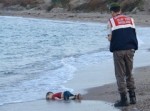
רציתי לדבר עם טימה כורדי ולשמוע קצת על תחושותיה הקשות, לאחר שאיבדה בראשית החודש את שני האחיינים שלה וגיסתה, עת ניסו לחצות עם אביהם עבדאללה כורדי את הים התיכון, בסירה עמוסה בת 16 פליטים של מבריחים, מטורקיה לאי היווני קוס. המסע הפשוט כיביכול שהיה אמור לקחת כחצי שעה, הפך לאחד האירועים המשמעותיים ביותר בתקשורת העולמית בתקופה האחרונה. וזאת לאור תוצאותיו ההרות אסון. האם ריהאם ושני בניה הקטנים גאליפ בן החמש ואיילאן בן השלוש טבעו למוות, ביחד עם עוד כ-12 פליטים סורים, לאחר שהסירה התהפכה בים הגועש. לאחר מכן, גופתו של איילאן נמצאה שרועה על החול בחופה של עיר הנמל הטורקית בודרום, והתמונה הזאת שתיזכר לעד, מסמלת יותר מכל את הטרגדיה האנושית עצומת הממדים של מלחמת האזרחים, שמתרחשת כל יום בארבע וחצי השנים האחרונות בסוריה, וגבתה כבר מחיר נוראי של למעלה ממאתיים אלף הרוגים, בהם ילדים רבים. גם הים התיכון עשה את שלו ולפי הערכה למעלה מאלפיים פליטים סורים טבעו בו.

שלא מרצונה הפכה טימה כורדי לדמות מבוקשת על ידי כל אמצעי התקשורת בעולם. זאת לאחר שחשפה את זהותה מול מצלמות הטלוויזיה, בראשית החודש, עת הזדהתה ואמרה כי היא הדודה של גאליפ ואיילאן הקטנים, ויש לה מה להגיד לעולם.

כורדי בת הארבעים וארבע עברה לקנדה ב-1992. היא נשואה כיום לקנדי ממוצא איטלקי בשם רוקו לוגוזו, ומחזיקה בסלון ליופי בעיר מגוריה קוקוויטלאם.

התקשרתי לביתה של כורדי ולוגוזו ענה. ביקשתי לדבר עימה ולאחר שהוא בדק איתה, ענה לי בנימוס, כי כורדי עייפה מאוד וכבר אין לה כוח לדבר עם התקשורת, לאחר שעיתונאים מכל העולם פונים אליה. הוא סיפר לי בקצרה מה קורה עם משפחתה הקרובה של כורדי, שיש לה שלוש אחיות ושני אחים ואב. אמה נפטרה לפני למעלה מעשר שנים. האב ואחת האחיות גרים בדמשק, ושאר האחים והאחיות שגרו בעיירה הכורדית קובאני שבצפון סוריה (הסמוכה לטורקיה), נמלטו עם המשכם של הקרבות הקשים וההרס הרב, ועברו לטורקיה. האח המבוגר במשפחה מוחמד (48) נמצא כרגע בגרמניה (בזמן שאשתו וחמשת ילדיו שוהים עדיין באיסטנבול). כורדי ניסתה להשיג אשרת הגירה לקנדה במעמד של פליטים למוחמד ומשפחתו, וזו נדחתה על ידי מחלקת ההגירה והאזרחות של הממשלה הפדרלית. בניגוד לפרסומים בתקשורת, היא לא הגישה בקשת הגירה לאחיה השני עבדאללה, שאיבד את משפחתו בים האכזר.

עם סיום השיחה, לוגוזו ואני סיכמנו שאנסה להתקשר שוב למחרת, ואולי אז כורדי תהיה במצב קל יותר ותוכל לשוחח עימי.
ואכן זה מה שקרה. התקשרתי למחרת ולוגוזו שוב ענה. הוא אמר לי שבדיוק הגיעו עכשיו אורחים לביתם. פלטתי שאולי אנסה להתקשר מאוחר יותר, אך הוא הספיק במהירות להתייעץ קצרות עם כורדי והעביר לה הטלפון. הרגשתי לא פשוט אחרי כל מה עבר עליה. כורדי כבר ידעה שאני עיתונאי ישראלי כך שלא היה צריך לפתוח בהסברים מי אני ואפשר היה לגשת מייד לשיחה. ביקשתי ממנה לספר לי על תחושותיה לאחר שאיבדה את שני אחיינה הקטנים וגיסתה. כורדי: “בדיוק אמרתי עכשיו לחברתי שהגיעה לביתנו, שאני לא יכולה לתאר לעצמי איך עבדאללה מרגיש עכשיו, לאחר שאיבד את כל משפחתו. הלוואי והייתי יכולה להיות איתו עכשיו בשעה הקשה הזו שלו. כואב לי מאוד מאוד כשאני חושבת עליו. הוא נורא שקט עכשיו ונמצא לבד בקובאני, היכן שילדיו ואשתו נקברו לפני מספר ימים. אני רוצה להוציא אותו משם ולהביא אותו אלינו בקנדה. אני רוצה לעזור לו. אבל מאוד קשה לדובב אותו. הוא נסגר בתוך עצמו”.

שאלתי את כורדי מתי היא ניפגשה לאחרונה עם האחיינים הקטנים גאליפ ואיילאן, והיא ציינה כי אף פעם לא ניפגשה עימם. “אבל כמעט כל יום הצלחתי לדבר עימם בטלפון, ולנחם אותם. הייתי מעורבת בחיים שלהם”. לפני קצת יותר משנה כורדי הגיעה לטורקיה כדי לפגוש את עבדאללה שהיה שם לבד, כיוון אשתו והילדים גרו אז בקובאני. עבדאללה הוא עבד בטורקיה והיה מבקר את משפחתו בקובאני בערך כל חצי שנה. מדוע הוא עבר בכלל לטורקיה אני שואל? “היו לו קצת קשרים שם והוא הצליח למצוא עבודה ולשלוח כסף למשפחתו. בקובאני המצב הלך ונהיה רע מיום ליום. המלחמה פגעה קשה מאוד בעיר והיה זה כמעט בלתי אפשרי עוד לשרוד בה. בדיוק בספטמבר אשתקד כאשר חזרתי מהביקור לקנדה, אשתו והילדים עזבו את קובאני ועברו אף הם לטורקיה, לגור עם אחי, ממש כאשר דאע”ש נכנסו לעיר והרסו את כולה”.

ומדוע עבדאללה רצה פתאם לעבור למערב אירופה, לגרמניה או למדינה אחרת קרובה? “מוחמד שהה כבר בגרמניה ואז עבדאללה חשב שאולי עדיף לעבור לשם, או נדמה לי שהוא תכנן לעבור לשוויץ, או אולי לאיטליה. זה לא היה ברור לי בדיוק. הוא האמין שבאחת המדינות האלה יהיה קל יותר להשיג עבודה, ולגדל את הילדים יותר בקלות. לגאליפ הייתה מחלת עור שלא מצאנו לה פתרון, והוא כל הזמן התגרד. לא יכלתי להביא אותם לכאן, ועבדאללה חשב שהמעבר לגרמניה או למדינה דומה יקל על הילדים הקטנים ויהיו להם חיים טובים יותר, לאחר שכל הזמן הם היו חולים וחלשים. וכן ימצא ריפוי למחלה של גאליפ”.

Blessings in our lives

Rabbi David Wolpe joins FEDtalks on Sept. 17 at Queen E. Theatre. (photo from Facebook)

When the man Newsweek calls the most influential rabbi in America gets up to speak in Vancouver this month, he may be as surprised as the audience by what he has to say.

“I really never know exactly until I get up to speak,” said Rabbi David Wolpe, who will be here Sept. 17 as one of four speakers at FEDtalks, the annual campaign launch of the Jewish Federation of Greater Vancouver. “I do this somewhat spontaneously and it will depend somewhat on what I hear the other people say because I don’t want to repeat what they would say.”

His talk, Inspiring Jewish Life, will address “something about the way in which our efforts have surprising and unanticipated consequences both in our community and in the world,” he told the Independent in a telephone interview.

Wolpe has also been dubbed one of the 50 most influential Jews in the world by the Jerusalem Post. He is the author of eight books, including the bestseller Making Loss Matter: Creating Meaning in Difficult Times. His most recent book, David, the Divided Heart, was a finalist for the National Jewish Book Awards. He has taught at the Jewish Theological Seminary of America in New York, the American Jewish University in Los Angeles, Hunter College and UCLA. He is a prolific writer and commentator.

Wolpe is the rabbi of Sinai Temple in Los Angeles, of which about half of the congregation are Jews of Iranian origin, which gives him an acute perspective on the nuclear deal between Iran and the P5+1 world powers.

“I would say in the Iranian Jewish community in L.A., the consensus is fairly strong against the deal,” he said. “It’s not unanimous, but it’s fairly strong.”

Wolpe sees a glimmer of hope but overall fears the deal is a bad one.

“The biggest reason for optimism long term is that the Iranian population is so young … and that many of those young people don’t support the theological or political views of their leaders,” said the rabbi. “That’s the reason long term for optimism and, of course, Iran and the United States have had an alliance in the past. Maybe one day that could be renewed.

“There is plenty of reason for worry, however,” he continued. “I, myself, oppose the deal. I think most of my Iranian congregants do as well. But whoever is correct about this deal, or no deal, I think that the prospect that Iran will get a nuclear bomb is both frighteningly real and just plain frightening.”

Wolpe is the son of a rabbi and has been taken aback by the persistence of global antisemitism across generations.

“When I started out in the rabbinate, I really did believe that, unlike my father’s rabbinate … antisemitism wasn’t going to be the theme of Jewish life anymore,” he said. “I really thought that. I thought it was on the wane. So, the resurgence through Europe is disheartening and pretty scary.”

Wolpe traveled in Europe this summer and sees little reason for optimism. “I wish I did,” he said. “The mood in Europe is very pessimistic.”

He believes that the United States is relatively well inoculated against antisemitism.

“Unlike the countries of Europe, the United States did not have an identifiable majority and minority,” he said. “Most antisemitism arose when there were the French and the Jews, the Germans and the Jews, the Russians and the Jews. The Jews were the clear, identifiable minority in most of these countries. That’s not true in America. We are a patchwork of minorities and, as a result … to be a Jew is not to be the one who stands out as being different.… America has historically not been a place that is hostile to Jews. Are there antisemitic acts? Yes. But I don’t see any serious signs that [tolerance toward Jews is] changing or threatens to change.”

Wolpe will be speaking at the event during the Days of Awe and said it is a good time to reflect on the positive.

“Rosh Hashana is really about our sense of gratitude, about the gift of everything that we have because we are showered with blessings,” he said. “Even though we focus on all the dangers and difficulties of our lives, we are just bursting with wonderful and extraordinary and often unprecedented blessings in our lives.”

For more information about and tickets to FEDtalks, visit jewishvancouver.com. Interviews with the three other speakers appeared in previous issues of the Independent: Irwin Cotler, Dafna Lifshitz and Eli Winkelman.