איילת כהן מונתה לרכזת התרבות הישראלית של הג’ואיש קומיוניטי סנטר
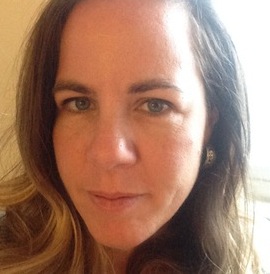
איילת כהן (צילום: LinkedIn)
לתפקיד רכזת התרבות הישראלית הקבועה של הג’ואיש קומיוניטי סנטר של מטרו ונקובר, מונתה בימים אלה הישראלית איילת כהן. היא מחליפה בתפקיד את אליין זהבי, ששימשה ממלאת מקום זמנית. זאת מאז שדפנה זילברשטיין יצאה לחופשת לידה (ולא תחזור למלא את התפקיד). כהן במקצועה היא בימאית, מפיקה ועורכת סרטים בתחום הקולנוע והטלוויזיה. היא סיימה לימודי תעודה בהפקות דוקומנטריות בלנגרה קולג’ שבוונקובר, והוציאה תואר ראשון בתחום המדיה ותקשורת המונים במכללה למנהל בתל אביב.
בחמש השנים האחרונות עובדת כהן כבימאית, מפיקה ועורכת עצמאית בתחומי הקולנוע והטלוויזיה, באזור ונקובר. בשנת 2011 היא עבדה בהתנדבות כמפיקה ומתאמת בפסטיבל הסרטים הבינלאומי של ונקובר. בישראל עבדה כהן כמפיקה עצמאית בתחום הטלוויזיה במשך כשבע שנים. וקודם לכן היא עבדה במשך כשנתיים בזכיינית של ערוץ 2 קשת. היא דוברת עברית, אנגלית וצרפתית.
על רשימת האירועים שכהן מארגנת בימים אלה לקראת ראש השנה: ערב שירה בציבור עם מרים בני, משה דנבורג ויונה בר סביר. האירוע יתקיים ביום ראשון ה-20 בחודש בשעה שבע בערב.
מתחתנים סידרתיים: זוג קנדי שהתחתן כבר שתיים עשרה פעמים נערך לאירוע נוסף – חתונת ההמזל
זוג מהעיר ויניפג פשוט מכורים לטקס החתונה. הם הספיקו להתחתן כבר לא פחות שתיים עשרה פעמים במקומות שונים ברחבי העולם. ובימים אלה איך לא, השניים נערכים לחתונה השלושה עשר במספר, שתתקיים בקרוב במונגוליה. עדיין לא ברור אם “חתונת המזל” כפי שהם קוראים לה, תהיה גם החתונה האחרונה שלהם, או שחתונות נוספות צפויות לבוא אחריה.
קרל פיקס (65) הוא פנסיונר ובעבר היה בעלים של חברת בנייה, ואשתו היפה סנדי באג (55) שהיא רופאת שניים, התחתנו לראשונה בחודש ינואר שבשנת 2004 בדרום אפריקה. אך כיוון שבאג איך שהוא איבדה את תעודת הנישואין שלהם, הם קבעו מייד להתחתן שלוש פעמים נוספות. מתברר שטקס החתונה וירח הדבש כל כך מצא חן בעיני פיקס ובאג, עד שהם הם התמכרו לנושא, והתחתנו עוד אחת עשרה פעמים נוספות, כאמור במקומות שונים בעולם. אגב את כל החתונות אירגן פיקס לבדו ללא התערבות באג. על חלק של החתונות הוא עבד במשך חודשים בסודיות מרובה, ובאג גילתה את דבר החתונה החדשה שבפתח ממש ברגע האחרון. רשימת המקומות בעולם הם המתחתנים הסידרתיים התחתנו כדלקמן: גרמניה, קנדה (בעיר ריג’יינה בה בנו את ביתם החדש ובו הם גרים עד היום), סורינאם, אתיופיה, נפאל, מוזמביק, בגו’נגל של יערות האמזון, לאס וגאס, טימבקטו שבבאלי ומונטה. החתונה האחרונה בסידרה עד כה צריך לציין, התקיימה לפני כחודש, על אוניית שייט במסגרת קרוז מול הקרחונים של האי גרינלנד. יצויין שבכל טקסי החתונות פיקס ובאג לובשים בגדי חתן וכלה מסורתיים, הנהוגים באותו מקום. עד היום מתברר שהזוג המאושר טס כבר למאה מקומות שונים ברחבי העולם, וניסיון העבר מלמד שידם עוד נטויה.
פיקס מציין כי בסך הכל יש להם רק חמש תעודות נישואין רשמיות, ובשאר טקסי החתונות לא הנופקו להם שום מסמכים. הוא מוסיף כי החתונות הרבות מבטיחות לו שבאג תישאר עימו לעד, כיוון שיהיה לה מאוד קשה למצוא עורך דין שיוכל להשיג כל כך הרבה תעודות גירושין, מכל כך הרבה מדינות בעולם. שלא לדבר שוזה יעלה לה גם הון. ואילו באג מוסיפה כי טקסי החתונות הרבים מוכחים את אהבתו הגדולה של פיקס אליה וזה כל מה שחשוב לה באמת.
Left to right: Playwright Vern Thiessen, composers Anton Lipovetsky and Ben Elliott and novelist Terry Fallis, whose The Best Laid Plans will see its musical première at York Theatre on Sept. 19. (photo from terryfallis.com)
It’s going to be a busy fall for author Terry Fallis. Already working on his sixth novel, his fifth is due in bookstores this October. And his first novel – which saw a CBC television adaptation in 2014 – will have its première as a musical at Vancouver’s York Theatre Sept. 19-Oct. 3.
For anyone who has dreams of being a successful author, Fallis is a beacon of hope. While the best laid plans of mice and men may often go awry, or “gang aft a-gley,” as wrote Scottish poet Robert Burns, Fallis’ rise in publishing is a tale about the good places to which awry can lead you. Many in the industry point to the internet as the main cause of publishing’s demise, yet that’s where Fallis’ The Best Laid Plans (McLelland and Stewart Ltd., 2007) – and his novelist career – got started.
A public relations professional, Fallis and a colleague created a podcast in 2006 called Inside PR. It occurred to him, he said in a phone interview from his office in Toronto, that, “in this emerging world of social media, where we are our own program managers … I would try that in the publishing world. When I couldn’t find anyone to take an interest in my first novel – I didn’t even get rejection letters, I was greeted with a deafening silence, perhaps because I’d written a satirical novel of Canadian politics – I decided to try and build an audience for it on my own. That’s when I decided to podcast the whole thing for free and give it away on iTunes and on my blog, just as a way to gather some kind of a following and to see whether or not I had written a novel because I honestly didn’t know whether I’d written a novel, so I was looking for objective feedback from anybody I could interest in listening to it.”
McLelland and Stewart Ltd. have since published every one of Fallis’ novels, all bestsellers, critically acclaimed and award nominees or winners. He remains loyal, he said, “to the podcast listeners and blog readers who were there right at the very beginning, who gave me that feedback and were encouraging. Without that support, it’s an open question of whether or not I would have self-published the novel. And, if I hadn’t self-published the novel, none of the rest of these wonderful things would have happened.”
In his continued appreciation, Fallis still shares content for free and listens to what people think of it. “Now, generally the book is finished by the time I podcast it,” he said, “so, to be clear, when I’m looking for feedback, it’s not so much that I want advice on how to change the novel, it’s more that I think it’s important for authors to be accessible to their readers. When the reader’s interested, you can actually have a contact, and I find that an important part of being a writer.”
Fallis said he loves both the “isolated solitude that comes when you’re in writing mode” and also gets “a charge out of traveling around and meeting readers and talking about the books, and talking to other writers. And I teach as well,” he added, “at the University of Toronto, in the writing program, and I like all of that stuff and I feel lucky that I happen to have both sides of that working for me.”
With more people reading these days than ever before, Fallis has hope in the publishing industry’s future. Acknowledging that people are “finding their content in many more places than were available 20 years ago,” he said, “I think this new world opens up a whole bunch of opportunities for writers and for publisher alike, and the ones who are surviving have embraced that which is new…. So, I think there are real opportunities, and writers can get their work in front of more eyes than ever before, even if they’re not published. There are websites and apps available, and communities online that will welcome new writers, and it’s sometimes a route to traditional publishing as, in a way, it was for me.”
When Touchstone Theatre’s Katrina Dunn contacted him and his agent about the possibility of adapting The Best Laid Plans into a musical, Fallis said, “We were really quite impressed with Katrina and Touchstone and Patrick Street Productions and what they had done in the past, and their vision for the musical, so it seemed like the right way to go – and we’ve been thrilled ever since.”
While he has yet to see the show, he has heard a few of the songs and read a portion of the script. Last fall, at the Vancouver Writers Festival, Fallis participated in a session with Dunn, playwright Vern Thiessen, composers Anton Lipovetksy (a member of the Jewish community) and Ben Elliott and director Peter Jorgensen of Patrick Street Productions. “They had a singer as well, and Anton and Ben both sing,” said Fallis. “And, for the first time ever, while I’m sitting on stage in front of this packed hall, I was hearing the songs for the first time, at least a few of them, and that was strange. I was very conscious of – people are watching you now as you’re reacting to the song, make sure that you’re polite, and I loved the songs, there was no need to be concerned, they were terrific. It was a great experience, and quite surreal to hear someone singing about characters I had created and carted around in my brainpan for so many years.”
While many of Fallis’ characters do indeed face challenges that arise from plans gone wrong, his novels are humor-filled and uplifting. He said that he is, by nature, an optimistic person.
“I think I see the world through relatively clear eyes,” he said, “but, I figure, if we have some choice in the matter, of crying or trying to find the thin, little sliver of goodwill somewhere in the story, I will go there. I don’t usually have much trouble finding humor in it. I grew up in a family where humor was just a daily staple.
“I think there’s a certain engineer’s logic in how I think about things, as well,” added Fallis, who got a degree in engineering before being lured into politics, where he worked in various capacities before entering the PR world, eventually co-founding Thornley Fallis. “If something happens and it can’t be changed, and we have no control over it, I don’t spend a lot of time wondering why it happened. You just move on, and I try not to dwell on it.”
Fallis credits growing up with an identical twin for helping form this positive attitude. He also has a younger sister – “We all get along wonderfully,” he said, “It’s rather an idyllic little family” – but “having someone you’re exactly the same age as and [who is] exactly like you, there is always someone to goof around with … having a twin brother to trigger that at every moment of every day was part of that, for sure.”
As is his innate curiosity. “I’m fascinated by so many things,” he said. When he was interested in something as a boy, he “would read every book around” on it and his mother would say, “’Terry’s on one of his kicks’ … you can’t imagine how many things I was interested in for short bursts of time, and I’ve maintained an interest in most of them, but not with the same intensity. The library became my friend and I find it stimulating and fulfilling.”
Curiosity is something, he said, that he and his wife have encouraged in their sons, now 23 and 20, who will be joining them on the trip to Vancouver for the première. “Curiosity is a wonderful gift,” said Fallis, “and I feel sorry for those who don’t have it in the same amount that I do.”
Now in the midst of plotting out his next book, which is going to be about twins – though the protagonist “doesn’t know he’s an identical twin until some ways into the book” – Fallis explained his creative process. Describing himself as “a heavy outliner,” he said, “The last thing I ever do is write the manuscript, and that’s right at the tail end of the process. The last four months I spend writing the manuscript, the previous year I spend thinking about it, mapping out the story, plotting it, developing the characters, and then doing a chapter by chapter outline. That’s the engineer in me – I need a blueprint for my novel before I can build it.”
For tickets and more information about The Best Laid Plans: A Musical, visit tickets.thecultch.com or call 604-251-1363.
On Sept. 20, the Centre for Israel and Jewish Affairs and SUCCESS are co-hosting Election 2015 Townhall. The Conservative, Liberal, New Democrat and Green parties have been invited to have a representative answer community members’ questions.
“Although the parties are well aware of the broad topics to be covered at the forum, neither the parties nor their candidates will be told the questions beforehand,” Jason Murray, chair of CIJA Pacific Region Local Partners Council, told the Independent. “It’s important to note that the townhall is not a debate, but an important opportunity to hear candidates address issues important to the communities served by SUCCESS and CIJA. The event will be open to the press.”
Jason Murray, chair of CIJA Pacific Region Local Partners Council. (photo from CIJA-PR)
The selection of the representatives has been left up to the parties, said Murray, “with the only requirement being that the candidate is nominated in a Metro Vancouver riding.”
The broad topics – immigration, employment, seniors’ care, security and the economy – are just some of the issues in which CIJA and SUCCESS share an interest, said Murray. The partnership in organizing the townhall, he said, “allows us to gain strength with greater numbers, bringing together our communities to advocate with candidates seeking office. Working together allows us opportunities to view these issues from each other’s perspectives.”
This is not the first time that SUCCESS has worked with the Jewish community.
“SUCCESS and CIJA’s predecessor, the Canadian Jewish Congress, have a long history of collaborating on civic engagement programs, including townhall-style events around municipal, provincial and federal elections,” said Murray. “Professional and volunteer leaders from SUCCESS and CIJA have continued to collaborate between elections, particularly in helping each other nurture advocacy efforts. We hope to continue to build on what we see as a solid foundation and to continue to bring together SUCCESS and our Federation and Federation’s partner agencies.”
“Both CIJA and SUCCESS are nonprofit and non-partisan organizations that are dedicated to improving the quality of life of newcomers in Canada by advancing the public policy interests of Canada’s communities,” Queenie Choo, chief executive officer of SUCCESS, told the Independent. “We have commonalities and strong values in these areas. Hence, it is a perfect fit as partners in this event.”
Queenie Choo, chief executive officer of SUCCESS. (photo from SUCCESS)
SUCCESS has sponsored other townhalls and information sessions, said Choo. “We have done it in the past for provincial and municipal pre-election forums. At this point, we are focusing on this townhall opportunity to ensure people are informed of the party positions on our topics, such as immigrants, seniors, housing, employment and security. It is also part of our mandates on promoting civil education and responsibility.”
Choo explained, “SUCCESS is one of the largest nonprofit social service agencies in B.C. that provide services for immigrants, seniors and people who need affordable housing. The topics of focus at this townhall really support our mission – one that builds bridges, harvests diversity and fosters integration through service and advocacy. Through this event, we hope to gain a better understanding of each party’s position on these subject matters, advancing our mission in these three key areas going forward.”
She added, “It is important that people are well informed of the positions and platform represented by each party in order to vote for what they believe in. People are encouraged to vote and be able to elect the party that can best represent them and their community.”
“In advocacy,” said Murray, “there is no substitute for in-person engagement. The Jewish community is a relatively small community in Canada and, particularly, in British Columbia. Through more intensive involvement in the political world – whether volunteering, serving as party activists, or running for office – Canadian Jews can make a disproportionate impact beyond the ballot box.
Community members must send their questions in advance to vancouver@cija.ca. The Election 2015 Townhall takes place Sept. 20, 2:30 p.m., at Choi Hall (SUCCESS main offices), 28 Pender St.
Eli Winkelman was just looking for a way to fit in at college. But her quest for a niche resulted in an international philanthropic phenomenon.
Winkelman’s passion for making challah caught fire with fellow students and she ended up founding one of the most familiar – and foodie-friendly – philanthropic endeavors in the Jewish community today.
Challah for Hunger is now known to thousands of students on campuses throughout Canada, the United States, Australia and elsewhere. Volunteers gather to make the irresistible braided loaves, then sell them to fellow students and divide the profits between a local charity and a designated national cause.
Winkelman, who founded the international movement, will be one of four speakers at FEDtalks, marking the launch of the Jewish Federation of Greater Vancouver’s annual campaign Sept. 17. She will speak on Chesed (Loving-kindness).
Winkelman’s expertise in challah came, as it has for centuries of women, through her mother. But where some recent generations have let the challah thread drop – who has time to knead, braid, bake? – Winkelman’s choice to become vegan sort of changed history.
“I decided to become vegan in high school and [her mother] said, ‘OK, but you’re making your own challah,’” she recalled.
When she arrived at the Claremont Colleges outside Los Angeles in 2004, Winkelman started baking challah for Shabbat dinners at Hillel.
“People heard that I was baking and they showed up to learn from me randomly,” she said. “And every week they came back and they complained that all their friends were eating their challah. So, I saw that there was demand for bread and demand for the activity of making the bread and I thought that we should scale up and do it for a good cause.”
Within two or three months of starting school, Winkelman had launched Challah for Hunger, selling 15 loaves. Her group started out baking in the dorm kitchen, then moved into the kitchen of the campus interfaith centre. They eventually got permission to use the dining hall kitchen.
The national charity is MAZON: A Jewish Response to Hunger. Local chapters can determine the cause to which they want to allocate the other 50% of profits. Some chapters, like at Emory University in Atlanta, have been supporting the same cause for years (in Emory’s case, a refugee assistance agency). Other campuses operate differently. At Stanford, for example, the chapter partners with other clubs every week and they choose a different designated recipient each time.
“Different chapters approach it differently, which I really love because they are figuring out how they want to be givers,” she said.
Winkelman is no longer operating the organization’s day-to-day activities – she’s started a business in Austin, Tex. – but she is on the board of directors and closely follows the progress. There are now more than 70 chapters worldwide, each baking 30 to 300 loaves, usually weekly. Sometimes they defy tradition and add chocolate chips, cinnamon sugar, sun-dried tomato or other innovations. Canada’s sole chapter is in Montreal.
Baking and sharing bread is an ancient, symbolic and ritualized process. Challah for Hunger makes it social in a way that may be particularly suited to undergrads finding their place and new friends.
“Part of how I define Challah for Hunger is doing it together and doing it on a regular basis so that it becomes a community,” she said. “For me, that is core to the organization. That’s how people learn and grow, by interacting with each other. Especially when you’re baking bread, your hands are engaged in something so you’re busy and that means that you can have a conversation or not have a conversation or have whatever kind of conversation you want with the person next to you. It really doesn’t leave any awkward quiet time.”
For more information about and tickets to FEDtalks, visit jewishvancouver.com. Interviews with fellow speakers Irwin Cotler and Dafna Lifshitz appeared in previous issues of the Independent, and Rabbi David Wolpe will be featured next.
Itamar Erez will perform together with Liron Man and François Houle on Sept. 11 at VCC Music Auditorium. (photo from CWR)
On Sept. 11, Itamar Erez takes to the stage with two of his “favorite musicians on earth”: Liron Man and François Houle.
Presented by Caravan World Rhythms, World Trio will take place at Vancouver Community College Music Auditorium. Just last month, Erez returned from Germany and Tunisia; he leaves for Colombia about a week and a half after the VCC concert.
“It has been busy and not always easy touring,” Erez admitted to the Independent, “but the thing is that I really enjoy sharing my music with new audiences around the world and it gives me more energy and enthusiasm to continue in my way and to create and perform.
“This year, I have played in Germany, Austria, Cyprus, India, the U.S.A., Canada, Tunisia, to name a few places. Tunisia was definitely a highlight. I played with Omar Faruk Tekbilek, the great sufi musician, in front of 6,000 people, got to visit the old city of Carthage and Sousse, and enjoyed the good Tunisian food and their warm hospitality. This summer, I also performed (with my percussionist, Yshai Afterman) at the Jewish Museum in Berlin, which was great. And, a few days later in Freiburg, we collaborated with Iranian musicians from Isfahan in a program called Face to Face – Music from Iran and Israel. It was really an amazing experience.”
Last year was also a remarkable one for Israel-born Erez, and not just for his many performances. Adding to the honors he has received over the years for his work, he garnered the 2014 ACUM and Landau prizes for special achievement in jazz.
Erez has two CDs with the Adama Ensemble – Desert Song (2006) and Hommage (2010) – and one with Afterman, New Dawn (2013). About his work with Afterman, a fellow Israeli, he said, “This duet has been working since 2011 and is touring extensively in Europe and Asia. We are very proud of this CD – in a duet setting, there is a lot of freedom to each musician, but at the same time you cannot hide behind other musicians. There is a lot more responsibility to each of us, so it is very challenging.
“Antonio Serrano, master of the harmonica, who collaborated for a long time with Paco De Lucía, until his [De Lucía’s] recent death, is a special guest on this album and can be heard in two tracks,” added Erez, who is currently working on new material for an upcoming CD.
Erez (piano and guitar) will be joined by Man (handpan and percussion) and Houle (clarinet) at VCC.
“I have known François for a long time,” said Erez. “He premièred some of my music when I lived in Vancouver at the end of the ’90s. I was always impressed by his creativity and musical skills but we never got to collaborate together until now. François is a musician who can play anything, in any style, and always keep his own unique voice.
“Liron is a good friend and a brilliant musician,” he continued. “We started together the Lavo Ensemble in Israel about two years ago and toured there. Liron is one of the best handpan (known also as Pantam or Hang) player in the world, and a great flamenco guitarist. His energy for making music is really contagious.”
Since this past July, Erez once again calls Vancouver home. When he returns from Colombia, where he will play with the Lavo Ensemble, he will have a solo guitar set at West Coast Guitar Night on Oct. 17 at the Cultch. “I will also be teaching at the VSO School of Music starting this fall,” he noted.
Now that he has moved back, there will hopefully be many more opportunities to hear him play.
VCC Music Auditorium is at 1155 East Broadway St. Tickets for the Sept. 11, 8 p.m., concert are $20/$30 in advance from caravanbc.com or 1-800-838-3006, and $25/$35 at the door (students receive a $5 discount).
Susan Freedman was inspired by her parents’ love letters. (photo from Susan Freedman)
Among this year’s Vancouver Fringe Festival offerings are several one- person shows, including Spilling Family Secrets by Susan Freedman and The Inventor of All Things by Jem Rolls – both of which have had soldout performances and received high praise on the Fringe circuit. The Independent spoke with each artist about their creation.
Spilling Family Secrets is Susan Freedman’s fourth one-woman Fringe show. Its basis is love letters that her parents wrote to each other between 1927 and 1937, which she melds with stories of her own “marital misadventures.”
JI: You’ve performed Spilling Family Secrets at other Fringes. What has some of the audience feedback been?
Susan Freedman, creator of Spilling Family Secrets. (photo from Susan Freedman)
SF: I’ve had terrific audience feedback on this show – and a lot of it! People talk to me about the letters themselves. They are very touched by them. People tell me about how they have seen/found their parents’ or great-grandparents’ love letters. Sometimes the letters have been burned! Sometimes people tell me they’re going to go back and look at them again.
I’ve had many people talk to me after the show about their marital and family issues. It’s an intimate show and people sometimes feel that because I’ve shared my stories, they are comfortable sharing theirs. There is lots of laughter in the show and often some teary-eyed audience members at the end. Yesterday, I had a woman (in Edmonton) run up and give me a huge hug. I’d never seen her before but she was very emotional and positive about the show and felt comfortable coming up to me like that. Pretty lovely!
JI: Sometimes in performing a role more than once, different understandings develop along the way. Have new revelations about your parents, your “marital misadventures” or other parts of the material arisen over the last year-plus?
SF: I am struck by how patient my parents were and how impetuous I was in my love life. More and more, as I do the show, I realize the great benefit in really getting to know the person you are going to marry – before you marry them! I’m more grateful than ever that my parents had such great values, and I realize my good fortune in having had them as parents. I love doing this show and when I mentioned that to my daughter, she said: “Of course you do. You get to spend time with your parents at their best.” It’s true. In their letters, they were young and hopeful and, as my father said in a letter written to Brownie in 1929: “I don’t think we will ever grow old.”
JI: Could you give a brief overview of your creative process, taking the letters from, well, letters, to a performance?
SF: [In the program, it explains:] “My parents’ love letters filled 75 pages – single-spaced – when I transcribed them in 2012. I did it because Brownie and Sam’s 80-year-old letters were too fragile to pass around and I wanted a record of their love story for the family. The letters were long, intimate and wonderful to read. But I do Fringe shows, so I wanted to use the letters in a show. Reading letters on stage is a challenge, so I edited – a lot. I hope what’s left gives you a flavor of Brownie and Sam’s personalities and their relationship….”
That’s what happened. And then I started to combine and add the events from my own life (and my daughter’s) that related to love, the letters and the milestones in the letters. I worked with a wonderful dramaturg-playwright, Lucia Frangione, and she pushed me, asked the right questions and helped so much. Everyone needs a great editor, right? She is mine. I worked with her until I had a good “rehearsal script,” a year ago April.
By now, I’ve done 18 drafts … and I’m pretty pleased with it. It’s just 45 minutes (including time for laughs) and it seems to be a very simple show. It took me a very long time to make it look simple!
I have continued to make small changes and, if I do it again next year (I’d still like to do Montreal and Ottawa Fringes), who knows, maybe more changes.
* * *
Jem Rolls introduces Fringe audiences to Hungarian Jew Leo Szilard (1898-1964), who Rolls believes is a hero. (photo from facebook.com/jem.rolls.1)
Jem Rolls’ The Inventor of All Things is based on the life of Hungarian Jew Leo Szilard (1898-1964): “peacemaker, physicist, refugee, celebrity, Martian, and more. And very funny. Hated by generals, first to think of the atom bomb, and too good to flush his own toilet.”
JI: When did you first “discover” Szilard? What went into creating Inventor?
JR: I was stuck in Dauphin, Man., one Christmas with nothing to read but a cheesy book on Nazi science, which led me to [Austrian Jewish physicist] Lise Meitner and her nephew Otto Frisch, who have a bunch of great stories I could imagine telling, most notably the famous walk in the snow on Christmas eve of 1938 at Kungälv, where she’s just escaped the Nazis by the skin of her teeth, and Auntie Lise and Nephew Otto discuss the strange results in Berlin and suddenly realize that they have all already been splitting the atom in their labs for years – a massive realization which opened everything up.
And that looked like a great story, but then it led me to the funniest, craziest guy of them all – Leo Szilard … he’d thought of the nuclear chain reaction and, so, the bomb, five years before, when he escaped the Nazis in 1933 and was stateless in London.
If he wasn’t so funny, and so preposterously eccentric, I wouldn’t have a show – it would be too dry and hefty. And the fact he’s forgotten just made it all the better to do, especially as the chief reason he’s forgotten is an antisemitic American general deliberately deleting him from history and the fact it’s such a big story of real historical reach. It’s like Frankenstein’s monster: he is the man who forced the atomic bomb genie out of the bottle – because of his fear of the Nazis – and then desperately tried to get it back in again when the German defeat was certain.
I have been thinking about the show for years, and I would explain my ideas to loads of people on the Fringe tour and they all said, “You should do a show about this,” so, in the end, I have.
I’m a performance poet by trade and, though I’m loath to leave that for awhile, the change has been great and, as it’s storytelling, I’ve had to make myself coherent and completely understandable, which has never quite been a priority before. Plus, performance poetry is a very good place to venture into storytelling from. I have all manner of vocal and physical and linguistic tricks I am thoroughly enjoying deploying in a tight historical narrative.
JI: When and where did you first perform Inventor? What are some of the ways in which you have adapted your performance or the content, if at all, as you’ve performed it?
JR: I wrote the show in Cyprus … having been thinking about it for years, and I edited it and learnt it up the Rio Negro in the Brazilian Amazon, in a lovely small town no one goes to called Barcelos and on the front of the slow boats which ply the reaches of the Amazon…. The journeys take days and I would sit on the front all day watching the unchanging jungle go by and muttering the script to myself as the sun arced the unchanging sky.
The process is a long one: years of thinking and reading/researching, a quick first draft and then a long four-month process of learning and editing to get the story in shape, which involves months of agonizing times, throwing bits out of the show that I really like till I have a tight, coherent thing which still has to be performed.
I always open in Montreal, and only then do I find what the show really is, and then there’s weeks of battle to get a show I am happy with and which my performance is doing justice to. It’s also a struggle to make oneself physically and mentally tough enough to give the show what it needs day in and day out.
Doing the show has forced the horrible realities of the times upon me. I know all the history, of course, but to follow the life of this guy who escaped the antisemitic reaction in Hungary in 1919, then the Nazis, who did so much to help his fellow Jews, who never finished any work because he’d always already had another brilliant idea … I really like the guy. I tell the audience I think he’s a hero, that I’m going to prove he’s a hero. Everyone likes their forgotten heroes and, when I show the audience that he was the chief wrecker of the Nazi bomb, I get a huge round of applause for the guy. One can make the claim that a Jew doomed Hitler – and that man is Szilard. And the forgotten-ness of the story is shocking – why hasn’t [Steven] Spielberg made a movie out of him?
I’ve had some very nice times with the show. I’ve been blessed in Hebrew by an old singer. I’ve had very respectable, well-dressed young men come up to me and shake my hand and say, “Well, I’m a Hungarian Jew and no one ever told me that story,” and I had a professor emeritus of physics from Toronto literally bouncing up and down in glee after show, Bob Logan, a Brooklyn Jewish guy who actually met Leo in ’57 and loved the show. I’ve had an Einstein scholar who had to go back and check his research and see that, yes, I was right, and he’d never realized certain things about Einstein because I am putting together Szilard’s story in a way that no one ever has – I am going for the drama, for the cliffhangers, for the big moments, and there a number of very big moments from 1933-1945.
***
Among the one-person shows at this year’s Vancouver Fringe Festival, which runs from Sept. 10-20, are also:
Comedienne Windy Wynazz takes a unique view of the life of a showgirl in UnCouth. (photo by Lynne Fried)
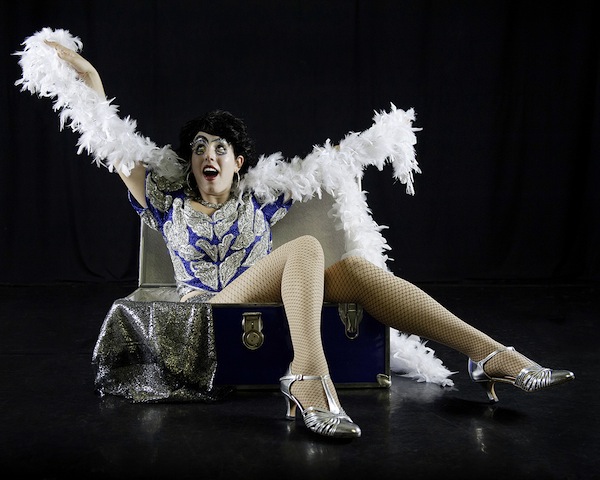
UnCouth (14+), created by Windy Wynazz with Dan Griffiths, and performed by Wynazz. The show is “a bawdy, campy, comedy cabaret, drawing for inspiration on real-life experiences of being teased in school, falling in with a ‘bad crowd,’ and heteronormative gender expectations,” Wynazz told the JI. The 2014 San Francisco Comedienne of the Year “uses contemporary clowning to dig deeper into the underbelly of humanity, all while providing subversive comic relief on the human condition.” UnCouth is also at the Victoria Fringe Festival till Sept. 4.
Roy Horovitz brings the English version of Benny Barbash’s play My First Sony (which is based on Barbash’s 1994 novel of the same name) to this year’s Fringe. (photo by Erez Schwarzbaum)
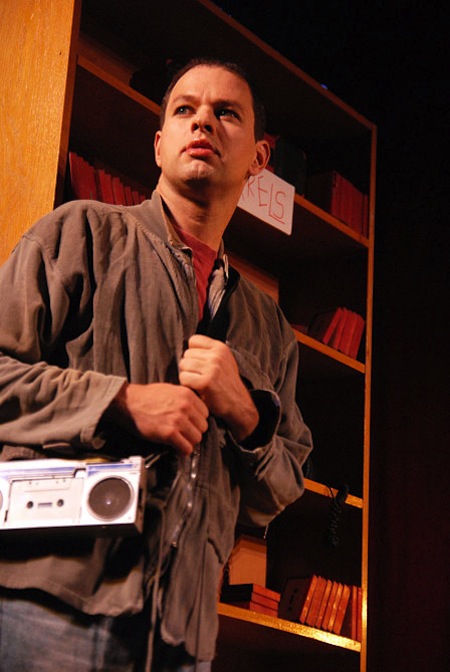
Roy Horovitz brings the English version of Benny Barbash’s play My First Sony (which is based on Barbash’s 1994 novel of the same name) to this year’s Fringe. The play is told from the perspective of Yotam, an 11-year-old who records everything on his tape recorder, “my first Sony,” including some of the painful moments in his life, such as his parents’ separation.
Interior ministers from the 28 member-states of the European Union will meet next week to address the crisis of migrants flowing into the continent from across the Mediterranean. But just what constitutes a crisis – and whose crisis is it?
Some politicians and commentators allege that the migrants are primarily “economic refugees,” people just seeking economic advancement. But Britain’s Guardian newspaper reports that 62% of the refugees who made it to Europe by boat in the first seven months of the year were from Syria, Eritrea and Afghanistan, with more coming from Darfur, Iraq, Somalia and Nigeria, all places where mere survival in war-ravaged zones supersedes economic advancement on the hierarchy of needs.
Fears stoked by the stream of migrants have led some, such as the British foreign secretary, to warn that the entire European social order is endangered. In fact, the 200,000 migrants who have made it to Europe so far this year represent 0.027% of the total EU population. Compare these numbers with the situation in Lebanon, a country of 4.5 million people currently hosting 1.2 million refugees from the Syrian civil war.
There is no question that much of the social unrest in Europe these days and a vast proportion of its antisemitism derive from immigrants from the same parts of the world from which today’s migrants originate. That is not a problem to be easily dismissed. But neither is it a justification for ignoring a humanitarian crisis.
Addressing the small proportion of radicalized or Jew-hating individuals within groups is an issue that Europe must confront and address – and it has so far not done an exemplary job. But the problem facing the migrants in their places of origin makes the “crisis” faced by the places in which they hope to settle pale in comparison.
Europe just happens to be the nearest beacon of freedom and peace these people can reach and, therefore, they are clamoring to make their way to the continent. But it is the responsibility of all of us, Canada included, to accommodate a share of people seeking escape from violence and war.
Israel has also been a destination for African migrants and the treatment of some has rightly raised concerns of refugee watchdog groups and, last month, the Israeli Supreme Court. The court ruled that the migrants who had been held in a sort of low-security detention facility, about 1,200 people from Eritrea, Sudan and Darfur, could not be held longer than a year. They were not confined to the encampment, but were required to be present twice daily for a roll call.
In all, Israel has about 45,000 asylum-seekers, the vast majority from Eritrea and 9,000 from Sudan. Most made their way by foot through the Sinai into Israel’s southern frontier. Most have been given visas that allow them to stay but not to work, which puts them in a predictably difficult position.
Meanwhile, countries like Hungary are rolling out razor wire along the southern border, an entry point to the European Union, beyond which migrants are comparatively free to travel throughout the 28 countries of the EU.
Recent days have brought particularly horrendous news, with 71 refugees, including a baby, found dead in a truck in Austria, victims of profiteers exploiting the desperation of migrants trying to reach Europe. In Libya, more than 100 bodies washed ashore after a boat sank filled with people trying to cross the Mediterranean. At least 2,600 people are known to have drowned this year in similar incidents.
It is a sign of the desperation that drives this mass migration. Most of these people leave behind everything they have to make their way to what they hope will be a peaceful and prosperous future. They are met with suspicion, incarceration, violence and worse.
It is a striking reversal of the Jewish people’s own history of the 20th century, when those trying to flee Europe were denied entry at every turn, including to what was to become the Jewish homeland in the Middle East. Now, thousands of people from the Middle East are fleeing to Europe and facing every obstacle.
It should not be ignored that many of the refugees are coming from places whose education systems and popular culture instil suspicion and hatred of Jews (and Western culture), and this will be no consolation to the remaining, beleaguered Jews of countries like France. But that underlying problem – and it is a significant one – must be addressed over the long term both in Europe and in the countries where cultural norms breed intolerance and antisemitism. In the meantime, thousands of people are fleeing for their lives and the world cannot turn our backs.
With the High Holidays around the corner, I have noticed my usual light bout of pre-holiday anxiety. So much always seems to ride on this part of the Jewish calendar. For strong believers, there’s the spiritual reckoning. For the less religious who still care about affiliation, there’s the loaded nature of synagogue attendance, compounded by the challenge of pricey tickets. And, for the simply social, there’s the pressure of ensuring some communal marking of the calendar.
Amid all of this, Reboot – an organization that bills itself as “affirm[ing] the value of Jewish traditions and creat[ing] new ways for people to make them their own” – is taking a lighter touch: its annual 10 questions project. Sign up at doyou10q.com and, starting on Sept. 13 and lasting 10 days, the website will email you one question per day encouraging you to engage in the kind of personal reflection that is customary during the intervening days between Rosh Hashana and Yom Kippur.
Once completed, the answers are sent to Reboot’s “vault” for safekeeping, and users can decide whether to share them or not. Either way, one year later, Reboot will send the answers back to the participant, and the questions will be posed again, so one can see what changes in life perspectives occur over time.
It’s a truism that Jewish life is fundamentally communal. A quorum of 10 is required for prayer; weekly Shabbat dinners are often an extended-family-and-friends affair; Jews are encouraged to educate their children Jewishly in a group setting; Jewish summer camp focuses on intense communal experiences; and bar and bat mitzvahs are marked by a public aliya la-Torah.
So, are individual, web-based initiatives like Reboot’s enough to scratch the itch of Jewish communal practice? Or are they, in their push-a-button way, a frivolous addition to what should be undivided attention to the technicalities of Jewish literacy and to the bricks and mortar of conventional Jewish life, where Judaism is experienced publicly and communally?
This question isn’t a surprising one, but it may be misplaced.
In the age of “destination” bar and bat mitzvah ceremonies, where almost no one from one’s community may be in attendance, and in the age of concierge Judaism – a term the Jewish Outreach Institute now uses to suggest that Jews may be looking for an array of products and services tailored to their own individual needs – and in the generation of the Millennial who seeks to refashion Judaism to suit her own sensibilities, Reboot knows that one has to reach Jews where they are.
But there’s more to it than simply realizing that initiatives like Reboot may be what’s needed to save do-it-yourself-style Jews from disconnection. Despite the absence of Hebrew or Jewish texts or a group of Jews sitting in a study session with a rabbi, initiatives like the 10 questions project is not a challenge to Jewish literacy at all. In discussing the initiative with colleagues, I realized that, without Reboot’s initiative, I might never have given those intervening days another thought.
In my typical hectic pace, I would likely be rearranging my work schedule, securing a break-fast invitation for my family or deciding whether to host one, and practising the Haftorah my shul has asked me to prepare for Yom Kippur morning. No doubt the personal reflection bit would fall by the wayside and, even if I did try to engage in it, it likely would not be as fulsome as that encouraged by the kinds of daily questions Reboot sends. That kind of thinking and writing – including being faced with one’s past challenges – takes immersive effort, both intellectual and emotional.
So, tailored-and-trendy versus tried-and-true may be a false dichotomy, after all. We would be better placed to think of Jewish life as being enriched by as many touch points as our current crop of Jewish innovators can create.
Mira Sucharovis an associate professor of political science at Carleton University. She blogs at Haaretz and the Jewish Daily Forward. This article was originally published in the Canadian Jewish News.
קו סאסאקי שמח מאוד לשמוע שלפחות סירתו ניצלה מהצונמי, והיא נמצאת כיום בידים טובות ומטופלת היטב. (צילום: Spirit Bear Adventures)
המרכז לענייני ישראל והיהודים מגביר את שיתוף הפעולה עם הסטודנטים היהודים במאבקם בפעילות האנטי ישראלית
המרכז לענייני ישראל והיהודים בקנדה שם לו למטרה ראשית לעזור לתא הסטודנטים היהודים הלל, במאבקים נגד הפעילות העניפה בקמפוסים השונים להחרמת ישראל. בשותפות עם הלל המרכז מספק לסטודנטים היהודים הדרכה אסטרטגית, תמיכה מסיבית בשטח ומשאבים כספיים, כדי שיוכלו להתמודד מול הקמפיינים האנטי ישראליים, בזמן אמת. המרכז והלל הכינו תוכניות ואסטרטגיות שונות בעת הצורך, כדי להתמודד ולהפריך את המיתוסים השונים שהומצאו על ישראל.
במקביל המרכז והלל עובדים מול הנהלות האוניברסיטאות השונות וסגל המרצים, להצגת ישראל האמיתית והעובדות הנכונות עליה. במסגרת זו המרכז לוקח נציגים מהאוניברסיטאות לביקורים בישראל, כדי שיראו מה קורה באמת בשטח. במרכז מציינים כי לאור הפעילות העניפה שלו מול האוניברסיטאות ונציגיה השונים, במקרים רבים הקמפיינים נגד ישראל הפכו לפחות פחות אפקטיביים.
נציגים של המרכז בשיתוף הפדרציות היהודיות בקנדה, עובדים ישירות מול הארגונים היהודים השונים לצורך הגברת הביטחון. הפעילות כוללת הדרכת ותדרוך העובדים במוסדות היהודים. נציגים של המרכז מבצעים בקביעות ביקורות אבטחה במוסדות היהודים, בהם הג’ואיש קומיוניטי סנטרס, בתי ספר, גני ילדים, מחנות קיץ ובתי הכנסת. בנוסף המרכז מסייע לארגונים בהגשת תוכניות אבטחה לתוכנית של הממשלה הפדרלית לאבטחת מוסדות בקנדה, שיפור התשתיות והקצאת משאבים כספיים ועוד.
האחראי על תחום הביטחון בהקהילה היהודית במרכז לענייני ישראל והיהודים בקנדה, אדם כהן, נמצא בקשר שוטף עם גורמי הביטחון הקנדיים, ובהם המשטרה הפדרלית, יחידות המשטרה המקומיות ועוד. הקשר הזה מאפשר למרכז לקבל מידע ביטחוני בזמן אמת ולהיערך בהתאם, כדי להגן על הקהילה היהודית בעת הצורך.
שוטי ספינתי: סירה של דייג יפני נסחפה עד לקנדה
דייג יפני שאיבד את משפחתו באסון רעידת האדמה והצונמי שפקדו את יפאן לפני כארבע שנים, יכול להתנחם בכך שסירתו שניסחפה והגיע עד לחופי קנדה, ממתינה כאן עבורו. קו סאסאקי איבד את כל עולמו באסון הטבע הגדול ביותר בהיסטוריה של יפאן, שהתרחש במרץ 2011. ברעידת האדמה והצונמי נגבה מחיר כבד מאוד של כתשעה עשר אלף איש שנהרגו (חלקם נחשבים לנערים עה היום). ובין ההרוגים גם אשתו ובנו היקרים של הדייג המסכן. סאסאקי נשאר מחוסר כל ואפילו סירת הדייג האהובה שלו נעלמה.
אך מתברר שהסירה הלבנה מהפיברגלס לא הלכה לאיבוד או נהרסה, אלא כמו מאות ואולי אלפי חפצים רבים אחרים, נסחפה במים העמוקים של האוקיאנוס השקט, והגיעה אחרי מסע אחרוך עד לחוף המערבי של קנדה. לפני כשנה תושבים אינדיאנים מקומיים שגרים באזור החוף של בריטיש קולומביה, מצאו את הסירה האבודה. התברר להפתעת הכל שלמרות הדרך הארוכה ואסון הטבע הנוראי, כלי השייט של הדייג לא ניזוק כלל. בעזרת זוג אמיד (הבעל קנדי והאישה ממוצא יפני) שהגיעו לבקר בכפר האינדיאנים שתושביו הם אלו שמצאו את הסירה, תורגמה הכתובת המוטבעת עליה. האישה היפנית הפעילה את הקשרים הענפים שיש לה ביפאן, והצליחה לאחרונה לאתר את בעלי הסירה המדוברת. סאסאקי שמח מאוד לשמוע שלפחות סירתו ניצלה מהצונמי, והיא נמצאת כיום בידים טובות ומטופלת היטב. הזוג הקנדי-יפני החליט לעזור לסאסאקי הדייג ולממן אף את ביקורו כאן. בימים אלה הוא אמור להגיע לקנדה כדי התאחד מחדש עם סירתו, לאחר ארבע שנים. ככל הנראה סאסאקי ישאיר את הסירה כאן כיוון שהעלויות להעברתה בחזרה ליפאן גבוהות מאוד. בינתיים מתברר שהדייג התחיל לשקם את חייו ואף רכש לו כבר סירת דייג חדשה.