Responding to emergencies

Israeli field hospital personnel look after those injured in the earthquake in Nepal. (photo by Sam Amiel)

Cardiac surgeon Lt.-Col. (res.) Dr. Ofer Merin is deputy director general of Shaare Zedek Medical Centre and lectures at the Hebrew University in Jerusalem. He heads the Israel Defence Forces Home Front Command’s field hospital, and was part of the IDF’s relief efforts in Haiti after the 2010 earthquake, in Japan after the 2011 tsunami, in the Philippines after the 2013 typhoon and in Nepal after the earthquake in April this year. With various colleagues, he has written about these experiences, as well as about the provision of trauma care at Shaare Zedek.

From the New England Journal of Medicine, March 2010: Within two days of the earthquake in Haiti in January 2010, Israel had sent “a military task force consisting of 230 people” who “landed in Port-au-Prince 15 hours after leaving Tel Aviv and began to deploy immediately…. In its 10 days of operation, the field hospital treated more than 1,100 patients.”

From the Journal of the American Medical Association, July 2015: After the earthquake in Nepal in April 2015, the IDF sent a medical team of 126, and the field hospital was “deployed as a stand-alone facility 82 hours after the earthquake.” Over 11 days, “we treated 1,668 patients, performed 85 operations and delivered eight babies.”

From the Lancet, April 2015: “There were 11 terror attacks in Jerusalem, Israel, between October–December 2014 alone. Two of the injured terrorists arrived at our institution and, following standing triage protocol, we prioritized one terrorist to undergo surgery first since his medical condition was more critical than that of the victims.”
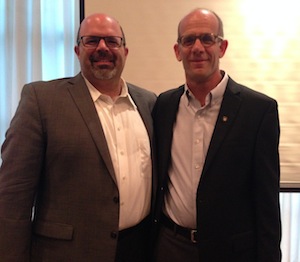
photo - Temple Sholom Rabbi Dan Moskovitz with Dr. Ofer Merin when Merin was in Vancouver in August
Temple Sholom Rabbi Dan Moskovitz with Dr. Ofer Merin when Merin was in Vancouver in August. (photo by Karen James)

These are but a few examples of the work Merin and his colleagues do, and the challenges they face. When Merin was in Vancouver recently, he shared some of his experiences and discussed the ethical issues surrounding trauma care. He spoke to the Jewish community on Aug. 20 and to physicians in the trauma unit at Vancouver General Hospital the day prior.

Dr. Rick Schreiber – professor of pediatrics at the University of British Columbia, director of the B.C. Pediatric Liver Transplant Program and president-elect of the Canadian Association for the Study of the Liver – was the catalyst for Merin’s visit. Yet his connection to Merin was not, as it first might appear, through his work as a fellow medical professional, but through Merin’s wife, Ora.

Schreiber was on an adult March of the Living mission earlier this year that was organized by the Montreal Jewish community.

“I’m originally from Montreal. I’ve been out here about 20 years,” said Schreiber, who is very involved with Jewish causes in Israel, overseas and elsewhere, including here with the Jewish Federation of Greater Vancouver. On this recent mission, he explained in a phone interview with the Independent, all of the tours and activities in Israel were organized by Ora Merin and her company,

Giant Leaps. “I was very impressed with how the program was laid out for the Israel aspects of the mission and the level of the people [we met] and the things that we did. We got to places that most people wouldn’t get to….”

Ofer Merin attended the mission’s closing dinner with his wife. With medicine in common, he and Schreiber started talking, and Merin’s involvement with the Israel Defences Forces disaster response team came up.

The next day, as Schreiber was leaving Israel, he saw Ora Merin again. She told Schreiber that her husband had left for Nepal, which had just experienced an earthquake. “I got to tell you,” said Schreiber, “within six hours, they had up and going a launch – and they bring everything.… It’s amazing what the Israelis do to be first responders, and they are recognized around the world as being the best. They get there very quickly and they set up all the units, like an intensive care and operating tents and all this kind of stuff, and triage, and get rescue things going long before other countries are even getting their finances together.”

“It’s amazing what the Israelis do to be first responders, and they are recognized around the world as being the best. They get there very quickly and they set up all the units, like an intensive care and operating tents … long before other countries are even getting their finances together.”

During that conversation, Ora mentioned that their family (she and Ofer have four adult children) was going to be in the United States – Ofer has a brother in Seattle – in the summer, and Schreiber suggested they think about coming up to Vancouver on that trip. He said that it would be good for her, because of her travel agency, to meet with Federation, which runs missions to Israel, and maybe her husband could give a talk on his work. “So, that’s how that all started, back in Israel, back last May,” he said.

In addition to the community meetings and talk, Schreiber also organized for Ofer Merin to speak at VGH. “There is a big group of trauma people at VGH, and they jumped on this because they had heard of him and they knew of him, and we organized for him to give rounds…. There was very good attendance at that rounds, and he talked about what he does. But he didn’t talk about all the people they deal with and how they set up, he talked about a lot of ethical things, like how do you decide to save this person versus that person – you only have limited space to save people.”

Merin spoke at VGH about treating such large numbers of injured after a natural disaster, and about handling the stress of that, said Schreiber. “The next thing he talked about, the ethics. You’re not able to provide the same level of care as you’re accustomed to, like we supply for trauma people in Vancouver, we can’t give the same level of care … you’ve got to treat people and turn them over quickly, so you can treat the next person.”

Merin also discussed how, at Shaare Zedek Hospital in Jerusalem, they have to treat victims of terror attacks, including, at times, the terrorist. Of the victims and the perpetrator(s), who do you take care of first? At Shaare Zedek, Merin said, such decisions are made on the basis of triage, who is the most badly injured.

The Independent caught up with Merin by email after his Vancouver visit.

JI: What interested you in cardiac medicine/surgery versus other specialties? Did you always want to be in medicine?

OM: My decision to go into medicine was relatively late, in my early 20s, not something I was born with. My decision to go into cardiac surgery, I guess, was based first on my “nature” to choose something surgical – more adrenalin, very quick results. Cardiac surgery in specific is a great combination of both surgery and the need of good clinical and physiology understanding.

JI: The burnout rate for doctors in general is quite high. It must be higher for trauma physicians. How do you (and/or your colleagues) manage the stress?

OM: I would divide [my response]. There are things done on the group level – discussions, sharing, etc. Especially these days in Jerusalem, there is an extra challenge – dealing with treatment of terror victims, and many times treatment of the terrorists themselves…. We have a psychologist who is doing some group work especially with the ER people and the intensive care unit. And, on the personal level, everyone has to find his ways to vent. I jog almost every day. For me, it’s a good way to relax. In missions abroad, I write every day. Also a great way to vent.

JI: The enormity of being part of a disaster-response team is almost beyond comprehension for anyone who has not had the experience. If it’s possible to outline a general order of events, from the time a natural disaster hits to when the Israeli unit is on the ground in another country providing care, could you please share the main points?

OM: One of the important things is to work in parallel. We bring in the team way before there is a full understanding of the scale of the disaster, so we are prepared before there is a governmental decision to send a team. Once a decision is taken, we are prepared to leave. We send immediately a small forward team, which can report back, and prepare whatever is needed for deployment. We drill every year, so we maintain a high level of preparedness.

JI: In a couple of articles, you mention collaboration/integration with local facilities in a disaster-response situation. What types of factors enter the decision of where the Israeli unit fits into the overall aid effort?

OM: To be honest, in the last natural disasters around the globe, Israel is almost always the largest and first to be on ground. Therefore, we communicate with the local health providers and make a mutual decision where it is best to deploy.

The decision if to deploy as a self-sufficient unit or to operate (like in the Philippines) as an integrated unit is based mainly on the question if the local services are still functional. If they are, it is many times better to assist them and not “compete” with them, as we are arriving for a short term.

Tackling conflict through comics

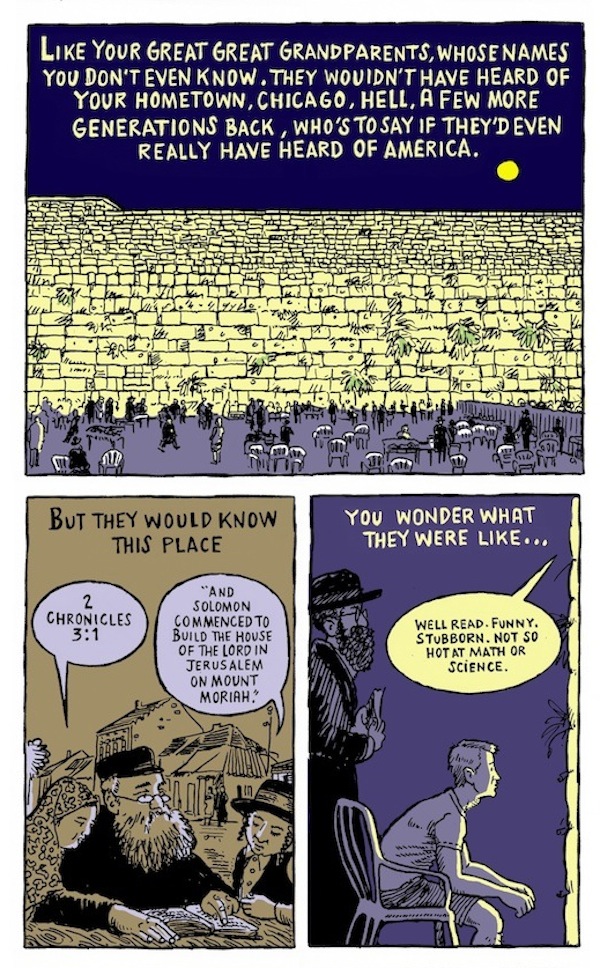
From The Completely Unfabulous Social Life of Ethan Green, by Eric Orner.

It was never on Eric Orner’s agenda to go to Israel. He resisted his mother’s entreaties to join a young people’s synagogue trip to the Jewish state. A relatively secular upbringing and a tendency to play hookey rather than attend Saturday morning religious classes meant he emerged into adulthood without a sense of strong connection to Israel or Zionism.

As a young adult, he was busy with a dual career that had him working days in the office of Barney Frank, the iconic, gay, Jewish congressman, and spending his nights drawing an iconic gay, Jewish comic strip that, at its height, was running in about 100 alternative and LGBTQ newspapers across North America.

It was circumstance, not Zionist fervor, that eventually took Orner to Israel, and among the results of his three years there is a series of comic strips that are, in turns, disturbing, thought-provoking and moving.

***

Starting in 1989, Orner drew the self-syndicated cartoon strip The Mostly Unfabulous Social Life of Ethan Green. For 15 years, it was a cult favorite that followed a cast of sharp-tongued characters across a dramatic time in the evolution of the AIDS epidemic, the gay rights movement and politics in general, while capturing the spirit of the time in ways that perhaps only the medium of a comic strip can. The cartoon is cut through with Yiddishisms and sometimes unmistakably Jewish humor and sensibilities. Orner acknowledges that Ethan Green is, like him, a short, culturally Jewish, gay man, but the strip is not about Orner’s life.

“There’s 15 years of episodes of things happening to him and those things didn’t happen to me,” he said. “It was about somebody who had characteristics like me but it wasn’t about my life.”

For those who missed the strip in its serial incarnation, or who want to catch up, a compilation has recently been released, titled The Completely Unfabulous Social Life of Ethan Green.

When The Mostly Unfabulous Social Life of Ethan Green was turned into a film, in 2005, Orner figured that was a good time to wind up the strip and make a change. He had spent a decade working in the Boston and Washington offices of Frank, the recently retired longtime congressman whose name is synonymous with Wall Street reform, consumer protection and pithy lines. Frank had met Orner around Boston, where the Chicago-born Orner was studying at Tufts University.

“I forget who first raised the question that he would work for me,” Frank told the Independent. “He’s very smart, he’s very thorough. The fact that he was doing the cartoons made him more interesting. It wasn’t relevant to his work one way or the other.”

But while Frank is noted for humorous quips, Orner apparently saves his best for the page.

“What I found in Eric is that his wit and humor comes out more in his writing,” Frank said. “He was not shy, but not nearly as outgoing as the cartoons.”

Frank said Orner has one of the hardest work ethics he’s encountered, which may help explain how he held down an intensive job as an aide to one of the country’s leading politicians while also pumping out a bi-weekly comic strip and distributing it, in the days before the internet, by stuffing it into envelopes. To top it off, during this time, Orner also studied law and was called to the bar.

Frank, who introduced the first gay rights bill in Massachusetts, in 1972, is a central figure in the movement for sexual orientation equality, which experienced its most dramatic achievement when the U.S. Supreme Court ordered marriage equality for gay and lesbian couples, just days before Frank spoke with the Independent.

“No social movement in America, that I can think of, has moved remotely as quickly as this one,” Frank said. While the congressman was fighting legislatively, he credits Orner for playing no small part in the movement as well.

“This was not always an easy fight for people and there is also this tendency for people in movements to be grim and to talk about all the negative stuff,” he said. “But having someone who saw the humor in it was affirming in a way.”

***

Orner left the congressman’s staff to follow his dream to draw full-time. He moved to California and got a job as an animator with Disney.

“Most cartoonists I know aren’t lucky enough to do it full-time,” Orner said. “The only time I’ve had that experience was the time when I was working in animation and really they both involve drawing but they’re very different.”

It was not everything he had imagined. Orner acknowledges he is a good animator, but maybe not as good as some at Disney, who accused his Tinkerbell of flitting across the screen like a Black Hawk helicopter. Even this was not the main problem.

“That was not about my creativity, that was about Uncle Walt,” he said. “Animation is, in some sense, factory work.”

Like a lot of factory work, much of it was moving overseas. His boss got a job as head of a project in Jerusalem, which was at the time competing with Tel Aviv to become a media industry hub.

“So they built a beautiful animation facility and a bunch of Californians, including myself, went over there to work on a film.” The project never saw light, which is common enough in animation, he said. But, again, he was moonlighting with his own projects.

“Suddenly there I was in Israel,” he said. “It changed my life in many, many ways. I didn’t want to go and I wasn’t very happy about it, but that all changed and I fell in love with it and now I worry about it every day of my life. I disagree with a lot of things that are happening over there and yet I have dear, dear friends.”

cartoon - From Avi & Jihad, by Eric Orner.
From Avi & Jihad, by Eric Orner.

The strips he wrote in Israel are part of a to-be-published volume called Avi & Jihad. One strip, called “Kotel 3 a.m.,” is a powerful short story of a midnight stroll to the Western Wall, where a skeptical American Jew finds resonance and a connection to the millennia of history there. When he tells his colleagues at the office about his stroll, it evokes stories of “nutcase Americans” who arrive from Great Neck or Savannah or Palo Alto and start speaking in tongues. Another is about the unadvisable idea of not taking seriously the El Al security agents. In one deeply dark strip, a love story between a Jewish man and a Palestinian Arab man turns into violent carnage that Orner said is not specifically about a single incident, but clearly evokes the murderous attack on a gay youth centre in 2009, and which has added resonance after the stabbings at this summer’s Pride parade in Jerusalem.

Orner’s politics were on his sleeve – or, rather, on the page – when he was writing Ethan. Some of his Israeli comics are less overt and more slice-of-life, but he pulls no punches when speaking about Israeli policies and the positions of American Zionists.

“I think that if it’s fair game to be critical of the Likud in Tel Aviv, then it should be fair game to be critical of it in Washington, D.C.,” Orner said. “I think we’re a little afraid to be critical. This is not the Israel of Golda Meir and Moshe Dayan and David Ben-Gurion.”

Orner said that if you can love America and not love George W. Bush, you can love Israel and be critical of its leadership.

“Sometimes, dialogue is unpleasant and uncomfortable and harsh,” he said. “I think we’re tough enough to handle that. I think we’re strong enough to have this conversation without going to pieces, thinking, oh God, our campuses are full of antisemites.”

Orner was in Israel from 2007 to 2009, which was the aftermath of the Second Intifada, the tensions of which are depicted in his pieces from those years.

“They are constantly under threat,” he said of Israelis. “Do I understand why people would then go to the polls and vote for Netanyahu? I do. Because you might disagree with him but, in the end, you think he’s a tough guy and that’s what we need.”

But Orner thinks there is an element in Israeli politics that doesn’t want a resolution to the conflict.

“I’m a Zionist, but I think the settlements, settlement activity, has been counterproductive from the beginning and I think there’s a lot of people that promote the settlement activity particularly because it is counter-productive to peace.”

Orner recognizes that his opinions may not be a consensus viewpoint, even in his own circles.

“I make a lot of people mad,” Orner said. “I’m not sure my old boss agrees. I know my stepfather disagrees. I know my best friend disagrees. But, having lived there for three years, that’s what I saw. I saw settlements over the [Green] Line and, if I were a Palestinian, that would enrage me also. I don’t know what the answer is, but my guess is building more settlements over the line quicker isn’t the answer.”

After the global recession hit and he lost his job in Jerusalem, Orner returned to Frank’s office and remained there until the congressman retired in 2013. Orner is now a speechwriter in New York. He is looking for a publisher for his Israeli cartoons and is working on another book depicting his time in California.

He has no regrets about his three years in Israel. It piqued his interest in Jewish history and changed him.

“I became far much more appreciative of my connections to Jews from other parts of the world, not just Israel, but France, Italy, Morocco, Iraq,” he said. “I looked out my window – I had this apartment that I could see the gold dome of the Al-Aqsa Mosque from my window – I lived in a hilltop neighborhood called Abu Tor and I looked right down on the Old City walls. You can’t live there without being more interested.”

Israel and the election

The Conservatives, Liberals and NDP have all expressed strong support for the Jewish state. Is there any difference between them?

Line up the platforms of the three main political parties and, despite the rhetoric, they are all solid allies of Israel.

The federal Conservatives, Liberals and NDP all profess support for Israel’s right to exist, for the nation’s right to defend itself and for a two-state solution. All three leaders have visited Israel, with Prime Minister Stephen Harper being the most recent to visit, in January 2014.

Indeed, Canadian political support for Israel has been consistent since the establishment of the Jewish state in 1948, said McGill sociology professor Morton Weinfeld.

It is rooted in a strong and shared Judeo-Christian tradition but has gotten a boost recently, as Canada and the West confront groups such as the Islamic State and other forms of militant Islam, he said.

The perception, especially among Jewish voters, however, is different.

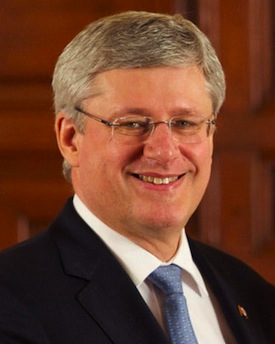
photo - Stephen Harper
Stephen Harper (photo from sv.wikipedia.org)

“I think the perception is that Stephen Harper and the Conservatives are the most committed to Israel’s security,” Weinfeld said. “They [voters] would probably say the NDP would be less committed to Israel, not because of [NDP leader Thomas] Mulcair, but because of elements in the party. I would think the perception that the Liberals under [leader Justin] Trudeau would be in the middle.”

That perception is based in reality, since the Harper government has made clear and forceful statements about support for Israel, Weinfeld said.

However, Liberal MP and foreign affairs critic Marc Garneau pointed out that it is simply because Harper occupies the highest office in the country that his decisions have greater visibility than statements by other parties.

“There are no differences [between the Conservatives and the Liberals] in terms of a lot of the positions [on Israel], and I try to get the message across. I don’t get to do it in the public way that you do when you’re the prime minister and the government of Canada.”

Meanwhile, in what is shaping up to be a close three-way race, foreign policy, once only of interest to wonks and Ottawa insiders, is coming under closer scrutiny by voters.

The amplified attention being paid to foreign policy is being driven by a more sophisticated and diverse electorate that is more globally connected, said Chad Rogers, a partner in public affairs agency Crestview Strategy.

But it would be wrong to assume that the Tories’ especially vocal support of Israel is a ploy to woo Jewish voters. The electoral math, with Jews concentrated in a handful of ridings, doesn’t add up, said Rogers, who has worked on several Conservative campaigns.

Rather, the Tories’ support is part of a consistent worldview that is reflected in its defence of Ukraine and on issues such as opposing the persecution of gays in Iran or protecting Syrian refugees, he said.

“The mistake is to look at this and say it’s a political issue and it’s about Jews and Israel,” he said. “It’s a worldview that says we will side with democracies over countries that are not democracies.”

While Harper is portrayed as being in lock step with Israeli Prime Minister Binyamin Netanyahu, that’s not accurate, Rogers said. Harper “has been very frank” with the Israeli government on its policy on settlements.

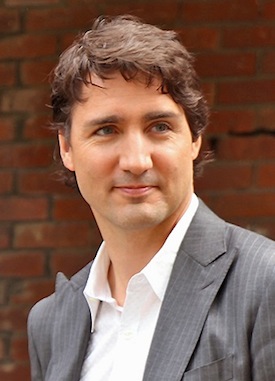
photo - Justin Trudeau
Justin Trudeau (photo from en.wikipedia.org)

For the Liberals, the greatest challenge is a political platform that’s identical to the Tories’ on support for Israel, but is perceived by some voters as weaker.

Trudeau “won’t make the issue of Israel a wedge issue. He believes Canada should support Israel because it is the right thing to do,” said Irwin Cotler, Liberal MP for Mount Royal and a former minister of justice and attorney general, who is not running for reelection.

“I welcome Harper’s support for Israel, but when Harper says if you care about Israel, you must vote Conservative, then he politicizes it,” Cotler said. “When you do that, it undercuts support for Israel.”

In previous elections, brochures were distributed to Jewish voters in his riding and others alleging that Cotler and the Liberals had not been forceful enough in countering antisemitism and terrorism and in supporting Israel. Cotler believes this type of negative campaign cost the Liberals seats in heavily Jewish ridings, partly because the allegations seemed so absurd that the candidates did not mount a strong defence, but he believes it won’t be successful this time around.

In recent weeks, guests invited to a Toronto fundraiser for the Liberals, hosted by pharmaceutical magnate Barry Sherman, received an email from a Jewish Conservative supporter charging that Trudeau was less than the staunch ally of Israel he professes to be.

Sherman countered with another email which, like the original exchange, has been distributed beyond the initial circle of invited guests. Cotler said this is the tack that Liberals need to take.

“What Sherman did was to fight back with the facts and the truth, rather than letting those allegations take hold,” said Cotler.

While elections are usually fought on domestic issues, Cotler believes foreign affairs concerns “have come to the fore” in this election, spurred by the instability in the Middle East.

Many Jews are not single-issue voters, but the threat posed by Iran and the deteriorating situation in Syria “create a heightened concern in general, and among Canadian Jews in particular,” he added.

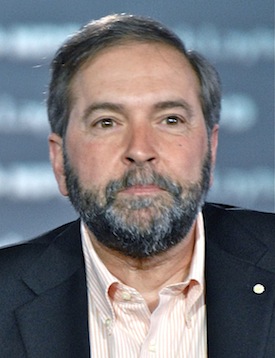
photo - Thomas Mulcair
Thomas Mulcair (photo by Asclepias via commons.wikimedia.org)

The NDP’s support for Israel puts it at odds with other leftist parties in Europe, which have taken a much harsher tone with Israel, but places it alongside other Canadian political parties, said Judy Wasylycia-Leis, a former NDP MP for Winnipeg North.

“The position is unique in social democratic parties because of Canada’s role as a peacekeeper and mediator generally in the world,” she said.

The NDP, especially under Mulcair, has shown unwavering support for Israel, she said.

Voters got a good look at how Mulcair would handle a crisis in the Middle East during the war in Gaza last summer. The NDP leader acknowledged that Hamas was a terrorist group and that Israel had a right to defend itself, while simultaneously lamenting the deaths of innocent civilians and calling for a ceasefire.

The intensified attention to foreign policy has left the parties competing for the title of who is Israel’s best ally.

While the Conservatives have painted themselves as “a strong friend” of Israel, Wasylycia-Leis disagrees. “I don’t think a good friend of Israel would use this as a wedge issue,” she said. The Tories’ uncritical support for Israel has made it a polarizing issue for Canadians instead. “I think the NDP has been criticized for offering a more nuanced, balanced approach.”

Meanwhile, Mulcair’s pro-Israel direction has also generated tension within the party itself. Last summer, a Montreal-area MP quit the party, citing Mulcair’s policy on Israel. A Nova Scotia NDP candidate for this year’s election resigned recently after making critical comments about Israel, while two other NDP candidates are facing close scrutiny for previous remarks.

As foreign policy concerns play a greater role in the election, the question is to what degree this drives voters. In the Jewish community, it certainly plays a pivotal role for many voters, strategists say.

While “bread-and-butter issues,” – the economy, jobs and health care – have traditionally been the chief concerns for voters, Wasylycia-Leis, who’s been through 14 elections, said foreign affairs have taken on a new significance for Canadians because of the Tories’ handling of such issues as Bill C-51, which addresses terrorism, and domestic controversies, such as the legality of wearing the niqab at citizenship ceremonies. But, for Jewish voters, the issue takes on even greater importance, she said.

“Positioning on the Middle East conflict is very important for Jewish voters. I’m not so sure they appreciate the Conservative approach,” she said. “I think they also understand that approach doesn’t bring help in terms of a long-term solution that everyone wants.”

Weinfeld agrees that Jewish voters tend to show special interest in Israeli affairs, but especially in this election, when the Conservatives have positioned themselves as Israel’s strongest ally.

“The community is probably split at this point,” he said. “Those for whom Israel’s security is the Number 1 concern, and think things like the Iran deal are disastrous, would tend to lean toward Harper.” But “many would think that Harper’s position’s is too one-sided or that there are other domestic issues, which might lead them away from support from Harper.”

– For more national Jews news, visit cjnews.com.

Seeking repatriation

From left to right, are Naomi, Michelle and Max Dodek with Gil Lewinsky in Abbotsford. Michelle is holding a one-day-old Jacob sheep. (photo by Jenna Lewinsky)

A couple living in Abbotsford is gaining international attention for their unusual quest. They want to return their flock of Jacob sheep to the breed’s ancestral home – Israel.

After visiting Gil and Jenna Lewinsky at the farm where they rent a barn and outdoor space for their sheep, there is no doubt that these modern Jewish shepherds are committed to taking their flock to Israel. Once there, the couple intends to set up a heritage park for visitors to connect with this aspect of ancient biblical history.

These sheep, according to the Lewinskys, are the descendants of Jacob’s original flock. Sheep are discussed in Genesis 30:32, when Jacob negotiates with Laban to keep the speckled and spotted offspring of Laban’s sheep in payment for his 14 years of service to Laban. As Laban has managed to trick Jacob before, most famously by switching brides and having him marry Leah instead of Rachel, he thinks he’s getting the better deal here, as well. However, the Torah explains the special techniques Jacob employs to grow a strong, large speckled flock, leaving the weaker, solid-colored sheep for Laban. It is the first recorded case of selective breeding and, apparently, it worked.

“People know that Jacob fathered the Jewish people but they don’t know that he also ‘fathered’ a breed of sheep,” said Gil. He also explained that these sheep followed Jacob’s family into Canaan and eventually Egypt. While the Children of Israel returned to Canaan after centuries of slavery, it seems that these sheep did not accompany them. They went west and ended up, many centuries later, in England, where they were bred extensively. A few of the “heirloom breed,” those unaltered from their original ancient Syrian physiology, have made it to hobby farmers in Canada. Not one lives in Israel.

The Lewinskys feel this is a problem that needs to be solved. “God put it into our hearts to bring the Jacob sheep back to Israel,” said Jenna in an interview. In response, she and her husband have formed a nonprofit organization called Friends of the Jacob Sheep with a stated mission to bring the animals back to Israel.

Friends of the Jacob Sheep plans to repatriate the sheep from Abbotsford to the Golan Heights, where the Lewinskys hope to open up a heritage park so that the biblical sheep can be seen in Israel and be put to their original purposes for the Jewish people.

According to Gil, Jacob sheep in ancient times were used in every aspect of life, including using the wool for religious clothing such as tallitot, the skin for leather for tefillin or parchment to make Torahs and mezzuzot, as well as for food and Temple sacrifices. Of course, the horns were also used to make shofars. This breed of sheep has an advantage in the area of shofar making because both male and female Jacob sheep are commonly found with four horns and can grow up to six at one time.

While the Lewinskys are very dedicated to their mission, there are a number of stumbling blocks in the way of their plan. In order to export animals to another country, many policies have to be followed. Ever determined, they have lobbied both the Israeli and Canadian governments to find a way to fast track a trade agreement that would enable the sheep to return to Israel. Federal Trade Minister Ed Fast visited the Lewinskys’ flock in early August this year. The Lewinskys describe Fast as a strong supporter of the state of Israel and they hope to use this contact to further their plans.

“We have around 50 sheep now and, when we reach 80, we will be ready to take them to Israel,” said Jenna. Since my visit to the farm, the flock has increased to about 70.

photo - The Lewinskys’ flock of Jacob sheep now stands at about 70
The Lewinskys’ flock of Jacob sheep now stands at about 70. (photo from facebook.com/friendsofthejacobsheep)

“Our new flock are from the Okanagan and from Cabri, Sask.,” said Gil in an email to the Independent. “The flock from Saskatchewan trace back to the first four Jacobs that were imported from the U.K. to Canada at the Assiniboine Zoo in Winnipeg. They retain their primitive confirmation.”

The increase in numbers is due in part to the Lewinskys’ continuing efforts to acquire heirloom Jacob sheep from farmers in Canada and the United States, and in part to a good spring, with many of their ewes birthing adorable lambs. Jenna and Gil have investigated and negotiated with an airline that specializes in transportation of livestock to transport the flock as soon as they can wade through the red tape currently preventing the exportation of the animals and, of course, once they have raised the money to do so.

By chance, one sheep made it onto Abbotsford Mayor Henry Braun’s Facebook page, and Gil has used his experience as a journalist to get the word out about these sheep all around the world, with the story being picked up in news outlets from Israel Vision TV to Scotland’s Jewish Telegraph. The couple said they are applying for grants from a number of agencies and making connections with both Jewish and non-Jewish communities for support.

For more information on Friends of the Jacob Sheep, visit their website (friendsofthejacobsheep.weebly.com) or like them on Facebook to keep abreast of the latest developments.

Michelle Dodek is a freelance writer living in Vancouver.

Be present as possible

On Rosh Hashana we will be inscribed and on Yom Kippur we will be sealed, who will live and who will die, who by fire and who by water. It’s a jarring incantation. Religious or not, however, this time of year – with fall approaching, a new school year starting – is a time for introspection and account-taking that extends to the very essence of our mortality.

Unless we are consciously faced with it, it is rare for people in our society to think deeply about our own deaths. (For an interesting reflection on the topic, see page 46.) But we would do well to keep the transience of life closer to front of mind throughout the year – not to be needlessly grim or to dwell on the negative, but because it is life’s finite nature that affords its value. Like anything that is limitless, life would lose some of its value if it were unending.

Time is central to Judaism. We mark the coming and the going of the day, the arrival of Shabbat and the return to the week, the numerous times in the calendar that call our attention to the seasons, our history, biblical events, the new year.

Time is likewise central to our existence. Our lives have a beginning and an end; what happens in the middle is what we make it, given the resources we are born into or develop. We do not know when we will die nor what happens to us afterward. We know, though, what happens when others die. We grieve our loss.

We lament and experience stages of pain and eventual relative acceptance.

At this time of year, as we gather with families and in our congregations and communities, there are countless obligations placed upon us. Our tradition tells us that we accept these obligations willingly and with openness. Our tshuva may be painful or involve humbling ourselves to make amends with those we have harmed, but we do this to improve ourselves, our relationships and our world.

In some interpretations, this is when our personal fate will be determined. But our attention naturally turns also to those around us. Who will be at the table this Rosh Hashana and not next? Whose presence do we miss even more keenly at this time of year than on an average day?

We are reminded now not to take for granted any of those we love. This is something we should certainly commit to carrying with us throughout the year. The presence of loving family and friends is a joy that we can easily forget to appreciate and we must remember to value these moments.

We should also be reminded of the presence of loved ones in a different, more ordinary sense. Perhaps there has never been a society more distracted than our own. The most obvious distraction is our digital devices, which can remove us from the presence of those we love even as we sit across from them at a table. Other distractions have been around longer – worries about work or some other aspect of our lives; obsessions and addictions; the myriad things that can take us away from what is truly most important in our lives.

As we mark the High Holidays and the start of a new year, let us be thankful for the presence of those around us, and let us try to be as present as possible in return.

Changing Israel education

In the longstanding debate over whether collective narratives should be transmitted as capital-T truth, or whether they should be challenged and problematized, there is a flurry of activity around rethinking Israel education for the next generation. As if they were speaking to each other (they weren’t – neither creative team knew of the other), a short documentary film and a new curriculum have emerged to address an apparent gap in critical thinking around Israel.

The director of the short film Between the Lines, Ali Kriegsman, was frustrated with the kind of Israel-right-or-wrong messaging she received growing up in Jewish day school. In the film, she interviews students, rabbis, Jewish educators and professors who each suggest that it’s time to allow the light of critical thought into our community’s classrooms when it comes to Israel.

As a professor who teaches Israeli-Palestinian relations, I am well aware that the kind of one-dimensional Israel education that some students receive does not make them well placed to take in the more intellectual, critical-thinking approach that is the hallmark of higher education. But where the film makes its most counter-intuitive suggestion is in the area of Israel advocacy on campus.

The film suggests that even for those who want to create effective Israel advocates, the current tone of Israel education falls short. Kriegsman, who says she “wants to see improvement and justice in Israel,” believes that “antisemitism still exists in the world” and is troubled by the fact that the Palestinians “are marginalized and mistreated and settlements continue to expand,” puts it this way. She believes that a student who has been force-fed a simplistic view of Israel and arrives on campus where the discourse is almost inevitably contentious and polarized will do one of three things.

In one scenario, the student will become embarrassed by the actions of the country they were taught to idealize and thus choose to detach entirely. In another scenario, the student will draw on the “AIPAC”-style advocacy “bubble” they lived inside during Jewish day school and will become completely closed to any alternative narratives. In this scenario, the hypothetical student might become an “exaggerated version of a day school student” – discriminatory and racist. In a third scenario, the hypothetical student may feel “duped or betrayed” by her Jewish day school education and burn her emotional connection to Israel entirely.

Having premièred at a SoHo loft in New York City, the documentary – which received seed money from the Bronfman fellows alumni fund – is slated for a West Coast première in October sponsored by a Los Angeles synagogue.

Unbeknown to Kriegsman, as the film was being made, a rabbi in Madison, Wis., was creating a new curriculum that appears to address the conceptual gaps that Between the Lines identifies. Called Reframing Israel, the curriculum is meant to address what Rabbi Laurie Zimmerman saw as a major deficiency in Israel education at the elementary and high school level: “There was virtually no published material that asks students to think critically about the conflict.”

The rabbi wants kids to think in more complex terms, to be inspired to look at Jewish texts.

How do you cultivate compassion for both Israelis and Palestinians? How do you understand Palestinian stories?

Rather than emphasize a “love” for Israel, Zimmerman uses the term “connection.” As she puts it, “We pick one of the following: Eretz Yisrael (the Land of Israel), Medinat Israel (the State of Israel) and Am Yisrael (the Nation of Israel). We ask, What does it mean to be connected to each of these?”

She has been piloting parts of the program over the last couple of years. Last year, two 13-year-olds created a debate with each other on the question of the one-state versus two-state solution to the Israeli-Palestinian conflict. “It didn’t matter what they believed,” she said. Rather, the act of articulating the critiques was really valuable.

Some critics of this open-minded approach will claim that, to be agnostic about whether Israel remains a Jewish state (given that a one-state solution, in its democratic form, would basically spell the end of Israel as we know it) is itself a betrayal. Zimmerman, however, “trust[s] kids enough to draw conclusions that are sound and solid.”

As for what kind of Jewish student she hopes to send to campus once they have graduated from religious school, Zimmerman wants to send kids who are “inquisitive; have open minds, can evaluate an argument, apply their knowledge; research a position and make an informed choice. I guess that makes me radical since I’m not trying to send kids to campus to defend Israel. I care mostly that they go to campus and think deeply about being Jewish, about their connection to Israel, about Palestinian perspectives. The role of education is to create people who are actively engaged in their communities.”

Mira Sucharov is an associate professor of political science at Carleton University. She blogs at Haaretz and the Jewish Daily Forward. A version of this article was originally published on haartez.com.

Local athletes have lots of fun

The silver-medal-winning volleyball team at the JCC Maccabi Games in Fort Lauderdale, Fla. (photo by Kyle Berger)

They weren’t the largest delegation at the JCC Maccabi Games in Fort Lauderdale this past August, but Team Vancouver’s 13 athletes certainly made their presence felt.

photo - Jada Wilson, left, and Sydney Cristall at the opening ceremonies of the games in Fort Lauderdale, Aug 7
Jada Wilson, left, and Sydney Cristall at the opening ceremonies of the games in Fort Lauderdale, Aug 7. (photo by Kyle Berger)

No moment stood out greater than when the six local girls joined with four others from around North America – meeting for the first time at the games – to make up a volleyball team. They ended up taking the silver medal, beating out more experienced teams from New York, Massachusetts and California. Leah Serlin, Leah Schwartz, Jada Wilson, Julia Tregobov, Sydney Cristall and Simone Killas, aged 13-16, formed the core of the team coached by Jack Serlin. Despite not practising as a full squad until arriving at the games, the group came together and lost only to the host city’s team of all 16-year-old club players in the finals.

“For a new team facing several challenges, to be able to beat out teams who train and play together all season, such as Bensonhurst (Brooklyn) and Orange County, is quite an achievement,” said Jack Serlin. “It was such an overall feeling of pride and satisfaction seeing the girls come together as a unit, genuinely grow to like and play for each other, and perform so well on the court and have so much fun off of it.”

Serlin said he is already considering plans to battle for the gold medal next summer. “The fact that all the eligible girls can’t wait to come back next year is truly a testament to how successful we were and what an incredible experience the JCC Maccabi Games are regardless of your background or from where you come,” he said.

photo - Rachel Bugis, left, and Magalee Blumenkrans celebrate after a big soccer victory
Rachel Bugis, left, and Magalee Blumenkrans celebrate after a big soccer victory. (photo by Kyle Berger)

The Team Vancouver delegation was also made up of soccer players Josh Bugis, Rachel Bugis, Magalee Blumenkrans and Saul Kalvari. Zach Moldowan joined a baseball team from North Miami Beach while Jackson March won a couple of bronze medals in table tennis and Sydney Swick from Winnipeg joined the Vancouver delegation and took home a couple of medals herself.

“The JCC Maccabi Games is awesome every time I go,” said Kalvari, who attended his second set of games this summer. “The people you meet are amazing, from all over the world, and everyone is there for the same reasons. It’s great to be surrounded by so many Jewish teens just there to have fun.”

The JCC Maccabi Games are an annual multi-sport event hosted in different North American cities each summer. Jewish teens from around the globe compete in the Olympic-style event. The JCC Maccabi Arts Fest runs parallel to the games, engaging teen artists, who participate in workshops with a final performance or show at the end of the week. The games and arts fest attracts more than 3,000 Jewish teens each summer.

For more information on the JCC Maccabi Games and next year’s events, contact me at kyle@jccgv.bc.ca.

Kyle Berger is Jewish Community Centre of Greater Vancouver sports coordinator, and a freelance writer living in Richmond.

Museum jazzes up website

The new Jewish Museum and Archives of British Columbia website, jewishmuseum.ca.

The Jewish Museum and Archives of British Columbia has launched its revamped website, unveiling a new look for the organization, simplifying navigation and making it easier for users to engage with the museum’s diverse programming and to access the holdings of the B.C. Jewish community archives.

The website, jewishmuseum.ca, features a contemporary design. Implementing the archives database system Access to Memory (AtoM), the new site gives researchers access to thousands of documents, photos, audio and video items documenting the 150-year history of Jews in British Columbia.

“For the first time in the history of the JMABC, we have the capability of providing online access to the treasures in the archives, while at the same time adhering to important archival standards,” said archivist Jennifer Yuhasz. “We are excited to join the vast community of professional archives already using AtoM, including UNESCO, World Bank Group Archives, Library and Archives Canada, and most of the provincial, municipal and university archives and libraries across B.C.”

Selections from this archival collection are presented in the form of online exhibits recounting specific themes and events in community history. Exhibits will be added each year.

The production of the new site was made possible through the support of the Betty Averbach Foundation, the Jewish Community Foundation of Greater Vancouver, numerous private donors and the more than 100 contributors to the JMABC’s 2014 Indiegogo campaign. Its launch follows the introduction of a new graphic identity for the museum and archives, designed by local graphic design firm Adria Consulting, which also redesigned the website.

Important elements of JMABC’s new look include a new wordmark, new typography, a palette of vibrant colors and a suite of facet shapes drawn from the Star of David. Together, these elements celebrate the diversity of B.C. Jewish history and the innovative spirit of JMABC, and they will be implemented throughout all of JMABC’s print and online materials, unifying the organization’s public presence as never before. The public were given their first taste of the new identity at the recent JMABC exhibit, Fred Schiffer: Lives in Photos, presented this spring as part of the Capture Photography Festival.

“Our new look reflects the exciting work we are doing, always seeking new ways to share our community’s rich history with everyone,” said Michael Schwartz, JMABC’s coordinator of programs and development. “Adria understood this immediately and devised an identity that boldly conveys our core principles.”

JMABC is dedicated to the collection and sharing of community memories of Jewish life in British Columbia. With 300 linear metres of textual records, 300,000 photographs and 725 oral history interviews, it chronicles all facets of the community’s history.

We need less awe, more action

“Day of Atonement” by Isidor Kaufmann, circa 1900. “We cannot afford the luxury that accompanies the perception of atonement as an end unto itself. We must look at every facet of our lives, internal and external, collective and individual, and challenge ourselves to think anew,” argues Donniel Hartman. (photo from commons.wikimedia.org)

There are those who believe that the goal of Yom Kippur (Day of Atonement), as its name attests, is to merely attain atonement for our sins, to recalibrate our standing before God. These are called the Days of Awe, for our destiny stands in the balance: who will live and who will die. To achieve this atonement, we fast and pray for forgiveness.

The problem with this approach, however, is that, beyond fidelity to the laws and practices of the holy days, it does not make any other demands upon us. Instead of striving to change our behavior, we are satisfied with the yearning for atonement. The old year fades out and a new one approaches, and everything stays as it was.

There is much experience of awe in the Days of Awe, but there is little action. Instead of serving as a catalyst for change, the High Holidays often remain a line of defence for the status quo, a defence achieved by the idea of atonement itself. Isaiah’s critique against his generation, who complained before God, “Why, when we fasted, did You not see? When we starved our bodies, did You pay no heed?” (Isaiah 58:3), continues to reverberate and have new significance.

What is the cause for this continuing failure? I believe that it may be found in the fact that the idea of atonement has two distinct meanings and we, unfortunately, give preference to the more convenient and easy one. Atonement can be viewed as an end unto itself or as a means that enables a new beginning. As an end unto itself, its goal is to change the consequences of past behavior and not to change the behavior itself. God is the one who atones for past mistakes and erases them from the equation. Yom Kippur has a goal to recalibrate the world, a form of restart button. However, as an end unto itself, it enables the human being to start over from the same place and to wait again for the next Yom Kippur with its promised “new beginning.”

On the other hand, atonement can be viewed as a means. Its importance is derived precisely from the fact that it has the capacity to enable and serve as a catalyst for change and renewal.

One of the major stumbling blocks that prevents us from changing our behavior is the difficulty in believing that we are capable of it. We are shackled to mediocrity and the status quo, for we often believe that we are ruled by the past and that it defines us in the present and will continue to do so in the future. The idea of atonement can serve as the ally of the status quo or as the vehicle of liberation from it. A human being who achieves atonement can squander this moment of grace by repeating the mistakes of the past, or he or she can use atonement to establish the belief that the past does not necessarily define who we will be in the future. One who receives the gift of atonement is given a chance to reshape one’s life; the critical question is whether we use this gift or waste it by believing that atonement as an end unto itself is sufficient.

The rabbinic tradition understood both the challenge and danger embedded in the idea of atonement. It consequently ruled that Yom Kippur atones only when it is accompanied by tshuva (Mishnah Yoma 8:8). The days are truly Days of Awe, for they are days of reckoning, not merely with God, but primarily with ourselves and regarding our lives. This notion of a day of reckoning requires us to go beyond the experience of the awe that accompanies these days and to act and challenge ourselves to embark on new directions for our lives. To do so, however, we must not merely pray, but must internalize the central category that fulfils a key role throughout the rituals of the Days of Awe – hattanu – we have sinned.

The purpose of the ritual of confession, the Al Het, is not to remove our sins from the eyes of God, but to establish them in front of our eyes. It is only a human being who recognizes his or her limitations and who strips away the aura of self-righteousness who can recognize both the need and responsibility to change.

It is not simple to be a Jew, for we are obligated to strive for excellence and to see in a life of mediocrity a contradiction to our identity. We cannot afford the luxury that accompanies the perception of atonement as an end unto itself. We must look at every facet of our lives, internal and external, collective and individual, and challenge ourselves to think anew. We must reconnect to our values and ideals, and find new ways to allow them to guide our individual and national lives.

May these Days of Awe serve as a spiritual foundation and moral anchor for the renewal of our people. May we truly believe in our potential for renewal and may this belief give birth to new levels of aspirations, dreaming and action. May this year be a year of health, happiness and peace. Shana tova.

Donniel Hartman is president of Shalom Hartman Institute and director of the Engaging Israel Project. He contributes a regular column to Times of Israel and writes for many other publications on a regular basis. This article can be found on the Shalom Hartman Institute website, hartman.org.il, and is reprinted with permission.