Skip to content
  • Home
  • Subscribe / donate
  • Events calendar
  • News
    • Local
    • National
    • Israel
    • World
    • עניין בחדשות
      A roundup of news in Canada and further afield, in Hebrew.
  • Opinion
    • From the JI
    • Op-Ed
  • Arts & Culture
    • Performing Arts
    • Music
    • Books
    • Visual Arts
    • TV & Film
  • Life
    • Celebrating the Holidays
    • Travel
    • The Daily Snooze
      Cartoons by Jacob Samuel
    • Mystery Photo
      Help the JI and JMABC fill in the gaps in our archives.
  • Community Links
    • Organizations, Etc.
    • Other News Sources & Blogs
    • Business Directory
  • FAQ
  • JI Chai Celebration
  • JI@88! video

Recent Posts

  • Sharing her testimony
  • Fall fight takes leap forward
  • The balancing of rights
  • Multiple Tony n’ Tina roles
  • Stories of trauma, resilience
  • Celebrate our culture
  • A responsibility to help
  • What wellness means at JCC
  • Together in mourning
  • Downhill after Trump?
  • Birth control even easier now
  • Eco-Sisters mentorship
  • Unexpected discoveries
  • Study’s results hopeful
  • Bad behaviour affects us all
  • Thankful for the police
  • UBC needs a wake-up call
  • Recalling a shining star
  • Sleep well …
  • BGU fosters startup culture
  • Photography and glass
  • Is it the end of an era?
  • Taking life a step at a time
  • Nakba exhibit biased
  • Film festival starts next week
  • Musical with heart and soul
  • Rabbi marks 13 years
  • Keeper of VTT’s history
  • Gala fêtes Infeld’s 20th
  • Building JWest together
  • Challah Mom comes to Vancouver
  • What to do about media bias
  • Education offers hope
  • Remembrance – a moral act
  • What makes us human
  • המלחמות של נתניהו וטראמפ

Archives

Follow @JewishIndie
image - The CJN - Visit Us Banner - 300x600 - 101625

Month: January 2015

Yuzyk Award nominations open

Canadians are invited to submit nominations for the seventh annual Paul Yuzyk Award for Multiculturalism. New this year, candidates may now be nominated in one of three categories: youth, organization (private or nonprofit) or lifetime achievement/outstanding achievement. One recipient can be chosen in each of the three categories.

Citizenship and Immigration Canada added new categories for youth and organizations to allow for the recognition of a wider range of Canadians. With these changes, youth aged 15 to 24 who have contributed to the success of Canada’s pluralism can now be nominated. In addition, Canadian businesses and other organizations may also be nominated for their contributions to multiculturalism.

These two new award categories are in addition to the lifetime achievement/outstanding achievement category, which has been awarded annually since 2009. The achievement category recognizes an individual or group that has recently made a significant contribution to promoting and embracing Canada’s long tradition of peaceful pluralism. It honors an individual who has demonstrated the same dedication over a period of at least 10 years. Each award recipient will receive a $10,000 grant to be directed to a registered not-for-profit Canadian organization of their choice.

The deadline for 2015 Paul Yuzyk Award for Multiculturalism nominations is March 31, 2015. All entries must be postmarked by that date to be considered for the 2015 award. Late entries will not be considered. Visit CIC’s website for all the details and nomination forms.

The award commemorates the legacy of the late Senator Paul Yuzyk, who was a member of the Senate of Canada from February 1963 to July 1986 and played a key role in the development of Canadian multiculturalism policy.

Posted on January 30, 2015January 29, 2015Author Citizenship and Immigration CanadaCategories NationalTags multiculturalism, Paul Yuzyk, pluralism

Contribute to Legacies

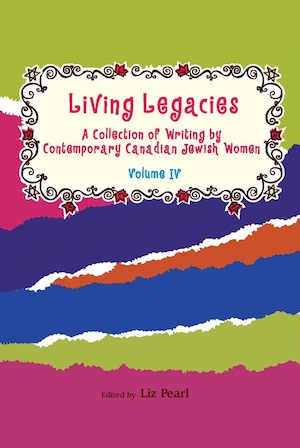
PK Press is now accepting submissions for the fifth volume of Living Legacies: A Collection of Writing by Contemporary Canadian Jewish Women. Edited by Liz Pearl – a Toronto-based educator and therapist specializing in psychogeriatrics and the expressive art therapies – the collection includes personal narratives, mini-memoirs and legacy writing from women across the country.

image - Living Legacies Vol. 4 cover
PK Press is now accepting submissions for the fifth volume of Living Legacies.

“What Living Legacies clearly indicates is that, in fact, we do not need to open our TV sets or buy glossy magazines to find inspiration. It is truly in our midst and we seem to have forgotten that our most profound life lessons can come from our mothers, sisters, girlfriends, children and, yes, ourselves. Liz has brought new meaning to the word legacy by making it so contemporary and alive. Her notion that we need to celebrate the legacies in our midst is unique; we all need to look around ourselves and rejoice in this wisdom,” writes Ina Fichman, president/producer of Intuitive Pictures Montreal, in the foreword to the fourth volume, which was published last year. One of the contributors to that collection is Lillian Boraks-Nemetz, with a story called “Sacrifice.”

Each volume of Living Legacies is available for purchase at a cost of $20 per copy plus shipping, and there is an order form online (at.yorku.ca/pk/ll-order.htm). PK Press updates are on Facebook, facebook.com/PKPress. For submission guidelines, email Pearl at [email protected].

Posted on January 30, 2015January 29, 2015Author PK PressCategories BooksTags Ina Fichman, Lillian Boraks-Nemetz, Living Legacies, Liz Pearl, women
Preserving culture, heritage

Preserving culture, heritage

Israeli food critic Gil Hovav, left, and Jack Gottlieb. (photo by Shahar Azran)

The newly formed World Jewish Heritage Fund (WJH) recently unveiled a planned global digital platform to protect and promote Jewish cultural heritage around the world during an event at the haute Israeli eatery Balaboosta in the heart of New York’s Soho neighborhood.

WJH founder Jack Gottlieb, an American expatriate based in Tel Aviv, introduced the ambitious project at the trendy restaurant on Jan. 14 night with the e-book Israel’s Top 100 Ethnic Restaurants serving as a digital appetizer to a wider menu of planned technology, including mobile applications, that will put the power of online, collaborative communications in the hands of the Jewish community to preserve Jewish heritage.

“We decided that what was needed was a kind of UNESCO for Judaism,” Gottlieb said. “Think of us as a cross between UNESCO, Wikipedia and Trip Advisor, with Jewish heritage and culture being the unique components tying it all together.”

Gottlieb founded the WJH as a nonprofit to preserve and protect the world’s Jewish heritage sites after he realized that no other organization was solely dedicated to that mission. After a trip to see Jewish sites in Belarus and Ukraine, Gottlieb said he realized “they had no voice; no one knew about them and they were falling into disrepair. I thought, ‘Can we do something about this?’” he said.

So, Gottlieb set out to build what he calls the World Jewish Heritage Preservation Model. “Using digital-tourism tools in order to push more and more visitors to Jewish heritage sites and cultural events will create incentives for countries, local authorities and organizations to keep preserving and investing in their Jewish heritage assets, which will further promote tourism to these sites and events, creating an eco-system of Jewish heritage tourism,” he explained.

The first type of heritage the organization is set up to preserve is Jewish culinary heritage, via its new e-book about Israel’s hidden ethnic culinary gems, and an e-book series to follow, about Jewish cuisine in North America and Europe. “We chose food as the first aspect of our heritage we’re trying to preserve, as it represents such an important part of our culture,” Gottlieb said. “It’s the stories behind the food, and behind the people who make it, that are the gateway to so many other aspects of our heritage.”

WJHtravel, a travel app, is currently in beta testing, and is available at the App Store; the WJHpedia, a community-based resource, fully integrated with both the app and the e-book, is available online for users to share their experiences of Jewish heritage travel all around the world.

To help celebrate the event, Balaboosta offered classic and modern Israeli foods, like fried olives, mini falafel, kubeh, bourekas, Moroccan carrot salad and a lemony cocktail made with arak. Also telling the WJH story was Israeli food critic, author and TV personality Gil Hovav, who regaled a crowd of food bloggers and other foodies with stories about his life in Israeli cuisine.

To learn more about WJH, visit worldjewishheritage.com.

Format ImagePosted on January 30, 2015January 29, 2015Author World Jewish Heritage FundCategories WorldTags Balaboosta, Gil Hovav, Jack Gottlieb, WJHtravel
Hospital hears about ASA

Hospital hears about ASA

Dr. Ayelet Erez (photo from weizmann.ac.il)

Dr. Ayelet Erez, a visiting clinician scientist from the Weizmann Institute in Rehovot, Israel, was invited to speak at B.C. Children’s Hospital earlier this month.

The group was comprised of clinicians, researchers and clinical lab scientists. The event was organized by Dr. Hilary Vallance, a Weizmann Vancouver chapter member, who is director of the B.C. Newborn Screening Program and the Biochemical Genetics Lab within the department of pathology at the hospital.

Erez gave a talk on argininosuccinic aciduria (ASA), a rare inherited disorder caused by a lack of the functional gene necessary to make an enzyme called argininosuccinate lyase. Her talk led to a discussion with members of the hospital’s metabolic division in attendance regarding various aspects of her research and how her findings could potentially improve the practice of treating patients with argininosuccinate lyase deficiency here in British Columbia.

For more information on Erez or Weizmann Canada events in Vancouver, contact Jan Goldenberg, [email protected], or call 1-855-337-9611.

Format ImagePosted on January 30, 2015January 29, 2015Author Weizmann CanadaCategories LocalTags argininosuccinic aciduria, ASA, Ayelet Erez, Hilary Vallance, Weizmann Institute
Put color in your chag

Put color in your chag

Mix it up this holiday with a colorful orange spice cake. (photo by Barry A. Kaplan)

In honor of Tu b’Shevat on Feb. 3-4, why not try some variety to celebrate the New Year of the Trees? One usually thinks of dates, figs and carob on this holiday, specifically the species of fruits that are listed in the Torah as native to Eretz Yisrael. In Israel today, sometimes we augment that with other in-season fruits, like apples, persimmons, strawberries (though beautiful, they are expensive!) or varieties of delicious citrus. Here are some recipes using oranges.

SYRIAN ORANGE CHICKEN
makes four servings

1 tbsp margarine
1 tbsp oil
1 cut-up chicken
1/2 cup orange juice
1 cup chicken soup
1 1/2 tsp corn starch
1/2 chopped onion
juice of 1/2 lemon
6-9 halved, pitted dates
orange slices

  1. Preheat oven to 350°F. Grease a baking dish.
  2. Heat margarine and oil in a frying pan and brown chicken. Place in a baking dish.
  3. Add orange juice, chicken soup, cornstarch, onion and lemon juice to frying pan and cook, stirring, until sauce thickens. Pour over chicken.
  4. Cover and bake 45 minutes.
  5. Garnish with dates and orange slices, cover and bake at least 15 minutes or until chicken is done. Serve with rice.

ORANGE JUICE SALAD DRESSING
The dressing is good on a salad with lettuce, avocado and grapefruit.

3/4 cup oil
6 tbsp orange juice
1/2 tsp sugar
pinch dry mustard

  1. Combine oil, orange juice, sugar and mustard in a jar.
  2. Shake well.

ORANGE SPICE CAKE

6 seeded, peeled, cut-up small oranges, such as mandarins or tangerines
1/3 cup canola oil
3 eggs
1 cup brown sugar
1/2 tsp ginger
1/4 tsp cinnamon
1 tsp vanilla
1 3/4 cups flour
1 1/2 tsp baking powder
1/2 cup non-dairy creamer

  1. Preheat oven to 350°F. Grease a cake pan, two loaf pans or place mini papers in a mini-muffin pan and spray with vegetable spray.
  2. Place orange pieces, oil, eggs and brown sugar in a mixer or food processor and blend a few seconds.
  3. Add ginger, cinnamon, vanilla, flour, baking powder and non-dairy creamer and blend.
  4. Spoon into baking pans. Bake 25 minutes or until a toothpick inserted in the centre comes out clean.

ORANGE DROP COOKIES
makes three dozen

1 cup sugar
2/3 cup unsalted pareve margarine
2 eggs
1/2 cup orange juice
1 tbsp grated orange peel
2 1/4 cups flour
1/2 tsp baking soda
1/2 cup chopped nuts

  1. Preheat oven to 350°F. Grease cookie sheets.
  2. Cream sugar and margarine with eggs. Stir in orange juice and orange peel.
  3. Add flour, baking soda and nuts and mix well.
  4. Drop by teaspoon onto cookie sheets. Bake 10 minutes or until golden brown.

Sybil Kaplan is a journalist, foreign correspondent, lecturer, food writer and book reviewer who lives in Jerusalem. She also does the restaurant features for janglo.net and leads weekly shuk walks in English in Jerusalem’s Jewish food market.

Format ImagePosted on January 30, 2015January 29, 2015Author Sybil KaplanCategories Celebrating the HolidaysTags New Year of the Trees, seder, Tu b'Shevat
Fruits, nuts, traditions

Fruits, nuts, traditions

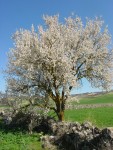
Tu b’Shevat, the New Year of the Trees, coincides with the flowering of the almond tree in Israel. (photo from en.wikipedia.org/wiki/Shevat)

Tu b’Shevat, which falls this year on Feb. 3-4, marks the end of the rainy season in Israel. Buds are beginning to appear on the trees, and the blossoming almond trees, the harbinger of spring, have begun to dot the landscape. So, on the 15th day of the Hebrew month of Shevat, we celebrate the yearly cycle for the growth of trees in Eretz Israel.

According to Jewish mystical tradition, Tu b’Shevat is the day when G-d renews sustenance and the “life-cycle” of the trees, when the sap starts to rise.

There are many customs to remind us of the meaning of this day, including a Tu b’Shevat seder, not unlike the ritual meal we have on Passover.

On Tu b’Shevat, fruit trees were measured for growth in order to calculate the annual tithe to the Temple. Even long after the Temple was destroyed, this seder was a new way to reaffirm the spiritual bond with the land in celebration of the approach of spring and the fruit of the earth.

This ancient tradition was developed in Safed, the seat of kabbalistic studies in the 16th century. Traditionally, we eat nuts and the fruits for which the Torah praises the Land of Israel, including grapes, figs and pomegranates, olives and dates. The table is set with a snowy white tablecloth, candles, fruit and nuts, and the sharing of prayers, readings and songs.

It is traditional to enjoy four cups of wine, like on Passover. Those glasses of wine can be paired with a corresponding fruit and divided into ascending levels of spirituality.

The first cup, therefore, is often white wine, symbolizing winter, accompanied by a fruit that needs a protective covering, such as oranges or almonds.

The second cup is white wine mixed with a small amount of red, signifying spring, the budding of new life. This glass is served with olives, apples, peaches and dates: the outer layer is eaten, yet the heart is protected and has within it the seed of new life.

The third cup is red wine with a small amount of white mixed in. This is the symbol of summer and a perfect world in which nothing is wasted. With this, fruits such as figs, grapes and berries are eaten. These are considered to symbolize the highest level of spiritual openness.

The fourth cup is red wine only, representing fertility and the bounty of the autumnal crops.

What else happens on Tu b’Shevat? Very little religiously, but a lovely ritual has arisen in Israel, one that’s now been adopted all over the Jewish world. It is a popular observance to plant trees, one of the greatest mitzvot we can perform.

Trees have great significance in Judaism. This Tu b’Shevat, however, we are still in a Shmita (jubilee) year in Israel; the land is resting, so no plantings will take place.

Trees hold a special place in Judaism. It is written in Deuteronomy: “When you besiege a city for many days to wage war against it to seize it, don’t destroy its trees….” In the Midrash Shmuel on Pirkei Avot 3:24, it is written that man is like a tree in that his good deeds are his produce, his “fruits,” and his arms and legs the “branches,” which bear these fruits. He is, however, an “upside-down tree,” for his head is rooted in the heavens, nestled in the spiritual soils of the Eternal, and nourished by his connection to his Creator.

At the end of the Hasmonean dynasty, there lived a holy man named Honi, known as the circle drawer, Honi HaMa’agel, and we read his story in Talmud Ta’anit 23a. One day, Honi sees a man planting a carob tree and asks him, “How many years does it take for the carob tree to bear fruit?” The man replies, “Seventy years.” Honi asks, “Do you think you will live another 70 years and reap its fruit?” The man responds, “I am planting the tree not for myself, but for my grandchildren.”

Although the world may not regard Jews as being tied closely to the land, the truth is that Judaism has close ties to agriculture and ecology. The midrash teaches us that man’s life depends on the tree, and we are forbidden to live in a city that has no gardens and trees. They are so important that Rabbi Yohanan Ben-Zakai declared, “If you hold a sapling in your hand and are told, ‘Come look, the Messiah has arrived,’ plant the sapling first and only then go and greet the Messiah.”

Happy Tu b’Shevat!

Dvora Waysman is the author of 13 books, which are available through Amazon, or from the author at [email protected]. Her website is dvorawaysman.com.
Format ImagePosted on January 30, 2015January 17, 2016Author Dvora WaysmanCategories Celebrating the HolidaysTags Israel, Judaism, New Year of the Trees, seder, Tu b'Shevat
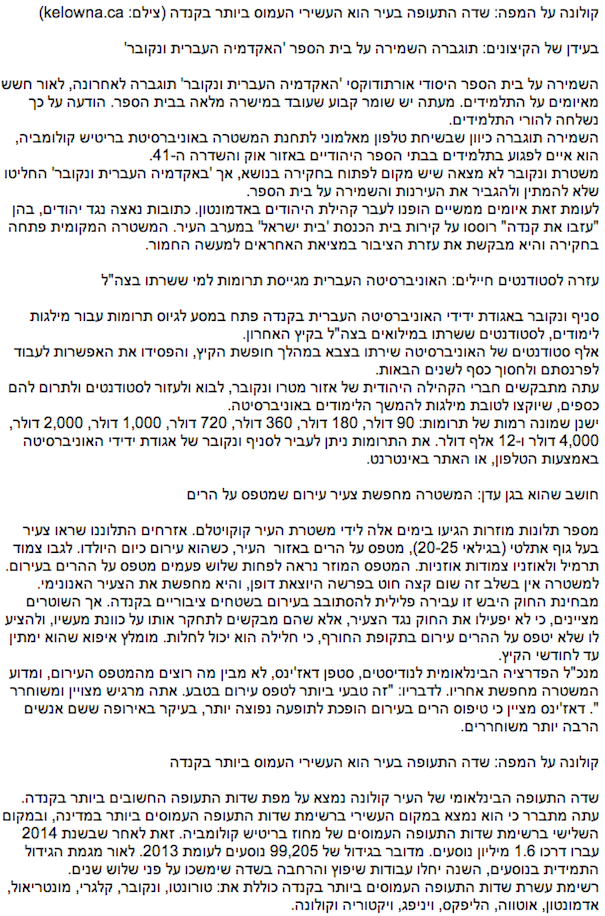
מסביב לקולומביה הבריטית

מסביב לקולומביה הבריטית

image - interesting in the news 15 - VHA security, CFHU soldier-students scholarship campaign, naked hiker missing in Coquitlam, Kelowna airport

Format ImagePosted on January 28, 2015January 27, 2015Author Roni RachmaniCategories עניין בחדשותTags airports, antisemitism, Coquitlam, Hebrew University, International Naturist Federation, Kelowna, naked climber, soldier-students, Stéphane Deschênes, Vancouver Hebrew Academy, האוניברסיטה העברית, האקדמיה העברית ונקובר, הפדרציה הבינלאומית לנודיסטים, מילגות לימודים, נגד יהודים, סטפן דאז'ינס, קולונה, קוקויטלם, שדות התעופה
Israel launches campaign to discredit inquiry

Israel launches campaign to discredit inquiry

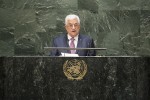
Palestinian Authority President Mahmoud Abbas at the United Nations General Assembly in September 2014. (photo from UN photo/Amanda Voisard)

The Israeli government has launched a public diplomacy campaign to discredit the legitimacy of the International Criminal Court’s recent decision to start an inquiry into what the Palestinians call Israeli “war crimes” in the disputed territories.

According to ICC prosecutor Fatou Bensouda, the inquiry – which was initiated after a request by the Palestinian Authority – is not a formal investigation, but rather “a process of examining the information available in order to reach a fully informed determination on whether there is a reasonable basis to proceed with an investigation pursuant to the criteria established by the [ICC’s] Rome Statute.”

Palestinian Authority President Mahmoud Abbas recently signed the Rome Statute in order to join the ICC after failing to get a UN Security Council resolution passed that called for Israel’s withdrawal from the disputed territories by 2017.

Israel’s campaign against the ICC inquiry will focus on the fact that the because the charges were filed by the PA, which is not a state, the court has no authority to act. In addition, the campaign will point out the court’s bias against Israel – a country on the frontline of the war against terrorism that makes sure to abide by international law by way of an independent legal system.

The Israeli government decided to launch the public diplomacy campaign at an emergency meeting in response to the ICC decision that was convened by Prime Minister Binyamin Netanyahu. The meeting, which took place at Netanyahu’s office, was attended by Israeli security, legal and diplomatic officials.

The ICC’s decision to launch the inquiry into Israeli actions is “the height of hypocrisy and the opposite of justice,” Netanyahu said on Sunday at the start of this week’s cabinet meeting, two days after the court announced the inquiry.

“During my years of public service, both as UN ambassador and as prime minister, I encountered these kinds of events, but this decision by the [ICC] prosecutor is in a league of its own,” Netanyahu said. “It gives international legitimacy to international terrorism.”

The prime minister said Israel would fight the ICC’s decision with every means it has available, including the enlistment of its allies. Along those lines, Israel is lobbying member states of the ICC to cut funding for the tribunal, Israeli Foreign Minister Avigdor Lieberman said on Sunday. Israel, which like the United States does not belong to the ICC, hopes to dent funding for the court that is drawn from its 122 member states in accordance with the size of member states’ economies, said Lieberman.

“We will demand of our friends in Canada, in Australia and in Germany simply to stop funding it,” Lieberman told Israel Radio.

Read more at jns.org.

Format ImagePosted on January 23, 2015January 23, 2015Author Shlomo Cesana ISRAEL HAYOM/JNS.ORGCategories IsraelTags Binyamin Netanyahu, Fatou Bensouda, ICC, International Criminal Court, Israel, Israeli-Palestinian conflict, Mahmoud Abbas, Palestine
Baird’s visit to Israel, Ramallah

Baird’s visit to Israel, Ramallah

Canada’s Foreign Minister John Baird, left, meets with Israeli Prime Minister Binyamin Netanyahu earlier this week. (photo by Kobi Gideon/GPO)

After a hostile greeting by protesters in the Palestinian Authority capital of Ramallah, who pelted his convoy with shoes and eggs, Canadian Foreign Minister John Baird returned to Jerusalem to meet with Israeli Prime Minister Binyamin Netanyahu, Foreign Minister Avigdor Lieberman and President Reuven Rivlin.

According to reports, Ramallah activists carried signs reading “Baird you are not welcome in Palestine.” Baird has opposed the PA’s bid for war crimes charges against Israel and other moves by the PA at the United Nations. Ottawa has also been vocally supportive of Israel during Stephen Harper’s tenure.

The foreign minister’s visit came on the anniversary of Harper’s tour of the region in 2014. Baird hoped to reaffirm Canada’s commitment to the strategic partnership and agreements forged on that visit. “Canada deeply values its close ties with Israel,” Baird said prior to his trip.

Baird traveled to Ramallah Sunday morning to meet with PA Foreign Minister Riyad al-Maliki. At that meeting, which Baird called “cordial and constructive,” Baird and Maliki discussed Canada’s “desire for a future of peace and prosperity, stability and security for both Palestinians and Israelis.”

Baird said Canada considers itself a “friend” to both Israel and the Palestinian Authority. “As friends, we have candid and frank exchanges on areas where we differ in opinion,” he said, adding that he asked Maliki to “strongly reconsider the consequences of moving forward with any action that may be counterproductive to a negotiated solution with the state of Israel.”

Last week, the PA brought war crimes charges against Israel at the International Criminal Court in The Hague, along with ongoing efforts to seek sanctions at the UN. Baird said these moves, “will not contribute to peace and security in the region.”

As Canadians, said Baird, “we strongly support Israel’s right to defend itself, and we will play our part to defend Israel from international attempts to delegitimize it.”

“Canada believes strongly in a two-state solution between Israel and the Palestinian Authority,” Baird said prior to the trip. “Negotiations provide the only viable path to lasting peace.”

Returning from Ramallah Sunday afternoon, Baird met privately with Lieberman.

Lieberman has earned scorn with his plan to annex Israeli Arab villages to the PA. Under Lieberman’s plan, only those Arab citizens who moved to Israeli-controlled areas and pledged loyalty to the state of Israel would retain their current citizenship. Once considered a contender for prime minister, Lieberman’s chances have been diminished considerably by recent corruption allegations.

The ministers jointly signed four memoranda of understanding and agreements, including a declaration of solidarity and friendship, and a declaration on trade that Baird said aims “to double the value of our [countries’] commercial relationship.”

Baird said that with the rise of worldwide terrorism, including October’s attack on the Parliament buildings in Ottawa, “the relationship between Canada and Israel is stronger than ever been, and getting stronger every day.”

Business development between the two countries will be targeted specifically in the area of defence, security and cyber security, Baird said.

Canadian Ambassador Vivian Bercovici and other official representatives from both countries remained after Baird’s departure for award presentations to the 10 finalists of Grand Challenges Israel (GCI). Inspired by Grand Challenges Canada (GCC), which is led by chief executive officer Peter Singer, who received the Order of Canada in 2011, GCI rewards entrepreneurs for advances in affordable health care for the developing world. Finalists, chosen from more than 100 entries, presented innovations in water purification, disease diagnosis and an affordable wheelchair for children. Worldwide, the Grand Challenges initiative was launched by the Bill and Melinda Gates Foundation in 2003.

Baird’s trip to the region included a stop in Egypt, which he visited prior to the Israel leg of his trip. There, he met with Foreign Minister Sameh Shoukry but failed to ensure the release of Canadian-Egyptian journalist Mohamed Fahmy, convicted for being a member of the Muslim Brotherhood, a group that is now banned in Egypt.

A year ago, on Jan. 20, Harper became the first Canadian prime minister to speak in the Knesset. His remarks about Israel’s right to exist and defend itself received a standing ovation, along with jeers and catcalls from Israeli Arab MKs who walked out in protest. On that visit, Harper pledged millions of dollars in increased support for the PA. Although Harper’s visit was well received by the Israeli media, the Canadian press was critical of Harper’s large delegation and “rigid” pro-Israel stance.

Baird’s Israel agenda originally included stops at the Dome of the Rock and the Al-Aqsa Mosque, both atop the Temple Mount area behind the Western Wall in Jerusalem. No reason was given for the decision to cancel visits there. Harper canceled a similar visit a year ago.

Baird met Netanyahu on Monday afternoon before leaving Israel. He continued to Davos, Switzerland, to attend the 2015 World Economic Forum from Jan. 21-24.

– For more national Jewish news, visit cjnews.com.

Format ImagePosted on January 23, 2015January 21, 2015Author CJN StaffCategories IsraelTags Avigdor Lieberman, Binyamin Netanyahu, Grand Challenges Israel, Israel, John Baird, PA, Palestine, Peter Singer, Reuven Rivlin, Riyad al-Maliki, Sameh Shoukry, Vivian Bercovici

Turkey under scrutiny

Paris terror suspect Hayat Boumedienne’s recent escape from France to Syria has renewed concern about Turkey’s ability and willingness to prevent terrorists from transiting through its territory.

Boumedienne is the romantic partner and alleged accomplice of Amedy Coulibaly, who was shot dead by police after killing four people in a kosher supermarket and shooting a police officer in Paris on Jan. 9. Airport footage shows Boumedienne’s arrival from Madrid to Istanbul on Jan. 2, and Turkish Foreign Minister Mevlüt Çavusoglu said she crossed the border to Syria six days later.

Turkey has been the subject of intense criticism from Western governments and commentators over its perceived lack of effort in stemming the flow of foreign fighters crossing its borders. However, some think this isn’t quite fair.

“I think it’s somewhat of a misplaced criticism,” said Sinan Ülgen, a scholar at Carnegie Europe. Though the Turkish government may have formerly looked the other way at the activities of Islamist groups because of a desire to bring down the Assad regime at any cost, “that policy by and large had changed by April 2014,” according to Ülgen.

At that time, Interior Minister Efkan Ala made an effort to enhance border security, “having realized the risks of getting into that sort of relationship with extremist groups,” said Ülgen. However, researcher Gareth Jenkins says it’s still very easy for foreign fighters to cross through Turkey.

“When you look at the ease with which [terrorists and would-be fighters] are able to go back and forth across the border, there still isn’t a full clampdown,” Jenkins said. “It’s not as easy as it used to be, but it’s still pretty easy.” He said he recently personally witnessed fighters in a Turkish village near the Syrian border. “There were jihadists sitting around waiting to go across.”

With some 40 million tourists visiting Turkey every year, border security is no easy task, but Jenkins says security forces could be doing a lot more. He claimed that difficulty over border security isn’t the only reason for Turkey’s failure at curbing the flow of foreign citizens seeking to join the ranks of ISIS and other groups.

Read more at themedialine.org.

Posted on January 23, 2015January 21, 2015Author Nick Ashdown TMLCategories WorldTags Gareth Jenkins, Hayat Boumedienne, security, Sinan Ülgen, terrorism, Turkey

Posts pagination

Previous page Page 1 Page 2 Page 3 … Page 6 Next page
Proudly powered by WordPress