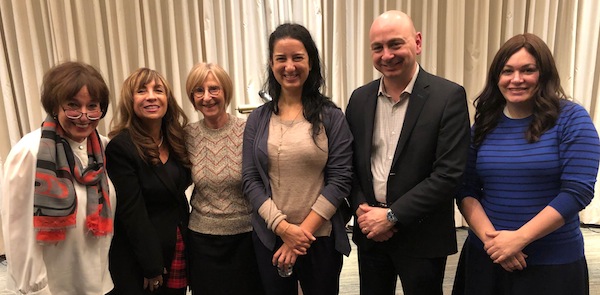
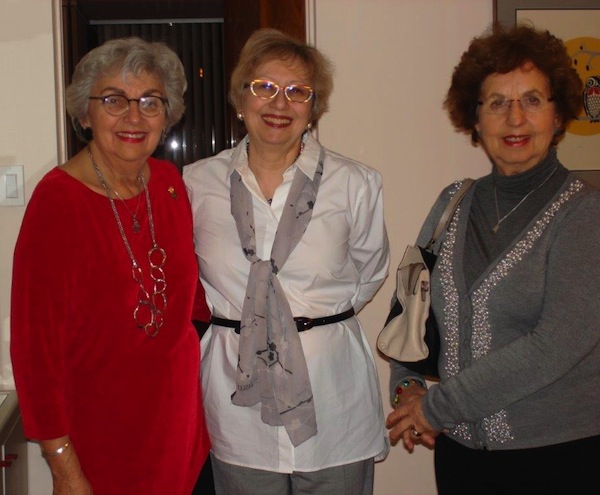
Left to right, National Council of Jewish Women of Canada Vancouver section’s 2018/19 board of directors Catherine Stoller (president), Linda Arato (secretary), Anne Lerner (social action chair), Rochelle Garfinkel (administration) and Debby Altow (past president) were installed by Shelagh Stoller, who gave a brief bio of each member and presented the traditional red rose. The 94th annual general meeting, which took place Oct. 14, confirmed members’ support of NCJWC’s advocacy at the United Nations, on Canada’s citizenship issues and against antisemitism here and abroad. Catherine Stoller reported on the programming for disadvantaged schools in Vancouver, which receives help from the B.C. Gaming Commission.
Tag: National Council of Jewish Women
Mystery photo … June 24/16
National Council of Jewish Women, 1965. (photo from JWB fonds, JMABC L.13971)
If you know someone in this photo, please help the JI fill the gaps of its predecessor’s (the Jewish Western Bulletin’s) collection at the Jewish Museum and Archives of B.C. by contacting [email protected] or 604-257-5199. To find out who has been identified in the photos, visit jewishmuseum.ca/blog.
Mystery photo … Nov. 27/15
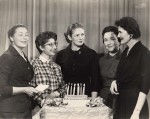
Women gathered around a table with a candled cake, National Council of Jewish Women, circa 1955. Leonore Freiman is in the middle. (photo from JWB fonds, JMABC L.13952)
If you know someone in this photo, please help the JI fill the gaps of its predecessor’s (the Jewish Western Bulletin’s) collection at the Jewish Museum and Archives of B.C. by contacting [email protected] or 604-257-5199. To find out who has been identified in the photos, visit jewishmuseum.ca/blog.
Mystery photo … Aug. 28/15
Children singing, Camp Miriam, Gabriola Island, B.C., 1979. (photo from JWB fonds; JMABC L.09623)
If you know someone in these photos, please help the JI fill the gaps of its predecessor’s (the Jewish Western Bulletin’s) collection at the Jewish Museum and Archives of B.C. by contacting [email protected] or 604-257-5199. To find out who has been identified in the photos, visit jewishmuseum.ca/blog.


We Care believes in change
Leah Gazan (photo by Rebeca Kuropatwa)
Human traffickers target those who are most vulnerable – women and children, and people from impoverished and marginalized cultures and communities. Anti-trafficking organizations estimate that between 12 and 30 million people are held in forced labor (including sexual servitude) and that two to four million people are trafficked across borders each year.
On March 12, Manitoba marked its second Human Trafficking Awareness Day. To observe the day, National Council of Jewish Women (NCJW) of Canada, Winnipeg section, held the event United We Care, An Evening in Support of the We Care Campaign for Education about Missing and Murdered Indigenous Women and Girls.
The program took place at Graffiti Art Programming and included an art exhibit, as well as an address from Leah Gazan, an advocate for MMIW issues in Manitoba and the rest of Canada. Indigenous artist Jessica Canard created a painting during the event that was auctioned off at the end of the night.
Gazan introduced herself as a member of the bear clan. “The bear clan has roles and responsibilities,” she said. “One is to be a protector. My mother was a child welfare survivor, a Lakota woman, a street kid. She overcame great obstacles, obtained a master’s degree, and changed legislation.
“My father was a Holocaust survivor from Holland and, like my mother and in spite of historical trauma he experienced, he went on to receive two master’s degrees, a teaching degree, raise a family and spend his life trying for social justice with a special focus on fighting for children.”
Gazan said her parents taught her that change is possible, “with the goal of realizing a good world for all peoples, animal life, plant life, our women and our girls. We are all sacred. We all have to take responsibility for the collective well-being of all creation.”
The We Care campaign came from a conversation between Gazan and artist and singer Raine Hamilton. Upset about what was happening to indigenous women and girls in Canada, Hamilton wanted to do something. Gazan encouraged her, saying, “If you want to do something, Raine, you do something, and I will support you.”
In 2013, James Anaya, former special rapporteur on indigenous issues for the United Nations, called the state of violence and the number of murdered and missing indigenous women in Canada a national crisis. According to the RCMP’s 2014 National Operational Review on Missing and Murdered Aboriginal Women, “Police-recorded incidents of aboriginal female homicides and unresolved missing aboriginal females in this review total 1,181 – 164 missing and 1,017 homicide victims.” There were 225 unsolved cases: 105 missing for more than 30 days as of Nov. 4, 2013, “whose cause of disappearance was categorized at the time as ‘unknown’ or ‘foul play suspected’ and 120 unsolved homicides between 1980 and 2012.”
“We represent 4.3 percent of the Canadian population, yet we represented 16 percent of all reported homicides,” said Gazan. “Indigenous women and girls are not safe in this country and this is related to a number of factors, including high rates of poverty among indigenous women.”
According to the UN and the platform action committee in Manitoba, Gazan said, “The current rate for poverty for indigenous women living off reserve is at 42.7 percent. That is twice the rate for non-indigenous women and exceeds rates of indigenous men, with an average income of $13,300. That’s $6,060 lower than non-indigenous women and approximately $5,000 lower than indigenous men.”
Gazan stressed, “This is not an indigenous issue. This is an issue for all Canadians who want to protect the fundamental rights of all persons. It will take all of us in solidarity to address these issues.
“One cannot begin to understand the complexity of this issue without the focus on the colonization of indigenous women,” she continued. “Prior to colonization, our women and, in particular, our grandmothers were the main decision makers within our nations. Women were seen as powerful. This was very much related to our ability to bring life into the world.
“Through the eyes of colonialists, indigenous women were seen as property of men, much like women in Europe at that time. The exclusion of indigenous women in decision making eventually led to the cultural, social and economical dispossession of indigenous women that was eventually stipulated in policies that were enforced in the Indian Act.
“In 2006, the International Indigenous Women’s Forum noted that the systemic violation of their collective rights as indigenous people is the single greatest risk factor for gender-based violence, including violence perpetrated within their communities.”
The situation can be changed, however, “and that’s exactly what the purpose of the We Care campaign is,” said Gazan. “It’s to educate and engage fellow Canadians so that we can change that story … so we can end what has resulted in unacceptable levels of violence that’s perpetrated against indigenous women and girls in this country.
“It’s a place where we can come together to demonstrate and send a clear message that we will not stop until indigenous women and girls are afforded the same rights and safety as are afforded to other Canadians.”
The group hopes that this campaign will become one of the main issues in the upcoming federal election.
“We need Canadians to join with us in unity, to say that we care,” said Gazan. “It seems so overwhelming that people don’t know what to do because it’s so bad, but I don’t think it’s because people don’t care. I believe people care.
“What if we start to join together to recreate a new story that results in a safer city, province and country for indigenous women and girls as an act of humanity?”
NCJW across Canada and its international body, the International Council of Jewish Women, has established advocacy against human trafficking as a priority issue. All proceeds from the March program’s ticket sales and the auction went to the We Care campaign.
To participate, snap a photo of yourself holding a sign that says #WeCare and #MMIW, then post it on Twitter and Facebook, showing it’s an issue that matters to you. More information is available at facebook.com/wecaremmiw.
Rebeca Kuropatwa is a Winnipeg freelance writer.

NCJW anniversary draws crowd
At NCJW’s 90th anniversary party, left to right, Robyn Lenn, Ezra S. Shanken, Debby Altow, Catherine Stoller, Sharon Allentuck and Cynthia Ramsay. (photo by Joanne Emerman)

The Vancouver section of National Council of Jewish Women of Canada welcomed national president Sharon Allentuck of Winnipeg and Robyn Lenn, president of International Council of Jewish Women, to a jam-packed 90th anniversary party at VanDusen Botanical Garden on Nov. 16.
Vancouver president Catherine Stoller and anniversary committee members greeted the approximately 125 people to a farmers’ market of food, bubbly and partner-agency displays. Council members had a chance to renew friendships, visit the displays of B.C. Transplant Society, Vancouver Coastal Health, HIPPY/MOSAIC, the JCC Jewish Book Festival, Children of the Street, Elizabeth Fry Society, and Council’s signature projects, Books for Kids, Operation Dressup and ALUMA of Israel.
Council of good deeds
Sarah Marel Schaffer, left, and Sandy Hazan pause while sorting clothing for Operation Dress-Up, a social action project sponsored by the National Council of Jewish Women, Vancouver section. (photo from NCJW Vancouver)
Shlepping bags of new underwear and socks plus bundles of gently used, donated clothing to inner-city Vancouver gives Sarah Marel Schaffer and Sandy Hazan a sense of fulfilment.
The two women spearhead Operation Dress-Up, a social action project of the National Council of Jewish Women, Vancouver section. The clothing they buy, collect and distribute goes to needy children identified by school counselors and principals, by neighborhood youth and family workers, or by the Jewish Family Service Agency.
On Sunday, Nov. 16, the Vancouver section of NCJW will celebrate 90 years of education, advocacy and social action projects such as Operation Dress-Up. The event is set for 11 a.m. to 2 p.m. at VanDusen Gardens, and all are welcome.
Operation Dress-Up, begun 20 years ago, is supported by NCJW fundraising and by grants. United Way recently awarded the project $6,000. Schaffer said they are “quite lucky” to get this amount at one time and will soon call schools to see what’s on their wish lists and determine where the money will be best used.
Both women have been involved in Operation Dress-Up for 10 years. Schaffer said that for her it’s a way to give back to the community. “It’s a joy to dress your own kids in nice clothes and it’s a joy to help out in this way,” she said.
Hazan has found her participation to be a learning experience. “When you see the desperate need in Vancouver, it’s very humbling. I never knew that the poorest postal code in Canada is on the Downtown Eastside. I was shocked,” she said.
While Operation Dress-Up is a hands-on project, NCJW works with many local organizations, mainly by providing grants. One recipient is Children of the Street, whose mission is to intervene to prevent the sexual exploitation and human trafficking of children and youth.
Human trafficking, a modern form of slavery, is a focus for NCJW nationally and internationally. Council has advocated for passage of Bill C-36, to protect girls and women from sexual exploitation, sponsored by MP Joy Smith (Kildonan-St. Paul, Man.).
International Council of Jewish Women has joined with Stop the Traffik (stopthetraffik.org), devoted to ending human trafficking worldwide. ICJW also works on various projects with nongovernment organizations at the United Nations.
In Israel, ICJW lobbies on behalf of women kept captive by unfair divorce laws (agunot), and supports the Women of the Wall in its quest for gender equality. NCJW of Canada supports ALUMA, formerly known as IFCA, Israel Family Services Association.
At the 90th anniversary celebration, a roving magician, speakers – national NCJW president Sharon Allentuck from Winnipeg and international president Robyn Lenn from Australia – and finger food will be part of the fun. Organizations that partner with Vancouver NCJW will be arranged in a “farmers market” of informational booths. Some of these will include the Vancouver Public Library, Richmond Jewish Day School, Vancouver Coastal Health, Elizabeth Fry Society, Jewish Book Festival, Children of the Street, Home Instruction for Parents of Preschool Youngsters (HIPPY), B.C. Transplant Society, Barefoot Books and the Jewish Community Centre of Greater Vancouver. Council’s own projects, Books 4 Kids and Operation Dress-Up, will also be on display.
Tickets to the 90th celebration are $18, available at Vancouver NCJW’s office at the JCCGV. Call the NCJW office at 604-257-5180 for reservations.
Mystery photo … Sept. 26/14
Women with thrift sale goods, National Council of Jewish Women, 1960. (photo from JWB fonds; JMABC L.13961)
If you know someone in this photo, please help the JI fill the gaps of its predecessor’s (the Jewish Western Bulletin’s) collection at the Jewish Museum and Archives of B.C. by contacting [email protected].
More Than Just Mrs. exhibit online
NCJW members unload boxes of toys headed for Israel as part of the Ship a Box to Israel program launched by NCJW Tikvah branch, Vancouver Harbor, 1947. (photo from JMABC L.11998)
Much of the work of Jewish women in Vancouver has occurred, both historically and still today, behind the scenes. The Jewish Museum and Archives of British Columbia is trying to change that with its online exhibit, More Than Just Mrs. Accessible at morethanjustmrs.wordpress.com, the exhibit discusses the history of the National Council of Jewish Women, Hadassah-WIZO (CHW) and Na’amat, the three predominant Jewish women’s organizations mid-century. It includes audio clips from local women who worked for these organizations and focuses exclusively on the work of the B.C. chapters.
“We’re trying to raise awareness of the Jewish community in B.C. and its history,” said Michael Schwartz, coordinator of development and public programs at JMABC, located in the Peretz Centre for Secular Jewish Culture in Vancouver. “When it came to these chapters of the organizations, I knew a few of the stories but wanted to fill in the gaps and learn more. I thought we should look at the organizations in greater detail, at the differences in their philosophies and the influential women who worked for them.”
The website has an introduction and then individual sections on each of NCJW, Hadassah and Na’amat, each one containing letters, certificates and other historical material relevant to the work the organizations performed. There are a total of six audio clips online but those who want to hear entire interviews may visit the Jewish museum offices to listen to them.
The exhibit offers a fascinating glimpse into Jewish life in Vancouver in the 1940s and ’50s: its fashions, the organizations’ priorities and their fundraising strategies. These women were professional volunteers, individuals who were not content to be “just Mrs.,” and insisted on devoting their time and talents to improving and meeting the needs of their local communities and communities in Israel and elsewhere. The name for the exhibit was drawn from an interview with one of the volunteers some 20 to 30 years ago, wherein she mentioned the phrase, “More than just Mrs.,” adding that, for her, doing this volunteer work was an opportunity to step out of her husband’s shadow.
NCJW supported an orphanage in Holland, for example, sending regular shipments of food and clothing to the aid of the 220 destitute war orphans being cared for in Bergstichting. The exhibit includes a letter from the orphanage dated April 1947, describing the difficult conditions at the orphanage. “The physical condition of our pupils being still rather week [sic], we had to fight with a scarlatina [scarlet fever] epidemic during five months,” wrote the director. “Sixty of our people were taken with this illness. But fortunately, your valuable gifts reached us just in those distressful months.”
The online exhibit was launched in September 2013 and some 2,500 people have visited the site since it was launched. Schwartz estimates it takes 60 to 90 minutes to read the material, which was produced by Annika Friedman last summer with the aid of Young Canada Works, a granting program subsidized by the federal government. Schwartz said another online exhibit is being produced this summer under the same program. Called Oakridge: The Final Frontier, it will chart the rise and decline of the Jewish community in the neighborhood. Elana Wenner, a master’s candidate in Jewish studies at Concordia University, will be interviewing community members and gathering photographs, videos and other relevant materials for the new exhibit. To contribute and for more information, Wenner can be reached at [email protected].
Lauren Kramer, an award-winning writer and editor, lives in Richmond, B.C. To read her work online, visit laurenkramer.net.
Mystery photo … Feb. 28/14
National Council of Jewish Women Israeli brunch, Vancouver, B.C., 1965. (JWB fonds, JMABC L.13972)
If you know someone in this photo, please help the JI fill the gaps of its predecessor’s (the Jewish Western Bulletin’s) collection at the Jewish Museum and Archives of B.C. by contacting [email protected].