Daniel Brenner’s klezmer aerobics workout and performance was inspired by the Klezmorims. (photo from Daniel Brenner)
Rabbi Daniel Brenner – who grew up in the small Jewish community of Charlotte, N.C. – has come up with an aerobic workout set to klezmer music.
Brenner graduated from the Reconstruction Rabbinical College which, at the time, was led by Rabbi Art Green. He began performing in 1987 with the late comic legend Chris Farley at the Ark Improvisational Theatre, and has been doing theatre ever since.
In rabbinical school, Brenner created the one-man-show Faster, Rabbi, Drill! Drill!, which won an All Out Arts New York playwriting award (2000). He also wrote a series of Chassidic folktales/plays for Philadelphia’s Theatre Ariel and has had a play produced by New York’s Vital Theatre, in addition to producing a handful of Purim shpiels. Today, he performs regularly with the band Midnight Nosh, on guitar, and lives with his wife Lisa and their three children in Montclair, N.J.
“Growing up, my home was a place that other people came to experience Judaism,” Brenner told the Independent. “There were no other Jewish families on my street, so my home was a site where many non-Jewish people experienced Judaism for the first time.”
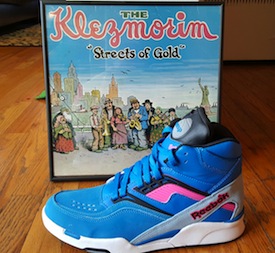
A big part of Daniel Brenner’s inspiration came from the Klezmorim’s Streets of Gold. (photo from Daniel Brenner)
Brenner’s love of music came early on, as he listened to a mix of Shlomo Carlebach and contemporary American folk. In the 1980s, Brenner’s parents went to a Klezmorim concert and came home with their record Streets of Gold.
“I was ecstatic listening to the music,” said Brenner. “I couldn’t believe that we had music that had so much soul. As a kid, I was enthralled with Michael Jackson – music you can dance to. But, when I heard the Klezmorim, I was like, this music is just as good for dance. I loved it.”
While working out and listening to klezmer, Brenner thought of how amazing it would be to lead a class using this music. Originally, he thought of pairing it with Zumba, but then decided that klezmer aerobics would be the best fit.
As he worked on the idea, he realized this could be more than just another class. “I really tried to think of what story it wants to tell,” he said. “That really helped me get to the place where it was a full narrative, and a full show about the relationship between someone in the 1980s and someone in the 1880s.
“I thought about it in terms of the two great shifts in human past civilization, recent history – the shift away from agricultural, industrial, rural to urban that happened in the 1880s, and then also the 1980s, the shift between the industrial era and the digital era. I wanted the story that I told to be about that shift.”
Brenner started researching moves that would reflect, as closely as possible, the 1880 dance fashion. He discovered Steven Lee Weintraub, who teaches Jewish traditional dance, and engaged him in private lessons. Brenner videotaped these lessons and practised intensely to get a good handle on the movements and to effectively incorporate them into his repertoire.
“I told my beloved, I told her, keep in mind that I want to do this over the next decade, so she understands I’m definitely thinking long-term about what I want to do with the project,” he explained. “My goal really will be to work together with local klezmer bands in various places around the world to create an experience for people – to perform a show as a way to not only teach dance and tell the story, but as a way to connect people to the local klezmer scene who may not experience it otherwise.”
Brenner has created ’80s Klezmer Aerobics, a family-friendly, interactive dance-storytelling workout wherein “the 1880s meets the 1980s.” In the show, Brenner plays an aerobics instructor and leads an audience-participation workout, as he tells the story of a dancer, Levi, and his apprentice. The audience learns the traditional Old Badchen dances that Levi learns and creates when he runs off to Warsaw.
“I feel that the fun ’80s Klezmer Aerobics and the experience is going to be a draw for a lot of people,” he said. “Then, I also feel like giving people the opportunity to hear live klezmer music is a rare thing. In anyway I can, I want to help people dig the stuff I dug when I was a boy in N.C., putting that record on for the first time.”
In addition to the family-friendly version, Brenner has been considering splitting the experience into two parts – one as a matinée for the family and one in the evening, attracting a different crowd.
Since being performed last November, there have been a few shows in different venues so far. Brenner is working with some Canadian friends to create shows in Canada, having received a few inquiries about it from Jewish community centres.
“I’ve also heard from New York, Atlanta and North Carolina,” he said. “I hope to take it around the Jewish world.”
For more information, visit klezmeraerobics.com or check out Klezmer Aerobics’ Facebook page. There are also videos available on YouTube.
Shtreiml and Ismail Fencioglu will play at the Vancouver Folk Music Festival, as well as concerts on Vancouver and Salt Spring islands. (photo from Vancouver Folk Music Festival)
Shtreiml and Ismail Fencioglu will be right at home among the top talent that will gather at the Vancouver Folk Music Festival July 17-19. As did their previous recordings, the group’s fourth CD, Eastern Hora, received critical acclaim – it also resulted in the band’s nomination as group of the year in the 2014 Canadian Folk Music Awards.
Shtreiml is composer, pianist and harmonica player Jason Rosenblatt; trombonist Rachel Lemisch, originally from Philadelphia, who met Rosenblatt at KlezKanada (the couple dated long-distance for a few years, marrying in 2004); drummer Thierry Arsenault; bassist Joel Kerr; and composer, oud player and vocalist Ismail Fencioglu, who harkens from Istanbul.
Rosenblatt met Fencioglu a couple of years after Shtreiml was formed. The two played together at Festival du Monde Arabe in 2004.
The festival’s artistic director, Joseph Nakhlé, is “very forward-thinking, and he wanted the festival to be “more inclusive and, of course, Jewish people have had a presence in the Arab world for thousands of years, so he wanted to have a Jewish group,” Rosenblatt told the Independent in a phone interview from Montreal. While Shtreiml is not a Mizrahi or Sephardi group by any stretch, he said, Nakhlé wanted to add another element of the Middle East, “so he introduced us to Ismail, and we started this collaborative project.
“The first concert, we played all traditional tunes … traditional Jewish or traditional Turkish melodies, and we’ve just been working ever since at creating our own music. He writes music for the group, I write music for the group, and we created this hybrid sound.”
Rosenblatt attributes the success of Shtreimel to several factors. “First of all, I think when we perform live, it’s engaging in the sense that … you have the instrumentation that people don’t see very often … it’s instruments that people aren’t necessarily familiar with … so, to see someone from Turkey playing the oud and also singing in a style (microtonal), getting the notes in between the notes, I think that’s interesting.”
Another factor, and Rosenblatt said he never thought he would describe the band in this way, but “people like to see an Orthodox Jew and a Muslim playing together. He’s a secular Muslim and I don’t make a secret that I’m an Orthodox Jew, I wear kippa on stage, but I think there’s something heartwarming about it.” The two have been friends for a long time now, and they still get along really well, said Rosenblatt.
And, of course, there’s the music. “We try to stay away from cliché compositions … and, if we do play something that’s super-traditional, we try to add our own flavor, our own spin on it.”
Rosenblatt grew up in a musical family.
“Jewish music was always in the house,” he said, “but the main form of music that my parents listened to was folk and blues, early jazz, that type of thing. But we always had klezmer greats, Dave Tarras, Naftule Brandwein, somewhere in the background; Yossele Rosenblatt [no relation] from cantorial music, my grandmother sang Yiddish folk songs. But my main love of music was – I was influenced by my parents to get into – blues and early jazz.”
Rosenblatt’s dad is a doctor but he plays guitar, and he would play for the kids when Rosenblatt was growing up. His mother is a folksinger, Abigail Rosenblatt, with recordings of her own, and she has accompanied Rosenblatt’s bands on various occasions and on recordings. He has four siblings, who all played an instrument when they were growing up, but did not choose music as a profession, or at least not their main profession, as one of his brothers, Eli, who is a lawyer, has made recordings.
Rosenblatt grew up singing in synagogue, leading services; he took piano lessons. He said he picked up his first harmonica when he was 15 years old because his dad had a bunch lying around. He thought that “Oh Susannah” might have been his first tune, then his parents gave him a tape of Sonny Terry and Brownie McGhee, “an African-American duo that were big in the ’30s, and then, with the folk music revival of the 1960s, a bunch of white, Jewish people rediscovered all these amazing African-American musicians, and it kind of brought them out of retirement. While these guys were out of style for the black community, for these young Jewish people that were rediscovering blues-roots music, these guys became stars again.”
Later, when Rosenblatt started getting into the electric harmonica and Chicago blues, his parents gave him other records to inspire him, Paul Butterfield Blues Band, for example.
While he majored in economics, many of his undergraduate credits were in music, he said, and, during his subsequent MBA, he was still playing weddings and other gigs.
He headed to Israel for about five years, in the latter half of the 1990s, to work in software design. It was an educational multimedia firm, he said, “so they had these various videos and diagrams explaining certain things, historical tours, they did different projects. One of them was the genius of Edison, and Leonardo da Vinci, so they explained various inventions and each invention that was being explained was in a video and I was doing the music for those videos, and then, at night I would play [music] in bars.”
In terms of college-level music instruction, Rosenblatt said he had “one year of serious music education,” the rest was on his own and through mentors, such as Howard Levy, a well-known harmonica player.
“I studied European music at the Rimon School of Jazz [and Contemporary Music] in Israel,” he said. “Then, toward my mid 20s, I started getting into Jewish music a little more seriously, the roots of Jewish music, klezmer and cantorial music, through an organization called KlezKanada…. And I really got into listening again to klezmer greats, trying to apply the repertoire, the ornamentation, etc., to the harmonica, and also to the piano.
“Out of that experience of learning these tunes,” he continued, “I needed some sort of outlet and I formed a band called Shtreiml…. I formed it with Josh Dolgin, who’s known as Socalled … and it started off as a young group playing traditional klezmer music with somewhat untraditional instruments because I was playing harmonica, my wife was on trombone, Josh Dolgin was on accordion, and then we had bass and drums. The group kind of morphed, we played traditional repertoire, to a certain degree, until we felt we couldn’t take the repertoire much further. Then, I started writing a bunch of new material, Jewish instrumental music based on traditional modes, using traditional ornamentation and improvisation, and that’s how the band started.”
As to his compositions, Rosenblatt said, “I listen to a lot of music and I come up with ideas. I don’t just compose in the Jewish realm, I also … have a new album coming out of ragtime and jazz, and not just instrumental music but vocal music as well…. Especially with regards to the Jewish material, I saw a need for it because we were researching a lot of old klezmer tunes and we kind of got tired of always having to research and look for something old, why not create something new? We always say that we have great new music that has a reverence for the past.”
Eastern Hora follows Harmonica Galitzianer (2002), Spicy Paprikash (2004) and Fenci’s Blues (2006). Between Eastern Hora and Fenci’s Blues, Rosenblatt was working with a group called D’Harmo, “and I came out with an album with them, I was working quite a bit with them. I was doing another project, called Jump Babylon, which is a Jewish rock project. It’s difficult, we are self-managed, in other words, I manage everything…. So, to try to do projects simultaneously, especially recording projects, it’s difficult, so that’s the reason for that gap in recordings for Shtreiml because I was doing other things in between [including his continuing role as artistic director of the six-year-old annual Montreal Jewish Music Festival, which will take place in August]. But that doesn’t mean that the band was on hiatus. We were still performing and, since the new record came out, I’ve been putting a lot of emphasis on trying to book the group because it’s fun and we get along, it’s fun to tour together. I think also that the playing of the group matured quite a bit between 2006 and 2014, and I think audiences see that the compositions are little more complex and I think our stage presence is better.”
Shtreiml and Fencioglu will be doing four gigs in British Columbia. He and Lemisch are bringing the whole mishpocha with them: four kids, 7, 5, 3 and seven months. “I’m looking forward to coming to Vancouver, it’s our second time. We were there last year for a wedding…. We have what we call functional music and then we have original music, and so we’re excited to be playing our artistic project for what I know is going to be an appreciative audience because whenever we go to folk festivals, it’s always people are there because they want to hear music.”
Shtreiml and Ismail Fencioglu will be at the Vancouver Folk Music Festival July 17-19, Congregation Emanu-El in Victoria July 15, Vancouver Island Musicfest in Comox July 10-12 and Fulford Hall on Salt Spring Island July 9.
Germany’s Daniel Kahn and the Painted Bird play at the Electric Owl on March 6 as part of the Chutzpah! festival. (photo from Daniel Kahn and the Painted Bird via Chutzpah!)
Daniel Kahn and the Painted Bird live up to the hype. They are indeed “helping klezmer reach a new renaissance, seasoning it with folk, punk and deep-digging lyrics, full of sarcasm and wicked self-irony.” They most certainly belong “to this caste of Yiddish music agitators” and their music is “[a]n absolute must for lovers of unusual, intelligent, challenging, exciting folk music and a blast at every instant.” They are “forward-marching and backward-glancing,” making “truly great art.”
And that’s not the half of it. On their website (paintedbird.de), you can read more about what reviewers have said, you can download the lyrics to all their songs, you can watch several videos – and you can get an excellent idea of what to expect when they perform at the Electric Owl on March 6 as part of this year’s Chutzpah! festival. Kahn spoke with the Jewish Independent ahead of that one-night only show.
JI: Could you share a bit about your background – how you came to be a musician, how and when you came to live in Berlin, for example?
DK: I’ve been a musician all my life but I first started working professionally as a singer-songwriter in Detroit, and then in New Orleans in 2001.
I was a part of founding the Earthwork music collective in Michigan, which has grown to a large community of artists and activists. I produced four albums of my songs with them. I first really invested in klezmer music and Yiddish after attending Klez Kanada, in Quebec, for the first time in 2004. It was there that I met Alan Bern, who was my accordion teacher. He had been living in Berlin for many years and he offered me his apartment to sublet. I was already quite interested in German theatre, particularly Brecht, and I wanted to live in Europe, so it fit.
After going to the Jewish festivals and workshops that summer in Krakow and Weimar, I had the idea to start the band the Painted Bird. And it was around then that I really started learning not only German, but Yiddish and incorporating translations into my songs, and performing in many languages at once. The band has had many members but the heart of it for all these years has always been Michael Tuttle, whom I met in New Orleans, playing bass, and Hampus Melin, a drummer from Sweden, whom we met in Berlin. We wanted to create a band that would be able to take traditional songs, folk songs, in different languages and infuse them with a modern sensibility that we take from the other music we dig – punk, jazz, new music. And Berlin is the perfect city for this band. It’s a real cosmopolis.
JI: You’ve studied drama and your bio notes that you’ve been a professional actor since age 12. How does acting fit in with your music career?
DK: From a performance perspective, I’ve never made too much of a distinction between ways of being on a stage. Songs and plays are simply different modes of collaborative or solo storytelling. As a musician, I get to employ many of the techniques I need to write, direct or act in the theatre. And I’ve never really quit making theatre. I’ve done many productions over the years, in the States, as well as in Germany. I’ve been involved as a composer or arranger of music and songs for various productions, and I’ve been acting and directing again, as well.
I’m currently very involved in Berlin at the Maxim Gorki theatre, a wonderful space for progressive work these days. The new artistic director, the Turkish-born German Shermin Langhoff, is an inspiring, powerful voice for diversity and political engagement in drama. I’ve been a kind of “house-poet” for the theatre, working on several productions as composer, actor, musician, etc. I’m about to direct a small play in their studio theatre space, an adaptation of Romain Gary’s The Dance of Genghis Cohn. It’s become an important family for me, and has also connected to the international klezmer family, as well. I curate a concert series there, focusing heavily on new Jewish music.
JI: What drew/draws you to Yiddish as a language in which to write and sing?
DK: Besides the connection it may have to my personal background as a descendant of immigrants from what we could call Yiddishland, I’m attracted to Yiddish on a purely esthetic level. I like the way Yiddish sounds, how it feels to sing and speak it. It tastes good. I like the things you can express in Yiddish that don’t quite work in other languages. And I like the challenge of trying to translate that not only into English, but into a kind of performance that makes sense to an audience that may not have the cultural or historical literacy to know where it comes from. I think Yiddish has a lot to teach us about the world we live in today, as well as the world of a century ago. It’s a language which defies borders, which defies easy categorization, which defies simple historical narratives. It’s a defiant language.
JI: Your lyrics are poetry, full of meaning, commentary on history and contemporary society. How would you describe your core beliefs/values? Do they have any foundation in Jewish traditions/ teachings?
DK: My core beliefs, which are never fixed, have their foundations in many things in my life. Some of those things are Jewish. Others simply come from being a child of Detroit in the late 20th century, being an ex-pat, being someone who travels a lot, etc. But some of what I received as a Jewish education goes against other values that I hold to. I try to take what I need from traditions and leave the rest alone. But this is itself a tradition. So, insofar as Jewish tradition contains a tradition of subverting other traditions, I’m a fairly traditional subversive.
JI: You also arrange the words of others, Heinrich Heine, Bertold Brecht, Itzik Manger, Leonard Cohen, and a wide range of writers. How do you choose, or what aspects of a poet’s words tend to interest/excite you?
DK: I work on what speaks to me.
I’ve loved Leonard Cohen since I was about 14 or 15 years old. I definitely owe the fact that I chose to be a songwriter and a poet largely to him. Brecht was the thinker and poet who kept me interested in the radical potential of the theatre to dynamically reflect the world in a political and lyrically effective way. My first plays that I worked on out of college were by him, in New Orleans and Detroit. Somehow, they were the best response I could find to the Bush era. Brecht wrote of living in “bad times for poetry.” I think I know what he meant. He was also a tremendous songwriter, who directly influenced people like Bob Dylan and performers like Nina Simone.
Heine and Manger were poets whom I really discovered in learning German and Yiddish. And now I understand that they are relatives of Cohen, Dylan (both Bob and Dylan Thomas) and others. They are just obscured behind the barriers of language and the catastrophes of history. I like to think of what a young woman I met once said after attending Klez Kanada and first encountering modern Yiddish poetry, she’s from Newfoundland, not Jewish, and she said: “I can’t believe it. It’s like a crime that I’ve been alive for 25 years and no one has ever told me about Itzik Manger!” I think a lot of people would feel that way if they could read him. He was amazing.
Daniel Kahn and the Painted Bird’s 19+ show at the Electric Owl, 1926 Main St., starts at 8 p.m. Tickets are $30/$25. For the other musical performances, as well as the dance, theatre and comedy shows that take place during Chutzpah!, visit chutzpahfestival.com.
Yiddish erotic poetry. It’s not a phrase that trips off the tongue, perhaps because Celia Dropkin may have been its only practitioner. There were Yiddish poets and writers in Eastern Europe and America who addressed risqué topics, but few, if any, in ways as explicit as Dropkin.
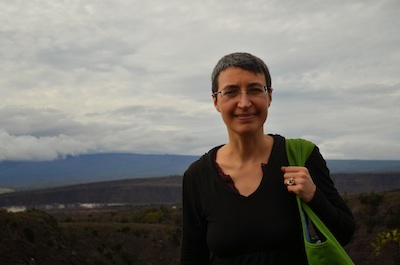
Faith Jones (photo from Faith Jones)
Faith Jones, a Vancouverite who teaches library science and who was previously a Yiddish bibliographer in the New York Public Library’s Jewish division, will discuss Dropkin and the craft of translating Yiddish erotic poetry at the first-ever Limmud Vancouver Feb. 9, one of 42 presentations on a hugely diverse array of topics over a full day. With two other scholars, Jones translates Dropkin’s work into English.
Dropkin (1887-1956) came to New York from Belarus in 1912, and immersed herself in the Bohemian life that was thriving there. It was at this time, as well, that she shifted from writing in Russian and began a career as a noted Yiddish poet and writer. This switch in vernacular appears to have been for practical reasons, not cultural or political ones, Jones explained.
“She wrote in Russian because she was educated in the gymnasium, in the Russian education system, and her literary influences were largely Russian,” said Jones. “To her – she came from a very poor family – being able to go to gymnasium was really quite an accomplishment and the Russian language was itself a status symbol. Her ability to use it artistically was something that she would have been very proud of.”
Once in New York, though, her audience would have been overwhelmingly Yiddish-speaking, and so it was probably a practical decision to switch. “I don’t think Yiddish to her was the beginning and end of being Jewish,” said Jones.
While nobody appears to have become rich writing poetry in Yiddish, Dropkin was comparatively a “commercial” success in terms of being widely read. She made some cash, particularly during the Depression, writing relatively mainstream short stories. Nevertheless, said Jones, “Her poetry was her real art, but you could not make a living on Yiddish poetry.”
Why, though, was this traditionally educated woman so apparently ahead of her time on sexual matters?
“She was educated in this different way – she was educated in a Russian way, not in a Jewish way,” Jones noted. “She also had a fair bit of freedom.” Dropkin’s father died when Celia was a child, and her mother was not particularly religious. The household appears to have been fairly open-minded and attuned to modernity. Her writing was different as well, Jones speculates, because she was a woman and also because she did not have the traditional Hebrew education that male poets of her time did.
“She was kind of freed because of being a woman,” said Jones. “She didn’t have a classical Hebrew education and so she was able to make up a different way of being a writer and wasn’t as constrained by expectations that, if you are a Jewish writer, your writing would be laced with references to the Bible and things like that.”
There were other poets writing about sexual matters, but in a much more veiled manner. A female Orthodox poet, for example, expressed her sensual ideas through depictions of hair, which would have resonance from an Orthodox female perspective. Dropkin was not so subtle.
“Dropkin had a poem, for example, in which it certainly seems to me that what she is describing is sadomasochistic sex. I don’t think she’s at all attempting to cover that up,” Jones said. “Other poets would just refer to the bed and some longing and maybe there is a stroke.”
Dropkin was published in the Yiddish journals of the day, despite the sometimes-scandalous nature of her work. “A scandal is always good for circulation,” Jones laughed. “So they were happy to have it. They were Bohemians, so they were going to publish that sort of thing.” There was a sense, among male critics and other poets, Jones said, that Dropkin’s work might bring disrepute to the Jews – even though, because it was written in Yiddish, only Jews could have read it. But criticism of Dropkin from other Jews, mostly male, was probably due to more straightforward reactions.
“It was shocking, a woman speaking about her physical body, her desires, her lust,” Jones said. “That was too much for them.”
Dropkin’s art, it seems, imitated her life. “She was really, really a Bohemian,” Jones said. “She really lived that life pretty fully, notwithstanding being married, which did not appear to have been any kind of difficulty. So, for example, I was able to meet with [Dropkin’s now deceased oldest son] many times and interview him, and I asked at one point, ‘Was your father at all upset by your mother’s sort of freewheeling life, having lovers, having a social life that was sort of separate from his?’ He said, ‘No it didn’t really bother him,’ and I had the impression that, you know, it went both ways.”
Jones warns attendees at next month’s Limmud conference that her session will not be appropriate for those who blanch at strong language and sexual imagery. But while the topic is erotic poetry and the craft of translating it, Jones said she has a broader ambition in presenting the topic.
“I would like people to think about re-envisioning our forbearers as people who were more like us. We need to really explore the people in our past and, as a historian, this is what I hope for most: that people will explore the past, understanding that these people were not like us, but in other ways were very much like us.”
***
About the same time that Dropkin was writing steamy poems in New York, the klezmer scene was heating up Montreal. Emily Lam, an independent researcher dedicated to the history of Jewish music in Montreal, will present on the subject at the Limmud conference – and some of her findings will surprise.
Emily Lam (photo from Emily Lam)
One of the first things to understand about klezmer music is that those who traditionally played it didn’t call it klezmer, Lam said. The word klezmer simply means musician. So when musicians were performing a tune, they called it by the kind of tune it was – a freylech, a doyna, a hora. For present-day practitioners of the traditional Jewish tunes, however, as for the rest of us, klezmer is a handy shorthand.
“It’s what they call it because everybody calls it that these days,” said Lam, who has interviewed as many Montreal musicians from the early part of the 20th century as she has been able to track down. Among these artists, mostly now in their 80s and 90s, the “true” klezmorim were those from Eastern Europe and the musicians who learned directly from those masters. What we call klezmer, according to Lam, is a music that represents “homeland and folk … synonymous with a particular place and time that was physically left behind, yet … instantly accessible through the music’s soundscapes, which connected the Jewish immigrant to their shtetl and the Yiddishkeit of their ancestral past.”
As klezmer has seen a dramatic revival in recent decades, Lam said her interviewees are pleased that the music is being performed and heard again, but they invariably say something is missing.
“Everybody is very happy that more people know about this kind of music, more people know about the history of it,” Lam said. “My interview subjects are happy that they still get to hear it if they choose to. They can go to concerts, they can go to festivals and events. They’re really happy about that. However, they feel that when they hear it, something about it isn’t the same. They always express that there is a lack of a certain feeling, a feeling within the music that they can’t hear, that they did hear with other musicians – their predecessors, their mentors. So when they hear things from the so-called revival, while they enjoy it, something about it is lacking and they always express … there’s just this feeling that’s missing.”
The progression of klezmer involved the original immigrants teaching it to their children, with a predictable downturn as the decades passed. “New immigrants want to carry on those traditions because that’s what they know,” Lam said. “There was a tradition that you learn this music and how to play it from your father and your uncles, relatives. The people that I interviewed were the children of the true klezmorim [the immigrants who brought the music from Eastern Europe]. They carried out the tradition but, obviously, as times change, people’s interests, especially children of new immigrants, what they wanted, how they see their lives, was different from Eastern Europe.”
Second-generation Canadians might have wanted the traditional tunes at their weddings, perhaps because their parents wanted it, but they also wanted more contemporary, popular music.
“As time progressed, there were less traditional tunes and more contemporary tunes,” said Lam. “It’s part of being an immigrant and having children in a new country. You try to instil these traditions. They’re going to choose their own path.”
But traditions can morph in unexpected ways. Weddings and bar mitzvahs may be a showcase for klezmer, but making a living in early- to mid-20th century Montreal as a musician meant being ready to take any gig that came along. Fortunately, klezmer can be a heavily improvisational musical form, similar to the vibrant jazz scene that was emerging in Montreal.
“If you were a klezmer, you were a versatile musician,” Lam said. “So [for] lots of Jewish musicians, especially going into the ’30s and onward, there’s lots of crossing over with jazz music in Montreal.”
Lam started her research during her undergraduate studies at the University of Ottawa, mentored by Prof. Rebecca Margolis, who specializes in Yiddish culture in Canada, among other topics. Lam, who grew up in Peterborough, Ont., is the daughter of immigrants who fled Vietnam during the war there. She does not directly attribute her interest in this subject to her family’s experience, but she sees a parallel. “I certainly can understand this sort of looking for something that reminds you of your homeland,” Lam said.
***
Many people can name the most famous Jewish baseball players – precisely because there have been so few of them. Despite this, there are striking parallels between the practice of Judaism and the practice of baseball, according to Vancouver rabbi and University of British Columbia faculty member Hillel Goelman, who will present at the Limmud conference.
Hillel Goelman (photo from Hillel Goelman)
“I’m not going to just talk about Sandy Koufax and Hank Greenberg,” he said. “That’s not what the discussion is about. The discussion is that there are aspects of Jewish spiritual understandings, about deeper meanings of Judaism and some of the deeper meanings of baseball and that we can learn about one from the other.”
There is a teaching in Jewish spirituality that views everything as being at an intersection of time and space and a journey of the soul, said Goelman. “Our whole history is about a journey through space, whether it’s Abraham to Egypt, or the Jewish people coming out of Egypt, or making aliyah to the Land of Israel,” he said. “In Jewish spirituality, in kabbalah, we believe that there are different realms of reality and that each of those can correspond to another level of reality that you can get higher and higher and higher until you end up at the highest, which is getting back home, and home is in the wholeness and the holiness of the home space.”
Baseball is also about an individual’s odyssey, he said. “Baseball is really about the individual, where it’s the individual who scores the points, scores the runs. The ball doesn’t have to go into a hoop or a net or anything like that. It’s the individual who goes through a journey through space,” he said.
There’s also an intergenerational aspect, he added, in that Judaism is passed down from parents to children. The love of baseball is also conveyed transgenerationally. In addition, Judaism and baseball both have “two aspects of gaining knowledge,” Goelman said. One aspect focuses on the legalistic proscriptions – “what you’re commanded to do, commanded not to do, the appropriate behaviors” – the other is a very rich mythological lore.
“There is a mythology in Judaism, there is a mythology in baseball, that goes beyond the literal meaning of what’s happening,” he said. “Judaism gives us some very powerful metaphors and images and practices, which really resonate very deeply with us in terms of what is the Sabbath and why is that important and what are the High Holidays and why are they important, what is a bar mitzvah and why is that important, why is a wedding ceremony important. There is a lot of symbol and symbolism and mythology. And in baseball, as well, there’s a lot of symbol and symbolism and mythology. I think that’s why many of us find it so riveting.”
The recent news of New York Yankee Alex Rodriguez’s use of performance-enhancing drugs offers a vignette into another aspect of mythology.
“Here’s another giant among us who has fallen, who has succumbed to whatever kind of temptation it was, of ego, of achievement, of seeing himself above and beyond the rules,” Goelman said. “And this is sort of the karmic consequences of someone who exceeds the boundaries and doesn’t really understand the beauty and the mythology of the game.”
LimmudVan ’14 is the first annual Limmud event here. The phenomenon, which began in London, has spread to dozens of cities worldwide. The Vancouver conference, which sold out weeks in advance, will feature more than 40 separate presentations on a huge array of topics. See next week’s issue for more on Limmud. Full details at limmudvancouver.ca.