Skip to content
  • Home
  • Subscribe / donate
  • Events calendar
  • News
    • Local
    • National
    • Israel
    • World
    • עניין בחדשות
      A roundup of news in Canada and further afield, in Hebrew.
  • Opinion
    • From the JI
    • Op-Ed
  • Arts & Culture
    • Performing Arts
    • Music
    • Books
    • Visual Arts
    • TV & Film
  • Life
    • Celebrating the Holidays
    • Travel
    • The Daily Snooze
      Cartoons by Jacob Samuel
    • Mystery Photo
      Help the JI and JMABC fill in the gaps in our archives.
  • Community Links
    • Organizations, Etc.
    • Other News Sources & Blogs
    • Business Directory
  • FAQ
  • JI Chai Celebration
  • JI@88! video

Recent Posts

  • Eby touts government record
  • Keep lighting candles
  • Facing a complex situation
  • Unique interview show a hit
  • See Annie at Gateway
  • Explorations of light
  • Help with the legal aspects
  • Stories create impact
  • Different faiths gather
  • Advocating for girls’ rights
  • An oral song tradition
  • Genealogy tools and tips
  • Jew-hatred is centuries old
  • Aiding medical research
  • Connecting Jews to Judaism
  • Beacon of light in heart of city
  • Drag & Dreidel: A Queer Jewish Hanukkah Celebration
  • An emotional reunion
  • Post-tumble, lights still shine
  • Visit to cradle of Ashkenaz
  • Unique, memorable travels
  • Family memoir a work of art
  • A little holiday romance
  • The Maccabees, old and new
  • My Hanukkah miracle
  • After the rededication … a Hanukkah cartoon
  • Improving the holiday table
  • Vive la différence!
  • Fresh, healthy comfort foods
  • From the archives … Hanukkah
  • תגובתי לכתבה על ישראלים שרצו להגר לקנדה ולא קיבלו אותם עם שטיח אדום
  • Lessons in Mamdani’s win
  • West Van Story at the York
  • Words hold much power
  • Plenty of hopefulness
  • Lessons from past for today

Archives

Follow @JewishIndie
image - The CJN - Visit Us Banner - 300x600 - 101625

Tag: justice

A 22-year-old open wound

A 22-year-old open wound

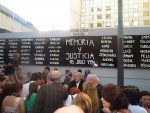
Every year on July 18, thousands of people gather to remember the victims of the AMIA bombing, and demand that justice prevails. (photo by Jaluj via commons.wikimedia.org)

After more than 20 years, an entire nation continues to search for answers and justice.

With an estimated population of 330,000, Argentina’s Jewish community is the largest in South America and, outside Israel, the sixth largest in the world. First arriving in Argentina in early days, Jews have continued to immigrate ever since. During its “golden era” (1900s to 1950s), an estimated 500,000 Jewish people lived there.

The vast majority of Jews in Argentina are Ashkenazi, from central and eastern Europe. From the start, this active, prosperous and engaged community has left its mark in local business, infrastructure, culture and politics. My family was part of this group; Argentina was the place we called home and where four generations of my family were born. AMIA (Asociación Mutual Israelita Argentina or the Argentine Israelite Mutual Association) is the central support organization for all Jews in Argentina, tracing its roots back to 1894.

Everything changed the morning of July 18, 1994, at 9:53 a.m. While I was attending a history class, more than 600 pounds of explosives hidden in a vehicle were detonated in front of AMIA. The explosion was followed by a cloud of smoke and dust seen for miles. In seconds, along with the iconic Jewish organization in Argentina and everything surrounding it, the building housing all of Argentina’s rich Jewish history was, simply, gone. This tragedy was followed by panic, mayhem, sirens, ambulances, calls for help, deaths totaling 85 and hundreds more victims, severely injured and traumatized, transported to hospital.

At my school, phones started to ring. The principal rushed into our classroom to have a private word with our teacher, who then broke the news that AMIA in Buenos Aires was bombed. We were in shock. The same black dusty cloud that could be seen above AMIA descended upon the student body, the teachers and the administrative staff. Frantic activity ensued and, within a few hours, the school was deserted.

My first reaction was concern for my family and friends, many of whom worked at AMIA. I would soon learn that, although one miraculously survived under the rubble and a few others were spared, having not yet arrived at the time of the attack, three died in the explosion. I would learn of the tremendous cultural and historical loss of books, manuscripts, community records, art, pictures and more. I would learn of the disorientation felt by so many who could not comprehend the magnitude of the attack. And I would learn of the rage of those who survived their loved ones. To this day, I will never forget the conversations around the dinner table that revealed the pervasive feeling we were no longer safe.

Some of my friends were immediately withdrawn from the private Jewish school I attended and transferred to the public school system. I would learn of sentiments such as “Jews should be concentrated in one place and live together so innocent Argentines would not suffer.” Yet, in my mind, we were all Argentines.

Over the following years, as I transitioned from my teenage to adult years, I would learn of government cover-ups, of the miscarriage of justice, and of injustice done in the name of greed and corruption. I would also learn of Hezbollah, Iran and other terrorist elements suspected of involvement one way or another. And I would be constantly reminded of the pain of those left behind, and the impunity of the perpetrators, which reinforced the sense of insecurity that took over a proud and vibrant Jewish community.

In spontaneous reaction, hundreds showed up to the site where the AMIA building had stood. Many, my father was among them, were volunteering to assist in the rebuilding process. Those were dark days. The community needed to reorganize. Within a week of the attack at Pasteur 633, a community building a few blocks away began to function. As the temporary head office of AMIA, the Ayacucho 632 site became the place where families sought information about the victims of the attack and where AMIA resumed essential operations, especially those pertaining to social services and community relations.

The Ayacucho building also became the place in which I started my journey as a Jewish community volunteer and where I later decided to pursue a professional career serving the Jewish community.

Five years after the attack, on the original site, a new building was opened that symbolized the creative drive of a community willing to preserve the heritage of a cultural tradition that honors life and collective memory.

This July 18, as every year, the bombing was commemorated with a ceremony in front of the new, now heavily fortified, AMIA: This year’s ceremony marked 22 years since the attack, Argentina’s deadliest bombing ever.

The AMIA bombing was an assault on all society and one that has left deep political scars, not just upon Argentina’s Jewish community. It is a symbol of the entire Argentine state and a society still searching for the truth. And the truth – about a sophisticated terrorist act of mass murder that sent a brutal message of destruction and death – must come to light. The attack is a wound that remains open to this day.

I vow to neither remain silent nor rest until those guilty of these attacks are apprehended, and I hope that the Argentine government will make every effort to ensure that the terrorists responsible for this horrendous act are brought to justice.

Viviana, Cristian and Guillermo, I will never forget. Porque tenemos memoria, exigimos justicia. Because we have memory, we demand justice.

Nico Slobinsky is director, Centre for Israel and Jewish Affairs, Pacific Region. He was born and raised in Argentina before immigrating to Israel and, later, to Canada.
Format ImagePosted on July 22, 2016July 19, 2016Author Nico SlobinskyCategories Op-EdTags AMIA, Asociación Mutual Israelita Argentina, bombing, CIJA, justice, memory, terrorism
Concern over incarceration

Concern over incarceration

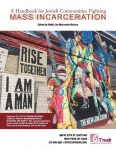
A new handbook published by T’ruah: The Rabbinic Call for Human Rights provides a resource for the Jewish community to press for change around the problem of mass incarceration in the United States.

“We are here to uphold ideas of redemption and mercy,” said T’ruah director of programs Rabbi Rachel Kahn-Troster, citing a colleague who described America’s prisons as having a “mercy deficit.”

The handbook is available for free download at truah.org/incarceration. It provides background and resources – steeped in Jewish texts and teachings – for Jewish communities to take action around these issues. Leading a network of 1,800 rabbis across North America, T’ruah aims to bring attention to an array of domestic social justice issues, as well as human rights for Israelis and Palestinians.

When it comes to mass incarceration, Canada doesn’t have the same problem, but we have similar societal ills when it comes to race, ethnicity and imprisonment – as well as problematic prison conditions themselves – that call out for redress.

The handbook initiative came out of T’ruah’s earlier work on ending solitary confinement. Over the last couple of years, Kahn-Troster has found the Jewish community to be increasingly receptive to grappling with issues around incarceration. Michelle Alexander’s book The New Jim Crow: Mass Incarceration in the Age of Colorblindness, which details the effect that mass incarceration – and the subsequent denial of civil rights for convicted felons – has had on the African American community, really opened people’s eyes, she told the Independent.

Why the term mass incarceration? Compared to other countries, the United States imprisons its population at alarmingly high rates: 698 out of every 100,000 citizens are behind bars. For comparative purposes, Canada’s per capita rate is 141 out of 100,000, according to Statistics Canada.

And then there is the problem of race. African Americans are six times more likely to be jailed than their white counterparts, yet crime rates are not necessarily different. According to American Civil Liberties Union data cited in the T’ruah report, despite equal rates of actual usage, a black person in America is 3.73 times more likely as a white person to be arrested for drug use.

In Canada, blacks are incarcerated at three times their rate in society, according to the Office of Correctional the Investigator of Canada (OCIC). And, while only four percent of the population of Canada is aboriginal, 25% of the prison population is aboriginal. Among the female prison population, fully 36% are aboriginal, and these percentages are only increasing, according to CBC News reporting from January of this year. For aboriginal adults in Canada, the incarceration rate is 10 times higher than for non-aboriginal adults, says OCIC. Maclean’s, in February, quoted criminologists describing Canadian prisons as the country’s new “residential schools.”

In addition, a report from Saskatoon and Regina, cited in the Saskatoon StarPhoenix, revealed that indigenous students are 1.6 times more likely to be stopped on the street than non-indigenous students. A Toronto Star analysis revealed that, in Toronto, blacks are three times more likely to be stopped by police than non-blacks.

As the Supreme Court of Canada has noted, “courts must take judicial notice of such matters as the history of colonialism, displacement and residential schools and how that history continues to translate into lower educational attainment, lower incomes, higher unemployment, higher rates of substance abuse and suicide and, of course, higher levels of incarceration for aboriginal peoples.”

The legacy of slavery in America looms large, and racial bias in the criminal justice system continues to haunt society. “People of color are more likely to be pulled over,” Kahn-Troster said. “The War on Drugs enables cops to search them. There’s a higher level of policing in black areas; there’s racial bias in jury selection; it’s easier to strike black people from juries; the sentencing is harsher if there’s a black perpetrator and a white victim than the other way around.”

In Canada, solitary confinement is an ongoing issue, as is overcrowding, concern over mental and physical health and rehabilitation, and an overall troubling rise in incarceration rates just as the crime rate lessens. Reporting in the Toronto Star puts the figure at a 17% increase in the federal prison population over the last decade.

With t’shuvah (repentance), cheshbon hanefesh (personal accounting), a questioning spirit and the search for social justice all core Jewish values, T’ruah’s initiative is laudable. It’s easy to look away – and harder to do the tough work of asking how we can both prevent harm to victims while improving our nation’s justice system to avoid discrimination and to shelter the most vulnerable.

Mira Sucharov is an associate professor of political science at Carleton University. She is a columnist for Canadian Jewish News and contributes to Haaretz and the Jewish Daily Forward, among other publications.

Format ImagePosted on June 24, 2016June 22, 2016Author Mira SucharovCategories NationalTags discrimination, incarceration, justice, prison, racism, T'ruah
A continuing pursuit of justice

A continuing pursuit of justice

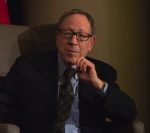
Irwin Cotler told those at the launch of the Pearson Centre for Progressive Policy’s Pursuing Justice Project on March 31 that his current focus is the Raoul Wallenberg Centre for Human Rights in Montreal. (photo by Dave Gordon)

Irwin Cotler was honored on March 31 for his dedication to human rights activism. Attendees at the Pearson Centre for Progressive Policy event learned how Jewish values drove, and intersected, with Cotler’s career in pursuing justice.

“My father used to say to me: the pursuit of justice is equal to all the commandments combined. This is what you must teach to your children,” said Cotler.

The gala at Toronto’s Omni King Edward Hotel served to launch the Pearson Centre’s Pursuing Justice Project, “which is focused on increasing the understanding of Canadians about justice, diversity and inclusion.” The centre describes itself as a centrist think tank, addressing policy issues related to justice, health and social services, with the goal “to engage Canadians in an active dialogue about a progressive future for Canada.”

Among the speakers offering introductory remarks at the launch were former prime ministers John Turner and, via video, Paul Martin.

“John Turner had the temerity to give me my first job out of law school,” Cotler shared.

In addition to serving as Liberal member of Parliament for Mount Royal in Montreal from 1999 to 2015, Cotler also served as federal minister of justice and attorney general during his career.

In a discussion with Indira Naidoo-Harris, Liberal member of the Legislative Assembly for Halton, Ont., Cotler spoke about a 10-year-old idea that never bore fruit, wherein justice ministers from Israel, the Palestinian Authority, Jordan and Egypt all agreed to convene with Canada’s justice minister, in Canada, to foster dialogue. A “justice summit” he dubbed it, “which I hoped would have a peace dividend.”

He would like the Trudeau government to revive the concept, because “educating each other in the culture of peace is important,” Cotler told the Independent. Palestinian incitement, in contrast, “is a threat to peace in the Middle East, threatens Palestinians’ right to self-determination … and glorifies terrorism.”

As an international human rights lawyer, Cotler served as counsel to many high-profile political prisoners, including South Africa’s Nelson Mandela and Israel’s Natan Sharansky, who was released from a decade in the Soviet gulag 30 years ago February, and became a member of the Knesset and an author.

Both former prisoners were beacons of “hope and the vision and the inspiration,” with respect to “two of the great human rights struggles of the second half of the 20th century,” Cotler remarked.

The release of political prisoners, he added, is “such an overriding commandment that you’re allowed to breach the Sabbath” to free them.

Cotler’s current undertaking is growing the Raoul Wallenberg Centre for Human Rights in Montreal, which he founded. Among its many objectives, he told the Independent, are “promoting human dignity, combating racism, hatred and antisemitism, and defending political prisoners.”

Dave Gordon is a Toronto-based freelance writer and the managing editor of landmarkreport.com.

Format ImagePosted on April 22, 2016April 20, 2016Author Dave GordonCategories NationalTags Cotler, human rights, Judaism, justice, Raoul Wallenberg
LEAF works for equality

LEAF works for equality

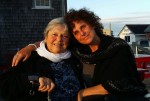
Michele Landsberg and her daughter, Ilana Landsberg-Lewis. (photo from West Coast LEAF)

Michele Landsberg and her daughter Ilana Landsberg-Lewis laughed and spoke over each other in an animated joint telephone interview with the Jewish Independent. The two women, who are among Canada’s most influential activists, agreed more than they disagreed, and their ideas and opinions flowed and meshed in a way made possible perhaps only through a lifetime of dialogue.

The mother-daughter duo will be keynote speakers at West Coast LEAF’s Equality Breakfast March 11. West Coast LEAF was founded in 1985, alongside its sister organization, the Women’s Legal and Education Action Fund (LEAF National), to ensure that the promises contained in the Canadian Charter of Rights and Freedoms would become a reality for women in British Columbia. West Coast LEAF’s founders recognized that there would be challenges and great potential in putting the abstract legal rights of Section 15 (the equality provision) into action through the courts. The annual Equality Breakfast generally falls around International Women’s Day, which is May 8.

Landsberg is a writer and social activist who wrote for the Globe and Mail and Chatelaine before a 25-year run as a columnist for the Toronto Star. An officer of the Order of Canada, Landsberg’s name is synonymous with feminist perspectives on Canadian and global events.

Landsberg-Lewis is a labor and human rights lawyer. She is the executive director of the Stephen Lewis Foundation, which she co-founded with her father, the former leader of Ontario’s New Democratic party, who also served as Canada’s ambassador to the United Nations. The foundation works with grassroots organizations in sub-Saharan Africa to turn the tide of the AIDS pandemic.

Landsberg-Lewis said she never felt any pressure to go into the family business. In addition to her mother’s writing and activism and her father’s political and diplomatic career, her grandfather David Lewis was leader of the federal NDP.

“There was always interesting and lively conversation,” she said. “Whatever column Mom was writing, whatever Dad was doing … all three of the kids, but I was the eldest, were encouraged to be part of that thinking and lively debate. Yes, I landed very firmly a millimetre away from the tree but, if you ask me, that was the right place to be.”

In her work with her father, Landsberg-Lewis sees the catastrophic advance of AIDS in Africa, but is also inspired by the responses of women who are, she said, “the most affected and infected” by the disease.

“They’re bearing the brunt of the apocalypse of AIDS, they are raising the children, they are pulling their communities together, they are the ones who are trying to effect change, they are the ones who are most adversely affected by discriminatory laws and, on that level, it’s pretty grim,” she said. On the other hand, she continued, despite global funding for fighting AIDS flatlining, affected women are stepping up.

“Take the grandmothers, for instance, who are raising 17 million orphaned children, who were living in isolation, stigma, absolute abject poverty, and were terribly grief stricken because of the loss of their adult children, and they get up the next morning and they look after all these kids. And more than that now – you see that they are beginning to run for local councils and land rights councils and they’re pushing for pensions and pushing for better health care for older women, and so there’s a groundswell of demands for their own rights to be recognized,” she said. “The world is being negligent. This is not surprising or unusual when it comes to women, but the women themselves, as usual, are not waiting for that support, they’re just making it happen.”

Back in North America, a whole different type of change is happening, both mother and daughter agree. Feminists who remember the fights of the 1950s and ’60s are coming up against a generation of young women with a very different idea of what equality and feminism mean. The recent comments by former U.S. secretary of state Madelaine Albright and feminist icon Gloria Steinem, who is a friend of Landsberg’s, nearly led to inter-generational warfare on social media.

Steinem apologized for her comment that young women are abandoning Hillary Clinton’s campaign for Bernie Sanders’ “because that’s where the boys are.” Landsberg blames a grueling book tour and Steinem’s emphatic support for Clinton for the comment, but added she thinks Steinem was getting at an important point when she misspoke.

“I think she meant that young women are still swayed by the power dynamics of our very gendered system, our gendered culture,” said Landsberg. “Boys have more clout and presence in the political world and young women tend to take their cues from them still, quite often, not always, obviously. I think that’s what she meant: that they are swayed by young men’s enthusiasm for Bernie.”

Landsberg-Lewis interjected, contending that the division between Clinton and Sanders supporters is based on ideology more than gender.

Landsberg, who admits she has never shared her friends’ enthusiasm for Clinton, leapt on Albright’s comment, “There is a special place in hell for women who don’t help other women.”

“If we really want to get it right, her quote is misguided,” Landsberg said. “It should be ‘there’s a special place in hell for women who don’t support feminist women.’ Not just any woman, because there was [British prime minister Margaret] Thatcher.”

Clinton, Landsberg said, is “not the kind of woman we can look to to undo the power that has oppressed many, many people.… She is part of the establishment, she is backed by Wall Street, she has endorsed many wars and would endorse more wars as president.”

The rise of Sanders, the democratic socialist whose campaign bills itself as a movement for change, is a good sign on several fronts, say the two. Feminism, among other movements, has struggled in the face of American individualism. This is something that differs in Canada, they agreed, but may signal a revival of movement feminism as more Americans hear Sanders’ message of shared responsibility.

“He’s talking about collective responsibility for changing the situation of women, collective power in collective action and vision,” said Landsberg-Lewis. “And I think that’s an extraordinarily powerful antidote to the individualism that has, I think, for young women – not all young women, not all the time – but has eclipsed the sense of feminism as really being about a movement as opposed to individual power.”

Moving to Canadian politics, mother and daughter both expressed optimism.

“I think the whole country woke up the day after the election and realized that that bad headache they’d had for 10 years was gone,” Landsberg said, laughing. “I think we had a nationwide depression under that grim regime and people felt a sense of relief that we had a new beginning.”

She’ll be watching the new government’s approach to a national child-care plan and worries that Trudeau may be too insulated in the world of “nannydom” to understand that affordable child care is key to women’s equality.

“It is very exciting to have a prime minister who runs around calling himself a feminist,” said Landsberg-Lewis. “I think that that is not a small thing. It’s a first time thing and it’s a big deal.”

“I am thrilled Michele and Ilana are coming together for our Equality Breakfast,” said West Coast LEAF interim executive director Alison Brewin. She said, “The fact that they are mother and daughter reflects the intergenerational nature of the fight to advance women’s equality. West Coast LEAF uses the law to make change, but the work comes in waves that catch and move mothers and daughters, fathers and sons – Michelle and Ilana represent our national struggle for justice.”

Tickets for the West Coast LEAF Equality Breakfast March 11, 7 a.m., at Fairmont Hotel Vancouver are $90 (tax receipt for eligible portion) from 2016equalitybreakfast.eventbrite.ca.

Format ImagePosted on February 26, 2016February 25, 2016Author Pat JohnsonCategories LocalTags Alison Brewin, Charter of Rights and Freedoms, equality, feminism, Ilana Landsberg-Lewis, justice, Michele Landsberg, West Coast LEAF

Posts pagination

Previous page Page 1 … Page 3 Page 4
Proudly powered by WordPress