Mixed reaction to Nini

Achinoam Nini at the 21st UNESCO Charity Gala 2012 in Dusseldorf, Germany. (photo by Michael Schilling via commons.wikimedia.org)

The Jewish Federation of Greater Vancouver’s invitation to Israeli singer Achinoam Nini (Noa) to perform at the community’s Yom Ha’atzmaut celebrations has received mixed reactions, including a withdrawal of support for the event by Jewish National Fund of Canada, Pacific Region.

In a Feb. 18 statement, JNF Canada chief executive officer Josh Cooper said the organization would be taking a one-year hiatus from its tradition of sponsoring the Yom Ha’atzmaut event “due to the views of the entertainment booked for this year’s celebration. The entertainer that has been hired does not reflect nor correspond to the mandate and values of the Jewish National Fund of Canada.” When pressed to answer where, specifically, Nini diverged from JNFs mandate, Cooper said he had “nothing further to add.”

Among the many Jewish community partners in a Jewish Federation of Cincinnati-sponsored performance by Nini and Mira Awad in June 2015 was JNF, and JNF was one of the sponsors of a Nini and Gil Dor concert in Atlanta less than two weeks ago. About the different mandates and values of JNF Canada and JNF USA, Cooper said “JNF/KKL has offices in 48 countries. While we all work together in Israel, we operate independent of each other in our respective countries.”

Jewish Federation of Greater Vancouver issued a statement saying the organization was “disappointed” by JNF’s decision to withdraw support: “JNF has been a valued sponsor of our Yom Ha’atzmaut celebration for many years, and we look forward to welcoming them back next year.”

In a Feb. 20 article, the world chair of Keren Kayemeth LeIsrael (KKL)-JNF, Danny Atar, told Haaretz that he was against JNF Canada’s withdrawal of support over Nini’s views, saying, “I intend to express my opinion on the decision directly to the leadership of JNF Canada at a meeting we will be having shortly in Israel.”

Locally, Nini’s scheduled appearance is drawing strong reactions from some community members.

Richmond resident Arnold Shuchat expressed his “complete opposition to the decision to engage the controversial artist” in a Feb. 18 letter to Ezra Shanken, chief executive officer of the Jewish Federation of Greater Vancouver, and to its board of directors. “The purpose of a Jewish community event should be to marshal and unify our community as opposed to fragment it,” he wrote. “It had to be obvious to any reasonable person who might have investigated her political positions that she would be a polarizing figure to many in the community. This decision is a regressive and irresponsible one and should be reversed as quickly as possible to prevent damage to both the reputation and fundraising ability of our Federation.”

René Ragetli, also from Richmond, agreed. “I think she’s a divisive figure and it’s a big mistake to have her here, especially for Yom Ha’atzmaut. She’s said some outrageous things – called our leaders fascist thugs and expressed admiration of Mahmoud Abbas. The woman is not balanced,” he said. “Her bringing comfort to the widow of a terrorist at an event to honor the Israeli fallen – it’s insulting. Sure, people are entitled to their own opinions, but having her on the stage for Yom Ha’atzmaut degrades the event. This is a storm that’s not going away, and a mistake that needs to be corrected.”

An online petition titled “Stop Achinoam Nini from performing at our Yom Ha’atzmaut celebration” had almost 400 signatures at the time of publication. Cynthia Ramsay, publisher of the Jewish Independent, said she has received several letters and emails about Nini.

“Every person who’s tried to get me to run a letter or has cc’d me on an email to Federation has the exact – and I mean exact – same two points: she supports B’Tselem and Breaking the Silence, and she’s anti-Israel or pro-BDS,” Ramsay said. (See “Let’s talk about Nini…” by the JI editorial board.) “No one has provided any evidence, not even a Jerusalem Post quote, to support their allegations, some of which are even nastier and also with zero proof. Because of the wording of most people’s emails/letters, I think it’s a chain reaction, everyone’s just repeating what they’ve heard from someone else without doing any research of their own. The main concern seems to be about BDS and she is against BDS from what I’ve read.”

Shuchat said the issue with Nini was not about BDS. “This has been very divisive because she’s very controversial, she’ll offend a lot of people and it was very foreseeable that this would happen. She’s polarizing so it was a dumb decision to invite her. Mainstream media are going to see this and say, ‘Look at all these heebs fighting with each other!’ Federation should cancel the engagement and focus on building a cohesive community.”

Ramsay disagreed. “I think it would be very sad if Federation withdrew its invitation or if Nini declined it because of the controversy it’s causing, which, I think, is unmerited.”

A Feb. 22 letter to Federation board chair Stephen Gaerber signed by more than 30 Israeli Canadians also urged “Federation to stick to the invitation.” It notes that “the current political climate in Israel condemns every person who advocates for peace and human rights, and campaigns, such as the recent one by Im Tirzu and other similar extremist groups, single out progressive artists, including Amos Oz and David Grossman to name a few.

“By canceling the invitation of Achinoam Nini to perform in Vancouver,” the letter continues, “we will not only be missing the opportunity to experience a great musician, it will also mean taking a stand against everything Vancouver and Canada is proudly known for, our belief in tolerance, pluralism, human rights, these same core values as they are reflected in our Jewish heritage. Here in Vancouver we must not get entangled in the type of intimidation that is going on in Israel. If the opportunity to bring her is missed due to politics, it sends a terrible message and may create rupture in the local Jewish community and will distance plural and liberal people like us from it.”

Lauren Kramer, an award-winning writer and editor, lives in Richmond. To read her work online, visit laurenkramer.net. A version of this article was published by Canadian Jewish News.
 

Working in community

Sidney Shmilovitch retired this July from Jewish National Fund, Pacific Region, after 19 years. (photo from Sidney Shmilovitch)

Being at the forefront of the baby boom generation, I was born in Vancouver after my father returned from serving overseas. The opportunity of work on Vancouver Island saw our family move and live in the small communities of Maple Bay and Departure Bay for the next 10 years. Moving back to the Lower Mainland, my parents and I settled in West Vancouver, where I graduated from West Vancouver Secondary. I then attended B.C. Institute of Technology and graduated with a diploma in X-ray technology, followed by a two-year stint as a Cuso volunteer working in small hospitals in the north and south of Nigeria.

Upon returning to Canada, and after a number of years working in Toronto, I moved back to the West Coast. Living in Abbotsford, I met and married Dan Shmilovitch, who was heading efforts to form what eventually became known as Ha’Emek Jewish Community. Holiday programming in the community was enhanced by the services of Chabad rabbis from Vancouver. When our children became of school age, we began attending Jewish events in Vancouver. A wise rabbi there told us that if we wanted our children to remain Jewish, we had to move to the city, join a synagogue and put our children in Hebrew school. So we did, in 1987, which marked the beginning of our relationship with the Jewish communities of Richmond and Vancouver.

In 1988, I began my first job in the Jewish community, working in Richmond as part-time secretary for Eitz Chaim Synagogue. This was my first experience working in the Jewish religious world and learning the complexities of growing a young congregation. Two years later, searching for full-time work, I was hired for a joint position with the Canadian Zionist Federation, Camp Miriam and the World Zionist Organization aliya department at their shared office space at the Jewish Community Centre of Greater Vancouver. The five years I spent working with these organizations introduced me to the important work of Jewish professionals, dedicated board members and volunteers.

In 1996, I joined Jewish National Fund, following in the footsteps of Maisie Myerthall, who was retiring after 26 years. And now, after 19 busy years working with JNF, it was my turn to retire this July. I will miss the special working relationships I had with colleagues in JNF offices from Vancouver to Montreal, especially of course, Ilan Pilo, Moran Nir and Liisa King in the Vancouver office – all part of the JNF family. It was a privilege for me to work with six JNF shlichim (emissaries) over the years, all of whom I admired for their humanity, love of life, energy, drive and determination.

As for me, now that I’m retired, I will volunteer with the JNF, and am considering other volunteer opportunities in the community – I’m open to ideas! And we will travel. So far, Dan and my travel plans revolve around visiting our kids and grandchildren on the east and west coasts of the United States.

I have many thanks to send. To my friends at the JCC, some of whom I have known for 25 years – keep up the good work! My sincere appreciation to the staff of communal organizations, synagogues and schools who were so accommodating and helpful to me. My love and thanks to the members of the JNF executive and board for all their support, hard work and devotion to Israel, and for being so enjoyable to work with. A thank you to all the leaders who have built a strong, vibrant and exciting community that will go from strength to strength. And, to the philanthropists, kol hakavod for your vision and inspirational generosity that make it all happen.

Dire new poll results?

A new report suggests potentially alarming trends in support for Israel among Americans.

Frank Luntz, a Republican consultant produced a poll, sponsored by the Jewish National Fund, of the country’s “opinion elites” – highly educated, very active political operatives – and found sharply divergent views between advocates for each party.

“Israel can no longer claim to have bipartisan support of America,” Luntz asserted.

Among the Democrats Luntz polled, 76% of those responding said that Israel has “too much influence” on U.S. foreign policy. Among Republicans, the number who affirmed that position was 20%.

Asked if Israel is a racist country, 40% of Democrats said it is, while 13% of Republicans agreed.

As to whether Israel wants peace with its neighbors, 88% of Republicans contended that it does, while just 48% of Democrats said so.

Questioned whether they would be more likely to vote for a politician who supports Israel and its right to defend itself, 76% of Republicans said yes, but only 18% of Democrats concurred. Seven percent of Republicans said this would make them less likely to support the candidate, while 32% of Democrats said so.

Asked whether a politician who criticizes Israeli occupation and “mistreatment of Palestinians” would get their vote, 45% of Democrats said yes, while six percent of Republicans agreed.

One-third of Democrats and 22% of Republicans said that they were upset that “Israel gets billions and billions of dollars in funding from the U.S. government that should be going to the American people”

On the choice of whether the United States should support Israel or the Palestinians, 90% of Republicans said Israel and two percent said Palestinians. Among Democrats, 51% said Israel and 18% said Palestinians. Asked to self-identify, 88% of Republicans and 46% of Democrats called themselves “pro-Israeli,” while 27% of Democrats and four percent of Republicans said they were “pro-Palestinian.”

Half of Democrats and 18% of Republicans said that “Jewish people are too hypersensitive and too often labeled legitimate criticisms of Israel as an antisemitic attack.”

The numbers look bad at first glance. But first glance is about all Luntz has given us. As other commentators have noted, the entirety of the poll’s methodology and results have not been made public, and the term “elites” suggests the interviewees may have been more “activist” than the average voters – read: “more liberal” in the case of Dems and “more conservative” in the case of Republicans.

As well, we would like to point out that asking someone if they support Palestinians or Israelis is a “false choice,” almost akin to asking which of their children they support. Such simplistic dichotomies are yet another example of the weakness of polling.

However, regardless of the specifics of the poll and its merits, Luntz had some common sense suggestions about pro-Israel messaging to which Americans, especially Democrats, respond well: messages of encouraging more communication and cooperation, and more diplomacy and discussion, not less, for example. The boycott, divestment and sanction movement, for instance, is opposed to these things and that is an Achilles’ heel for them.

Emphasizing the equality of women and freedom of religion, he found, were effective at increasing sympathy for Israel, while less successful were messages emphasizing the need for Jewish sovereignty after the Holocaust, claims to the Holy Land and depicting Israel as a “startup nation,” said Luntz.

Though the extent of the “crisis” may not be as severe as Luntz implies – Democratic nominee-apparent Hillary Clinton is striking an unambiguously pro-Israel tone in her campaign, for example – no one doubts that there are frictions in the Israel-U.S. relationship that are stronger on the Democratic side.

Certainly the petulant relationship between U.S. President Barack Obama and Israeli Prime Minister Binyamin Netanyahu has not made things better.

There is also the fact of 15 years and counting of concerted anti-Israel mobilization on the left, especially on American university campuses, and in the burgeoning online media world.

Some of the unfriendliness may reflect simple political differences between a Democratic administration in the United States and a Likud government in Israel.

Despite the right-wing government in Israel, though, it remains ideologically consistent for people on the left and centre-left to remain committed to Israel because of its inherent liberal values. That is a message that needs to be more emphatically expressed by Israel activists on this side of the ocean. It won’t solve every problem, but it will be a start.

Canada, in this as in other things, differs. In Canada, the trajectory may well be the opposite, with the federal government’s pro-Israel position dragging the opposition parties and some of the public closer to Israel.

In both Canada and the United States, pro-Israel activists should be careful to tend all sides of our gardens. We need to ensure that people of all political persuasions understand that the existence, security and thriving of Israel is not a partisan matter, but one that, in addition to all the other reasons, makes the world a better place.

JNF park named after Baird

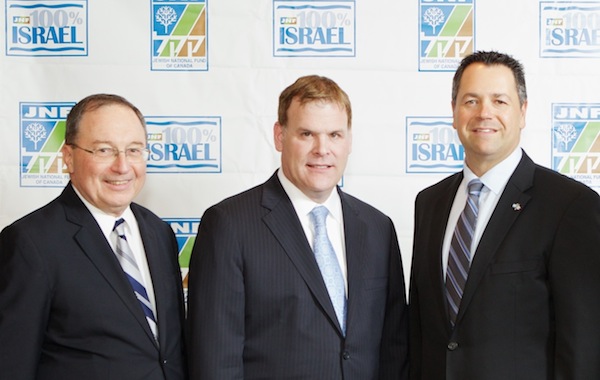
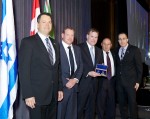
Left to right: Josh Cooper, Frank Sirlin, John Baird, Avi Dickstein and Ilan Pilo. (photo from Jewish National Fund, Pacific Region)

On June 7, the Jewish National Fund, Pacific Region, hosted the 2015 Negev Dinner at the Four Seasons Hotel in honor of Canada’s former minister of foreign affairs, John Baird.

In his speech, Baird summed up Israel and Canada’s friendship, saying, “Canada doesn’t stand behind Israel, but rather, walks shoulder to shoulder with Israel.”

Ilan Pilo, JNF Jerusalem emissary and executive director of JNF-PR, said, “Mr. Baird is a man of integrity and a true friend to Israel. JNF was grateful to honor him for his leadership on the world stage, for years of devoted service to the citizens of Canada, his dedication to the Jews of Canada and to the state of Israel. Thanks to John Baird’s outstanding leadership, Canada has become Israel’s most unwavering ally.”

photo - Left to right: Rafael Barak, John Baird and Josh Cooper
Left to right: Rafael Barak, John Baird and Josh Cooper. (photo from Jewish National Fund, Pacific Region)

Among the 350 guests at the dinner were Minister of Justice Suzanne Anton, representing the province, representatives of major Jewish institutions, as well as many community rabbis. Also in attendance were Rafael Barak, Israel’s ambassador to Canada; Josh Cooper, chief executive officer of JNF of Canada; and Avi Dickstein, executive director of the research and development division of KKL-JNF. All three dignitaries spoke of the uniquely warm relationship between Canada and Israel.

Proceeds from the dinner will support the creation of the Sderot Memorial Park in Israel, which will be named after Baird. This multi-functional urban park will host sports, leisure and recreation activities, as well as community events, and will provide children and their families with playground and fitness facilities. The new park will lift the morale of the residents of the city, which has been the ongoing target of rocket attacks from the Gaza Strip since 2001, as well as provide a venue for community activities and contribute to improving the quality of life for residents.

Canada is not referee: Baird

Canada is not a referee in the game of geopolitics, said John Baird, Canada’s former foreign minister, it’s a player.

photo - John Baird
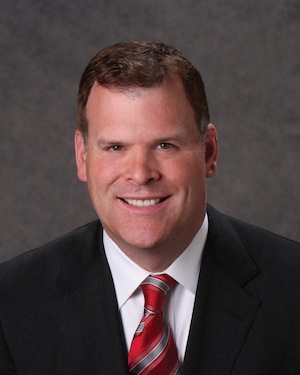
John Baird (photo from Jewish National Fund)

Baird, who will be honored at the Jewish National Fund’s Negev Dinner in Vancouver on June 7, spoke of his admiration for Israel and Canada’s close connections with that country in an interview with the Independent Sunday.

Responding to criticism that Canada has lost its place as a middle power or neutral broker, Baird insisted that is not Canada’s role in the world.

“We are a player,” he said. “We are on the liberal democratic team. We make no apologies for that.”

He cited the Conservative government’s role opposing Iran’s drive for nuclear weapons and regional dominance. The impact this has had in the Arab world is misunderstood by many Canadians, he said.

“Our standing in the Arab world today is stronger than it has ever been,” said Baird, speaking from Ottawa. “When I was foreign minister, we built good relations with the new government of Egypt, with the government in Iraq, with the UAE, the Saudis, the Bahrainis. We are widely respected among the political leadership. Yes, we have an honest difference of opinion with respect to our position on Israel. But when it comes to the Muslim Brotherhood, when it comes to Hamas, when it comes to Hezbollah, when it comes to Iran’s nuclear program, Iran’s material support for terrorism, when it comes to the Iranian-backed advance in Yemen … Saudi Arabia, Israel, Canada: we all share the same view. That’s not understood very well in this country.”

Baird said Canada is a world leader on child and maternal health, opposing forced marriages of girls, and supporting the rights of sexual minorities. Opponents of the government may have difficulty squaring their ideas of how a Conservative administration should behave with the record of the current Canadian government on issues of gender and sexual equality, but Baird says, “Look at the facts.”

“Prime Minister [Stephen] Harper personally has championed child and maternal health,” he said. “We’ve seen record investments not just in Canada but around the world because of his leadership. If you look at the leadership that I undertook with respect to young girls being forced into marriage, we became a leader in that. Canada followed the United Kingdom’s lead on sexual violence in conflict, not just on policy but on programming. When you look at [United Nations’ projects supporting] women, peace and security, we’ve taken a big role in North Africa. So, if you look at the facts, it’s undeniable, particularly on the issue of women and girls. The Day of the Girl resolution was championed by Canada at the UN.”

Advancing the rights of women worldwide is both a human rights matter and a determinant of societal health, Baird said.

“It’s in our own interest to do so,” he said. “It’s not just about human rights. The stronger role that women can play in government, in parliament, in civil society, the more we can combat extremism and promote pluralism.”

Reminded of a comment he made several years ago that, were he to leave politics he would probably go work on a kibbutz in Israel, Baird explained his respect for the Jewish state.

“I just have a passion for Israel, for its people, its culture, its history,” Baird said. “For everything the Jewish people have accomplished in the last 67 years. It’s really remarkable.”

What the Jewish people have built from the ashes of the Holocaust, he said, is admirable.

“The strength and ingenuity of the Jewish people, what they’ve accomplished in science, technology, agriculture, the huge history, it’s a remarkable accomplishment. What they’ve accomplished politically – a liberal democratic state in a pretty dangerous part of the world. The values that underpin the state of Israel, it’s just a remarkable, remarkable achievement.”

While Canada’s foreign policy, particularly under Baird, has turned Canada into what is frequently called Israel’s best friend in the world, the global attitude toward Israel remains highly negative, Baird acknowledged.

“We see far too much moral relativism,” he said. “It has stunned me the amount of criticism that Israel gets in so many international arenas, whether it’s the UN in New York or in Geneva … the UN Human Rights Council … others. On occasion it can be disappointing. It can be difficult to stand up against the rest of the crowd but it’s important to do what’s right. Canadians can be very proud that their government’s taken the path less traveled. We’ve never been afraid to stand up and support our liberal democratic friends.”

The former minister, who left politics earlier this year, speculated on where the animosity toward Israel comes from.

“I don’t think everyone who is against Israel is an antisemite,” he said. “But all antisemites are against Israel. I have great concern that we’ve seen, instead of people targeting the individual Jew, they’re targeting the collective Jew, the Jewish state. These things cause us great concern.”

Although he is moving into the private sector – he is working as a member of Barrick Gold’s advisory board and last week was elected to the board of Canadian Pacific – Baird promises to continue to be an outspoken supporter of Israel and a critic of Iran’s nuclear program and its support for terrorism.

Asked if he might return to public life as a candidate for the Conservative leadership when Harper retires, Baird deflected the idea with a flat “no” and refused, with a laugh, to elaborate.

Ilan Pilo, shaliach and executive director of Jewish National Fund, Pacific region, called Baird “a man of integrity and a true friend to Israel.”

“JNF is grateful to honor him for his leadership on the world stage, for years of devoted service to the citizens of Canada, his dedication to the Jews of Canada and to the state of Israel,” said Pilo. “Thanks to Baird’s outstanding leadership, Canada has become Israel’s most unwavering ally.”

Baird returned the compliment.

“Canadian supporters of JNF can be very proud of the work they’ve done over the years,” said Baird.

This year’s Negev Dinner, which takes place at the Four Seasons Hotel, supports a project in the city of Sderot, adjacent the Gaza Strip. The city has been under bombardment by Hamas missiles for the last several years. The park and fitness facility will enhance life for the citizens and provide a “green lung” for the city.

Pat Johnson is a Vancouver writer and principal in PRsuasiveMedia.com.

אורח הכבוד בערב הגאלה של קק”ל הוא שר החוץ לשעבר בירד

 שר החוץ הקנדי לשעבר ג’ון בירד, עת ביקר את ראש הממשלה בנימין נתניהו, בירושלים ב-20 בינואר השנה. בירד הוא אורח כבוד ‘בנגב דינר’ של קק”ל בוונקובר ב-7 ביוני. (צילום: Kobi Gideon-GPO via Ashernet)

מחלוקת בין ידידים: הרפר שוב תומך בהקמת מדינה פלסטינית בניגוד לנתניהו

ראש ממשלת קנדה, סטיבן הרפר, שנחשב לידיד הקרוב ביותר של ראש ממשלת ישראל, בנימין נתניהו, מקרב מנהיגי העולם, חלוק עימו בסוגיה מאוד משמעותית. בשיחה שהתקיימה בין השניים ביום ראשון שעבר, חזר והדגיש הרפר בפני נתניהו, כי הוא תומך בפתרון שתי המדינות והקמת מדינה פלסטינית לצידה של ישראל. הדברים נאמרו לאור הכרזת נתניהו ערב הבחירות בישראל, כי הוא מתנגד להקמת מדינה הפלסטינית וכי ימשיך את הבנייה בשטחים.

הרפר שוחח עם נתניהו לראשונה בטלפון לאחר ניצחונו בבחירות שהתקיימו לפני שבועיים, בזמן שהוא נערך להקמת הממשלה החדשה. מייד עם פרסום תוצאות הבחירות, שלח ראש ממשלת קנדה ברכות חמות לראש ממשלת ישראל היוצא והנכנס, והוסיף שהוא מצפה לעבוד ביחד עם הממשלה החדשה בישראל, וכי לישראל אין ידידה קרובה יותר מאשר קנדה. בשיחת הטלפון שוב בירך הרפר את נתניהו, וכן הבטיח כי קנדה תמשיך לעמוד במחוייבותה לדאוג לביטחונה של ישראל. וציין כאמור שהוא תומך בפתרון שתי המדינות.

אפשר לסכם את הפרק הזה ביחסי קנדה וישראל באמירה, כי הרפר מאז נבחר לרשות ממשלת קנדה (2006), ממשיך לעמוד לצידה של ישראל ומדיניותה בכל עניין. למעט שתי סוגיות עקרוניות משמעותיות: תמיכה בהקמת המדינה  הפלסטינית והתנגדות להמשך בניית ההתנחלויות בשטחים.

הערכה לידיד: אורח הכבוד בערב הגאלה של קק”ל הוא שר החוץ לשעבר בירד

סניף ונקובר של אגודת ידידי קרן קיימת לישראל (קק”ל) בקנדה בראשות אילן פילו, יקיים ערב גאלה מיוחד, בהשתתפות אורח הכבוד שר החוץ של קנדה לשעבר, ג’ון בירד. האירוע מתקיים לכבודו של בירד שנחשב לידיד קרוב מאוד של ישראל, וכמו ראש הממשלה סטיבן הרפר, עמד לצידה לכל אורך הדרך. בירד ביקר בישראל מספר פעמים וזכה לאירוח לבבי. האירוע במסגרת ‘נגב דינר 2015’ יערך ב-7 ביוני (יום ראשון) במלון ארבע עונות בדאון טאון ונקובר, ומחיר כרטיס 270 דולר.

קק”ל ונקובר תגייס תרומות לטובת הקמת פרוייקט בישראל שיקרא על שמו של בירד, ובשלב זה אין פרטים נוספים. כדי לקבל הכרה בפרויקט ע”י בירד יש לתרום לפחות 6,000 דולר.

קק”ל בקנדה יסדה את ‘נגב דינר’ עם הקמת מדינת ישראל ב-1948. האירוע מתקיים בכל רחבי קנדה מדי שנה להבליט את העשייה החשובה של קק”ל, לגייס כספים לטובת פרוייקטים בישראל, ולהעניק אות כבוד למי שעוזר ותומך בישראל.

בירד (45) פרש בראשית פברואר מתפקידו כשר החוץ בממשלת הרפר. בימים אלה הוא הצטרף לקואורפוריישן ‘בריק גולד’ (חברת כריית הזהב הגדולה בעולם), בתפקיד יועץ בינלאומי. הוא עבד בשירות הציבורי במשך כעשרים שנים, ושימש שר החוץ מאז 2011. קודם לכן החזיק בתפקידים בכירים שונים (בהם שר התחבורה ושר האנרגיה) בממשלות הרפר. ברד הוזכר לא פעם כמועמד להחליף את הרפר ביחד עם השר ההגנה, ג’ייסון קני, שגם הוא תומך גדול בישראל.

קק”ל שחוגגת השנה 114 שנים להיווסדה מקיימת שורה של אירועים בישראל. במסגרת זו אגודות ידידי קק”ל בעולם מארגנות מסע לישראל בן שמונה ימים, בחודש מאי (12-20). המשתתפים ישהו במלון מצודת דוד בירושלים. המסע יכלול מפגשים עם מספר אישים ובהם: נשיא המדינה, ראובן ריבלין וראש עיריית ירושלים, ניר ברקת. הסיורים יכללו בין היתר: ביקור בבסיס חיל האוויר, השתתפות באירועי יום ירושלים (ב-17 במאי), ביקור בתחנת הטלוויזיה של ערוץ החדשות באנגלית ’24 ניוז’, סיור ביקב, ביקור בשוק של יפו העתיקה, ביקור בבאר שבע ובנגב.

Gillerman: “call a spade a spade”

Dan Gillerman addresses the audience at Jewish National Fund Pacific Region’s Tu b’Shevat event Feb. 3 as emcee Geoffrey Druker looks on. (photo by Robert Albanese)

A former Israeli ambassador to the United Nations heaped praise on Canada and excoriated the United States during a candid speech here last week.

photo - Left to right, former ambassador to the United Nations Dan Gillerman, Mayor of Victoria Lisa Helps and JNF Pacific Region shaliach Ilan Pilo
Left to right, former ambassador to the United Nations Dan Gillerman, Mayor of Victoria Lisa Helps and JNF Pacific Region shaliach Ilan Pilo. (photo by Julie Elizabeth)

Dan Gillerman, who led the Israeli delegation at the UN from 2003 to 2008, was filling in for current Ambassador Ron Prosor, whose obligations kept him in New York. The occasion was the Jewish National Fund of Canada’s Tu b’Shevat event at Beth Israel on Feb. 3. He also spoke in Victoria at Emanu-El for JNF the next day.

Gillerman, who acknowledges that he has a penchant for political incorrectness and is now a private citizen free to speak his mind without the constraints of a diplomatic post, received a strong ovation when he called Canada “by far, the greatest friend Israel has in the world” and when he heaped praise on Canada’s Prime Minister Stephen Harper as “probably the greatest leader in the world.”

His perspective on the United States was not nearly as positive.

“I think that what we are witnessing today is at least a perception, hopefully a wrong perception, of a weak America and a weak American president,” Gillerman said. Even a whiff of American weakness is a dangerous thing in the world, he said, with America’s enemies feeling that they can get away with murder and America’s allies believing that they cannot rely on the superpower.

Gillerman equates the contemporary situation of the United States with the advent of the First World War a century ago, which he says was due in part to perceptions of British weakness under Prime Minister H.H. Asquith. Gillerman contended that Russian dictator Vladimir Putin would not do what he did in Ukraine and other countries would not do what they are doing elsewhere if they thought the United States would intervene.

On dangers facing Israel, Gillerman said that the most serious threats are not Hamas or Hezbollah, and not even Iran, which is pushing for nuclear capability. “They are not our most dangerous threats, because we can take care of them,” he said. “The two most dangerous phenomena we face today are appeasement and being politically correct.”

Trying to appease terror and the Iranian regime, as the world is doing today, Gillerman said, is very dangerous.

About political correctness, he said the world is “trying to find other words to explain what is happening,” other than identifying it as Islamic extremism and terrorism. “We have to call a spade a spade,” he said. “There is evil in this world. There is terror in this world. It threatens your country and every country in the world.”

On Iran, Gillerman characterized nuclear negotiations as “a weak America and a weak American president who wants an agreement at any cost.”

Gillerman said he had a conversation with UN Secretary-General Ban Ki-Moon, who is South Korean. Gillerman said that the global powers dithered while North Korea prepared for nuclear weaponry then one day the world woke up to a nuclear North Korea. Gillerman said Ban told him that Iran is much more dangerous than North Korea.

“North Korea sought nuclear weapons out of desperation,” Gillerman quoted Ban as telling him. “While Iran is seeking them out of aspiration.”

Gillerman spoke of his close relationship with the late former Israeli prime minister Ariel Sharon, who appointed him ambassador to the UN. Gillerman’s background is not in politics or diplomacy, but business, and he was chairman of the Israeli Chamber of Commerce before his ambassadorial appointment.

He said Sharon warned him that the appointment to the UN would leave him lonely and facing hostility, but Gillerman said he later told the prime minister that he had been wrong. As Israel’s representative at the world body, Gillerman said, he operated on the knowledge that he represented a country that “is far, far better than most other member countries of the United Nations.”

Despite Israel’s isolation at the UN, one of Gillerman’s achievements during his time as ambassador was the proclamation of International Holocaust Remembrance Day every January. It was the first time that an Israeli-sponsored resolution was passed by the General Assembly.

Gillerman was speaking on the day that Canadian foreign minister John Baird announced his resignation from cabinet and politics. Gillerman said that he had spent several days with Baird recently in Davos, Switzerland, and had no indication that Baird was planning a major change.

“I think it’s a loss for Canada and a loss for Israel, but I wish him well,” Gillerman said, before once again praising Canada’s leaders.

“I think you have in Stephen Harper one of the greatest leaders in the world. Probably the greatest leader in the world and definitely the best friend Israel has in the world,” he said.

While the bulk of the former ambassador’s speech was ominous and pessimistic, it didn’t conclude that way.

“Despite all that, I am optimistic about the future of Israel,” he said near the end of his remarks. “I believe that the world is waking up.”

In the Arab world, he said, the fight between extremists and moderates will lead moderates to recognize that Israel is not the enemy. Comparatively moderate Arab states are as afraid of Iranian extremism and nuclear capability as Israel is – possibly more afraid – he said, and a regional agreement will emerge from shared interests.

“I believe we can reach a fair and lasting settlement with the Palestinians,” he said, adding that leadership is needed on both sides, and in the world, and that it must go beyond bilateralism. He predicted what he calls a “23-state solution,” an agreement between Israel and Arab countries that leads to lasting peace.

He went on to say that if the Palestinian issue were settled, Arab states could calm their streets and become partners with Israel.

To those who say that the United Nations is a failed, useless organization, Gillerman described it as simply a building on First Avenue in Manhattan that is only as good as its tenants. Blaming the UN for the faults of its member-states is like blaming Madison Square Garden when the Knicks lose, he said. “It’s not the UN as an organization, it’s the world we live in.” The UN General Assembly has a “built-in immoral majority,” he said.

photo - Left to right, Frank Sirlin, president of Jewish National Fund Pacific Region, former ambassador to the United Nations Dan Gillerman and JNF Pacific Region shaliach Ilan Pilo
Left to right, Frank Sirlin, president of Jewish National Fund Pacific Region, former ambassador to the United Nations Dan Gillerman and JNF Pacific Region shaliach Ilan Pilo. (photo by Robert Albanese)

Prosor, the ambassador who was originally slated to attend, provided a video message that was screened at the beginning of the event. Singers from Vancouver Talmud Torah sang a song for Tu b’Shevat and King David High School students sang the national anthems. The event was emceed by Geoffrey Druker, Rabbi Jonathan Infeld welcomed visitors to the new Beth Israel building and Diane Switzer, board chair of the Jewish Federation of Greater Vancouver, introduced Gillerman. Frank Sirlin, president of JNF Canada Pacific Region, spoke about this year’s Tu b’Shevat campaign, which will see trees planted along roads in Israel that are within range of gunfire from the Gaza Strip. The “green barrier” will help green the desert while shielding drivers and passengers from sniper fire. The JNF campaign includes two telethon sessions, on Feb. 15 and 22.

Pat Johnson is a Vancouver writer and principal in PRsuasiveMedia.com.

More Canadas needed

Israeli Ambassador to the United Nations Ron Prosor speaks in Vancouver on Feb. 3 and in Victoria on Feb. 4. (photo from Ron Prosor via Jewish National Fund Vancouver)

Israel’s ambassador to the United Nations says Canada’s foreign policy is at the “heart of the world’s moral compass.”

In an email interview with the Jewish Independent, Ambassador Ron Prosor credited Canada as being a voice of reason and justice.

“Prime Minister [Stephen] Harper and Foreign Minister John Baird have proven time and again to be true friends to Israel,” Prosor said. “They are at the heart of the world’s moral compass.… Canada is standing with Israel as we stand on the frontline in the battle against terror. They are often the first to denounce the anti-Israel bias and stand up as the voice of justice and reason. There are many examples of this bond: Canada was a strong proponent of the effort to make Yom Kippur an official UN holiday; it partnered with us to organize the upcoming special session in the General Assembly on antisemitism; and was one of the few countries to condemn the Syrian delegate … for comparing Israel’s policy to that of the Nazis.”

Prosor spoke to the paper in advance of his visit here in early February, hosted by Jewish National Fund of Canada, British Columbia. He will speak Feb. 3 in Vancouver at Congregation Beth Israel, at 7:30 p.m., and in Victoria the following day, at 7:30 p.m., at Congregation Emanu-El.

Prosor criticized efforts by the Palestinian Authority to gain recognition at the UN and at the International Criminal Court, saying it is an effort to avoid a negotiated resolution to the conflict.

“The Palestinians have found every possible opportunity to avoid direct negotiations with Israel,” he said. “They have engaged in a never-ending string of political games, literally shooting in all directions and missing the real target. The fact of the matter is that their habit of bypassing negotiations by taking unilateral action and blaming everyone but themselves will only move us further from peace. It’s time for the Palestinians to aim higher and find constructive solutions – beginning by engaging in meaningful dialogue.”

The United Nations is the body that, in 1947, passed the Partition Resolution intended to create a Jewish and an Arab state in Palestine. Israel’s critics routinely note that the very agency that is responsible for its existence is repeatedly on record condemning Israeli policies. Prosor responds that the UN is not the same body it was nearly 70 years ago.

“The landscape of the UN has changed dramatically since its founding,” Prosor said. “Today, fewer than half of its member states are democracies. The halls of the UN used to ring with calls for human rights and human dignity; today, they ring with voices demonizing and delegitimizing the Jewish state. This year, the UN passed 20 resolutions condemning Israel. In comparison, the world’s worst human rights abusers – Iran, Syria, and North Korea – each received one condemnation. This anti-Israel bias pervades the UN system.”

Many of the UN’s most vociferous condemnations of Israel emanate from the UN Human Right Council (UNHRC).

“For years, the Human Rights Council has singled out Israel for condemnation,” Prosor said. “I have to note that some of the world’s most repressive regimes, including Saudi Arabia and Cuba, are members of the Human Rights Council.”

Saudi Arabia is currently in the international spotlight for carrying out the first of 20 court-ordered floggings of democracy blogger Raif Badawi. After Friday prayers a week ago, Badawi, who created the blog Free Saudi Liberals, was lashed 50 times over the course of 15 minutes in a public square in front of a mosque in Jeddah. He is scheduled to receive the same punishment for a total of 20 successive Fridays, or 1,000 lashes. This is in addition to his sentence of 10 years in prison.

Despite this immediate example and other atrocities perpetrated by elected members of UNHRC, the body’s attentions are overwhelmingly focused on the Jewish state, Prosor said.

“To date, there have been 22 emergency meetings of the HRC to deal with situations around the world – 33 percent of them dealt with Israel,” Prosor said. “Additionally, Israel is singled out during regular sessions. Article 4 of the Council’s agenda examines the abuses of every single country in the world, except one. Israel – and Israel alone – has its own permanent place on the agenda: Article 7. This isn’t just a double standard, it’s a triple standard. One standard for democracies, one standard for dictators and a whole other impossible standard for Israel.”

“Another example is the UN’s UNISPAL [UN Information System on the Question of Palestine] website,” Prosor said. “It has advertised ‘apartheid tours’ in Israel and promoted a petition calling for the Canadian prime minister to cancel a visit to Israel.

“The UN could be playing a more constructive role by investing less time targeting Israel and more time advancing peace and security, economic growth, women’s rights, minority rights and so on,” he said. “None of this will be possible so long as the institution is held hostage by the world’s most repressive regimes.”

Though he is the lead representative of Israel at an organization that sometimes seems to have condemnation of the Jewish state as its primary mission, Prosor insists he is not intimidated.

“I walk the halls of this organization tall and proud of my extraordinary nation, one of the freest and more democratic countries on earth,” he said. “At the UN, I feel it is important to show the world what Israel is about beyond our conflict. We have so much innovation and ingenuity to share in agriculture, medicine, high-tech, education and more. We are a nation of just eight million that has produced 12 Nobel prizes, that sends satellites into space, puts electric cars on the road and develops the technology to power everything from cellphones to solar panels to medical devices. I feel privileged to represent Israel and the Jewish people.”

Prosor said he is bringing a message to Canada that emphasizes the parallels between the two countries.

“Israel and Canada share the same value system – we believe in democracy, justice, human rights and peace,” he said. “Together, we are standing firm amidst the stormy seas of global diplomacy to make the world a more peaceful place. The UN needs more countries like Canada – countries that are willing to take a stand and defend our common values.”

Pat Johnson is a Vancouver writer and principal in PRsuasiveMedia.com.

סניף ונקובר של קק”ל מברך את פרושאור

image - interesting in the news Jan 1 - Ron Prosor to Vancouver, bitcoin, Tim Hortons snake incident

“Israel is an example”: Premier Christy Clark

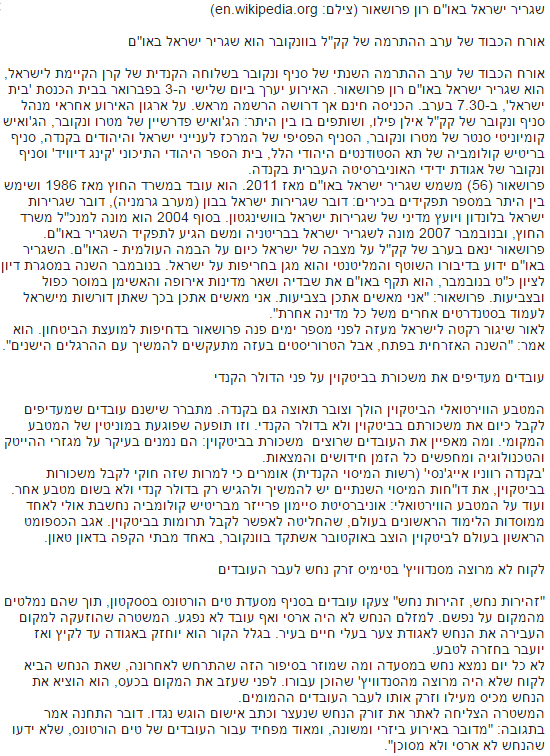
Kibbutz Magen member Shunit Dekel speaks via Skype to the almost 800 people who came out to Temple Sholom to show support for Israel. Dina Wachtel, executive director, Western Region, Canadian Friends of the Hebrew University, is at the podium. (photo from JFGV)

Close to 800 people gathered at Temple Sholom the night of July 27 to show solidarity between Canadians and the state of Israel.

Temple Sholom Rabbi Dan Moskovitz started the evening by leading the crowd in “Am Yisrael Chai,” and Jewish Federation of Greater Vancouver chair Diane Switzer read aloud a letter of support from Premier Christy Clark who wrote, “The current conflict in Israel and Gaza is of great concern to anyone who believes in democracy and human rights…. At this difficult time, let us remember the values we share with Israel: a vibrant, culturally rich, democratic nation committed to maintaining the rights of its citizens, regardless of gender or religion. Israel is an example not only to the region, but the world.”

photo - Farid Rohani, a businessman, social activist and a board member of the Laurier Institution, speaks to those gathered at Temple Sholom
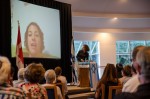
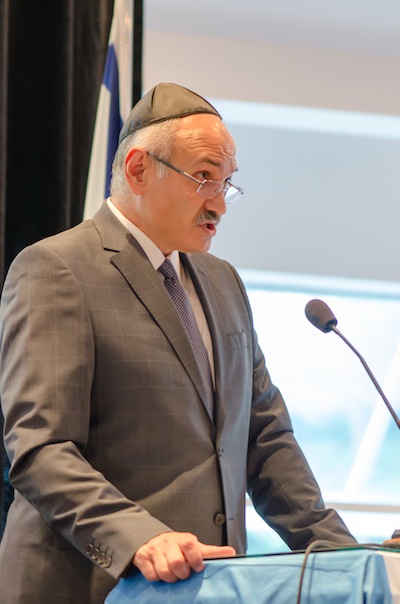
Farid Rohani, a businessman, social activist and a board member of the Laurier Institution, speaks to those gathered at Temple Sholom. (photo from JFGV)

The event featured a number of guest speakers, including Shunit Dekel, a member of Kibbutz Magen, and Farid Rohani, a businessman, social activist and a board member of the Laurier Institution. Dekel spoke via Skype from her home 4.3 kilometres outside of Gaza. Her kibbutz was forced into lockdown three times last week, because of the danger posed by the underground tunnels connecting it with Gaza. Rohani addressed the issue of antisemitism in recent social media. Through his own analysis of Twitter, he concluded that the coverage is remarkably lopsided and that “remaining quiet is a disservice not only to the values that we share as Canadians, but to order and what is right.”

The event was a collaborative effort between several local organizations: Canadian Friends of Ben Gurion University, Canadian Friends of Hebrew University, Canadian Jewish Political Affairs Committee, Magen David Adom, Congregation Beit Hamidrash, Congregation Beth Israel, Congregation Temple Sholom, Congregation Schara Tzedeck, Hillel BC, Jewish Community Centre of Greater Vancouver, Jewish National Fund, Or Shalom, State of Israel Bonds and the Centre for Israel and Jewish Affairs, Pacific Region.

At the end of the night, community member Bill Levine remarked, “The tone of the evening was respectful, and stressed our desire for a peaceful resolution. It was good to see the community react in the spirit of coming together.”