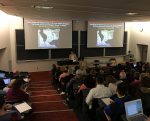
Dr. Ra’anan Boustan of Princeton University delivers the Itta and Eliezer Zeisler Memorial Lecture at the University of British Columbia on March 23. (photo by Gregg Gardner)
A mosaic from Late Antiquity has lessons for Jewish communities today. According to Dr. Ra’anan Boustan of Princeton University, “Jewish identity, historically, was broader, more porous, and integrated more non-Jewish elements than we might think, and, likewise today, we should not hasten to essentialize or rigidly define Jewish identity or culture.”
Boustan offered this insight when delivering the Itta and Eliezer Zeisler Memorial Lecture at the University of British Columbia on March 23. Called Greek Kings and Judaean Priests in the Late Antique Synagogue: The Newly Discovered “Elephant Mosaic,” Boustan’s visit was presented by the Archeological Institute of America, Vancouver Society, and co-sponsored by the UBC Diamond Chair in Jewish Law and Ethics, and the department of classical, Near Eastern and religious studies (CNERS).
A 2011 dig led by archeologist Jodi Magness excavated several sections at the site of a former village, Huqoq, near the Sea of Galilee. Among the items uncovered was a mosaic that is said to have adorned the floor of an elaborate 1,600-year-old synagogue.
“The discovery of the mosaic was a major find,” Prof. Gregg Gardner of CNERS told the Jewish Independent. “There are very few mosaics from the ancient world that depict biblical scenes.”
The mosaics’ scenes include Samson fighting the Philistines, Noah and the flood, the destruction of the Egyptian army in the Red Sea, and others. A particularly noteworthy element is that the mosaics also show images from Greek history and mythology. “This confluence of biblical and Greek imagery was quite surprising,” said Gardner.
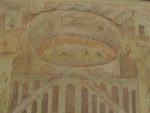
Boustan was in Vancouver to talk about the “Elephant Panel,” which depicts a battle between unknown actors. Although some have argued that the panel represents Alexander the Great, Boustan interprets the mosaic as the depiction of a Seleucid attack on Jerusalem led by King Antiochus VII in 132 BC. “It shows they had a sense of historical connection to predecessors in a more robust way than we might have expected, and wanted to have that memorialized in synagogue art. This shows a historical consciousness, not just the timeless world of rabbis and scriptural interpretation developing in the Talmud of the same period.”
Boustan is a specialist in Judaism in Late Antiquity (circa 200-700 CE) who has focused particularly on understanding “extra-rabbinic culture,” the Judaism that existed outside of what was preserved in the narratives of the rabbis. “The rabbinic writings – the Talmud, the Midrash – preserve the world through their eyes, what they thought was important and how they wanted things to be viewed. The rabbis did not represent all Jews or all Judaism, and the wider Jewish world may have had different viewpoints and priorities.”
Boustan has focused on studying the piyyutim (hymns) written and preserved outside the rabbinic canon and containing some unusual theological ideas, as well as on apocalyptic and mystical literature, which flourished on the fertile edge between Jewish and non-Jewish cultures.
“The mosaic is important for understanding the history of Jews and Judaism and gives us something to think about in terms of Jews living in the Western world today,” he said, noting the broader and more porous nature of Jewish identity in those times, and how we shouldn’t be in a hurry to “rigidly define Jewish identity or culture.”
For example, Boustan explained, “The figural art we are finding at Huqoq and elsewhere upends some of our assumptions that, classically, Jews didn’t do that. In fact, we’ve found many small villages of one to two thousand habitants who built very expensive buildings containing a mixture of folk art and world-class art. In Huqoq, the art is imperial-quality work, which would not be surprising to find in a major landowner’s villa in Antioch. Yet, there it is, being commissioned, paid for and used by a farming village of maybe 2,000 people. That tells us we have a lot more to learn about the Jews of Late Antiquity.”
He noted, “In addition, the synagogue art contains a zodiac wheel with a figure of the sun god, Helios, in the centre. What’s going on there? Is it just a decoration? Was it actually part of religious worship in the synagogue? Was it seen allegorically as a poetic representation of God?
“Helios imagery was adopted by Christians in the third century, along with many other Greek religious symbols,” he said. “As the Greco-Roman world Christianized, however, they distanced themselves from ‘pagan’ imagery. By the late fourth to seventh [century], Jews are the only ones actively cultivating zodiacal and Helios imagery. Ironically, if you find a building with Helios imagery from that period, it’s almost definitely a synagogue.”
Matthew Gindinis a freelance journalist, writer and lecturer. He writes regularly for the Forward and All That Is Interesting, and has been published in Religion Dispatches, Situate Magazine, Tikkun and elsewhere. He can be found on Medium and Twitter.
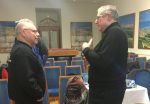
Jewish Genealogical Society of British Columbia member Danny Gelmon, left, speaks with Hal Bookbinder. (photo Stephen Falk)
Why Did Our Ancestors Leave a Nice Place Like the Pale? That was the title of Hal Bookbinder’s March 14 talk at Temple Sholom.
Bookbinder was hosted in Vancouver by the Jewish Genealogical Society of British Columbia (JGenBC). He is involved with JewishGen, JewishGen Ukraine and the Jewish Genealogical Society of Los Angeles. He has published numerous articles on research techniques, Jewish history, and border changes; the latter a matter of particular import to Ashkenazi Jews researching their families’ histories in Eastern Europe. A former president of the International Association of Jewish Genealogical Societies, Bookbinder was honoured in 2010 with the association’s Lifetime Achievement Award.
On March 14, Bookbinder gave a detailed and insightful presentation, all without using notes. “Pale comes from the Latin palus for a stake, the stakes which were used to mark off an area.” he explained. “It was also used for the English Pale, a territory within Ireland controlled by the English. The Pale of Jewish Settlement in western Russia was a territory within the borders of Czarist Russia where Jews were allowed to live.”
Bookbinder said, “Limits on the area in which Jews could live came into being when Russia attempted to integrate Jews into the expanding country, from which Jews had been excluded since the end of the 15th century.” From 1791 until 1915, he said, the majority of Jews living in Eastern Europe were confined by the czars of Russia within the “Pale of Settlement.”
Bookbinder broke up the history of the Pale into six periods, each approximately 25 years long: creation, confinement, oppression, enlightenment, pogroms and chaos. The first era, that of creation, arose from Russia’s westward march to seize new territories in Belarus, Poland and Ukraine, he explained. Russia didn’t want Jews within its borders, but, as it expanded its empire westward, it came to be responsible for millions of them, creating a “Jewish question” for itself.
Catherine the Great (who reigned 1762-1796) responded by ruling that Jews should stay in the Pale. The confinement era intensified efforts to keep the Jews in the Pale, so as not to “infect our good Eastern Orthodox brethren,” explained Bookbinder. During this era, Catherine the Great’s son, Paul I, initiated a new program aimed at assimilating Jews into Christian culture by making their lives so miserable they would rather convert than remain as they were.
This led to the period of the cantonists, during which Jewish boys were drafted into the Russian army. Some did convert, though most did not. Large numbers died from mistreatment, neglect and malnourishment. The military schools provided army training as well as a rudimentary education. Discipline was maintained by the threat of starvation and corporal punishment. At the age of 18, pupils were drafted to regular army units, where they served for 25 years. Enlistment for the cantonist institutions, which originated in the 17th century, was most rigorously enforced during the reigns of Paul I’s son Alexander I (reigned 1801–1825) and Nicholas I (reigned 1825–1855), said Bookbinder. It is estimated that around 40,000 Jewish children were stolen from their families during this period. The practice was abolished in 1856 under Alexander II (reigned 1855-1881).
Czar Alexander II took a more “enlightened” approach, continuing to seek the conversion and assimilation of Jews through gentler methods. Czar Alexander III, a rabid antisemite like his grandfather, initiated the era of pogroms after he came to power in 1881.
Starting in 1905, with the ascension of Nicholas II, the chaos period began. “Russia was in ferment,” said Bookbinder, “and it was the era of assassination attempts, the Bolsheviks, fighting between the Red Army and the White Army, the Cossacks – creating a situation that was so unpleasant that it prompted many of our ancestors to leave.”
But, Bookbinder asked, “Why did they leave then? They had lived through so many horrors, and this was far from the worst they had seen. I think it is because, during the more enlightened era of Czar Alexander II, our ancestors got a taste of a more dignified, more secure existence and took courage. When things descended again into chaos, they had had enough, and many escaped Russia.”
Matthew Gindin is a freelance journalist, writer and lecturer. He writes regularly for the Forward and All That Is Interesting, and has been published in Religion Dispatches, Situate Magazine, Tikkun and elsewhere. He can be found on Medium and Twitter.
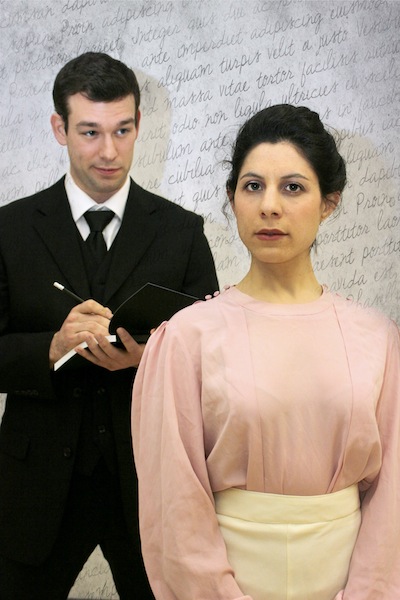
Left to right are Kaila Kask (Mary Phagan), Emily Smith, Rachel Garnet and Alina Quarin with Riley Sandbeck (Leo Frank). (photo by Allyson Fournier)
On Aug. 17, 1915, 31-year-old Leo Frank was kidnapped from the Georgia State Penitentiary in Milledgeville by a Ku Klux Klan lynch mob and hanged by his neck until he was dead. His alleged crime: the rape and murder of 13-year-old factory worker Mary Phagan. His real crime: being Jewish, successful and a northerner in an impoverished Deep South still reeling from the humiliation of the Civil War and looking for retribution against its perceived oppressors.
The case has been the subject of novels, plays, movies and even a mini-series. But who would have thought that you could make a musical out of such a tragedy. Author Alfred Uhry (Driving Miss Daisy) and Broadway producer Hal Prince (Cabaret) did. Thus Parade was born, with music and lyrics by Jason Robert Brown. It opened on Broadway in 1998, won two Tonys and went on to be produced across America to much acclaim.
Now, Fighting Chance Productions, a local amateur theatre company, is bringing this compelling story to Vancouver audiences for its Western Canadian première at the Rothstein Theatre April 14-29. Director Ryan Mooney and lead actor Advah Soudack (Lucille) spoke with the Jewish Independent about the upcoming production. But first, more background, because it is an incredible story.
Frank was a slight man – five feet, six inches tall, 120 pounds – with a nervous temperament. Born in Texas and raised in Brooklyn, he graduated from Cornell University with a degree in mechanical engineering and was enticed to move to Atlanta in 1908 to run the factory owned by his uncle. There, he met and married Lucille, a 21-year-old woman from a prominent Jewish family. The newlyweds lived a life of privilege and wealth in a posh Atlanta neighbourhood, Frank became the president of the local B’nai B’rith chapter. However, having been brought up in the vibrant Yiddish milieu of New York, he always felt like an outsider amid the assimilated Southern Jewish community.
The journey to his tragic demise started the morning of Saturday, April 26, 1913, when little Mary put on her best clothes to attend the Confederate Memorial Day Parade in downtown Atlanta. On the way, she stopped at the National Pencil Factory, where Frank was the superintendent, to pick up her weekly pay packet from his office. That was the last time she was seen alive. Her body, half-naked and bloodied, was found in the basement of the factory later that day. Shortly after, Frank was arrested by the police and charged with the crime along with the African-American janitor, Jim Conley.
The trial was a media circus fueled by a zealous district attorney, Hugh Dorsey, who was looking for a conviction in a high-profile case to popularize his bid for the governorship of Georgia, and Tom Watson, a right-wing newspaper publisher who wrote virulent, racist editorials against Frank, casting him as a diabolical criminal and calling for a revival of the Klan “to do justice.” Frank was convicted by an all-white jury on the testimony of Conley – who had turned state’s evidence in exchange for immunity – and sentenced to death in a trial that can only be characterized as a miscarriage of justice replete with a botched police investigation, the withholding of crucial evidence, witness tampering and perjured testimony. This was America’s Dreyfus trial and Frank was the scapegoat.
The conviction appalled right-thinking people and mobilized Jewish communities across America into action. William Randolph Hearst and New York Times publisher Adolph Ochs campaigned on Frank’s behalf. The conviction and sentence were appealed. Georgia governor John Slaton was lobbied to review the case. For two years, Frank sat in jail not knowing his fate until, one day, he heard that Slaton had commuted his death sentence to life in prison. In response, frenzied mobs rioted in the streets and stormed the governor’s mansion. A state of martial law was declared and the National Guard called out to protect the city. Against this backdrop, Frank was transferred into protective custody at the state penitentiary but that did not stop the lynch mob, some of whom had been jurors at the trial.
It wasn’t until 1986 that Frank was (posthumously) pardoned by the Georgia State Board of Pardons and Paroles.
Jewish Independent: What attracted you to this play?
Ryan Mooney: Parade has been a favourite musical of mine for as long as I can remember. I was drawn to it because it is such a fascinating story, it speaks so much to its time and continues to speak to us. When people see it, they will want to know more. It has beautiful soaring music, is very emotional, but also it is real, so relatable. It will take you on a journey that will touch you in many ways.
Advah Soudack: The songs, the music. When I was going through the script and getting used to the music, I could not get through some of the songs without choking up, it was so emotional, beautiful and real.
JI: How would you classify it as a theatrical piece?
J.P. McLean (Britt Craig) and Advah Soudack (Lucille Frank) are part of the 25-person cast of Parade, which will have its Western Canadian première at the Rothstein Theatre April 14-29. (photo by Allyson Fournier)
RM: It is, in essence, a love story about a young man and a woman who learn through tragic circumstances to have a deeper love for each other and to appreciate each other’s kind of love.
AS: Leo sees love as a service, being a provider, while Lucille looks for love in spending quality time together and physical intimacy. Over time, their two loves unite.
JI: This isn’t your typical musical. It has a very dark side. It covers the kind of subject matter usually covered in narrative plays. Do you think people want to see this kind of musical theatre?
RM: Our company, as our name states, takes chances and we are taking a chance on this, but I think the risk is worthwhile and that audiences will appreciate the story. It seems to do very well wherever it plays – Broadway, London. We thought the Rothstein Theatre would be the perfect venue and we hope that the Jewish community will support us.
JI: Is this strictly a Jewish story?
RM: It is not necessarily just a Jewish story, it could be about anybody, anywhere. It is a fascinating look at a historic event through a musical lens. I don’t think Prince was trying to make a political statement when he produced the show but rather to educate people about the event. At the time of its first production, 1998, shows like Ragtime and Showboat were on Broadway alongside Parade. It seemed to be a time for examining how mainstream America treated those people it considered lesser citizens.
JI: What was it like to cast?
RM: The production requires a large cast: 25. I needed people who could sing and act. Lots of people auditioned and we ended up with a great cast, with the members spanning the ages of 18 to 60. What makes this show very relevant is that we have actors playing roles for their real ages, not trying to be someone younger or older, and that makes the production more realistic. I wanted at least one of the leads to be Jewish and Avdah was perfect for the role of Lucille.
AS: When I heard about this show, I jumped at the chance to apply. I had been out of theatre for about 10 years and I really wanted to get back into it. I was lucky enough to get a callback after my first audition and felt very proud of my performance the second time around. I was thrilled when I got the role.
JI: What is it like to deal with a true event as opposed to a fictional account?
RM: Because it is a real life story, there is so much more research you can do to make sure you get it right. I read Steve Oney’s And the Dead Shall Rise: The Murder of Mary Phagan and the Lynching of Leo Frank and gave it to members of the cast to read to get a feel for the characters and some background information. There is some material that did not make it into the musical but the play does essentially honour the accuracy of the event.
AS: I am reading the book right now and it is so fascinating to get the story behind the character and be able to use that as an actor.
JI: How are Leo and Lucille portrayed in the script?
RM: He is not portrayed that sympathetically. At the trial, he is really cold and does not look repentant but, ultimately, we see him break. If he were just shown as a martyr and everyone else a villain, that would not be interesting for the audience. Instead, the audience sees his flawed human character and that is why it is a great story to tell – [he’s] a person with faults that anyone can relate to.
AS: She is a Southern woman and a product of the American melting pot, more assimilated than Jewish, and that is how she survives. America wants you to become American first and everything else second. People like her thought like that and assimilated. Then, she is thrust into this case, where horrific things are being said against her husband on a daily basis in the newspapers and she has to deal with that. Yet, she stands by him and is one of his biggest supporters. She even went to the governor’s mansion to personally lobby him to intervene in the case. For a young Southern Jewish woman, that was a big step. So, you see her grow into this strong, independent woman.
She comes across very strong in the play, perhaps stronger than she really was in real life, but she was so committed to Leo’s cause and to him. She came every day to jail to visit him and bring him food. The circumstances of the tragedy allowed her the opportunity to become a heroine.
JI: What will the staging be like?
RM: The set is a long wall with platforms set at different levels. The lights will move through the different levels from scene to scene to create more of a cinematic flow, more like a movie than live theatre. We did not want the story’s flow to be interrupted by the audience clapping after every song. Of course, we do hope the audience will give a standing ovation at the end of the show.
JI: What do you expect audiences to take away from the musical?
RM: I want them to walk out with questions and want to look up more information about the case, but I also want them to leave with the understanding that all good art finds the grey in life and that everything is not black and white. One of the biggest issues in America today is the mentality that you are either with us or you are against us. The world is going in that direction and it is a hard place to be. You have to be able to see issues from all angles if you want to see any positive growth. There are some ambiguities in the show but there are also strong life lessons about the dangers of prejudice and ignorance.
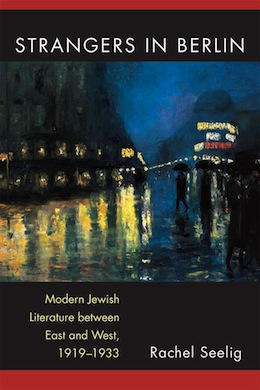
Rachel Seelig, author of Strangers in Berlin: Modern Jewish Literature Between East and West, 1919-1933. (photo by Lauren Kurc)
Rachel Seelig’s Strangers in Berlin: Modern Jewish Literature Between East and West, 1919-1933 (University of Michigan Press, 2016) encompasses so many ideas – some very nuanced, others technical – that a reader will enjoy it on their own, but will learn much more if they can discuss and analyze it with others.
Strangers in Berlin uses the example of four poets – Ludwig Strauss, Moyshe Kulbak, Uri Zvi Greenberg and Gertrud Kolmar – to examine the influence that Berlin during the Weimar Republic had on Jewish literature.
“The relationship between German Jews and East European Jews in Germany typically has been depicted in terms of … German Jews figuring as reluctant hosts, cultural insiders who viewed the so-called Ostjuden as outsiders or even infiltrators,” writes Seelig. “Strangers in Berlin is aimed at destabilizing these designations by presenting Berlin as a border traversable in both directions…. Foreigners arriving from abroad availed themselves of artistic inspiration and anonymity in order to cultivate new forms of culture, while those native to Germany ascertained their increasing estrangement from the fatherland, which they similarly channeled into artistic production. Whether they were coming or going, exiled in Germany or soon-to-be-exiled from Germany, these writers experienced Berlin as a transitional site between a moribund pre-World War I political order and an increasingly divided, nationalistic European reality.”
Seelig told the Independent that she “chose to focus on four poets who are not necessarily remembered as key figures in Weimar culture but who had considerable influence in their own day.”
She explained, “One of the reasons that these poets are relatively neglected is that they are not easily categorized according to national literary boundaries. Two of them, Strauss and Greenberg, immigrated from Europe to Palestine and wrote in more than one language (Strauss in German and Hebrew and Greenberg in Yiddish and Hebrew) and the other two, Kulbak and Kolmar, produced highly diverse, avant-garde bodies of work that do not align with what we tend to see as the dominant literary trends of their day. So, these writers weren’t just ‘strangers in Berlin’ – that is, writers who are located on the margins of the cultural milieu in which they had either permanently or provisionally settled – but also strangers to us as readers in the 21st century.
“I suppose I made it my mission to bring their extraordinary writing to light, and the best way to do so was to group them together within this context of intense transition and transformation,” she said. “For all four, the experience of living in Weimar Berlin – even if only briefly – left a profound imprint on their work and on their national identity. For all four, Berlin was a place in which they were forced to renegotiate identity. Taken together, I think their works provide a fascinating glimpse into the multiplicity of images of Jewish homeland that emerged during this very fruitful yet volatile period in history.”
Weimar Berlin brought together German, Hebrew and Yiddish literature and Strangers in Berlin examines “the impact of migration – of individuals, languages and cultural concepts – on Jewish national consciousness between the world wars,” writes Seelig. She chose to focus on poets, in part, “because establishing an autonomous and multifaceted poetic tradition was a crucial component of modern national movements.”
Whereas both the Westjuden and Ostjuden “initially viewed Germany as the wellspring of liberal, Western values, by World War I, they had begun to ‘re-orient’ their gaze toward the ‘East,’ extending temporally and geographically from the ancient Near East to contemporary Eastern Europe,” writes Seelig. “Plagued by the uncertainty of national homelessness and the terror of rising antisemitism, both groups looked eastward with a combination of nostalgia, hope and despair in a effort to come to terms with the failure of the West to fulfil the promise of coexistence predicated on the liberal principles of Enlightment. Indeed, melancholic longing for the ‘East’ betrayed profound dislocation in the ‘West,’ which in turn fueled the search for a new national homeland, whether real or imagined.”
Vancouver-born and -raised, Seelig received her undergraduate degree in comparative literature at Stanford University, then worked for a time in New York. She earned her master’s and PhD in Jewish studies at the University of Chicago, spending her last couple years of graduate school in Tel Aviv. She received the Ray D. Wolfe Postdoctoral Fellowship in Jewish Studies at the University of Toronto and then, after that, returned to Israel, where she was a Mandel Postdoctoral Fellow at the Hebrew University of Jerusalem. Currently, she is a fellow at the University of Michigan’s Frankel Institute for Advanced Judaic Studies. She speaks English, Hebrew, German and Yiddish. From even this brief bio, it is no wonder that Seelig is interested in borders and thresholds.
“We live in a world today that is both utterly divided and, in a sense, borderless,” she told the Independent. “The phenomena of globalization and mass migration have made us keenly aware of the ways in which borders are, on the one hand, more easily traversed, and, on the other hand, rigourously enforced and policed. Borders have always been sites of contestation and conflict, but a border can also be seen as a threshold that one crosses from one reality to another and a productive site of transfer and transformation.
“I myself migrated across several borders as this book came into being. It started to develop as a doctoral dissertation in Chicago, which I finished writing in Tel Aviv. It became a book – one that changed shape continuously – in Toronto, Berlin and Jerusalem, and was ultimately published in Ann Arbor, Mich. My own nomadic experience as an academic (and I realize, of course, that mine is a kind of privileged nomadism) made me particularly attentive to the impact of changing surroundings and of transitions on one’s thinking, work and identity.”
While accessible, Strangers in Berlin’s dissertation origins are evident, and there are some sentences people will have to read more than once for understanding.
“Strangers in Berlin is first and foremost an academic book, which grew out of my doctoral dissertation, acknowledged Seelig. “But, in the process of transforming the dissertation into a book – and I should point out that the book departs fairly dramatically in terms of content and argument from the dissertation – I made a concerted effort to make the text engaging and highly readable by simplifying the language and peppering every chapter with interesting anecdotes. It will be used by researchers and teachers within the academic context, but I also very much hope that it will be read by lay readers who are interested in modern Jewish culture and the history of the Weimar Republic, which is such a vibrant and captivating time period. I also think that the themes of homeland and migration, which are at the centre of the book, are extraordinarily relevant today, and I hope that readers will find this glimpse into Weimar culture and history resonates with our own political reality today.”
Certain parts of Strangers in Berlin will make readers shiver with a sense of déjà vu. In the chapter on Kolmar, for instance, Seelig writes that, in the poet’s one novel, Die jüdische Mutter (The Jewish Mother), “Kolmar offers a pained reflection on the impossibility of salvaging a viable German-Jewish female identity in an era when both Jewishness and femininity were under siege.” Seelig notes, “Conservatives seeking to safeguard their middle-class privileges and to rebuild a healthy Germany Volkskörper (national body) regarded independent women and integrated Jews as similarly ‘decadent’ social elements…. The result of this campaign was a new form of male repression, which was often shrouded in xenophobic sentiments.”
Readers will see similarities between the Weimar period and what is currently happening in some European countries and in the United States. As it happens, Strangers in Berlin’s launch took place the day after the U.S. presidential election.
“A few hours before the event,” she said, “I was reading an article by Chemi Shalev in the Israeli newspaper Haaretz, in which he commented that many millions of Muslims, Mexicans and Jews now feel like ‘strangers in the country they call home.’ Obviously, his statement resonated very strongly with me and with my book.
“The book deals with a historical moment, nearly a century ago, when Berlin emerged as a major metropolis that attracted large swaths of immigrants, who were often seen as unwelcome infiltrators. In this respect, 1920s Berlin isn’t such a far cry from Berlin or Toronto or New York City of today. The book really does resonate with what’s going on in the U.S. and in so much of the world.… We are witnessing the rise of nativist sentiments and attendant xenophobia and bigotry that are oh so reminiscent of interwar Europe. And we’re seeing the way in which various forms of bigotry (anti-immigration, antisemitism and misogyny, all addressed in the book) have a tendency to intersect and even merge when these nativist sentiments are bolstered by political power. I realize it’s a cliché, but it really is remarkable to see how history repeats itself. It’s such a shame that the humanities, specifically history and literature, are under attack today (Trump just eliminated funding for the National Endowment for the Humanities from his proposed budget) at a time when we so desperately need them.”
Strangers in Berlin’s four poets struggle, as we all do, with the impossibility of being one thing – a German (or any other nationality), a Jew (or any other religion), for example. Not to mention the different conceptions of what comprises a “real” German (Canadian, American, etc.) or an “authentic” Jew (within the ranges of observance, belief). From all the research Seelig has done – her work, travel, ability to speak multiple languages and negotiate various cultures – has she any theories as to why humans have such trouble, in general, with multiplicity, ambiguity, a lack of borders?
“I wish I knew why we as humans have such a hard time with ambiguity,” she said. “This is something that affects our lives not only in terms of cultural, national or political identity but also in terms of relationships, career paths, place of residence, etc. On the one hand, we have more freedom than ever before to dwell ‘between’ identities, or to inhabit more than one identity, and yet that’s somehow deeply unsettling to us as creatures that crave order, certainty and security.
“I think there’s so much to be learned by the figures in my book, who didn’t have the luxury to choose where they would live or which system of beliefs to subscribe to (at least not without the risk of persecution), and who were profoundly shaped by the contingencies and vicissitudes of life. Each of the four main writers in the book represents more than one identity and, for each one, this was certainly a source of anxiety but also a source of profound inspiration and enrichment.”
Jewish Community Centre of Greater Vancouver, 1950. (photo from JWB fonds, JMABC L.11154)
If you know someone in this photo, please help the JI fill the gaps of its predecessor’s (the Jewish Western Bulletin’s) collection at the Jewish Museum and Archives of B.C. by contacting archives@jewishmuseum.ca or 604-257-5199. To find out who has been identified in the photos, visit jewishmuseum.ca/blog.
Yuri Dojc and Katya Krausova found classrooms, textbooks, a synagogue, prayer books, clothing and ritual ornaments, all lovingly cared for, undisturbed, unmolested and somehow cherished since the scooping up of three-quarters of the Jews in the towns of Slovakia in 1942. (photo by Yuri Dojc)
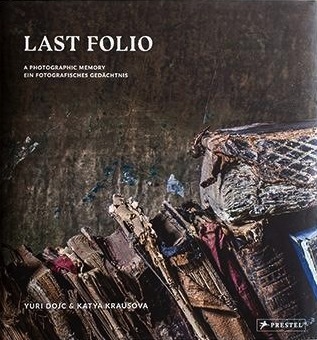
Fascination, horror, admiration, exaltation are the words that come to mind when I search to describe the emotions I felt reading Michael Posner’s book review of Last Folio: A Photographic Memory by Yuri Dojc and Katya Krausova (Indiana University Press, 2011) in Queen’s Quarterly (Winter 2016). The personal saga of Krausova, a cinematographer, and Dojc, a photographer, the horror of the Holocaust in Slovakia and the discovery of remnants of the vibrant Jewish communities stripped of their Jews, their culture and their religion, provoked my curiosity and my imagination.
Dojc and Krausova found classrooms, textbooks, a synagogue, prayer books, clothing and ritual ornaments, all lovingly cared for, undisturbed, unmolested and somehow cherished since the scooping up of three-quarters of the Jews in the towns of Slovakia in 1942.
“It was as if he were entering a time capsule, classrooms frozen at almost the precise moment that Nazi transports had taken the students to the concentration camps – and almost certain death,” writes Posner. “Except for the mould and the yellowed, tattered pages, everything was exactly as they had left it: a bowl of sugar on the shelf, books inscribed with childhood signatures, notebooks filled with essays on their aborted life ambitions.”
Yet, for me, there was something more than photographs and meetings with Holocaust survivors that were being revealed. I rushed to buy the book. It is a work of art filled with dramatic testimony and the saga of an epic journey of chance meetings and breathtaking discoveries resulting in exquisite photographs, as well as a documentary film – labours of love and devotion by Dojc and Krausova.
After reading the text and examining the photographs – the most beautiful I have ever seen – I began to meditate on the fact that all these images were found in places abandoned in 1942; their Jewish owners and community members wiped out by the Nazis. Strange place names like Bratislava, Bardejov, Sastin, Michalovce and Kosice became familiar to me, as the tallit, tefillin, prayer books, mikvah and Torah fragments came alive in my eyes. One of the most haunting images is that of a book fragment with the Hebrew word הנשאר, “that which remains,” clearly legible on the delicate paper.
The essays that follow by Azar Nafisi and Steven Uhly commemorate and honour the murdered Slovak Jews and their collective memory. Yet, there was still something that I was missing. I reread the text by Krausova and stopped on the following lines:
“Mr. Bogol’ tells us that he is the warden of the Protestant church, that he and his wife have lived in the same block with the Simonovics for more than 40 years and that following the death of Mrs. Simonovic’s brother, he became the keeper of the keys of a building in the town…. Time stopped still in this building, which housed a Jewish school a long time ago, almost certainly in 1942, the day when Bardejov Jews vanished forever. Mr. Bogol’ proudly shows us how he and his wife have been painstakingly cleaning each bench, each light, each seat, finding – and preserving – every object, religious or otherwise.”
And, they find another building filled with books, also preserved and protected; waiting for Dojc and Krausova to discover them.
Last Folio is a work of art filled with dramatic testimony and the saga of an epic journey of chance meetings and breathtaking discoveries resulting in exquisite photographs. (photo by Yuri Dojc)
Here was my phantom question, here was the missing link! How is it that these empty, cold, barren places were taken care of for more than 70 years? Who would do such a thing? Why would they do it? Were the guardians of these precious objects waiting for someone? Why didn’t the municipality tear down the buildings or strip them of everything and renovate them? Who paid for the maintenance and taxes on the buildings?
The guardians and the keepers of the keys took these responsibilities upon themselves, year after year, until they bumped into Dojc and Krausova, convincing the harried and exhausted researchers to take a look.
Embossed on the inside cloth cover of the book we read: “Last Folio Charts a Personal Journey in Cultural Memory / A Reflection on Universal Loss as a Part of European Remembrance.”
These unheralded, unacknowledged guardians were the protectors and defenders of the memory of the Jews of Slovakia and their Jewish community. To them, we owe enormous gratitude.
To see an extended trailer of the 81-minute documentary about Krausova and Dojc’s research and the making of the book and photo exhibition, visit youtube.com/watch?v=0vZeL63l1ok.
Dolores Luber, a retired psychotherapist and psychology teacher, is editor of Jewish Seniors Alliance’s Senior Line magazine and website (jsalliance.org). She blogs for yossilinks.com and writes movies reviews for the Isaac Waldman Jewish Public Library website.
For many of us, it is hard to get excited about a subject until we can experience it, or meet someone who has. Historical fiction can bridge the gap between simply memorizing dates and names to empathizing with those affected and taking what we learn into our lives.
Two recent Second Story Press publications do an excellent job of teaching and engaging younger readers. They also provide a starting point for these readers and their parents, family, friends and educators to discuss difficult and sensitive topics that not only relate to the past, but to current situations, as well.
The Ship to Nowhere: On Board the Exodus by Rona Arato (for ages 9 to 13) tells the story of the ship Exodus 1947 through the eyes of 11-year-old Rachel Landesman. I Am Not a Number by Jenny Kay Dupuis and Kathy Kacer and illustrated by Gillian Newland (for ages 7 to 11) tells the story of 8-year-old Irene Couchie, who is forcibly taken from her First Nations family and home to live in a residential school in 1928. Both Rachel and Irene are real people.
Sadly, their stories are representative of what also happened to countless others. And, even more sadly, what continues to happen. The Ship to Nowhere could lead to a conversation about the Syrian refugee crisis and antisemitism in Canada and elsewhere. I Am Not a Number brings to mind some parallels between the Holocaust and the attempted genocide of Canada’s First Nations, as well as the inequalities that still exist in Canada, the treaties that have not been ratified, the reconciliation over the residential schools that is long overdue and has barely begun.
Given the ages of their intended readers, both of these books tread lightly – that said, they deliver powerful messages and succeed in their missions to educate.
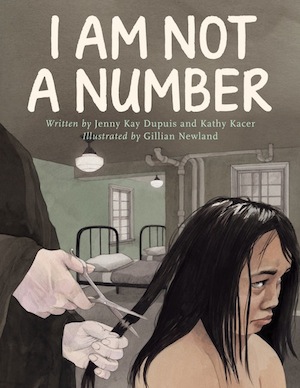
The illustrations in I Am Not a Number, a hardcover picture book, are as revealing as the text. Irene and her siblings, as they huddle behind their father when the government agent comes to take her and two of her brothers away; the sadness on Irene’s face as a nun cuts her hair, the anger as she sits in church; and the unbridled joy when she and her brothers are back at home after a tortuous year – these are just some of the emotions Newland movingly captures.
And Kay Dupuis tells her grandmother’s story with such love. This was a family that was strong and, in the end, luckier than many, in that Irene and her brothers didn’t return to the residential school – when they came home for the summer, their family kept them hidden from the government agent.
I Am Not a Number includes a brief overview of the residential school system, and mention of the Truth and Reconciliation Commission. Kay Dupuis also tells readers a bit more about her grandmother in an afterword, where there are a few photos of the Couchie family.
The Ship to Nowhere has photos throughout, and Arato uses the author’s note at the end to let readers briefly know what happened to Rachel, Rachel’s mom and sisters (her dad was killed in the Holocaust), the ship’s captain, Yitzhak Aronowicz (known as Captain Ike) and one of the journalists who doggedly reported to the world the Exodus’s journey, Ruth Gruber.
Since it is for older young readers, there are parts of The Ship to Nowhere that are quite graphic – the incredible brutality of the British is well-depicted, as are Britain’s efforts to prevent the ship’s 4,500-plus Holocaust survivors from knowing what the media were reporting on their treatment. Even with the passage of time, the anger boils in reading about how these survivors were tear-gassed and beaten (in some cases to death) on the Exodus, forced to live as captives on three other ships after they were turned out of Palestine, and again beaten and manhandled if they refused to leave their ships in Germany, where the British took them eventually, to live in refugee camps.
There are many touching moments between the crew and their passengers and between fellow refugees. It is important to be reminded that France offered to take in all of the refugees; an offer that was declined. And it would be nice to think that, at the least, the Exodus’s plight positively influenced some United Nations members to vote in favour of the creation of Israel.
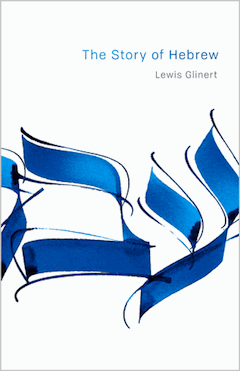
Let’s say it at the outset: this book is a gem. Every page of The Story of Hebrew by Lewis Glinert (Princeton University Press, 2017) is packed with information about the language, from its beginnings through post-1948 Israel. In addition to this longitudinal approach, Glinert, a professor of Hebrew and linguistics at Dartmouth, also approaches his subject laterally, focusing on various lands where Jewish/Hebrew life and culture thrived, like early Palestine, Babylonia, North Africa, Spain, Europe and Russia, the United States and Israel.
The book shows us how living under Greek and Roman domination affected Hebrew and how vocabulary from those occupiers seeped into the language. Two examples, the first mine, the second Glinert’s: the simple word for shoemaker in Hebrew, sandlar, which comes from the Latin sandalrius; and Sanhedrin, the Jewish High Court, which stems from the Greek synedrion. Jews did not shy away from these foreign influences; their Hebrew language embraced them.
Glinert also traces the changes in the use of the language from biblical times through the Mishnah (before and after 200 CE), where the Hebrew of that period was more direct and seemingly more colloquial, as can be seen by comparing a text from the Mishnah with any chapter in the Bible. During the next two or three hundred years, written Hebrew then moved on from the Hebrew-only Mishnah to the two-language Talmud, with its mix of mostly Aramaic and much less Hebrew. (In all of this, of course, we only have written texts to go by.)
With sacred books passing from generation to generation orally, correct pronunciation might be lost or distorted. Along came the Masoretes (from the Hebrew word, masorah, tradition), who, by the year 1000, had created above- and below-the-letters signs that ingeniously indicated pronunciation, melody, accent and phrasing.
Jews also contributed to scientific learning by writing about medicine in Hebrew. I am sure it will surprise many readers, as it did me, that in Italy’s first medical school, in Salerno, founded in the ninth century, the languages of instruction were Hebrew, Greek, Latin and Arabic. And, in southern France, in Arles, Narbonne and Montpellier, the official language of instruction in these medical schools was Hebrew.
Religious attitude also influenced how Hebrew was used. Glinert delves into this divide by showing that, during the 11th and 12th centuries in Ashkenaz (in northern France and the Rhineland), the accent was on liturgy and Torah scholarship – the works of Rashi, for instance – while in Sepharad (Spain) and Italy secular Hebrew poetry flourished, influenced by Arabic poetry, exemplified by Yehuda Halevi and other poets.
The book devotes two remarkable chapters to the interaction of Christians with Hebrew.
In one of these unholy intersections, two of the noted translators of the Bible from Hebrew, the church father Jerome (fourth century) and Martin Luther (1534), respected Hebrew but disparaged Jews and Judaism. In his notorious 1542 book On the Jews and Their Lies, Luther asserts, “Jews should be expelled before they poison more wells and ritually abuse more children.”
A better relationship ensued with English translators. William Tyndale was the first to render the Five Books of Moses (1530) into English directly from the Hebrew. In so doing, he defied a bishop’s ban on a translation other than the Latin Vulgate. Tyndale’s translation led to the classic 1611 King James version of the complete Bible, whose English rhythms, cadences and even sentence structure enormously affected English.
As Glinert elegantly puts it: these two translations would “inject a Hebraic quality into the syntax and phraseology of English literary usage without parallel in any other European culture.” The author further adds that echoes of this biblical English can be seen from Walt Whitman’s Leaves of Grass poetry collection to Martin Luther King’s “I Have a Dream” speech.
Hebrew also made its mark in the early history of the United States. The Pilgrims saw themselves as the New Israelites, giving their towns name like New Canaan and Salem – even their Thanksgiving was a belated Sukkot to celebrate a bountiful harvest. And Hebrew was at one time ensconced as a mandatory subject in the Ivy League colleges. I recently read that at graduation ceremonies students would deliver orations in Hebrew, Greek and Latin, and university presidents, like Ezra Stiles of Yale, would also occasionally give their commencement talks in Hebrew.
Glinert writes that the door to modernity in Europe was opened in 1780 by two books published on different sides of Europe. One, in Germany, was Moses Mendelssohn’s Biur, the first volume of his translation of the Torah into German; the other, in a small town in the Ukraine, was a book in Hebrew about Chassidic thought.
Slowly, from the advent of the Haskalah, the Jewish Enlightenment movement, through newspapers, magazines and books, modern Hebrew was being reshaped, culminating with Jews resettling Palestine in the late 19th century, along with Eliezer Ben-Yehuda’s call, at the turn of the 20th century, for Jews to speak only Hebrew. Glinert shows us how the thrust for Hebraization continued once the British got the Mandate for Palestine in 1922 from the League of Nations. They recognized Hebrew as the language of instruction for public schools, broadcasting, the courts and civil regulations. With the founding of the state of Israel in 1948 and mass immigration, Hebrew – which throughout the centuries had always been read, studied and written, and only occasionally spoken – reached its efflorescence.
The Story of Hebrew is a superb book, meticulously researched and beautifully written. Two of my favourites among the many text-enhancing illustrations and photographs are a photo of a page from one of Sir Isaac Newton’s notebooks, where he has a phrase in Hebrew written in his neat printed script; and a page from Franz Kafka’s Hebrew notebook, with two columns of nicely calligraphed Hebrew words on one side with their German translation (in longhand) on the other.
Read this marvelous study – perhaps, if you don’t know Hebrew, it will inspire you to learn it and become part of a more than 3,000-year tradition of transmission.
Curt Leviant’smost recent books are the novels King of Yiddish and Kafka’s Son.
A painting from Pompeii showing gladiators fighting. It is housed in the National Archeology Museum in Naples. (photo by Deborah Rubin Fields)
Among the fabulous finds of Pompeii is the helmet of an apparently Jewish gladiator. Who would have thought?
As many readers might know, Pompeii was the unfortunate recipient of Mount Vesuvius’s 79 CE wrath. Many gladiator helmets have been dug up in Pompeii’s excavations. (Unfortunately, this collection is kept in storage at Naples’ National Archeology Museum.)
In the paper “A Jewish Gladiator in Pompeii,” historian Dr. Samuele Rocca notes that one of these stored helmets stands out for its unique decoration. While there are images on other recovered helmets and weapons, they usually come from pagan iconography. On this one helmet’s forehead relief, however, there is a seven-branched palmetto tree with a cluster of dates on each side.
During the time of the gladiators, the palmetto symbol was apparently employed in only one other place – as an engraving on Judaean coins. These coins, Rocca says, were associated with Jews. Indeed, the symbol was jointly chosen by the local Jewish leadership and the Roman procurator. Thus, the palm tree symbolized both the religious and secular ideals of the late Second Temple Jewish leadership.
The amphitheatre in Pompeii. (photo by Deborah Rubin Fields)
Moreover, Rocca reports that a small number of other Jews came to Pompeii both before the exile of 70 CE and afterward. In Pompeii, they did not form a Jewish community as such, but apparently Jewish women lived at Pompeii.
Remarkably, archeologists have excavated lists of Pompeian names. Apparently, during this time, Maria was a Jewish name. One Pompeii woman bearing that name worked with textiles.
Another woman with the same name lived in the Casa dei Quattro Stili, although her rank and societal position remain a mystery. It is theorized that the most well-known Maria was a prostitute, who worked in the Thermopolium of Asellina, in Via dell’Abbondanza.
While Prof. Andrew Wallace-Hadrill, in Herculaneum, Past and Present, writes that food could not have stayed hot in the thermopolia’s terracotta containers, others maintain that the thermopolia were the precursors of today’s restaurants. In brief, this explanation makes a case for Maria to have been a barmaid or waitress.
Estimates are that, in 70 CE, Titus took 20,000 Jewish slaves to Rome, so it is not surprising that Jews arrived in Pompeii as slaves. In fact, from the many documents salvaged from Herculaneum – another town severely affected by that same Vesuvius eruption – we know that Roman society was organized along the lines of freeborn, enslaved, freed and those holding a special status. According to Wallace-Hadrill, “It is a society in which your legal status has an overwhelming importance…. But a society characterized by movement between status groups … the third group comprised those who were neither freeborn nor regularly set free … but who had nevertheless … been promoted to full citizenship.” On still-legible marble panels listing residents’ names, he writes, “only a sixth of the Roman male citizens in Herculaneum could name their freeborn fathers … it leaves them massively outnumbered.”
After Mount Vesuvius’s horrific 79 CE eruption, you may well wonder how so much Herculaneum documentation is still available. Wallace-Hadrill explains, “Pompeii was blanketed in ash and pumice pebbles, while Herculaneum was covered in the fine, hot dust of pyroclastic surges and flows, result[ing] in the extensive preservation at Herculaneum of organic material – principally wood, but also foodstuffs, papyrus and cloth.”
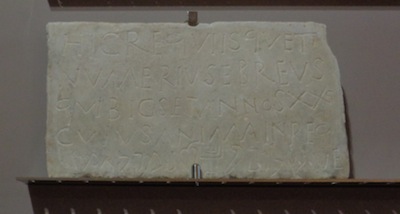
The tombstone for the young Jewish Numerius, written in both Latin and Hebrew, which can be seen at the National Archeology Museum in Naples. Note the menorah in the middle of the bottom line. (photo by Deborah Rubin Fields)
As somewhat of an aside, Salvatore Ciro Nappo, in Pompeii, notes that the Pompeians apparently did not consider Mount Vesuvius dangerous. One indication of this is that the House of the Centenary has a lararium (shrine niche for household gods) fresco in the servants’ rooms showing Bacchus, a thyrsus (a type of staff or wand) and a panther in front of the mountain. Vineyards entirely cover the mountain, presumably indicating Vesuvius brought festivity and prosperity.
Today, archeology is, for the most part, an appreciated study, but that was not always the case. According to Wallace-Hadrill, when medieval rulers wanted to tunnel down into the ruins of Pompeii, they ran into opposition from the Inquisition. Sanctioned excavation – haphazard as it first was, with some kings taking “the good stuff” or even going so far as to destroy finds so as not to share the wealth – did not begin until the 1700s.
Archeology has shown that nearby Naples, located 14 miles southeast of Pompeii, had a bona fide Jewish community pre-dating the Jewish arrival in Pompeii. For trade reasons, Jews started settling in this port city in the first century BCE. Life was tolerable for them, even as the Roman Empire started falling apart. When, in the late fifth and sixth centuries CE, Justinian tried to regain the Roman Empire from the Germanic Ostrogoths, the Jews of Naples fought against Justinian.
These Jews apparently “blended in” to the extent that they inscribed their tombstones almost entirely in Greek or Latin. Significantly, while the travertine (the land-formed version of limestone) grave markers at Naples’ National Archeology Museum are usually not in chiseled Hebrew, they do contain obvious Jewish symbols such as menorot, lulavim, etrogim and shofarot. On one tombstone, the inscription reads: “Here lies Numerius, a Jew, who lived for 26 years and whose soul is in peace. Shalom, Numeri[u]s, amen.”
The French Angevins oppressed the Jews in the 13th century, but their Aragon successors (in the 1400s) basically left them in peace. Naples thus became a major centre of Jewish book production during the 15th century. Then, as happened in other European countries, the Jews were expelled in 1541, only allowed back in generations later. In the 1800s, the Rothschilds, who were the banking concern in Naples, helped restart the Jewish community. In the 1920s, the community grew to 1,000. While 80% of Italian Jewry survived the Holocaust, Naples’ current Jewish population is about half its former size, with even fewer people belonging to Naples’ synagogue.
Deborah Rubin Fields is an Israel-based features writer. She is also the author of Take a Peek Inside: A Child’s Guide to Radiology Exams, published in English, Hebrew and Arabic.
Jewish Museum and Archives of British Columbia hosts a new supper club and a podcast. (photo from JMABC)
The Jewish Museum and Archives of British Columbia is launching two new programs celebrating the diversity of food traditions represented within the B.C. Jewish community. From all corners of the world, from Baghdad to Bangalore, Kiev to Cape Town, Jewish families have made a new home here, bringing with them a wealth of culinary traditions.
One of the programs, the Chosen Food Supper Club, will give guests the opportunity to try these foods and hear the stories behind them. Why do Syrian Jews eat leeks, Swiss chard and gourds on Rosh Hashanah? What are boerewors and bobotie? How do you prepare the ultimate chicken tagine? These mysteries and more will be solved (deliciously) at the supper club, which will take place over 10 evenings between April and September. Each dining experience will run from 5-8 p.m. on a Sunday evening. Guests will enjoy a complete dinner while hearing firsthand stories from members of the Jewish community. All meals are kosher-style, not certified kosher. Tickets are $40 per person per meal, and are available at jewishmuseum.ca/programs/the-chosen-food; they must be purchased in advance.
The JMABC’s other new program is The Kitchen Stories podcast.
When we talk about food, we often end up talking about so much more. Family traditions, patterns of migration, gender dynamics, our relationship to the land. More than just a source of nourishment, food is a means of communication. And, in The Kitchen Stories series, listeners will hear what it was like to be a Jewish family living in far-flung places such as Eritrea, Chile and India. They will hear about the pressures to fit in or stand out, and how food was often a means of doing both. They will hear about the difficulty of maintaining family culinary traditions after migrating to a new country.
Podcast episodes will include community members developing new traditions or reviving long-forgotten ones, a Jew by choice who is learning to cook Jewish cuisine while not wanting to forget her own family’s food traditions, and families adopting new traditions to strengthen their relationship to the land.
The 12-episode series will be available for download on the iTunes store, Google Play, Soundcloud and at jewishmuseum.ca.



 Certain parts of Strangers in Berlin will make readers shiver with a sense of déjà vu. In the chapter on Kolmar, for instance, Seelig writes that, in the poet’s one novel, Die jüdische Mutter (The Jewish Mother), “Kolmar offers a pained reflection on the impossibility of salvaging a viable German-Jewish female identity in an era when both Jewishness and femininity were under siege.” Seelig notes, “Conservatives seeking to safeguard their middle-class privileges and to rebuild a healthy Germany Volkskörper (national body) regarded independent women and integrated Jews as similarly ‘decadent’ social elements…. The result of this campaign was a new form of male repression, which was often shrouded in xenophobic sentiments.”
 Yet, for me, there was something more than photographs and meetings with Holocaust survivors that were being revealed. I rushed to buy the book. It is a work of art filled with dramatic testimony and the saga of an epic journey of chance meetings and breathtaking discoveries resulting in exquisite photographs, as well as a documentary film – labours of love and devotion by Dojc and Krausova.

 The illustrations in I Am Not a Number, a hardcover picture book, are as revealing as the text. Irene and her siblings, as they huddle behind their father when the government agent comes to take her and two of her brothers away; the sadness on Irene’s face as a nun cuts her hair, the anger as she sits in church; and the unbridled joy when she and her brothers are back at home after a tortuous year – these are just some of the emotions Newland movingly captures.
 Glinert also traces the changes in the use of the language from biblical times through the Mishnah (before and after 200 CE), where the Hebrew of that period was more direct and seemingly more colloquial, as can be seen by comparing a text from the Mishnah with any chapter in the Bible. During the next two or three hundred years, written Hebrew then moved on from the Hebrew-only Mishnah to the two-language Talmud, with its mix of mostly Aramaic and much less Hebrew. (In all of this, of course, we only have written texts to go by.)