

Skip to content
  • Home
  • Subscribe / donate
  • Events calendar
  • Business Directory
  • FAQ
  • News
    • Local
    • National
    • Israel
    • World
    • עניין בחדשות
      A roundup of news in Canada and further afield, in Hebrew.
  • Opinion
    • From the JI
    • Op-Ed
  • Arts & Culture
    • Performing Arts
    • Music
    • Books
    • Visual Arts
    • TV & Film
  • Life
    • Celebrating the Holidays
    • Travel
    • The Daily Snooze
      Cartoons by Jacob Samuel
    • Mystery Photo
      Help the JI and JMABC fill in the gaps in our archives.
  • Community Links
    • Organizations, Etc.
    • Other News Sources & Blogs
  • JI Chai Celebration
  • JI@88! video

Recent Posts

  • SFU honours Gloria Gutman
  • Lifting people’s spirits
  • Wedding a ray of light
  • Indigeneity and Zionism
  • Rule of law broken: councilor
  • Football and its roles
  • The burden of defence
  • Fish Café returns after fire
  • All right in what goes wrong
  • Nuns & mermaids at TUTS
  • Camp offers holiday retreat
  • Students and mentors inspire
  • Once-in-a-lifetime trip
  • 100 dancers, one heart
  • Money for the sciences
  • What “Jewish food” means
  • Have a cookie, schnitzel too
  • Federation now across BC
  • Israel fighting for its existence
  • Deal strengthens Iran
  • Patriotic belonging diminishes
  • A campaign to engage
  • Upstanders’ first live event
  • Responding to Carney
  • Having your own home
  • Music a family tradition
  • Musical to warm heart
  • Community milestones … June 2026
  • Sharing her passion for Israel
  • Or Shalom reopens its doors
  • JFS from past to future
  • Need holistic approach
  • Sharing stories, advice
  • Journalist shares fears
  • Skills to live together
  • Road to independence

Archives

Follow @JewishIndie
image - CJN box ad Rockowers 2026

Tag: dementia

Early detection is key

Early detection is key

Left to right: Dr. Alon Friedman, Jayson Dzikowicz, Dr. Michael Ellis and Benedict Albensi. (photo by Rebeca Kuropatwa)

It has been known for years that there is a connection between brain injuries and diseases like Alzheimer’s, autisms and epilepsy, but early detection and possible prevention still elude us.

This was the message Ben-Gurion University’s Dr. Alon Friedman relayed at a recent brain-injury panel discussion, hosted by the Canadian Associates of Ben-Gurion University in Winnipeg. A professor in the medical faculty at Dalhousie University, Friedman was joined by Dr. Michael Ellis of the Pan Am Clinic Concussion Program; Dr. Benedict Albensi of the University of Manitoba and St. Boniface Hospital; and Jayson Dzikowicz of the Blue Bomber Alumni Association. The discussion was moderated by Charles Laflèche of St. Boniface Hospital Foundation.

Friedman opened with remarks on the work being done in the field of brain injuries at BGU and broke the discussion into two topics: traumatic brain injury and brain deterioration due to age.

“The money that we as a community spend on traumatic brain injury and on the outcome is tremendous,” said Friedman. “Sport injury is only one small part of it. Mostly, it’s road accidents and falls.

“We are getting into the 21st century and the average [life] expectancy in Western countries is around 80-to-90-years-old. Most of us will live at least until 90 or 100. The price is that we will all probably die with a brain disorder.”

According to Friedman, what is clear with all of the diseases is that we lose a lot of brain tissue before we see any symptoms. “The main problem is that we don’t understand how the diseases are generated. [Over] the last decade, we are trying to look differently at the brain.”

Researchers are now starting to look at the brain as a whole entity, including different cells that interact and communicate with one another all the time.

“While the brain gets the most blood to supply it with the elements it needs, blood does not enter into the brain tissue normally,” said Friedman. “The brain has its own environment protected by what researchers call ‘the blood-brain barrier.’ This separation allows the nerve cells in the brain to act in a very accurate and stable condition, regardless of what’s happening in the blood. A brain injury occurs when this barrier is broken.”

BGU learned more about this barrier by studying a group of football players in Be’er Sheva. “The reason we did it with football players is we knew it would attract the media much more than others, unfortunately,” said Friedman.

To help the audience grasp what football players face, Dzikowicz, who is a former player, shared his experiences with the panel. He has had approximately nine concussions. “Usually, one is more than enough to take people out of sports,” he said. “In business, if you’re faulting, it’s a long process to replace you. In sports, your replacement is standing 30 feet away…. You’re heavily motivated to stay on the field despite injury.

“When it became an issue with me … if you ever rub your eyes a lot and you see those circles … when I had those circles permanently, and when I got hit in the head and they’d be pulsing and flashing for weeks on end, that’s when I got the message that maybe I should stop playing.”

In the 1990s, when Dzikowicz played the game, his coaches’ main reaction was to say that he had “had his bell rung.” Dzikowicz went on to explain, “You got two plays off, you got some smelling salts and you got tapped on the butt and sent back on the field.”

Run by Ellis, the Pan Am Clinic Concussion Program treats children who have had concussions – the program focuses on kids with head injuries. “It’s a very unique partnership between Pan Am, the Children’s Hospital and our provincial government – multidisciplinary care for the children of Manitoba with mild, traumatic brain injuries,” he said. “Patients with more severe injuries go to the Children’s Hospital. We see 40-60 children a week.

“Fortunately, the vast majority of children who sustain a concussion will recover within two to three weeks, but we know that there’s a certain proportion, about 30-40%, who will have symptoms that will last longer.”

Some kids will have headaches or visual/reading abnormalities, issues with balance or develop mood disorders. The focus of the Pan Am program is to bring together experts from various fields to meet the needs of each individual patient.

While collaborative research on brain tumors and Alzheimer’s is being conducted, less is known about the connection between concussions and epilepsy. About the connection between brain trauma and epilepsy, however, Albensi said, “There’s certainly very good evidence that head trauma can lead to neurodegenerative disease…. The question is how many patients with TBI [traumatic brain injuries] develop epilepsy?”

At BGU, the focus is on using MRI to get better pictures of brain injuries and comparing them with images of normal brains. At Pan Am, researchers are developing an MRI brain stress test and looking at blood flow within the brain.

All the panelists agreed that treatment would be more effective with early detection. “Unfortunately, if someone has full-blown Alzheimer’s, the chances of reversing and changing the situation is almost impossible,” said Friedman. “The only chance … is early diagnosis.”

One of the biggest hurdles is getting those who are experiencing memory loss to see a doctor early enough and for the doctor to send them to a specialist without dismissing the memory loss as “normal.”

“There is a lack of awareness, because people don’t think that there’s something to do,” said Friedman. “Patients can go to early diagnosis in every large hospital today. There is general advice to be made and practice for detection, for treating.”

“I think that what we agree on is that there is some risk in families,” added Albensi. “It’s basically impossible to predict if a parent had Alzheimer’s whether his/her son or daughter will have it. Early diagnosis is more important.”

Albensi explained, “What we study in my laboratory as far as the inflammatory response are transcription factors, which are specialized proteins involved long term in the inflammatory process. And, it’s getting the brain to turn off this inflammatory process, in my view, that is key to reducing the risk for these neurodegenerative disorders.”

“The brain can change itself any time in our life,” said Friedman. “The fact that we can learn means the brain can change, at any age. In any condition basically after a trauma, whether emotional or physical, I don’t think it’s that important, but it’s possible.

“Inside a person, stress is a very important factor against brain plasticity. If we are motivated to change our brain, we can find ways to do it and help ourselves.”

Rebeca Kuropatwa is a Winnipeg freelance writer.
Format ImagePosted on May 29, 2015May 27, 2015Author Rebeca KuropatwaCategories LifeTags Alon Friedman, Alzheimer's, autism, Benedict Albensi, brain, concussion, dementia, epilepsy, Jayson Dzikowicz, Michael Ellis
Chanukah with Alzheimer’s

Chanukah with Alzheimer’s

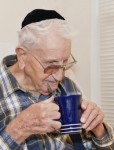
(photo from chabad.org)

Bubby’s crispy latkes, Grandpa’s melodious singing and the image of multiple generations gazing at the Chanukah flames – these are among some of our most cherished memories of Chanukah. But what are we to do when someone in our family is suffering from dementia and is no longer able to celebrate the holidays as he or she once did? How can we make sure that Chanukah remains meaningful and enjoyable, as well as safe, for the whole family? In search of answers, two experts in the field of eldercare and dementia offer some advice.

Dr. Allen Power is a geriatrician who is a recognized leader in the field of dementia and other eldercare topics. He has written extensively about dementia care and has been interviewed by major media outlets such as BBC television and the Wall Street Journal.

Dan Fern is the owner of Homewatch CareGivers, a home-care services company in Phoenix. Fern’s mother is an elderly Holocaust survivor who suffers from dementia.

Menachem Posner: As we plan our celebrations with our aging family members in mind, what can we do to make the experience as smooth as possible?

Allen Power: Scheduling is important. Think about what time of day your parent or grandparent feels best, and schedule your celebration for that time. Some people feel better in the morning, and others do better in the evenings, so plan accordingly. Also, bear in mind that they may not be able to handle as long a party as they once did, so plan to have a shorter party, or at least a way for them to leave when you sense that they are beginning to tire.

Also, coach small children in advance. Help them understand the sensitivities involved, and let them know about communication issues or other limitations beforehand so that they can contribute to a positive experience.

Dan Fern: I would add that it may be better to bring the party to them instead of bringing them to the party. That will reduce the level of stimulation and allow them to enjoy the celebration in a safe, familiar environment. Also, designate someone in advance whose job it will be to act as caregiver, making sure that the parent or grandparent can take a rest or go to the bathroom when they need to.

MP: How can we deal with dietary restrictions? What do you suggest for seniors who are no longer able to cook?

AP: I don’t have a lot of concerns about food. In many cases, you can probably work around whatever restrictions there are. Even though there are some caveats, it’s important to involve people with traditions. Flavors and smells can evoke powerful memories, even for people who forget so much, so they are important.

DF: In my work, it is important that our staff help our clients participate to whatever degree possible. We may have women read recipes, stir a pot, cut veggies, or give them other roles they feel connected to. Of course, for men, we also try to help them take on at least part of the role they used to have, making sure they are not left out.

MP: What do you suggest for menorah lighting? What can we do for people who are no longer able to light on their own?

DF: My mom is 91, and she has moderate dementia. We go to her apartment and light the candles, and she loves to watch them and sing the songs. Singing is a big part of the Jewish holidays and a form of reminiscence. It has also been shown to put you in a better mood and brings oxygen to your brain. Stimulation from light, sounds and large crowds of people can be overwhelming for her, so we come to her apartment, and she thoroughly enjoys the experience. We also make sure to take out the menorah a few days in advance and leave it out where she can see it and discuss it. Just seeing the unlit menorah brings her comfort.

AP: Also make sure that you do it in a safe way. If you are afraid the person may knock over the flames, tea lights placed on a tray are a good, safe alternative.

MP: What can be done to ease the discomfort of a Chanukah gift-giver who no longer knows who gets what?

AP: If people are forgetful, never put them on the spot. Coach family members to introduce themselves when they arrive, and to do so often throughout the visit. Set things up so that they cannot make mistakes that will embarrass them. If there is gift giving, keep a written record so that they can refer to a list.

DF: And when they do make a mistake, don’t correct them; just go with it. My mom knows my name but she doesn’t know our relationship. Sometimes she calls me her nephew, and sometimes she calls me a relative. I don’t correct her. If they use the wrong name, just accept it. Of course, you can help things along by reminding your parent or grandparent beforehand what people’s names are and how they are related.

MP: How many nights of Chanukah would you suggest celebrating?

DF: It’s a unique experience every night. Even if you do exactly the same thing every night, people with dementia will not remember and will be happy to do it each time, so see them as much as you can. It’s well documented that, for people with dementia, a good mood lingers even they no longer know what caused them to feel good in the first place. Remember, you have a limited number of days to celebrate with your beloved parent or grandparent, so take advantage of all the time that is available.

AP: That’s right. One of the wonderful things about people with dementia is that they live fully in the present, so make the most of each present moment. If you want to make some visits briefer than others, that’s fine.

MP: What tips can you suggest for taking grandchildren to see grandparents with dementia?

AP: In my writings, I spend a lot of time talking about how we can model though our speech and body language, showing others how to deal with our seniors. Treat their limitations matter-of-factly and normalize them. Tell the kids, “This is Grandma, we love her and it’s OK.” Give the message that they don’t need to be fearful. You can also show respect by asking the senior for an opinion, demonstrating that this person is someone to be looked up to. Cast your parent or grandparent in the role of wise elder. Also, since people with dementia live in the moment, they tend to do well with little kids who also live in the moment.

DF: When asking questions, make sure they can answer them. Say things, like, “We use this candle to light the menorah, right?” or “Remember when we had such a great time last year?” Even if they don’t remember, they are likely to say they do. You can also engage them by using open-ended comments that allow them to respond as they see fit. With a lot of people, showing affection is very appropriate. Sit next to them, hug them, kiss them and hold their hand. Do what you can to make them feel welcomed and part of what is going on around them.

MP: With so many people living far away from parents and grandparents, what can be done to make holidays special from a distance?

AP: It depends on the person. You can always call [or] Skype, even when it’s not Chanukah. For some people, seeing a face and voice may be very reassuring. But be aware that some people may not relate to it, and seeing a loved one on a screen may be unsettling. In those cases, a handwritten letter that someone can read to them may be better.

DF: A major limitation for many older people is hearing impairment, which makes the phone and Skype difficult. Cards, drawings and pictures can often accomplish the same thing, and they can be looked at again and again.

MP: Any more advice?

AP: Most people with dementia are an open book. Look in their eyes and you can see how they are feeling and proceed appropriately.

DF: Constantly monitor the situation. Be aware of the possibility that you may be pushing the limits. They may be tired and ready for a nap. Keep close tabs, and act before things become a problem. It all comes back to the fact that we want them to have a good time, we want to make them feel comfortable and not put them on the spot. If we’re sensitive to their emotions, it can be a great Chanukah celebration. Chanukah is a time when we make and relive great memories.

AP: I hope this will help people not be fearful of bringing Chanukah to a relative with dementia. Isolation can be harmful, so I hope people take the plunge and do it well.

– This article is reprinted with permission from chabad.org.

Format ImagePosted on December 12, 2014December 10, 2014Author Menachem Posner • Chabad.orgCategories Celebrating the HolidaysTags Allen Power, Alzheimer's, Chanukah, Dan Fern, dementia

Posts pagination

Previous page Page 1 Page 2 Page 3
Proudly powered by WordPress