Skip to content
  • Home
  • Subscribe / donate
  • Events calendar
  • News
    • Local
    • National
    • Israel
    • World
    • עניין בחדשות
      A roundup of news in Canada and further afield, in Hebrew.
  • Opinion
    • From the JI
    • Op-Ed
  • Arts & Culture
    • Performing Arts
    • Music
    • Books
    • Visual Arts
    • TV & Film
  • Life
    • Celebrating the Holidays
    • Travel
    • The Daily Snooze
      Cartoons by Jacob Samuel
    • Mystery Photo
      Help the JI and JMABC fill in the gaps in our archives.
  • Community Links
    • Organizations, Etc.
    • Other News Sources & Blogs
    • Business Directory
  • FAQ
  • JI Chai Celebration
  • JI@88! video

Recent Posts

  • Eby touts government record
  • Keep lighting candles
  • Facing a complex situation
  • Unique interview show a hit
  • See Annie at Gateway
  • Explorations of light
  • Help with the legal aspects
  • Stories create impact
  • Different faiths gather
  • Advocating for girls’ rights
  • An oral song tradition
  • Genealogy tools and tips
  • Jew-hatred is centuries old
  • Aiding medical research
  • Connecting Jews to Judaism
  • Beacon of light in heart of city
  • Drag & Dreidel: A Queer Jewish Hanukkah Celebration
  • An emotional reunion
  • Post-tumble, lights still shine
  • Visit to cradle of Ashkenaz
  • Unique, memorable travels
  • Family memoir a work of art
  • A little holiday romance
  • The Maccabees, old and new
  • My Hanukkah miracle
  • After the rededication … a Hanukkah cartoon
  • Improving the holiday table
  • Vive la différence!
  • Fresh, healthy comfort foods
  • From the archives … Hanukkah
  • תגובתי לכתבה על ישראלים שרצו להגר לקנדה ולא קיבלו אותם עם שטיח אדום
  • Lessons in Mamdani’s win
  • West Van Story at the York
  • Words hold much power
  • Plenty of hopefulness
  • Lessons from past for today

Archives

Follow @JewishIndie
image - The CJN - Visit Us Banner - 300x600 - 101625

Tag: Cherie Smith JCC Jewish Book Festival

Life-changing lecture

Life-changing lecture

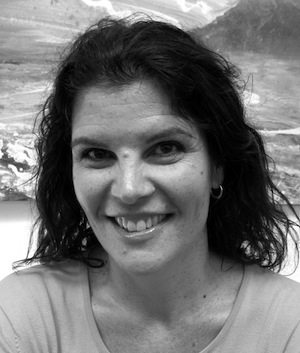
Avrum Nadigel (photo from Avrum Nadigel)

Not only is there no quick fix to making a relationship work, but there’s no quick fix for absorbing the main points of Avrum Nadigel’s Learning to Commit: The Best Time to Work on Your Marriage is When You’re Single. Its lessons can’t be summed up in a few bullet points – you’re going to have to read it.

That being said, Nadigel will have to make the audience at the Cherie Smith JCC Jewish Book Festival “fall in love with” his book in less than 180 seconds. He’s part of the event A Literary Quickie, which takes place on Nov. 22, 10 a.m., at the Jewish Community Centre of Greater Vancouver. The brunch event lineup includes authors Richa Dwor, A.D. Gentle, Rosa Harris, Revital Shiri-Horowitz, Paula Hurwitz, June Hutton, Evelyn H. Lazare, Olga Medvedeva-Nathoo and Marina Sonkina. Admission is by donation.

Nadigel has been a therapist for more than 15 years. He received his master’s of social work from McGill University in Montreal in 1997, and did post-graduate training with the Western Pennsylvania Family Centre, which teaches Bowen family systems theory. He also received supervision via Skype from author and family therapist Dr. David Freeman (who died in 2010). In Learning to Commit, Nadigel doesn’t just offer theories, but advice gained from personal and professional experience. Advice that changed his life, and he’s hoping it’ll help others.

Though Nadigel only lived in Vancouver for about six years, from 1999 to 2005, it was here that he first encountered Freeman, who was speaking at a singles event at the J. His words had a profound impact on Nadigel.

“For all I thought I knew about relationships (I was a practising therapist at that time), Freeman debunked many of my own assumptions, for example, that poor communication is the cause of relationship problems,” writes Nadigel. “He introduced novel ideas about romantic love, providing subtle warnings that the very things that cause a young lover’s heart to flutter can, down the road, be the catalyst of dissatisfaction and divorce. He encouraged us to focus on our own interests, because the more interesting we are to ourselves, the more we have to bring to the table in our relationships.”

Nadigel had come out west, lured by the Rocky Mountains. “From that moment on,” he said, “I knew I had to live near mountains, but also in close proximity to a Jewish community. Vancouver was an easy choice.”

He told the Independent, “It was a total ‘head west young man’ move. I was 30 years old. I sold everything I owned, loaded all of my guitars, some clothes and CDs (remember those?) and headed west. No job, no family, no relationship and only one friend in B.C.

“For money, I worked as a child protection worker, and then as an addiction therapist and family therapist…. Most importantly, I took courses at Emily Carr, composed music for films and learned how to mountain bike.”

He also came here to meet a local Jewish woman but, he said, “true to [his] commitment-phobic self,” he “couldn’t find anyone in Vancouver (or Victoria, Seattle or Calgary) to settle down with.” Eventually, on frumster.com, he met the woman who would become his wife, Dr. Aliza Israel – from Richmond. At the time, she was living and studying in Toronto. “Anyway, we dated long-distance (perfect for a commitment-phobe), and then I agreed to move wherever her residency would be. She was accepted into the Toronto psychiatry program, and the rest is history.”

The two were married in June 2007 at the J here because that’s where Nadigel first heard Freeman, which led to his rethinking about marriage and other things. “The JCC in Vancouver holds a very special place in my heart,” he said.

And so still does Freeman, one of the people to whom Learning to Commit is dedicated, “for providing me with a lighthouse; a way to navigate the rocky seas of my relationships.”

At least one of the ideas in the book seems counterintuitive – the admonition to not compromise.

“Too many relationship books/ speakers assume that compromise is the key to a successful relationship, and so our culture embraces this opinion – and that’s all it really is. And good people use this to avoid growing … discomfort, fear, etc.,” explained Nadigel. “Compromise is no virtue if it’s the first thing you reach for to avoid difficult discussions or situations. Now, more mature people are able to compromise without feeling like they’re betraying their values/principles, because they’re clear on what they stand for, and what they won’t put up with. They won’t compromise on big-ticket items, and will be willing to face the sting/consequence of staying true to their principles.”
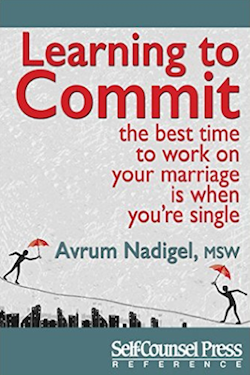
book cover - Learning to CommitIn Learning to Commit, Nadigel writes, “According to Dr. Murray Bowen, togetherness and individuality are two opposing forces that we are all born with. We spend the rest of our lives trying to reconcile their often-contradictory impulses.” A well-differentiated person – someone who is confident of their values and principles, and doesn’t change their opinion or action “just to defuse tension” is able to balance those opposing forces.

“Differentiation is not selfishness,” stressed Nadigel. “It is not about a focus on my needs, damn everyone else. It’s about living a life guided by well-thought-out principles, some of which will address who I want to be/act/think with my partner, children, parents, colleagues, friends, etc. It’s about balancing feelings with good, clear thinking. Actually, one could say that immature, high-feeling-centric people are so fragile that the mere thought of considering another person’s point of view is crushing, whereas higher differentiated people can choose to be guided by their partner’s best interest. But the key here is choice!”

The lessons in Nadigel’s book are relevant for all relationships – in fact, he writes, “one of the main tenets of family systems theory [is]: ‘You will only succeed in future relationships in ways you have already succeeded with your parents, siblings and/or extended families.” They are also useful in dealing with controversy or difficult issues, in developing the ability to hear what you need to hear, even though you may not want to hear it.

To remain open, he explained, “you need two things – curiosity and (if possible) playfulness. These things are very hard to come by in high-tense situations, i.e. acrimonious marriage, Middle East discussions, anything involving high emotions mixed with perceived/real threats. Which is why I believe, as a blogger recently noted while discussing my book: ‘Doing some self-examination and exploration … while we are single might be the best marital therapy we’ll ever have.’ Curiosity and playfulness is much more likely when we’re single, or dating, than when mired in the marital muck of resentment, etc…. I think the best that one can do – in any area – is to share your thoughts as clearly as possible, and without any expectation that people are going to support your thinking or applaud your efforts. When you think about the qualities of great leaders/leadership, these attributes apply.”

For the full book festival schedule, visit jewishbookfestival.ca.
Format ImagePosted on November 13, 2015November 13, 2015Author Cynthia RamsayCategories BooksTags Avrum Nadigel, Bowen family systems, Cherie Smith JCC Jewish Book Festival, marriage, self-help
Hot off holiday press

Hot off holiday press

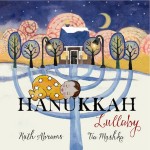
In the last couple of months, three new Chanukah-themed picture books have been published. Most recently, out of Mahone Bay, N.S., is Hanukkah Lullaby. Out of New York City are Oskar and the Eight Blessings and The Parakeet Named Dreidel. All three are delightful.

Hanukkah Lullaby, written by Ruth Abrams and illustrated by Tia Mushka, is part of a series of books from Baby Lullaby Publishing. Until this holiday edition, the series – the books of which have various authors and illustrators – has focused only on places: in Canada, Newfoundland and Labrador, Nova Scotia, Prince Edward Island, Saskatchewan, and Alberta; in the United States, Hawaii and Alaska. Each book, intended for a 0-to-6-year-old audience, has a link to its own song and video. The music for Hanukkah Lullaby was composed by Keith Andrews and the video was made by Jonah Peveril, both of whom have contributed to other lullabies in the series.

Hanukkah Lullaby follows one family’s celebration: enjoying the winter snow, making dreidels, lighting the chanukiyah, dreaming of the Maccabees, eating all the fried treats, spending time with Baba and Zayda, singing songs, telling the Chanukah story and having a lantern parade. The last two pages of the 18-page board book offer a very brief overview of the holiday’s symbols and rituals, and a paragraph summarizing the story of the Maccabees. Abrams’ lyric text and Mushka’s bold, colorful artwork make for a lovely read.

***

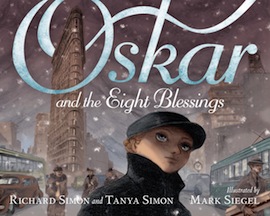
Oskar and the Eight Blessings (Roaring Brook Press), written by husband-wife team Richard Simon and Tanya Simon and illustrated by Mark Siegel, is for somewhat older readers, ages 4-8.

book cover - Oskar and the Eight Blessings It begins, “Oskar’s mother and father believed in the power of blessings. So did Oskar … until the Night of Broken Glass. His parents put him on a ship to America. He had nothing but an address and a photo of a woman he didn’t know – ‘It’s your Aunt Esther.’ – and his father’s last words to him: ‘Oskar, even in bad times, people can be good. You have to look for the blessings.’”

When Oskar arrives in New York, it is the seventh day of Chanukah and he wants to reach his aunt’s – 100 blocks away – before she lights the chanukiyah. Along Broadway Avenue, he encounters a woman feeding some pigeons, a newsstand vendor, Count Basie, boys having a snowball fight, First Lady Eleanor Roosevelt and a Christmas tree seller. He is treated with kindness at every turn, and is able to reciprocate on more than one occasion. Siegel’s rich illustrations beautifully capture the darkness and the hope of Oskar’s journey.

In the author’s note that follows the story, Richard Simon writes about the inspiration for the book and its 1938 setting, including a bit about the real people the fictional Oskar meets along the way.

“Oskar has lost everything,” he writes, “but from his despair he awakens to his freedom: the choice to see the good in his new world. I like to think that this orientation of optimism is the key to our survival, as individuals and as a species. It is how we, as American Jews, have made a place for ourselves beyond the shadow of darkness that tried to destroy us.”

***

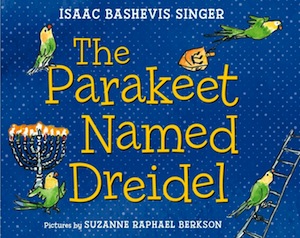
The playful and imaginative watercolor illustrations by Suzanne Raphael Berkson dovetail perfectly with Isaac Bashevis Singer’s story in The Parakeet Named Dreidel (Farrar, Straus and Giroux).

book cover - The Parakeet Named DreidelIntended for kids age 5 to 8, the title character loses his way. As David and his parents celebrate Chanukah, David notices the yellow-green bird outside their window. A cold Brooklyn night, they quickly move aside the chanukiyah (so the bird won’t get burned by its candles), open the window and welcome it in. Initially frightened, the bird settles down, eats some millet, drinks some water, plays a little dreidel – and speaks some Yiddish! “Zeldele, geh schlofen.” (“Zeldele, go to sleep.”)

Despite posting notices around the neighborhood, no one claims the lost bird, who the family names Dreidel. The “photo” montage of Dreidel and David growing up together is wonderful. The bird really does become part of the family.

When, years later, David meets a woman named Zelda at college, it turns out that she is Dreidel’s Zeldele. But lest readers worry that Dreidel leaves David’s parents, the bird becomes part of a larger family when David and Zelda get married, their families come together, and the couple decides to start a family of their own.

All of three of these books are available from chapters.indigo.ca and their respective publishers in hard copy and electronic formats. Hanukkah Lullaby will be available at the Cherie Smith JCC Jewish Book Festival, Nov. 21-26, at the Jewish Community Centre of Greater Vancouver.

Format ImagePosted on November 13, 2015November 11, 2015Author Cynthia RamsayCategories BooksTags Cherie Smith JCC Jewish Book Festival, Hanukkah Lullaby, Isaac Bashevis Singer, Mark Siegel, Oskar and the Eight Blessings, Parakeet Named Dreidel, Richard Simon, Ruth Abrams, Suzanne Raphael Berkson, Tanya Simon, Tia Mushka
Meet authors at book festival

Meet authors at book festival

Assaf Gavron (photo from JCC Jewish Book Festival)

As it does every year, the 31st annual Cherie Smith JCC Jewish Book Festival offers readers the chance to meet some of their favorite authors. Sean Michaels, the 2014 Scotiabank Giller Prize winner, starts it all off on Nov. 21 at the Jewish Community Centre of Greater Vancouver’s Rothstein Theatre. Among the festival’s many highlights are Israeli writer Assaf Gavron and American writer Nomi Eve, to whom the Independent had a chance to e-speak recently.

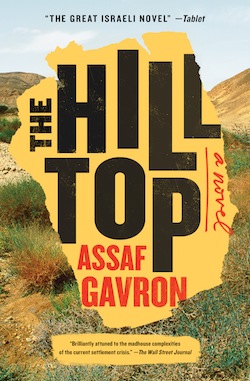
image - The Hilltop book coverGavron’s latest novel, The Hilltop (translated into English from Hebrew by Stephen Cohen), deals with one of the most contentious and emotion-laden aspects of the Israeli-Palestinian conflict: the settlements in the West Bank. It does so with humor and humanity – and an even eye, examining the larger societal issues through the troubled relationship of two troubled brothers. Family, bureaucracy, unintended consequences, and more, factor into the story.

JI: What is it about fiction that allows it to communicate controversial ideas or speak to controversial topics in a way that seems to be more easily received than other media, such as journalism, academia, documentary film?

AG: I think that usually when ideas are termed “controversial,” it is on a simplistic level – when you can sum it up in a sentence or two, it is easy to annoy, or touch a nerve, or whatever. The other forms of media you mention, like journalism or documentary, are also susceptible to this superficiality. Fiction gives you more time, and depth, to really get to the story and to the people behind it. And, whatever the subject is, it can’t remain on the simplistic level. Yes, hopefully it causes more thinking and a better understanding of complexities. I like that about reading fiction, but as to the reason why I choose to write, I think that, over the years, I learned that it is the kind of storytelling I am best at, and most comfortable with.

JI: When I used to ask my grandmother how she was doing, her response often was that she still had her sense of humor – once she lost that, then…. What purpose does humor serve in your writing, or is it “just” a matter of style?

AG: That’s how I write, it is part of me, part of how I communicate. I can identify with your grandmother. I think that it is important, and sane, not to take things too seriously. And not less so, probably more so, in situations that are perceived as sad and difficult and tragic. We must be able to smile. In writing, it is mainly entertainment. It is more fun and enjoyable to read something that makes you laugh. In my books, I would like to entertain as much as anything else, like making a point, educating, etc.

JI: Not everyone can put themselves into someone else’s shoes, something you seem to have mastered in your writing, including your latest novel, The Hilltop. Does that openness and empathy extend into your “real” life? What is it in your personal “toolkit” that allows you to at least write from multiple viewpoints with sincerity?

AG: I disagree. I think everyone can put themselves in someone else’s shoes. This is why people read books, go to movies, read newspapers or even just talk to each other – they are curious about the experiences of others and, when they hear or read or watch them, they are always imagining if it was them, what would they do, how would they react. But it is true that people are reluctant to identify or see the world through eyes of people they perceive as an enemy, or as very different, as an “other,” in the real life. Sure, I hope I’m as open in real life. I think it is crucial to fundamentally accept that there are others, and to attempt to get to know them. I guess that it is no more than this belief that is my “toolkit.”

JI: You write books, translate, create videogames, are in a band … could you share a little bit about your background and how you came to your expertise in these areas?

AG: First and foremost I’m a fiction writer. But I’m also a curious person, like to keep myself interested … so I tend to do other things as well. The band, for example, is a lifelong project of three friends, who decided to do this for the long run, with little interference to our “daily” life. This is why we release an album every six years and not more frequently. Translating and teaching I do sometimes for income and sometimes for interest. The computer game was a one-off project.

JI: Your write-up on Wikipedia notes that you were in Vancouver in 1997, studying “new media.” Do you still have Vancouver connections?

AG: I do! My first cousin lives there with her family. Having family was part of the reason I came, and what I heard and imagined of the city and the school, which offered what I was interested in studying at the time. I had a great year in Vancouver, had a lovely apartment in Kitsilano. That year, I also wrote what would be my second book. I have been back only once since then, in 2003, I think, so it’s been awhile. I’m really looking forward to this visit, my first as a writer.

JI: Where are you and your family currently based?

AG: We are in Omaha, Neb. I have been teaching here for the past year. I’m moving to your time zone, San Diego, in January for six months, and then next summer back home to Israel.

***

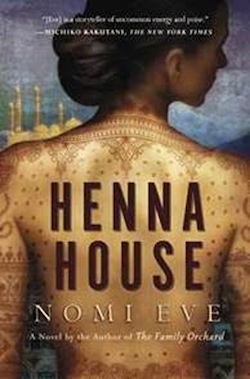
The main character in Nomi Eve’s second novel, Henna House, is Adara, born in Yemen in 1918, the year that Imam Yahya took control of the region. He passed many restrictive decrees, including the Orphans Decree, calling “for any Jewish child to be confiscated, converted and quickly adopted by a Muslim family if a father died,” writes Eve. When the story begins, Adara’s father is already ill.

image - Henna House book coverThe bulk of the novel follows Adara and her family – notably, two cousins – from the 1920s in Yemen to the early years of Israel, briefly touching upon Operation On Wings of Eagles, better known by its nickname Operation Magic Carpet, when almost 50,000 Yemenite Jews were airlifted to Israel between June 1949 and September 1950.

JI: Research is an essential part of your creative process, but you also said in one interview that reality limits your creativity. How did you navigate the need for both research/reality and imagination in your two novels, seeing as both are rooted in “real” historical spaces?

NE: History is much more than a backdrop in my fiction. It also provides soul and substance. But I never let myself feel straightjacketed by history. I make things up and let my readers know that this is fiction, not academic research that they are reading. In Henna House, the fact that I have a first-person narrator also helped me navigate this terrain. My narrator uses her memory and imagination to construct her own version of the past. Memory is porous, and doesn’t always hold truth. Memory is powerful and often finds truth in unlikely places.

JI: Have you reached your 100 Book Clubs goal?

NE: I did book club #143 tonight – it was a Skype visit to Toronto. I love my book club visits. Readers are my wildest dream, and I feel lucky each time I get to chat with a new group.

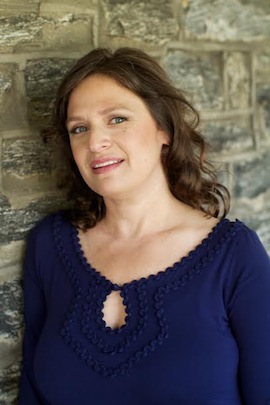
photo - Nomi Eve
Nomi Eve (photo from JCC Jewish Book Festival)

JI: In Henna House, you write about Mizrahi Jews. What is your background? Did you have a mix of traditions growing up, given that your father was from Israel?

NE: My family is Ashkenazi, but I have a Yemenite aunt. It is from her that I learned to love Yemenite Jewish culture. But most of what I learned about the history of the Jews of North Yemen and Aden I learned through my own research. The most fascinating things that I learned were about henna traditions, and the Orphan’s Decree. Both of these things became central to the plot of my book.

JI: Your two novels are both set in the past. What appeals to you about the past and imagining what it might have been like?

NE: I find it easier to write about the past than about the present. The past feels multi-dimensional to me, whereas the present feels one-dimensional. I think that I am attracted to the fierce power of memory and the perspective gained by the passage of time.

Assaf Gavron in conversation with Marsha Lederman takes place Sunday, Nov. 22, 8 p.m.; tickets are $18. Nomi Eve speaks with Israeli-Canadian writer Ayelet Tsabari on Tuesday, Nov. 24, at an intimate gathering at 6:30 p.m. ($16) and to a book club and book-lovers event at 8 p.m. ($18); to attend both, the price is $30. For tickets to these and other festival events, call 604-257-5111 or drop by the J in person. For tickets and the full festival lineup, visit jewishbookfestival.ca.

Format ImagePosted on November 6, 2015November 4, 2015Author Cynthia RamsayCategories BooksTags Assaf Gavron, Cherie Smith JCC Jewish Book Festival, Henna House, Hilltop, Nomi Eve

Writers Fest appoints Nozick

photo - Nicole Nozick
Nicole Nozick (photo from Nicole Nozick)

The board of directors of the Vancouver Writers Fest has appointed Nicole Nozick as executive director, effective June 22.

“Nicole brings to the Writers Fest extensive experience in festival management, journalism and communications, a collaborative approach to her work, and many business skills. We are excited to welcome her to our team,” said board chair Sandy Jakab. Nozick takes over from the Vancouver Writers Fest’s current executive director, Camilla Tibbs, who will move to her new role as executive director of the Richmond Gateway Theatre.

“I am honored to be joining the team at the Vancouver Writers Festival – a festival whose accomplishments I have long admired,” said Nozick. “With its sterling international reputation as one of North America’s premier literary events, the VWF is a cornerstone of Vancouver’s festival scene, well reflecting the energy, curiosity and vibrancy of our city. I am looking forward to working with the VWF board and artistic director Hal Wake, in co-leading this remarkable literary showcase that enriches the lives of so many.”

Nozick holds a BA in English from University of Cape Town and a post-graduate diploma in journalism from Tel Aviv University. Most recently, she was director of the Cherie Smith JCC Jewish Book Festival.

Posted on June 26, 2015June 25, 2015Author Vancouver Writers FestCategories Arts & CultureTags Cherie Smith JCC Jewish Book Festival, Nicole Nozick, Sandy Jakab, Vancouver Writers Fest, VWF

Posts pagination

Previous page Page 1 Page 2 Page 3
Proudly powered by WordPress