
Last week at the United Nations, Palestinian President Mahmoud Abbas once again accused Israel of heinous crimes, including “genocide.” And, once again, the global community demonstrated its collective gullibility. It was left to Israeli Prime Minister Binyamin Netanyahu Monday to stand at the same lectern before the UN General Assembly and deliver what has become an annual rebuttal to the most preposterous allegations against the Jewish state.
It was not a cheery speech, but nor was it all doom and gloom. In that half-empty assembly hall – many delegates, apparently, cannot even bear to listen to the words of an Israeli leader – Netanyahu took on one accusation after another.
“I’ve come here to expose the brazen lies spoken from this very podium against my country and against the brave soldiers who defend it,” he said, holding up the Israel Defence Forces as representative of “the highest moral values of any army in the world” and insisting that “Israel’s soldiers deserve not condemnation, but admiration … from decent people everywhere.”
He slammed the UN’s Human Rights Council, which he declared an oxymoron.
“By investigating Israel, rather than Hamas, for war crimes, the UN Human Rights Council has betrayed its noble mission to protect the innocent,” the prime minister said. “In fact, what it’s doing is to turn the laws of war upside-down. Israel, which took unprecedented steps to minimize civilian casualties – Israel is condemned. Hamas, which both targeted and hid behind civilians – that, a double war crime – Hamas is given a pass. The Human Rights Council is thus sending a clear message to terrorists everywhere: use civilians as human shields. Use them again and again and again. And you know why? Because, sadly, it works.”
Then he turned his sights toward Iran’s nuclear ambitions. He warned that, while Iran may have softened its tone, its aim is the same as that of ISIS, Hamas and other militant Islamists – world domination.
These common dangers – “a nuclear-armed Iran and militant Islamist movements gaining ground” – provide an opening for peace between Israel and its neighbors. And not only militarily, but also in terms of regional development.
“Together we can strengthen regional security,” said Netanyahu. “We can advance projects in water, agriculture, in transportation, in health, in energy, in so many fields.
“I believe the partnership between us can also help facilitate peace between Israel and the Palestinians. Many have long assumed that an Israeli-Palestinian peace can help facilitate a broader rapprochement between Israel and the Arab world. But, these days, I think it may work the other way around: namely, that a broader rapprochement between Israel and the Arab world may help facilitate an Israeli-Palestinian peace.”
If Israel’s prime minister can talk about the potential for “new opportunities” in the Middle East alongside the dangers, and of “the indispensable role of Arab states in advancing peace with the Palestinians,” perhaps it’s not so naïve to remain hopeful.
The whirlwind visit to the Holy Land by the head of world Catholicism, Pope Francis, left commentators hyperventilating. The brief, two-day excursion was ram-jam full of symbolism, some of it seemingly contradictory.
After visiting Jordan, the Pope traveled to Bethlehem, pointedly referring to the area as the “state of Palestine.” He made an unscheduled stop at the security barrier, adjacent to graffiti reading “Pope we need some 1 to speak about Justice … Bethlehem look like Warsaw ghetto.” The Pope placed his forehead against the barrier and prayed, in an image most commonly associated with visitors to the Western Wall, a few kilometres away.
The Pope’s visit was emphatically billed as “strictly religious” and non-political, but, it appears, everything is political in this part of the world, most of all religion. The “state of Palestine” was festooned in posters of the pope conjoined with Palestinian President Mahmoud Abbas. Images abounded of Palestinian suffering parallel with images of the suffering of Jesus, from which some viewers might conclude that the same people who have for millennia borne the blame for the one incident are also solely responsible for the other. Of course, the Pope’s entourage was not responsible for Photoshopping done by Palestinian partisans. Yet, neither was the Pope’s time in Israel free from perceptions of politicization. He visited the tomb of Theodor Herzl, which must certainly have appeared to Palestinians as unambiguous as his reference to the “state of Palestine.”
The Pope invited Abbas and Israel’s President Shimon Peres to a prayer summit at the Vatican – an invitation both leaders accepted and which is to take place next week. Some commentators have noted that Peres is a figurehead who will not be directly involved in future peace negotiations and whose term is nearly at an end, but papal spokespeople noted that Francis and Peres have developed a cordial relationship and the event should not be seen as a snubbing of Abbas’ counterpart in peace talks, Prime Minister Binyamin Netanyahu. The prayer summit is seen as an opportunity to recast religion as a unifying force in the Israeli-Palestinian relationship, rather than the divisive force as which it is frequently perceived. The invitation is an interesting gambit, and an apparently overt move by the Pope to insert the Vatican back into the centre of global diplomacy where it sat for centuries. And while prayers for peace are always welcome, a mass prayer at the Vatican some months ago for peace in Syria seems to have fallen on deaf ears. Still, it can’t hurt.
Papal visits, in the age of 24-hour news, are highly visual and symbolic. Symbolism is powerful, particularly in scenarios of diplomatic complexity. But, by definition, symbolism lacks nuance. The Pope apparently attempted to please everybody, by paying homage to the national rights of both peoples. But while he voiced explicit hopes for an end to terrorism and for the right of Israelis to live in security – which, all ancillary issues aside, are the two pillars upon which eventual peaceful coexistence will stand – his symbolic efforts to please both sides are as likely to please no one. In this, Pope Francis is in good company with everyone else who has attempted to walk the impossible line of equanimity in this conflict.
Meanwhile, as attention was focused to the Middle East, events in Europe reflected a sadly repetitive history. As Pope Francis was incanting “Never again” at Yad Vashem and at a memorial to victims of terror, families were mourning the murders of four at a Jewish museum in Brussels. The Pope condemned the attack as a “criminal act of antisemitic hatred.” As well, the Pope’s travels partially eclipsed news of fringe extremist groups, some openly antisemitic, making significant gains in elections to the European parliament.
As Pope Francis returns to his home in the Vatican and prepares to welcome Abbas and Peres, there is no shortage of topics to pray about.
While the announcement of a Fatah-Hamas unity pact on April 23 may seem to have come out of the blue, the resulting collapse of the U.S.-led peace talks was not as surprising.
The negotiations never really gained steam and, just over a month ago, they started their nosedive. Israel announced it would not release another group of prisoners by March 29 unless the Palestinian Authority agreed to extend talks beyond their April 29 deadline (which they did not). On April 1, Israel issued tenders for homes in the east Jerusalem neighborhood of Gilo and, the next day, the Palestine Liberation Organization central council applied for membership in 15 United Nations agencies/treaties. While settlement construction freezes were not a peace-talk commitment, the prisoner releases and abstention from international recognition attempts were concessions that each side offered before the talks began last July.
The day before the unity announcement, PA President Mahmoud Abbas had threatened to hand the West Bank over to Israel if peace talks failed. After the announcement, he said that a unity government under his charge would recognize Israel, accept previous Israeli-Palestinian agreements and have Fatah in control of any weaponry/soldiers. Yet, on April 26, he demanded in return that Israel freeze settlement construction, free prisoners and begin border discussions.
On April 27, more developments. Abbas acknowledged the tragedy of the Holocaust and expressed sympathy for the families of the victims, while Hamas said that, actually, it would never accept Israel as a Jewish state. Also that Sunday, the PLO council decided to pursue membership in another 60-plus UN agencies/treaties. As well, the council refused to recognize Israel’s Jewish nature and demanded “a complete end to the occupation … the illegitimacy of settlements … and a refusal of land swaps,” when Abbas had indicated amenability to “limited land swaps.”
Israel’s cabinet made the decision on April 24 to suspend talks, not willing to deal with any government that included Hamas, a terrorist organization. However, there were dissenting opinions: Justice Minister Tzipi Livni (Hatnua), Finance Minister Yair Lapid (Yesh Atid) and Opposition leader Isaac Herzog (Labor) wanted to leave the door to negotiations open, even in the case of a unity government, if it adhered to the three conditions stipulated by the Quartet (the UN, United States, European Union and Russia): recognizing Israel, accepting previous agreements and renouncing terrorism. That said, Naftali Bennet’s Jewish Home party doesn’t recognize the Palestinians’ right to a state and Prime Minister Binyamin Netanyahu’s Likud is deeply divided on the matter.
On Sunday, Netanyahu dismissed Abbas’ Holocaust comments as “damage control,” and said that Israel will look for alternative paths to peace, that he’s “not going to accept a stalemate.” On Tuesday, the Israeli government decided to use the tax funds it collects on behalf of the PA to pay debts owed to it by the PA, and was considering additional sanctions. To that date, Netanyahu had resisted calls from within Israel to unilaterally draw its own borders.
As the United States/U.S. Secretary of State John Kerry went from blaming Israel for reneging on the prisoner release, to blaming both sides for the troubles, to understanding why Israel wouldn’t want to deal with an organization that doesn’t believe in its right to exist in the first place, to viewing the end of talks as an expected “holding period where parties need to figure out what is next,” to using apartheid to describe a possible future Israel, their leadership of the negotiations floundered. Amid this flurry of activity, the EU issued a statement Sunday supporting Palestinian reconciliation as long as a unity government upheld nonviolence, was committed to a two-state solution and accepted Israel’s “legitimate right to exist.” On Monday, the Arab League blamed Israel for the failed talks.
In broad strokes, that’s where things stood at press time. What then are some of the concerns going forward? Analysts have pointed to many, including:
• Hamas may be agreeing to resign from power when the unity government is formed because they hope to win Palestinian public opinion and, eventually, the elections to rule over both Gaza and the West Bank.
• With peace talks off the table, Hamas won’t have to change its stance towards Israel if it forms a coalition with the PA.
• Without the talks, there may be increased violence in/from the West Bank and increased international efforts to boycott Israeli goods and institutions.
• The PA could collapse if the United States withdraws financial aid because of the reconciliation with Hamas, leaving Israel responsible for West Bank residents and the moral issues that entails, as well as more international criticism and the threat of a state in which Arabs will eventually outnumber Jews.
So, as Israel turns 66, it looks like a challenging year lies ahead. We can think of more than one wish to make as the candles are blown out.
Images and symbolism mean a great deal in politics. This was presumably on the mind of Conservative Member of Parliament Mark Adler last week, when he hounded an aide to Prime Minister Stephen Harper to let him into the cordoned-off area adjacent to Jerusalem’s Western Wall, where Harper was to be photographed having a quiet moment of reflection against Judaism’s holiest site.
Adler, who later claimed he was making a joke, asked Harper’s handler to let him get a photo with the prime minister at the Wall, saying, “This, it’s the reelection. This is the million-dollar shot.”
Assuming that not everything Adler said was in jest, he was not speaking about the Conservative party’s reelection as government, but his own reelection in a swing riding with a large Jewish population (Toronto York Centre). The incident was particularly harmful – joke or no joke – because it seemed to confirm what many critics have posited about the prime minister’s visit.
Harper and his supporters maintain emphatically that the prime minister and his government’s stalwart allegiance to Israel is based on principle. Adler’s outburst appeared to be evidence that the most cynical political calculations were at play, at least for some members of the tour. Regardless, it is probably safe to say that, after nearly eight years of Harper’s prime ministership, any Jewish Canadian who is going to be influenced to vote Conservative based on Harper’s foreign policy has already been won over.
Meanwhile, Israeli Prime Minister Binyamin Netanyahu’s words early this week also sent people into a tizzy. Netanyahu appeared to moot the idea that, when a two-state resolution is realized, the Jews living in the West Bank should have the option of becoming citizens of the new Palestinian state.
Netanyahu’s intention, perhaps, was to draw global attention to the hypocrisy of accepted wisdom that Israel should be a multicultural society that respects minorities and that Israel should negotiate a “right of return” for Palestinians, while a “free” Palestine should be free of Jews. Realistically, of course, the idea of Jewish residents opting to remain in a new Palestinian state holds the potential for both comedy and tragedy. Not for nothing have Jews almost to a number fled every Arab-majority state in the region. Most settlers would not look fondly at their options under Palestinian rule. In fact, if Netanyahu’s trial balloon was meant to get a reaction from the world community, the sharpest response was from closer to home. His own cabinet minister, Naftali Bennett, responded with a single word: “Never.”
In any negotiation, wise participants put forward proposals that the other side is certain to reject, sometimes in an effort at appearing to compromise, sometimes to expose the other side’s pretense. Netanyahu’s latest gambit appears to be along these lines. But the Palestinians have demonstrated no willingness to entertain the idea of giving Jewish people citizenship in their new country. And the world community, for whom the words may have been expressed in the first place, will likely be unswayed.
However, Netanyahu’s own right flank appears to view his comments as the abandonment of the Jews of the West Bank. In the aftermath of the resulting backlash, one can almost imagine him taking a cue from Adler, who, after the incident at the Wall, confronted the reporters who conveyed the incident to voters back home: “You guys don’t get a joke, huh? It’s all said tongue-in-cheek. Tongue-in-cheek, guys, come on.”
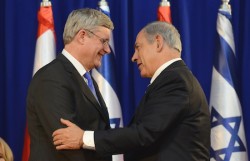
Prime Minister Binyamin Netanyahu welcomed Canadian Prime Minister Stephen Harper and his wife, Laureen, to Israel earlier this week, acclaiming him as “a great friend of the Jewish state.” During his official four-day visit to Israel, Harper addressed the Knesset and also held a meeting with Palestinian leader Mahmoud Abbas. This was Harper’s first visit to Israel.
During his speech to the Knesset, Harper spoke out strongly in defence of Israel. “People who would never say they hate and blame the Jews for their own failings or the problems of the world, instead declare their hatred of Israel and blame the only Jewish state for the problems of the Middle East,” he said. “This is twisted logic and outright malice. Some civil-society leaders today call for a boycott of Israel – most disgracefully of all, some openly call Israel an apartheid state. Think about that. Think about the twisted logic and outright malice behind that. A state, based on freedom, democracy and the rule of law, that was founded so Jews can flourish as Jews and seek shelter from the shadow of the worst racist experiment in history,” he said.
“But what else can we call criticism that selectively condemns only the Jewish state and effectively denies its right to defend itself while systematically ignoring – or excusing – the violence and oppression all around it? This is the face of the new antisemitism. It targets the Jewish people by targeting Israel and attempts to make the old bigotry acceptable for a new generation.”
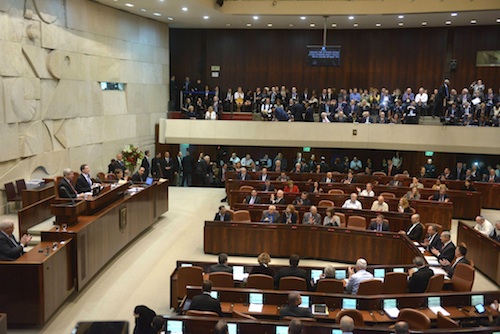
He continued, “Canada will defend Israel’s right to exist, because Jewish people deserve their own homeland after generations of persecution. Jewish people deserve to live safely and peacefully in that homeland. And, just as Canada supports Israel’s right to self-defence, Canada supports a just and secure future for the Palestinian people.” Earlier that day, Harper announced a $66 million aid package for the Palestinians.