Skip to content
  • Home
  • Subscribe / donate
  • Events calendar
  • News
    • Local
    • National
    • Israel
    • World
    • עניין בחדשות
      A roundup of news in Canada and further afield, in Hebrew.
  • Opinion
    • From the JI
    • Op-Ed
  • Arts & Culture
    • Performing Arts
    • Music
    • Books
    • Visual Arts
    • TV & Film
  • Life
    • Celebrating the Holidays
    • Travel
    • The Daily Snooze
      Cartoons by Jacob Samuel
    • Mystery Photo
      Help the JI and JMABC fill in the gaps in our archives.
  • Community Links
    • Organizations, Etc.
    • Other News Sources & Blogs
    • Business Directory
  • FAQ
  • JI Chai Celebration
  • JI@88! video

Recent Posts

  • Eby touts government record
  • Keep lighting candles
  • Facing a complex situation
  • Unique interview show a hit
  • See Annie at Gateway
  • Explorations of light
  • Help with the legal aspects
  • Stories create impact
  • Different faiths gather
  • Advocating for girls’ rights
  • An oral song tradition
  • Genealogy tools and tips
  • Jew-hatred is centuries old
  • Aiding medical research
  • Connecting Jews to Judaism
  • Beacon of light in heart of city
  • Drag & Dreidel: A Queer Jewish Hanukkah Celebration
  • An emotional reunion
  • Post-tumble, lights still shine
  • Visit to cradle of Ashkenaz
  • Unique, memorable travels
  • Family memoir a work of art
  • A little holiday romance
  • The Maccabees, old and new
  • My Hanukkah miracle
  • After the rededication … a Hanukkah cartoon
  • Improving the holiday table
  • Vive la différence!
  • Fresh, healthy comfort foods
  • From the archives … Hanukkah
  • תגובתי לכתבה על ישראלים שרצו להגר לקנדה ולא קיבלו אותם עם שטיח אדום
  • Lessons in Mamdani’s win
  • West Van Story at the York
  • Words hold much power
  • Plenty of hopefulness
  • Lessons from past for today

Archives

Follow @JewishIndie
image - The CJN - Visit Us Banner - 300x600 - 101625

Tag: Auschwitz

“We shall never forget”

“We shall never forget”

Prime Minister Justin Trudeau at the Auschwitz Memorial and Museum (photo from auschwitz.org)

On July 10, Prime Minister Justin Trudeau visited the Auschwitz Memorial and Museum. He was accompanied by, among others, Nate Leipciger, a former prisoner of Auschwitz born in 1928 in Chorzów, who emigrated to Canada in 1948 and has visited the memorial on more than one March of the Living; Canadian Minister for Foreign Affairs Stéphane Dion; and Rabbi Adam Scheier from Montreal, vice-president of the Council of Rabbis. The guests were welcomed by museum director Dr. Piotr M.A. Cywiński, who told them about the history of the camp and the contemporary challenges of the memorial.

Trudeau laid a wreath and held a minute’s silence in front of the Wall of Death in the courtyard of Block 11, where executions by shooting were held, as a commemoration of all victims of the German Nazi concentration and extermination camp.

The guests visited the vast portion of the museum’s exposition. They saw, among other places, Block 4, which was dedicated to the extermination of Jews and which contains German photographs documenting the arrival of the transport of Jews from Hungary, a model of gas chamber and crematorium II from Birkenau, Zyklon B canisters, as well as human hair taken from the murdered. There is also a display dedicated to the story of storage rooms for looted property which, in the jargon of the camp, were called “Kanada.” In Block 5, the visiting delegation saw personal objects of victims that were found in these storage rooms after the liberation of the camp, such as shoes, suitcases, glasses, brushes and kitchen utensils. The delegation also visited the building of the first gas chamber and crematorium in Auschwitz I.

In the second part of the visit, Trudeau walked through the former Auschwitz II-Birkenau camp. He walked along the rail ramp where the Germans conducted selection of the Jews, and also saw the ruins of the gas chamber and crematorium III, where the Jewish prayer for the dead, the Kaddish, was said. Candles were lit at the monument, commemorating all victims of the camp.

The prime minister also made an entry in the guest book of the museum. “Tolerance is never sufficient: humanity must learn to love our differences,” wrote Trudeau. “Today, we bear witness to humanity’s capacity for deliberate cruelty and evil. May we ever remember this painful truth about ourselves and may it strengthen our commitment to never again allow such darkness to prevail. We shall never forget. Nous nous souviendrons.”

Format ImagePosted on July 15, 2016July 13, 2016Author Auschwitz Memorial and MuseumCategories WorldTags Auschwitz, Holocaust, Leipciger, Trudeau
From Israel to Poland

From Israel to Poland

Dor Brown wrapped in the Israeli flag as he approaches Treblinka death camp. (photo from Dor Brown)

Israel’s Journey to Poland – the equivalent of the Diaspora’s March of the Living, but without the Israel portion – is organized by the Israel Education Ministry and funded mainly by the parents.

Sept. 4, 2015

Every year in Israel, senior classes from high schools across the country have the option to travel to Poland on an organized tour of those terrible, yet important, Holocaust death camps. I chose to join my class and am now writing this from the bus on my way back from the Majdanek death camp. It’s probably been one of the most difficult and emotional days of my life.

We were in Majdanek for a grisly four hours. Going into the “showers.” The barracks. The room where the Nazis burned the dead bodies. At the end of the tour, we held a very touching ceremony near the mountain of the ashes. Yes, a literal mountain.

With my hand on my heart, this trip is a must for every Jew worldwide. Until you go to Poland and see firsthand these horrific sights, you really cannot fully understand the depth of the horrors and misery and death.

A snapshot. One hundred fifty students from my school crying their hearts out while looking at those terrible sights. Weeping while holding the Israeli flag. While crying out loud, we were all shouting together in our hearts and minds and with great pride: “Am Yisrael chai!”

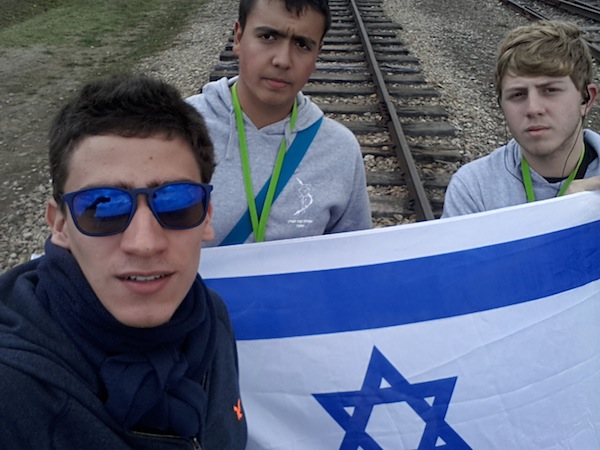
photo - Left to right: Dor Brown, Alex Katz and Oren Bizuener
Left to right: Dor Brown, Alex Katz and Oren Bizuener. (photo from Dor Brown)

Sept. 7, 2015

Today, we were in Auschwitz I, the labor camp and concentration camp that is now a museum. It was very difficult and very moving. Piles of hair. Piles of discarded shoes. Piles of glasses. It was unbelievably difficult to look at. An experience we should all have, however tough, to really understand how low civilization stooped.

After Auschwitz, we boarded our buses to the Plaszow labor camp. What remains is basically a beautiful memorial site. Amon Goeth was the cruel, barbaric and sadistic commander of this camp. He was the one who famously shot Jews for fun and practice. And tortured them in terrible ways.

Wrapping up the tour, our guide shared a story about a certain Jewish prisoner.

One morning, a Nazi guard came to this prisoner and told him he must run to his bunk. The prisoner did as he was told. When he arrived, he was greeted by Goeth. His meagre belongings were strewn across his thin cot.

Goeth was hunkering over his stuff with a picture in his hands. The picture was of Binyamin Ze’ev Herzl. “Who is this!” Goeth barked.

“Theodor Herzl,” replied the prisoner.

Goeth mocked, “The crazy Jew from Vienna who thinks there will be a Jewish country?!”

The prisoner was shaking with fear. He thought his death was near.

Goeth laughed and spat out, “The chances that it will happen are as slim as you becoming a cabinet member in that country’s government, or an ambassador.” With that, Goeth struck the man so hard that the poor prisoner blacked out.

Forty years later, that prisoner – Zvi Zimmerman – fulfilled Goeth’s prophecy. During his life, he not only was ambassador to New Zealand and a Knesset member in four Israeli governments but was also a deputy speaker of the Israeli parliament.

Upon finishing his story, the guide – with tears in his eyes – shouted, “Am Yisrael chai!”

For the rest of the day, we were all Zvi Zimmerman.

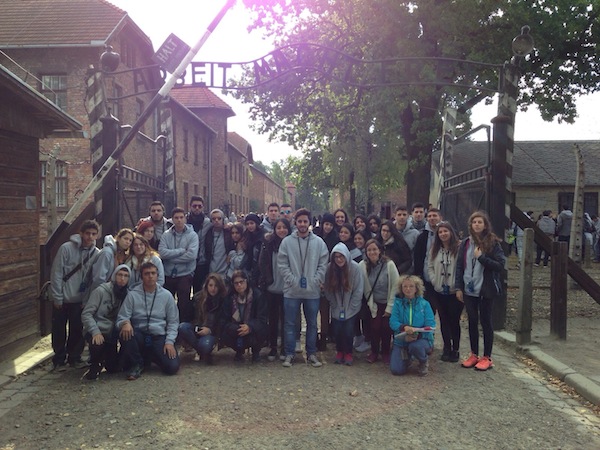
photo - The whole group at Auschwitz concentration camp under the infamous sign, “Arbeit Macht Frei,” “Work Makes You Free.”
The whole group at Auschwitz concentration camp under the infamous sign, “Arbeit Macht Frei,” “Work Makes You Free.” (photo from Dor Brown)

Sept. 9, 2015

Our last day in Poland. We woke up at 6:30 a.m. and headed to Auschwitz-Birkenau, the largest of the death camps. The largest death camp the world has ever seen. And, hopefully, the last death camp the world will ever know.

We saw lots of difficult places and sights over the past week but this was the toughest. I can’t describe the chills of dread going through my body as we entered the gate. The images of death running through my mind as I walked through the camp, the death place of my ancestors.

“Work Makes You Free.” Indeed.

The camp is huge. And beautiful. The surrounding trees are tall and green. To think that those trees were the last sight that almost one million of our people ever saw. How dare the camp be so beautiful today.

At the end of the tour, we had a ceremony where we each had to read out loud the names of persons who died in the Holocaust. It was a sad and exhausting roll call.

As the ceremony wrapped up, with tears pouring down our cheeks like rain, with hearts and souls broken, we all shouted together our rallying cry of the week: “Am Yisrael chai!”

As Yigal Alon said: a country that doesn’t know its past will have an uncertain present and future.

Dor Brown is the son of Bruce Brown, who immigrated to Israel more than 20 years ago from Canada. Dor and his family live in Rehovot. Dor is finishing high school this year, and will enter the Israel Defence Forces in October 2016.


Format ImagePosted on November 6, 2015November 4, 2015Author Dor BrownCategories Op-EdTags Auschwitz, Holocaust, Journey to Poland, Majdanek

The godliness of survival

As the 70th anniversary of the liberation of Auschwitz approached last month, discussion turned to the shrinking number of survivors. My father-in-law, Bill Gluck of Vancouver, was one of them, having been deported to Auschwitz from Hungary in 1944, a beautiful boy of 13 with piercing green eyes, a compact frame and a knockout grin. We mentally celebrated his life on that anniversary. But not 24 hours later, his ailing body gave out.

As we began to grieve my father-in-law’s death, I became aware of the delicate dance between remembering Holocaust survivors for the individuals they were, and invoking their identity as survivors.

Esteemed psychoanalyst and child survivor of the Holocaust Anna Ornstein specializes in trauma. Yet even she bristles at being called a “survivor,” telling the Washington Post on Jan. 23, “That’s almost like another crime.” She added, “We were reduced to a race…. This is my name, I had parents who raised me a certain way, and that was not washed away.”

Mourners don’t have the luxury of asking the departed how they wish to be remembered. In any case, we each carry our own points of salience with us when we remember.

At my father-in-law’s funeral and shiva, Bill’s nephew recalled dancing on his uncle’s feet. My husband described the invisible love that had been all around him, like clean air. Bill’s daughter reflected on the heartiness of autumn’s last remaining leaves as she had helped make her father comfortable during his final weeks. And there were his fellow Holocaust survivors, coming to pay respects to a departed member of their own.

Before I met him some 20 years ago, my father-in-law had visited Vancouver schools, telling students his personal story of survival and freedom. For some of the audience, this was their first experience of learning about the Holocaust. One of these students later befriended a young man from Toronto when they studied together at Queen’s University. That young Torontonian would, a few years later, become Bill’s son-in-law.

My stepmom encountered Bill years before I met him, hearing him relay his personal account one evening at Vancouver’s Jewish community centre. I, too, recall reading about Bill’s journey in the pages of the Jewish Western Bulletin (now the Jewish Independent) before meeting his son, who I would go on to marry.

Survivors manage to touch so many, directly and indirectly. Yet, as each one is, my father-in-law was so much more than the sum of those harrowing experiences. Along with his wife, my beloved mother-in-law, Bill built a life of love out of the depths of inhumanity. He lavished a great deal of affection and nurturing on his family, and found his own moments of serenity and solitude as he took up distance sailing around the islands of British Columbia in his later years.

As the rabbi spoke about my father-in-law at the graveside service, he spoke of the godliness that surely ran through him. In young Bill’s harrowing months at Auschwitz, he had found ways to help his fellow inmates. Perhaps most profoundly, Bill had also committed to memory details of instances of kindness amid the horror. Sometimes a certain German guard in the camps would help him – pulling him out of a work line to give him a less strenuous task, placing him on a bicycle during a long march, even giving him his gun to hold. These stories of goodness didn’t die with Bill, for my father-in-law had taken pains to impress these anecdotes upon his children.

Perhaps the godliness of survival is also the godliness of looking for kindness wherever it happens to be, and instilling goodness in the everyday. Bill wanted life to be simple and good; he wanted to find kindness around him, and he hoped others did too.

Mira Sucharov is an associate professor of political science at Carleton University. She blogs at Haaretz and the Jewish Daily Forward. A version of this article was previously published in the Canadian Jewish News.

Posted on February 13, 2015February 12, 2015Author Mira SucharovCategories Op-EdTags Anna Ornstein, Auschwitz, Bill Gluck, Holocaust, survivors
A return to Auschwitz

A return to Auschwitz

Mordechai Ronen (Canada) is embraced by Ronald Lauder. (photo by Shahar Azran)

Fifteen Auschwitz survivors, aged 80-94, returned to the infamous camp – some for the first time – ahead of the 70th anniversary celebration of its liberation on Jan. 27. Joining the survivors on their visit was Ronald S. Lauder, president of the World Jewish Congress, who, along with the USC Shoah Foundation, organized the delegation of returning survivors from across the world.

“When I arrived in Poland, the tall trees made me immediately anxious. They reminded me of my arrival to Auschwitz – the same day my mother and little sister were gassed,” said Johnny Pekats, 80, one of the American survivors who returned to the death camp for the first time. “For years, I refused to return to this horrible place, but I finally decided to come back with my son. I wanted to say Kaddish with him there. This is my first and last visit to Auschwitz and my message for the world is that it’s not enough just to remember; we have to make sure that this never happens again.”

More than 100 Auschwitz survivors from at least 19 countries traveled to Poland as part of the WJC delegation to participate in the ceremony.

“I deeply admire the courage of these survivors,” said Lauder, who joined them at Auschwitz. “For some of them, this was the first time they returned to the place of their nightmares. Each survivor is a living testament to the triumph of good over evil, of life over death, and they are my heroes.”

There was also a reception at a Krakow hotel for the survivors and other guests, at which film director and founding chair of the USC Shoah Foundation Steven Spielberg said, “Their testimonies give each survivor everlasting life and give all of us everlasting value. We need to be preserving places like Auschwitz so people can see for themselves how evil ideologies can become tangible acts of murder. My hope for tomorrow’s commemoration is that the survivors will feel confident that we are renewing their call to remember. We will make sure the lessons of the past remain with us in the present so that we can now and forever find humanitarian ways to fight the inhumanity.”

Format ImagePosted on February 6, 2015February 5, 2015Author World Jewish CongressCategories WorldTags Auschwitz, Holocaust, Johnny Pekats, Ronald S. Lauder, WJC, World Jewish Congress
Auschwitz survivors at 70th

Auschwitz survivors at 70th

(photo by Alexander Vorontsov via Auschwitz-Birkenau State Museum)

More than 100 Auschwitz survivors from at least 17 countries will travel to Poland to participate in the observance of the 70th anniversary of the liberation of the Nazi concentration and extermination camp Auschwitz on Jan. 27, on the occasion of International Holocaust Remembrance Day. The official event will be organized by Auschwitz-Birkenau State Museum and the International Auschwitz Council. World Jewish Congress and USC Shoah Foundation – The Institute for Visual History and Education will be among the organizations supporting this commemorative event.

The main commemoration will take place in front of the Death Gate at Birkenau. The ceremony will be under the high patronage of Poland’s President Bronislaw Komorowski. Countries from around the world will be sending official delegations, some of which will include Auschwitz survivors.

“This anniversary is crucial because it may be the last major one marked by survivors. We are truly honored that so many of them, despite their age, have agreed to make this trip,” said Ronald S. Lauder, president of World Jewish Congress. “Few moments in the drama that was World War II are more etched in our collective memory than the day Red Army troops came upon, perhaps, the greatest evil of our time.”

“We have to say it clearly: it is the last big anniversary that we can commemorate with a significant group of survivors,” said Dr. Piotr M.A. Cywinski, director of the Auschwitz-Birkenau State Museum. “Until now, it has been them who taught us how to look at the tragedy of the victims of the Third Reich and the total destruction of the world of European Jews. Their voices became the most important warning against the human capacity for extreme humiliation, contempt and genocide.”

“On this special day, we want to show the survivors and the whole world that we, the postwar generation, have matured to our own responsibility for remembrance,” Marek Zajac, secretary of the International Auschwitz Council, added.

Lauder praised the efforts to preserve the site where at least 1.1 million people, most of them Jews, were murdered within less than five years. “Twenty-five years ago, when I saw the stunning truth of Auschwitz for the first time, every part of the former camp was disintegrating. Now, after a monumental effort, it has been preserved for future generations, and that is important in an age of Holocaust deniers.”

Twenty years ago, Lauder, along with Kalman Sultanik and Ernie Michel, raised $40 million from 19 countries in order to ensure that what remained in Auschwitz-Birkenau forever be preserved and bear witness for future generations. Lauder also financed the creation of the conservation laboratory at the Auschwitz Memorial, which preserves every shoe, every document, and every building that remains at the site.

The financing of the long-term preservation is continued by the Auschwitz-Birkenau Foundation. It was created in 2009 to collect €120 million ($151 million US) for the perpetual capital that will finance conservation work and preservation of all authentic remains of the former Auschwitz camp. To date, 32 countries have contributed more than €102 million ($128 million US). The foundation has started the 18 Pillars of Memory campaign to raise the remaining €18 million and it hopes to be able to announce the completion of the project on the day of the 70th anniversary of liberation.

Ahead of the event, World Jewish Congress has located Auschwitz survivors from at least 17 countries who are able to travel to Poland, especially from countries from which Jews were deported to Auschwitz during the war and from countries where significant numbers of survivors settled after the Shoah.

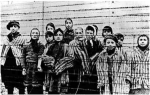
With the help of archivists from the Auschwitz-Birkenau State Museum, USC Shoah Foundation has identified the children from the historic photo seen above, taken by Red Army photographer Alexander Vorontsov who, in 1945, documented the liberation of the death camp. The surviving children are now between the ages of 81 and 86 and have been also invited to participate in the official commemoration.

“Faced as we are with the loss of living witnesses,” said Stephen Smith, USC Shoah Foundation executive director, “it is imperative we honor them and take their stories with us into the future so those who come after us will have no excuse to let such atrocities happen again. Survivors speak not only for themselves, but for the millions whose voices were violently silenced.”

Posted on January 16, 2015January 14, 2015Author Auschwitz-Birkenau State MuseumCategories WorldTags Auschwitz, Auschwitz-Birkenau State Museum, Holocaust, survivors, USC Shoah Foundation, World Jewish Congress

Posts pagination

Previous page Page 1 Page 2
Proudly powered by WordPress