Skip to content
  • Home
  • Subscribe / donate
  • Events calendar
  • News
    • Local
    • National
    • Israel
    • World
    • עניין בחדשות
      A roundup of news in Canada and further afield, in Hebrew.
  • Opinion
    • From the JI
    • Op-Ed
  • Arts & Culture
    • Performing Arts
    • Music
    • Books
    • Visual Arts
    • TV & Film
  • Life
    • Celebrating the Holidays
    • Travel
    • The Daily Snooze
      Cartoons by Jacob Samuel
    • Mystery Photo
      Help the JI and JMABC fill in the gaps in our archives.
  • Community Links
    • Organizations, Etc.
    • Other News Sources & Blogs
    • Business Directory
  • FAQ
  • JI Chai Celebration
  • JI@88! video

Recent Posts

  • Sharing her testimony
  • Fall fight takes leap forward
  • The balancing of rights
  • Multiple Tony n’ Tina roles
  • Stories of trauma, resilience
  • Celebrate our culture
  • A responsibility to help
  • What wellness means at JCC
  • Together in mourning
  • Downhill after Trump?
  • Birth control even easier now
  • Eco-Sisters mentorship
  • Unexpected discoveries
  • Study’s results hopeful
  • Bad behaviour affects us all
  • Thankful for the police
  • UBC needs a wake-up call
  • Recalling a shining star
  • Sleep well …
  • BGU fosters startup culture
  • Photography and glass
  • Is it the end of an era?
  • Taking life a step at a time
  • Nakba exhibit biased
  • Film festival starts next week
  • Musical with heart and soul
  • Rabbi marks 13 years
  • Keeper of VTT’s history
  • Gala fêtes Infeld’s 20th
  • Building JWest together
  • Challah Mom comes to Vancouver
  • What to do about media bias
  • Education offers hope
  • Remembrance – a moral act
  • What makes us human
  • המלחמות של נתניהו וטראמפ

Archives

Follow @JewishIndie
image - The CJN - Visit Us Banner - 300x600 - 101625

Tag: antisemitism

Unpacking Lintel’s background

Vancouver’s Pacific Theatre kicked off the new year with Underneath the Lintel, on stage until Jan. 31. Though it seems the well-known Emmy-winning playwright Glen Berger did not intend the bigotry implied by his play, his thematic choices create a serious problem nonetheless. This Lintel comes to Vancouver from Alberta’s Rosebud Theatre. (Spoiler alert: the ending of the play is revealed and discussed below.)

While British, Canadian and American critics have given the play mixed reviews, some have argued that it’s not antisemitic, unlike the story that inspired it. And it’s been a hit with producers, who have given it numerous productions across North America and even a run in London’s West End starring Richard Schiff of West Wing fame.

Berger’s 2001 comedy is a contemporary adaptation of the allegorical medieval Christian myth of the Wandering Jew, a figure that has served for centuries as a symbol of the Jewish people’s rejection of Christianity.

Many readers will be familiar with the story, which tells the tale of a Jewish cobbler in Jerusalem who ignores Jesus’ plea for help on his way to crucifixion. The 13th-century fable tells us that, in response, Jesus cursed the Jew. To paraphrase, Jesus says: “For your failure to demonstrate kindness, you are doomed to wander the earth, without rest, until we meet again.” The cobbler is forced to leave his family and wander the earth, alone and unloved, until the Second Coming. He still wanders today, exhausted (in some versions, wicked) and waiting for Jesus to return.

According to historian Salo Wittmayer Baron, the legend became popular with the audiences for medieval passion plays in which the fable was enacted. “Although, from the outset, everyone realized that [the cobbler] had been a Jerusalemite Jew, he now began to be identified with the unconverted eastern Jew still alive in modern times,” he writes in Social and Religious History of the Jews: Late Middle Ages (vol. 10). The first written record of the fable is from the 13th century; indeed, it becomes the very first mass publication when its German-language version is published in 1602.

Underneath the Lintel follows a Dutch librarian (called Librarian in the program) around the world as he searches for the person who returned a library book that was 113 years overdue. During his international pursuit of the culprit, Librarian tells us, he realizes he may, in fact, be following in the footsteps of the Wandering Jew. He then shares the basics of the medieval fable with the audience (without context or dwelling on the work’s antisemitic history) and reasons that if he has discovered that the Wandering Jew really exists, this also proves that God exists. Librarian is awed and thrilled by that possibility, and the play turns into his search for God. Soon, however, the audience realizes what Librarian does not: he may be the Wandering Jew himself.

The play’s only character is Librarian (a very good Nathan Schmidt). Librarian never judges (a punishing) God’s treatment of the Wandering Jew. In a 2013 essay for American Conservatory Theatre, Berger writes that the Wandering Jew is guilty of a “mistake, a simple mistake.”

This Pacific Theatre production is a very good play, and the story of Librarian is compelling; two features irrelevant to the content of the script. Undoubtedly, the script’s problem is the result of sloppy writing and a somewhat ignorant reading of what the Wandering Jew folktale implies. The playwright seems very naïve.

In a 2013 interview with JWeekly, Berger said, “Up to the 19th century, the Wandering Jew was considered a condemnation of Jews and Judaism, because he wasn’t very nice to Jesus and consequently got punished for it. I think people just know The Wandering Jew as an antisemitic tale in any context.” Including this one? He doesn’t say, but it appears that Berger believes he’s cleansed the fable of its offensiveness. It’s just another cautionary tale now, his script implies, like The Little Mermaid or Pinocchio.

Berger signals a slight shift in the American Conservatory Theatre essay. He writes, “Now, I was quite aware that the myth of The Wandering Jew was originally an antisemitic tale, but the myth had taken on more complex meanings in its 700-odd-year history and I felt, besides, that an artist can always appropriate myths for his own ends.”

This is true. Artists can do whatever they want with whatever they want. What Berger has done here, however, is confirm the conclusion of the original antisemitic folktale. A more “complex meaning” than simple bigotry is tough to imagine.

In this play, the Wandering Jew commits his “crime” while standing “underneath the lintel” of his front door. He watches but ignores the procession of the condemned. When Jesus falls before his door and begs for help, the Jew remains still. In some version of the tale, the Jew strikes Jesus or tells him to hurry. Berger writes in the program’s playwright’s note: “[The Wandering Jew’s] predicament is the predicament of all humanity – he made a mistake, a single mistake ‘underneath the lintel,’ when he put fear and self-interest ahead of compassion. Everyone does this all the time.”

Berger, therefore, reduces the fable to “people make mistakes.” What mistake? Was it a mistake to reject Jesus and Christianity? In whose eyes? Berger allows: “Did the punishment fit the crime? No.” But guilty nonetheless, he implies: there has been a crime. Perhaps Berger thinks the sentence a little long. He never articulates his thoughts on the punishment beyond its failure to fit the transgression.

“I’ve received letters calling Underneath the Lintel antisemitic,” Berger writes. “That said, I’ve also received letters calling the play too ‘pro-Zionist,’ and also ‘anti-Christian,’ for the portrayal of a cruel Christ, I suppose. So go figure.”

In the end, of course, we discover that Librarian might actually be the Wandering Jew and just not know it. On the surface, we learn that the Dutch librarian is also guilty of “a mistake” that has ruined his life. Underneath his own lintel, Librarian rejected the only woman he ever loved. The cost of that mistake is loneliness and an obsessive pursuit of the Wandering Jew that forces him to travel the world. Berger, here, equates Librarian’s mistake with the Jew’s mistake. Librarian rejected a woman; the Jew rejected Jesus. Only one was punished for eternity. Librarian, however, has free will.

It’s difficult to understand why the vast majority of critics do not notice the play’s antisemitism, and why, those who do insist on announcing that it is not antisemitic.

Some audiences will surely argue that the play is not antisemitic but, rather, about antisemitism. Not evident, I believe. Others will compare the retelling of this legend to the problematic Merchant of Venice. But this is a contemporary play, not the revival of a period piece. Some will argue that the play questions God’s fundamental justice: it does not.

Underneath the Lintel was written by an American Jew to entertain and provoke audiences; one might say that The Wandering Jew was written by medieval Christians to entertain and provoke audiences – but, more to the point, to promote hatred and violence. The playwright succeeds in diminishing the true meaning of The Wandering Jew when he equates it, thematically, with a simple story of lost love.

As a final “surprise,” as the play ends, Librarian transforms into a cartoon Jew. He already has a beard and an accent that sounds Yiddish. Now, he dons an old black suit that we’re told is dirty and smelly. The jacket bears the Star of David we’re told Jews were forced to wear in the 15th century. He wears the funnel-shaped cap Jews were forced to wear in the 14th century. He holds a prayer book in one hand and (what appears to be) a candlestick in the other.

Costumed thus, he dances Tevye-style to klezmer music and the play ends. This final image smacks of historic – and overtly – racist portrayals of the Wandering Jew in art. If Berger intended to comment on this image, on this object of scorn, he forgot to do so. The play ends instead with the comic dance of the Jew.

Michael Groberman is a Vancouver freelancer writer.

Posted on January 23, 2015January 21, 2015Author Michael GrobermanCategories Op-EdTags antisemitism, Glen Berger, Salo Wittmayer Baron, The Wandering Jew, Underneath the Lintel1 Comment on Unpacking Lintel’s background

Model response to injustice

Seventy-two years ago yesterday, two Polish women, Zofia Kossak and Wanda Filipowicz, founded the Council for the Assistance of the Jews. By 1942, awareness of the intent of the Final Solution was becoming widespread. By creating an underground movement to assist and shelter Jews in Nazi-occupied Poland, these women and all who assisted them put their own lives at immense risk.

Throughout the Second World War, countless individuals, at great risk to themselves and their families, undertook to assist their Jewish neighbors. These included Christians in every part of Europe and also Muslims, notably in Albania.

There are, of course, plenty of stories of collusion, betrayal and collaboration. There are, we remind our children, good and bad behaviors among any group of people, but the redemptive stories of people doing the right thing help restore humanity to our collective self-understanding.

Today, Jewish people still face challenges in various parts of the world. By sheer numbers, however, the vast majority of Jews live in Israel and North America, where life is free of the systemic bigotry Jewish people experienced in much of the world through much of history. Especially now, from our place of relative security and privilege, we should be turning our attention to the atrocities playing out against other minorities around the world.

In the world today, Christians are being persecuted and murdered in Africa and Asia. In North Korea, an estimated 50,000-70,000 Christians are held in the country’s notorious labor camps. In Nigeria last year, more than 300 churches were destroyed and more than 600 Christians killed; and mosques are being targeted with deadly attacks against clerics who speak out against the Islamist group Boko Haram, as happened – again, tragically – earlier this week. In Yemen and elsewhere in the Muslim world, those who convert to Christianity face the death penalty. In China, government forces oppress Uyghur Muslims in the west of the country. In Cambodia, members of the Buddhist majority have been attacking the Muslim minority. And, in India, systematic violence against Muslims is widespread. The list goes on and on – and this list only includes instances of persecution against Muslims and Christians; there are many other populations around the world under threat of discrimination, persecution and brutality.

The Jewish value of adam yachid, a single human being, means that humankind descended from one individual so that no one can say, “My father is greater than your father.” As Jews, but more especially as people who enjoy the freedom to express ourselves without fear of retribution from government or mob, we have an obligation to speak out on behalf of those who cannot. This is something we should do not because others did it when we were oppressed, but because their actions are the model of the human(e) response to injustice.

What can we do? In small and large ways, we can inform ourselves and our circles of influence about the issues facing minority communities worldwide. There are plenty of organizations working quietly on these topics. Consider supporting one. Inform yourself on events in other parts of the world that affect specific populations. When elected officials – and those who hope to become elected officials – knock on our doors in the federal election next year, we should let them know that the issues that are important to us go beyond those that impact our immediate lives.

Posted on December 5, 2014December 3, 2014Author The Editorial BoardCategories From the JITags antisemitism, Christians, Jews, Muslims, persecution, racism
Review by OSCE at 10

Review by OSCE at 10

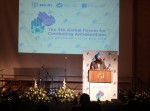
The Hon. Lynne Yelich, Canada’s minister of state (foreign affairs and consular), right, with two fellow panelists, moderator Melissa Eddy, New York Times correspondent in Berlin, and Miroslav Lajcák, deputy prime minister and minister of foreign and European affairs, Slovak Republic. (photo from Foreign Affairs, Trade and Development Canada)

On Nov. 13, the Hon. Lynne Yelich, Canada’s minister of state (foreign affairs and consular), concluded her participation at the High-Level Commemorative Event and Civil Society Forum on the 10th Anniversary of the Organization for Security and Cooperation in Europe’s (OSCE’s) Berlin Conference on Antisemitism.

The Berlin Declaration was proclaimed 10 years ago; it spelled out a series of commitments for OSCE member states, including Canada. Canada is deeply engaged in the fight against antisemitism, both at home and abroad, and remains committed to enhancing Holocaust education, remembrance and research.

Yelich participated in a panel that reviewed efforts over the past 10 years in addressing antisemitism throughout the OSCE. The panel analyzed ways that member states can counter contemporary antisemitism and discussed recommendations put forward by civil society groups.

Yelich reiterated that Canada encourages all states to take a similar, zero-tolerance approach to antisemitism. “As we commemorate the 10th anniversary of the Berlin Declaration on antisemitism, we must acknowledge that antisemitism continues to be a sad reality,” she said.

The complete address delivered by Yelich at the conference, as it was written, follows:

It is both a pleasure and a privilege to represent Canada at this important event in Berlin today and to reflect upon what has been achieved in fighting antisemitism throughout the Organization for Security and Cooperation in Europe over the past 10 years.

As a matter of priority and principle, Canada supports efforts to combat all forms of racism and discrimination. However, the Government of Canada understands that hatred can manifest itself in specific ways requiring specific responses.

We recognize that antisemitism constitutes a unique form of racism, whose extreme manifestations have led to some of the darkest hours in the history of mankind. As Prime Minister Stephen Harper has said, antisemitism is “a pernicious evil that must be exposed, confronted and repudiated whenever and wherever it appears, an evil so profound that it is ultimately a threat to us all.”

As we commemorate the 10th anniversary of the Berlin Declaration on antisemitism, we must acknowledge that antisemitism continues to be a sad reality.

Our Nationally Standardized Data Collection Strategy on Hate-Motivated Crime indicates that Jews are the most likely religious group to be targeted for hate crimes, even though Jews constitute less than one percent of the Canadian population.

Too often, not enough is done to ensure our societies, and especially our younger generations, remember the lessons of the Holocaust.

On April 23, 2013, the Government of Canada announced that a site had been selected in our capital city of Ottawa to build Canada’s National Holocaust Monument. This monument, to be inaugurated in fall 2015, will encourage people to reflect upon the events of the Holocaust, remember the victims and pay tribute to the survivors. It will also encourage people to reflect on the responsibilities each of us has to protect human rights and dignity.

In the same spirit of education, reflection and prevention, the recently opened Canadian Museum for Human Rights in Winnipeg, Man., houses a permanent exhibition devoted to the Holocaust.

With respect to law enforcement and protection, the Canadian government continues to develop its systems for collecting data on hate crime. Combined with law enforcement training, these systems allow the authorities to better address violence against groups at risk, including the Jewish community.

In this context, to help protect communities against hate-motivated crimes, we created a program called Communities at Risk: Security Infrastructure Program. Renewed in February 2013, this program allows not-for-profit organizations to apply for funding to allay the costs of security infrastructure improvements for places of worship and community centres vulnerable to hate-motivated crime.

Canada is also at the forefront of the fight against antisemitism on the international stage.

In November 2010, Canada hosted the second Inter-parliamentary Coalition for Combating Antisemitism Conference. Parliamentarians from around the world came together to develop mechanisms to combat antisemitism and address antisemitic propaganda in the media and on the Internet.

By unanimous consent, parliamentarians issued the Ottawa Protocol on Combating Antisemitism, which seeks commitments from governments to collect and report data on hate crimes, including antisemitism; to monitor and share best practices; to propose a common working definition of antisemitism; and to engage further with the United Nations on this issue.

Through our Office of Religious Freedom, established within Foreign Affairs, Trade and Development Canada and headed by Andrew Bennett, Canada works internationally to combat antisemitism and other forms of intolerance on the basis of religion or belief, including by supporting projects implemented by the OSCE’s Office for Democratic Institutions and Human Rights.

The Government of Canada also recognizes the scourge of the “new” antisemitism. This sometimes-violent movement, which often portrays itself as anti-Zionism, rejects the right of the Jewish people to a homeland. We made our stand clear when Canada – the first country to do so – decided to withdraw from the United Nations Durban Review Conference because of profound concerns about the manifestations of antisemitism that had marred the first Durban Conference, as well as the participation of such overtly antisemitic regimes as Iran in the planning of the review conference.

As we collectively seek ways to improve our response to antisemitism, Canada encourages all states to take a similar, zero-tolerance approach to antisemitism. This can include supporting the principles of the Declaration of the Stockholm International Forum on the Holocaust, the London Declaration on Combating Antisemitism and the Ottawa Protocol; further developing data collection systems on hate crimes; and fully implementing the provisions of the 2004 OSCE Berlin Declaration on antisemitism.

Thank you.

Format ImagePosted on November 21, 2014November 19, 2014Author Foreign Affairs Trade and Development CanadaCategories WorldTags antisemitism, Lynne Yelich, Organization for Security and Cooperation in Europe, OSCE

The indefatigable people

With antisemitism on the rise in France, England and around the world, and Israel once again facing strong headwinds, it seems like a good time to turn to history in search of some perspective on current events.

Earlier this year, PBS aired a popular two-part series on Jewish history written and presented by historian Simon Schama. The account was based largely on his book The Story of the Jews: Finding the Words 1000 BC-1492 AD (ecco, 2013), published last year in Great Britain. The second volume – from 1492 to the present – is expected this fall.

Schama, a highly accomplished, award-winning historian, has written 16 books and 40 television documentaries, focusing mostly on art histories and histories of France, the Netherlands, Britain and the United States. He has also written a book about Israel and the Rothschilds.

image - The Story of the Jews book coverIn The Story of the Jews, he abandons the distance of an academic historian right at the start. This is the story of his people, not an abstract theoretical exercise of writing history. He is emotionally invested in this project and his passion spills out on every page.

It is also clear from the beginning that he is foremost a storyteller. With incredible details, Schama delights the reader with engaging vignettes about both ordinary and powerful people. He recreates pivotal moments in history by describing the events in the life of individuals, from Sheloman, a young Jewish mercenary in service of the Persian authorities in 475 BCE, to Abraham Zacuto, a talmudist and astronomer who put together the almanac used by Christopher Columbus in 1492.

His chatty approach to history occasionally drifts sideways, as if he just thought about something else he has to tell you. It is sometimes difficult to keep up with him, as he jumps across centuries, from country to country, commenting about historical figures without much of an introduction.

Yet, the story he tells is compelling. Schama wanders through numerous far-flung Jewish communities offering fascinating glimpses of their lives and surprising perspectives on Jewish worship, relations with non-Jews and violence against Jews.

More than is usually acknowledged, the Jewish community has lived in harmony with paganism, Christianity and Muslim societies. Yet the portrait of Jewish history, as he presents it, is not pretty.

Despite periods of well-being, sometimes stretching over hundreds of years, the story of the Jews is an account of a people caught in a Sisyphean cycle of settlement, prosperity, persecution and devastation, over and over again, beginning in Egypt in the 13th century BCE.

Schama delves deep into the brutal rhetoric and cruel fantasies that provoked the recurring waves of murder and expulsion. Over two millennia, the venom spread from Egypt to Palestine and throughout the empires of Persia, Greece, Rome and Constantinople, through the Near East and the Iberian peninsula.

He shines an especially bright light on the vile attacks by the disciples and followers of Jesus, who turned Jews into god-killers and child murderers. He writes about Jewish moneylenders, international traders, tax collectors and confidantes of royalty who were once in favor and then were not.

Schama begins his story in Elephantine, an island in the Nile. The Persians in 525 BCE found a thriving, well-established Jewish community in Elephantine, with a temple that had many similarities to the First Temple in Jerusalem that had been destroyed 61 years earlier.

Documents describing Elephantine provide the first hard evidence of daily life of Jews in antiquity. The Elephantine community was wiped out by the mid-fourth century BCE.

Again and again, Jewish communities were decimated. England expelled its Jews in 1290; France issued edicts expelling Jews in 1306 and again in 1394. Spain followed in 1492 and Portugal in 1497. Schama identifies 29 towns under Christian rule across Europe that kicked out Jews between 1010 and 1540.

Many civilizations have thrived and then disappeared. But Judaism has always found a way to thrive and survive. Schama attributes the durability of Judaism to its devotion to words.

Judaism depends neither on its leaders, its places of worship nor its institutions. The Jewish people are the People of the Book; words are the invisible thread that binds Jews together over the millennia, Schama posits. And, according to his perspective, the Torah is the work of the religious and intellectual elite in the eighth to fifth century BCE, nearly 500 years after the Exodus was supposed to have happened.

Reverting to his role as academic, he notes that no evidence – archeological or otherwise – has turned up to substantiate the Exodus story. By his account, the Hebrew Bible is a picture of Israel’s imagined origins and ancestry that converges at some point with the reality of Jewish history.

The genius of the priests, prophets and writers, intellectual elites, was to make their writing sacred, in standardized Hebrew, as the exclusive carrier of YHWH’s law and historic vision, Schama writes. “Thus encoded and set down, the spoken (and memorized) scroll could and would outlive monuments and military forces of empires.”

The Hebrew Bible was fashioned to be the common possession of elite and ordinary people, he writes. The divinity was reflected in the words of the Torah, not in an image of a divine creature or a person. And the message of the Torah was not confined to a holy sanctuary. It is to be posted on the doorpost of every Jew and bound on the head and arms of all Jews as they prayed.

“No part of life, no dwelling or body, was to be free of the scroll-book … the Torah was compact, transferable history, law, wisdom, poetic chant, prophecy, consolation and counsel…. The speaking scroll was designed to survive incineration … the people of YHWH could be broken and slaughtered, but their book would be indefatigable.”

In other words, survival depends on, as his subtitle says, “finding the words” for Torah study and the story of the Jews.

Media consultant Robert Matas, a former Globe and Mail journalist, still reads books. Simon Schama’s book is available at the Isaac Waldman Jewish Public Library. To reserve it, or any other, call 604-257-5181 or email [email protected]. To view the catalogue, visit jccgv.com and click on Isaac Waldman Library.

Posted on October 17, 2014October 17, 2014Author Robert MatasCategories BooksTags antisemitism, Judaism, Simon Schama

Christianity stands accused

The Catholic Church did not initiate diplomatic relations with the state of Israel until 1993 and, according to the Italian writer Giulio Meotti, things haven’t been all rainbows since then either.

image - J'Accuse coverThe creation of a thriving Jewish state creates a theological conundrum for the Catholic Church, Meotti writes in The Vatican Against Israel: J’Accuse (Mantua Books, 2013), because it is a refutation of the theological view that Judaism should wither and die in the shadow of a successor religion, Christianity. The theological imperative of Jewish disappearance is now accompanied, he writes, by a geopolitical imperative that Israel should vanish.

“Replacement theology stated that Christians had inherited the covenant and replaced the Jews as the Chosen People. The concept of replacement geography similarly replaces the historical connection of one people to the land with a connection between another people and the land,” Meotti writes. “The existence of a restored Israel in the land of the Bible, proof that the Jewish people is not annihilated, assimilated and withering away, is the living refutation of the Christian myth about the Jewish end in the historical process.”

The necessity of rejecting Zionism and, in its time, Israel, bested even the liberalizing influence of the Second Vatican Council, the near-revolutionary reconsideration that took place within Catholicism in the early 1960s. This period, which saw the Church recognize Judaism and Christianity as familial theologies and renounce the millennia-old deicide charge against the Jews, nevertheless has a stream that abhors Zionism. Meotti writes that two conflicting Vatican tendencies developed at that time and still dominate: “theological dialogue with Judaism, and political support for the Arabs.” (The gushing lamentation offered by the Vatican on the death of Yasser Arafat is particularly striking.)

Meotti contends that this process has involved the Catholic Church differentiating between “good” and “docile” Jews of the Diaspora and the “bad” and “arrogant” Jews of Israel.

The book is a litany of indictments. The Church had relations with the PLO before it had relations with Israel. Top Church leaders have repeatedly accused Israel of behaving like Nazis. They routinely use crucifixion motifs in the Israeli-Palestinian context, with Jews playing the Romans and Palestinians, of course, playing the beatific victim. Israel, said one archbishop, was imposing “the sufferings of the passion of Jesus on the Arab Christians.” Another, at the time of the Palestinians’ seizure of the Church of the Nativity in Bethlehem, declared: “Our Palestinian people in Bethlehem died like a crucified martyr.” Arafat himself jumped on the bandwagon, declaring: “Jesus Christ was the first Palestinian fedayeen who carried his sword along the road on which today the Palestinians carry their cross.”

The first translation into Arabic of the Protocols of the Elders of Zion was courtesy of the Catholic Church. One archbishop was convicted of using his immunity to smuggle explosives to Palestinian terrorists and served just four years of his 12-year term after intervention by the Pope and a promise to make no more trouble. (He turned up again in 2010 on the fatal “Freedom Flotilla” that sought to bring aid to Hamas terrorists and has goaded Palestinian Christians to violence, insisting it is the only thing that will move Israelis.) Today, Catholic-affiliated nongovernmental organizations are among the leaders in the anti-Israel boycott, divestment and sanctions movement.

The Vatican’s relationship to the Holocaust is particularly dissolute. Pope John Paul II, in 1979, spoke at Auschwitz, noting that “six million Poles lost their lives during the Second World War, one-fifth of the nation,” failing to note that these were almost all Jews. Instead, he called Auschwitz “the Golgotha of the contemporary world,” Golgotha being the place in Jerusalem where Jesus is said to have been crucified.

More perversely, after visiting Mauthausen, the Pope said that the Jews “enriched the world by their suffering,” He seemed to be echoing the thoughts of John Cardinal O’Connor, then archbishop of New York, who a year earlier had visited Yad Vashem, Israel’s Holocaust museum, and asserted that “the Holocaust is an enormous gift that Judaism has given to the world.”

John Paul also infuriated Jews, among others, by conferring a papal knighthood on Kurt Waldheim, the former Austrian president, United Nations secretary-general and Nazi war criminal.

When Jews objected to a proposal to build a Carmelite convent at Auschwitz, the mother superior of the order asked: “Why do the Jews want special treatment in Auschwitz only for themselves? Do they still consider themselves the Chosen People?”

The “J’Accuse” part, which channels the moral outrage of Emile Zola, is fair enough, but this book is only partly about the Vatican. Meotti dredges up equally egregious affronts perpetrated by countless other Christian denominations.

The book is a searing indictment of the Catholic Church, but it is also deeply flawed. At the least, the title is deceptive. The “J’Accuse” part, which channels the moral outrage of Emile Zola, is fair enough, but this book is only partly about the Vatican. Meotti dredges up equally egregious affronts perpetrated by countless other Christian denominations. By no means is Meotti’s condemnation limited to the Vatican, and it is difficult to discern why the title should suggest it is.

Meotti frequently puts uncited statements in quotations. For example, during the 1967 war, when Israel faced annihilation from the Arab states, Meotti claims the Vatican gave the order: “Cheer for the other side.” The quote marks suggest someone literally said this, but whom? On another occasion, he attributes, in quotes, the statement “Jerusalem must be Judenrein.” But who is alleged to have said it? One can also frequently sense comments being stretched out of context to fit the thesis.

Too many times to count, Meotti declares one Christian assertion or another “a blood libel.” The term’s over-usage diminishes whatever power the accusation carries. And nowhere is his over-usage more disturbing than in his casual, often flippant invocation of Nazism.

He writes, “Like Hitlerism, Palestinianism is not a national identity, but a criminal ideological construct…. Worse, the Netanya Passover bombing that killed 30 is a “mini Holocaust.” And, “The dark irony is that the Europeans who are supporting the Palestinians’ ‘right of return’ are living in homes stolen from Jews they helped to gas.”

Meotti’s book has the potential to make an important case against Christian antisemitism and anti-Zionism. While it doesn’t fail completely – the evidence being compendious – the charge to the jury is so overwrought that one feels resentful at being manipulated. The facts would speak for themselves if the author would step back a bit.

Pat Johnson is a Vancouver writer and principal in PRsuasiveMedia.com.

Posted on September 19, 2014January 13, 2015Author Pat JohnsonCategories BooksTags antisemitism, Giulio Meotti, Holocaust, Israel, Nazism, Palestinians

The elite aren’t who you think they are

At any given time, but especially in recent weeks when Israel’s conflict with Hamas has been front-page news, a perusal of the comments under any story involving Jews almost inevitably devolves into some variation on the theme of Jewish control. It is notable how frequently, even in 21st-century Canada, Jews are depicted as manipulating the media and puppet-mastering the powerful, like the United States.

The advent of the electronic age has brought the phenomenon to even greater levels of intensity. We are now all broadcasters. We are all publishers. We are all curators of the news.

A few years ago, the vast majority of North Americans gathered their information from the same couple of sources. While every city and town had its own newspaper, these mostly received international news from the same few press agencies. On television, Canadians were offered CBC or CTV. We now have access to hundreds of English-language TV stations and millions, if not billions, of other sources for whatever information we seek. News, which was once a staid medium, has morphed into infotainment, in which beheadings in Iraq mingle with Kardashian marriages.

Time was, one could count on the fact that most of the people at your dinner party would have heard what Barbara Frum had said the previous night or would catch the reference to a Wayne and Shuster skit. Now, if you don’t “get” the references, an electronic device will promptly be provided so that you can watch the original source of the reference itself.

There is certainly something democratizing about this panoramic access to information. Yet there may be something contra to healthy democracy in this situation, as well. The underpinnings of a successful civil society rest partly on a shared foundation of knowledge. As we have become more individualized in our choices of what we know or ignore, those shared foundations are crumbling. That a great number of young people get their news from sources like Jon

Stewart’s The Daily Show is slightly reassuring in the sense that at least they’re getting some knowledge of world affairs, similar to the transition in the 1960s when attitudes changed from viewing comic books as something akin to pornography to a resigned attitude that “at least the kids are reading.”

It is true that social media has helped young people – all people – take up causes and devote themselves to social change if they seek to do so. One of the greatest examples was this summer’s ubiquitous Ice Bucket Challenge, which has raised millions of dollars for ALS research and advocacy. Still, there is a diminishing of comprehensive, shared, reliable news and information upon which all people form their opinions.

In a democracy, everyone has the same voice at the ballot box. But a democratic society is not formed only on one day every four years. A thriving democratic society requires the engagement of an informed population every day. From that perspective, democracies risk losing an important element of viability and vibrancy when a huge proportion of the population is choosing the garden channel over Newsworld, TMZ over the New York Times.

For centuries, there has been the conspiracy theory that a tiny minority somehow controls knowledge and everything that goes with it. In a strange way, this myth may be approaching reality. But it is not Jews who are the elite increasingly controlling what transpires in the world – it is the diminishing number of people who are actually paying attention.

This is not, like the conspiracy theory, the effect of a minority seizing control from the masses. It is the opposite: it is masses of people abdicating their right and responsibility to be informed, active participants in democratic society. And, as more people look away from the uncomfortable realities of the world, a smaller and smaller elite – those who choose to remain informed – will have an outsized influence on public opinion and what governments do worldwide.

Posted on September 12, 2014September 10, 2014Author The Editorial BoardCategories From the JITags antisemitism, internet

Ukrainian incidents concerning

In Europe, it has often been dangerous for Jews to be Jews. And Easter in particular has led to frenzied antisemitism, as priests commonly riled up parishioners with a selective retelling of the crucifixion story, after which throngs would emerge from churches and attack Jewish fellow residents.

This is a generalization, of course. Many Easters have passed peacefully in many parts of Europe. But Jew-bashing was a common occurrence with formal and informal sanction. Children sometimes came home from school with arts and crafts mallets to be used symbolically to hammer the Jews on Easter weekend. Predictably in such an environment, on many, many occasions, the hammering was not symbolic.

So it was this past weekend, when firebombs were reportedly thrown through the windows of the main synagogue in the Ukrainian city of Nikolayev. Thankfully, prayers were not taking place at the time and no one was injured. But the traumatized and beleaguered community must certainly have heard echoes of the past in this act of contemporary vandalism and hate.

Ukraine, of course, is the centre of global anxieties, verging as it does on something between a civil war among ethnic Russian and Ukrainian citizens and an incipient full-scale invasion by Vladimir Putin’s Russia, which has already invaded and annexed Crimea.

It may be an unofficial aspect of our tradition to always expect the worst even while hoping for the best, so it may not have come as a complete surprise to some of us that Easter weekend did not pass without an unfortunate incident. Particularly in the aftermath of another chilling incident in the days before the firebombing. A photocopied sheet was spread throughout parts of Ukraine during Passover declaring that Jews over the age of 16 must register at the (Russian-occupied) government building in Donetsk, paying a $50 registration fee and listing all real estate owned. The echoes of the past this poster elicited were obvious and outrage went viral.

From the start, there was uncertainty about the provenance of the sheet and whether it was being distributed on behalf of an official/ government agency. By the weekend, media were reporting that the poster had been “debunked,” that it was not issued by authorities. If true – because the “debunking” report is no more certain than the original belief that it came from whatever counts as a government in the region now – it would be a bit of a relief. But there should be no great celebration. In recent weeks, as Ukraine and Russia have become more and more conflicted, Jewish citizens of Ukraine have found themselves in an historically familiar and dangerously undesirable position. As has been so often the case in Europe, sides in the conflict are either demanding Jewish allegiance or scapegoating Jews.

Ukraine has a small but overt, visible and thriving neo-Nazi movement – with the support of about one in 10 Ukrainians – which is trouble enough. Putin did not help matters when he suggested recently that Russian influence in Ukraine would be good for the Jews because of rampant antisemitism there. There could hardly be a more dangerous position for Ukrainian Jews than to be seen as a justification for Russian incursion (as if Russia or Putin have records worthy of Jewish admiration).

Leaders of Ukraine’s Jewish community, which traditionally has been more Russian-speaking than Ukrainian-speaking, stood firm with their Ukrainian fellow citizens against Putin’s assertions that Ukraine is a hotbed of Jew-hatred.

“Your certainty about the growth of antisemitism in Ukraine, which you expressed at your press conference, also does not correspond to the actual facts,” rabbis and other leading figures in the community wrote in an open letter to the Russian president. “Perhaps you got Ukraine confused with Russia, where Jewish organizations have noticed growth in antisemitic tendencies last year.”

All these decades and centuries later, our coreligionists still struggle to find a place of welcome in their home countries, amid the nationalist and racial conflicts of Europe. Of course, we should not assume this is a far-away problem. The murders at two Jewish institutions in Kansas City last week is proof that antisemitism exists in our own backyards, as well, and we will continue to watch developments in the region and closer to home with wariness and hope, prepared to speak out and act on behalf of Jews – and anyone – who is endangered.

Posted on April 25, 2014May 8, 2014Author The Editorial BoardCategories From the JITags antisemitism, Donetsk, Easter, Kansas City murders, neo-Nazi, Nikolayev, Ukraine, Vladimir Putin

Posts pagination

Previous page Page 1 … Page 43 Page 44
Proudly powered by WordPress