An anonymous contribution helped purchase a Magen David Adom ambulance for Israel in honor of Canadian Prime Minister Stephen Harper’s recent trip there. (photo from Magen David Adom)
Yarin Levi, 16, was moments from death after a rocket exploded near him in Ashkelon during the recent Gaza Operation Protective Edge. His life was saved by Ainav Asulin, a senior paramedic for Magen David Adom (MDA). In the course of five minutes, the paramedic secured him, performed CPR, arranged transport and ensured the hospital where he was transported would have blood transfusion supplies to save his life. Levi would live to thank the paramedic that saved his life.
While Asulin is not from Vancouver, during Operation Protective Edge, four Jewish volunteers from Vancouver and Richmond took part in the overseas volunteer program for MDA operations, responding to the aftermath of rockets, as most of Israel’s population ran to bomb shelters. The organization’s Vancouver office was involved not only in the sending of volunteers but also in securing donations for the procurement of MDA hardware, including ambulances, mobile intensive care units and medical equipment. Due to an anonymous contribution, an ambulance was gifted to Israel in honor of Canadian Prime Minister Stephen Harper’s recent trip there.
According to Roy Grinshpan, president of the B.C. regional chapter of MDA, there is always room to grow. At present, 40 percent of donations come from Christian organizations, and 12,000 volunteers worldwide keep MDA functioning, he told the Independent.
Donors that purchase ambulances with their contributions can have them dedicated, he said. Currently, ambulances in operation from Vancouver are based in Tel Aviv, Bat Yam and Modiin in central Israel and Carmiel in the north. According to Grinshpan, these ambulances are produced in a Montreal factory where Israeli orders represent a significant volume despite its small size. “Every year, Israel tries to upgrade their infrastructure” through research and development, and experience, he said. “It’s a win-win situation as [the] plant can keep their modifications” for use on other ambulances.
According to Ilan Klein, a front-line paramedic and deputy director of the fundraising and international relations department for MDA, who was in Vancouver on a cross-country speaking tour, the connection between MDA internationally and Vancouver can only be strengthened. Comparing the relationship to the Hebrew word for life, chai, he said that a strong connection is key to saving lives in Israel. “The community in Canada can help buy ambulances through a trusted relationship,” he said. “Two sides need to work to make a connection…. MDA needs to also invest more in speakers, paramedics and volunteers to come here to speak.”
Responding to the needs of MDA, Klein was quick to conceptualize the need for preparedness. During Operation Protective Edge, there were 600 Israelis
injured, 30 severely. The role of MDA was to respond to every person in distress. “Eighteen days before [Protective Edge], three teens were killed, and MDA began to be ready for more escalation,” said Klein. One thousand ambulances were on standby and 300 were activated to be ready for a fast response. MDA was an integral on-call first responder during the conflict. “While during a siren the Israeli people run to shelter, the MDA go out to help,” he said. “We work with the police and army [to respond quickly].”
Thanking the community, Klein said that Jews around the world, including Vancouver Jews, can and will continue to play an essential role in keeping MDA operational. “MDA and Israel would not have succeeded without a Diaspora Jewish community.”
Gil Lavieis a freelance correspondent, with articles published in the Jerusalem Post, Shalom Toronto and Tazpit News Agency. He has a master’s of global affairs from the Munk School of Global Affairs at the University of Toronto.
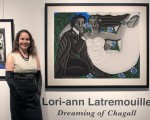
Artist Lori-ann Latremouille at the opening of her solo show at the Zack Gallery on Nov. 6. (photo from Lori-ann Latremouille)
Fairy tales do happen in real life. Take, for example, the story of local artist Lori-ann Latremouille. In her case, it was not Prince Charming who changed her life, but rather an art agent, by offering representation to the then 21-year-old unknown artist.
Latremouille left home at 16 to escape an unfortunate family situation. Although she liked painting and drawing at school, she was never exposed to the art world as a child. Later, to make a living, she had to take a job that had nothing to do with the arts. Still, art resided in her heart and wouldn’t be denied. “I knew even then I wanted to be creative, not answer the phones for the rest of my life,” she said in an interview with the Independent. “After a couple years, I quit my job and went to the local library.”
She taught herself art history by reading library books and copying masterpieces from illustrations in those books. She even had a show of her reproductions at that library when she was 18. “I kept asking my friends to pose for me but I couldn’t pay them,” she recalled with a smile. “They soon got tired of it, and so did I.”
Despite the tight budget, she continued teaching herself. “I took a class at Emily Carr once and loved it. At about the same time, I went to an art show opening. I had never been to an art show before. I loved it. I wanted to be involved in an art exhibition.”
After a few setbacks and gallons of perseverance, she managed to open her first solo show when she was 20. “There was another gallery show next door. It opened on the same day as mine, and I got lots of traffic from them,” she recalled. “I even sold a few pieces. Then an agent came to my show. She introduced me to the Heffel Gallery.”
One of the most prominent galleries in Vancouver, Heffel represented Latremouille for several years. Soon after this lucky break, she got an offer from an American dealer: he would buy several of her paintings at once and pay her as much as she needed for her monthly rent and bills so she could paint without financial worries. “He asked me how much I needed a month. I gave him a very modest estimate. I was used to economizing, had lots of practise since I was 16.” She was 21 then and she is still represented by that gallery in Portland. “I was blessed,” she said. “I met the right person at the right time.”
Of course, her talent had something to do with it. Her distinctive style – black and white palette, expressive lines and an occasional splash of solid color – emerged in the very beginning of her artistic career. “One color is like one note in music,” she said. “Black and white make the colors sing.”
Visitors to the Jewish Community Centre of Greater Vancouver can enjoy Latremouille’s visual songs this month, as her solo show Dreaming of Chagall is at the Sidney and Gertrude Zack Gallery until Nov. 30.
“When I started painting,” she said, “I didn’t see any of the great artists [and their work]. I simply liked black and white. Later, one of the prominent collectors of Chagall’s art in San Francisco mentioned the similarities of my works and Chagall’s. She even bought one of my pieces for her collection. I feel honored.… When I first saw Chagall’s paintings and drawings, I fell in love. There is magic in his works. He also liked black and white. One of my favorite quotes of his is, ‘If I create from the heart, nearly everything works; if from the head, almost nothing.’ That’s how I feel, too. My art comes from the heart. There is so much heart in Chagall.”
Latremouille considers herself an apprentice to Chagall, and several of her pictures reflect that self-assessment. Her drawing “Passing the Egg” is a metaphor for such an apprenticeship, a passing of the torch of art. The theme is also apparent in “Master and Apprentice,” while the bride and groom painting “Blue Orchid” clearly drew its inspiration from Chagall’s soaring brides.
Another theme of the show is the unity of human beings with the natural world. In many paintings, the shapes of people and creatures intertwine. There is no border but skin between them. “I always loved nature, loved animals,” she said. “Most forms of animals, birds and fish fit into the shapes of human bodies. We are intrinsically the same. I know that humanity is capable of doing great harm to nature but we are also capable of healing it. People do it all the time, work on restoring the environment, streams and forests. Maybe I’m a bit naïve but I believe it.”
One other pervading theme, running through almost every painting and drawing, is music. Instruments have a place of honor in most images. “I always loved listening to music when I drew. I also wrote poetry. Still do. I wanted to write songs, so I learned to play guitar in my late 20s. I’m an artist first, of course, but I love music and songwriting. I love drawing musical instruments. I think visual art foreshadowed my interest in music.”
Music often feeds her creativity, but anything can give a spark to an idea: a song, a painting by another artist, something she encountered on an outdoor trip. “I sketch all the time,” she said. “Then I look through my sketchbooks, pick a sketch I like, and start a painting. It grows organically, like a visual conversation with the emerging image. I love the creative process, when I see things falling into place, popping up from the two-dimensional lines of the sketch. When people buy a piece, it’s just icing on the cake.”
Even pain and illness have been an inspiration for her art. In 2012, she was diagnosed with breast cancer. After the diagnosis, depression hit her hard, but she fought it. Several of the best pieces in the Zack Gallery show were painted after her recovery from both cancer and depression. “Rescue from Blue” is a visual tale of escaping fear and pain, of flying into the light, while “Dreaming of Chagall” marks a new direction in the artist’s development. The painting is full of joy and more colorful than any other in the exhibition.
Olga Livshinis a Vancouver freelance writer. She can be reached at o[email protected].
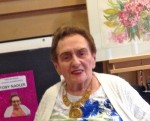
Toby Nadler (photo from Louis Brier Jewish Aged Foundation)
On Thursday, Oct. 23, Louis Brier Home and Hospital hosted an exhibit of accomplished artist and resident Toby Nadler’s work. The exhibit was open to all residents.
In 1970, Nadler began to study oil painting at the Montreal Museum of Fine Art with the late Arthur Lismer, one of Canada’s Group of Seven. After completing a teacher’s certificate at Macdonald College in Montreal, she spent four years teaching children at elementary schools in Montreal’s inner city, where art was one of the subjects, and took evening art courses at Concordia University. She graduated from Concordia in 1980 with a bachelor of fine arts degree, majoring in studio art.
Later, she studied watercolor and multimedia art with Judy Garfin, a Vancouver artist, at McGill University. After a few years, Nadler became interested in Chinese watercolors and calligraphy, and studied privately with a group of other Westerners. The teacher was Virginia Chang, who exhibited her students’ work.
In 1984, Nadler and her late husband Moe moved to Vancouver. Nadler wished to continue studying Chinese art in her new city. She also studied Mandarin at the Chinese library and watercolors with Nigel Szeto at the Chinese Cultural Centre. He was impressed with her work but, after seeing her Western paintings, recommended she continue with her own style, as her personality did not come across in the Chinese paintings to the same degree.
Nadler joined the English Bay Arts Club and the University Women’s Club, where she studied watercolor with various artists, as well as exhibiting there. After a few years, she became an active member of the Federation of Canadian Artists. She volunteered and took courses with their artists and exhibited her own work around the city, including at the Vancouver Public Library. During an exhibit at Oakridge Shopping Centre, an art dealer from Hong Kong admired her work and wanted to know if she had unframed paintings, so that he could roll them up and ship them to his two galleries in Hong Kong. He bought 10 works.
Studying with Lone Tratt, Nadler took watercolor and acrylic courses at the Jewish Community Centre of Greater Vancouver, where she also exhibited. Upon request, she donated six of her paintings to decorate their seniors lounge. Her home was decorated with many of her paintings.
A resident of Louis Brier since August 2014, Nadler still occasionally paints at her leisure. The Louis Brier Jewish Aged Foundation accepted her donation of more than 10 paintings as part of their collection to decorate the halls of the home. They also have another few pieces, which they will use to decorate the interior of residents’ and staff rooms. It is hoped that her unique style will bring pleasure to all who see them.
At the Oct. 23 exhibit, Nadler’s son, Peter Nadler, spoke, giving a history of his mother as an artist, and Dvori Balshine thanked Nadler for all of her artwork donations. Music therapist Megan Goudreau and recreational therapist Ginger Lerner composed and performed an original song in Nadler’s honor about her contributions to the art world.
U.S. President Barack Obama has sent a letter to the Ayatollah Ali Khamenei requesting Iran’s support in the battle against ISIS. At a time when Israel’s relationship with the American administration is strained, the letter (which was apparently sent back in October and whose existence was recently reported by the Wall Street Journal) has sparked a great deal of reaction.
Stopping the Islamic State is and should be a global priority, but the softening of attitudes toward Iran’s regime is a concern. While there appears to be some progress in talks on Iran’s nuclear program – negotiations that are rapidly approaching a Nov. 24 deadline for an agreement – the hatred directed at Israel is as vibrant as ever. Just days ago, Khamenei tweeted an infographic titled “9 Key Questions About Elimination of Israel.”
The graphic design is better than the English grammar, but the message is unmistakable. No less than ever – and regardless of what we may read suggesting schisms in the highest reaches of the regime – the top leader is as committed as he ever was to the annihilation of Israel.
While insisting that, “of course, the elimination of Israel does not mean the massacre of Jewish people in the region,” the emphatic message is, put mildly, unwelcoming. Still, the world seems convinced that it’s a bluff. To see events at the United Nations, one would think it was Israel that was threatening to obliterate another member-state. Commentators dismiss destructive rhetoric like Khamenei’s as propaganda for domestic consumption, but most Jews, and anyone with a sense of history, take seriously threats like this at any time, but particularly in the week that we commemorate both the 76th anniversary of Kristallnacht and Remembrance Day.
Meanwhile, U.S. Secretary of State John Kerry insists any Iran overture is unrelated to the broader issues of the Middle East, as if the interconnected web of intrigues, hatreds and alliances could be unraveled from one another. And then, as if there are not enough issues in the world with which to be concerned, European states are lining up to recognize the “state of Palestine.” These legally meaningless but symbolic votes by Britain and Sweden, with more legislatures intending to follow suit, are meant to force negotiations toward a two-state solution, with an underlying assumption that Israel is to blame for the lack of progress. All the incitement to violence by Palestinian leaders and the recent upsurge in vehicular murders and stabbings of Israelis are blamed on the Israelis themselves, who must somehow deserve what they get.
Often, commentators, including Kerry recently, state that resolving the Israeli-Palestinian conflict is the lynchpin to resolving the broader conflict in the region. By obsessing about Israel, the UN, European powers and others are wasting their energies on a sideshow while the feature presentations get short shrift.
From Nov. 12-15, Rumble Theatre’s Tremors presents three different plays – Trainspotting by Harry Gibson, The 4th Graders Present an Unnamed Love-Suicide by Sean Graney and This is War by Hannah Moscovitch. They will take place simultaneously in different parts of the Russian Hall. After each night’s performances, the entertainment will continue, with an after-party to which everyone is invited.
Part of Rumble Theatre’s mission is to foster “meaningful interactions between emerging and established artists,” and Tremors does just that. From start to finish, each of the plays is mounted by a group of relative newcomers to the professional theatre world. Knowing Rumble Theatre either directly or indirectly through colleagues, both Andrew Cohen and Naomi Vogt leapt at the opportunity to be involved when the call for artists went out.
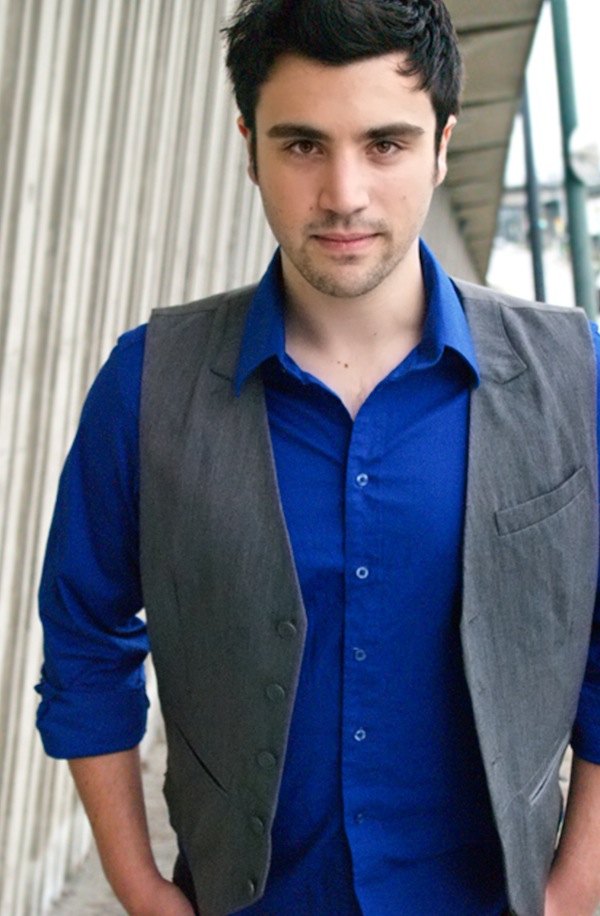
Andrew Cohen is doing sound design for Trainspotting. (photo from Rumble Theatre)
“I have been interested in music composition and sound design for a long time,” said Cohen. “When I watch – or hear – a show, the moments I can connect to most are the ones where the sound is used to mirror the action onstage. I’m excited to have started exploring and establishing myself as a composer and designer in addition to performing.”
Cohen will be in charge of sound design for Trainspotting. “I submitted to Stephen Drover, artistic director of Rumble Theatre not knowing which plays were being mounted,” he said. “When we all submitted, we were asked which types of shows we were interested in working on and why. They paired all the designers and directors with their respective shows based on similar theatrical esthetics and tastes.”
Rumble’s mandate to mentor newcomers means that “all Tremors artists are assigned mentors, who are helping us to navigate this challenging material,” said Vogt, who was a student ambassador for the organization in her final year of theatre school.
“I promoted Rumble Theatre’s work, especially their phenomenal show Penelope, and co-produced a 48-hour play-building experiment called The Crockpot, which featured one representative from Vancouver’s theatre training facilities: UBC, Studio 58, Douglas, Capilano, Trinity Western and SFU. The goal of the project was to inspire students at these schools to connect with each other. There’s a tendency among theatre students to work only with their peers, even after graduation. It’s important to maintain those contacts from school, but it’s also important to expand into the larger community of Vancouver artists.”
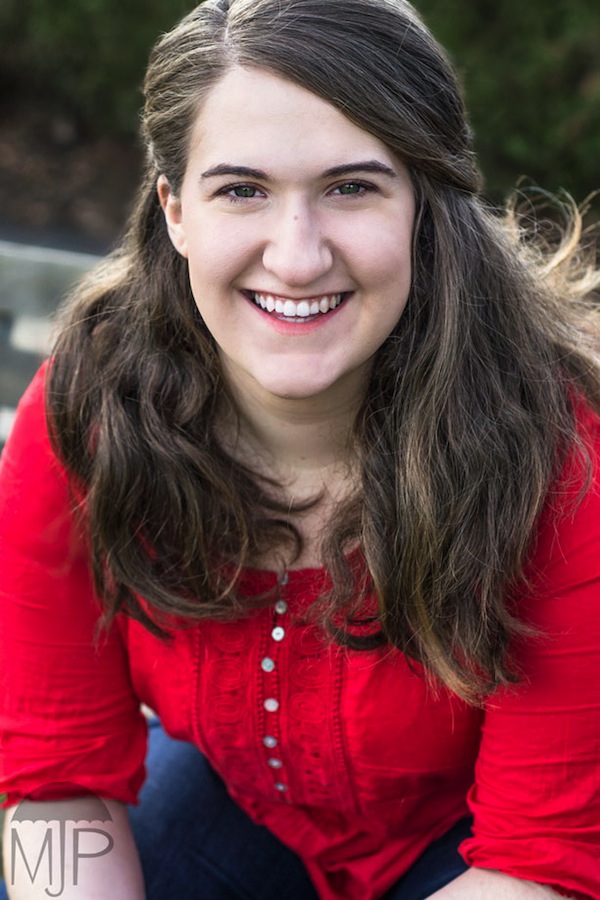
Vogt will be acting in The 4th Graders, which “is about a class of fourth-grade students who honor their classmate Johnny with a play he wrote, following his suicide,” she explained. “The play details Johnny’s version of the series of events that led to his suicide. I play Rachel, an unpopular 10-year-old who is bullied for being overweight. Rachel and Johnny were ‘boyfriend/girlfriend,’ but Rachel ends the relationship because she believes she’s not deserving of Johnny’s love. The 4th Graders Present an Unnamed Love-Suicide is dark, but it’s so hilarious, too. It explores serious themes of love, betrayal and revenge, but through the lens of a 9-year-old, which I hope resonates with audience members of all ages.
Her past experience should help in her portrayal.
“I started performing in elementary school,” she explained, “when I was given special permission to dramatize Shel Silverstein poems during ‘reading hour’ with a friend. We weren’t popular girls, but our classmates thought our skits were funny – plus, we got out of reading hour! We kept going, eventually developing a sketch series of Oprah Winfrey Show parodies, which we’d perform almost daily to our Grade 4 classmates. I, an overgrown poofy-haired 8-year-old, played Oprah. My friend Allison, a tiny bespectacled thing, played our various idols: Michael Jordan, Michael Jackson, Shania Twain and others. We were a hit.”
Naomi Vogt plays Rachel The 4th Graders Present an Unnamed Love-Suicide. (photo from Rumble Theatre)
It was then that Vogt knew she wanted to be an actor. “It offered some respect and acknowledgment I otherwise didn’t receive in the social arena,” she said. “I knew it was a job grown-ups had, so I thought, ‘Perfect, got that whole what-do-you-want-to-be-when-you-grow-up business sorted. I’m going to take acting classes, hang up some Destiny’s Child posters and things are going to fall into place for me.’ Obviously, a career in the arts is different than my fourth-grade mind dreamed it would be. I’ve only just transitioned into the professional world, and things are difficult sometimes, but my grade school dream is still alive!”
Flourishing, actually. Vogt just completed the bachelor of fine arts acting program at the University of British Columbia, where she won the Evelyn Harden Award. “It’s an award that the UBC theatre faculty gives to a graduating theatre student and, happily, it accompanies a cheque,” she explained. “It’s made available annually through the generosity of Dr. Evelyn Harden. I was so grateful to be the recipient among my class and it helped me make it through my final year.”
Vogt also expressed gratitude for her connection to the Jewish community. “Like theatre,” she said, “my affiliation with Judaism gave me a cultural anchor. In the rocky seas of adolescence, I knew I was a Jewish theatre nerd and, whenever I felt lame, ostracized or unusual, I could feel confident about those two things. It’s still a big part of my life, and so it features pretty largely in my improv and sketch comedy. I often find myself muttering broken Hebrew prayers or referencing Jewish holidays or practices onstage.”
Describing herself as a “‘character’ type within a pool of ingénues,” Vogt said she “often played one of the following roles: old women, very old women, and men. And, I honestly wouldn’t have it any other way. I’m unusual, so I get to play interesting people. For example, in my final show at UBC, I had the fantastic opportunity to play the murderous king Pere Ubu in an all-female version of Alfred Jarry’s masterpiece Ubu Roi, and I couldn’t have asked for a weirder, bigger, more joyful undertaking.”
Cohen, who has been featured in the Jewish Independent on more than one occasion, is also engaged in several interesting and meaningful undertakings. He was in the JI just a few months ago, when he was interviewed about his involvement as part of the faculty of Gotta Sing! Gotta Dance!, which celebrated its 20th anniversary this past summer.
Over the last couple of years, Cohen said he has spent most of his time out of Vancouver, performing in plays and musicals in Calgary, Edmonton, Toronto and Halifax.
“I spent several months traveling around the Americas to work with the Broadway organization Artists Striving to End Poverty. They commissioned me to direct and musically arrange an international music video featuring some of the students from their schools around the world, and some of their celebrity teachers (like cast members from Netflix’s Orange is the New Black, HBO’s Looking, Wicked’s Kristin Chenoweth and others).
“Most recently, I have been working on re-imagining and rearranging the Joni Mitchell canon for a new show co-created with my beautiful, talented fiancé Anna Kuman. Our show, Circle Game, for the Untitled Theatre Company, was developed as part of the inaugural residency with Capilano University. Anna and I are excited to have been granted another development residence, this time with a professional theatre company in the city. We are also very excited to have New York and Stratford director Robert McQueen helm our next workshop.”
Cohen is part of the tech team for Firehall Arts Centre’s presentation of Urinetown, which runs until Nov. 29. This month, he also “will be workshopping a new musical with Axis Theatre that tours around Western Canada in the new year. Following that will be the next development phase of my show Circle Game…. And then, next summer, I will be playing Judas in the Arts Club Theatre’s production of Godspell. After that, I’ve booked the biggest, most exciting gig of my life: marrying the incredible Anna Kuman!”
As for Vogt, she said about her future plans, “It’s scary to be released out of the safety of theatre school, but it’s exciting to work in the professional community, too. I’m teaching with the Vancouver Youth Theatre right now, which is especially fun because I took their classes as a child. I’m also experimenting with physical theatre and puppetry and, right now, I’m taking a clowning class with the remarkable Gina Bastone. Traveling is a big part of my immediate plans, too – I’m hoping to go to Israel in the spring. But, until then, feel free to hire me!”
Tickets for Tremors ($15 for each play) can be purchased via rumble.org. Since the plays take place simultaneously, it is only possible to see one play per night.
In The Remains of Love, her latest novel to be translated into English, Zeruya Shalev once again explores (and crosses) intimate emotional boundaries. In this novel, however, she also overtly explores territory that she has actively resisted – Israel, where she was born and still lives.
“In my previous works, I avoided relating to the Israeli reality in a straightforward way,” Shalev told the Independent in an email interview. “The readers could have sensed it only indirectly – through the reckless pace, the intensity and perhaps even the pessimism. In this book, however, I felt an urge to open more windows to the Israeli reality – such as the history of the kibbutz and the burning issues of human rights. Each book has its own needs. Many issues that did not fit right in the previous books with the previous protagonists found themselves fitting perfectly into this one and its characters; this is because the Israeli reality affects them in a deeper and a more profound manner. And yet, still I am wrestling with the dominance of this reality, and try not to let it take over my books – it’s enough that it controls my life.”
Shalev included a winking emoticon after this last comment, indicating that the remark should be taken with a grain of salt, or at least not as seriously as it reads. She has an engaging manner and a sense of humor, which comes through in her writing (amid the serious, emotional and provocative material) and especially in interviews (there are several available on YouTube). In addition to her talent as a writer – her novels are critically acclaimed and have garnered various awards – Shalev is a thoughtful, friendly and relaxed interviewee. She is a great choice to launch this year’s Cherie Smith JCCGV Jewish Book Festival on Nov. 22.
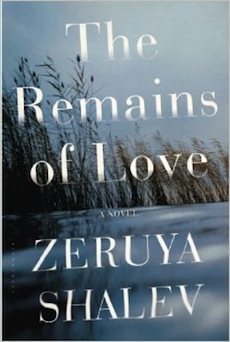
The Remains of Love (Bloomsbury, 2013) centres around a dying woman, Hemda Horovitz, and her two adult children, who each have families, foibles and problems of their own. Her favorite, Avner, is a human rights lawyer; he is questioning everything about his life, whether he has made a dent in the inequality and injustice in the world, as well as his relationship with his wife and sons. Hemda’s daughter, Dina, has devoted herself to her own daughter, Nitzan – giving her the love she never received from Hemda – but, like most teenagers, Nitzan is pulling away, so Dina looks to adopting a child to fill the void, even though her husband and daughter are against it.
The focus on three protagonists required a change in style for Shalev.
“In my previous novels, I concentrated on one protagonist, and followed her stream of consciousness in the first person, which creates immediate intimacy,” she explained. “The first person traps the readers in the inner world of the character, and even when he or she depicts other characters, they often seem like a projection of his or her own qualities. In this book, I wandered between three minds, three streams of consciousness, and the third person enables me much space and flexibility. At first, I was afraid that the third person might hurt the intimacy of the voice, but in retrospect it seems (or at least I hope) it didn’t. The first person is completely monogamous, and the third person gives you more freedom, which I and my protagonists needed for this book.”
The literal translation of the novel’s title is “the shards of life.” In the French version – and perhaps in other languages, too – chayyim is translated as “life.” However, Philip Simpson, who does a skilled job of translating the book’s content, style and emotion, chooses the word “love.”
“The French title of the book is more loyal to the original title in Hebrew (The Remains of Life) than the English one,” acknowledged Shalev. “Yet my English publisher (in the U.K. and U.S.A.) turned to me and explained that this name does not possess enough beauty and lyric in English; I therefore agreed to change it. We tried together to find a new title that would fit the themes in the book, and also be of poetic value, and this is how we got to this name. It is indeed interesting to realize how easily one can substitute the word ‘life’ for the word ‘love.’ All three protagonists of this book are indeed longing for love, all are experiencing it as a drug-of-life, each in their own unique way. Life without love seems to them tasteless, and they are all willing to go a long way to find it; not only in the footsteps of romantic love, but the love for a child, a brother, for life itself.”
Shalev’s Vancouver visit is part of a tour that begins in Houston and which also stops in Detroit, New York and Chicago.
“Unlike the dozens of tours I have done in Europe, I haven’t had many professional visits in the U.S. and Canada,” she said. “I am very much looking forward, especially to seeing Vancouver, which I heard is amazingly beautiful. As someone who has lived her entire life in a warm and desert land, I admire the cold weather, the mountains and lakes.”
Hopefully, she also likes rain.
***
The Sol & Shirley Kort Author Series will feature Zeruya Shalev in conversation with the Globe’s Marsha Lederman on Nov. 22, 7:30 p.m., in the Rothstein Theatre. Tickets ($20) are available from ticketpeak.com/jccgv or the Jewish Community Centre of Greater Vancouver, in person or by calling 604-257-5111. For the full Cherie Smith JCCGV Jewish Book Festival lineup, visit jewishbookfestival.ca.
In Late Company, Kerry Sandomirsky and Michael Kopsa are a couple who has lost a son to bullying. (photo by David Cooper)
“One year after a tragedy, two couples sit down to dinner. Far from finding the closure they seek, the dinner strips bare their good intentions to reveal layers of parental, sexual and political hypocrisy.”
So begins the promotional material for the award-winning play Late Company, being presented by Touchstone Theatre later this month. It continues, “Loosely based on the true story of the son of a Tory politician who killed himself after being extensively bullied, Late Company imagines what a restorative justice dinner held a year later might have looked like between the parents of a dead gay son, his chief tormentor and that boy’s parents.”
Kerry Sandomirsky takes on the role of the grieving mother. She spoke with the Jewish Independent about the part – and other topics – via email.
JI: The subject matter – and small cast – of Late Company combine to make what seems like a very heavy, intense role. How do you prepare for such roles in general and this one in particular, especially as a mother yourself?
KS: I put my attention on the things that are important to the character, and the world starts to inform you via synchronicity. I was riding on a bus to Kerrisdale and I saw an ad above me for the Josh Platzer Society. It’s for teen suicide prevention and awareness. I contacted them and I’m now communicating with a mother who lost her son. I am also using their recommended reading list for research.
At the same time, my character is a sculptor so I’m reading a biography of Barbara Hepworth.
Earlier this year, I did a similar maternal role in Clybourne Park for the Citadel Theatre in Edmonton. When it comes to intense parts, your nervous system doesn’t know that the grief on stage isn’t real, so there’s a cost. Your adrenal system gets depleted. Being a mom, you have to guard against the play contaminating your life.
I got through Clybourne Park by exercising every day and not drinking any wine. Maybe for this one I’ll have to do the opposite.
JI: The last time the JI spoke with you was in 2011, before The Philanderer. At that time, you were returning to the stage after a two-plus-year hiatus to recover from a head injury. In what ways did that period of being away from theatre change your work/life?
KS: I became a teacher at Studio 58, I accepted an offer to direct, and I decided to take more holidays! I also gave myself permission to be a writer. I turned down playing Cleopatra for Bard on the Beach and instead attended SFU Writers Studio to work with Ivan E. Coyote. After that, I was chosen to go to the Banff Playwrights Colony to work on my one-woman play called Wobble.
JI: Your directorial debut (… didn’t see that coming) was a Pick of the Fringe this year. What were some of the highlights and challenges of directing? Can you see yourself doing more directing?
KS: It was a delight to direct one of my favorite people on the planet, Beverley Elliott, and we had Bill Costin doing our music. So, it was a privilege being in the same room with that much talent for almost a month. I’d definitely do it again. I loved not having to learn all those lines.
JI: When I met you at a recent Museum of Vancouver event, you mentioned having just filmed with Denys Arcand. Is there anything about that you can share?
KS: When you work with someone that gifted, there’s no fear on the set. There’s no ego. There’s just creative collaboration. Denys Arcand and the director Adad Hannah both welcomed input from their actors. Denys is quick to laugh. He was a joy to be around.
JI: What are some of the projects on which you’re currently working?
KS: I want to finish writing Wobble. And, of course, doing another new Canadian play is always fulfilling. I dream of collaborating with Crystal Pite. I’m not a dancer, but I did a workshop with her anyway. I was a troll among the whippets. And I’m hoping to work with Jovanni Sy, the new artistic director of Gateway Theatre. I met him at the Playwrights Colony. He’s a great addition to our Vancouver theatre community.
JI: In what part of the process from idea to stage is Wobble?
KS: Katrina Dunn, the director of Late Company, came to Banff and helped me workshop it. We’ve got a solid first draft. I value her intelligence, her feminism and her compassion. As the artistic director of Touchstone Theatre, she champions new Canadian work. The playwright for Late Company, Jordan Tannahill, just got nominated for a Governor General’s Award, but Katrina chose do a play by him long before that. Her instincts are superb. This will be our fifth production together. It’s a treat to be directed by her.
***
Late Company is at the Cultch, Vancity Culture Lab, 1895 Venables St., from Nov. 21-30, 8 p.m. (Tuesdays to Sundays), plus Nov. 22, 29 and 30, 2 p.m. There is a two-for-one preview Nov. 20, 8 p.m. Tickets ($27/$22) are available from the Cultch, 604-251-1363 or tickets.thecultch.com.
Co-creator Andy Thompson directs the sci-fi musical that is being remounted at the Cultch’s York Theatre Nov. 12-22. (photo from the Virutal Stage)
Broken Sex Doll is back. A hit at the Cultch in 2013, it ventured out to Halifax for the 2014 Magnetic North Festival, and returns to Vancouver Nov. 12-22, where it will play at the Cultch’s York Theatre as part of a national tour. The production will then head to the Yukon for four shows, returning to the Lower Mainland for a run at Coquitlam’s Evergreen Cultural Centre (Dec. 16-20).
Produced by the Virtual Stage, the sci-fi musical is the creation of Jewish community members Andy Thompson (director, book, lyrics) and Anton Lipovetsky (composer). The new production is being billed as “bigger and better.”
“We have a new set. A new lighting design. New costumes. Re-tooled songs. Some new performers. And the script has been tinkered with a little bit,” the award-winning director and writer Thompson told the Independent. “Refining a show is not something you always get to do, so the process feels somewhat luxurious. Rolling up our sleeves together and chiseling out details on a show like this is a lot of fun. Just today we were refining choreography and songs to a level of detail rarely explored in the rehearsal process. Often in the past I have found myself relieved just to get a show on its feet, but where we are currently at with Broken Sex Doll is altogether different. And installing it at the gorgeous York Theatre has been such an honor and delight.”
About the challenges and benefits of remounting a production, Thompson said, “This has been a wonderful opportunity to take another look at the show and make refinements, with the experience and knowledge gleaned from previous incarnations of what worked and what could be improved upon. The challenges vary from the artistic to the technical. My aim with this production is to raise the bar as high as I possibly can and produce as close to a Broadway-calibre musical as possible. Making the show tourable has also been a significant challenge.”
Broken Sex Doll comes with a content warning, and the evening performances are for audiences 19 and older. But is it as risqué as the title makes it sound?
“I think that depends on your perspective,” said Thompson. “It could be ‘too much’ for some and ‘not enough’ for others. For example, I chose not to include any nudity in excess of a male bum or two. Female nudity was off the table. I knew anything more than what we’re doing could cause discomfort within some audience members, ‘taking them out’ of the experience of the story. It’s a fine line that I’m walking. In the world of the show, social morality as we know it has more or less collapsed. And, while that’s been freeing to me a playwright to explore, I know that there are certain lines that, when crossed, are counterproductive. Pushing the boundaries in the rehearsal process was a hoot, to say the least. There’s a lot of simulated sex in the show. And, if done ‘tastefully’ on stage, sex can be entertaining. And even hilarious.”
The 2013 incarnation of Broken Sex Doll garnered seven Jessie Richardson Theatre Award nominations, including outstanding production and outstanding direction for Thompson, who is also an award-winning actor, filmmaker and teacher.
Born and raised in Chillwack, the Studio 58 graduate is founder of the Virtual Stage. Another of his sci-fi (and Jessie-nominated) creations is The Zombie Syndrome, “in which audience members with smartphones are endowed as elite agents on a mission to save the world from a deadly zombie plague.” The Virtual Stage-produced annual event, which began in 2012, generated a 2013 sequel called The Zombie Syndrome: On Death Island.
Broken Sex Doll opens at York Theatre, 639 Commercial Dr., on Nov. 12, 8 p.m. It runs Nov. 13-16, 18-22, 8 p.m.; and Nov. 15, 16, 22, 2 p.m. All 8 p.m. performances are 19+ only. There are Q&A sessions after the Nov. 13, 16 (2 p.m.) and 18 shows. Tickets (starting at $19) are available from 604-251-1363 or tickets.thecultch.com.