Skip to content
  • Home
  • Subscribe / donate
  • Events calendar
  • Business Directory
  • FAQ
  • News
    • Local
    • National
    • Israel
    • World
    • עניין בחדשות
      A roundup of news in Canada and further afield, in Hebrew.
  • Opinion
    • From the JI
    • Op-Ed
  • Arts & Culture
    • Performing Arts
    • Music
    • Books
    • Visual Arts
    • TV & Film
  • Life
    • Celebrating the Holidays
    • Travel
    • The Daily Snooze
      Cartoons by Jacob Samuel
    • Mystery Photo
      Help the JI and JMABC fill in the gaps in our archives.
  • Community Links
    • Organizations, Etc.
    • Other News Sources & Blogs
  • JI Chai Celebration
  • JI@88! video

Recent Posts

  • Legal help for students
  • Revisiting myth of Lilith
  • Wrong person rebuked
  • Canada’s mixed messages
  • Questions for museum
  • Symposium on antizionism
  • Making soccer political
  • CJPAC lauds Pulver’s impact
  • City recognizes Vrba’s legacy  
  • Organ donation saves lives
  • Theodore’s March premiere
  • A healing Shabbaton
  • Supplying healthy food
  • A chime of metal tags
  • Yellowknife seder a first
  • Ishai energizes, unifies
  • A Lag b’Omer to remember
  • Expanding the healing
  • Hannah Senesh – a unique hero
  • Community milestones … May 2026
  • Sharing her testimony
  • Fall fight takes leap forward
  • The balancing of rights
  • Multiple Tony n’ Tina roles
  • Stories of trauma, resilience
  • Celebrate our culture
  • A responsibility to help
  • What wellness means at JCC
  • Together in mourning
  • Downhill after Trump?
  • Birth control even easier now
  • Eco-Sisters mentorship
  • Unexpected discoveries
  • Study’s results hopeful
  • Bad behaviour affects us all
  • Thankful for the police

Archives

Follow @JewishIndie
image - The CJN - Visit Us Banner - 300x600 - 101625

Category: World

Israel-Turkey relations

Israelis buying a Japanese car in Tel Aviv might be surprised to learn that the car was actually built in Turkey. Tourists buying dried figs in Israel’s Machane Yehuda market probably don’t know that the figs might also be imported.

These are just two of the examples of the burgeoning trade between Israel and Turkey, trade that has more than doubled in the past five years, according to the Turkish Statistics Institute, and confirmed by Israeli officials, to $5.6 billion. About half of that is exports from Israel to Turkey, and the other half, Turkish goods, like the cars, coming to Israel.

photo - Turkish President Recep Tayyip Erdogan
Turkish President Recep Tayyip Erdogan. (photo from commons.wikimedia.org)

“The economies of Turkey and Israel complement each other and the trade ties are flourishing,” Israeli foreign ministry spokesman Emmanuel Nachshon told this reporter. “That’s the good news. Unfortunately, the political ties are not as good, and this is a consequence of the harsh attack by the Turkish leadership against Israel.”

Ties between Israel and Turkey have foundered since Israeli naval commandos killed 10 Turkish activists on a ship that was trying to break Israel’s blockade of the Gaza Strip. Three years later, U.S. President Barack Obama brokered a telephone apology from Israeli Prime Minister Binyamin Netanyahu for the deaths of the 10 Turkish citizens, but relations have not returned to normal.

Israel and Turkey do not currently have ambassadors in each other’s countries, but do have lower-level diplomatic representatives. Turkish Prime Minister Recep Tayyip Erdogan has consistently made anti-Israel comments, including last month, commenting on Netanyahu’s trip to Paris after the killings at Charlie Hebdo and the kosher supermarket. Referring to last summer’s fighting between Israel and Hamas in the Gaza Strip, Erdogan said Netanyahu must “give an account for the children, women you massacred.”

In response, Israel’s Foreign Minister Avigdor Lieberman called Erodan an “antisemitic neighborhood bully.”

That type of Turkish rhetoric has been stepped up in advance of the June 2015 election for 550 new members of the Grand National Assembly, the country’s parliament.

“We’ve repeatedly seen that whenever there is an election campaign there is an increase in anti-Israel rhetoric,” a senior Israeli official told this reporter on condition of anonymity. “It’s almost part of the electoral campaign and the more anti-Israel you are, the more popular you are. That is something we can’t accept.”

Yet both Israel and Turkey seem happy to distinguish between their political and economic connections.

Read more at themedialine.org.

Posted on February 20, 2015February 19, 2015Author Linda Gradstein TMLCategories WorldTags Avigdor Lieberman, economics, Israel, Recep Tayyip Erdogan, Turkey
One day to raise $1 million

One day to raise $1 million

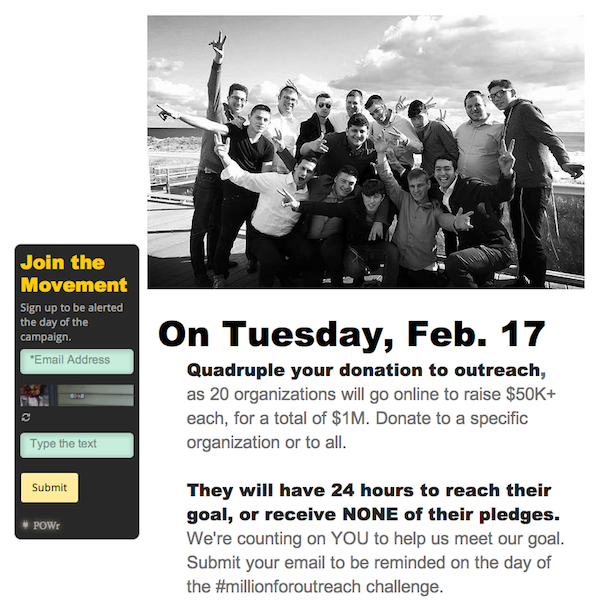
Twenty Orthodox Jewish outreach groups to fundraise together.

The Association for Jewish Outreach Professionals (AJOP) has issued a challenge to North American Orthodox Jewish outreach organizations to raise $1 million in one day collaboratively. And it’s all or nothing.

Each of 20 outreach organizations will have 24 hours to raise approximately $50,000 or more, each using the crowdfunding platform charidy.com:

  • All donations pledged online on Feb. 17 will be matched by three donors, quadrupling each gift.
  • If the organizations do not meet their online goals within 24 hours, none of the pledges will be processed or collected for any of the organizations.

Rabbi Yitzchok Lowenbraun, national director of AJOP, explained, “This ambitious event is designed to increase support for the participating organizations, allowing them to spend more of their time on outreach, and less time on fundraising. At the same time, we hope to give hundreds of people who would give a gift to kiruv [bringing secular Jews closer to Orthodox Judaism] a chance to show their support, as well as encourage new donors who have an affinity for kiruv and would give $10, $18 or $100 if they had an easy way to do it. At the end of the day, donors at all levels will see how significant their support is and that they are partners in a much bigger picture – their donation to a local organization will help leverage $1 million for the klal [whole].”

Participating organizations include UJCEEA (United Jewish Communities of Eastern Europe and Asia), Judaic Heritage (University of Maryland, Baltimore), Meor NYU (New York University), Aish Israeli, Aish Jerusalem, OU (Orthodox Union) NextGen and NCSY (National Conference of Synagogue Youth) alumni program.

The donation page (charidy.com/millionforoutreach) will only be open on Feb. 17, but earlier this week, information about the event was posted on millionforoutreach.com.

Format ImagePosted on February 13, 2015February 12, 2015Author AJOPCategories WorldTags AOJP, charidy.com, fundraising, kiruv, Orthodox1 Comment on One day to raise $1 million
Israel-China economic ties keep growing

Israel-China economic ties keep growing

A senior delegation from Shengjing visits JVP in Jerusalem. (photo by Yael Rivkind, JVP, via israel21c.org)

Fiona Darmon, a partner at JVP, one of Israel’s most successful venture capital funds, was recently in China at a meeting with a large investor. She sat in his office for more than an hour, chatting with him about everything but business. Only then, she said, did he nod to his subordinates, and Darmon was taken into another room, where the business discussions began.

“The mindset in China is that if we’re going to do business and I’m going to entrust you with my capital, let’s see if we have a personal rapport before I even move to the next step,” Darmon told this reporter. “It’s about you as a person, first.”

Israelis are not known for their patience, and that can be a challenge, said Ilan Maor, a managing director of Sheng-BDO (Business Development Organization) and a former Israeli consul in China. Yet economic ties are “booming,” he said.

“The most important aspects of the commercial cooperation are gradually moving from buying and selling toward the main pillars of the future of technology and investment,” Maor explained. “China is taking its place gradually as a strategic player in the Israeli market.”

As an example, the Chinese company Bright Star is on the verge of buying a majority stake in Tnuva, Israel’s iconic dairy company. The company is so central to Israel’s image of itself that, on leaving Israel, the last thing you see on the way to duty free is the logo of Tnuva’s cottage cheese container made out of flowers. If the sale goes through as expected, China and Israel’s kibbutz cooperative movement will share ownership of the dairy company.

More and more Chinese business people are visiting Israel looking to invest and to learn from Israel’s entrepreneurs.

“Israel is not only the ‘startup nation,’ it is also the ‘innovation nation,’” said Xueling Cao, director of the Shengjing Group, who was in Israel when she spoke with this reporter. “China is a huge consumer market and Israel is a huge source of innovation and technology, and we can match the two together.”

Read more at themedialine.org.

Format ImagePosted on February 13, 2015February 12, 2015Author Linda Gradstein TMLCategories WorldTags China, economy, Fiona Darmon, Ilan Maor, Israel, JVP, Sheng-BDO, Shengjing, Tnuva, Xueling Cao
Funding for entrepreneurs

Funding for entrepreneurs

Digital Shmita is one of four projects that received 2015 Natan Grants for ROI Entrepreneurs.

A digital Shmita project, Israel’s version of the radio show This American Life, a global initiative promoting tourism to Jewish communities and a foundation supporting Israel Defence Forces soldiers who served in the Yahalom unit were all awarded 2015 Natan Grants for ROI Entrepreneurs.

In late January, the Natan Fund, a giving circle for young professionals, issued its third annual round of dedicated grants for ROI Entrepreneurs, totaling $40,000, to four ROI (“return on investment”) Community members from the United States, Israel and Latin America. These grants will kickstart projects that invite young Jews and the broader community to explore and experience diverse and creative ways of bringing Jewish values and culture into their lives.

The partnership between Natan and ROI Community was formed to connect Natan Fund’s young philanthropists with ROI members who have developed cutting-edge projects to deepen global Jewish engagement. The recipients of the 2015 Natan Grants for ROI Entrepreneurs are:

Digital Shmita (Israel): Digital Shmita is taking the idea of Shmita (Fallow) to the internet. Digital Shmita works in collaboration with Labshul’s FallowLab and the Print Screen Festival for digital culture in Israel. Its ultimate goal is to produce free solutions that will allow everyone to experience Shmita in their daily connected lives. fallowlab.com/digitalshmita.

Israel Story/Sippur Israeli (United States and Israel): Israel Story is a new radio program dedicated to telling the story of a different, diverse Israel. Modeled after National Public Radio’s This American Life, this show seeks to portray the intricacies of Israeli society and showcase its plurality. It seeks to amplify and humanize voices that are rarely heard on the airwaves; to tell long-form, non-fiction tales by, and about, regular Israelis. israelstory.org.

Judaic Tourism (Latin America): Judaic Tourism is a project that works to strengthen Jewish identity through the preservation and enhancement of Jewish heritage. It connects people with history, culture and Jewish life in cities around the world, promoting tourism to Jewish sites and communities and connecting visitors to local Jewish culture. turismojudaico.com.

Yahalom Foundation (Israel): The Yahalom Foundation will be the first nonprofit organization benefiting current and former soldiers of Yahalom, a special forces combat engineering unit in the IDF. The foundation is dedicated to supporting Yahalom commandos during their active-duty service and afterwards, during their reserve duty. amplifiergiving.org/organization/131/yahalom-foundation.

The work of these ROI activists and entrepreneurs dovetails with the Natan Fund’s mission (natan.org) to provide early-stage funding for creative approaches that seek to address some of the central challenges facing the Jewish people and Israel. Among Natan’s goals is to create new access points to Jewish life, especially for younger Jews who are less engaged with existing communal organizations. Its members pool their charitable contributions, set the philanthropic strategy and agenda for the foundation, and allocate funds to organizations that are building new visions for the Jewish people and the state of Israel.

Founded in 2006, ROI Community (roicommunity.org) is part of the Charles and Lynn Schusterman Family Foundation, a global organization that encourages young people to create positive change for themselves, the Jewish community and the broader world. ROI Community members channel a diversity of perspectives, skills and interests toward a shared passion for advancing ideas and partnerships that will strengthen Jewish communities and improve society.

Format ImagePosted on February 13, 2015February 12, 2015Author PuderPRCategories WorldTags entrepreneurship, fundraising, Natan Fund, ROI community
Training Haitian physicians

Training Haitian physicians

Dr. Neil Pollock, second from the left, in Haiti. (photo from Neil Pollock)

Vancouver-based Dr. Neil Pollock has recently returned from a mission to Haiti, where he trained surgeons in newborn male circumcision to help fight against HIV.

Among other benefits, “circumcision reduces AIDs transmission by 60 percent and that would reduce a man’s risk of acquiring HIV. The reason is, the foreskin has receptor cells that selectively bind the HIV virus and promote its uptake into the body. So, by removing the foreskin, you remove the portal of entry for the virus,” explained Pollock, who specializes in circumcision and adult vasectomy.

Pollock was approached to lead the Haiti mission by Dr. Jeffrey Klausner, a medical doctor and professor of medicine at UCLA, specializing in infectious disease. Klausner volunteers with GHESKIO, a nongovernmental organization run out of the Centre for Global Health at Weill Cornell Medical College in partnership with the Haitian government.

In a phone interview with the Independent, Klausner said that, around 2007/08, “evidence became very clear that circumcision was a highly effective prevention intervention for HIV and the first priority was to get adolescents and young men circumcised. And, over time, we scaled up progress for newborns.”

After moving from South Africa to Los Angeles, Klausner started working in various countries. It was in Haiti in March 2012 that he connected with GHESKIO. He said it was one of the first NGOs to respond to the AIDs crisis in the early 1980s. Through GHESKIO, he was introduced to Haiti’s first lady, Sophia Martelly, in Washington, D.C., at the International AIDs Conference. Klausner said that, when talking to Martelly about the prospect of introducing newborn circumcision to Haiti, she said, “Absolutely, we’d love to do that, but we don’t have the resources, we don’t have the technical expertise, so we really need to rely on people like you to help us.”

Klausner returned to GHESKIO and worked to organize “a physical place, the proper clean procedure room … certain types of equipment and supplies and autoclaves, sterilized surgical equipment, and the tab was running into tens of thousands, about $50,000…. Once we had the supplies and materials, then the next step was to get the training, and I’m not a surgeon. I contacted the head of circumcision programs in Kenya, a guy named Robert Bailey.”

Bailey directed Klausner to Pollock. Klausner said he was “encouraged by [Pollock’s] enthusiasm and … set up a training program for May 2014.” (see jewishindependent.ca/vancouver-doctor-will-train-doctors-in-haiti-in-circumcision) However, the mission had to be postponed to November, as just days before they were set to depart, an “outbreak of chikungunya fever hit, which is a rare [virus] that causes fever, joint pain, and about one of 100 people can get lifelong arthritis.” In addition, “there was a fire in a supply room and we lost some of the tables we had bought and one of the autoclaves,” and “a box of supplies went missing.”

Despite these and other challenges in organizing and executing the mission, such as difficulties in communication due to power outages and poor internet connections, Klausner said, “I have been doing international work, research and programs for 25 years now and [obstacles are] par for the course. This actually went smoother than many other projects [in which] I have been involved.”

For the Haiti mission, said Klausner, “We had to make sure there were at least 200 parents and babies that were already pre-examined, pre-consented, pre-educated and prepared” because for “a training program like this to be successful you really need to do between 50 to 100 [surgeries] a day in a short period with a lot of cases to make sure the people you are training learn, and learn effectively so they can go on and do this independently and confidently.”

Pollock said he had “arranged to train two surgeons, in case one of them did not have the aptitude to succeed – in the end, one did not, and it was difficult of course to tell him that, but it was clear that it would not be safe to pass him and enable him to operate on patients.”

With the use of the technique he taught in Haiti, said Pollock, recovery time will be reduced compared to current Haitian practices “because there is so little trauma caused during surgery.”

Klausner offered three measures for the mission’s success. “One is the actual conduct of safe, well-done circumcision on the babies that Dr. Pollock and his colleague Pierre Crouse did. That’s an achievement in itself: they did over 100 infants in two and a half days. The second part is that the surgeon and the teams that were trained, they continue to do it themselves, so they have done an additional 100 since we left. And then the third piece is that we have trained the trainers, and now other teams are being trained” to perform the surgery.

Klausner’s and Pollock’s efforts in combating HIV and AIDs received notice from some high-profile celebrities. “I was quite surprised to get a text from Sean Penn on the day after we landed in Port-au-Prince that he wanted to come down and meet and observe what myself and my team were doing and discuss synergies between our global interests in promoting health care,” said Pollock. Penn was joined by Charlize Theron, “who was also interested in discussing collaborative efforts in association with her foundation helping improve health care for the people in her native country of South Africa.”

Klausner said, “I have been working in eastern South Africa, KwaZulu-Natal province … with the public health leaders there to introduce a similar effort where we would train surgeons, create a permanent resource, such as a training program, to expand the number of trained doctors or medical officers in newborn circumcision.” In that province, he said, “40 percent of people have HIV infection” and “75 percent of women aged 30 have HIV. So, right now, that part of South Africa … is in a complete, out of control, HIV epidemic. I helped introduce adult circumcision there, but I think, to have greater impact in the long term, we need to introduce newborn circumcision.”

He added, “I believe Dr. Pollock had a very positive experience [in Haiti] and I suspect he is optimistic about the possibility to go and do it again elsewhere.”

Zach Sagorin is a Vancouver freelance writer.

Format ImagePosted on February 6, 2015July 2, 2020Author Zach SagorinCategories WorldTags AIDS, circumcision, GHESKIO, Haiti, HIV, Jeffrey Klausner, Neil Pollock
Clues to the end game

Clues to the end game

On Jan. 28, Israeli soldiers in the northern Mount Dov region are pictured after an Israel Defence Forces patrol came under anti-tank fire from Hezbollah terrorist operatives. The Hezbollah attack killed two Israeli soldiers and injured seven others. (photo by Basal Awidat/Flash90)

Who was behind the Jan. 28 attack on northern Israel that killed two Israeli soldiers and wounded seven others? The easy answer is the Lebanon-based terrorist group Hezbollah, which claimed responsibility for the attack. But the wider view suggests Hezbollah’s state sponsor: Iran.

Dr. Ely Karmon, a senior research scholar at Israel’s International Institute for Counterterrorism, said that Hezbollah’s actions represent “an attempt to change the strategic rules of the game.” According to Karmon, Iran and Hezbollah have been working for months to take advantage of instability in Syria in order to create a forward military position against

Israel in Syria’s Quneitra region, close to the triple Syria-Lebanon-Israel border.

“This is actually an Iranian project,” Karmon told this reporter. “They have around 1,500 people on the ground in Syria, most of whom are counseling or training Syrian militias, and they have Hezbollah providing military support.”

On Jan. 28, Hezbollah fired five Kornet guided anti-tank missiles at an Israeli military convoy approximately 2.5 miles inside Israel’s border with Lebanon. A day earlier, less sophisticated mortars were fired from southern Syria into Israeli territory, with no damage reported.

In response to the Jan. 28 attack, Israeli Prime Minister Binyamin Netanyahu said, “Whoever is behind today’s attack will pay the full price.” Netanyahu – like Karmon – stressed that the attack points back to Iran, adding, “with the assistance of Hezbollah, Iran has been for some time trying to open another front against Israel on the Golan Heights. We are acting with force and determination against these attempts.”

“Because of the weakness of the Syrian regime, the Iranians are now permitted to have a foothold directly on Israel’s border, which until now they didn’t have,” Karmon explained.

Israel is widely believed to be responsible for a Jan. 18 airstrike against that foothold in southern Syria, which killed six Hezbollah operatives and six Iranians, including notorious Hezbollah commander Jihad Mughniyeh and Iranian general Mohammad Ali Allahdadi.

Karmon believes the airstrike “was a message sent by Israel” to forewarn Iran and Hezbollah not to continue their military efforts in Syrian territory.

The retaliatory attacks by Hezbollah following the deadly airstrike were widely expected. That the more sophisticated Kornet anti-tank missiles were fired from Lebanon and not Syria provides a strong indication that the Syrian position is not as well-stocked with weaponry as southern Lebanon – a zone that was supposed to remain completely demilitarized under United Nations Security Council Resolution 1701, which arranged for the cessation of hostilities following the Second Lebanon War of 2006.

“Resolution 1701 calls for complete disarmament in southern Lebanon and, yet, Hezbollah, instead of disarming, they have amassed some 80,000-90,000 missiles,” Karmon said.

“Now, they want to achieve the same equation in southern Syria. If Israel does not stop them, and there are two to three years with relative quiet, with only occasional penetrations of our border and sometimes mortar fire and so on, a kind of ‘war of attrition,’ then all of a sudden we will find ourselves staring at 5,000-10,000 missiles,” he said.

Read more at jns.org.

Format ImagePosted on February 6, 2015February 5, 2015Author Alex Traiman JNS.ORGCategories WorldTags Binyamin Netanyahu, Ely Karmon, Hezbollah, Iran, Israel, Syria, terrorism
A return to Auschwitz

A return to Auschwitz

Mordechai Ronen (Canada) is embraced by Ronald Lauder. (photo by Shahar Azran)

Fifteen Auschwitz survivors, aged 80-94, returned to the infamous camp – some for the first time – ahead of the 70th anniversary celebration of its liberation on Jan. 27. Joining the survivors on their visit was Ronald S. Lauder, president of the World Jewish Congress, who, along with the USC Shoah Foundation, organized the delegation of returning survivors from across the world.

“When I arrived in Poland, the tall trees made me immediately anxious. They reminded me of my arrival to Auschwitz – the same day my mother and little sister were gassed,” said Johnny Pekats, 80, one of the American survivors who returned to the death camp for the first time. “For years, I refused to return to this horrible place, but I finally decided to come back with my son. I wanted to say Kaddish with him there. This is my first and last visit to Auschwitz and my message for the world is that it’s not enough just to remember; we have to make sure that this never happens again.”

More than 100 Auschwitz survivors from at least 19 countries traveled to Poland as part of the WJC delegation to participate in the ceremony.

“I deeply admire the courage of these survivors,” said Lauder, who joined them at Auschwitz. “For some of them, this was the first time they returned to the place of their nightmares. Each survivor is a living testament to the triumph of good over evil, of life over death, and they are my heroes.”

There was also a reception at a Krakow hotel for the survivors and other guests, at which film director and founding chair of the USC Shoah Foundation Steven Spielberg said, “Their testimonies give each survivor everlasting life and give all of us everlasting value. We need to be preserving places like Auschwitz so people can see for themselves how evil ideologies can become tangible acts of murder. My hope for tomorrow’s commemoration is that the survivors will feel confident that we are renewing their call to remember. We will make sure the lessons of the past remain with us in the present so that we can now and forever find humanitarian ways to fight the inhumanity.”

Format ImagePosted on February 6, 2015February 5, 2015Author World Jewish CongressCategories WorldTags Auschwitz, Holocaust, Johnny Pekats, Ronald S. Lauder, WJC, World Jewish Congress
Blaney addresses UN

Blaney addresses UN

Minister Steven Blaney addresses an informal meeting of the United Nations General Assembly on Jan. 22. (photo from Public Safety Canada)

The Hon. Steven Blaney, Canada’s minister of public safety and emergency preparedness, on Jan. 22 delivered a statement addressing concerns of a worldwide rise in antisemitism. The speech was delivered at an informal meeting organized in New York by the United Nations General Assembly. Blaney addressed the assembly and delivered the statement to more than 50 UN member states, as well as special guests. His remarks were as follows:

“Mr. President, Mr. Secretary General, members of the General Assembly, distinguished guests, dignitaries and senior representatives, Mr. [Bernard-Henri] Levy, Mr. [Elie] Wiesel, ladies and gentlemen:

“Elie Wiesel is a man who lived through the horror of the Holocaust. He has called it ‘Night.’ He has spent his life fighting antisemitism, repression and racism. He is a source of inspiration in assuming mankind’s duty to remember.

“For Canada, Israel has an absolute and non-negotiable right to exist as a Jewish state. Indeed, almost exactly one year ago, our Prime Minister [Stephen] Harper stood in the Knesset in Jerusalem to declare that, through fire and water, Canada would stand with the people of Israel in the face of antisemitism.

“Our Canadian government has adopted an unequivocal approach against groups that spread hatred of Jews, rewrite history, publicly deny historical facts and the scope of the extermination of Jews during the Holocaust [or] are in favor of terrorist acts committed against the state of Israel.

“Sadly, recent events demonstrate that hatred of Jews is in resurgence around the world. The antisemitic attack on a kosher supermarket in Paris occurred on the heels of the horrific jihadist terror attack on Charlie Hebdo journalists.

“On Jan. 10 of this year, I had the privilege of laying a floral tribute in Paris – in front of the Hyper Cacher market – in honor of the victims of those cowardly terrorist attacks.

“Those voices that are being assassinated today and those pens that are being broken through violence are attacks on our own freedom of expression, our own liberty, our democracy, our way of life and our reason for being.

“The world will not be destroyed by those who do evil, but by those who watch them without doing anything. That is why Canada is a leader in the fight against ISIL and is working with a broad coalition of allies to reduce the very real threat posed by that group and terrorists who attack us. As Canada’s Foreign Minister John Baird said during a recent trip to Israel, ‘the great struggle of our generation is terrorism.’

“This very week, we witnessed threats and acts of vandalism against Jewish religious institutions, particularly the Beth Israel synagogue in Alberta.

“In 2010, the prime minister spoke at the Ottawa Conference on Combating Antisemitism, clearly outlining the real threat of antisemitism and Canada’s duty to respond. He said: ‘We must speak clearly. Remembering the Holocaust is not merely an act of historical recognition. It must also be an understanding and an undertaking. An understanding that the same threats exist today, and an undertaking of a solemn responsibility to fight those threats.’

“It was then in Canada, along with 50 other nations, that the Ottawa Protocol on Combating Antisemitism was signed; a robust action plan to share ideas and exchange practices about the best ways to combat and eliminate antisemitism around the world.

“Canada has taken a zero-tolerance approach to antisemitism and all forms of discrimination, including in rhetoric towards Israel and attempts to delegitimize Israel, such as the boycott, divestment and sanctions movement. This is because we have seen time and again that those who threaten the existence of the Jewish people are a grave threat to us all.

“More work needs to be done to combat the scourge of discrimination inherent to antisemitism and, under Prime Minister Harper’s leadership, Canada will continue to be a leader in those efforts.

“As I clearly stated to Jews with whom I met this year in Montreal, Paris or Jerusalem, Canada is your friend and your ally. You can count on our friendship and our untiring support.”


Format ImagePosted on January 30, 2015January 29, 2015Author Public Safety CanadaCategories WorldTags antisemitism, Charlie Hebdo, Holocaust, Hyper Cacher, Steven Blaney, United Nations
Preserving culture, heritage

Preserving culture, heritage

Israeli food critic Gil Hovav, left, and Jack Gottlieb. (photo by Shahar Azran)

The newly formed World Jewish Heritage Fund (WJH) recently unveiled a planned global digital platform to protect and promote Jewish cultural heritage around the world during an event at the haute Israeli eatery Balaboosta in the heart of New York’s Soho neighborhood.

WJH founder Jack Gottlieb, an American expatriate based in Tel Aviv, introduced the ambitious project at the trendy restaurant on Jan. 14 night with the e-book Israel’s Top 100 Ethnic Restaurants serving as a digital appetizer to a wider menu of planned technology, including mobile applications, that will put the power of online, collaborative communications in the hands of the Jewish community to preserve Jewish heritage.

“We decided that what was needed was a kind of UNESCO for Judaism,” Gottlieb said. “Think of us as a cross between UNESCO, Wikipedia and Trip Advisor, with Jewish heritage and culture being the unique components tying it all together.”

Gottlieb founded the WJH as a nonprofit to preserve and protect the world’s Jewish heritage sites after he realized that no other organization was solely dedicated to that mission. After a trip to see Jewish sites in Belarus and Ukraine, Gottlieb said he realized “they had no voice; no one knew about them and they were falling into disrepair. I thought, ‘Can we do something about this?’” he said.

So, Gottlieb set out to build what he calls the World Jewish Heritage Preservation Model. “Using digital-tourism tools in order to push more and more visitors to Jewish heritage sites and cultural events will create incentives for countries, local authorities and organizations to keep preserving and investing in their Jewish heritage assets, which will further promote tourism to these sites and events, creating an eco-system of Jewish heritage tourism,” he explained.

The first type of heritage the organization is set up to preserve is Jewish culinary heritage, via its new e-book about Israel’s hidden ethnic culinary gems, and an e-book series to follow, about Jewish cuisine in North America and Europe. “We chose food as the first aspect of our heritage we’re trying to preserve, as it represents such an important part of our culture,” Gottlieb said. “It’s the stories behind the food, and behind the people who make it, that are the gateway to so many other aspects of our heritage.”

WJHtravel, a travel app, is currently in beta testing, and is available at the App Store; the WJHpedia, a community-based resource, fully integrated with both the app and the e-book, is available online for users to share their experiences of Jewish heritage travel all around the world.

To help celebrate the event, Balaboosta offered classic and modern Israeli foods, like fried olives, mini falafel, kubeh, bourekas, Moroccan carrot salad and a lemony cocktail made with arak. Also telling the WJH story was Israeli food critic, author and TV personality Gil Hovav, who regaled a crowd of food bloggers and other foodies with stories about his life in Israeli cuisine.

To learn more about WJH, visit worldjewishheritage.com.

Format ImagePosted on January 30, 2015January 29, 2015Author World Jewish Heritage FundCategories WorldTags Balaboosta, Gil Hovav, Jack Gottlieb, WJHtravel

Turkey under scrutiny

Paris terror suspect Hayat Boumedienne’s recent escape from France to Syria has renewed concern about Turkey’s ability and willingness to prevent terrorists from transiting through its territory.

Boumedienne is the romantic partner and alleged accomplice of Amedy Coulibaly, who was shot dead by police after killing four people in a kosher supermarket and shooting a police officer in Paris on Jan. 9. Airport footage shows Boumedienne’s arrival from Madrid to Istanbul on Jan. 2, and Turkish Foreign Minister Mevlüt Çavusoglu said she crossed the border to Syria six days later.

Turkey has been the subject of intense criticism from Western governments and commentators over its perceived lack of effort in stemming the flow of foreign fighters crossing its borders. However, some think this isn’t quite fair.

“I think it’s somewhat of a misplaced criticism,” said Sinan Ülgen, a scholar at Carnegie Europe. Though the Turkish government may have formerly looked the other way at the activities of Islamist groups because of a desire to bring down the Assad regime at any cost, “that policy by and large had changed by April 2014,” according to Ülgen.

At that time, Interior Minister Efkan Ala made an effort to enhance border security, “having realized the risks of getting into that sort of relationship with extremist groups,” said Ülgen. However, researcher Gareth Jenkins says it’s still very easy for foreign fighters to cross through Turkey.

“When you look at the ease with which [terrorists and would-be fighters] are able to go back and forth across the border, there still isn’t a full clampdown,” Jenkins said. “It’s not as easy as it used to be, but it’s still pretty easy.” He said he recently personally witnessed fighters in a Turkish village near the Syrian border. “There were jihadists sitting around waiting to go across.”

With some 40 million tourists visiting Turkey every year, border security is no easy task, but Jenkins says security forces could be doing a lot more. He claimed that difficulty over border security isn’t the only reason for Turkey’s failure at curbing the flow of foreign citizens seeking to join the ranks of ISIS and other groups.

Read more at themedialine.org.

Posted on January 23, 2015January 21, 2015Author Nick Ashdown TMLCategories WorldTags Gareth Jenkins, Hayat Boumedienne, security, Sinan Ülgen, terrorism, Turkey

Posts pagination

Previous page Page 1 … Page 28 Page 29 Page 30 … Page 33 Next page
Proudly powered by WordPress