Skip to content
  • Home
  • Subscribe / donate
  • Events calendar
  • News
    • Local
    • National
    • Israel
    • World
    • עניין בחדשות
      A roundup of news in Canada and further afield, in Hebrew.
  • Opinion
    • From the JI
    • Op-Ed
  • Arts & Culture
    • Performing Arts
    • Music
    • Books
    • Visual Arts
    • TV & Film
  • Life
    • Celebrating the Holidays
    • Travel
    • The Daily Snooze
      Cartoons by Jacob Samuel
    • Mystery Photo
      Help the JI and JMABC fill in the gaps in our archives.
  • Community Links
    • Organizations, Etc.
    • Other News Sources & Blogs
    • Business Directory
  • FAQ
  • JI Chai Celebration
  • JI@88! video

Recent Posts

  • Eby touts government record
  • Keep lighting candles
  • Facing a complex situation
  • Unique interview show a hit
  • See Annie at Gateway
  • Explorations of light
  • Help with the legal aspects
  • Stories create impact
  • Different faiths gather
  • Advocating for girls’ rights
  • An oral song tradition
  • Genealogy tools and tips
  • Jew-hatred is centuries old
  • Aiding medical research
  • Connecting Jews to Judaism
  • Beacon of light in heart of city
  • Drag & Dreidel: A Queer Jewish Hanukkah Celebration
  • An emotional reunion
  • Post-tumble, lights still shine
  • Visit to cradle of Ashkenaz
  • Unique, memorable travels
  • Family memoir a work of art
  • A little holiday romance
  • The Maccabees, old and new
  • My Hanukkah miracle
  • After the rededication … a Hanukkah cartoon
  • Improving the holiday table
  • Vive la différence!
  • Fresh, healthy comfort foods
  • From the archives … Hanukkah
  • תגובתי לכתבה על ישראלים שרצו להגר לקנדה ולא קיבלו אותם עם שטיח אדום
  • Lessons in Mamdani’s win
  • West Van Story at the York
  • Words hold much power
  • Plenty of hopefulness
  • Lessons from past for today

Archives

Follow @JewishIndie
image - The CJN - Visit Us Banner - 300x600 - 101625

Category: Life

A vegan Passover

A vegan Passover

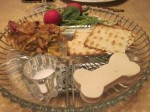
A vegan seder plate. (photo by Gene Blalok)

Veganism is about much more than dietary choice. It is an ethical philosophy based on the belief that other animals are not ours to use. Like humans, animals are sentient: they experience pain and pleasure, they suffer and they form deep emotional bonds with others in their families and communities. Vegans do not use animals for food, clothing, entertainment or animal experimentation regardless of taste, pleasure or tradition. Being a vegan is also much more commonplace today, as is following a vegan diet for health reasons. This means it might not be unusual to find a vegan at your table on Passover.

For the fourth year in a row, my wife and I will be hosting an all-vegan Passover seder, or “veder,” as we call it. We started this tradition after a group of Jewish vegan friends expressed how alienating it can be to celebrate the holiday in the traditional way. As ethical vegans, it is difficult to sit at a table laden with the body parts of the nonhuman animals that we are working to protect and rescue. Many had stopped attending their family dinners, and one friend was no longer invited simply because others felt uncomfortable when she passed up most of the food on the table. But our hunger for the Jewish tradition of Passover remained.

The Passover seder commemorates our liberation from Pharaoh and the larger issue of the immorality of slavery. As Jews, we have a long history of suffering, oppression and slavery and, as animal activists, this has informed our choices to work to help others end their own oppression – including animals. It’s no wonder Jews have played key roles in other movements such as civil rights, women’s rights, gay rights and animal rights. The liberation of animals is another social justice movement for which the Jewish community should naturally feel empathy. Jews and vegans share common values such as justice, fairness, equality and compassion.

How we as animal activists celebrate the meaning of the Passover seder is to remember the evils of the past and to expand our circles of compassion and justice so that no group, human or nonhuman, need experience the suffering and exploitation of being different or unequal. Passover is a great opportunity to reflect on how we can create less suffering for all those who are oppressed through our personal behaviors and choices.

Simply adding vegan foods and vegan versions of traditional dishes to the table is a way of making a statement that we include the most vulnerable and innocent among us when we celebrate this holiday. These days, it’s as simple as Googling “vegan [whatever dish] recipe,” vegan or “vegan Passover recipes,” and thousands of animal-free options will magically appear. At our veder, we serve all of the traditional dishes we grew up eating – matzah brie, brisket, gefilte fish, potato latkes, matzah ball soup, kugel, macaroons – in veganized versions without meat, dairy or eggs.

With a little effort and creativity, your entire seder dinner can be made vegan. We even have an animal-friendly seder plate. Instead of a lamb shank bone, we use a dog cookie-cutter to make a playful bone-shaped piece of tofu. Instead of an egg, we use a small dab of commercial “egg replacer” used in vegan baking. I encourage all Jews to embrace the meaning and tradition of the holiday while also incorporating new traditions that reflect values of justice, ethics and compassion. When we can celebrate the holiday without doing any harm to others, why wouldn’t we?

VEGAN CHOPPED LIVER

Adapted from The Jewish Vegetarian Year Cookbook by Roberta Kalechofsky and Roda Rasiel (Micah Publications, 1997).

1/2 lb brown lentils
1 large onion, diced
2 tbsp olive oil
1 cup walnuts
salt and pepper to taste

1. Put lentils in a two- or three-quart pot and cover with water. Bring to a boil, partially cover and simmer until tender, about 30-40 minutes. Check occasionally to make sure water has not boiled off, and add water as needed.

2. Sauté onions in olive oil until golden and tender. Allow to cool slightly.

3. Drain lentils and blend, along with the walnuts and onions, in a food processor until homogenized, but leave some of the texture intact.

4. Add salt and pepper to taste. Chill about two hours.

Gary Smith, co-founder of Evolotus, a PR agency working for a better world, blogs at thethinkingvegan.com and has written for many publications. He and his wife are ethical vegans and live in Los Angeles with their cat Chloe and two beagles rescued from an animal testing laboratory, Frederick and Douglass.

(Editor’s note: Some vegan recipes will contain ingredients that are not strictly kosher for Passover. For those who are less strict, the options abound. For more strict kosher diets, incorporate dishes that are heavier on fruits and vegetables, and avoid using legumes, like lentils, or products that contain wheat or gluten. Also, only certain egg substitutes are kosher for Passover, and many Ashkenazi Jews abstain from eating kitniyot on Passover; tofu is made from soybeans, and is considered to be kitniyot.)
Format ImagePosted on April 11, 2014April 16, 2014Author Gary SmithCategories Celebrating the HolidaysTags Passover, Roberta Kalechofsky, Roda Rasiel, seder, The Jewish Vegetarian Year Cookbook, vegan

Trading in the perfect life for more

Why would someone who had a “perfect” life trade it in for a different one? Fifteen years ago, I did just this. And, no, I didn’t leave the husband or abandon the kids or take off to Fiji. I was a Canadian, secular, Jewish, urban, working mom with young kids, piles of laundry to do and diapers to change. Yet, something was missing; in those precious micro-moments when I had time for a small thought, I realized I wanted to learn how to teach my children values.

photo - Nicole Nathan
Nicole Nathan

Yes, I had taken multiple parenting classes and workshops, enrolled my young kids in art classes, library groups and bought tickets for every cultural show that came to town. They saw Chinese acrobats, Balinese shadow puppets and the Bolshoi Ballet. It was all enriching, entertaining and cosmopolitan, but not substantive and enduring. Until I took a class taught by a rabbi – and then another. And another.

The wisdom they offered was enlightening, profound, inspiring. My husband and I learned more and more, diving into an enriched, exciting new world.

Before we could utter the words “shomer Shabbos,” we had become Torah-observant Jews. We turned our lives upside down, even trading in a designer, ceramic kitchen sink for a kasherable version.

After a year, my family was 100 percent certifiably kosher and Shabbat observant. My husband and I enrolled our children in religious Jewish schools and we moved closer to the Orthodox shul. But we soon discovered that living in a Torah-observant community was more complex than wearing a head covering and going to shul. We also realized that our Jewish journey had only just begun.

We were ba’alei teshuvah (BT), newly Observant Jews. We had learned a lot and felt that we knew nothing, just like the light bulb joke that asks how many ba’alei teshuvah it takes to change a light bulb? Answer: is it allowed?

Is it? Can we do this? What will the neighbors think? Will our kids be accepted? I agonized over these thoughts and dreaded “Jewish geography” at the Shabbos table, fearing my past would be unmasked. I wanted to fit in seamlessly.

image - Let My RV Go! cover
Nicole Nathan published her first novel, Let My RV Go!, in 2013.

In our early BT days, we tried to belong in our new religious community, yet understood that we did not belong anywhere. Our secular friends and family shook their heads in dismay, labeling us crazy, while the religious Jewish community thought we were unusual. So, our close friends became other ba’alei teshuvah and, together, we would share inspiring stories, confide our blunders and insecurities and laugh out loud at our outrageous, most embarrassing mistakes. Those Shabbat meals spent with BT friends were funny, meaningful and stranger than fiction and, over the years, provided great material for my first novel.

Some of my BT friends molded themselves until they fit snugly into their newly adoptive Orthodox communities. And they felt fulfilled.

For others, myself included, it was not an easy fit, as I did not want to reinvent everything about myself; I just wanted a “kosher” version of me. I struggled with this for years and eventually decided to embrace my past and not hide from it.

Secular or religious, I learned that all Jews have something unique and important to contribute. Yet, we have to first respect each other so we can learn from one another.

Unfortunately, there is a disconnect and distrust between the secular and Orthodox communities, both in North America and in Israel. And, sadly, the Jewish people are a small, fragile and threatened nation. Now, more than ever, we must develop tolerance and respect, and reach out to support each other. As Rav Kook explained in his commentary Ein Aya, truth is built from different viewpoints and positions. Only this enriches wisdom and brings peace.

Forget Fiji. Life is a journey filled with countless opportunities to grow together. May we take the path that helps us understand our differences so we can respect each other.

Nicole Nathan is the author of the novel Let My RV Go!, a humorous, insightful look at becoming religious that seeks to bridge the gap between secular and observant Jews. It is available in paperback and as an ebook.

Posted on April 11, 2014April 10, 2014Author Nicole NathanCategories LifeTags ba'alei teshuvah, Let My RV Go!, Nicole Nathan
Israel: a bucket list for kids

Israel: a bucket list for kids

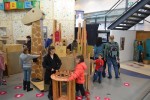
Holon Children’s Museum is a children’s museum unlike any other.
(photo by Lauren Kramer)

Take small kids with you to Israel and one thing is for sure: you’ll want to have more on your itinerary than holy sites and 2,000-year-old ruins. Fortunately, this small country has a diverse range of fun family attractions that appeal to toddlers, kids and preteens. From a biblical zoo to a chocolate factory and science museum, here are some highlights that will keep your kids smiling in the Holy Land.

Jerusalem Biblical Zoo (jerusalemzoo.org.il). This 100-acre zoo started as a petting zoo in the 1940s and now includes more than 300 species, a quarter of them animals that were mentioned in the Bible, such as Syrian brown bears, Persian fallow deer, Asian lions, Nile crocodile and the Asian leopard. There are also many non-biblical animals in this expansive zoo, which easily takes a half-day to explore. Look out for Sumatran tigers, a rhino and a hippo, giraffes, kangaroos, wolves and fruit bats. Many of the animals are under threat of extinction. Israel is the only country in the Middle East offering protection to wolves, for example, and the wolf exhibit tries to raise awareness on how wolves and people can live in harmony. Open year round, the zoo charges $28 for admission for adults and $11 for kids.

Bloomfield Science Museum (mada.org.il). When it first opened 21 years ago, the Jerusalem museum was the only one in the country: today, it’s one of four. Its interior is far from fancy, but it more than compensates in its wide range of innovative exhibits, a selection geared to entertain and engage all age groups, from 3 through 83. “Hands-on” is the theme here and, in every exhibit, visitors are encouraged to touch, play and explore. We visited during Chanukah, when the museum had set up a station for kids to build their own unique spinning tops using recycled materials. We loved the light and shadow exhibit, a labyrinth of rooms that combine art with the science of how light and shadow interact. Other exhibits explain the connection between physics and how amusement parks work, how electricity is distributed, and how science and technology play out in some of Israel’s favorite children’s stories. Free for kids under five, the museum charges $12 for kids and adults or $45 for families.

Galita Chocolate Factory (galita.co.il). Combine kids and chocolate and the result is delight, especially if the experience includes making your own treats. The chocolate factory at Kibbutz Degania on the Sea of Galilee offers a selection of kid-focused workshops with various candy-making projects, from building and decorating a miniature chocolate candy house to creating chocolate lollipops, truffles and more. Kids play with mixtures of white and brown chocolate and carefully decorate their creations before the finished versions are refrigerated and taken home. An on-site chocolate shop sells the creations of Galit Alpert, the Belgium-trained Israeli owner whose delicacies are irresistible. Prices range from $11-$22 per person, depending on the project, and reservations are recommended.

Holon Children’s Museum (childrensmuseum.org.il or 03-6503000, ext. 3). Don’t be fooled by its name – this is a children’s museum unlike any other you’ll ever set foot in. Its four segments cater to vastly different age groups. Kids age nine and up will love Dialogue in the Dark, an exhibit wherein visitors get to experience what it is like to have no vision by taking a tour in complete darkness, in the company of blind guides. Along the way, they experience the various rooms they enter by relying on their other senses. Likewise, in Invitation to Silence, adults and kids age 10 and up get immersed in a tour of silence, one wherein they need to use other methods of communication – hands, face and body – to communicate emotions and reactions. In Dialogue with Time, visitors explore the concept of aging through experiences and games. They’re invited to identify various songs and objects that crisscross the generation gap, and to experience what it feels like to lose dexterity in the hands and feet by donning special gloves and shoes. Talking figurines reflect on their different experiences of aging and the entire experience invites discussion, dialogue and contemplation on what it means to age gracefully. Finally, in the only segment of the museum that remotely resembles a typical children’s museum, children ages 4-8 get to explore the making of music and art using unconventional instruments and objects, led by actor guides. Each tour lasts between 90 minutes and 1.5 hours and costs $15 per segment. Reservations are essential.

Lauren Kramer, an award-winning writer and editor, lives in Richmond, B.C. To read her work online, visit laurenkramer.net.

Format ImagePosted on April 11, 2014April 16, 2014Author Lauren KramerCategories TravelTags Bloomfield Science Museum, Galita Chocolate FActory, Holon Children's Museum, Jerusalem Biblical Zoo
Different sort of pilgrimage – to the Basque

Different sort of pilgrimage – to the Basque

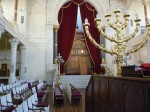
Inside Bordeaux’s Grand Synagogue of the Gironde.
(photo by Karen Ginsberg)

On a recent trip to the Basque, my husband and I learned a great deal about the strong Jewish presence that formerly existed in the region.

The Basque country comprises southwestern France and northeastern Spain. Our journey started in Bordeaux, France, which, strictly speaking, is not part of the Basque. Rather, Bordeaux is the capital of the neighboring Aquitaine region. Our sightseeing there included a visit to the Grand Synagogue of the Gironde, located in central Bordeaux, serving a Jewish population of 1,100. A 2007 brochure given to us on our visit, History of the Jewish Population of Bordeaux, dates the synagogue back to the 1880s, the land for it having been a gift from the city. On the morning of our visit, a young man, soon to be a bar mitzvah, was just finishing his practise session on the bimah, which gave life to the building.

From Bordeaux, we traveled by train two hours southwest to St. Jean de Luz, a mid-size town on the Atlantic coast that is part of the French Basque, where we had rented an apartment. We found our most substantive Jewish Basque connection on a day trip to nearby Bayonne.

photo - Musée Basque et de l’histoire de Bayonne
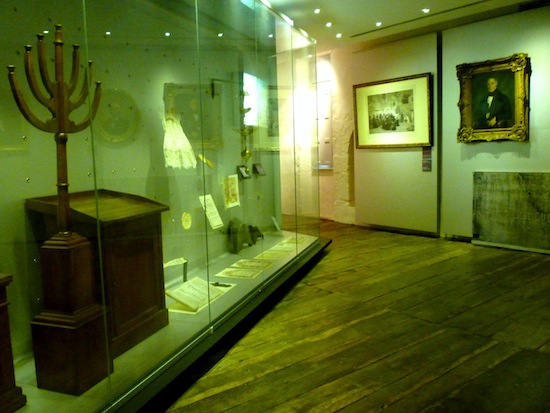
Musée Basque et de l’histoire de Bayonne has quite an interesting collection of Jewish artifacts.
(photo by Karen Ginsberg)

Musée Basque et de l’histoire de Bayonne is a modernized space housing the history and culture of the people of the region. Within, there is a special exhibit that celebrates the presence of Jews in the Basque since the 1600s. The roots of the Jewish community there stem from the migration that took place when the Jews were expelled during the Spanish Inquisition.

Among the collection of artifacts is a beautiful portrait of Augusta Furtado, who, in the 17th century, was a merchant and president of the Israelite Consistory of Bayonne, as well as twice serving as Bayonne’s mayor. The collection also includes furniture and religious objects from a private synagogue in the 19th century, including an ark, menorah and pulpit, a child’s temple presentation dress, circa 1885, a shofar, an 18th-century mezuzah and a sabbatical lamp from a Portuguese ceremony that was used in Bordeaux and Bayonne. One of the most interesting items is a document dated Jan. 19, 1753, entitled The Statues of the Jewish Nation of Saint Esprit, a reiteration of the royal protective orders of 1550 in which the title Jew is used for the first time instead of the term New Christian or Portuguese.

A further Jewish connection in the region has to do with one of the sources of Bayonne’s current fame as a world centre for the manufacture of high-quality chocolate. The chocolate-making skills of the exiled Spanish Jews who settled in the area were put to use. Their contribution to the industry is told at some length in the self-guided tour of the city’s delightful l’Atelier du chocolat. Both my husband and I felt compelled to enjoy a generous chocolate-tasting at the atelier out of respect for our ancestors!

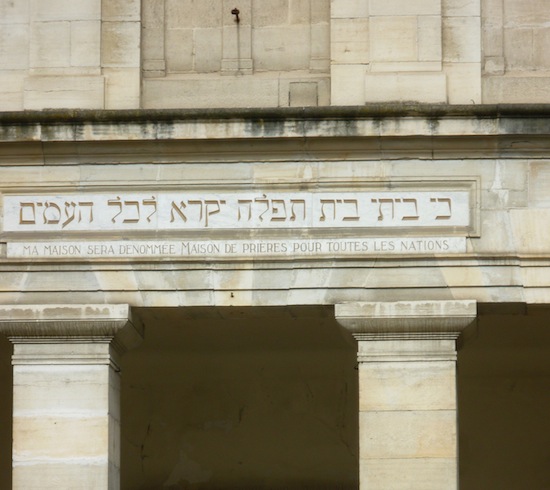
Bayonne has a beautiful synagogue in the core of city, but it is locked behind steel gates with no one available to provide any information on whether and how the building is being used, if at all. Nevertheless, an inscription carved onto the exterior of the synagogue speaks volumes about the vision the community had for this holy place: “Ma maison sera denommée une maison de prières pour toutes les nations.” (“My house will be marked as a house of prayer for all nations.”)

photo - Bayonne’s synagogue is all locked up, but this inscription is clearly visible on its exterior.
Bayonne’s synagogue is all locked up, but this inscription is clearly visible on its exterior.
(photo by Karen Ginsberg)

Signage outside the synagogue gates draws further attention to the pride that the community had in being able to build its own shul: “This place of worship for the Bayonne Jewish community was built in the 19th century by architect Capdeville. The monumental neo-classical-style building illustrates the wish of the community’s leaders to assert the presence of Judaism in the heart of the district and also to provide a single place of worship for the faithful, replacing the private synagogues used previously.”

Our last daylong outing – to Saint-Jean-Pied-de-Port, France – metaphorically closed a circle for us with respect to early Jewish life in the Basque region.

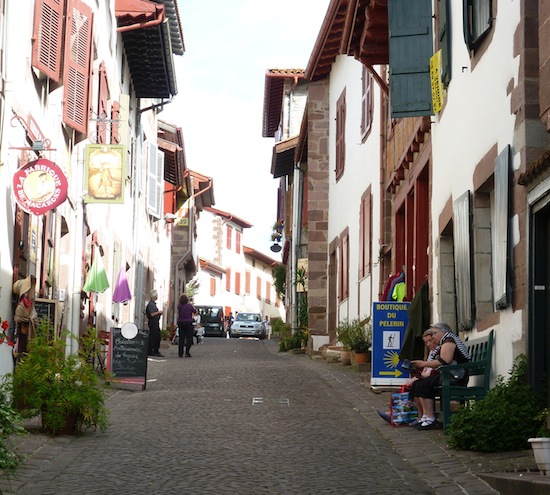
These days, it seems, almost everyone knows someone who has undertaken the six-week walk referred to as the Camino de Santiago (the Way of Saint James). This medieval pilgrimage runs from Saint-Jean-Pied-de-Port, near the Spanish border, more than 750 kilometres northwest of the Spanish city of Santiago de Compostela. There is generally a degree of wonderment and respect accorded to anyone who has retraced those steps. One has only to walk the steep main street of Saint-Jean-Pied-de-Port to understand that there is a hardship to be endured no matter how solid one’s walking shoes or how well-organized is today’s network of rest places along the route. Being in Saint-Jean-Pied-de-Port surrounded by modern-day pilgrims at the start of their journey brought to my mind how different their trek would be to that of the expelled Spanish Jews. I could not help thinking what it must be like to have to flee one’s home under threat of death, travel on foot, by cart and, for some, partially by boat, to hopefully reach the safety of new lands. These Jewish travelers had no fancy walking shoes, no “service centres” along their route and they most certainly traveled with fear in their hearts.

photo - Saint-Jean-Pied-de-Port
Saint-Jean-Pied-de-Port is the starting point for the Camino de Santiago pilgrimage.
(photo by Karen Ginsberg)

My husband and I left the Basque knowing that there were likely many other remnants of a Jewish presence in the area yet to be discovered. Our curiosity peaked, it’s a challenge we will hopefully be able to take up on a future visit.

Karen Ginsberg is a travel writer living in Ottawa.

Format ImagePosted on April 11, 2014May 3, 2014Author Karen GinsbergCategories TravelTags Augusta Furtado, Basques, Camino de Santiago, Capdeville, Israelite Consistory of Bayonne, l'Atelier du chocolat, Musée Basque et de l'histoire de Bayonne
A visit to the Jewish communities in India

A visit to the Jewish communities in India

Steven Finkleman in front of the restored Chennamangalam Synagogue.
(photo by Steven Finkleman)

I had bought my airline ticket to Mumbai in the fall, aiming to track down the remains of the Jewish community in India. I set out with my backpack on Jan. 9 and, after several days, arrived. I had pre-booked a stay at Sassoon House, which is a residence for Jewish travelers at Magen David Synagogue in Mumbai.

Lufthansa pulled in at 2:30 a.m. Perfect time for arrival into a strange city of 18,000,000 people. Somehow, I found a taxi and a Western traveler who wanted to share the ride with me. And, somehow, I managed to give some direction to the synagogue, which is currently situated in the predominantly Muslim district of Byculla. It does take a bit of guts.

We pulled into the synagogue compound around 3:30 a.m. under the watchful eyes of Mumbai’s finest, accompanied by huge spotlights, army tanks and AK47s (all in response to the terrorist attack at a Mumbai synagogue five years ago). I was as cool as a cucumber. My taxi partner at this point was in apoplectic shock.

Fortunately, Mr. David, the caretaker of Sassoon House did answer the phone and let me in for four hours of rest, prior to attending the Shacharit service for Shabbat at 8:45 a.m. Interesting service. I was #11 in attendance, so was superfluous to the congregation. (I often have been #10 in these circumstances, serving as the final man needed to allow the service to proceed.) The service was rapid, Sephardi Orthodox, and the accent of the Baghdadi congregation made following along somewhat challenging. The familiar tunes of the Barchu, the Shma, the Amidah, the Aleinu, were absent and keeping up with the service required heavy concentration on my part after a 36-hour flight and four hours of sleep.

I received an aliyah to the Torah and, when I gave my name as Zalman ben Yaacov, Zalman being a Yiddish name and, therefore, totally unheard of in Mumbai, they interpreted my name as Solomon, and called me up as Shlomo ben Yaacov. Lunch at the rabbi’s home followed. Considerable gin was flowing (considering it was a former British colony) accompanied by lots of traditional Judeo-Marathi songs. I was forced to sing a representative Canadian song and led them all in a rousing version of “Allouette.” The luncheon ended with everyone sharing some snuff! As they all snorted away, I was sure to ask, “Are you certain that this is only tobacco?” before trying some myself.

The Indian community goes back about 2,000 years. Some date it to the expulsion after the destruction of the First Temple, others to after the destruction of the Second Temple. The community has four components.

The Bene Israel and Cochin communities came both around the same time. The Cochin community was likely from seafarers and merchants, possibly dating back to King Solomon’s time. The Bene Israel community around Mumbai dates from a shipwreck 2,000 years ago where seven men and seven women survived. Their holy books were lost, but they remembered to keep the Shabbat, kashrut and brit milah. Generations later, they were tutored by the Cochini community to improve their knowledge of Judaism.

The third community to arrive was the Paradesi community. Paradesi means foreigner, and this group was basically Sephardim who arrived from Spain or via Amsterdam in the 16th century, and headed to Cochin. The fourth group, led by David Sassoon, emigrated from Baghdad, and came in the 18th century, setting up congregations in Mumbai, Pune and Ahmedabad. The Sassoon dynasty was very dynamic both for the Jewish community and the Mumbai community at large.

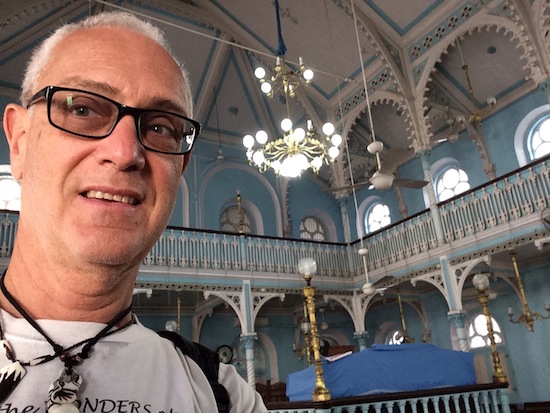
There are several residual synagogues in Mumbai, with some still in use, such as the Baghdadi community’s Magen David (where I stayed) and Keneseth Eliyahoo, along with the original Bene Israel community’s Tiferet Israel synagogue. Five thousand Jews remain in Mumbai, and three or four synagogues hold services on Shabbat. Tiferet Israel has a strong component of younger men.

photo - Inside Keneseth Eliyahoo Synagogue, downtown Mumbai
Inside Keneseth Eliyahoo Synagogue, downtown Mumbai.
(photo by Steven Finkleman)

I was lucky to travel to Cochin (now called Kochi) in Kerala state and, besides spending a wonderful day in Jewtown, Cochin, and visiting the Paradesi synagogue, I also rented a taxi and went to search out the remnants of the Jewish community in more remote areas. I visited two restored synagogues at Parur (or Paravoor) and Chennamangalam (or Chendamangalam), and I visited the Kadavumbagan synagogue in Ernakulum, which was closed 40-50 years ago and remains unrestored.

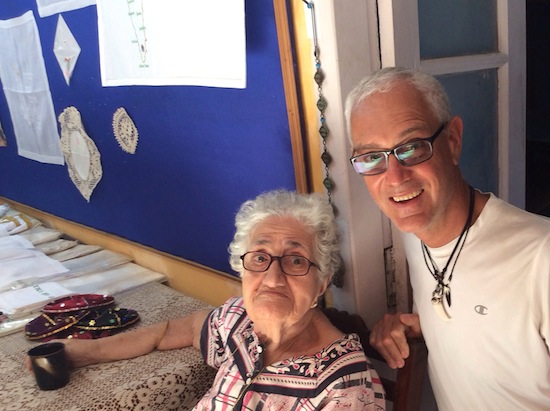
There are about 12 Jews left in Kerala. I spent two days visiting Sarah Cohen. Sarah, 91, is the matriarch of the Cochin Jewish community. She reminded me totally of my Baba Sarah. On my first visit, I asked her if I could bring her anything that she needed. She asked for chocolate and beer, and I returned the next day with some Cadbury. Sarah has an embroidery shop on Jew Street in Jewtown, in the city’s Mattanchery neighborhood, two blocks from the Paradesi synagogue, which is spectacular – it is a national historic landmark, expertly renovated and with excellent historical information.

photo - TSteven Finkleman visits Sarah Cohen in her embroidery shop
The author visits Sarah Cohen in her embroidery shop.
(photo by Steven Finkleman)

I was also able to meet Elias Josephi at the Kadavumbagan synagogue. About 50 years ago, the synagogue disbanded because of lack of membership and Josephi purchased it. He currently runs a plant nursery and an aquarium/fish shop in the antechamber of the synagogue. Behind his desk, the closed door leads to the treasure of the sanctuary, exactly as it was left 40-50 years ago.

At the peak, there may have been about 100,000 Jews in India. Eighty percent of them emigrated to Israel in the 1950s/60s. It is interesting that they remained separate. The Cochinis went to Nevatim and the Bene Israel went to Dimona, Ashdod, etc. Fifteen percent of the Indian Jews went to English-speaking countries such as the United States, Canada, the United Kingdom and Australia, and five percent remain in India today.

What a fascinating Diaspora story. How intriguing that at all ends of the earth, one can find Jewish communities. I believe it was one of our sages who once said, “If there is oxygen, there are Jews.” Or, perhaps, it was me who made up that line!

Steven Finkleman, originally from Winnipeg, is a retired pediatrician living in Kelowna. He travels extensively and often researches and visits remote Diaspora communities on his adventures.

Format ImagePosted on April 11, 2014April 16, 2014Author Steven FinklemanCategories TravelTags Bene Israel, Chennamangalam Synagogue, Cochin, Kadavumbagan, Keneseth Eliyahoo, Magen David Synagogue, Mumbai, Paradesi, Sarah Cohen, Tiferet Israel
This week’s cartoon … April 4/14

This week’s cartoon … April 4/14

For more cartoons, visit thedailysnooze.com.

Format ImagePosted on April 4, 2014May 2, 2014Author Jacob SamuelCategories The Daily SnoozeTags Jacob Samuel, pen is mightier than the sword, thedailysnooze.com
Mystery photo … March 28/14

Mystery photo … March 28/14

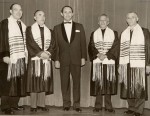
Cantor Herskovits and Schara Tzedeck Choir, Vancouver, 1955. (JWB fonds, JMABC L.14274)

If you know someone in this photo, please help the JI fill the gaps of its predecessor’s (the Jewish Western Bulletin’s) collection at the Jewish Museum and Archives of B.C. by contacting [email protected].

Format ImagePosted on March 28, 2014July 23, 2014Author JI and JMABCCategories Mystery PhotoTags Herskovits, Jewish Museum and Archives of British Columbia, Jewish Western Bulletin, JMABC, JWB, Schara Tzedeck Choir

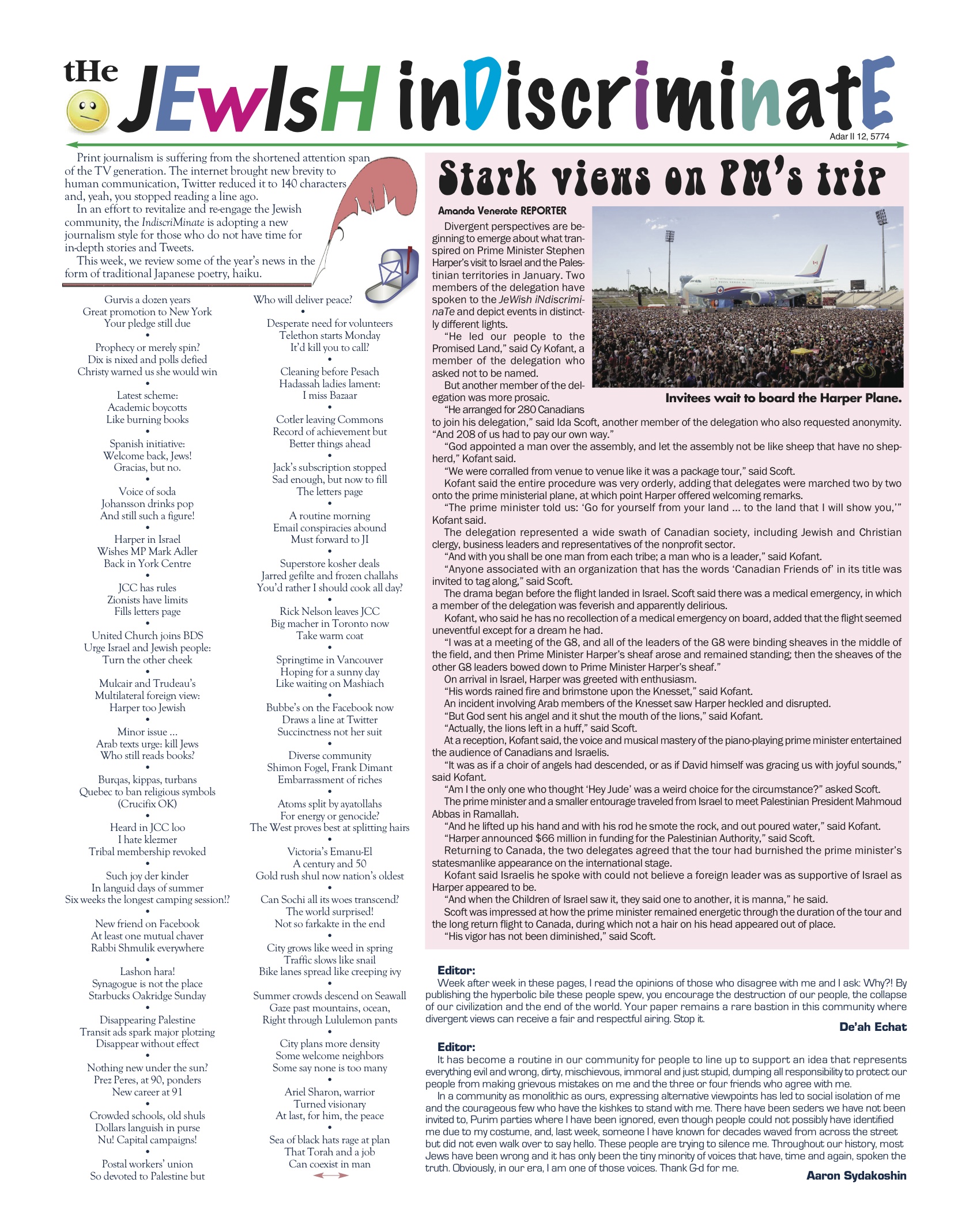
The JeWish InDisCrimInaTe

image - JI Purim Spoof newspaper 2014
Click to enlarge. Happy Purim!
Posted on March 14, 2014March 16, 2016Author FreelancerCategories Celebrating the HolidaysTags Purim, spoof
Add hints of automation for unique and modern home design

Add hints of automation for unique and modern home design

Recessed LED home lighting can make a big statement, inside and out. (photo by Mark Whitehead) 

Customization, once seen as a luxury, can now be found in all facets of consumer products. The newest trend: controlling your home with your fingertips from anywhere in the world.

With the launch of everything electronic and motorized, handheld devices such as your smart phone or tablet are now able to control almost anything with the touch of a finger.  With the newest builds and renovations, home automation, in some form or another, is being specified into the design. Technology has catapulted the use of home automation to the next degree and has become more popular – and more affordable.

Home automation spans a wide breadth of components: from controlling a home’s lighting and window coverings by using a smart phone or tablet, to scheduling timers throughout the day, to turning on and off your central heating and home-entertainment systems. New builds and renovations are taking advantage of open walls, and the trend of installing hidden speakers, wireless routers and other normally obvious audio components into the walls makes the final interior design seamless. Even motorized tracks can be hidden within the ceiling, hiding drapery tracks, for example, which creates additional visual height with true floor-to-ceiling draperies.

Trending with window shades is the option for motorization, as well. The sleek and contemporary designs of roman shades, cellular blinds, even the newest in vertical blinds, can be motorized and fit in perfectly with contemporary home décor. And with many more affordable products on the market, consumers are able to have luxury items without paying the luxury ticket.

The popularity of LED lighting is making a huge impact in interior design. Custom LED home lighting has moved from just changing a light bulb to installing fully recessed indoor perimeter lighting, and even offers various outdoor applications, such as illuminating walkways, pathways and porch lights.

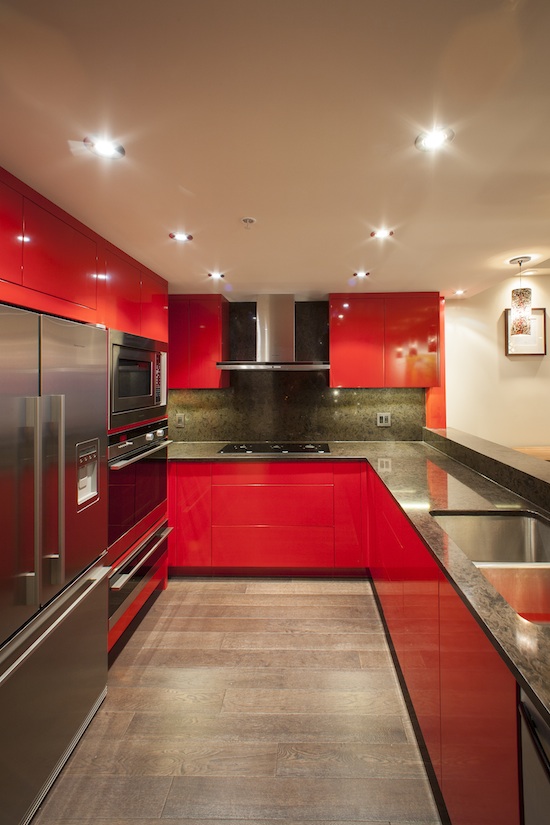
Kitchens are the heart of any home, and esthetic is just as important as functionality in the design of a great kitchen. Hardware mechanisms that provide soft-close drawers and cabinets add an extra bit of luxury to a kitchen’s everyday use. Whether choosing contemporary handles in clear acrylic and chrome, or streamlined and contemporary push-touch cabinetry instead, the selections of hardware are endless.

photo - The esthetic is just as important as functionality in the design of a great kitchen.
The esthetic is just as important as functionality in the design of a great kitchen.
(photo by Mark Whitehead)

Acrylic elements are also creeping into today’s homes in versatile ways other than in the kitchen. Resembling glass, acrylic gives the illusion of glass without the fragility and weight. One of the ways this medium is making a statement in contemporary interior home design is molded into contemporary sculptures. On its own or in a collection, acrylic sculpture can offer a focal point to any room. Some acrylic sculpture suppliers give the option of custom colors, adding an extra personal touch to a statement piece or collection. Especially when beautifully lit, acrylic sculpture brings simple elegance to the home.

Don’t forget about the importance of fabric in home design. This year, texture is big and the more layered the better! Mix different textures with bold patterns to make a statement, or mix soft and sleek textures to create a luxurious atmosphere. Fabrics enhance a room’s décor, creating soft, easy lines and offering points of visual interest. By playing with color and lots of layered textures, interiors are warming up to cheerful design and easy, comfortable living.

Michelle Diaz is a design assistant at RodRozen Designs. The firm, now celebrating its 10th anniversary, is proud of its achievements in the interior design and construction trade. Consisting of co-owners Derick and Steven RodRozen and a design team, RodRozen Designs strives to create uniquely stunning and luxurious homes throughout the Lower Mainland. For more information, visit rodrozen.com or email [email protected].

Format ImagePosted on March 14, 2014April 14, 2014Author Michelle DiazCategories LifeTags Derick RodRozen, LED lighting, RodRozen Designs, Steven RodRozen
Shockeling: an age-old tradition

Shockeling: an age-old tradition

Shockeling can help you achieve kavanah, intense concentration with Hashem through the medium of prayer. (photo by Ashernet)

The language of Yiddish is one of the most unique forms of expression. It is in fact untranslatable. Tomes have been written on it. Its vocabulary and expressions are so self-descriptive. Many words have found their way into the English vocabulary. Who can translate the word nu, or shlep, or bittere gelegte or … shockel? It is this last word in which I am interested here.

Shockel: a description of the rhythmic, swaying movement that Jews all over adopt when they are engrossed in prayer. I have been intrigued and bemused over many years of observation of how Jews pray, and this script is a description of the main styles that tend to be adopted. They are often reflective of the personalities of their users. The next time you go to shul, watch the men in prayer, and see if you can identify the styles. Try them out yourself, and maybe you will be able to choose one that really stimulates you into an attitude of devotion and prayer.

The simple shockel

This is a gentle rhythmic bow from the waste with a pelvic lunge as you straighten up – a very simple, easy-to-learn movement. But there are some variations, for instance, the simple shockel with head extension. Here, you proceed with the movements of the simple shockel, but it is done rather slower. The body tends to fall forward until the point at which it appears to overbalance, at which point the head is stretched forward very rapidly while the body straightens up. All in all, an intriguing movement, and very good for the cervical vertebrae, if you don’t put your neck out while practising it.

The friendly simple shockel with lateral movement

Here, instead of bending forward from the waist, you twist alternately to the left and the right, as if you are addressing a large audience. Combined with a head extension and a slight smile on the face, the incumbent gives the impression of being a really friendly fellow. A style that you may well want to emulate. But be careful of straining the vertebrae. It could take weeks to recover.

Charlie Chaplin

An entertaining variation of the friendly shockel with lateral movement, you stand with your feet slightly apart, toes pointed outwards – the further the better. (Some folks can do this movement with the toes pointed out about 90 degrees!) The trick is to keep the legs and back quite stiff. You bow from the waist to the left and simultaneously lift the right toe. Repeat to the other side. When accompanied by a glazed look in your eyes, the effect can be highly spiritual.

Walking on the spot

Now, here is an interesting movement. This overcomes the restrictions of keeping the feet together during the Shemoneh Esrei prayer, when you are not allowed to separate the feet. The movement consists of simply bending your knees alternately as you bend forward. A fine variation is to raise the toe of the leg whose knee is bending, simultaneously with the heel of the opposite foot. It’s very good exercise for the muscles of the feet, but needs practise to coordinate properly.

Alternate bowing with ankle twist

When I first saw this, I was very impressed, as it requires tremendous coordination of rhythm. It shouldn’t be done during the Shemoneh Esrei because it requires the feet to be slightly separated, but one wonders…. The technique is simple, but requires a lot of practise. With the feet slightly separated, you bow rhythmically to the left and right alternately, as in the simple shockel with lateral movement. But here is the catch. As you bow to the left, you raise the right ankle slightly, and similarly on the other side. Once you have mastered this movement, you proceed to move the raised foot in a circular, back-and-forth movement, similar to squashing a bug. A beautiful thing to watch, and one certainly worth the effort of learning.

The lunge

I first saw this style used in a Chassidic community in Israel. The congregant stands sideways with one foot ahead of the other, as if he is prepared for a fencing competition. He then proceeds to lunge forward and back in a rhythmic motion in time with his prayers.

The lunge with second thoughts

The basic lunge is very good for the lungs, if combined with proper breathing, but it reaches perfection in this variation. The operator goes into the lunge movement, but then draws up suddenly as if he has second thoughts, and draws himself back rapidly to an upright position. It imposes a tremendous strain on the back muscles, since they have to go into reverse at the very instant that the body has reached its maximum momentum in a forward direction, so be careful before attempting this shockel. If you work into it slowly, and perfect it, you could be the admired hero of the congregation.

The hula hoop

This is a relaxing movement, most suitable for use during intermediate prayers, while you are building up your spiritual resources for the Shema or Shemoneh Esrei. You stand upright with your feet slightly apart, and exercise a rotational movement as if you are trying to maintain a hula hoop in motion. It is particularly good for the stomach muscles, and will help tighten any slightly (or not so slightly) sagging abdominal area.

The vibrating calf

This movement is usually used by persons who are either in a hurry to get to the end of the service, or who are eagerly anticipating the arrival of Moshiach. It is executed by standing perfectly still, and rapidly vibrating the muscles of the calf from side to side. It may sound simple, but it can look pretty spectacular if done with finesse.

The drunken swagger

This movement is performed with ease if you have had a couple of tots of whisky prior to entering your house of prayer. However, I have seen it done very effectively by folks who are stone-cold sober. You need to stand with feet fairly widely apart, with knees bent, hips thrust forward and shoulders well back. The trick is to give the appearance that you are about to collapse backwards while you sway gently from side to side. A glazed look in the eyes contributes enormously to the effect.

The wanderer

This is more an expression of urgency than style. All congregations have their wanderers. They wander around aimlessly during the service, walking determinedly in one direction, and then stopping as if they have suddenly changed their mind, and then walking back again. Many of them wander around and examine every detail in the shul – the books, the seats, the cracks in the walls. Some even pick up objects and examine them. Some intone loudly as they meander. Others simply appear lost. I remember one wanderer who was actually scary. A rather big, heavily bearded guy who would fix me with a stare from the opposite side of the shul, and then start to walk determinedly in my direction. As he approached, his eyes opened wider and took on an aggressive look. He would come within a distance of about one foot, thrust his face into mine, and then abruptly turn around and wander back again. He would repeat this a few times during the service.

The helicopter movement

This is a rotational motion from the waist up. The upper body rotates in a circular movement, building up momentum, and the hands swing out to the sides, lifting up higher and higher as the rotational speed increases. (Of course, you need to know the prayers by heart for this version of the shockel.) At top speed, the effect is not unlike a helicopter blade rotating and, indeed, sometimes there is a very real fear that the operator will take off vertically. This one takes years of practise.

These descriptions should give you a renewed interest in and enthusiasm for davening. But be warned – it is easy to be distracted from the real purpose of it all, which is to achieve kavanah, intense concentration with Hashem through the medium of prayer. So, please take these descriptions in the spirit in which they were written.

Dr. Stan Shear emigrated in 2004 to Vancouver from South Africa, where he taught information systems at the University of Cape Town until his retirement. He also has officiated as a chazzan for the past 30 years, both in South Africa and Vancouver.

Format ImagePosted on March 14, 2014April 14, 2014Author Stan ShearCategories LifeTags prayer, shockeling

Posts pagination

Previous page Page 1 … Page 74 Page 75 Page 76 Page 77 Next page
Proudly powered by WordPress