
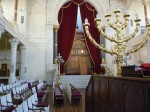
Inside Bordeaux’s Grand Synagogue of the Gironde.
(photo by Karen Ginsberg)
On a recent trip to the Basque, my husband and I learned a great deal about the strong Jewish presence that formerly existed in the region.
The Basque country comprises southwestern France and northeastern Spain. Our journey started in Bordeaux, France, which, strictly speaking, is not part of the Basque. Rather, Bordeaux is the capital of the neighboring Aquitaine region. Our sightseeing there included a visit to the Grand Synagogue of the Gironde, located in central Bordeaux, serving a Jewish population of 1,100. A 2007 brochure given to us on our visit, History of the Jewish Population of Bordeaux, dates the synagogue back to the 1880s, the land for it having been a gift from the city. On the morning of our visit, a young man, soon to be a bar mitzvah, was just finishing his practise session on the bimah, which gave life to the building.
From Bordeaux, we traveled by train two hours southwest to St. Jean de Luz, a mid-size town on the Atlantic coast that is part of the French Basque, where we had rented an apartment. We found our most substantive Jewish Basque connection on a day trip to nearby Bayonne.
(photo by Karen Ginsberg)
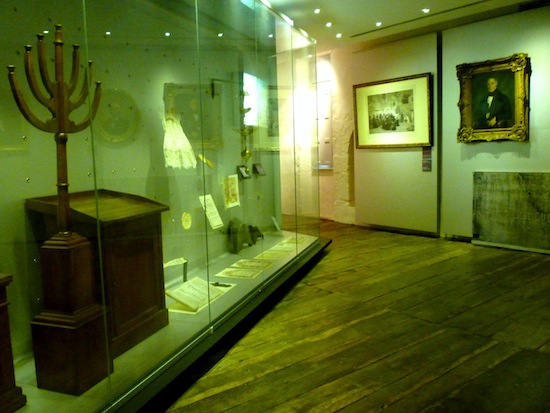
Musée Basque et de l’histoire de Bayonne is a modernized space housing the history and culture of the people of the region. Within, there is a special exhibit that celebrates the presence of Jews in the Basque since the 1600s. The roots of the Jewish community there stem from the migration that took place when the Jews were expelled during the Spanish Inquisition.
Among the collection of artifacts is a beautiful portrait of Augusta Furtado, who, in the 17th century, was a merchant and president of the Israelite Consistory of Bayonne, as well as twice serving as Bayonne’s mayor. The collection also includes furniture and religious objects from a private synagogue in the 19th century, including an ark, menorah and pulpit, a child’s temple presentation dress, circa 1885, a shofar, an 18th-century mezuzah and a sabbatical lamp from a Portuguese ceremony that was used in Bordeaux and Bayonne. One of the most interesting items is a document dated Jan. 19, 1753, entitled The Statues of the Jewish Nation of Saint Esprit, a reiteration of the royal protective orders of 1550 in which the title Jew is used for the first time instead of the term New Christian or Portuguese.
A further Jewish connection in the region has to do with one of the sources of Bayonne’s current fame as a world centre for the manufacture of high-quality chocolate. The chocolate-making skills of the exiled Spanish Jews who settled in the area were put to use. Their contribution to the industry is told at some length in the self-guided tour of the city’s delightful l’Atelier du chocolat. Both my husband and I felt compelled to enjoy a generous chocolate-tasting at the atelier out of respect for our ancestors!
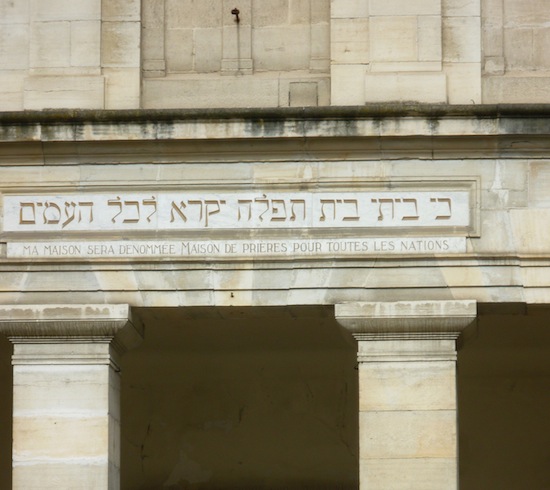
Bayonne has a beautiful synagogue in the core of city, but it is locked behind steel gates with no one available to provide any information on whether and how the building is being used, if at all. Nevertheless, an inscription carved onto the exterior of the synagogue speaks volumes about the vision the community had for this holy place: “Ma maison sera denommée une maison de prières pour toutes les nations.” (“My house will be marked as a house of prayer for all nations.”)
(photo by Karen Ginsberg)
Signage outside the synagogue gates draws further attention to the pride that the community had in being able to build its own shul: “This place of worship for the Bayonne Jewish community was built in the 19th century by architect Capdeville. The monumental neo-classical-style building illustrates the wish of the community’s leaders to assert the presence of Judaism in the heart of the district and also to provide a single place of worship for the faithful, replacing the private synagogues used previously.”
Our last daylong outing – to Saint-Jean-Pied-de-Port, France – metaphorically closed a circle for us with respect to early Jewish life in the Basque region.
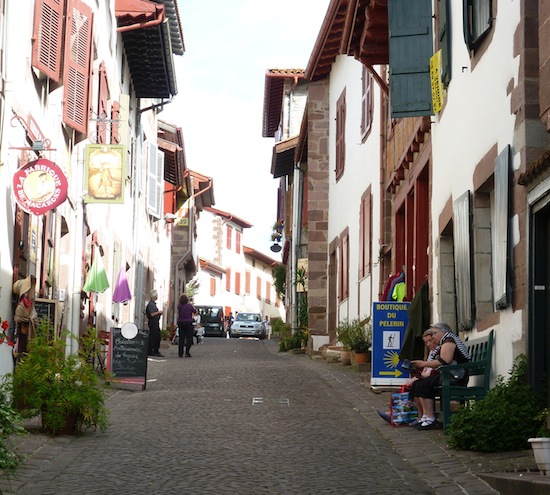
These days, it seems, almost everyone knows someone who has undertaken the six-week walk referred to as the Camino de Santiago (the Way of Saint James). This medieval pilgrimage runs from Saint-Jean-Pied-de-Port, near the Spanish border, more than 750 kilometres northwest of the Spanish city of Santiago de Compostela. There is generally a degree of wonderment and respect accorded to anyone who has retraced those steps. One has only to walk the steep main street of Saint-Jean-Pied-de-Port to understand that there is a hardship to be endured no matter how solid one’s walking shoes or how well-organized is today’s network of rest places along the route. Being in Saint-Jean-Pied-de-Port surrounded by modern-day pilgrims at the start of their journey brought to my mind how different their trek would be to that of the expelled Spanish Jews. I could not help thinking what it must be like to have to flee one’s home under threat of death, travel on foot, by cart and, for some, partially by boat, to hopefully reach the safety of new lands. These Jewish travelers had no fancy walking shoes, no “service centres” along their route and they most certainly traveled with fear in their hearts.
(photo by Karen Ginsberg)
My husband and I left the Basque knowing that there were likely many other remnants of a Jewish presence in the area yet to be discovered. Our curiosity peaked, it’s a challenge we will hopefully be able to take up on a future visit.
Karen Ginsberg is a travel writer living in Ottawa.