Skip to content
  • Home
  • Subscribe / donate
  • Events calendar
  • News
    • Local
    • National
    • Israel
    • World
    • עניין בחדשות
      A roundup of news in Canada and further afield, in Hebrew.
  • Opinion
    • From the JI
    • Op-Ed
  • Arts & Culture
    • Performing Arts
    • Music
    • Books
    • Visual Arts
    • TV & Film
  • Life
    • Celebrating the Holidays
    • Travel
    • The Daily Snooze
      Cartoons by Jacob Samuel
    • Mystery Photo
      Help the JI and JMABC fill in the gaps in our archives.
  • Community Links
    • Organizations, Etc.
    • Other News Sources & Blogs
    • Business Directory
  • FAQ
  • JI Chai Celebration
  • JI@88! video

Recent Posts

  • BGU fosters startup culture
  • Photography and glass
  • Is it the end of an era?
  • Taking life a step at a time
  • Nakba exhibit biased
  • Film festival starts next week
  • Musical with heart and soul
  • Rabbi marks 13 years
  • Keeper of VTT’s history
  • Gala fêtes Infeld’s 20th
  • Building JWest together
  • Challah Mom comes to Vancouver
  • What to do about media bias
  • Education offers hope
  • Remembrance – a moral act
  • What makes us human
  • המלחמות של נתניהו וטראמפ
  • Zionism wins big in Vegas
  • Different but connected
  • Survival not passive
  • Musical celebration of Israel
  • Shoppe celebrates 25 years
  • Human “book” event
  • Reclaiming Jewish stories
  • Bema presents Perseverance
  • CSS honours Bellas z”l
  • Sheba Promise here May 7
  • Reflections from Be’eri
  • New law a desecration
  • Resilient joy in tough times
  • Rescue dog brings joy
  • Art chosen for new museum
  • Reminder of hope, resilience
  • The national food of Israel?
  • Story of Israel’s north
  • Sheltering in train stations

Archives

Follow @JewishIndie
image - The CJN - Visit Us Banner - 300x600 - 101625

Category: Visual Arts

Barrable-Segal brings printmaking to life

Barrable-Segal brings printmaking to life

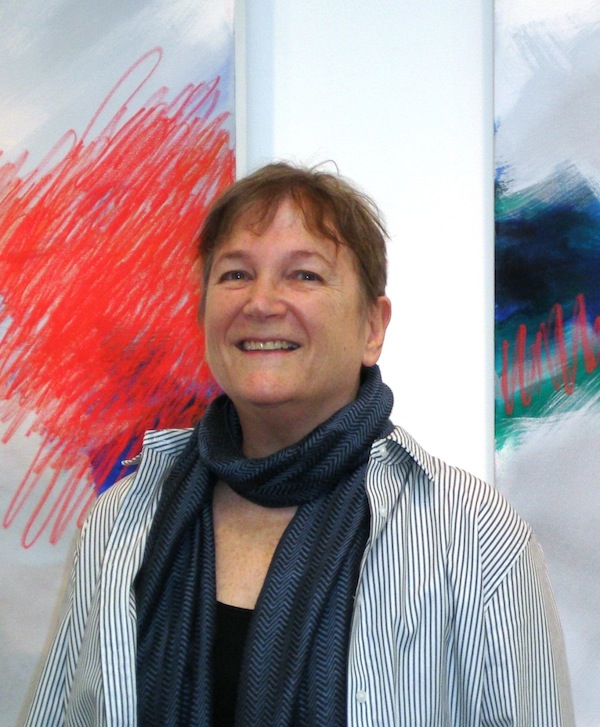
Jocelyn Barrable-Segal (photo by Olga Livshin)

Jocelyn Barrable-Segal was raised by parents with two vastly different professional backgrounds: her mother was an architect and her father was a pilot. Following her own path, Barrable-Segal managed to combine the two in her own career. For 35 years, she has been a flight attendant with Air Canada. Several days each month, she flies around the world. The days she is not in the air, she is an artist, and you can find her at Malaspina Printmakers, a printmakers’ workshop on Granville Island, where she creates unique lithographs.

“Malaspina is an artist-run centre,” Barrable-Segal told the Jewish Independent on a recent visit. “It started in the early ’70s with three or four artists. Now there are about 60 of us.” She went on to explain that Malaspina is equipped for a dozen different systems used in printmaking, but she uses only one process, the ancient technique of stone lithography. “I love to draw,” she said, “and lithography is the only technique that requires drawing.”

Barrable-Segal does that drawing on stone. The technicalities of embedding an image into stone and later transferring it from stone to paper are not for this short article, but it’s important to point out that each image can have many layers, each layer introducing one additional color plus whatever details the artist wants to add or alter. The process is time consuming and labor intensive, but Barrable-Segal said she doesn’t conceive of working in any other art form.

“With lithographs, you can change the image if you change your mind, have layers of drawing and colors,” she said, “while in painting, as soon as you’re done, that’s it.” She also likes to be able to have several copies of the same print, although she never mass-produces them. “I make limited editions, no more than seven copies of one print.”

Her prints are mostly flowers or landscapes but they are never life-like. They hover between abstract and impressionism. “I’m attracted to metaphors,” she said. She uses multiple sources for her pictures, including photographs from her travels, but she transforms the imagery through the creative filter of her imagination, enriches reality with emotional and esthetic folds. Her artistic touch converts memory into art.

That’s why she keeps flying, to bring back more visual mementos, more nutrients for her lithographs, she explained. “I see different countries, and each happy place finds its way into my images. Of course, no photocopies.”

Frequently, she draws flowers and floral compositions. “I buy live flowers at the public market and look at them,” she said. “That’s how it starts.” Flowers are the predominant theme for her work in the In Wait show that recently opened at Burnaby Art Gallery.

“In Wait is a collaborative project of the Full Circle Art Collective,” she said. “There are seven of us in the collective, seven women: Heather Aston, Hannamari Jalovaara, Julie McIntyre, Milos Jones, Wendy Morosoff Smith, Rina Pita and me. We all met at Malaspina, but then some of us drifted apart. We reunited for this show.”

The inspiration for the show came from the story of Penelope, the wife of Odysseus, she said, and it took the artists three years from the idea to the vernissage.

“Penelope was waiting for her husband to return, but her suitors were insistent that he was dead and she should choose one of them. She said she would weave a shroud before she married again. All day long she wove and then, in the night, her ladies-in-wait would unweave what she had done. The shroud was never completed. She waited. We all wait for something in our lives. It’s a universal theme for women.”

For her, another sad theme overlaid the waiting – the theme of grief. Her parents passed away recently, and working on the show helped her deal with her sadness. “For me, grief associated with poppies. I needed to find solace. I drew lots of poppies for the show.”

Women friends and their collaboration and support were another aspect of the show that came from the story of Penelope and her faithful maids. “Each one of us would make a piece and pass it on to the others. The others would add something, change. They would say: what does it need? Perhaps this detail or line or color should be added.”

Sometimes three or four people would contribute to the image before it returned to the original artist. “When you get your image back with someone else’s input, you think: what do I do now? It’s different. How to keep the integrity of the image? How to bring our combined visions together? This way, you’re always creating.”

Art making is ingrained in Barrable-Segal’s life. “I started flying because I didn’t want to be a full-time artist. It’s not realistic, even though I have a master’s degree in fine arts. But I would never abandon art. I do it for myself. I would continue even if I didn’t sell anything. I always have my sketchbook with me. When I play golf with my husband, I’m not interested in the ball. I look at my shadow on the grass and think how it would look in a lithograph.”

In Wait is at Burnaby Art Gallery until Nov. 9. For more on Barrable-Segal, visit jmbs.ca.

Olga Livshin is a Vancouver freelance writer. She can be reached at [email protected].

Format ImagePosted on October 10, 2014October 9, 2014Author Olga LivshinCategories Visual ArtsTags BAG, Burnaby Art Gallery, Full Circle Art Collective, Jocelyn Barrable-Segal, lithography, Malaspina Printmakers
Schiffer photograph on display for first time since 1999

Schiffer photograph on display for first time since 1999

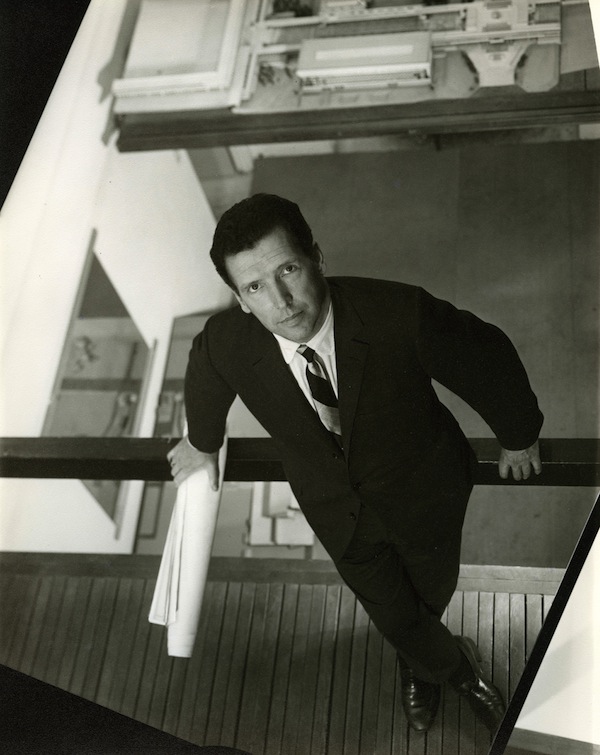
Arthur Erickson, circa 1970, Vancouver. (photo by Fred Schiffer; JMABC)

photo - Mirtha Legrand, circa 1953, Argentina. Legrand was the stage name of Rosa María Juana Martínez Suárez
Mirtha Legrand, circa 1953, Argentina. Legrand was the stage name of Rosa María Juana Martínez Suárez. (photo by Fred Schiffer; JMABC L.23933)

Thanks to the B.C. History Digitization Program and the Young Canada Works program, the Jewish Museum and Archives of British Columbia (JMABC) now has more than 1,700 photographs from the Fred Schiffer Photography collection available for viewing on the Yosef Wosk Online Photo Library (flickr.com/photos/jewishmuseum). This is only the first of many phases in the processing and digitization of this collection. The JMABC is also in the beginning stages of developing both a physical and online exhibit of Schiffer’s work.

The Fred Schiffer Photography collection (circa 1940s-1999) contains approximately 80,000 photographs and four metres of textual records and artifacts. Most of the digitized material is from the Vancouver series (1958-1999), which documents family groups, weddings, news celebrities, judiciary, film, stage and music personalities, and many more. Portraits digitized include Vancouver citizens of all walks of life juxtaposed with prominent B.C. personalities (both Jewish and non-Jewish). A smaller portion of the digitized photographs represent his work from when he lived in Buenos Aires.

photo - Chief Dan George, May 3, 1971, Vancouver
Chief Dan George, May 3, 1971, Vancouver. (photo by Fred Schiffer; JMABC L.24421)

Fred Siegfried Schiffer was born in Vienna on April 1, 1917. A law student at the University of Vienna until 1938, he reached England as a refugee shortly before war broke out. He was the sole survivor of his family of five, all of whom perished in the Holocaust. In England, he met his wife Olive, whom he married in 1942, and began his distinguished career as a photographer. Olive and Fred had two children, Jennifer and Roger.

In 1948, the family set off to Argentina. In Buenos Aires, Schiffer became a respected artistic and commercial photographer. In 1958, when political unrest in Argentina became unbearable, the Schiffer family moved to Vancouver. Schiffer opened his studio on Seymour Street, where he quickly became Vancouver’s top portrait photographer.

Schiffer had an impeccable eye and a gift for revealing portraiture, as is evidenced in these selections from his collection.

Format ImagePosted on September 26, 2014September 25, 2014Author Jewish Museum and Archives of British ColumbiaCategories Visual ArtsTags Fred Schiffer, JMABC
Vote Cooper for RBC award

Vote Cooper for RBC award

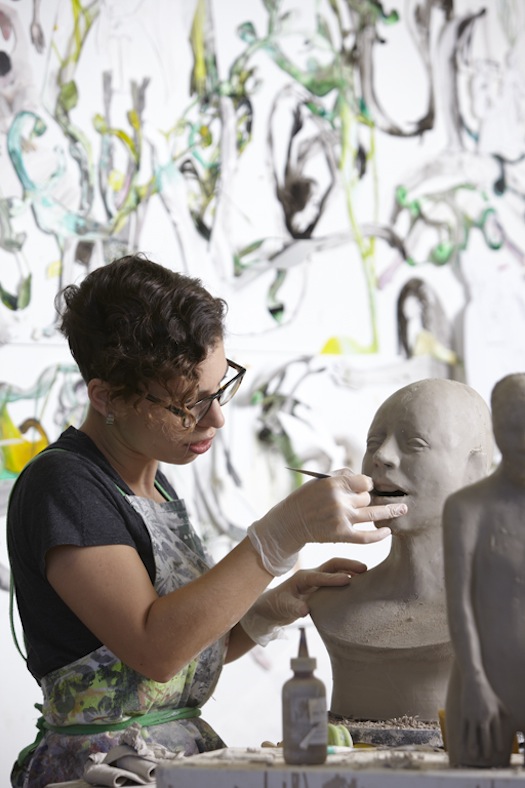
Artist Jess Riva Cooper’s work for the Gardiner Museum competition is entitled Viral Series. You can vote for her at gardinermuseum.on.ca. (photo by Sophia Wallace)

Canadian artist Jess Riva Cooper is currently vying for the RBC Emerging Artist People’s Choice Award, taking place at the Gardiner Museum. You can vote online at the Gardiner site until Oct. 12, 2014. The winner, selected by your votes, will receive $10,000.

“It’s an honor to be nominated as one of five Canadian emerging artists, and the only woman, for this award,” Cooper said.

photo - from Gardiner Museum
(photo from Gardiner Museum)

A ceramic artist and educator, Cooper has participated in residencies across Canada and the United States, including a stint as artist in residence at Medalta in Medicine Hat, Alta., and Brandeis University in Massachusetts.

She cites Yiddish folklore among her most meaningful influences, particularly the foundation myths of the golem and dybbuk spirits, which she reinterprets through a female lens. Her artist statement expands on this point: “I see a direct parallel between my interest in insidious plant life and a malevolent dybbuk spirit, which takes over the human body. In both situations, a loss of control is suffered as the parasitic entity subsumes the host.”

Cooper’s work for the Gardiner competition, entitled Viral Series, is a continued exploration into the death and regeneration taking place in deteriorating communities. Places and things, once bustling and animated, have succumbed to nature’s mercy. Without intervention, nature takes over and breathes new life into objects, as it does in her sculptures. The busts, once plain, are hardly recognizable. They become tattooed with nature. Their heads grow leaves instead of hair. The faces scream out in pain – or perhaps pleasure – in the midst of transformation. Often used to represent life, nature instead becomes a parable for an alternative state, one where life and death intersect.

Supported by the RBC Emerging Artists Project, the $10,000 award honors a Canadian artist who has been out of school and practising professionally with clay as part of his/her artistry for seven years or less. A national panel of artists, curators and arts educators nominated the five exceptional artists.


Format ImagePosted on September 19, 2014September 17, 2014Author Michael MendelCategories Visual ArtsTags Gardiner Museum, Jess Riva Cooper, RBC Emerging Artist
Artist via camera lens

Artist via camera lens

Michael Seelig is donating the proceeds of his photography exhibit to the Zack Gallery. (photo by Olga Livshin)

Every one of Michael Seelig’s photographs reflects a place, its character, its soul. He doesn’t enhance the images in any way. Photoshop’s magic is not for him. He even scoffs at cropping. “I might crop a tiny bit for the printing, just the edges,” he said in an interview with the Independent. “That’s my real challenge – to get every frame right.”

His approach to photography is that of an artist. And, he also paints, although unlike his photos, Seelig doesn’t sell his paintings. “They are for family and friends. I never exhibited them,” he said. “My paintings are mostly watercolors. The compositions are similar to my photographs – urban, for the most part – but they are different, too, depending on my mood, often architectural but less precise than photos, less angular. You have to allow the paints to run, to find their own way.”

Seelig’s solo exhibit Traces opened on Sept. 4 at the Zack Gallery. It is a fundraiser for the gallery. “I’m lucky to be able to donate this show to the gallery and the JCC [Jewish Community Centre of Greater Vancouver],” he said. “My wife and I have been supporters of this important institution in Vancouver for many years. We donated time and money, worked as volunteers at various points. I think maybe some people will buy prints of my photographs because the proceeds would benefit the JCC.”

Seelig took most of the photographs during his travels, and he has traveled extensively, especially after he retired. “We live part of every year in Israel,” he explained. “Everything is close there – Europe and Asia.”

Many people travel and take photos, but not everybody can produce a body of photography worthy of an exhibition. Arriving on location is just a matter of buying a plane ticket, but finding uncommon angles and perspectives takes inspiration and a creative eye.

“I took the photo of the historical buildings in Budapest from the opposite roof,” he said about one of the images. “The view from there was outstanding, but I had to find the perfect spot for this shot. I’m interested in details and, for this shot, I wanted to align the lamp post with the border between the two buildings.”

Another of his images, a majestic panorama of Turkish mountains with an air balloon as a focal point, he took from an ascending balloon. “The view was spectacular, the juxtaposition of a thousands-year-old landscape and the bright modern balloon.” He couldn’t have gotten such an impressive shot any other way.

“That’s what I like about photography,” he said. “I’m always looking for things to photograph but, as a rule, panoramas don’t interest me.” Instead, he admitted his fascination with urban details.

As a professional architect, he taught urban planning and design at the University of British Columbia for 30 years and he frequently used his city photos for his lectures. “When I travel, I always have a camera with me, but not in Vancouver, not now. Before I retired, though, I photographed Vancouver for my PowerPoint presentations. I had a lecture on benches in the city, another one on traffic lights. Signs in Vancouver – the images were fantastic. None of those signs exists anymore, which is a pity. I have those photos somewhere.”

None of his Vancouver photos are on display in the gallery. Some pictures, however, represent highly unusual urban elements, like a stairway on a blank wall in India or wall paintings in Italy, which look like abstract canvasses. Others, Seelig took in nature, but the lines and correlations of light and shadow evoke man-made formations. Boulders, for example, pile haphazardly against a blindingly blue sky in Israel, like a modernist sculpture, although no human arranged them. The eerie composition was created by sun, sand and wind.

In one image, trees strain up in parallel lines in the forests of America or Turkey, lovely pastel patterns in yellow and green.

“I love trees,” said Seelig. “In this show, there are four different kinds of trees.” One tree in particular, an ancient terebinth growing in an Israeli desert among the rocks, seems surreal, almost sentient. The colors of the photo are muted silver and gold, bleached by the relentless sun, as the old gnarled tree contemplates the mysteries of the universe. It doesn’t feel like people should exist anywhere near it.

“I have been taking photos for many years,” said Seelig. “Before, they were either for my paintings, although I never copied them, not directly, just to remember something I saw, or I took photos for my teaching. In the last 15 years, I do a lot more photography.”

Seelig’s photos are available in limited editions of five only. Each one will last a long time, as he produces his prints not on photo paper but on archival metallic paper and mounted to aluminum.

Traces runs until Sept. 28.

Olga Livshin is a Vancouver freelance writer. She can be reached at [email protected].

Format ImagePosted on September 12, 2014September 12, 2014Author Olga LivshinCategories Visual ArtsTags Jewish Community Centre of Greater Vancouver
Hundreds unite to stitch Torah

Hundreds unite to stitch Torah

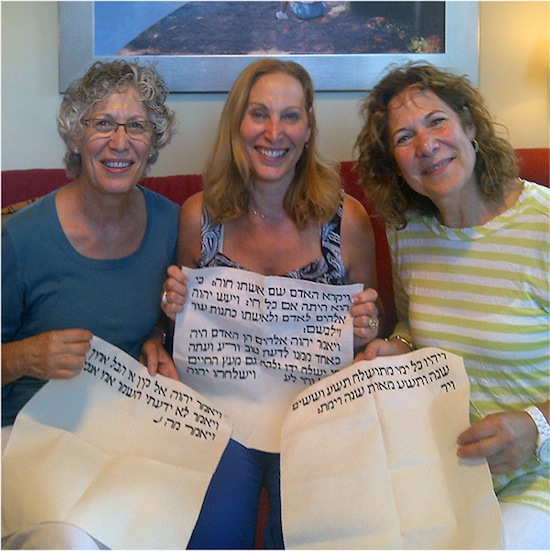
Sisters Brenda Silver, Susan Rubin and Mimi Wolch are among the hundreds who will contribute to the Torah Stitch by Stitch project. (photo by Phillip Silver)

A new Torah scroll is in the making. The brainchild of Temma Gentles, Holy Blossom Temple’s artist-in-residence in Toronto, the project originated from a chance encounter Gentles had with Marilynne Cass a year ago.

Gentles, an award-winning Judaic textile artist, is the artistic director of Torah Stitch by Stitch (TSBS), while Cass is the project’s executive coordinator.

“I fell in love with the concept and have thoroughly enjoyed seeing this dream turn into a reality,” said Cass about accepting Gentles’ invitation to join the team when the project was just beginning.

Gentles came up with the idea while on sabbatical in Israel several years ago, when seeking a way to help people engage in the words of Torah. As a textile artist, she envisioned creating a cross-stitched Torah.

“Temma chose cross-stitch because it’s a universally known craft that has been traditionally taught to young girls around the world for adorning clothing and household items,” said Cass. “It was also often the way in which girls learned their letters and numbers. While it’s a simple skill to master, it can still produce amazingly beautiful pieces of work. Using cross-stitch for TSBS has been an inspired choice, as it has allowed people from around the world to work together on a single project.”

Gentles designed a new font for Hebrew letters and divided the entire Torah into 1,463 four-verse segments for people to work on. TSBS participants range from men and women in their teens to those well into their 90s, from skilled stitchers to novices.

“There is no skill test to pass,” said Cass. “The only requirement is that each person commits to following the stitching graph correctly, complete their canvas in a timely manner and treat the work with respect.”

TSBS stitchers come from many different religions – from Judaism to Christianity, Buddhism to Islam. “Even though we’re doing the Torah (the Five Books of Moses), this isn’t an exclusively Jewish project,” said Cass.

“The Torah is the basis of three of the world’s major religions and TSBS has universal appeal,” she added, noting the project includes avowed atheists and the mother superior of a convent. “Everyone is welcome,” said Cass. “In fact, we’re actively looking for more Muslim stitchers.”

While many TSBS stitchers are from the Toronto area, the project has spread throughout Canada.

“I found out about this project from my sister, Brenda Silver, who met the artist through her synagogue in Toronto,” said Susan Rubin, chief financial officer of a downtown Vancouver junior mining company, who resides on the North Shore. “Both of my sisters volunteered to do panels, so I decided to sign up for a panel, too.”

Rubin paid $18 to cover the kit cost and received the template for the verses, the fabric and the embroidery threads in the mail. “At first, it was difficult to figure out how to start, but soon I got the hang of it,” she said. “I hadn’t done any cross-stitching for about 40 years, but it’s not that difficult. I worked on the cross-stitching at night, doing an hour here and an hour there. After about six months, it was done. It was very satisfying work and fun to do.”

Gentles asked Rubin to be more involved in the project and asked whether she would like to be a coach. “I was pleased to take a position,” said Rubin. “I’m one of many volunteers assisting Temma. Some volunteers are helping people with the stitching, while others are helping to compile the finished panels.”

image - The display for the Torah scroll has been designed by Phillip Silver
The display for the Torah scroll has been designed by Phillip Silver. (illustration by Phillip Silver)

Rubin is helping keep track of the 700 stitchers. “I assign each stitcher a coach, so they have someone to contact if they run into trouble,” she said. “I also follow up with the stitchers who’ve had their panel for over six months and haven’t yet completed it. If someone cannot complete their panel, we try and find out why and offer help or, if need be, find a volunteer to adopt the panel. It’s important that all panels are complete, so the finished project is the entire Torah.

“It’s been interesting to hear feedback and personal stories from the volunteers. Even though this is a folk art project, there is a spiritual overtone and the stitchers receive great satisfaction in working with the words of the Torah.”

TSBS now has nearly 900 participants in 13 countries, with more applications coming in each week.

“Our ultimate goal is to have all 1,463 panels completed,” said Cass. “We’re more than halfway there.” The books of Genesis and Exodus have been finished, and stitchers are now working on Leviticus.

“We expect it to take another year before all the remaining canvases have been assigned,” she added. “Meanwhile, we’re working on the final details for the display format.”

The display has been designed by Phillip Silver, one of Canada’s foremost stage designers. It will be about 2.5 metres high and nearly 100 metres long. “The finished work will be museum quality and we hope it will be exhibited in several museums,” said Cass. “The goal is to allow people to feel as if they’re wrapped in the Torah.”

The project’s registration form, more information and helpful tips are available at torahstitchbystitch.temmagentles.com.

Rebeca Kuropatwa is a Winnipeg freelance writer.

Format ImagePosted on August 29, 2014August 28, 2014Author Rebeca KuropatwaCategories Visual ArtsTags Brenda Silver, Marilynne Cass, Mimi Wolch, Phillip Silver, Susan Rubin, Temma Gentles, Torah Stitch by Stitch, TSBS
Mordechai Edel exhibits tapestries of light on canvas

Mordechai Edel exhibits tapestries of light on canvas

Mordechai Edel at work in the studio. (photo from the artist)

Mordechai Edel is not a stranger to grief and pain. His parents escaped Austria in 1939. His uncle spent years in the Nazi concentration camps. His father died when he was 16 years old. Edel has been aware of the darkness in the world since he was a child, but he has never succumbed to it. The art he creates is light fantastic, bursting with colors, suffused with gladness. “Bringing joy to the world,” is his artistic motto.

Edel’s solo art show at the Unitarian Church on West 49th Avenue opened on Aug. 1. The artist talked to the Independent about his life and his paintings. His involvement with the arts started in his early childhood.

“My mom baked cakes for a coffee shop in Birmingham. It was also a gallery, and the owner,

Andre Drucker, was my first art teacher. When I was about 8, I won a BBC art competition with my self-portrait. It must’ve been my bright red hair,” he joked.

Even more than painting, he said, he wanted to sing, but for a child of a working immigrant family in post-war Birmingham, it wasn’t an easy or even a realistic dream, especially after his father fell sick and young Edel had to leave school at 14 to help his mother.

“I listened to the radio when they played classical music and opera,” he said. “We also had a very good cantor in our synagogue, and I wanted to sound like him. I sang in the choir.”

He frequently bought classical opera records at the local flea market but couldn’t listen to them at home – the family didn’t own a record player. When someone at the flea market suggested playing them on his player, the music was a revelation to the boy. “I wanted to sing like Caruso,” he remembered. “I wanted to study classical music and opera.”

Instead, he followed a much more practical route and apprenticed to a hairdresser. “My uncle was an opera singer before the war. It saved his life in the Nazi camp – he sang there. After the war, he immigrated to Canada and became a hairdresser. Nobody needed an opera singer.”

Edel followed in his uncle’s footsteps. He moved to Canada in 1969, when he was 20, and worked as a hairdresser, while spending all his money on music and singing lessons. He sang in concerts. At some points in his life, he was a cantor in Victoria and a soloist for the Tel Aviv opera.

But visual art was always an intrinsic part of his life, always casting light onto the shadows. When he opened his own hairdressing salon, he played classical music there and decorated the room with his paintings. His patrons loved the ambience, and the word of mouth spread about the hairdresser artist and his paintings.

It is no wonder that one of the recurring themes in Edel’s paintings is music. The picture “Spinner of Light” looks like a tapestry of colors and notes, where fantastic creatures sway to the unearthly melodies in an imaginary landscape. Flowers dance in several of his paintings, and Chassidic bands indulge in merry klezmer tunes. “O Sole Leone” is more grounded but just as whimsical, a song of Vancouver at night, while “Transparent Emet” reminds the viewer of the spiritual theatre of life. The musicians play in the pit, but the conductor exalts above, a part of a mystical pomegranate.

Symbolism plays a huge part in Edel’s artistic vision. Combined with his colorful esthetics, it leads him the way of impressionists, where emotions get embedded in pictures, entangled with floral and abstract motifs.

“I listen to classical records when I paint. Sometimes I listen to my wife Annie playing her violin. She is my muse. She inspires me.” Married for four decades, he is as much in love with his wife now as ever, he said, and their mutual devotion helped them five years ago, when darkness struck the family.

Someone they had trusted conned them out of their life savings. After working hard for more than 40 years, the family lost everything, about half a million dollars.

“People don’t like to hear others crying,” Edel said, “but frankly, it’s played havoc with our lives. We had intended to make aliyah to Israel for the ‘last and best’ retirement years – even though artists never retire – but we had to recoil into a one-bedroom rented apartment these past few years. And yet, in order to combat our tragedy and adversity, I came up with my ‘artidote.’… So many people need to be uplifted with light and laughter.”

“I don’t dwell on darkness. I try to stay positive, although it’s a challenge to be happy in the face of darkness,” 

Currently, the couple lives on a small government pension, and he paints in the living room – his studio. Like in all other areas of their life, however, his wife is his source of happiness and stability. “My wife says we go forward. And we do. I don’t dwell on darkness. I try to stay positive, although it’s a challenge to be happy in the face of darkness,” he admitted.

The current show emphasizes Edel’s drive towards the light. His paintings vibrate with joyful energy. “I wanted to reach out with my art, to show my paintings to Jews and non-Jews alike,” he said, explaining the placing of his deeply Jewish art in a Christian church.

The show runs until Aug. 31 and viewing is by appointment. On Aug. 27, at 7 p.m., there will be a guided tour by the artist and a complimentary concert. To register, call the Unitarian Church, 604-261-7204, or contact the artist, 604-875-9949.

Olga Livshin is a Vancouver freelance writer. She can be reached at [email protected].

Format ImagePosted on August 22, 2014August 21, 2014Author Olga LivshinCategories Visual ArtsTags Mordechai Edel, Unitarian Church
Monsters at the Zack

Monsters at the Zack

Claudia Segovia’s creations are colorful, whimsical monsters. (photo from Claudia Segovia)

It took Claudia Segovia a long time to find her niche. “I always liked art,” she said in an interview with the Jewish Independent, “but I’ve been primarily a dancer, drawing on the sideline. When I got pregnant 17 years ago, I couldn’t dance, so I started drawing much more. I also always liked sewing, so I experimented with textile art, tried different techniques: finger puppets, smaller pictures, drawings, collages, sewn little monsters. Nothing seemed to fit, until I began painting. I have only been painting for a few years but I know that’s my direction, that’s what I want to do.”

Segovia’s solo show, Intuitive Mythology, opened at the Zack Gallery on Aug. 17. It is awash with colorful, whimsical monsters. Painted as large pictures or crafted as fabric dolls, the artist’s monsters are full of contradictions. They are childish and philosophical, ugly and charming, spout big ideas or cavort like spoiled brats.

photo - Claudia Segovia
Claudia Segovia (photo from the artist)

“I don’t decide what I paint,” Segovia said. “First, I let my intuition flow and play with colors and figures on canvas for the background. Then, when it’s done, I try to see what shapes are there, what creature emerges from within. Once the creature is realized, I work to fulfil its life. Only then, I try to understand its meaning. For me, it is the most important part. Sometimes I see my siblings there, sometimes a timepiece, sometimes a totem pole. It is as amazing to me as it is to the viewers. Each piece is a surprise. What does this creature mean? What words come up? What questions does it answer?”

For this show, Segovia doubled each of her painted monsters as a hand-made fabric doll. “After I finished the painting, I worked on a 3D textile sculpture. I try to match the fabrics to the texture and colors of the painting. I display my sewn creatures in front of the paintings, as if they are coming out of the canvases, into life.”

Each of her monsters has a story to tell, if only the viewers would listen. All of them are unique, sweet and tart fruits of Segovia’s imagination.

“I have a passion for little monsters, the ones that are funny and different. I don’t like realistic art,” she admitted. “Sometimes, I write words on my monsters. My intuition guides me.… I’m inspired by the Mexican folk art, especially Alebrije – painted wooden sculpture from Oaxaca. I visited the town once, when I was younger, and talked to the artists. I do similar things with my monsters. It’s not on purpose, it just happened.”

Segovia started selling her little sewn beasties long before she started painting them. “My son was about five,” she recalled. “I wasn’t painting yet but I was making the fabric creatures. I emailed all my friends and they emailed their friends and, eventually, a couple of gift shops expressed interest. Now, three stores in B.C. carry my monsters and my smaller pictures and collages. One is on Granville Island, one on Main and one in Victoria.”

She feels excited when someone buys her art – and it’s not about the money. “People buy it because they love my piece so much they want to take it home,” she explained. “It feels wonderful.”

Unfortunately, like many artists, Segovia can’t make a living with her art. “It helps,” she said, laughing, “but to pay the bills, I teach. I teach art and I teach dancing. I love teaching.”

“I don’t teach computers anymore. Now, I only teach what I love: dancing and art. And I concentrate on my painting.”

Before she immigrated to Canada from Mexico, Segovia taught computers. Her educational background includes training in computers, as well as in art and dancing. “I did it in Canada, too, for a few years,” she noted, “before the high-tech crash in 2001. Then, when no job in the computer industry was available, I started teaching dance and art, choreographed a few pieces. I don’t teach computers anymore. Now, I only teach what I love: dancing and art. And I concentrate on my painting.”

As with her own work, in her art lessons, Segovia lets intuition take the reins. “I’m interested in the creative process, not the technique,” she said. “When I come to a school to teach, my lessons depend on the supplies. Scraps of fabrics? We’ll make aprons. Snippets of paper and old magazines? We’ll make collages. I look at what they have and think, What can we make of it?… My favorite art student’s age is from 6 to 9. Such kids engage easily. I think that must be my real age inside, too, about 8 years old.”

Segovia is a respected teacher in Vancouver, teaching art and dancing at Arts Umbrella, the Jewish Community Centre of Greater Vancouver and the Shadbolt Centre for the Arts. For more information about her, visit claudiasegoviaart.blogspot.com. Intuitive Mythology runs until Aug 31.

Olga Livshin is a Vancouver freelance writer. She can be reached at [email protected].

Format ImagePosted on August 22, 2014August 21, 2014Author Olga LivshinCategories Visual ArtsTags Claudia Segovia, Intuitive Mythology, Zack Gallery
Peretz Centre opens gallery

Peretz Centre opens gallery

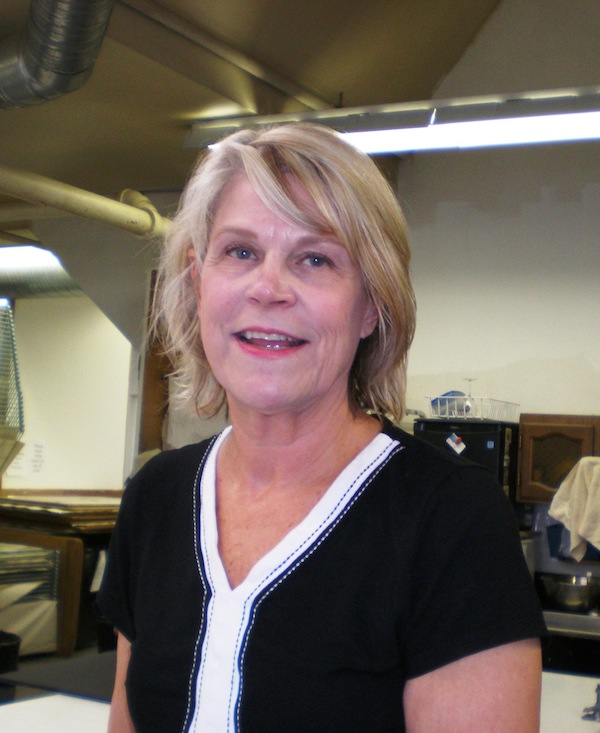
Left to right: Simon Bonettemaker, Hinda Avery, Claire Cohen and Colin Nicol-Smith. (photo by Olga Livshin)

“We decided we’ll be the Peretz Painters,” said Colin Nicol-Smith, one of the collaborators of the inaugural art show that opened on July 16 at the new art gallery in the Peretz Centre for Secular Jewish Culture. The other “Peretz Painters” include Claire Cohen, Hinda Avery and Simon Bonettemaker.

Nicol-Smith knows both Avery and Cohen through the Peretz Centre, and Bonettemaker was his long-term business partner in their engineering consulting firm. In an interview with the Independent, Nicol-Smith said that the idea for the show and the gallery first came up after a conversation with Avery.

“She said that the lounge would be an ideal place for an art gallery. I agreed and put it in front of the board – I’m a member. The board agreed, too. So, I contacted the others, and we decided we would be the first to exhibit here.” The plan is for an annual summer show at the gallery. “All other months of the year the lounge is too busy,” Nicol-Smith explained.

The stories of the four Peretz Painters are as different as their art.

Cohen is a professional artist. She has a bachelor’s degree in fine art and a master’s in art therapy. Her paintings feature the theme of music. The instruments in the paintings blend and dance with other forms, producing multiple and complex associations. Architecture and flowers, people and history mesh with musical nuances – a string, an elegant cello neck, a snippet of notes – as lines and shapes flow into each other. The paintings vibrate with color. They are festive, celebrating the artist’s love of classical music. “Classical music is part of my life. I always listen to it when I paint,” said Cohen.

Art makes her whole and happy, and that’s why she went into art therapy. “I wanted to give more meaning to my art, help others with it,” explained Cohen, who has worked with private clients and addicted teenagers. “I tried to help them focus on expressing themselves through art. Addiction stopped them from feeling, but art is a tricky way to help one to open up. Talking about themselves is hard for them. But, through art, they can.”

According to Cohen, art helps all of us deal with problems, with voids in our lives, and Avery can testify to the therapeutic effect of art in her own life. A former academic who taught at the University of British Columbia, she has been painting full time since she retired. Her artistic journey started after a trip to Europe in search of her family roots.

“Many women in my family, the Rosen family, were murdered by the Nazis because they were Jews. No records exist, but I needed to know them, so I started painting them.” At first, she used old family albums and war photographs to produce her paintings. Her compositions resembled real life and were imbued with sadness, reflecting the Holocaust.

“I depicted the murdered women as grim resistance fighters, but it felt constrained. I wanted to distance myself from the sombre historical reality, wanted the women to win. My latest paintings are like giant graphic novels. The women transitioned into gun-slinging folks. They mock the Nazis. They are not victims anymore, not intimidated. I wanted to confront atrocities with my absurd revenge fantasy.”

The show has two Avery paintings on display. One is a giant panel of “Rosen Women,” dressed in bright yoga tank tops and fitted cropped pants in neon colors, laughing and brandishing their weapons at Hitler. The second is a small, black and white caricature of Hitler. The pathetic little man depicted doesn’t stand a chance against the droll defiance of the Rosen heroines. The artist’s humor keeps her family alive long after they perished in the Holocaust.

Nicol-Smith is another retiree who found an artistic second wind. “I always drew,” he said. “But, as a consulting engineer, my drawings were technical. After I retired 16 years ago, I wanted to paint. I studied painting for two years at Langara.”

He paints from photographs, his own or those taken by others. One of his best paintings, of a Vancouver beach, is based on a photo taken by his grandfather in the 1900s. Unfortunately, it is not in the exhibit. “My wife likes it so much she refused to allow me to sell it,” he said. “My series of paintings on display at the show, ‘Four Significant Figures,’ is comprised of four male images. I’m interested in the topic of a male body.”

Unlike Nicol-Smith, who retired to paint, his former partner, Bonettemaker, hasn’t retired yet. “I’m an architectural technologist, semi-retired,” he said. “I have been painting watercolors for years. As an artist, I’m self-taught, but my paintings are close to architectural designs, very realistic, with distinctive details: landscapes, seascapes, still life.”

Sharp lines and quiet, subdued colors characterize his artwork. His Vancouver streets and shores, totem poles and sailing boats blend reality with fantasy. “I combine photos and imagination in my paintings, sometimes use elements from several different sources in one picture.” All of his paintings are from the 1990s. He hasn’t painted in awhile. “I’m thinking about retiring,” he said. “Then I’ll have more time to paint.”

The Peretz Painters exhibit runs until Aug 13.

Olga Livshin is a Vancouver freelance writer. She can be reached at [email protected].

Format ImagePosted on July 25, 2014July 23, 2014Author Olga LivshinCategories Visual ArtsTags Claire Cohen, Colin Nicol-Smith, Hinda Avery, Peretz Centre, Simon Bonettemaker
VanDusen hosts Sculptors’ Society exhibit

VanDusen hosts Sculptors’ Society exhibit

The art of Jesse Rubin, above, and Suzy Birstein will be among the work displayed at the summer exhibit of the Sculptors’ Society. (photo courtesy of Jesse Rubin)

From larger than life to the minute details of life, the artwork that will be on display at the 38th annual summer exhibit of the Sculptors’ Society of British Columbia will engage viewers with multiple aspects of life – and a lot of remarkable art.

The exhibition, which opens July 31 at VanDusen Botanical Garden, features more than 15 artists, including Jewish community members Suzy Birstein and Jesse Rubin. Looking at the difference in style and material of these two artists alone gives an idea of what diverse interest the exhibit will hold. And, as noted in the promotional material, “In some cases, this exhibition is one of the few chances you will have to see [sculptors’] work here in their home province.”

Birstein says in her artist statement for the exhibit, “As a child, I studied dance, Hollywood musicals, film noire and Rembrandt. As an adult, I’ve been seduced by the sensuality, spontaneity and intellectual activity of working with clay and color, and the essence of romance.

“I see my imagery as a marriage of my childhood and adult influences. The figure dominates my work as I endeavor to create archetypal icons … overlaid with the spirit of song and dance. I long to merge the power of Nefertiti with the spirit of Carmen Miranda.”

The magnitude of Birstein’s scope is evident in her colorful, playful sculptures that engender a larger-than-life feeling, even if they are “regular” size. Meanwhile,

Rubin operates at the other end of the spectrum, making detailed miniatures that, while also fun, are highly realistic. A self-taught artist who began sculpting 19 years ago, Rubin writes in his statement, “I try to express the inner emotion of each piece, and hopefully the viewer will get a feel for what the person or creature might actually be like.”

Nefertiti meets Miranda

photo - Suzy Birstein will be displayed at the Sculptors’ Society exhibit, July 31-Aug. 4
Suzy Birstein’s art will be displayed at the Sculptors’ Society exhibit, July 31-Aug. 4.
(photo courtesy of Suzy Birstein)

While Birstein’s name will be familiar to many JI readers, the last interview the paper carried with her was in 2008  (though she wrote about her Mia Muse workshops in 2013). Since then, Birstein told the Independent, she has created the Tap to the Muse exhibition of life-size Muses, a film that features her dancing and her sculptures, as well as “Motion Pitchers” for the Academy Awards’ ‘Everyone Wins at the Oscars’ gift bags.

“During the summer of 2008, film again serendipitously influenced my life,” she said. “I saw Mama Mia, and it took me back to my early 20s, living in Greece. After crying my way through the film with nostalgia for Greece, I was determined to go to that island.”

The island was Skopelos and, as it happens, Birstein had been forwarded website information for an art centre there. “I wrote to the two American women who founded the centre and the Mia Muse biannual workshops were created. I have been there three times since 2009 and can’t wait to return August/September 2015!” she said.

With each trip to Skopelos comes “European art adventure – Turkey, France and Spain – with new artistic influences,” said Birstein. “After France, I fell in love with painting – spent two years teaching myself to paint with oils, creating portraits of my Muses.

“After Spain in 2013, I was inspired by Velázquez’s ‘Las Meninas’ painting. Although not in Madrid to experience the original, the influence of ‘Las Meninas’ was all over Spain – at the Museu Picasso in Barcelona, in tourist art, contemporary art. My new sculptures are inspired by ‘Las Meninas’ but, as with all my art, there is never any one influence.

“India is the other place and culture that greatly fascinates me,” she added. “I am planning to create art during an artist residency in India and to explore the giant terracotta horses of Tamil Nadu. I have just begun a series of sculptures and paintings fusing these elements together.”

When asked about her desire to merge Nefertiti and Miranda, Birstein explained, “All my work is interplay of ancient and contemporary world cultures,” adding that she is “particularly fascinated with the concept of goddesses and cultural icons from Ancient Egypt to contemporary film.

“Queen Nefertiti symbolizes tradition, beauty, power, grace.

Carmen Miranda, wild, elaborate, ornate, fun, song ’n’ dance and with the hint of tragedy from personal life. The notion of transcending tragedy with absolute abandon to the joy of creativity, collaboration, performance and costume” is what draws her to both Nefertiti and Miranda.

“For me,” said Birstein, “life as art is one – my work, person, home, garden, teaching. I am mentored by art spirits and, through this, mentor my students.”

Birstein’s recent work includes 15 sculptures that will be given out as awards by the B.C. Tap Dance Society. “I have always loved tap and been inspired by Hollywood musicals – Fred Astaire, Gene Kelly,” she explained. “I went to the Tap Dance Festival 12 years ago created by VTDS and was hooked!”

She has been dancing with Vancouver Tap Dance Society ever since and is now part of Heart and Soul, their adult company.

“VTDS creates an amazing tap festival annually, on Labor Day Weekend, and this year they are having a silent auction on Aug. 28, giving 15 awards – five to tap artists, five to volunteers, five to patrons. They wanted to present meaningful/personalized awards from someone within their community and thought of me, especially because I also did this for the Academy Awards in 2008. I am creating very funky, colorful ceramic shoes.”

For Mia Muse 2015, Birstein will “have the opportunity to teach children in Skopelos at their film festival, SIFFY, followed by the Mia Muse ceramics workshop for adults. It is fabulous,” she said, to be able to “combine film/travel/art with mentoring children and adults.”

Molding his own reality

Born in Montreal, Rubin was five years old when he moved with his family to Vancouver in 1974. Here, they “opened the first bakery to sell bagels in Vancouver, the Bagel King, and, later, the Montreal Bagel Factory in Kitsilano.”

In an interview with the Independent, Rubin shared a bit about his journey to becoming an artist.

“As a kid, I enjoyed drawing, but, by the age of 13, I began playing the guitar. Music has always been a huge passion,” he said.

“I began sculpting on a whim when I was 26. I bought a pound of clay and made some whimsical cartoonish characters like goofy frogs. After a few months of getting used to working with clay in that manner, I began to sculpt parts of the human body as realistically as I could. The learning curve was fun, painful and, at times, slow. It took a few years to get the fundamentals down and, in retrospect, I could have benefited from some proper instruction. Years later, when I wanted to learn how to make silicone molds in order to reproduce my work, I turned to instructional DVDs for help.

“As far as the scale I work in,” he continued, “my father was a jeweler, so maybe it’s in the genes. I do know that I’m attracted to small-scale realistic sculpture. I like the idea of condensing all that visual information into a small space.”

Many different influences and approaches combine to form Rubin’s final creations. “First, I sculpt my piece out of Sculpey,” he explained. “It stays malleable until you bake it in the oven. (My wife does a little blessing before I bake each piece because it’s so fragile and, once it’s in the oven, it can twist, crack and, occasionally, develop small surface bubbles.) So, once I have my baked Sculpey model, I then use it to make a silicone mold. When I have the silicone mold, I reproduce the sculpture in resin. From there, I go on to the painting.”

Rubin’s art can be seen at deviantart.com, which is a communal website for artists: search for jesserubin. Birstein’s website is suzybirstein.com. For more information about the Sculptors’ Society or the exhibit, visit ssbc.ca or email [email protected]. The exhibit opens July 31, 5:30-7:30 p.m., and runs Aug. 1-4, 9 a.m.-9 p.m., at VanDusen. (Garden admission or membership is required.)

Format ImagePosted on July 18, 2014July 17, 2014Author Cynthia RamsayCategories Visual ArtsTags Jesse Rubin, Sculptors’ Society, Suzy Birstein, Vancouver Tap Dance Society, VanDusen Botanical Garden
Melanie Fogell’s paintings inspire imagination

Melanie Fogell’s paintings inspire imagination

Melanie Fogell’s paintings inspired the story told here. (photo by Olga Livshin)

The solo show Illuminated Forests by Melanie Fogell is on display at the Sidney and Gertrude Zack Gallery until July 27. As I wandered through the gallery, surrounded by Fogell’s paintings, I felt as if I were in a varicolored forest, alive with stories. Stories grew between the majestic trees, flitted among the rustling leaves and dozed under the evergreens.

***

Tia guided her wheelchair into the park. The dappled leaves whispered above her head, green and pink and pretty, smelling of sunlight. She resented them. Nothing should be that beautiful, while she was stuck in this ugly chair. After a single brief glance around, she stared sullenly ahead, into the shimmering, fragrant air. She found it oppressive. An hour outside, as the doctor prescribed, and she would head back home, into her room, where no beautiful things waited.

A gasp to her left caused her finger to jerk on the control stick, and her chair lurched forward. No matter how she detested the forest’s loveliness, she didn’t want to run anyone down. When she stopped and looked for the source of the noise, she saw an old woman in a wheelchair. The woman’s silver hair surrounded a pale wrinkled face like snowy lace.

“Hi,” the woman said. “You startled me, dear. How romantic. Two wheelchairs meeting in a park. Almost a love story.” She smiled.

“Nothing romantic,” Tia blurted. “And nothing to smile about. Definitely not a love story.” Tears sprang up, despite her attempt to suppress them. “Stupid,” she muttered, her fingers tightening on the controller.

“Don’t go,” the woman said. “It’s lonely here. Would you tell me about yourself? Was it an accident? I’m Alice.”

“I’m Tia.” Tia nodded stiffly. Alice looked truly interested. Why not? She had to kill the next hour anyway. She started talking. She was in a car, with her friend driving, and a drunk driver rammed his van into them.

Both her friend and the drunken jerk ended up dead, leaving her alive to deal with mangled legs.

“They are broken in a gazillion places.” She kept a sob inside by sheer willpower. “I was a dancer. Now, I’m … a cripple. The doctor said I might walk again, eventually, after another surgery. I’ll probably always limp. No dancing for sure.” This time, a sob escaped.

“So, you got lucky,” Alice said calmly. “You survived.”

“Lucky, ha!” Tia swore loudly, daring Alice to disapprove. She would never have said anything so rude before her accident, but now, she didn’t care. Rudeness even made a perverted sense. It helped her not to cry.

Alice nodded. “Good idea.” Then, she too swore, very creatively. “The trees absorb our anger and hurts,” she said. “They heal us. With obscenities, we pour out our pain, bury it. It’s like verbal manure.”

Surprised, Tia laughed. “You think so?”

“Yes. Now, inhale the sweet air. Take in the goodness.” Alice looked expectant, waiting.

Tia shrugged. Inhaled. Alice was right, the forest smelled good. It smelled of living things, of dreams.

“Now swear again,” Alice said. “Repeat after me.” The following string of descriptive verbal abuse made Tia laugh aloud for the first time since the accident. She dutifully repeated the words, wincing only a little.

“Well, dear. Do you feel better? I have to go back now, so I’ll have to turn here, at this intersection, but we’ll meet again, right?” She reversed her chair and met Tia’s eyes. “I hope you’ll walk soon. Bye, Tia.” Alice brushed her thin fingers across Tia’s hand, and then rolled away into the gold and green mosaic of the foliage, vanishing behind a bend in the greenery. The lower branches swayed in her wake, a bird trilled overhead.

“Bye, Alice,” Tia said. She did feel better. Only later, after returning home, she realized that she didn’t even thank Alice.

She visited the park every day afterwards, watching the trees and the light change with the season, feeling her pain draining away. She never met Alice again. The next surgery went well, and she healed quickly. After a couple months of grueling physiotherapy, she started limping on her own feet. The doctor said the limp would fade in time. No dancing, of course, but walking felt good. She would find Alice and say thank you.

The autumn forest overflowed with color, reds and greens and yellows of every shade. The fallen leaves bounced under her shoes. Alice would love it, she thought. But when Tia entered the nursing home on the other side of the park, Alice wasn’t there.

“She died in the spring,” said the receptionist. “Are you Tia?”

“Yes,” Tia breathed.

“She left something for you. She was an artist.”

It was a small painting, a forest in spring: leaves and sunlight embracing each other in a quiet melody of green and amber and peach, singing of hope.

Olga Livshin is a Vancouver freelance writer. She can be reached at [email protected].

Format ImagePosted on July 4, 2014July 2, 2014Author Olga LivshinCategories Visual ArtsTags Illuminated Forests, Melanie Fogell

Posts pagination

Previous page Page 1 … Page 23 Page 24 Page 25 Next page
Proudly powered by WordPress