
Skip to content
  • Home
  • Subscribe / donate
  • Events calendar
  • News
    • Local
    • National
    • Israel
    • World
    • עניין בחדשות
      A roundup of news in Canada and further afield, in Hebrew.
  • Opinion
    • From the JI
    • Op-Ed
  • Arts & Culture
    • Performing Arts
    • Music
    • Books
    • Visual Arts
    • TV & Film
  • Life
    • Celebrating the Holidays
    • Travel
    • The Daily Snooze
      Cartoons by Jacob Samuel
    • Mystery Photo
      Help the JI and JMABC fill in the gaps in our archives.
  • Community Links
    • Organizations, Etc.
    • Other News Sources & Blogs
    • Business Directory
  • FAQ
  • JI Chai Celebration
  • JI@88! video

Recent Posts

  • Eby touts government record
  • Keep lighting candles
  • Facing a complex situation
  • Unique interview show a hit
  • See Annie at Gateway
  • Explorations of light
  • Help with the legal aspects
  • Stories create impact
  • Different faiths gather
  • Advocating for girls’ rights
  • An oral song tradition
  • Genealogy tools and tips
  • Jew-hatred is centuries old
  • Aiding medical research
  • Connecting Jews to Judaism
  • Beacon of light in heart of city
  • Drag & Dreidel: A Queer Jewish Hanukkah Celebration
  • An emotional reunion
  • Post-tumble, lights still shine
  • Visit to cradle of Ashkenaz
  • Unique, memorable travels
  • Family memoir a work of art
  • A little holiday romance
  • The Maccabees, old and new
  • My Hanukkah miracle
  • After the rededication … a Hanukkah cartoon
  • Improving the holiday table
  • Vive la différence!
  • Fresh, healthy comfort foods
  • From the archives … Hanukkah
  • תגובתי לכתבה על ישראלים שרצו להגר לקנדה ולא קיבלו אותם עם שטיח אדום
  • Lessons in Mamdani’s win
  • West Van Story at the York
  • Words hold much power
  • Plenty of hopefulness
  • Lessons from past for today

Archives

Follow @JewishIndie
image - The CJN - Visit Us Banner - 300x600 - 101625

Tag: Mordechai Edel

The art of creating ketubot

The art of creating ketubot

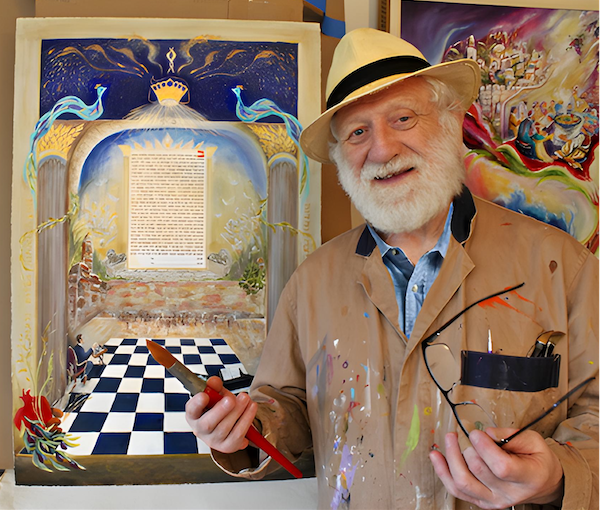
Mordechai Edel beside the personalized ketubah he created for A.J. and Olena Steigman; A.J. is a chess champion and Olena is a classical pianist. (photo from Mordechai Edel)

Vancouver artist Mordechai Edel is one of a handful of people in Canada who make ketubot (singular: ketubah), the standard contract for traditional Jewish marriages, which have been used for millennia.

“I was trained as an impressionist artist, from which I developed the philosophic concept of ‘impression-mystic’ art,” Edel told the Independent. “Hopefully, this contributes in a small way to ‘marrying’ wedding contracts with art and harmonizing the opposites of heaven and earth, chiaroscuro [the use of strong contrasts of dark and light], fire and water.”

While the central theme of a ketubah is constant – an obligation on the part of the groom to provide for his bride – their designs can vary immensely, and each one designed by Edel tells, in its way, a separate story. He has been creating ketubot for 40 years.

“I often incorporate a stylized menorah symbol, which reflects the potential marriage of all humanity uniting together under G-d’s joyous chuppah canopy of shalom [peace and wholeness],” he said.

A kosher ketubah requires precision and documentation, especially regarding Hebrew names, marriage location and dates. Ketubot are usually written in Aramaic, in calligraphic style, and halachic (Jewish legal) requirements allow little room for embellishment. 

“Not much fun there,” said Edel of the creative possibilities. “However, ‘the fun’ may begin with the surrounding artwork. That’s when personal requests start to kick in. I am often requested to incorporate ‘painted stories,’ illustrating romantic memories of how a couple first met.”

In the past several years, Edel has received numerous ketubah requests from local rabbis, including a “standard house model” developed with Rabbi Andrew Rosenblatt of Congregation Schara Tzedeck.

“Occasionally, some people do still enjoy elaborate weddings, which tend to generate requests for more personalized, sometimes eccentric artwork,” said Edel.

Depending on the couple’s budget, the creative detail of a personalized ketubah can vary substantially, from minimal artwork to the most elaborate designs, he said.

Edel can take several weeks to paint a personalized ketubah, although sometimes it can “just click” and he can finish one in two to three weeks. Ideally, couples planning on getting married would contact him as soon as possible, to give him as much time as possible.

Often, he said, the biggest challenge is to receive accurate place, name, date and time information. Sephardi ketubot do not permit any erasures, whereas Ashkenazi halachah (Jewish law) allows changes before the contract is signed and validated by two kosher witnesses, he explained.

Edel shared an experience that happened during a Sephardi wedding in the mid-2000s. He had painted a calla lily ketubah for a couple that had met in Acapulco, replete with a romantic sunset and a ship setting sail for Jerusalem in the background.

“Guess what? The night before the marriage, the rabbi checked the ketubah and there was one letter, ‘vov,’ missing in the Hebrew spelling of Vancouver. I was told it was invalid, it could not be rectified and was void,” Edel recalled. 

The solution, Edel found, was to physically cut out the contract part, leaving the surrounding artwork, forming a window. He then spent the entire night rewriting the document, which he then inserted, forming a two-part ketubah.

“This negative-into-positive transformation has become a trademark blessing that I now incorporate into all commissioned ketubot,” said Edel. “And, in case of a last-minute error or wine spill, all ketubot come with a duplicate backup document.”

Along the way, Edel has received some unique ketubah requests. One couple, who had encountered a skunk on their first date in Stanley Park, asked that the scene be recreated in the marriage contract. 

“I had difficulty finding a stinky model who would sit still,” Edel recalled. “That turned out to be a most scentimental ketubah.”

Another couple commissioned a grandiose, oil-on-canvas ketubah to fit over their fireplace. At the wedding ceremony, the three-foot-by-five-foot ketubah was carried into the sanctuary. The audience stood up and, according to Edel, let out an enormous communal “wow!”

Some of the more exceptional commissions Edel has seen have come from far afield. He recently completed a request that arrived “out of nowhere” from American businessman and professional chess player A.J. Steigman and his bride Olena, a classical pianist. They got married at the Western Wall (Kotel) in Israel and the ketubah features the groom (chatan) playing chess on a Vermeer-style chessboard with the bride (kalla) playing a Shostakovich concerto, all in the foreground of the Kotel.

Edel has also refurbished ketubot. In one instance, he was commissioned by the son-in-law of longstanding Schara Tzedeck members to “enhance” their original 1948 marriage certificate for their 50th anniversary. He created a ketubah “with memories of leaving the shtetl in sepia tones, transported into modern times via heaven’s kohanic [priestly] blessings, and embellished with a gorgeous bouquet of their favourite, fragrant rose flowers.”

One of Edel’s ketubot, “Le Picnique,” began as a painting commissioned by the late Joe and Rosalie Segal to be viewed by residents and staff at the Louis Brier Home and Hospital. “It later developed into a ketubah as a joyous tribute to this wonderful, caring couple,” said Edel.

Edel is grateful for the many blessings he has received in life, and gives special thanks to his wife, Annie, who helps design the ketubot.

“It is humbly interesting to note that the surname Edel means fine and noble, whereas a play on words of Mordechai suggests the French amour de chai or love of life,” Edel said. “It is this joyous love of life partnership that characterizes our ketubot and relationship between G-d, bride and groom and artist.”

For more information about Edel’s art and his ketubot, visit edelartworks.com. 

Sam Margolis has written for the Globe and Mail, the National Post, UPI and MSNBC.
Format ImagePosted on March 22, 2024March 20, 2024Author Sam MargolisCategories Visual ArtsTags Jewish marriage contract, Judaism, ketubah, ketubot, marriage, Mordechai Edel, painting
Mordechai Edel exhibits tapestries of light on canvas

Mordechai Edel exhibits tapestries of light on canvas

Mordechai Edel at work in the studio. (photo from the artist)

Mordechai Edel is not a stranger to grief and pain. His parents escaped Austria in 1939. His uncle spent years in the Nazi concentration camps. His father died when he was 16 years old. Edel has been aware of the darkness in the world since he was a child, but he has never succumbed to it. The art he creates is light fantastic, bursting with colors, suffused with gladness. “Bringing joy to the world,” is his artistic motto.

Edel’s solo art show at the Unitarian Church on West 49th Avenue opened on Aug. 1. The artist talked to the Independent about his life and his paintings. His involvement with the arts started in his early childhood.

“My mom baked cakes for a coffee shop in Birmingham. It was also a gallery, and the owner,

Andre Drucker, was my first art teacher. When I was about 8, I won a BBC art competition with my self-portrait. It must’ve been my bright red hair,” he joked.

Even more than painting, he said, he wanted to sing, but for a child of a working immigrant family in post-war Birmingham, it wasn’t an easy or even a realistic dream, especially after his father fell sick and young Edel had to leave school at 14 to help his mother.

“I listened to the radio when they played classical music and opera,” he said. “We also had a very good cantor in our synagogue, and I wanted to sound like him. I sang in the choir.”

He frequently bought classical opera records at the local flea market but couldn’t listen to them at home – the family didn’t own a record player. When someone at the flea market suggested playing them on his player, the music was a revelation to the boy. “I wanted to sing like Caruso,” he remembered. “I wanted to study classical music and opera.”

Instead, he followed a much more practical route and apprenticed to a hairdresser. “My uncle was an opera singer before the war. It saved his life in the Nazi camp – he sang there. After the war, he immigrated to Canada and became a hairdresser. Nobody needed an opera singer.”

Edel followed in his uncle’s footsteps. He moved to Canada in 1969, when he was 20, and worked as a hairdresser, while spending all his money on music and singing lessons. He sang in concerts. At some points in his life, he was a cantor in Victoria and a soloist for the Tel Aviv opera.

But visual art was always an intrinsic part of his life, always casting light onto the shadows. When he opened his own hairdressing salon, he played classical music there and decorated the room with his paintings. His patrons loved the ambience, and the word of mouth spread about the hairdresser artist and his paintings.

It is no wonder that one of the recurring themes in Edel’s paintings is music. The picture “Spinner of Light” looks like a tapestry of colors and notes, where fantastic creatures sway to the unearthly melodies in an imaginary landscape. Flowers dance in several of his paintings, and Chassidic bands indulge in merry klezmer tunes. “O Sole Leone” is more grounded but just as whimsical, a song of Vancouver at night, while “Transparent Emet” reminds the viewer of the spiritual theatre of life. The musicians play in the pit, but the conductor exalts above, a part of a mystical pomegranate.

Symbolism plays a huge part in Edel’s artistic vision. Combined with his colorful esthetics, it leads him the way of impressionists, where emotions get embedded in pictures, entangled with floral and abstract motifs.

“I listen to classical records when I paint. Sometimes I listen to my wife Annie playing her violin. She is my muse. She inspires me.” Married for four decades, he is as much in love with his wife now as ever, he said, and their mutual devotion helped them five years ago, when darkness struck the family.

Someone they had trusted conned them out of their life savings. After working hard for more than 40 years, the family lost everything, about half a million dollars.

“People don’t like to hear others crying,” Edel said, “but frankly, it’s played havoc with our lives. We had intended to make aliyah to Israel for the ‘last and best’ retirement years – even though artists never retire – but we had to recoil into a one-bedroom rented apartment these past few years. And yet, in order to combat our tragedy and adversity, I came up with my ‘artidote.’… So many people need to be uplifted with light and laughter.”

“I don’t dwell on darkness. I try to stay positive, although it’s a challenge to be happy in the face of darkness,” 

Currently, the couple lives on a small government pension, and he paints in the living room – his studio. Like in all other areas of their life, however, his wife is his source of happiness and stability. “My wife says we go forward. And we do. I don’t dwell on darkness. I try to stay positive, although it’s a challenge to be happy in the face of darkness,” he admitted.

The current show emphasizes Edel’s drive towards the light. His paintings vibrate with joyful energy. “I wanted to reach out with my art, to show my paintings to Jews and non-Jews alike,” he said, explaining the placing of his deeply Jewish art in a Christian church.

The show runs until Aug. 31 and viewing is by appointment. On Aug. 27, at 7 p.m., there will be a guided tour by the artist and a complimentary concert. To register, call the Unitarian Church, 604-261-7204, or contact the artist, 604-875-9949.

Olga Livshin is a Vancouver freelance writer. She can be reached at [email protected].

Format ImagePosted on August 22, 2014August 21, 2014Author Olga LivshinCategories Visual ArtsTags Mordechai Edel, Unitarian Church
Proudly powered by WordPress