Skip to content
  • Home
  • Subscribe / donate
  • Events calendar
  • Business Directory
  • FAQ
  • News
    • Local
    • National
    • Israel
    • World
    • עניין בחדשות
      A roundup of news in Canada and further afield, in Hebrew.
  • Opinion
    • From the JI
    • Op-Ed
  • Arts & Culture
    • Performing Arts
    • Music
    • Books
    • Visual Arts
    • TV & Film
  • Life
    • Celebrating the Holidays
    • Travel
    • The Daily Snooze
      Cartoons by Jacob Samuel
    • Mystery Photo
      Help the JI and JMABC fill in the gaps in our archives.
  • Community Links
    • Organizations, Etc.
    • Other News Sources & Blogs
  • JI Chai Celebration
  • JI@88! video

Recent Posts

  • Or Shalom reopens its doors
  • JFS from past to future
  • Need holistic approach
  • Sharing stories, advice
  • Journalist shares fears
  • Skills to live together
  • Road to independence
  • Cutting grass with scissors
  • Zionism as a solution
  • Deceit, desire & the divine
  • Reclaiming sacredness
  • Creative project ideas
  • Summer squares and cobbler
  • Thou shalt … summer commandments
  • Legal help for students
  • Revisiting myth of Lilith
  • Wrong person rebuked
  • Canada’s mixed messages
  • Questions for museum
  • Symposium on antizionism
  • Making soccer political
  • CJPAC lauds Pulver’s impact
  • City recognizes Vrba’s legacy  
  • Organ donation saves lives
  • Theodore’s March premiere
  • A healing Shabbaton
  • Supplying healthy food
  • A chime of metal tags
  • Yellowknife seder a first
  • Ishai energizes, unifies
  • A Lag b’Omer to remember
  • Expanding the healing
  • Hannah Senesh – a unique hero
  • Community milestones … May 2026
  • Деньги до зарплаты на карту Займ до зп онлайн за 5 минут 2026
  • Микрокредит онлайн в Казахстане Микрозайм в Акшамат

Archives

Follow @JewishIndie
image - The CJN - Visit Us Banner - 300x600 - 101625

Byline: Cynthia Ramsay

Family inspires playwright

Family inspires playwright

Caitlin McCarthy and Amitai Marmorstein co-star in What You’re Missing by Tamara Micner, which is at Chutzpah! March 10-15. (photo by Tim Matheson)

Playwright Tamara Micner returns to Vancouver in March for the North American première at Chutzpah! of What You’re Missing, a play based on her family’s stories, but in which we will all, no doubt, see aspects of our own experience.
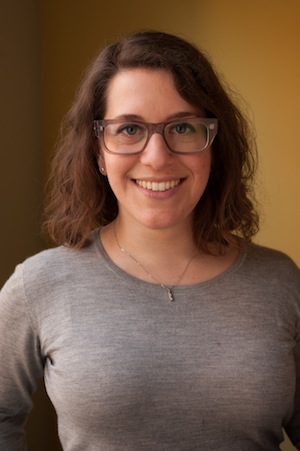
photo - Tamara Micner
Tamara Micner returns to Vancouver for the North American première at Chutzpah! of What You’re Missing, a play based on her family’s stories. (photo from Tamara Micner)

Micner left Vancouver in 2003 for Yale, where she earned her bachelor of arts in English literature. She worked with Google for a few years, which took her to San Francisco and Toronto, then studied at Cambridge, receiving her master’s of philosophy in 2011. When she last spoke with the Independent, she was on her way to London, England, because, as she told the JI, “for plays, London is the best city in the world.” There, she has continued learning and working, not only in theatre, but also as a journalist and copywriter. The JI caught up with Micner earlier this month.

JI: When the JI last spoke with you, Fantasmagoriana was at the Edinburgh Festival Fringe, and you also had two new plays in the works, one of which was called Highlight. Could you share some aspects of its development, from its première at Cambridge in 2011 as Highlight to its run last year as What You’re Missing at King’s Head Theatre in London, to its upcoming production at Chutzpah?

TM: What You’re Missing has been in the works for four years, and hopefully it will continue to live after Chutzpah as well.

We started developing the play during my master’s degree at Cambridge, with a rehearsed reading and a run at the main student theatre. I then left it for awhile and worked on other projects, and gave myself time to come back to it with greater distance and a clearer head.

In 2013, I did more rewrites and started submitting it to theatres in London, including the King’s Head, which accepted it for final development. By the time we performed it last year, it was pretty well “finished.”

It’s gone through many rounds of changes. It started out more purely comedic and, over time, it’s gotten more political and more serious, alongside the comedy that (hopefully) pervades the piece.

JI: You described Highlight in the 2011 JI interview as being based on the beginning of your parents’ relationship, and as “a dysfunctional family comedy.” In general, what has been the reaction of family (and friends) to the plays in which they see themselves represented? Do you have any advice for aspiring writers as to how to use family/friend elements without causing (too many) hard feelings?

TM: My sense is that my relatives who inspired the characters in What You’re Missing have enjoyed seeing versions of themselves and their experiences represented onstage. (Or they’ve just been polite.) The play is critical and truthful, but it’s also a dramatization, and it’s written from a place of love and affection, which I think comes through. I wasn’t alive in the 1970s, when this play is set, so it’s drawing from elements of my family’s stories – from a specific time, place and set of experiences – to explore broader questions about family, love, politics, religion, gender and so on.

When we debuted the play in London, people of different nationalities, religions and backgrounds said that they related to the story and characters, and saw themselves or their lives reflected in the piece in some way. That response really pleased me (and was a relief!) because that was my hope. I see theatre as, among other things, a way to bring people together and remind us of the things we share.

I think artists need to share their truths, and personal experience is where a lot of our truths come from. That might cause hard feelings. But, if we’re honest and nuanced, rather than heavy-handed, people will respond and connect to the work, and the truth in it will come through.

JI: In 2011, you said that you chose to move to London for its theatre presence and because you loved the city. Has the city lived up to your expectations? Do you plan on staying for the foreseeable future?

TM: I’m very happy living in London. I’ve found a neighborhood and communities that I feel at home in, including easy access to pita, dates and baklava, and I’m still discovering more of the city and the country. I was approved for Polish citizenship last year, so assuming the U.K. doesn’t vote to leave the EU, I plan to stay here indefinitely.

JI: Will you be coming to Vancouver for the Chutzpah shows? If so, how much input, if any, will you have into this production? Did you have any hand in casting?

TM: Yes, I will be in Vancouver for the run. I’ve met with the director, John Cooper, in person and on Skype, and we’ve talked about the origins and development of the play and his vision for the production. He oversaw the casting, and I trust his instincts and judgment. It’s exciting to see how other people interpret your work and bring it to life, sometimes in surprising ways.

JI: Are there any projects you have currently on the go, or that you’re considering undertaking, that you would like to share with JI readers?

TM: I’m developing a new show, Wink the Other Eye, with two actors and a musician. It’s about music hall, a major genre of British entertainment from the mid-19th century until about the ’20s (when ragtime and revue, and radio, started taking over). For example, if you know the song “Daisy Bell,” that’s actually from music hall.

The show is devised – collaboratively created and written – which is a new style of working for me. We plan to do some showings of the piece in the spring, working toward a production later this year. We’ve been approved for funding from Arts Council England to finish development, which is a big help and a stamp of credibility.

Our show looks at Marie Lloyd, one of the most famous performers of her day, who toured the British Empire (South Africa, Australia, North America) and sang from the age of 15 until she died aged 52. She had a story similar to Whitney Houston’s, Judy Garland’s: an insatiable entertainer who lived to perform and had a pretty awful life offstage (including domestic abuse and alcoholism). The show combines live performances of her songs with important moments from her private life, and the actor who plays her is related to her. (We’ve put some of the music and comedy from the show online: soundcloud.com/winktheothereye.)

What You’re Missing is at the Rothstein Theatre from March 10-15. The other theatre offering is Kafka and Son, performed by Alon Nashman, on March 2. Visit chutzpahfestival.com for more information on these and other productions.

Format ImagePosted on February 27, 2015February 26, 2015Author Cynthia RamsayCategories Performing ArtsTags Chutzpah!, Tamara Micner, What You're Missing

Poet’s passion shines

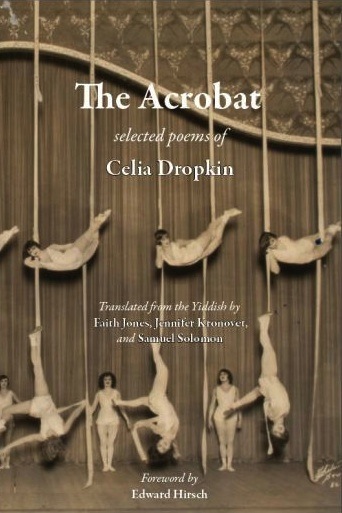
From the moment I read Pat Johnson’s interview with Faith Jones prior to last year’s Limmud, I knew I wanted to read The Acrobat: Selected Poems of Celia Dropkin (Tebot Bach, 2014).

image - The Acrobat book coverThe title of the collection wasn’t mentioned but the topic was: “erotic Yiddish poetry.” Jones, who translated Dropkin’s work into English with Jennifer Kronovet and Samuel Solomon, gave an overview of the poet’s background, which is explained in more detail in The Acrobat. That Dropkin writes with and about such passion is notable given her life’s circumstances. Born in Belarus in 1887, she and her family had to rely on the charity of relatives after her father died. While difficult, it meant that she could receive an education, and she became a writer. In 1909, she married Shmaye Dropkin, a Bund activist whose political activities forced him to flee czarist Russia, and, in 1912, Dropkin (and their son) joined him in New York.

“There,” reads the Translators’ Note, “inspired by the foment of Yiddish culture she found, Dropkin shifted from writing in Russian to writing in Yiddish…. She became a part of the thriving Yiddish literary scene, publishing widely in Yiddish newspapers and literary journals. Yet, she was publicly criticized by her male contemporaries for the perceived extremity of her work. All this time, Dropkin raised five children; a sixth died in infancy. She occasionally wrote stories and novellas in serialization for money, especially during the Depression when her family needed the income. Although the bulk of her oeuvre dates from the 1920s and ’30s, Dropkin never stopped writing poems. She wrote almost until her death in 1956.”

The Acrobat is not a comprehensive collection, but rather, as Jones explained in an interview with Leah Falk at yivo.org, the translators “chose the ones that we thought we could make into good poems in English…. The poems, even some of her quite important poems, that we did not think we knew how to work with, or that lost something in the translation that we didn’t think would be regained, we didn’t keep…. We weren’t able to capture them in the way that we felt really did them justice.”

A page-facing translation – i.e. the Yiddish poem is on the page facing the English version – those who understand Yiddish can not only engage in discussions about a poem’s meanings, but its translation. For example, the title poem, which is generally translated as “The Circus Lady,” gives an idea of the complexity of language, and the different images that are conjured by words that basically mean the same thing.

Dropkin’s poems more than withstand the test of time. Eighty-plus years later, they retain their immediacy. As Edward Hirsch writes in the foreword, Dropkin’s “lyrics come fully loaded. They are erotically frank and emotionally unabashed, deeply engendered, relentlessly truthful. They are terse and musical, like songs, and carefully constructed to explode with maximum impact.”

More than a decade in the making, The Acrobat is, remarkably, the first collection of Dropkin’s work in English, and she could not have gotten a better group of translators. Their love of the poetry comes through, as does their skill. One could almost be forgiven for thinking that Dropkin wrote in English. The Acrobat is truly an inspiring – and sometimes challenging – read. But it is more than that.

In speaking to Johnson, Jones admitted another objective. “I would like people to think about re-envisioning our forbearers as people who were more like us,” she said. “We need to really explore the people in our past and, as a historian, this is what I hope for most: that people will explore the past, understanding that these people were not like us, but in other ways were very much like us.”

In this, she and her colleagues also succeed. This is your bubbe’s poetry, as much as it is yours. And, while thought may be a little unsettling, given some of the subject matter, it is also very cool.

 ***

He and She
by Celia Dropkin (from The Acrobat)

He is a branch;
she – the green leaves on the branch.
From him to her flows
dark power, thick fertile sap.
She shudders with each touch of wind,
whispers and laughs,
turns the silver
of delighted eyes.
He is simple, mute.
Autumn dyes her deep
colors. The cold wind cruelly
exiles her from the branch,
while he remains the same, simple,
robust, mute.


Posted on February 27, 2015February 26, 2015Author Cynthia RamsayCategories BooksTags Celia Dropkin, Faith Jones, Jennifer Kronovet, poetry, Samuel Solomon, Yiddish
Klezmer meets punk

Klezmer meets punk

Germany’s Daniel Kahn and the Painted Bird play at the Electric Owl on March 6 as part of the Chutzpah! festival. (photo from Daniel Kahn and the Painted Bird via Chutzpah!)

Daniel Kahn and the Painted Bird live up to the hype. They are indeed “helping klezmer reach a new renaissance, seasoning it with folk, punk and deep-digging lyrics, full of sarcasm and wicked self-irony.” They most certainly belong “to this caste of Yiddish music agitators” and their music is “[a]n absolute must for lovers of unusual, intelligent, challenging, exciting folk music and a blast at every instant.” They are “forward-marching and backward-glancing,” making “truly great art.”

And that’s not the half of it. On their website (paintedbird.de), you can read more about what reviewers have said, you can download the lyrics to all their songs, you can watch several videos – and you can get an excellent idea of what to expect when they perform at the Electric Owl on March 6 as part of this year’s Chutzpah! festival. Kahn spoke with the Jewish Independent ahead of that one-night only show.

JI: Could you share a bit about your background – how you came to be a musician, how and when you came to live in Berlin, for example?

DK: I’ve been a musician all my life but I first started working professionally as a singer-songwriter in Detroit, and then in New Orleans in 2001.

I was a part of founding the Earthwork music collective in Michigan, which has grown to a large community of artists and activists. I produced four albums of my songs with them. I first really invested in klezmer music and Yiddish after attending Klez Kanada, in Quebec, for the first time in 2004. It was there that I met Alan Bern, who was my accordion teacher. He had been living in Berlin for many years and he offered me his apartment to sublet. I was already quite interested in German theatre, particularly Brecht, and I wanted to live in Europe, so it fit.

After going to the Jewish festivals and workshops that summer in Krakow and Weimar, I had the idea to start the band the Painted Bird. And it was around then that I really started learning not only German, but Yiddish and incorporating translations into my songs, and performing in many languages at once. The band has had many members but the heart of it for all these years has always been Michael Tuttle, whom I met in New Orleans, playing bass, and Hampus Melin, a drummer from Sweden, whom we met in Berlin. We wanted to create a band that would be able to take traditional songs, folk songs, in different languages and infuse them with a modern sensibility that we take from the other music we dig – punk, jazz, new music. And Berlin is the perfect city for this band. It’s a real cosmopolis.

JI: You’ve studied drama and your bio notes that you’ve been a professional actor since age 12. How does acting fit in with your music career?

DK: From a performance perspective, I’ve never made too much of a distinction between ways of being on a stage. Songs and plays are simply different modes of collaborative or solo storytelling. As a musician, I get to employ many of the techniques I need to write, direct or act in the theatre. And I’ve never really quit making theatre. I’ve done many productions over the years, in the States, as well as in Germany. I’ve been involved as a composer or arranger of music and songs for various productions, and I’ve been acting and directing again, as well.

I’m currently very involved in Berlin at the Maxim Gorki theatre, a wonderful space for progressive work these days. The new artistic director, the Turkish-born German Shermin Langhoff, is an inspiring, powerful voice for diversity and political engagement in drama. I’ve been a kind of “house-poet” for the theatre, working on several productions as composer, actor, musician, etc. I’m about to direct a small play in their studio theatre space, an adaptation of Romain Gary’s The Dance of Genghis Cohn. It’s become an important family for me, and has also connected to the international klezmer family, as well. I curate a concert series there, focusing heavily on new Jewish music.

JI: What drew/draws you to Yiddish as a language in which to write and sing?

DK: Besides the connection it may have to my personal background as a descendant of immigrants from what we could call Yiddishland, I’m attracted to Yiddish on a purely esthetic level. I like the way Yiddish sounds, how it feels to sing and speak it. It tastes good. I like the things you can express in Yiddish that don’t quite work in other languages. And I like the challenge of trying to translate that not only into English, but into a kind of performance that makes sense to an audience that may not have the cultural or historical literacy to know where it comes from. I think Yiddish has a lot to teach us about the world we live in today, as well as the world of a century ago. It’s a language which defies borders, which defies easy categorization, which defies simple historical narratives. It’s a defiant language.

JI: Your lyrics are poetry, full of meaning, commentary on history and contemporary society. How would you describe your core beliefs/values? Do they have any foundation in Jewish traditions/ teachings?

DK: My core beliefs, which are never fixed, have their foundations in many things in my life. Some of those things are Jewish. Others simply come from being a child of Detroit in the late 20th century, being an ex-pat, being someone who travels a lot, etc. But some of what I received as a Jewish education goes against other values that I hold to. I try to take what I need from traditions and leave the rest alone. But this is itself a tradition. So, insofar as Jewish tradition contains a tradition of subverting other traditions, I’m a fairly traditional subversive.

JI: You also arrange the words of others, Heinrich Heine, Bertold Brecht, Itzik Manger, Leonard Cohen, and a wide range of writers. How do you choose, or what aspects of a poet’s words tend to interest/excite you?

DK: I work on what speaks to me.

I’ve loved Leonard Cohen since I was about 14 or 15 years old. I definitely owe the fact that I chose to be a songwriter and a poet largely to him. Brecht was the thinker and poet who kept me interested in the radical potential of the theatre to dynamically reflect the world in a political and lyrically effective way. My first plays that I worked on out of college were by him, in New Orleans and Detroit. Somehow, they were the best response I could find to the Bush era. Brecht wrote of living in “bad times for poetry.” I think I know what he meant. He was also a tremendous songwriter, who directly influenced people like Bob Dylan and performers like Nina Simone.

Heine and Manger were poets whom I really discovered in learning German and Yiddish. And now I understand that they are relatives of Cohen, Dylan (both Bob and Dylan Thomas) and others. They are just obscured behind the barriers of language and the catastrophes of history. I like to think of what a young woman I met once said after attending Klez Kanada and first encountering modern Yiddish poetry, she’s from Newfoundland, not Jewish, and she said: “I can’t believe it. It’s like a crime that I’ve been alive for 25 years and no one has ever told me about Itzik Manger!” I think a lot of people would feel that way if they could read him. He was amazing.

Daniel Kahn and the Painted Bird’s 19+ show at the Electric Owl, 1926 Main St., starts at 8 p.m. Tickets are $30/$25. For the other musical performances, as well as the dance, theatre and comedy shows that take place during Chutzpah!, visit chutzpahfestival.com.

Format ImagePosted on February 20, 2015February 20, 2015Author Cynthia RamsayCategories MusicTags Chutzpah!, Daniel Kahn, klezmer, Painted Bird
Portraying the mess of life

Portraying the mess of life

Claire Hesselgrave as D in Wide Awake Hearts. (photo by Eric Chad)

“I want love. I want only love,” confesses C, a playboy, amid a lengthy list of his shortcomings. A rare, vulnerable moment of honesty? Or is he merely reciting his lines in a movie scene?

Such is the nature of Wide Awake Hearts by Brendan Gall, now playing at Little Mountain Gallery. One is never certain of what is real, or personal, and what is being acted for public consumption.

Of course, being a play, everything is scripted and for entertainment, however, within Wide Awake Hearts are four characters whose professional and personal lives overlap to an indistinguishable degree. Apparently named according to when they first speak/appear, A (Sean Harris Oliver) is married to B (Genevieve Fleming) and he hires his best friend C (Robert Salvador) to perform opposite her in a new movie that he has written and is producing. By the time D (Claire Hesselgrave) arrives on the scene to replace a recently fired editor, the tensions are high, and the line between what is part of the film and what is “actually” happening between the characters is well and truly blurred.

Despite being an editor, part of whose job, as D states, is to make sense out of the senseless, D’s presence only adds to reality’s murkiness. First of all, editors can only work with what they are given, what’s been shot; they can’t create anything, she explains, they can only interpret. And she’s not an objective outsider, which makes her job that much more difficult. D has been in a long-running on-and-off-again relationship with C. Meanwhile, C is in love with B, and A is jealous of what he believes is happening between C and B. As D laments, “Sometimes, the mess wins.”

That mess is life, not Wide Awake Hearts, which is a sharply written, insightful play. Tempers and desires run hot and C’s confession is one of the few quiet, calm moments that, along with the occasional biting (funny) comment, break the tension. Each character has a monologue that also serves to narrow the focus, slowing the pace before it once again ramps up.

All four actors do an excellent job of working in the intimate space of Little Mountain Gallery, sometimes a foot or two away from the audience as they perform, for example, a raucous sex scene. Director Brian Cochrane and stage manager Breanne Jackson deserve kudos for that, too, as does Sabrina Evertt for her set and props, as well as for her costumes; sound designer Jay Clift’s work is only noticeable when it should be. For the most part, everything comes together such that being in the audience is like being a voyeur, part of the action yet removed from it.

The production team being so small, it would a shame not to mention Eric Chad (projection designer), whose talents could have been exploited more; assistant director Jamie King; and publicity and front of house, Angie Descalzi. This combined Hardline Productions and Twenty Something Theatre effort, in which everyone involved seems to be doing double or even triple duty, delivers as much or more than many larger, more flush productions.

Wide Awake Hearts is at Little Mountain Gallery, 195 East 26th Ave., until Dec. 20, Tues-Sat, 8 p.m. Tickets are $22 plus service charge from brownpapertickets.com, with $15 matinées Dec. 13, 14 and 20, 2 p.m. For more information about the production companies, visit hardlineproductions.ca and twentysomethingtheatre.com.

Format ImagePosted on December 12, 2014December 11, 2014Author Cynthia RamsayCategories Performing ArtsTags Breanne Jackson, Claire Hesselgrave, Genevieve Fleming, Robert Salvador, Sean Harris Oliver
Laughter guaranteed

Laughter guaranteed

Left to right, Josh Drebit, Donna Soares, Allan Zinyk and James Long in Cinderella: An East Van Panto. (photo by Emily Cooper)

If Canada wants to be an energy super power, it’s going to have to run some pipelines through some plays. Well, some pantos. Starting with Cinderella: An East Van Panto, now on at the York Theatre until Dec. 28.

As with the inaugural East Van Panto last year, which took Jack & the Beanstalk to strange and hilarious new heights, this Cinderella is only loosely based on the fairy tale. In this version, Ella – Cinderella is only a mean nickname given to her by her wicked step-hipsters (not a typo) – loses her mother in a tragic food truck accident. Her father directs his grief to improving safety standards and is awarded for his efforts with the Mike Duffy Food Truck Safety Award, or something along those lines. He falls in love with the Government of Canada representative who presents him the medal. Marriage soon follows, the father is offered a senatorship, which takes him to Ottawa, leaving his beloved Ella – played wonderfully as the straight man to everyone else’s wackiness by Donna Soares – in the hands of her stepmother.

In true panto fashion, Ella’s new family is played by Allan Zinyk as the matriarch and Josh Drebit and James Long as her sisters. As they order Cinderella about, the audience gets to boo every meanness, and cheer Cinderella’s every win. While Jewish community member Drebit ably pulls off the fishnets, his comedic talents really shine as Feral Cat. Drebit, Long (as Rat) and Dawn Petten (as Old Crow) are about as far away from Disney cartoon birds and other forest animals as one can get, but “the other vermin,” three young actors as mice, are absolutely adorable – and, in a panto, the audience is allowed to “ooh and ahh” at their cuteness.

Zinyk also plays bad guy Ronald Grump, costumed in a business suit and an awful wig that’s only marginally worse than that worn by the character’s inspiration, Donald Trump. King Grump decides to hold a ball (there are lots of ball jokes, FYI) to celebrate the opening of Grump Towers (plural, even though there’s only one). At the ball, there will be a beauty pageant – a speed-dating marathon, actually – to find a wife for his son, played by Petten channeling Justin Bieber. (Petten also plays the hippy narrator/canvasser, Len Til, to perfection.)

And this brings us back to pipelines, and the spills that the suit-wearing, hard-hatted forewoman notes “only happen in movies and on the news.” As the chorus (pipe)line is passing through Cinderella’s family home, sadly, there is a spill – a spill that Cinderella must clean up before she can go to the ball. With the help of her vermin friends and, in one of the funniest scenarios to be conceived, a vacuum-harmonica-playing David Suzuki (played by Zinyk, you have to see it to believe it) and her B.C. Ferry Godmother, the belle gets to the ball.

But does she marry her prince? You’ll have to go to the panto for the answer – and for all the witty, weird, Vancouver-specific humor, the inventive costumes (Cinderella’s gown appears like magic), the charming music, the fitting choreography, the inspired sets and props, the bold and beautiful backdrops.

With Cinderella, the creative team of playwright Charles Demers, musician Veda Hille and director Amiel Gladstone have improved on what was already an intelligent, silly, energetic, crowd-pleasing formula. The lead actors in this year’s production are joined by the very talented chorus of Bailey Soleil Creed, Sean Sonier (who rocks a tutu) and Alexandra Wever, as well as the children who share the roles of the mice.

If you’re wondering what to give that person on your Chanukah list who has everything, at least 99 percent of non-Grumps would enjoy this show. For times and tickets, visit thecultch.com or call 604-251-1363.

Format ImagePosted on December 12, 2014December 11, 2014Author Cynthia RamsayCategories Performing ArtsTags Allan Zinyk, Amiel Gladstone, Charles Demers, Cinderella, Dawn Petten, Donna Soares, East Van Panto, James Long, Josh Drebit, Veda Hille
Arcady survives with soccer

Arcady survives with soccer

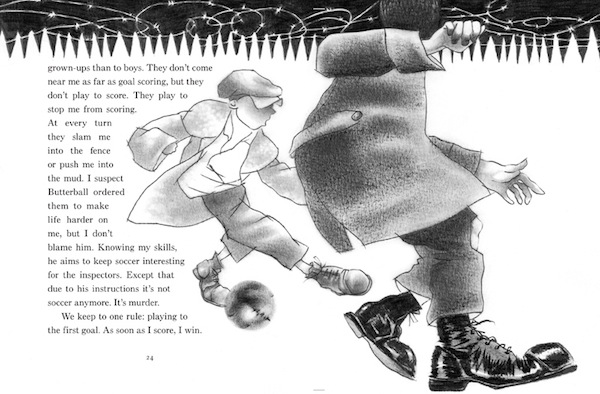
Eugene Yelchin’s illustrations are an integral part of the storytelling in Arcady’s Goal.

What a special tribute to a parent. Eugene Yelchin’s most recent children’s book,

image - Arcady's Goal - book cover

Arcady’s Goal, started with a 1945 photograph of the Red Army Soccer Club. One of fewer than a dozen photos of his family that “survived the turbulent history of the Soviet Union,” it includes the team’s captain, Arcady Yelchin, his father.

Historical fiction aimed at kids age 9 to 12, Arcady’s Goal (Henry Holt Books for Young Readers, 2014) will hold the interest of older readers and elicit much discussion. Set in Soviet Russia during Stalin’s reign of terror, its main character, Arcady, is a feisty, self-confident 12-year-old who has lived in several children’s homes (“home” being euphemistic for camp or prison) since he was 3 years old and his parents were arrested on the charge of “participation in a terrorist organization. Preparing to overthrow Soviet power and the defeat of the USSR in a future war.”

Arcady has survived on his wits, his courage to stand up to those in authority and strength to deal with the consequences, and his incredible skill at soccer. Playing one-on-one soccer with other kids for rations, Arcady initially seems ruthless, but the act of it is revealed when he returns his winnings (“an eighth of bread, our daily ration”) to the boy he beats. And, when a group of inspectors comes to the compound, Arcady makes a deal with the director: Arcady will play whomever the director lines up and, for every win, the director will give him and the loser of the match two bread rations.

During the “games,” one of the inspectors seems especially interested in Arcady. While Arcady didn’t believe the director who, when trying to convince him to play, said there might be a soccer coach among the inspectors scouting for new talent, Arcady nonetheless starts thinking that this man is indeed a coach. When Ivan Ivanych returns to adopt Arcady, the boy thinks it’s because of his soccer talent – and that, if he fails to perform as expected, he’ll find himself back at the children’s home.

Without revealing what happens, the relationship between Arcady and Ivan is really touching. Reading how it develops, the hurdles they both have to overcome, the trust they both need to gain, the courage they both need to find, is inspiring, especially surrounded as they are by people who would do them ill out of fear or ambition – with two notable exceptions. Arcady’s Goal is a well-told story that respects its readers and doesn’t shy away from difficult material even while delivering a positive, hopeful message. The black and white illustrations by Yelchin communicate an additional depth of feeling and movement, or stillness.

image - The black and white illustrations by Yelchin communicate an additional depth of feeling and movement, or stillness.
The black and white illustrations by Eugene Yelchin communicate an additional depth of feeling and movement, or stillness in Arcady’s Goal.

Yelchin, who was born in Russia, left the former Soviet Union when he was 27. Arcady’s Goal is considered a companion novel to Breaking Stalin’s Nose (Henry Holt Books for Young Readers, 2011). Also written and illustrated by Yelchin, the 2012 Newberry Honor book centres around 10-year-old Sasha Zaichik, who has wanted to be a Young Soviet Pioneer since he was 6 but when the time comes to join, “everything seems to go awry. Perhaps Sasha does not want to be a Young Soviet Pioneer after all. Is it possible that everything he knows about the Soviet government is a lie?”

In the author’s note that follows the story in Arcady’s Goal, Yelchin writes about an experience he had in the summer of 2013 when he was at Oakland University in Michigan to speak to students who were studying Breaking Stalin’s Nose. After his talk, he caught a cab to the airport. The driver had also come from St. Petersburg. When the reason for Yelchin’s trip came up in conversation, the driver fell silent, then revealed that his grandfather had died as a result of being sent to a hard labor camp for 10 years by Stalin. “I caught myself leaning in close to hear Yury,” writes Yelchin. “He was whispering.

“And so it goes. The terror inflicted upon the Russian people by Stalinism did not die with those who experienced it firsthand but continued on from one generation to the next. It is as if anyone born in the Soviet Union continued to suffer from a post-traumatic stress disorder that has never been treated.” The Communist Party, with its preemptive strikes against people who might disagree with them, “ensured that this trauma would live on even after the demise of communism. It did so by shattering families of the enemies of the people. Their family members were denied places to live, work, permits and food rations. Children suffered the most. Infants were separated from their mothers, placed into the security police-run orphanages and often given different surnames.” Yelchin notes that everything was taken away from these children, and that children could receive the death penalty at age 12. For these and other reasons, says Yelchin, even 60 years after Stalin’s death, a cab driver thousands of miles away from Russia whispered “as he shared the fate of his grandfather, an enemy of the people.”

There is a teacher’s guide for Arcady’s Goal that can be downloaded from eugeneyelchinbooks.com/arcadys-goal.php. It is quite intriguing in and of itself, and would be an excellent resource for non-teachers as well.

Format ImagePosted on December 12, 2014December 10, 2014Author Cynthia RamsayCategories BooksTags Eugene Yelchin, Henry Holt Books, Soviet Russia, Stalin

Writers play with reality

Men’s books. Normally, I don’t classify the novels I read along gender lines, though I have read and reviewed “chick lit.” Both Wiseman’s Wager by Dave Margoshes and Fun & Games by David Michael Slater are far removed from that genre – the sex is less romantic, the language more crude, the energy more confrontational or aggressive. My guess is that the former will appeal most to older male readers, the latter to younger.

Both novels feature main characters with whom readers can sympathize. Despite their faults, they are likable, and they have an energy that drives the narrative, even as it circles, as in Wiseman’s Wager, or spins out of control, as in Fun & Games.

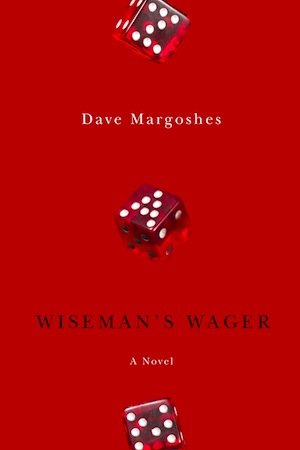
image - Wiseman's Wager book coverIn Wiseman’s Wager, Zan Wiseman, 82, has recently moved to Calgary from Las Vegas. His longtime partner, Myrna, has passed away and his only remaining sibling, Abe, lives in Calgary, where his wife, Dolly, lies in a coma. In the late 1980s, the “A to Z Brothers, together again after all these years.”

Zan grew up with his brothers in Winnipeg, participating in the labor movement through the General Strike in 1919. The family moved to Toronto for a short period after the strike but returned to Winnipeg. Zan himself moved to Toronto soon thereafter and lived there for many years, continuing his union and communist party involvement.

Early into his stay in Calgary, Zan, suffering from severe constipation, lands in hospital, where he makes a joke about killing himself. We mainly learn about his younger days, his one novel – The Wise Men of Chelm, published in 1932 with little fanfare because the publisher goes bankrupt (it was the Depression, after all) and republished some 30 years later to great acclaim – his many wives, his brothers’ escapades (arrest for robbery, going to war, etc.), his relationship with his parents and his feelings about religion, politics and love, through his government-imposed therapy sessions with the “Lady Doctor,” Zelda, on whom he develops a small crush. There are also journal entries, “duets” in which he and Abe exchange brief, rapid-fire repartee, and Abe’s one-sided conversations with Dolly.

Zan is opinionated, sarcastic and difficult at times, but he is also endearing. He has led (perhaps) a fascinating life in an historically fascinating time. The confessional of an elderly man, there is uncertainty as to what did and did not happen, but readers won’t struggle with that aspect. While probably realistic as to how such memories would unfold, the repetition impedes the flow of the story somewhat and, at times, the dialogue crosses into stereotype; two bickering old Jewish men (Zan and Abe) or a crotchety old grump (Zan with Zelda).

The issues raised during the novel, however, are extremely engaging. Zan’s involvement with the Communist Party in Canada; his views on religion, particularly Judaism, of course; the losses we incur as we age; the different paths that members of the same family take; the way in which we fall in and out of love. There is much to recommend this novel, but it just didn’t hold my attention from start to finish. As Zan’s mind wandered, so did mine. A more exacting editor would have helped.

As for Fun & Games, it is much more focused and is also very well written, but it takes many trips to Crazy Town. It is a very stylistic novel that will appeal to many with its dark humor and intelligent take on various aspects of life, but the plot was a little over-the-top unrealistic, though the characters felt real enough.

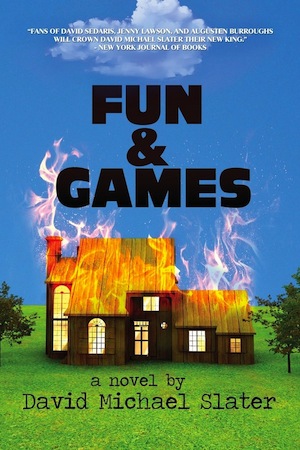
image - Fun & Games book coverThe expression is, “It’s all fun and games until somebody gets hurt.” And, sometimes tacked on to the end of that is, “Then it’s hilarious.” Well, there is much that is funny in this book but it didn’t reach hilarity for me, despite, not to ruin any surprises, the fact that many, many people get hurt (i.e. die) – I don’t know how high a body count there is for most coming-of-age tales but if there were a list, Fun & Games would be pretty high up on it.

We meet Jon Schwartz, his three main buddies, his parents and two sisters, as well as his grandparents, when he is in Grade 9. It is the late 1980s. Not surprisingly, sex – or, more accurately, curiosity about it – is a prominent part of Jon’s life. He and his friends discuss it a lot, experiment with it a little, and fall victim to Jon’s sisters’ use of it to manipulate them.

Religion and Judaism feature prominently in Fun & Games. Jon’s grandmother is constantly making discomforting “jokes” about Jews, Israelis and the Holocaust – she and her husband are survivors – and his father is an avowed atheist and a respected scholar and author on the topic. One of Jon’s friends covets the rabbi’s daughter, and the rabbi is apparently one of the few people able to argue with his father about religion to any effect.

Jon, who more than one character remarks, “handle[s] everything so well,” handles a lot from Grade 9 to his first semester at university, where Fun & Games leaves us. If you can suspend your disbelief to the full extent, you will enjoy the fast-paced exhilarating ride that is Fun & Games. And it’s not an empty ride. I can still feel the thrill that came for me from the more philosophical parts, the ideas Slater’s presents amid the contrived chaos, and the reflections on family, friendship, loss and life.

Posted on December 12, 2014December 10, 2014Author Cynthia RamsayCategories BooksTags Dave Margoshes, David Michael Slater, Fun & Games, Wiseman’s Wager
Higher learning in the Negev

Higher learning in the Negev

Ben-Gurion University of the Negev. (photo by Dani Machlis)

Approximately 2,000 Ben-Gurion University of the Negev students served during Operation Protective Edge, and another almost 1,000 remained in Beersheva to volunteer in the community. Between July 8 and Aug. 26, all activities, classes and exams were canceled. It was the third time and the longest period that the university has had to close its campus because of rockets from Gaza.

“Tragically, four members of the BGU family fell in battle. Their deaths are the latest permanent and heartbreaking reminder of the enormous price we continue to pay for an independent Jewish state,” wrote Prof. Rivka Carmi, MD, president of BGU, in her Sept. 14 e-message.

photo - Prof. Rivka Carmi is in her third term as president of Ben-Gurion University of the Negev
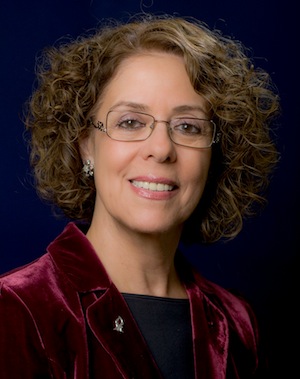
Prof. Rivka Carmi is in her third term as president of Ben-Gurion University of the Negev. (photo by Dani Machlis)

“Other members of the university family, more than I believe we will ever know, served their country, their neighborhoods, their communities and their families by devoting time and energy to helping others endure the more than 50 days of what seemed like never-ending sirens, explosions and the awful anticipation of the next one,” continued the message.

“For many of those affected by the war, the plans they had to work and earn the money needed to cover the costs of tuition and living expenses never came to fruition.”

To help, Carmi asked BGU’s associates organizations to raise $1 million, which they did. As of that message, Canadian Associates of BGU had raised more than $125,000 “for scholarships, with more expected to be donated.” As well, “approximately $120,000 … [was] received to purchase a 3-D electrocardiograph to be used with the wounded soldiers in Soroka hospital.” In August, American lawyer and philanthropist Murray H. Shusterman had pledged $1 million to improve campus safety against rocket attacks.

“We are worrying about our students so that they won’t suffer from the consequences of the university being closed and from the impact of having done extended military duty, while outlining how we need to be prepared for the possibility of more rockets in the future,” Carmi told the Jewish Independent in an email interview. “Basically, we reopened immediately on Aug. 26th to minimize loss of time, so that we wouldn’t have to delay the start of the fall semester. We have also had to institute a number of budget cuts to cover the many unexpected costs of the summer’s closure.”

While the university’s “annual operating budget comes from the government (primarily for salaries) through the Council for Higher Education in Israel, all growth and development comes through fundraising,” she explained. “Growth – in both physical infrastructure and human capacity – are made possible through amazing philanthropists who share our vision.” She voiced appreciation for the Canadian Jewish community’s support.

Carmi is the first woman to have served as president of an Israeli university, and the first as dean of a health sciences faculty. Elected for her first term as BGU president in 2006, she was confirmed for her third term this past May.

“I am sorry to say it is still an accomplishment to be the first woman and, though the situation is improving, it isn’t happening fast enough for me,” she said when asked about how women’s involvement at these levels had changed in the past 15 years or so. “There is a real problem still today to encourage girls to pursue their studies in the sciences. BGU operates a number of programs to encourage girls to expand their horizons through our Access to Higher Education program.”

One of her favorites is Inbal, which was spearheaded by Prof. Hugo Guterman. According to the blurb that accompanies the YouTube video of a group of program participants, “‘Only three to five percent of students in the department of electrical and computer engineering are women. In general engineering, it’s about 25 percent,’ he notes. Three years ago, he, along with BGU and the Beersheva municipality, began a course in robotics for female middle school and high school pupils. Beginning with less than 15 girls participating, this year [2012] nearly 120 girls took part in the course.”

With similar intent – to get more women into higher education – Carmi co-founded with Fatma Kassim the nongovernmental organization Alnuhud, the Association for the Promotion of Bedouin Women’s Education in the Negev. “It was the first such an organization … in the community,” said Carmi. “We realized then that an educated woman has a huge impact on the community and her family. The goal was to ensure that girls can compete on their own level to enter into university. At the same time, the university created what has turned into a very successful medical cadet program, launched by Prof. Riad Agbaria, to find promising Bedouin high school students and help them prepare for university studies in the health sciences.

“People like Shira Herzog (z”l) and the Kahnaoff Foundation have put us in a position to be able to offer scholarships to Bedouin women. When you are out in the Negev, you really feel the difference. There are now many Bedouin women out there making a difference in their communities.”

Two years ago, Carmi led a national committee examining the barriers and possible solutions to the situation. “The findings were conclusive,” reads BGU’s President’s Report 2014, “while Israel graduates a large number of female PhDs, it has far fewer women in the ranks of senior faculty than other European countries.

“This year, there were 216 women among the faculty, not including clinical medical staff, representing 27 percent of the total. The higher one ascends the ladder of seniority, the lower the percentage of women. Today, 40 percent of lecturers, 35 percent of senior lecturers, 19 percent of associate professors and only 16 percent of full professors are women. Of the 38 new faculty members recruited this year, one third are women.

“The average age for a woman completing a doctorate in Israel is relatively high: 37.3 years old. Israeli women also tend to have more children than similarly educated women around the world. The result is that potential candidates for international fellowships are older, with more children and less flexibility than their peers.”

“One of the key stumbling blocks, the report found, is the postdoctoral fellowship, generally done abroad. The average age for a woman completing a doctorate in Israel is relatively high: 37.3 years old. Israeli women also tend to have more children than similarly educated women around the world. The result is that potential candidates for international fellowships are older, with more children and less flexibility than their peers.”

The report listed a few initiatives that had been implemented based on the findings, but it is a continuing process. Just last month, said Carmi, “we organized a national conference to encourage women to a pursue an academic career. More than 350 young academics – men and women – came to Beersheva for the event that included hands-on advice and a panel of young female researchers who have ‘made it’ talking about their experiences. The responses we received from the participants have been overwhelmingly supportive.”

Carmi herself is a renowned researcher, and there is even a medical condition named after her. “During my work as a neonatal physician, I treated babies who were born without skin and with other severe birth defectives,” she explained about how the Carmi syndrome came to be named. “I was highly motivated to find the cause for this horrible condition. The problems we observed had never been seen before so it was decided to name this horrible disease after me. Twenty-five years later, I was fortunate enough to identify the gene mutation that causes it!”

For Carmi, genetics has been a long-held passion. “When I was in school,” she said, “I fell in love with the whole idea of research. My curiosity was captured by genetics and how it all shapes our lives. I decided very early on to become a genetics researcher. I realized that the best way to do this and help people at the same time was to study medicine and combine it with scientific research.”

While time no longer permits Carmi to be actively involved in research, she said, “It was my life, but I am happy in my new career that allows me to make a difference. I moved to the Negev in 1975. Watching it change and grow is very satisfying.”

“We are overcoming budget shortages and the incredible competition with universities around the world to attract the best and brightest young researchers through a special presidential fund…. I have funded researchers in fields that range from Yiddish to cognitive brain sciences.”

One of Carmi’s missions when she became BGU president was to “inject scientific content and research” into the university. On the progress of that mission, she said, “We are overcoming budget shortages and the incredible competition with universities around the world to attract the best and brightest young researchers through a special presidential fund. This allows BGU to offer competitive packages to researchers who might otherwise go elsewhere and opens up new positions as part of a wider agenda to stop Israel’s brain drain. I have funded researchers in fields that range from Yiddish to cognitive brain sciences.”

Carmi has received many honors over her career, including from Canadian organizations, and there have been several collaborations between BGU and Canadian science/academia.

“As a researcher, I had no Canadian contacts, but when I became dean of the faculty of health sciences, I became involved with the Canada International Scientific Exchange Program (CISEPO), which honored me in 2002 for my work. Now, our students participate regularly in their programs,” Carmi told the Independent.

“Over the past few years,” she added, “we have created a number of cooperative agreements with Canadian universities, the most noteworthy is with Dalhousie,” from which she received an honorary doctorate last year. The BGU-Dalhousie memorandum of understanding involves joint research projects, among other cooperative ventures, including the development of an Ocean Studies Centre in Eilat.

“We have had a significant increase in the number of Canadian academics coming to the Negev. The result has been a number of agreements for students and cooperative projects,” said Carmi, who was among those participating in a late-October conference in Ottawa on innovation that “focused on the Canadian-Israeli connection. It was fascinating,” she said, “and is sure to result in further partnerships.”

For more information about BGU, visit bengurion.ca.

Format ImagePosted on December 5, 2014December 3, 2014Author Cynthia RamsayCategories IsraelTags Ben-Gurion University, BGU, Rivka Carmi
World musician at Rothstein

World musician at Rothstein

On Dec. 5, Lenka Lichtenberg will perform traditional and original songs at the Rothstein Theatre, self-accompanied on piano, guitar, harmonium and percussion. (photo from lenkalichtenberg.com)

Three new CDs in three years made in three different regions of the world, garnering at least as many awards and even more nominations. Toronto-based Lenka Lichtenberg has been on creative fire. She sent the Independent greetings from Prague earlier this month, as she was preparing for a concert there, and early next month, she will be in Vancouver.

The group Art Without Borders is bringing Lichtenberg here for a Dec. 5 solo performance at the Norman and Annette Rothstein Theatre.

According to its website, the nonprofit organization has two missions: “it strives to promote an understanding and appreciation for Czech culture through the arts both within and without the Czech community” and “it endeavors to cultivate dialogue between Canada and Central Europe.”

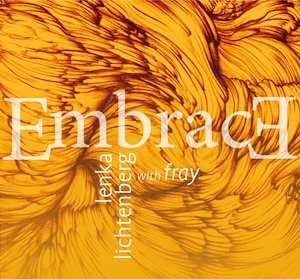
Lichtenberg’s work certainly forms cultural connections, and it greatly expands upon the dialogue. Consider only her most recent recordings, all of which bring together top-notch musicians from around the world to create music that blends multiple languages, cultures, melodies and rhythms: Songs for the Breathing Walls (2012) with the help of many international artists, Embrace (2013) with Canadian world-music group Fray and Lullabies from Exile (2014) with Israel’s Yair Dalal.

In addition, on her website, Lichtenberg has a virtual museum that displays some of what she has discovered about her family. Born in Prague, she didn’t find out she was Jewish until she was 9 or 10 years old. “It took me awhile to learn about my roots, as my mother did not say much about it; she did not know herself,” writes Lichtenberg. “My mother, while 100 percent Jewish, was brought up a Catholic by her family who left Judaism one by one. My great-grandmother described herself as ‘without faith’ already in 1919, and my grandmother and grandfather left Judaism some three to four years later. There were no signs of Jewish roots in the households, Christmas was celebrated. Not a completely atypical Czech Jewish urban family, I believe; assimilation was widespread. Then, the Holocaust … and my family was murdered. As an adult, I began learning.

image - Songs for the Breathing Walls cover“The activities of the past 25 years of my life, since my first trip to Masada, have largely been an attempt to learn about, and honor, my heritage in ways available to me: as a Yiddish singer (picking up Yiddish as an adult) and musician, composer of music built in one way or another on Jewish traditions, and a singer of beautiful liturgy. My 2010-2012 project Songs for the Breathing Walls was the most determined milestone in my quest to honor and connect with the past – via the history of the wider Jewish community of Czech and Moravian lands.”

The album Songs for the Breathing Walls connects that past with the future, preserving traditional Hebrew liturgy and poems in contemporary arrangements that were performed live in 12 different synagogues, or buildings that were once synagogues or used as such (nine Czech and three in Moravia). The recordings were made from July 2010 through July 2011. “The journey ended in Terezin, where my mother’s family was incarcerated; for the first time, I walked in the halls of the building where my mother had lived for two and a half years,” writes Lichtenberg in the liner notes. Appropriately, the memorial prayer El Maleh Rachamim was recorded there. Several of the recordings are prayers from the Yizkor service, but they mix with an Adon Olam based by Dalal on a melody of Babylonian Jews, an Avinu Malkeinu arranged by Lichtenberg and other holiday or weekday prayers.

Mourning and hope, sadness and joy cohabitate easily in this beautiful, moving and meaningful recording, the idea for which came to Lichtenberg in 2009. Performing on consecutive days in synagogues in Plzen and in Liberec, she noticed a difference in sound, ambience and feeling, “a unique character stemming from something deeper than mere acoustics … perhaps something left behind by those who built these structures and filled them with their lives.” Her hope is that, in listening to Songs for the Breathing Walls, people “will be able to hear the ‘breathing walls’ as well, embracing those who lived among them, love, suffered, prayed for peace. Perhaps then, their memory will live on….”

image -  Embrace coverIn all of Lichtenberg’s music, the memory and traditions of those who have lived before can be heard – they are celebrated, and merge with the memories, traditions and passions of Lichtenberg and the artists with whom she collaborates. A completely different mood infuses Embrace than Songs for the Breathing Walls, yet it too crosses temporal, cultural and geographic borders. Recorded in Toronto with Fray, co-led by percussionist Alan Hetherington, Embrace features lyrics inspired by religious texts, folk tales, poems, family and friends, with melodies rooted in the Middle East, North America, South America and India.

Lichtenberg is at home in many languages and musical styles, and every release highlights her talents, and those of the musicians with which she works, Lullabies from Exile being another example. It is one of the most distinctive collections of lullabies you’ll ever hear. With songs recorded in Israel, Canada and Czech Republic, it brings together Babylonian and Yiddish music, songs sung to Dalal and Lichtenberg by their mothers, literally intertwining them in eight medleys, each arranged from a song from each of their traditions.

image - Lullabies from Exile coverAs explained on Dalal’s website, the collaboration on this CD “was born before a joint concert in Kosice, Slovakia, when Lichtenberg played the album’s opening lullaby, ‘Yankele,’ for Dalal to see if he could accompany her on oud. Soon, Dalal was playing an Iraqi lullaby from his childhood [‘Wien Ya Galub’] that connected to Lichtenberg’s Yiddish song with a remarkably natural intuition…. While most of these lullabies are in Judeo-Iraqi Arabic and Yiddish, the concept grew to include songs in Czech, Slovak and Hebrew in order to reflect the artists’ personal histories, as well as English, to acknowledge the experience of the English-speaking Diaspora.” The CD also includes two non-medleys.

When the Jewish Independent first interviewed Lichtenberg (“Eclectic Jewish music,” Dec. 15, 2006), it was about her third CD, Pashtes/Simplicity, a collaboration with Brian Katz, in which she set the Yiddish poetry of Simcha Simchovitch to Jewish, jazz, Brazilian and other melodies. Having performed previously “in lounges, bars, in a rock band, more bars, and a cruise line,” she explained what she realized in Israel: “… I needed to change my direction and truly embrace my roots, my identity, which at that time was barely visible. I decided to ‘do Jewish.’ Being a musician, it meant dropping the kind of music I made my living with up to then in Canada and starting from scratch as a Jewish singer…. I concentrated on Yiddish, as I felt it would be closer to my true identity than Hebrew, even though my family, my mom and grandma, Holocaust survivors, didn’t speak a word of Yiddish. [They were] totally assimilated, as [were] most Czech Jews.” Lichtenberg, who had also been studying cantorial music for several years by 2006, described her experience with Jewish music as being “a growing process.”

While it is tempting, having listened to these latest recordings, to say that Lichtenberg’s Jewish music is all grown up, so to speak, written and performed with a confidence and skill that is remarkable, she seems like someone who will continually push herself to keep growing, experimenting in each new project. And, of course, she has several on the go. For more information about Lichtenberg, visit lenkalichtenberg.com. For tickets to her Dec. 5, 8 p.m., solo concert at the Rothstein Theatre, visit arwibo.org ($25) or the theatre box office at the Jewish Community Centre of Greater Vancouver ($28).

Format ImagePosted on November 21, 2014November 19, 2014Author Cynthia RamsayCategories MusicTags Art Without Borders, Embrace, Lenka Lichtenberg, Lullabies from Exile, Rothstein Theatre, Songs for the Breathing Walls, Yair Dalal

Jewish Book Fest in a week

More than 30 authors are featured in this year’s Cherie Smith JCCGV Book Festival, from the time it opens on Saturday night, Nov. 22, with Israeli author Zeruya Shalev (The Remains of Love) till it closes on Thursday night, Nov. 27, with Toronto emergency physician and CBC Radio host Dr. Brian Goldman (The Secret Language of Doctors). Here’s a taste of what to expect each literary day.

image - Nora Gold's Fields of Exile book coverSunday: Fact Meets Fiction

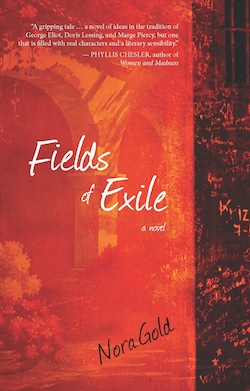
Speaking twice on Sunday is writer, editor and activist Nora Gold. Her late-afternoon talk will be about jewishfiction.net, an online journal that she founded and edits. In the evening, her novel Fields of Exile will be the focus. In it, the main character, Judith, faces antisemitism in the guise of anti-Israelism on the fictional campus of Dunhill University, where she is taking a master’s in social work. Gold’s opinion on the subject comes out clearly and the novel will make many Jews who have had to endure Apartheid Weeks and anti-Israel propaganda on campus feel less alone; the frustration and fear that Judith experiences will be familiar.

Judith is a knowledgeable and critical supporter of Israel, she has lived in the country, worked for peace and on human rights projects there, and only returns to Canada because her father becomes ill. Nevertheless, with few exceptions, her opinions on Israel are discounted and dismissed by professors and students alike. Ultimately, the anti-Israel words and images turn into violence because they are never put in check by the university, each professor having their own reasons for ignoring, or not speaking out, against antisemitism.

image - Joseph Kertes' Afterlife of Stars book coverMonday: Focus on Hungarian Jewry

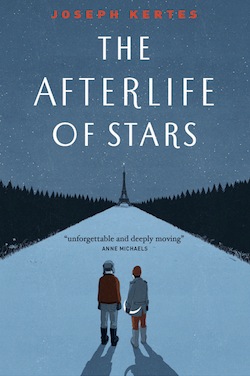
Joseph Kertes shares his session with Ayelet Waldman (Love and Treasure), hosted by Janos Maté. Kertes’ The Afterlife of Stars follows the Beck family’s flight from Budapest to Paris as Russia invades Hungary in 1956. The terrifying reality of the period, the human and material losses, are tempered by the story being told by 9.8-year-old Robert Beck, whose class is in the process of reviewing decimal points when the book begins. Robert and his 13.7-year-old brother Atilla don’t necessarily understand what is happening, though Atilla is wise beyond his years, always asking questions, philosophizing, taking Robert on dangerous (though they don’t usually realize it) journeys, to see a movie, to see some statues, various adventures without their parents’ knowledge.

The wonder of the brothers and their relationship provides the energy of the story, which slows and becomes pedantic in places where historical or background information is explained, especially once the family reaches Paris. Overall, though, The Afterlife of Stars is mostly a charming tale with moments of sadness and beauty, written from a unique perspective.

image - Stephen Galloway's Confabulist book coverTuesday: For Book Clubs and Book Lovers

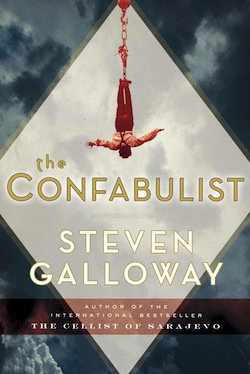
Steven Galloway’s most recent novel, The Confabulist, is, in a word: fun. This tale of Houdini, as told by Houdini and Martin Strauss, the man who killed him (twice), is perfect vacation/relaxation fare. Galloway explains some of Houdini’s greatest illusions, regales with tales of Houdini working with the secret service as a spy and captivates with Houdini’s efforts to expose spiritualists for the frauds they were perpetrating – on some very powerful and influential people. Out of all the threats facing Houdini, it was an unexpected punch in a bar that killed him … or was it?

The entertainment value of The Confabulist is enriched with ponderings on the role and purpose of magic in our lives; the fallibility and malleability of memory. Both Houdini and Strauss contemplate how they have lived and what they have accomplished, and perhaps their observations will prompt readers to think about their own pleasures and regrets. Or maybe they’ll just enjoy the show.

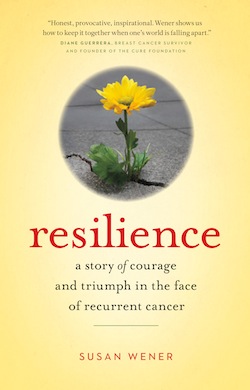
image - Susan Wener's Resilience book coverWednesday: The Power to Triumph

Susan Wener has had several serious health issues in her life, including two bouts of cancer. In Resilience: A Story of Courage and Triumph in the Face of Recurrent Cancer, she matter-of-factly takes readers through her experiences and how she handled them. Already a health-care system veteran when she was first diagnosed with cancer at age 36, when her children were young, Wener hoped to live long enough to see them to adulthood – she now has several grandchildren.

There are many life lessons from such a memoir, of course. One of the most powerful in this one is that it’s OK to be angry, to breakdown, to react how you react. You are not in charge of the disease but you are in charge of everything else, what tests and treatments you undergo, what therapies you try, who you ask for help, how you live your life.

Wener writes without bravado. She kept getting up every day, but she wasn’t always a fighter or optimistic. Her illnesses, especially the last serious one – years of pain and horrible treatments before being diagnosed with a functional obstruction in the colon – pushed her to the limit, as the title of that chapter openly admits. But she did push through, she took the tests, did the research, underwent the surgeries, made the decisions.

Wener shares her thoughts about and discussions with her husband and daughters, and these moments are incredibly emotional. Readers will readily imagine such conversations with their own family and friends and, despite the lack of sentimentality with which Wener writes – or perhaps because of it – most readers will not be able to get through this memoir without getting a little choked up and teary-eyed at times.

image - Dr. Yoni Freedhoff's Diet Fix book coverThursday: Fix Your Diet

In the penultimate event of the festival, Dr. Yoni Freedhoff speaks about The Diet Fix: Why Diets Fail and How to Make Yours Work, a clear, concise book that outlines the main weaknesses and myths surrounding dieting, and offers a detailed program that Freedhoff believes can result in success – i.e. long-term weight loss.

It is not a difficult program, but neither is it for the faint of heart. Be prepared to diarize, measure, goal-set and cook. And to be patient, both with the length of time it might take to lose the weight but also with yourself if you break your diet or exercise routine.

According to Freedhoff, most diets suffer from “seven deadly sins,” such as the constant need to battle hunger or resist temptation, and these sins traumatize many people, leading to depression, binge eating and other problems. His solution begins with a “10-day reset.” He does not promise you will lose a pant size or two, but, rather, the reset “is about lifting the guilt, the fear and the traumas of the past off your shoulders and giving you a brand-new relationship with your body, your weight and your health.”

The reset he lays out and the discussion of how it can be applied to any diet and in your broader life seems pragmatic. Freedhoff includes advice for people on medication that leads to weight gain, and for parents on how they can help with their children’s weight. Throughout the book, Freedhoff offers advice that makes it seem like his plan has a better chance than most of working. For example, he summarizes in the epilogue 10 points to remember, including, “If you can’t happily eat any less, you’re not going to eat any less,” and “If you can’t use food both for comfort and celebration, then you’re on a diet that you’re ultimately going to quit.”

The book ends with recipes for snacks and meals, as well as suggested reading and other resources, including smartphone apps.

Posted on November 14, 2014November 13, 2014Author Cynthia RamsayCategories BooksTags Afterlife of Stars, cancer, Confabulist, Diet Fix, Fields of Exile, Joseph Kertes, Nora Gold, Steven Galloway, Susan Wener, Yoni Freedhoff

Posts pagination

Previous page Page 1 … Page 79 Page 80 Page 81 … Page 85 Next page
Proudly powered by WordPress