Veganism is about much more than dietary choice. It is an ethical philosophy based on the belief that other animals are not ours to use. Like humans, animals are sentient: they experience pain and pleasure, they suffer and they form deep emotional bonds with others in their families and communities. Vegans do not use animals for food, clothing, entertainment or animal experimentation regardless of taste, pleasure or tradition. Being a vegan is also much more commonplace today, as is following a vegan diet for health reasons. This means it might not be unusual to find a vegan at your table on Passover.
For the fourth year in a row, my wife and I will be hosting an all-vegan Passover seder, or “veder,” as we call it. We started this tradition after a group of Jewish vegan friends expressed how alienating it can be to celebrate the holiday in the traditional way. As ethical vegans, it is difficult to sit at a table laden with the body parts of the nonhuman animals that we are working to protect and rescue. Many had stopped attending their family dinners, and one friend was no longer invited simply because others felt uncomfortable when she passed up most of the food on the table. But our hunger for the Jewish tradition of Passover remained.
The Passover seder commemorates our liberation from Pharaoh and the larger issue of the immorality of slavery. As Jews, we have a long history of suffering, oppression and slavery and, as animal activists, this has informed our choices to work to help others end their own oppression – including animals. It’s no wonder Jews have played key roles in other movements such as civil rights, women’s rights, gay rights and animal rights. The liberation of animals is another social justice movement for which the Jewish community should naturally feel empathy. Jews and vegans share common values such as justice, fairness, equality and compassion.
How we as animal activists celebrate the meaning of the Passover seder is to remember the evils of the past and to expand our circles of compassion and justice so that no group, human or nonhuman, need experience the suffering and exploitation of being different or unequal. Passover is a great opportunity to reflect on how we can create less suffering for all those who are oppressed through our personal behaviors and choices.
Simply adding vegan foods and vegan versions of traditional dishes to the table is a way of making a statement that we include the most vulnerable and innocent among us when we celebrate this holiday. These days, it’s as simple as Googling “vegan [whatever dish] recipe,” vegan or “vegan Passover recipes,” and thousands of animal-free options will magically appear. At our veder, we serve all of the traditional dishes we grew up eating – matzah brie, brisket, gefilte fish, potato latkes, matzah ball soup, kugel, macaroons – in veganized versions without meat, dairy or eggs.
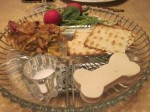
With a little effort and creativity, your entire seder dinner can be made vegan. We even have an animal-friendly seder plate. Instead of a lamb shank bone, we use a dog cookie-cutter to make a playful bone-shaped piece of tofu. Instead of an egg, we use a small dab of commercial “egg replacer” used in vegan baking. I encourage all Jews to embrace the meaning and tradition of the holiday while also incorporating new traditions that reflect values of justice, ethics and compassion. When we can celebrate the holiday without doing any harm to others, why wouldn’t we?
VEGAN CHOPPED LIVER
Adapted from The Jewish Vegetarian Year Cookbook by Roberta Kalechofsky and Roda Rasiel (Micah Publications, 1997).
1/2 lb brown lentils 1 large onion, diced 2 tbsp olive oil 1 cup walnuts salt and pepper to taste
1. Put lentils in a two- or three-quart pot and cover with water. Bring to a boil, partially cover and simmer until tender, about 30-40 minutes. Check occasionally to make sure water has not boiled off, and add water as needed.
2. Sauté onions in olive oil until golden and tender. Allow to cool slightly.
3. Drain lentils and blend, along with the walnuts and onions, in a food processor until homogenized, but leave some of the texture intact.
4. Add salt and pepper to taste. Chill about two hours.
Gary Smith, co-founder of Evolotus, a PR agency working for a better world, blogs at thethinkingvegan.com and has written for many publications. He and his wife are ethical vegans and live in Los Angeles with their cat Chloe and two beagles rescued from an animal testing laboratory, Frederick and Douglass.
(Editor’s note: Some vegan recipes will contain ingredients that are not strictly kosher for Passover. For those who are less strict, the options abound. For more strict kosher diets, incorporate dishes that are heavier on fruits and vegetables, and avoid using legumes, like lentils, or products that contain wheat or gluten. Also, only certain egg substitutes are kosher for Passover, and many Ashkenazi Jews abstain from eating kitniyot on Passover; tofu is made from soybeans, and is considered to be kitniyot.)
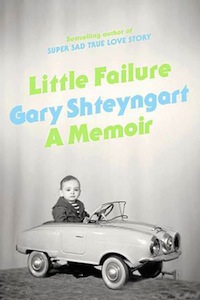
Gary Shteyngart is widely regarded as one of the most entertaining storytellers in contemporary literature. The highly enjoyable memoir Little Failure (Random House, 2014), his fourth book after three well-received novels, is his story as a Jewish immigrant from Russia trying to make sense of his place in the new world.
Beyond biography, Little Failure offers a rare glimpse into an international phenomenon.
Celebrity memoirs are often intended to settle accounts or redeem reputations. Shteyngart uses his memoir to share the important moments of his life, from his birth in Leningrad through his difficulties as an immigrant to the publication of his first novel, The Russian Debutante’s Handbook, which won the Stephen Crane Award for first fiction and the National Jewish Book Award for fiction.
In Little Failure, he writes with humor and introspection about the family’s struggles – the poverty, the hesitation in abandoning ways of the old country and the missteps in trying to fit in. As he moves through a Hebrew parochial school and on to Oberlin College, he delves into the frustrations and absurdities of immigrant life.
Tales of violence at home and unrelenting bullying in the schoolyard are followed by comical accounts of teenaged drinking, pot-smoking and attempts to connect with women. Several incidents will be familiar to those who have read his novels. He often uses events from his own life in his writing.
The memoir jumps back and forth from his recollection of events in his life to his thoughts as he writes the book. Throughout, Shteyngart keeps coming back to his relationship with his parents, and especially his father.
While writing the memoir, his father apparently told him that he read on the Russian Internet that Shteyngart and his novels would soon be forgotten. His mother identified the blogger who made the comment.
“Do you want me to be forgotten, Father?” Shteyngart thought to himself. His parents have not read his latest book but they know the name of the blogger who says he will be soon forgotten, Shteyngart moans.
His father persisted. Shteyngart was 30th on a list of New York writers. “David Remmick (editor of The New Yorker) was eight positions ahead of you,” his father said. His mother tried to calm the waters. Many writers aren’t acknowledged until after their death, she said in an attempt that did not make Shteyngart feel any better.
A few days later, his parents were kvelling over a book review in France. The French Internet described his book as one of the best of the year.
He appreciates the humor in the situation. “After each teardown, after each discussion of Internet rankings and blogs, after each barrage of insults presented as jokes, my father finishes with, ‘You should call me more.’”
What should he make of these exchanges? “Down and up. Up and down. I am forgotten. I am remembered. I am number thirty. I am beloved in France. What is this? This is parenting.”
Beyond biography, Little Failure offers a rare glimpse into an international phenomenon. The emigration of Jews from Russia has been a cause célèbre for many Jewish communities over the past four decades. Shteyngart’s memoir offers the perspective of Russian immigrants, facing numerous difficulties on the way out of the country and in starting life over in a foreign land.
His family left Russia near the end of a decade that saw 250,000 Jews coming to the West. Israel “begged” them to move to the Holy Land, he writes, but his father “courageously” resisted. A Jewish immigrant aid group helped them establish a home in New York. Shteyngart was sent to Solomon Schechter School in Queens. He does not write about those who helped the family.
The memoir also omits something I would have liked to find out. Shteyngart does not write about authors who have influenced his work or what he reads. However, he does pinpoint those events in his life that helped shape the making of the writer Gary Shteyngart.
To some extent, he was born a storyteller. He writes that he has never been stuck for words. “My mind is running at insomniac speed,” he says in the memoir. “The words are falling in like soldiers at reveille. Put me in front of a keyboard and I will fill up a screen.”
He was introduced to the art of storytelling at an early age. With debilitating asthma from birth, much of his early years in Leningrad was spent in “a fort of pillows and duvets and comforters,” fighting suffocation. He became “a pathological reader.” He recalls at age 5 reading The Wonderful Adventures of Nils, a dense 160-page volume by Selma Lagerlif, the first woman to win the Nobel Prize in literature.
Around the same time, his father was making up comic stories, dubbed “The Planet of the Yids,” about a Hebraic corner of the galaxy besieged by gentile spacemen who attacked with torpedoes filled with salted raw pig fat. Famous Jewish dissident Natan Sharansky ran the planet. Whenever the KGB was on the verge of gaining the upper hand, a fearless leader called Igor (Shteyngart’s name before he changed it to Gary) saved the Yids.
Shteyngart remembers inventing his first story at the age of 5. His grandmother, Galya, who once worked as a journalist and editor at a Leningrad newspaper, suggested he write his own novel. She offered him slices of cheese for every page he wrote, a sandwich with bread, butter and cheese for each chapter.
He put together a surrealistic tale of political adventurism and betrayal involving Lenin, Finland and a wild goose. The novel, Lenin and His Magical Goose, probably cost a hundred pieces of cheese and at least a dozen sandwiches, he estimates.
His first attempt at writing a story in English came when he was 10, three years after arriving in New York. He was a misfit at school, constantly bullied and ridiculed by his classmates. He considered himself to be one of the most hated boys at Hebrew school.
The 59-page novella, The Chalenge (sic), was an imaginative space adventure involving a blond kid who does not look Jewish, a best friend and a girl caught in the middle between the two boys.
“I write because there is nothing as joyful as writing, even when the writing is twisted and full of hate, the self-hate that makes writing not only possible but necessary,” he says in the memoir.
Shteyngart hated himself and the people around him. He was not strong enough to stand up to those who hit him, and he struck back with rage in the imaginary world he created. He discovered the power of laughter from a teacher who was ridiculed during a show-and-tell session in the classroom. He thought the teacher would burst out in tears when kids made fun of her. Instead, she just laughed and continued what she was doing. It was a revelation to him. “She has laughed at herself and emerged unscathed!”
The teacher asked him to bring The Chalenge to school and read a few pages to the class. Excited, he stood at the front of the class and read as fast as he could. “Slowly,” she said. “Read slowly, Gary. Let us enjoy the words.”
Her response startled him. “I breathe that in. Ms. S wants to enjoy the words.”
His classmates listened closely as he read the story aloud over the following five weeks. Reading his story changed how the children interacted with him. They were eager to hear the next instalment. He was not yet one of them on the playground but the terms of engagement had changed. He was no longer a Russian outcast.
Responding to their enthusiasm, he felt the pressure to write something new every day, lest he fall out of favor. It’s a responsibility that has haunted him for the rest of his life, he writes.
“God bless these kids for giving me a chance,” Shteyngart says. “May their G-d bless them every one.”
While still at Solomon Schechter School in Queens, he also wrote a satire of the Torah, called The Gnorah. He described the book as a hatchet job directed at his parochial school religious experience: rote memorization of ancient texts, aggressive shouting of blessings and an ornery rabbi who was the principal. Foreshadowing his writing style over the following decades, he mixed comic references to popular culture figures with the lives of characters in his story. Exodus became Sexodus, Moses was renamed Mishugana and the burning bush was turned into a burning television.
The Gnorah in 1984 marked the beginning of his true assimilation into American English, he writes. It would take almost two more decades before he started to receive awards for his writing.
The Russian Debutante’s Handbook was published in 2002. His second published novel, Absurdistan, was chosen as one of the 10 best books of 2006 by The New York Times Book Review and Time magazine. And, Super Sad True Love Story won the 2011 Bollinger Everyman Wodehouse Prize for comic literature – the Jewish Independent interviewed Shteyngart when that book came out, prior to his participation in the Cherie Smith JCCGV Jewish Book Festival (see “Satirist launches series,” Nov. 12, 2010, jewishindependent.ca). Shteyngart’s work has been translated into 28 languages.
Media consultant Robert Matas, a former Globe and Mail journalist, still reads books. Little Failure is available at the Isaac Waldman Jewish Public Library. To reserve this book, or any other, call 604-257-5181 or email [email protected]. To view the catalogue, visit jccgv.com and click on Isaac Waldman Library.
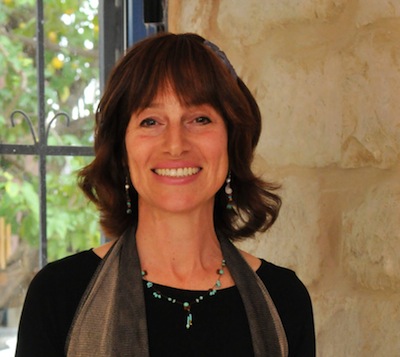
Reading From the Dream, Carol Rose’s most recent collection of poetry, led me to my bookshelf, where her first collection, Behind the Blue Gate, was safely stored. This shelf is home to books that have particularly impressed me, and which I may want to read again, as well as those that have been written by friends. Rose’s falls into both groups, and From the Dream will soon be joining its older sister.
Carol Rose’s newest collection of poetry was published by Albion-Andalus Inc. in 2013.
In looking back at Behind the Blue Gate (Beach Holme Publishing, 1997), I not only enjoyed it on its own merit, but enjoyed comparing its themes and style with From the Dream (Albion-Andalus Inc., 2013). While both collections were obviously written by the same intelligent and caring person, the effects of time and experience were evident, and there is a difference in tone: the latter seems more accepting of the way of the world. My first thought was that, perhaps having grandchildren – which Rose now does aplenty – required a person to be more optimistic.
“I am not sure if it is about being a grandparent, or about living longer and suffering the losses and demise that come with age while, at the same time, learning to treasure what we have at this very moment (including partners, children, grandchildren and friends). From the Dream seems to investigate these ideas, even the humorous poems,” said Rose in an email interview, giving as an example the poem “singin like he used to,” about attending a Bob Dylan concert as an older person, which “has us reluctantly ‘aging before our very eyes,’ while still being able to laugh at the life we are blessed to continue living.”
She agreed that the poems in From the Dream are less confrontational or cynical than those in Behind the Blue Gate. “Particularly,” she noted, “when it comes to poems about women in the Bible or women in Judaism.”
Rose was quite involved in the Jewish feminist movement (from the early 1970s) and, she said, “I think that my writing was driven by a desire to create a new myth or a new narrative, or perhaps a more inclusive midrash.
“Just as there were women who were lobbying for political change, or women who were trying to create new rituals – and I was part of that effort, as well – there were also many women who were trying to create woman-centred interpretations of biblical teachings. We realized that women had only heard about biblical matriarchs (or even about Lilith) through the teachings of their rabbis or preachers. I wondered (along with many others, in various faith communities) what would happen if women began telling these same stories – but from their own point of view. To that end, I wrote some midrashic poems, including some that can be found in ‘The Crones’ section of Behind the Blue Gate.
“In those years, I was not only reading and studying the material, I was teaching and running workshops on women and spirituality, so it was very ‘alive’ in my thinking. I am not teaching that material as much, now, and there are certainly wonderful contemporary midrashic materials (by and about women) that have appeared in the last 15-20 years, so I no longer feel that same urgency.
“What I feel most drawn to, these days,” she said, “are women’s rituals, women’s dreams, women’s experience of the Holy, the angelic, and women’s encounters with Mystery – in nature, and in the lives of their family and friends. From the Dream, especially the section called ‘Shivering in the Silence,’ explores some of these ideas.”
From the Dream includes work from the mid-1990s through to recent years. When asked about the process for deciding what was to be included, Rose said, “As you know, it can take many years for a collection of poems to become a book. In the selection, many individual poems are left behind. As the new work began to emerge, I noticed that several of the earlier poems were still very much alive. From the Dream plucked them up and wove them into its theme of memory and loss. My friend, poet Di Brandt, once said that we are ‘always writing the same poem.’ I don’t know that I agree with her entirely, but I do believe that we strive to write ourselves out of pain and uncertainty, and that some of the earlier poems seemed to help me understand what it was that I was still wrestling with.”
The idea of “wrestling” in this context brings to mind Jacob’s struggle with God, and many of the poems in both From the Dream and Behind the Blue Gate are inspired by Jewish texts and beliefs, in which Rose is steeped. But her work is by no means parochial, and reflects a broad understanding of and empathy for humanity, beyond the religious, geographic, relational and other boundaries by which we separate ourselves from each other.
Born in New York City, Rose has lived in various places, and currently divides her time between Winnipeg, St. Louis and Jerusalem. Among her academic credentials are a bachelor’s in religious studies from the University of Manitoba and a master’s in theology from the University of Winnipeg, as well as graduate work in cross-cultural and international education. For several years, she has taught imagery and, according to her bio, “she also uses imagery work in a private counseling practice she shares with her husband, Dr. Neal Rose,” who also happens to be a rabbi.
“In terms of spirituality,” she told the Independent, “I suppose I would say that my frame is Jewish mysticism, that I believe that the world was created out of the word (or words); that we are part of ongoing revelation, believing that we can receive or grasp truth (sometimes with the help of a presence, a friend, an angel or a loved one); that we are loved and capable of loving; that the dead live on, that their presence (in our memory or awareness) urges us to live justly; that the created world is a gift, that we take only what we need and that we respect the cycles of time, celebrate the Sabbath, eat permitted food with awareness, offer thanksgiving, extend our hands and hearts to others. I think both books convey these sentiments.”
She explained imagery work as “similar to what we have come to know as ‘visualization,’ though my teacher (psychologist and wise woman Colette Aboulker-Muscat) preferred to call it ‘imagery’ because she believed that we can access information through any of our senses.
“When the mind is brought to stillness, through a brief breathing exercise and a directed intention (know as kavanah), we can gain a deeper connection to intuition and/or inspirational thinking. Clearly, as a writer, quieting the mind and sitting in stillness is a useful technique. But imagery work is much more complex; it is a system based on liturgical, biblical and mystical teachings that can help us contact our innermost thoughts and feelings. Using this technique can offer us healing, increased creativity and a sense of wholeness. I generally teach this method in small groups, on retreats, or as a spiritual director, with individuals of all faiths.”
In addition to being a teacher and a multiple-award-winning writer whose poetry and essays have been published in several journals and anthologies, Rose is also an editor. She knows well the power and weakness of words, and even deals with them explicitly in her work, such as in the poem “etching images,” which forms part of the “Shivering in the Silence,” section of From the Dream.
“Ah, the limitations of language,” she acknowledged. “Yes, this is a constant tug of war! How to express what one sees, senses, feels or understands? How, especially, in those moments of enormous insight, or of injustice and deep suffering, or of great love and amazing beauty? (Is it any wonder that some midrashim describe Moses as a ‘stutterer’ or a man ‘slow of speech’?) How can words capture numinous experiences? And yet, for the poet this becomes the challenge.
“Certainly, the closer we come to describing what we think, feel, understand or experience, the better we are able to communicate with others – the closer we come to the medieval notion of what it means to be human: m’daber, the one who speaks.”
There are some very talented writers who contribute to the Jewish Independent, so it’s not surprising that many of them have been published elsewhere. Here are brief reviews of six books that feature contributions from, or are authored by, freelancers who have written for the JI at some point.
***
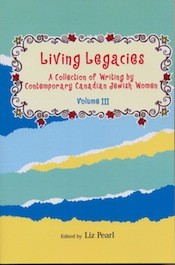
Living Legacies: A Collection of Writing by Contemporary Canadian Jewish Women, Volume 3 (PK Press, 2011), edited by Liz Pearl, comprises essays from more than 35 women, including at least two who have contributed to the JI – Shoshana Litman (Victoria) and Ricki Segal (Winnipeg) – as well as three other British Columbians: Shelley Halpern Evans, Dale Adams Segal and Helen Waldstein Wilkes. In this most recent volume, Pearl has once again collected from women across the country stories that create connections, both spiritual and human.
Living Legacies Vol. III was released in 2011.
In writing about her family and the role that food plays in their expression of love, for example, Evans touches upon rituals that are important to secular and religious Jewish life; the way in which a recipe passed down from a grandmother or the care that a parent or a spouse puts into making a meal brings family and friends closer. Litman’s Shabbat dinner at a friend’s home in Brooklyn offers her “[h]ints of heaven,” and also reconnects her to a woman she knew from Vancouver – these “divine encounters” not only make Litman “feel encouraged and uplifted,” but also, she writes, “The thin veil that separates me from others disappears, like overcast skies swept clean by spring winds to reveal the warm sunlight that is always there.”
In writing about how she’s been composing prayers all her life, despite her non-religious upbringing, Dale Adams Segal notes that she has “paddl[ed] down many rivers of growing up: of being married and divorced and married again, of birthing children and witnessing the birth of a granddaughter, of finding those whom I would love and losing those whom I have loved…. I share with you that this practice of writing prayer has restored me to life again and again….” And Ricki Segal pays tribute to her mother, who at the time of writing was suffering from dementia, in sharing some of what she has learned from her mother about love, attentiveness, tenacity, forgiveness and other important facets of life.
Wilkes’ essay is about her personal journey, from being made to feel ashamed about being Jewish by antisemitic classmates when she was a child to “com[ing] home” when she heard the Barchu: “I began to weep,” she writes. “Something deep inside me had been touched, and I knew that I had indeed come home.” She now sees Jewishness as a bridge that helps her “see aging as a purposeful process. Hopefully, the passing years will be accompanied by a growing measure of wisdom. If this means that I can be a role model to my children and grandchildren, then I will be blessed indeed.”
Role models would describe all of the contributors to this and previous volumes of Living Legacies – and this fact offers reassurance that there are many more women (men and children) who would also fit that bill.
***
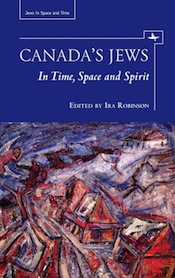
Canada’s Jews: In Time, Space and Spirit, edited by Concordia University’s Prof. Ira Robinson, was published by Academic Studies Press in 2013. It is part of the Jews in Space and Time series which, according to ASP’s website, “brings together some of the best scholars in their respective fields to explore the histories of Jewish communities in different geographical areas and historical eras, deepening our understanding of Jews and the relationships that they forged within their host countries.”
Canada’s Jews “brings together some of the best scholars in their respective fields.”
Canada’s Jews is special for several reasons, including its dedication to two men who for a part of their lives called Vancouver home and contributed to several local institutions, including the JI’s forerunner, the Jewish Western Bulletin: David Rome (1910-1996) and Abraham Arnold (1922-2011). These men, as Robinson notes, also “broke new ground in the field of Canadian Jewish studies.”
For Canada’s Jews, Robinson has amassed almost everyone who is currently attempting to continue Rome’s and Arnold’s legacy. Local contributors are Jewish Historical Society of British Columbia historian emeritus Cyril Leonoff, who co-wrote the chapter on Vancouver with me; University of British Columbia Prof. Alex Hart, who contributed an extensive essay on Jews in English literature; and UBC Prof. Richard Menkis, who wrote two chapters, a revised version of a previous article on Reform Judaism in Canada, and a comprehensive look at Conservative Judaism, as well as Reconstructionism and Renewal.
In the preface, Robinson notes that Canada’s Jews “will be of interest to scholars, students and readers of Canadian and Jewish studies,” however, the essays are, on the whole, very accessible and most people will find something to engage them.
The book has three parts: the first spans the history of Canadian Jews from the mid-1700s to after the Second World War; the second looks at contemporary Canada, beginning with a couple of chapters on general demographics and politics, followed by chapters on Jewish communities across the country; and the third comprises chapters on Judaism, Yiddish, literature and art, with the volume’s concluding chapter being a detailed inventory of the state of Jewish studies in Canada and recommendations for how the field might expand.
Canada’s Jews is full of factoids that can be gleaned on a quick reading. For example, “While almost all Canadian Jews in 1945 were Ashkenazi, today close to 20% have Sephardi roots” (Franklin Bialystock); Regina’s Jewish population in 2001 was 720, “about the same as it had been since 1951” (Debby Shoctor); and 2005 calculations show the average household size for the Jewish community as a whole in Greater Montreal to be 3.46, compared to that of the Satmar/Belz/Skver, 5.69; Lubavitch, 5.45; and Tosh, 6.37 (William Shaffir).
Because of how data are collected and the fact that such essay collections take a long time to put together, hunters for current statistics will be frustrated, as many of the survey and census figures are almost 10 or more years old. As well, the chapters on specific cities’ communities are quite brief in some cases and, while they provide a general overview and raise some issues for future research most – including the chapter I co-wrote – do not delve into any analysis, for example, of issues such as the effects of immigration on communal participation and/or fundraising. Perhaps the situation in small communities is similar – limited availability of information and little previous analytical work on which to build.
These small criticisms aside, the volume will contribute much to readers’ knowledge of Jews in Canada, and there are several in-depth analyses in the collection, including a couple of chapters that provide fascinating reading for anyone interested in the evolution of the mainstream Jewish community’s structure on a national level.
***
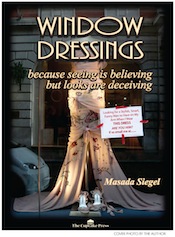
On the fiction front, readers of chick lit will appreciate Masada Siegel’s first novel, Window Dressings (Cupcake Press, 2012). It begins with the main character, Skye Silver, attempting – and failing – to manouevre her body into a position that her boyfriend Gregg wants her to try from the Palmasutra, a mobile operating system version of the Kamasutra. The trouble in bed is but one of the problems this couple is having in their soon-to-be over three-year relationship. Religion (Skye is Jewish, Gregg is Protestant), lack of communication and insecurity, among other things, lead to the betrayal that sends Skye into singlehood.
Readers of chick lit will appreciate Masada Siegel’s first novel.
Despite a poor body image, sadness over her break-up and very high standards for the outward beauty of possible mates, Skye manages to find many suitors, and much of Window Dressings is about what happens on those dates. She is supported by two besties: Josh, a writer/editor, with whom “mutual attraction had turned into a strong friendship”; and Karen, an international model.
While Skye is getting used to her new status and trying to meet “hot neighbor boy” – both a real character and Skye’s ideal man – she loses her job at Xtremedream advertising. Halfheartedly looking for a new job, she takes on some freelance work, falling back on the journalism degree she got in addition to her master’s in business admin. With relative ease, it seems, she lands a job at the New York Times and, dream job in hand, life gets even better for Skye.
***
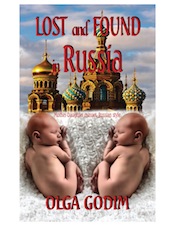
In Lost and Found in Russia by Olga Godim (Eternal Press, 2013), Amanda anxiously awaits news about her daughter, Gloria, who is in the hospital after a car accident. Amanda volunteers to give blood for the needed transfusion and, while the lab work is being done, we find out that Amanda is a linguist. A contract decades earlier had her teaching Russian to a group of Toronto journalists. She fell in love with one of them, Donald, and married him a week before they moved to Russia, where Gloria was born. For Amanda, it was Gloria who “filled the emptiness left after Donald’s death.”
When the blood work reveals that Gloria is not Amanda’s biological daughter, the doctor makes a comment about a possible switch at birth, and Amanda recalls that, 34 years ago, “Two red-headed girls were born on the same day in that decrepit hospital with peeling paint on the walls and one washroom for the entire corridor.” As she sits by Gloria’s bedside, Amanda resolves to find her other daughter: “Of course, Gloria was her daughter, her blood type notwithstanding. She just had another red-haired daughter somewhere in Russia.”
Olga Godim’s first novel explores mother-daughter relationships.
Meanwhile, Sonya is steeling herself to kick out her drunk of a husband, Alexei, as she can no longer afford to support him, herself and their teenage daughter, Ksenya, on what she earns from working two jobs. The Russian family arrived in Canada two years earlier from Israel, where Sonya had been a dancer and a dance instructor, and they now live in Vancouver, where Alexei’s supposed musical genius is as underappreciated as it was in Israel. Sonya not only has to deal with an alcoholic partner and trying to scrape out a living, but with her daughter’s understandable frustrations.
The book follows Amanda’s search for her other daughter; along the way, she also opens herself up to life for the first time since her husband died. It also follows Sonya’s struggles with Ksenya, and their rapprochement. Godim writes authentic dialogue, and captures the intricacies of relationships, mainly that between mother-daughter. Most interesting, however, is the view of Judaism from a Russian perspective, not only how one self-identifies culturally, religiously or otherwise, but the prevalent antisemitism. The fairytale ending is over the top, and there are a few odd scenes that could have been replaced with more development of the main characters, but the writing style and especially the Sonya-Ksenya relationship, make Lost and Found in Russia a good read.
***
It’s hard to know what to think about Curt Leviant’s Zix Zexy Stories (Texas Tech University Press, 2012). Leviant is an excellent writer, he’s knowledgeable about literature, Yiddish and Judaism, among other topics, and he has what to say. But he has a weakness, or made a poor choice. In pretty much every one of the seven (not zix) stories in this collection, he features a young, blond, big-breasted, non-Jewish, beautiful, dumb woman who admires, lusts after or is married to an older, professorial/rabbinical Jewish man. Perhaps this is an intentional attempt to link the stories – with the trope of the shiksa goddess – but, if so, it doesn’t work. Better the Franz Kafka connection that ties at least four of the stories.
Curt Leviant’s short stories are thought-provoking.
Zeven Ztrange Ztories would have been a better title, in that the collection successfully channels Kafka-esque absurdity, and intelligently considers existential matters. For example, in “From Helena; or, Sanskrit is Sexy Too,” a professor named Keller is introduced to a woman who is the object of many men’s desire, including the married man who introduces Keller to her. At this woman’s house, Keller runs into her professor father, who is doing kabbalistic research that entails cracking open walnuts to see if they’re all “built the same.” The father is dressed in a cloak and cowl. When Keller asks him why, he explains, “… A wise man, I believe it was Thomas Mann – you heard of Thomas Mann, I suppose – said that an esthetic worldview is incapable of solving world problems that cry for solution. Nevertheless, esthetics is crucial. Without esthetics we would be dogs barking at the moon. That’s why I don this unseemly garb. To put myself in the medieval mood. I am doing research.”
Throughout the collection, such thought-provoking passages appear. As well, Leviant is a strong storyteller. In “From Golden Necklace,” about an architect who travels to Italy to see a special collection of art, the tension is palpable when the architect sees the necklace his mother – who, along with his father, was killed in the Holocaust – on the woman escorting him around the palazzo. As another example, ignoring the object of Shmulik Gafni’s supposed affections (a shiksa), Leviant masterfully exhibits the ability of words to both accuse and acquit someone: none of the facts substantiates the rumor that Gafni is an adulterer, yet that very fact fuels it. All of the stories have something to recommend them.
***
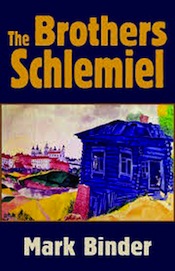
Mark Binder’s The Brothers Schlemiel is a good story very well told.
On the inside cover, The Brothers Schlemiel by Mark Binder (Light Publications, 2013) is described as “… a novel of Chelm … being the reasonably complete adventures of Abraham and Adam Schlemiel, identical twins, born in the village of fools and confused from birth.” As most readers know, from Chelm – from dim-wittedness and confusion – comes great wisdom and clarity, along with, of course, much humor.
Binder has created characters with whom we empathize, not just Adam and Abraham, or Abraham and Adam, who can’t even tell themselves apart at times, but their parents, sister and the other villagers. He ably manages some fine balances: writing about silliness without the story becoming stupid, and evoking sentimentality while not becoming saccharine. There are parts of The Brothers Schlemiel that could even be called scary – encounters with Russian soldiers and gun-wielding robbers. As well, through the vehicles of comedy and fantasy, The Brothers Schlemiel touches on many serious topics, from poverty to racism, to ethics in business, to whom people choose to be, and more. At the end of the day, however, The Brothers Schlemiel is just a good story very well told.
Why would someone who had a “perfect” life trade it in for a different one? Fifteen years ago, I did just this. And, no, I didn’t leave the husband or abandon the kids or take off to Fiji. I was a Canadian, secular, Jewish, urban, working mom with young kids, piles of laundry to do and diapers to change. Yet, something was missing; in those precious micro-moments when I had time for a small thought, I realized I wanted to learn how to teach my children values.
Nicole Nathan
Yes, I had taken multiple parenting classes and workshops, enrolled my young kids in art classes, library groups and bought tickets for every cultural show that came to town. They saw Chinese acrobats, Balinese shadow puppets and the Bolshoi Ballet. It was all enriching, entertaining and cosmopolitan, but not substantive and enduring. Until I took a class taught by a rabbi – and then another. And another.
The wisdom they offered was enlightening, profound, inspiring. My husband and I learned more and more, diving into an enriched, exciting new world.
Before we could utter the words “shomer Shabbos,” we had become Torah-observant Jews. We turned our lives upside down, even trading in a designer, ceramic kitchen sink for a kasherable version.
After a year, my family was 100 percent certifiably kosher and Shabbat observant. My husband and I enrolled our children in religious Jewish schools and we moved closer to the Orthodox shul. But we soon discovered that living in a Torah-observant community was more complex than wearing a head covering and going to shul. We also realized that our Jewish journey had only just begun.
We were ba’alei teshuvah (BT), newly Observant Jews. We had learned a lot and felt that we knew nothing, just like the light bulb joke that asks how many ba’alei teshuvah it takes to change a light bulb? Answer: is it allowed?
Is it? Can we do this? What will the neighbors think? Will our kids be accepted? I agonized over these thoughts and dreaded “Jewish geography” at the Shabbos table, fearing my past would be unmasked. I wanted to fit in seamlessly.
Nicole Nathan published her first novel, Let My RV Go!, in 2013.
In our early BT days, we tried to belong in our new religious community, yet understood that we did not belong anywhere. Our secular friends and family shook their heads in dismay, labeling us crazy, while the religious Jewish community thought we were unusual. So, our close friends became other ba’alei teshuvah and, together, we would share inspiring stories, confide our blunders and insecurities and laugh out loud at our outrageous, most embarrassing mistakes. Those Shabbat meals spent with BT friends were funny, meaningful and stranger than fiction and, over the years, provided great material for my first novel.
Some of my BT friends molded themselves until they fit snugly into their newly adoptive Orthodox communities. And they felt fulfilled.
For others, myself included, it was not an easy fit, as I did not want to reinvent everything about myself; I just wanted a “kosher” version of me. I struggled with this for years and eventually decided to embrace my past and not hide from it.
Secular or religious, I learned that all Jews have something unique and important to contribute. Yet, we have to first respect each other so we can learn from one another.
Unfortunately, there is a disconnect and distrust between the secular and Orthodox communities, both in North America and in Israel. And, sadly, the Jewish people are a small, fragile and threatened nation. Now, more than ever, we must develop tolerance and respect, and reach out to support each other. As Rav Kook explained in his commentary Ein Aya, truth is built from different viewpoints and positions. Only this enriches wisdom and brings peace.
Forget Fiji. Life is a journey filled with countless opportunities to grow together. May we take the path that helps us understand our differences so we can respect each other.
Nicole Nathan is the author of the novel Let My RV Go!, a humorous, insightful look at becoming religious that seeks to bridge the gap between secular and observant Jews. It is available in paperback and as an ebook.
Volunteers at the drop-in centre work together to offer legal advice, medical care, transportation passes, child care, nutritious meals, friendship and more. (photo from New North London Synagogue)
What would your daily life be like if you were not free? For starters, you would have to learn the skills of surviving while in a state of constant fear. Are you facing torture or rape? Are you in jail for a crime you did not commit? Is there a gun pointed at you because you are gay? If the opportunity to escape persecution presented itself, would you risk your life for a chance at freedom?
Every day in the news, we hear of courageous people doing just this – risking their lives to be free. No matter how dangerous it may be to attempt escape, flight offers their one hope for freedom. The lucky ones end up in free countries. What happens later, though, for those whose hope of establishing legitimacy, of officially being recognized as refugees, is gone? How do undocumented asylum seekers get by?
I was honored when my cousin invited me to volunteer with a group of asylum seekers while vacationing in London, England, last year. Though I was only there for three hours, I caught a brief glimpse into their lives and it has left a lasting impression on me.
Since 2006, New North London Synagogue has been running a monthly asylum drop-in centre. Launched by volunteers, the group works with asylum seekers whose claims have been denied. The group offers medical treatment, legal advice, healthy meals, food parcels, transportation passes, clothing and diapers. The drop-in centre is housed at an elementary school, which I’m told is not large enough to accommodate the more than one thousand people who come from metropolitan London to get assistance.
Asylum can be defined as “a place offering protection and safety; a shelter.” Judging by the crowds in need at the New North London Synagogue, Britain would seem to have failed to offer these protections. Most of the asylum seekers that use the centre’s services have chosen to stay and live in abominable destitution rather than accept deportation to the places from which they risked their lives to escape.
Researching the situation of asylum seekers through the Refugee Council of the United Kingdom, I learned many facts, including:
• The vast majority of people seeking asylum in Britain are law-abiding people;
• Many asylum seekers fear approaching the police to report incidents of assault or sexual harassment. They fear that reporting crimes will expose them to being placed in detention and eventually deported;
• Immigration officers have the power to detain asylum seekers, even if they have not committed any crime; even on mere suspicion.
My cousin, Catherine, is a regular volunteer. Her fluent French is an asset and she often serves as an interpreter. I was there in August and Catherine was worried that there might not be enough volunteers. Thankfully, there were plenty on that day.
Fifteen minutes before opening, a briefing takes place to explain the events of that afternoon. I volunteer to help with the children, as that’s where I think I can be of best use. The children have a section to themselves, but parents may not leave their children unsupervised. In the briefing, we are forewarned that some of the children have difficulty interacting and some may not be comfortable with play because the toys available are foreign to them.
Upon arrival, everyone receives a name tag. New asylum seekers are interviewed. Some queue for legal or medical advice. Everyone enjoys a nutritious meal. There are people from the Democratic Republic of Congo, Bangladesh, Egypt, Iran, South Sudan, Zaire, Nigeria and Turkey. It is fascinating to hear the various languages and dialects being spoken.
Eventually, I sum up the courage to sit down and speak to people. I talk to a blind woman from Iran who has been coming to the drop-in centre for several years. She lives in a little room, a good 15 miles away. She has no kitchen facilities and must rely on the kindness of friends for food and other necessities.
A Nigerian family of four has been coming for eight years. They ask me about Canada. They have family in Toronto and have heard such wonderful things about this country but, at this point, they do not dare to make enquiries about moving to Canada. As I hold their youngest child, it’s hard not to feel sad that this little boy, despite being born in Britain, may not be afforded legal status.
A single mother tries to gulp down some lunch and socialize with friends while chasing after her active 2-year-old twin girls.
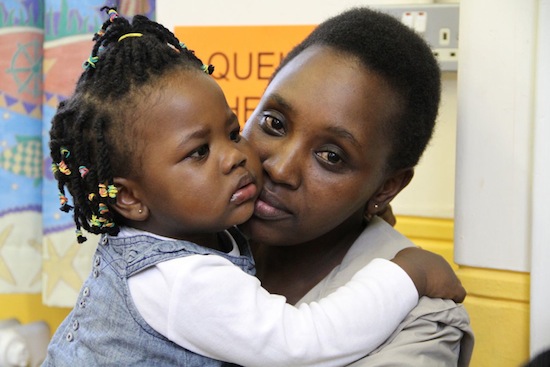
A mother and daughter at the New North London Synagogue drop-in centre for asylum seekers. (photo from New North London Synagogue)
A situation that touches me deeply is assisting a young paraplegic man from central Africa. He tells me that he arrived in England eight months prior. Once a Paralympian, his proficiency at manoeuvring his rickety manual wheelchair around narrow corridors and cracked sidewalks is impressive. All his family remain in Africa. He tells me that his goal is to become a lawyer. I guide him to the bus stop where it will take him roughly two hours to get home.
Little children are sitting at tables, munching on snacks and playing with the large assortment of toys. All are supervised by a group of caring volunteers who take time to play and read with them.
Surveying the scene it’s hard not to feel that the situation these people face is grim. It’s a harsh reminder that all is not OK in Britain – or in the world, for that matter. Indeed, there are many British who wish asylum seekers would go away and take their problems with them. There’s a post on the New North London Synagogue website that seeks to clarify the situation: “All of our clients have fled persecution and many have been tortured. Yet myths prevail that this group are here for benefits, free housing and to take British jobs. In fact, asylum seekers are not allowed to work and many receive no accommodation or government support.”
At the same time, despite the despair, positive moments are in evidence. Expressions of a caring community are everywhere, woven into every activity. Camaraderie can be felt in the crowded rooms. In fact, if someone were to walk in off the street, they would see what looks to be a happy afternoon gathering. People sit in groups, smiling, laughing, exchanging information and eating a plate of nutritious food. Children play, interacting with each other. Enthusiastic volunteers, teenagers and senior citizens and all ages in between, are connecting and offering advice. Many of them are former asylum seekers who have been given permission to stay in Britain and are volunteering to give back to the community.
On that day in August, the hope was that people would leave the drop-in centre with renewed hope, their spirits lifted, and that volunteers would feel they have played at least a small role in brightening someone’s day.
We must all be active in raising awareness of refugee issues, so that refugees and asylum seekers can know the peace and freedom we are so blessed to enjoy. This Pesach, at my family seder, we will read the Haggadah, celebrating our people’s journey to freedom. My family and I will stop to think of all the refugees of today who have had to make their own exodus from persecution, extreme hunger and violence, and even from modern-day slavery. Stateless, many are forced to continue to wander in an urban wilderness. May they find peace and comfort in a new land.
Jenny Wright is a singer, music therapist and freelance writer in Vancouver who is interested in setting up a similar drop-in centre here. If you are interested in learning more, email [email protected].
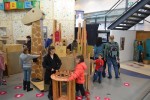
Holon Children’s Museum is a children’s museum unlike any other. (photo by Lauren Kramer)
Take small kids with you to Israel and one thing is for sure: you’ll want to have more on your itinerary than holy sites and 2,000-year-old ruins. Fortunately, this small country has a diverse range of fun family attractions that appeal to toddlers, kids and preteens. From a biblical zoo to a chocolate factory and science museum, here are some highlights that will keep your kids smiling in the Holy Land.
Jerusalem Biblical Zoo (jerusalemzoo.org.il). This 100-acre zoo started as a petting zoo in the 1940s and now includes more than 300 species, a quarter of them animals that were mentioned in the Bible, such as Syrian brown bears, Persian fallow deer, Asian lions, Nile crocodile and the Asian leopard. There are also many non-biblical animals in this expansive zoo, which easily takes a half-day to explore. Look out for Sumatran tigers, a rhino and a hippo, giraffes, kangaroos, wolves and fruit bats. Many of the animals are under threat of extinction. Israel is the only country in the Middle East offering protection to wolves, for example, and the wolf exhibit tries to raise awareness on how wolves and people can live in harmony. Open year round, the zoo charges $28 for admission for adults and $11 for kids.
Bloomfield Science Museum (mada.org.il). When it first opened 21 years ago, the Jerusalem museum was the only one in the country: today, it’s one of four. Its interior is far from fancy, but it more than compensates in its wide range of innovative exhibits, a selection geared to entertain and engage all age groups, from 3 through 83. “Hands-on” is the theme here and, in every exhibit, visitors are encouraged to touch, play and explore. We visited during Chanukah, when the museum had set up a station for kids to build their own unique spinning tops using recycled materials. We loved the light and shadow exhibit, a labyrinth of rooms that combine art with the science of how light and shadow interact. Other exhibits explain the connection between physics and how amusement parks work, how electricity is distributed, and how science and technology play out in some of Israel’s favorite children’s stories. Free for kids under five, the museum charges $12 for kids and adults or $45 for families.
Galita Chocolate Factory (galita.co.il). Combine kids and chocolate and the result is delight, especially if the experience includes making your own treats. The chocolate factory at Kibbutz Degania on the Sea of Galilee offers a selection of kid-focused workshops with various candy-making projects, from building and decorating a miniature chocolate candy house to creating chocolate lollipops, truffles and more. Kids play with mixtures of white and brown chocolate and carefully decorate their creations before the finished versions are refrigerated and taken home. An on-site chocolate shop sells the creations of Galit Alpert, the Belgium-trained Israeli owner whose delicacies are irresistible. Prices range from $11-$22 per person, depending on the project, and reservations are recommended.
Holon Children’s Museum (childrensmuseum.org.il or 03-6503000, ext. 3). Don’t be fooled by its name – this is a children’s museum unlike any other you’ll ever set foot in. Its four segments cater to vastly different age groups. Kids age nine and up will love Dialogue in the Dark, an exhibit wherein visitors get to experience what it is like to have no vision by taking a tour in complete darkness, in the company of blind guides. Along the way, they experience the various rooms they enter by relying on their other senses. Likewise, in Invitation to Silence, adults and kids age 10 and up get immersed in a tour of silence, one wherein they need to use other methods of communication – hands, face and body – to communicate emotions and reactions. In Dialogue with Time, visitors explore the concept of aging through experiences and games. They’re invited to identify various songs and objects that crisscross the generation gap, and to experience what it feels like to lose dexterity in the hands and feet by donning special gloves and shoes. Talking figurines reflect on their different experiences of aging and the entire experience invites discussion, dialogue and contemplation on what it means to age gracefully. Finally, in the only segment of the museum that remotely resembles a typical children’s museum, children ages 4-8 get to explore the making of music and art using unconventional instruments and objects, led by actor guides. Each tour lasts between 90 minutes and 1.5 hours and costs $15 per segment. Reservations are essential.
Lauren Kramer, an award-winning writer and editor, lives in Richmond, B.C. To read her work online, visit laurenkramer.net.
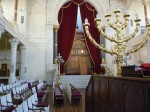
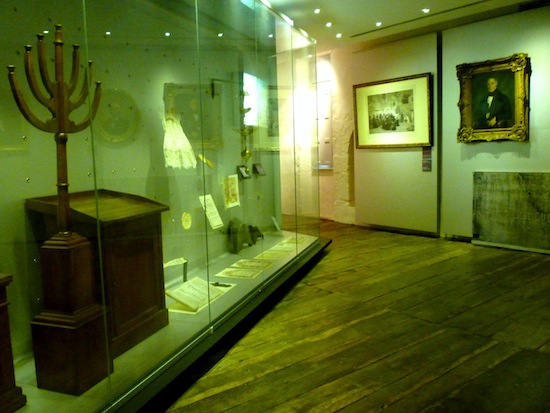
Inside Bordeaux’s Grand Synagogue of the Gironde. (photo by Karen Ginsberg)
On a recent trip to the Basque, my husband and I learned a great deal about the strong Jewish presence that formerly existed in the region.
The Basque country comprises southwestern France and northeastern Spain. Our journey started in Bordeaux, France, which, strictly speaking, is not part of the Basque. Rather, Bordeaux is the capital of the neighboring Aquitaine region. Our sightseeing there included a visit to the Grand Synagogue of the Gironde, located in central Bordeaux, serving a Jewish population of 1,100. A 2007 brochure given to us on our visit, History of the Jewish Population of Bordeaux, dates the synagogue back to the 1880s, the land for it having been a gift from the city. On the morning of our visit, a young man, soon to be a bar mitzvah, was just finishing his practise session on the bimah, which gave life to the building.
From Bordeaux, we traveled by train two hours southwest to St. Jean de Luz, a mid-size town on the Atlantic coast that is part of the French Basque, where we had rented an apartment. We found our most substantive Jewish Basque connection on a day trip to nearby Bayonne.
Musée Basque et de l’histoire de Bayonne has quite an interesting collection of Jewish artifacts. (photo by Karen Ginsberg)
Musée Basque et de l’histoire de Bayonne is a modernized space housing the history and culture of the people of the region. Within, there is a special exhibit that celebrates the presence of Jews in the Basque since the 1600s. The roots of the Jewish community there stem from the migration that took place when the Jews were expelled during the Spanish Inquisition.
Among the collection of artifacts is a beautiful portrait of Augusta Furtado, who, in the 17th century, was a merchant and president of the Israelite Consistory of Bayonne, as well as twice serving as Bayonne’s mayor. The collection also includes furniture and religious objects from a private synagogue in the 19th century, including an ark, menorah and pulpit, a child’s temple presentation dress, circa 1885, a shofar, an 18th-century mezuzah and a sabbatical lamp from a Portuguese ceremony that was used in Bordeaux and Bayonne. One of the most interesting items is a document dated Jan. 19, 1753, entitled The Statues of the Jewish Nation of Saint Esprit, a reiteration of the royal protective orders of 1550 in which the title Jew is used for the first time instead of the term New Christian or Portuguese.
A further Jewish connection in the region has to do with one of the sources of Bayonne’s current fame as a world centre for the manufacture of high-quality chocolate. The chocolate-making skills of the exiled Spanish Jews who settled in the area were put to use. Their contribution to the industry is told at some length in the self-guided tour of the city’s delightful l’Atelier du chocolat. Both my husband and I felt compelled to enjoy a generous chocolate-tasting at the atelier out of respect for our ancestors!
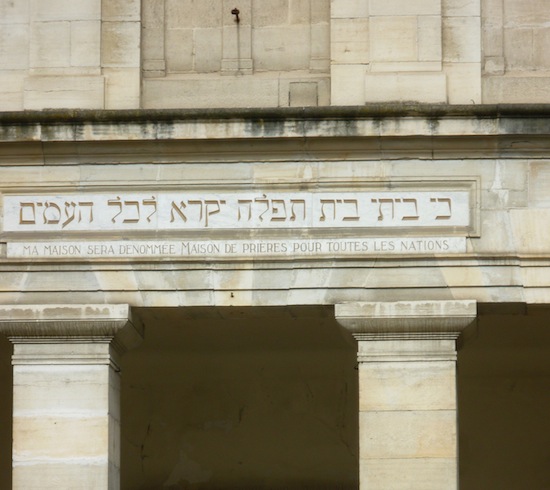
Bayonne has a beautiful synagogue in the core of city, but it is locked behind steel gates with no one available to provide any information on whether and how the building is being used, if at all. Nevertheless, an inscription carved onto the exterior of the synagogue speaks volumes about the vision the community had for this holy place: “Ma maison sera denommée une maison de prières pour toutes les nations.” (“My house will be marked as a house of prayer for all nations.”)
Bayonne’s synagogue is all locked up, but this inscription is clearly visible on its exterior. (photo by Karen Ginsberg)
Signage outside the synagogue gates draws further attention to the pride that the community had in being able to build its own shul: “This place of worship for the Bayonne Jewish community was built in the 19th century by architect Capdeville. The monumental neo-classical-style building illustrates the wish of the community’s leaders to assert the presence of Judaism in the heart of the district and also to provide a single place of worship for the faithful, replacing the private synagogues used previously.”
Our last daylong outing – to Saint-Jean-Pied-de-Port, France – metaphorically closed a circle for us with respect to early Jewish life in the Basque region.
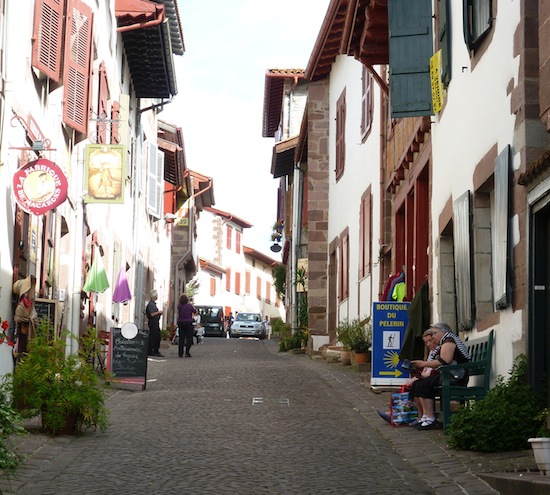
These days, it seems, almost everyone knows someone who has undertaken the six-week walk referred to as the Camino de Santiago (the Way of Saint James). This medieval pilgrimage runs from Saint-Jean-Pied-de-Port, near the Spanish border, more than 750 kilometres northwest of the Spanish city of Santiago de Compostela. There is generally a degree of wonderment and respect accorded to anyone who has retraced those steps. One has only to walk the steep main street of Saint-Jean-Pied-de-Port to understand that there is a hardship to be endured no matter how solid one’s walking shoes or how well-organized is today’s network of rest places along the route. Being in Saint-Jean-Pied-de-Port surrounded by modern-day pilgrims at the start of their journey brought to my mind how different their trek would be to that of the expelled Spanish Jews. I could not help thinking what it must be like to have to flee one’s home under threat of death, travel on foot, by cart and, for some, partially by boat, to hopefully reach the safety of new lands. These Jewish travelers had no fancy walking shoes, no “service centres” along their route and they most certainly traveled with fear in their hearts.
Saint-Jean-Pied-de-Port is the starting point for the Camino de Santiago pilgrimage. (photo by Karen Ginsberg)
My husband and I left the Basque knowing that there were likely many other remnants of a Jewish presence in the area yet to be discovered. Our curiosity peaked, it’s a challenge we will hopefully be able to take up on a future visit.
Karen Ginsberg is a travel writer living in Ottawa.
Steven Finkleman in front of the restored Chennamangalam Synagogue. (photo by Steven Finkleman)
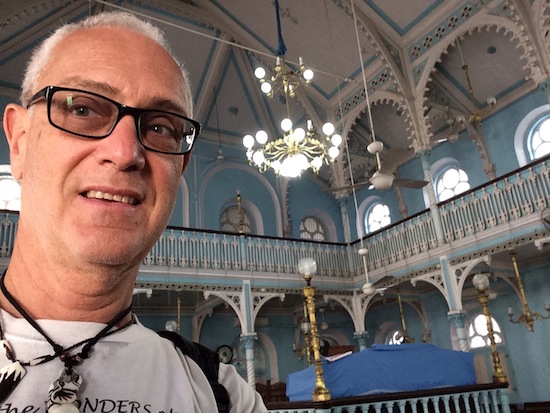
I had bought my airline ticket to Mumbai in the fall, aiming to track down the remains of the Jewish community in India. I set out with my backpack on Jan. 9 and, after several days, arrived. I had pre-booked a stay at Sassoon House, which is a residence for Jewish travelers at Magen David Synagogue in Mumbai.
Lufthansa pulled in at 2:30 a.m. Perfect time for arrival into a strange city of 18,000,000 people. Somehow, I found a taxi and a Western traveler who wanted to share the ride with me. And, somehow, I managed to give some direction to the synagogue, which is currently situated in the predominantly Muslim district of Byculla. It does take a bit of guts.
We pulled into the synagogue compound around 3:30 a.m. under the watchful eyes of Mumbai’s finest, accompanied by huge spotlights, army tanks and AK47s (all in response to the terrorist attack at a Mumbai synagogue five years ago). I was as cool as a cucumber. My taxi partner at this point was in apoplectic shock.
Fortunately, Mr. David, the caretaker of Sassoon House did answer the phone and let me in for four hours of rest, prior to attending the Shacharit service for Shabbat at 8:45 a.m. Interesting service. I was #11 in attendance, so was superfluous to the congregation. (I often have been #10 in these circumstances, serving as the final man needed to allow the service to proceed.) The service was rapid, Sephardi Orthodox, and the accent of the Baghdadi congregation made following along somewhat challenging. The familiar tunes of the Barchu, the Shma, the Amidah, the Aleinu, were absent and keeping up with the service required heavy concentration on my part after a 36-hour flight and four hours of sleep.
I received an aliyah to the Torah and, when I gave my name as Zalman ben Yaacov, Zalman being a Yiddish name and, therefore, totally unheard of in Mumbai, they interpreted my name as Solomon, and called me up as Shlomo ben Yaacov. Lunch at the rabbi’s home followed. Considerable gin was flowing (considering it was a former British colony) accompanied by lots of traditional Judeo-Marathi songs. I was forced to sing a representative Canadian song and led them all in a rousing version of “Allouette.” The luncheon ended with everyone sharing some snuff! As they all snorted away, I was sure to ask, “Are you certain that this is only tobacco?” before trying some myself.
The Indian community goes back about 2,000 years. Some date it to the expulsion after the destruction of the First Temple, others to after the destruction of the Second Temple. The community has four components.
The Bene Israel and Cochin communities came both around the same time. The Cochin community was likely from seafarers and merchants, possibly dating back to King Solomon’s time. The Bene Israel community around Mumbai dates from a shipwreck 2,000 years ago where seven men and seven women survived. Their holy books were lost, but they remembered to keep the Shabbat, kashrut and brit milah. Generations later, they were tutored by the Cochini community to improve their knowledge of Judaism.
The third community to arrive was the Paradesi community. Paradesi means foreigner, and this group was basically Sephardim who arrived from Spain or via Amsterdam in the 16th century, and headed to Cochin. The fourth group, led by David Sassoon, emigrated from Baghdad, and came in the 18th century, setting up congregations in Mumbai, Pune and Ahmedabad. The Sassoon dynasty was very dynamic both for the Jewish community and the Mumbai community at large.
There are several residual synagogues in Mumbai, with some still in use, such as the Baghdadi community’s Magen David (where I stayed) and Keneseth Eliyahoo, along with the original Bene Israel community’s Tiferet Israel synagogue. Five thousand Jews remain in Mumbai, and three or four synagogues hold services on Shabbat. Tiferet Israel has a strong component of younger men.
Inside Keneseth Eliyahoo Synagogue, downtown Mumbai. (photo by Steven Finkleman)
I was lucky to travel to Cochin (now called Kochi) in Kerala state and, besides spending a wonderful day in Jewtown, Cochin, and visiting the Paradesi synagogue, I also rented a taxi and went to search out the remnants of the Jewish community in more remote areas. I visited two restored synagogues at Parur (or Paravoor) and Chennamangalam (or Chendamangalam), and I visited the Kadavumbagan synagogue in Ernakulum, which was closed 40-50 years ago and remains unrestored.
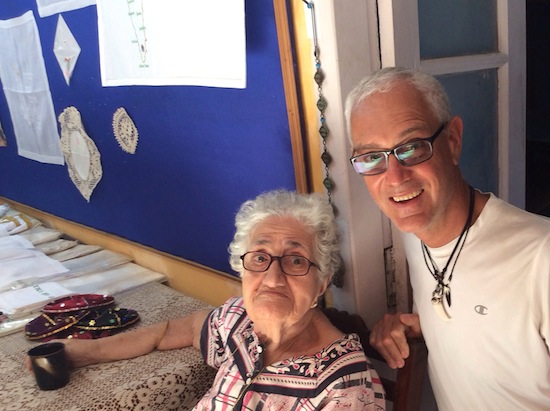
There are about 12 Jews left in Kerala. I spent two days visiting Sarah Cohen. Sarah, 91, is the matriarch of the Cochin Jewish community. She reminded me totally of my Baba Sarah. On my first visit, I asked her if I could bring her anything that she needed. She asked for chocolate and beer, and I returned the next day with some Cadbury. Sarah has an embroidery shop on Jew Street in Jewtown, in the city’s Mattanchery neighborhood, two blocks from the Paradesi synagogue, which is spectacular – it is a national historic landmark, expertly renovated and with excellent historical information.
The author visits Sarah Cohen in her embroidery shop. (photo by Steven Finkleman)
I was also able to meet Elias Josephi at the Kadavumbagan synagogue. About 50 years ago, the synagogue disbanded because of lack of membership and Josephi purchased it. He currently runs a plant nursery and an aquarium/fish shop in the antechamber of the synagogue. Behind his desk, the closed door leads to the treasure of the sanctuary, exactly as it was left 40-50 years ago.
At the peak, there may have been about 100,000 Jews in India. Eighty percent of them emigrated to Israel in the 1950s/60s. It is interesting that they remained separate. The Cochinis went to Nevatim and the Bene Israel went to Dimona, Ashdod, etc. Fifteen percent of the Indian Jews went to English-speaking countries such as the United States, Canada, the United Kingdom and Australia, and five percent remain in India today.
What a fascinating Diaspora story. How intriguing that at all ends of the earth, one can find Jewish communities. I believe it was one of our sages who once said, “If there is oxygen, there are Jews.” Or, perhaps, it was me who made up that line!
Steven Finkleman, originally from Winnipeg, is a retired pediatrician living in Kelowna. He travels extensively and often researches and visits remote Diaspora communities on his adventures.
Dr. Neil Pollock instructs a team of surgeons in Rwanda on carrying out his technique of circumcision. (photo from Dr. Neil Pollock)
Dr. Neil Pollock specializes in circumcision, from newborn to adult, and adult vasectomy. As a leading expert in circumcision, he has traveled around the world to train physicians and, this summer, he will head to Port-au-Prince, Haiti, to teach a team of doctors in medical newborn and infant circumcision.
“After carrying out 50,000 infant circumcisions and traveling recently to Turkey, China and Africa to exchange ideas, I have evolved my technique to make it applicable to infants, children, teenagers and adults,” Pollock told the Independent in a recent interview. “I have developed a technique to do circumcision in this older age group under local anesthetic without using sutures and using, instead, a cyanocrylate skin glue that closes the wound. Being able to do the procedure under local anesthetic and with skin glue instead of a general anesthetic in hospital provides for a much simpler, easier, quicker, safer and improved cosmetic outcome for patients.”
This method, he said, is unique. “I’m unaware of this approach being used anywhere in [Canada] except in my clinics. The older age group is currently requesting circumcision for reasons like reduction in disease transmission, preference of their partners and improved hygiene.”
In 2008, Dr. David Patrick was the head of the B.C. Centre for Disease Control. Pollock said he was asked by his colleague “to teach my surgical techniques for circumcision in Rwanda, where they were using scissors and stitches, without anesthetic, and their surgeons desperately required training in an alternative quick, safe and painless infant circumcision technique that would be accepted by their population. In coordination with their surgeons, I planned with my team a five-day surgical training mission that year and flew to Rwanda. I have been in contact with these surgeons by email since my trip and they have informed me that they are using my technique effectively and safely throughout the country now.
“The impact of our humanitarian effort became known in the international medical community, which led to Dr. Jeffrey Klausner, professor at [the University of California, Los Angeles] Medical School, contacting me recently and asking me to essentially replicate the work I did in Rwanda, but this time in Port-au-Prince, Haiti, where they are being overwhelmed by the number of patients requiring treatment for AIDS and would receive huge benefit from introducing a preventative strategy to reduce AIDS transmission, such as infant circumcision, which will reduce the risk of their circumcised infants later contracting AIDS when they hit sexual age, by over 60 percent. Its impact and effectiveness has been referenced metaphorically to be like a vaccine.” Circumcision, he added, “works to reduce AIDS by removing the portal of entry of the virus, which is the foreskin.”
Klausner, a professor of medicine in the division of infectious diseases and the program in global health at UCLA, is an advocate in the use of medical male circumcision for the prevention of sexually transmitted diseases and HIV. He volunteers with GHESKIO, an organization run out of the Centre for Global Health at Weill Cornell Medical College in partnership with the Haitian government. Operating primarily in Port-au-Prince, their work is supported by Haiti’s first lady and has a mission to combat HIV and improve conditions of maternal and child health. GHESKIO will host Pollock’s training in Port-au-Prince.
Raised in Winnipeg, Pollock explained that he decided to become a doctor “because I had a strong interest in sciences, medicine and surgery from a young age.” Early in his career, he decided to create a special focus on circumcision and vasectomy, and built a highly focused practice and a well-tested – and respected – technique.
“My interest in developing a safe, quick and painless approach to circumcision for the medical community in B.C. arose initially from some of the rabbis approaching me approximately 20 years ago and encouraging me to become a mohel in Vancouver,” Pollock said.
The benefits of newborn and infant circumcision are many, but the rates of the procedure vary from region to region, and remain contentious to those opposed to what’s seen as elective (non-consenting) surgeries for babies.
Pollock noted, “The most important change recently in how the medical community has come to view circumcision is expressed in the … consensus statement from the American Academy of Pediatrics released in late 2012 declaring that ‘the medical benefits of infant circumcision outweigh the risks.’ This is the strongest statement of support ever issued by the American Academy of Pediatrics.
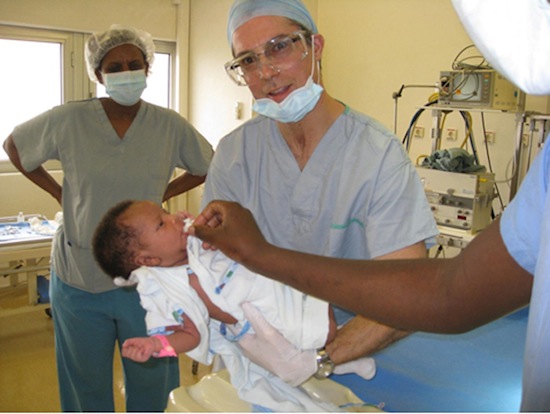
Dr. Neil Pollock in Rwanda with an infant post-circumcision. (photo from Dr. Neil Pollock)
“The benefits of circumcision are multiple; they include reduction in the risk of urinary tract infection, which can lead to kidney infection and renal failure, reduced risk of cancer of the penis, cancer of the cervix in partners, reduced risk of balanitis (which is infection of the foreskin), and other foreskin-related problems, like phimosis.” As well, circumcised males also experience a “reduction of multiple sexually transmitted diseases, like HPV, herpes and AIDS transmission. The latter is exponentially more important in places like Haiti and Africa, where a large number of the population has AIDS in comparison to other regions of the world where AIDS is less common.” Possible risks include “bleeding and infection,” he added, “but, in experienced hands, risks are extremely low.”
Rwanda and Haiti share a history of national trauma, which has led in both countries to poor health outcomes. In 1994, at least 800,000 Rwandans were massacred by their countrymen in a genocide. In 2010, Haiti, already the victim of more than two centuries of extreme poverty, dictatorships and U.S.-led military interventions, experienced a 7.0 earthquake that resulted in the deaths of more than 100,000, and displaced 1.5 million of the tiny country’s 10 million people. Since then, Haitians have been hit by serious outbreaks of preventable disease, including cholera, tuberculosis and AIDS. According to the United Nations, life expectancy is 61 years for men and 64 for women.
The health challenges that Haitians are very similar to those experienced in Africa, and the training is seen as critical in addressing those obstacles. “Like there was in Rwanda, there is a need to train surgeons in Haiti to carry out a quick, safe and painless infant circumcision technique,” Pollock explained. “In regards to what accounts to gaps in circumcision rates, there may be a deficiency in trained surgeons to carry out the surgery in an acceptable manner, along with variations in social and cultural norms that influence the choice to have circumcision.”
The ultimate intention of the training, Pollock said, is “to set up a national program accepted by the population, to introduce infant circumcision safely and effectively, and have it evolve to become a widespread practice throughout the country, thereby reducing the transmission of multiple diseases, including AIDS.”
Pollock’s visit to Haiti will involve intensive training. “My goal is to carry out a similar plan to what we executed in Rwanda. I worked with physicians there weeks ahead to set up a surgical schedule of 20-to-30 infants per day, over four-to-five days of operating. After working with doctors on models that I brought to demonstrate the technique and do the primary teaching, they moved to assist me with the surgeries and eventually carry them out under my supervision on the infants booked for circumcision.”
The training in Haiti, part of a nongovernmental public health initiative, will be partially supported by charitable donations. “The commitment from my end for Haiti will include a week away from my practice and the commitment to help raise the $25,000 for the mission to take place. The plan is to raise $25,000 from the Vancouver community in the next seven days or so as to be able to launch the teaching mission in Haiti by the end of the summer. During the week in Haiti, I will train two physicians, who will then train other physicians once our team leaves. I will maintain follow-up with these physicians to help them manage any issues that should arise.” The goal is to create a sustainable public health campaign and donated funds not only will go towards covering the costs for the week, but also for “the next 500 infants once we leave.”
Readers who would like to donate to the effort “will support an initiative, which will undoubtedly over the years save thousands and thousands of lives,” Pollock said. “It’s intended that Haiti will become a training centre for circumcision in the Caribbean. It is likely that my technique, once taught in Haiti, will soon be shared with multiple countries throughout the Caribbean, multiplying its effect to save lives throughout the entire region. So, I’m asking readers and members of the community to reach deep and consider making a financial donation to help us raise $25,000 in the next [several] days to allow this mission to proceed.”
To make a donation, contact Dr. Neil Pollock at 604-644-5775 or [email protected]. “We will make it very easy for people to donate, and make arrangements for their cheques (made payable to the Vancouver Foundation) to be picked up by our team,” he said. Donations can also be mailed to 4943 Connaught Dr., Vancouver, B.C., V6M 3E8.