Skip to content
  • Home
  • Subscribe / donate
  • Events calendar
  • News
    • Local
    • National
    • Israel
    • World
    • עניין בחדשות
      A roundup of news in Canada and further afield, in Hebrew.
  • Opinion
    • From the JI
    • Op-Ed
  • Arts & Culture
    • Performing Arts
    • Music
    • Books
    • Visual Arts
    • TV & Film
  • Life
    • Celebrating the Holidays
    • Travel
    • The Daily Snooze
      Cartoons by Jacob Samuel
    • Mystery Photo
      Help the JI and JMABC fill in the gaps in our archives.
  • Community Links
    • Organizations, Etc.
    • Other News Sources & Blogs
    • Business Directory
  • FAQ
  • JI Chai Celebration
  • JI@88! video

Recent Posts

  • Story of Israel’s north
  • Sheltering in train stations
  • Teach critical thinking
  • Learning to bridge divides
  • Supporting Iranian community
  • Art dismantles systems
  • Beth Tikvah celebrates 50th
  • What is Jewish music?
  • Celebrate joy of music
  • Women share experiences 
  • Raising funds for Survivors
  • Call for digital literacy
  • The hidden hand of hate
  • Tarot as spiritual ritual
  • Students create fancy meal
  • Encouraging young voices
  • Rose’s Angels delivers
  • Living life to its fullest
  • Drawing on his roots
  • Panama City welcoming
  • Pesach cleaning
  • On the wings of griffon vultures
  • Vast recipe & story collection
  • A word, please …
  • מארק קרני לא ממתין לטראמפ
  • On war and antisemitism
  • Jews shine in Canucks colours
  • Moment of opportunity
  • Shooting response
  • BC budget fails seniors
  • Ritual is what makes life holy
  • Dogs help war veterans live again
  • Remain vital and outspoken
  • An urgent play to see
  • Pop-up exhibit popular
  • An invite to join JWest

Archives

Follow @JewishIndie
image - The CJN - Visit Us Banner - 300x600 - 101625

Author: Nicole Grubner FINN PARTNERS

Marc and Chantal Belzberg’s OneFamily helps victims of terrorism

Marc and Chantal Belzberg’s OneFamily helps victims of terrorism

Marc and Chantal Belzberg with MK Danny Danon, centre, at OneFamily’s August 2013 launch of Longing for a Hug, an exhibit of original artworks created from the personal stories of bereaved Israeli children. (photo from Finn Partners)


In the summer of 2001, Jerusalemites Marc and Chantal Belzberg were busy planning their daughter Michal’s bat mitzvah. Relatives from Vancouver and New York were booking their flights to Israel in anticipation of what was to be a huge and festive family gathering. Then, on Aug. 9, 2001, just one month before the bat mitzvah celebration, a suicide bomber entered the Sbarro pizza shop in Jerusalem and executed one of the most notorious terror attacks of the Second Intifada. The family was faced with an uncomfortable question: How could they possibly celebrate in the face of such great tragedy?

The Belzbergs decided to cancel the party and instead committed themselves to a bat mitzvah project. They would visit and console the injured and bereaved families of the Sbarro bombing, and the money that Michal’s extended family would have spent coming to Israel for the celebration would be collected and turned into a fund for these victims of terror.

Less than a week later, another suicide attack wounded 15 Israelis in a café. The needs were clear, and the Belzbergs felt that they had to try to assist these latest victims of terror, as well.

“It turned into a family project, a long-term commitment that we took on after several months of working with the victims,” Chantal Belzberg, now the executive vice-chair of OneFamily, recalled. “We came to the simple conclusion that if they need help, they are our family. We wanted to help every one of them.”

The small family project quickly blossomed into a large nonprofit operation. From the tragedies of the Second Intifada, OneFamily, a national organization dedicated to the rehabilitation of victims of terror attacks and their families, was born. Though maintaining the organization was a daunting task, a strong family history of commitment to the Jewish community prepared them for the challenge.

The Belzberg family has roots in Vancouver that go back 46 years, when they moved here from Edmonton in 1968.

“I went to Eric Hamber High School but, for Grade 10, my parents sent me on a program called Haddasim,” Marc Belzberg recalled, referring to the program sponsored by Hadassah-WIZO that sent groups of Canadian teenagers to Israel for the year in order for them to serve as youth ambassadors upon their return. Along with the deep connection he forged with the land of Israel, he also developed a love for philanthropy, a familial commitment he picked up in his youth.

“My father, Samuel Belzberg, was involved with and actively supported so many institutions and programs, both in Vancouver and throughout North America. He supported Simon Fraser University and started a leadership program called Action Canada for the 15 best and brightest future leaders in the country. In the Jewish community, he supported the Conservative synagogue Beth Israel and [an] Orthodox synagogue, Schara Tzedeck. He invested in Jewish education in Vancouver through his work with Vancouver Hebrew Academy, Vancouver Talmud Torah, the former Maimonides [Secondary School], and now King David High School, as well as NCSY, and he helped preserve Jewish history, contributing to the foundation of the Wiesenthal Centre and the Museum of Tolerance in Los Angeles.”

Imbued with a sense of communal responsibility and a love for Israel, Marc and Chantal Belzberg moved their family to Jerusalem in 1991. With the foundation of OneFamily 10 years later, they continued the family legacy of philanthropic work.

OneFamily supports victims of terror from the time of impact, and continues to provide assistance, be it emotional or financial, for as long as needed, Marc Belzberg explained. “Today, the support required is so different. People don’t know what is going on here in Israel, like they did during the intifada. Thank God, attacks are not happening on a large scale like they were, but they are happening on an individual level: an officer is stabbed, a soldier is killed while sleeping on the bus. But there are no more headlines like there used to be.”

This reality makes the work undertaken by OneFamily even more important. “OneFamily does not just provide an emergency response, we are in it for the long term,” said Marc Belzberg. “That means we are there for the young man who is scared to start his own family due to trauma a decade earlier. We are there to pay for IVF treatments for the woman over 40 who lost her children. And we are there for the woman who cannot support her children due to severe PTSD from three separate terror attacks.”

A quarter of OneFamily’s budget goes to the children’s division, because, as Chantal Belzberg explained, children have the greatest chance of fully healing from trauma. Each child is paired up with a volunteer counselor who builds a relationship with the child(ren). They are present for important dates, such as the yahrzeit (anniversary) of family members who were killed.

As a “full-service” organization, OneFamily helps victims throughout the entire healing process and provides financial aid, including lobbying the government to ensure that victims are receiving the funding to which they may be entitled. They also provide social services, including psychological treatment, Shabbat retreats, summer camps and other activities to help bring victims together. She summarized OneFamily’s approach simply: “Victims can help each other. Healing happens better together than alone.”

While the headlines about Israel focus on peace talks, it is important to remember the individuals who have suffered throughout the conflict and need continuing support. As the Belzbergs see it, every last one of them is family.

For more information about OneFamily, visit onefamilytogether.org.

Nicole Grubner is a former Vancouverite who now lives and works in Israel. This article appears courtesy of Finn Partners.
Format ImagePosted on April 4, 2014April 27, 2014Author Nicole Grubner FINN PARTNERSCategories IsraelTags Chantal Belzberg, Marc Belzberg, OneFamily, Sbarro, Second Intifada

Small changes can combat climate change

Melting ice caps, disappearing Arctic sea ice, imperiled water supplies, heat waves of unprecedented frequency and duration, torrential rains, dying coral reefs, fish and mammals migrating or going extinct. It may sound like a trailer for Hollywood’s just-released biblical fantasy epic Noah, but unfortunately, it’s real and it’s getting worse.

The Intergovernmental Panel on Climate Change, a United Nations-initiated group of thinkers, released a major report on Monday about what is happening to our global climate. The panel received the Nobel Peace Prize in 2007, with Al Gore, for aiding awareness about climate change.

Rising oceans endanger coastlines and habitats, human and animal. And the waters are becoming acidic from absorbing carbon dioxide, killing sea life and, in other cases, altering growth patterns, while industrial and automotive emissions pollute the atmosphere and increase temperatures. As polar ice caps melt, organic matter that has been frozen for millions of years thaws, then decays, causing additional greenhouse gases that compound the problem.

“Nobody on this planet is going to be untouched by the impacts of climate change,” said the chair of the panel, Rajendra K. Pachauri, in releasing the report.

The potentials caused by climate change are vast. Mass migrations of people may be unavoidable. The global health impacts are myriad. Food security may be threatened, with incalculable results to human life and social stability. Wars will be fought over water.

This may seem apocalyptic, but we are already seeing the literal costs of compensating for years of inaction. As just one recent example illustrates, after Hurricane Sandy, the power provider to most of New York City was obligated to invest $1 billion in protecting their infrastructure against flooding and other weather-related threats because this sort of superstorm is becoming more frequent.

There is still a sizable segment of the population that denies the dangers of climate change or who deny what so much evidence demonstrates. More dangerous than the skeptics, however, are the masses, the millions who do not take action individually and demand that our governments do so, as well.

It is, of course, much easier to do nothing. As individuals and as collectives – businesses, organizations, governments – human beings naturally default to what is convenient and comfortable. Change that requires sacrifice is difficult for individuals to undertake, even in self-interest. However, for groups, especially corporations, which have a financial bottom line to protect, and governments, which have a bottom line of getting reelected, the status quo can seem like a good option. Indeed, short-term thinking has led us to this point.

What impact can one person have on this global problem? A lot – and we all know it. Each of us can plainly see areas where our own behaviors can change in small ways. We can reduce the energy we use, for starters. Small changes can have large impacts: leaving our vehicles at home at least one day a week to carpool, walk, cycle or transit to work can reduce our individual energy consumption by 20 percent. Another reasonable change is to take at least one day off meat and dairy each week, a dietary adjustment that the report’s authors assert will help reverse the toll of agricultural climate pollution. Significantly, we can also make these issues a top concern when we vote and when we speak with our elected officials, so that they know we care and that we will vote based on how our representatives treat our environment.

In Pirkei Avot (Ethics of the Fathers), Rabbi Tarfon taught: “It is not your responsibility to finish the work [of perfecting the world], but you are not free to desist from it either.” One individual cannot solve this problem alone. But millions together can.

Posted on April 4, 2014May 8, 2014Author The Editorial BoardCategories From the JITags Ethics of Our Fathers, Hurricane Sandy, Intergovernmental Panel on Climate Change, Pirkei Avot, United Nations
Tel Motza excavation points to “pagan Yahwism”

Tel Motza excavation points to “pagan Yahwism”

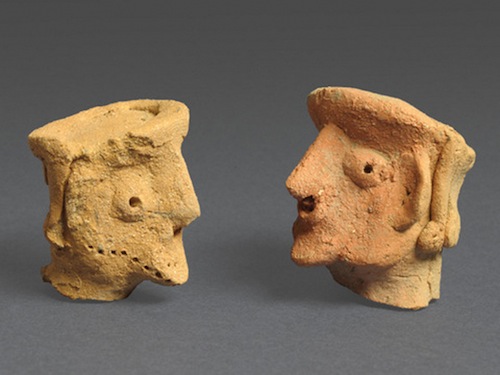
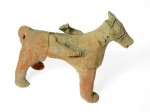
A horse figurine is evidence of early Jewish ritual practice.
(photo by Clara Amit/IAA.COM)

One might think that a significant archeological find a few hours’ walk from Solomon’s Temple in Jerusalem would turn up artifacts we would recognize as Jewish. But since the Judaism of the day was not what we know, the find yielded ritual objects that seem vaguely pagan, almost heretical by today’s standards.

photo - archeologist Shula Kisilevitz
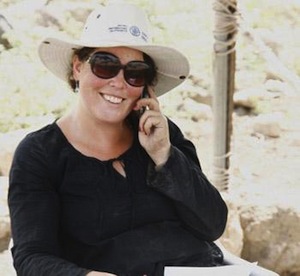
Archeologist Shua Kisilevitz describes the religion of the era as “pagan Yahwism.”
(photo from cjnews.com)

Shua Kisilevitz, the archeologist who was part of the team that excavated the site at Tel Motza, about seven kilometres west of Jerusalem, prefers the phrase “pagan Yahwism” to describe the religion of the era.

Last December, Kisilevitz and three fellow archeologists announced what they called an “unusual and striking” find, unearthed in construction for a highway: the 2,750-year-old walls of a temple, along with a cache of ritual objects that included a pedestal decorated with lions and sphinxes, pendants, pottery and vessel fragments, and figurines – two human and two animal – that may or may not have depicted deities.

The dig provides “rare archeological evidence for the existence of temples and ritual enclosures in the Kingdom of Judah in general and in the Jerusalem region in particular,” the team announced.

The uniqueness of the find is even more remarkable, the archeologists said, because of its proximity to the First Temple, built, according to the Bible, under King Solomon in 960 BCE. But archeologists know little about the period’s religious practices because there are hardly any remnants of ritual buildings from the era, according to Kisilevitz.

While more study is needed, the find provides valuable insights into what those rituals might have been, she said in an interview prior to her recent talk on the subject at the University of Toronto. While those practices may seem strange and un-Jewish today, they were in keeping with the rules of the time, Kisilevitz said.

Previous excavations showed that Motza functioned within the royal administration of the Kingdom of Judah, she said. “It was very much connected to Jerusalem. [It couldn’t] create its own religion. The people of Motza didn’t wake up one morning and say, ‘Oh, we want to create something new.’ They couldn’t break off so easily.”

photo - artifacts from Tel Motza excavation
According to Shua Kisilevitz, artifacts such as these found at Tel Motza, are important because they reflect a formative time for Judaism.
(photo by Clara Amit/IAA.COM)

The artifacts are important because they reflect a formative time for Judaism, she noted, adding they show that the ancient Israelite faith was not always centralized in Jerusalem and its practitioners may have used ritual objects now forbidden as graven images.   “There are all these presumptions we have which we project onto the early formation of religion,” Kisilevitz said. “This temple finally shows us how the religion started out and what it really looked like at the time. They [were] doing what was common in the period.”

The find also conforms to biblical accounts, which mention local religious precincts outside Jerusalem, she added. And “Motza” is mentioned in the Book of Joshua as a town in the tribal lands of Benjamin, which bordered Judah.

Kisilevitz, who works for the Israeli Antiquities Authority and is in Ontario for several months on an exchange with the University of Toronto, said the team does not know whether the human and animal figurines served a religious purpose. “It’s kind of tricky and a little bit hard to say,” she noted.

The archeological team believes the temple at Tel Motza must have functioned before religious reforms enacted in the times of kings Hezekiah and Josiah, which abolished all ritual sites outside Jerusalem and concentrated religious practices solely in the Temple.

Kisilevitz believes the artifacts do not conflict “at all” with modern understanding of Judaism. “We just have to change the way we think of the religion at the beginning.”

Ron Csillag is a Toronto freelance writer. A version of this article was originally published in the Canadian Jewish News.

Format ImagePosted on April 4, 2014April 10, 2014Author Ron CsillagCategories IsraelTags archeology, Book of Joshua, First Temple, Israel Antiquities Authority, Jerusalem, Judaism, King Solomon, Shula Kisilevitz, Solomon's Temple, Tel Motza
This week’s cartoon … April 4/14

This week’s cartoon … April 4/14

For more cartoons, visit thedailysnooze.com.

Format ImagePosted on April 4, 2014May 2, 2014Author Jacob SamuelCategories The Daily SnoozeTags Jacob Samuel, pen is mightier than the sword, thedailysnooze.com
Mystery photo … March 28/14

Mystery photo … March 28/14

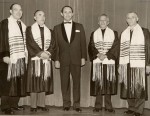
Cantor Herskovits and Schara Tzedeck Choir, Vancouver, 1955. (JWB fonds, JMABC L.14274)

If you know someone in this photo, please help the JI fill the gaps of its predecessor’s (the Jewish Western Bulletin’s) collection at the Jewish Museum and Archives of B.C. by contacting [email protected].

Format ImagePosted on March 28, 2014July 23, 2014Author JI and JMABCCategories Mystery PhotoTags Herskovits, Jewish Museum and Archives of British Columbia, Jewish Western Bulletin, JMABC, JWB, Schara Tzedeck Choir
LACAR redefines jewelry

LACAR redefines jewelry

Morgan Carrier and Shira Laye are LACAR. (photo from Morgan Carrier)

Nearly a decade ago, Shira Laye set out to explore the world of jewelry design. In 2013, she and her partner Morgan Carrier established LACAR – a combination of their surnames – a line of beautiful, wearable art, with influences ranging from “the dark side of Victorian mourning jewelry, to the architectural shapes of art deco and the great jewelry eras of the past.” I am the proud owner of several LACAR pieces.

Growing up in a large family, each child has to intentionally carve out her individuality. In our household of five siblings, this was no less true. From a young age, Shira, one of my younger sisters, had a particular talent for assembling stylish and unique outfits, with a remarkable flair for accessories. It was her childhood love of ancient artifacts and art, however, that originally sparked her love of jewelry.

Shira’s first brushes with the ancient world happened on a 1993 family trip to the Holy Land. “My first big trip as a kid to a faraway destination was our family trip to Israel, where I spent time in museums looking at ancient artifacts and pieces of jewelry from a long time ago, imagining that I was somewhere where someone might have worn that,” she recalled in chat over a coffee and sandwich at a café on Main Street. In fact, while I was spending much of my summer in a decidedly less artistic environment, in a microbiology lab at the Technion, most of the rest of the family was heading out to explore the ruins of Katzrin and the Old City, the springs at Ein Gedi or the collection at the Israel Museum.

In Israel, Shira got her first inklings of what she might like to be when she grew up. “I spent a lot of time illustrating what I saw and I decided that I wanted to become an archeologist. Not because I wanted to discover an ancient civilization, but rather I was sure I would unearth a treasure. A couple of years later, as a teenager, I went on another trip to Israel and spent the day on a dig with our older cousin, which was fun but a little bit disappointing. I decided I didn’t want to be an archeologist anymore – we didn’t find anything remotely shiny, it was just a hot day in the sun. I realized the only way to find treasure was by buying it at the store or learning to make it myself. And so, my fascination with ancient art and artifacts and jewelry of all kinds remained.”

After studying art history, Shira signed up “on a whim” for a course in jewelry making at Vancouver Community College. “I made just a simple silver band and a hammered cuff that I gave away as a gift,” she recalled. “And then I didn’t do anything for a little while, until I met a friend that had a home studio and traded me in exchange for doing some simple tasks like filing and sanding. She showed me some techniques … I really liked it, so I signed up for a program in New York, at Studio Jewelers in Midtown.”

At the time, I was living in Manhattan and Shira joined me there to study jewelry design and experience what the city has to offer. “It was a really great time,” she said. “I was equally as inspired by being in New York, living there, as I was by the techniques I was learning in school…. I ended up extending my stay to apprentice with a jeweler, a pretty unique guy, a little bit out there. It was a lot of running around. I knew where to buy pearls in one area in the jewelry district or where to get this from that person. It wasn’t as much technique as I would’ve liked. After I came home, I continued to learn more technique, as I still do to this day.”

Shira established her own line soon after and began taking on custom work, “which was a way to learn to expand my techniques,” she said. “And just by necessity, I would take on a project and I’d be like, OK, I get to learn how to do this! It was a great way to learn. And then, as time went on, Morgan was spending more and more time with me in the studio, and I’d show him how to do different finishing techniques or he’d help throughout the whole process of making a piece. He’s really natural with anything that’s hands-on and design oriented and, in no time at all, he was contributing to the design process as well. So, it just made sense to team up officially since that’s what we were doing unofficially.” The two came out with their first collection, Oculus, in 2013.

Of their work together and his background, Morgan shared, “I’m a handy guy with a background in the arts and construction. I studied theatre at UBC and then went on to a brief film career after studying documentary film studies in Paris for two years. I am always building or sculpting something, so it wasn’t a stretch in skills for me to pitch in. Shira would bribe me into date nights at the studio and we would listen to an episode of This American Life while slowly depleting a glass of red wine. It was romantic, but it also involved a lot of sanding, filing and polishing between sips of wine and, before I knew it, we were collaborating on designs. In our case, life partners make great business partners. This is my third or fourth career in life, and I’m loving it. It combines all the skills I’ve been mastering in other jobs over the past 20 years.”

Morgan said they both love “creating objects of beauty that appear simple but require problem solving in making them. We love that the possibilities are endless.”

It’s the shared love for objects of beauty that is key to making a successful collaboration, Shira said. “Every piece is a collaboration because even if it starts out as one person’s idea, it kind of morphs as we discuss it together, the idea comes to fruition. It ends up having little bits of both of us. We’re really lucky because we definitely have our own ideas, but we really share a similar esthetic. Our design processes are a little different but we really work well together; we’re good team. One of us might have an idea for a motif and then bring it to the other person. It may change slightly or be applied to a different piece or shape.”

LACAR make their home at Main and Broadway, a new studio space they share with fellow jeweler Anita Sikma. “I’ve spent years building up a studio and the repertoire of tools that I have on hand,” Shira said. “Now, I have a nice new bench that Morgan built for me since the move. I have on it all kinds of hand tools, files, hammers, measuring tools, steel blocks, a Fordham, safety goggles, and then we also have a lot of big tools.”

The move means that LACAR can expand their repertoire, Shira said. “We work in silver and bronze primarily for our collections, but our work is available in gold on a make-to-order basis. We can work in any metal – platinum, white gold – anything. We’d love to experiment with other mediums in the future. Now that we have a big studio space, we’ve got big plans.”

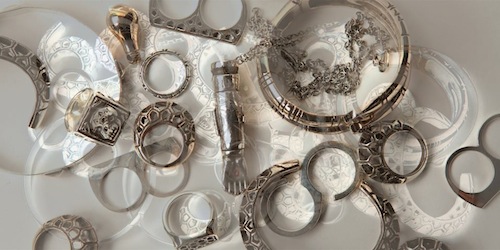
Their debut collection “was an expression of the beauty of eroded sanctuary,” the two told me in a follow-up email. “We wanted our pieces to be monumental, worthy of worship, but we wanted them to be light and wearable. So, we came up with the esthetic of the Gothic archway. The arches create a heavy vaulted lacework, drawing inspiration from sacred architectures.”

photo - LACAR's debut collection of jewelry
LACAR’s debut collection was inspired by Gothic architecture. (image from lacarstudio.com)

Soon after it debuted, they started making rings for Morgan to wear. “Until then, our line was mostly geared towards women,” Shira said, “and Morgan felt like he should be wearing more LACAR to promote our brand. Before we knew it, men were taking notice of our small ring collection. We decided to launch a men’s line, one that would have androgynous appeal. The pieces are heavy and solid; we tried to keep it a little more streamlined – lots of clean lines, flat surfaces.”

Though it’s hard to pick favorites, Morgan said he really loves the Obelisk ear cuff. “We wanted to make a cuff that complimented the form of the ear,” he said. “And the Signet ring, which we created as part of our new line, but that we’ve already customized for clients using family crests and other motifs.”

“Nothing passes through the studio door if we are not happy with it,” added Shira. “I really like all of the pieces that we have made. Morgan only wears some of them, but I get to wear them all. I would say that right now I’ve been wearing our gold Helm earrings with black diamonds pretty much every day, which we also have available without the diamonds and in silver and bronze, different price points, as well as the Vault bracelet with black jade inlay. Those pieces I wear every day and the other pieces kind of rotate. I’ve also been wearing our Siamese collar quite a bit. A bit more of a statement piece, but it looks really nice with a dress or even a casual pair of pants – it adds a nice detail.”

photo - a model wears LACAR
A model wears LACAR’s S-Ring, Helm choker and Obelisk ear cuff with white sapphires. (image from lacarstudio.com)

Favorites that they don’t get to wear “are some of the custom pieces that we’ve created. These come out of a nice collaborative process with the client’s ideas and our designs and technique. I’ve been really sad to see some of those pieces go! I specifically love working on engagement rings – that’s the favorite for me. Right now, we’re working on a beautiful ring, kind of a deco-inspired piece where the client brought in his girlfriend’s grandmother’s ring, which had a beautiful centre diamond and yellow gold, but he wanted something in white gold and with a different feel. We are using the diamond and creating a whole new piece that better fits her style and her esthetic.

“We do wedding rings, as well, and we’re right now working on a whole bunch of bridesmaids gifts, so that’s exciting…. One of the custom pieces that stands out was another art deco-inspired engagement ring that was inspired by the skyline.”

LACAR has been a mainstay at some of Vancouver’s pop-up shops, including at the Chinatown Experiment earlier this month. “It was with the Dreamlover Collective, which is friends of ours: Andrea Rokosz of Army of Rokosz and Karen La of Broken Promises and Marie Foxall of Wasted Effort…. They’re hosting so many great local vendors and designers, everything from hot sauce to jewelry, ceramic works, stockings. Our studio mate, Anita Sikma, is one of my favorite jewelers in the city … she was part of it, too. It’s great to be part of that, and a lot of fun.”

Aside from more retailers, Shira said they would love to work on a fine collection. “That would be really satisfying. We’re slowly building up, just continuing to work. Sometimes it’s hard to hone in on doing one collection because you’re constantly having so many ideas…. We just want to continue to create new things all the time!

LACAR is available at lacarstudio.com, their studio showroom (by appointment to [email protected]) and Cavalier in Gastown.

Format ImagePosted on March 28, 2014April 27, 2014Author Basya LayeCategories Arts & CultureTags Cavalier, Helm choker, LACAR, Live and Let Live Signet ring, Morgan Carrier, Obelisk ear cuff, S-Ring, Shira Laye
Gasoi at the Rothstein

Gasoi at the Rothstein

Jennifer Gasoi (photo from jennifergasoi.com)

In 2003, the Jewish Independent reviewed Jennifer Gasoi’s debut children’s album, Songs for You, describing it as “intelligent, energetic, philosophical, educational, at times silly and, most importantly, it’s high-quality music.” Since then, Gasoi has garnered numerous awards and nominations for her music. The latest – her second CD, Throw a Penny in the Wishing Well, took home the 2014 Grammy Award for best children’s album.

With the big January win still fresh, Gasoi – the first Canadian to ever receive this Grammy honor – returns to Vancouver next month. Living in Montreal since 2002, she is not only coming back to see family, but to perform two concerts on April 12 to benefit the Children’s Hearing and Speech Centre of British Columbia.

Gasoi, who also won the 2013 Sirius XM Canadian Indie Awards for children’s artist of the year, the Parent Choice Award and the Canadian Book Centre’s selection for best children’s music, and was a semi-finalist in the International Songwriting Competition and a Juno nominee for children’s album of the year, took time to speak with the Jewish Independent before her upcoming visit.

JI: You’ve won other honors and nominations in your career. In what ways, if any, is the Grammy different, and in what ways has it already affected your work/schedule?

JG: The other awards and nominations were wonderful accolades, but winning a Grammy has taken my career into a whole new realm. I’m being asked to speak and represent many different organizations. I’ve had quite a few requests internationally – to play shows (U.S.), to submit my music to radio stations (Australia), to sell my CDs (a theatre company in Oklahoma) and I’ve even had interest to play a show in China. There’s a certain status associated with being a Grammy winner that I’m still getting used to! It’s been quite a challenge keeping up with all the requests and opportunities arising. There’s no question that new doors are opening and my horizons are broadening.

JI: You have consistently put out quality recordings. From where do you find your inspiration? How do you keep the work fresh and interesting for yourself?

CD cover - Jennifer Gasoi's Throw a Penny in the Wishing Well
Jennifer Gasoi won a Grammy this year for Throw a Penny in the Wishing Well. (image from jennifergasoi.com)

JG: I am inspired by life. By people, experiences, nature, music, small moments, unexpected interactions, synchronicities. Sometimes, it’s just a simple two-minute interaction that can inspire a song. Or a memory can be the catalyst. “The Little Things” started off with the image of jelly tots– little candies that I used to love as a child – and it spun into a whole song about all the joyful moments from my childhood. “The Pizza Man” was inspired by a real-life pizza man at a iconic pizzeria in Montreal. Inspiration can hit anytime, anywhere. To keep the creative energy flowing, I see live shows, listen to music, practise yoga and meditation, go for walks on the mountain, take improv comedy classes, watch inspiring videos, dance, and spend time with creative and inspiring people. Children are one of my main sources of inspiration. They continually amaze me. They are so full of life, connected, brilliant, openhearted, pure and so much fun to be with. They remind me of what is really important in life.”

JI: You’ve been very involved in the Jewish communities of both Vancouver and Montreal. In what ways, if at all, has your Jewish heritage/upbringing/communal ties influenced your life/work?

JG: There is something very special about being part of such a close-knit community in both Vancouver and Montreal. It has provided me with a real sense of belonging and groundedness. When I was a child and attended synagogue at Temple Sholom, I was deeply moved by the music played during the services. I love Jewish music. It touches my soul. My Jewish heritage has definitely influenced my songwriting. In my first album, Songs for You, I have a klezmer tune called “The Animal Party,” and, in my latest CD, Throw a Penny in the Wishing Well, the hora features prominently at the end of “The Purple Man.”

I have the privilege of playing music for seniors and patients in several hospitals in Montreal. There is a significant Jewish population, so I often play classic Jewish songs such as “Hinei Ma Tov,” “Heveinu Shalom Aleichem” and “B’shana Ha’ba’a.” I once played Hatikvah during one of my gigs at a Jewish seniors group held in a synagogue, and everyone in the room stood up and sang along. It was so powerful, it brought me to tears.

JI: Are there any projects on which you’re currently working/collaborating?

JG: I have some projects in the works. That’s all I’ll say for now. My priority is to get all my business in order so that I can continue to create music, perform and reach a wider audience.

JI: Is there is anything else you’d like to share?

JG: I am so grateful to be living the life of my dreams. I hope that I can inspire others – big and small – to take chances in their lives, to live from the heart and know that anything is possible.

Jennifer Gasoi will perform twice at the Children’s Hearing and Speech Centre of British Columbia’s annual Family Concert on April 12, at 10:30 a.m. and 1 p.m. The event at the Norman and Annette Rothstein Theatre – which raises funds to support CHSC’s audiology program – will also feature clowns, games, auction items and face painting. Tickets are $15.50 per child and youth under 17, $18.50 per adult 18 and over, and $60 for a family of four (two adults and two children under 17); they are available from childrenshearing.ca.

Format ImagePosted on March 28, 2014May 3, 2014Author Cynthia RamsayCategories MusicTags Children's Hearing and Speech Centre, CHSC, Grammy, JCCGV, Jennifer Gasoi, Rothstein Theatre, Throw a Penny in the WIshing Well
Report concludes Iranian Jews were murdered

Report concludes Iranian Jews were murdered

Former Sephardi chief rabbi Shlomo Amar (at head of table) joins David Meidan, to Amar’s right, to inform Iranian Jewish families of the fate of their family members. (photo by Ashernet/IGPO)

For the past 20 years, the fate of eight Iranian Jews who were attempting to escape to Israel has been unknown. On Thursday, March 20, former Mossad official David Meidan, who was charged with the inquiry into the disappearance of the eight Jews (plus three other Jews who were last heard from in 1997), told the families in Jerusalem that there is enough reliable information to conclude that all eight of the original Jews were captured and murdered while making their escape.

A statement from the Prime Minister’s Office confirmed that the Mossad had been tracking the 11 Jews who had fled Iran in four separate groups, eight in 1994 and the remaining three in 1997. The Iranian Jews vanished without a trace during their clandestine attempts to reach Israel. Families were left clinging to the hope that they had been kidnapped, or perhaps held in captivity by foreign governments. The Mossad did not provide detail into when or where the eight were killed, or by whom.

The Prime Minister’s Office said that the Mossad had relied on a “reliable source” for the information. An inquiry into the fate of the additional three Iranian Jews, who were last heard from in 1997, is ongoing.

The original eight Jews included Babak Shaoulian-Tehrani, 17, of Tehran; Shahin Nik-Khoo, 19, of Tehran; Salari Behzad, 21, of Kermanshah; Farad Ezati-Mahmoudi, 22, of Kermanshah; Homayoun Bala-Zade, 41, of Shiraz; Omid Solouki, 17, of Tehran; Rubin Kohan-Mosleh, 17, of Shiraz; and Ibrahim Kohan-Mosleh, 16, of Shiraz.

The three Jews whose fates remain currently unknown are Syrous Ghahremani, 32 at time of disappearance, of Kermanshah; Ibrahim Ghahremani, 61, of Kermanshah; and Nourollah Rabi-Zade, 52, of Shiraz.

Prime Minister Binyamin Netanyahu sent his condolences to the families and pledged to continue the investigation into the disappearance of the remaining three Iranians.

Meidan, the veteran Mossad official overseeing the investigation, was also involved in the negotiations for the release of soldier Gilad Shalit. After retiring two years ago, Meidan was approached by Netanyahu to continue to investigate the two cases.

Before the findings were presented to the families, the report was sent to former Sephardi chief rabbi Shlomo Amar, who ruled that the information was reliable according to halachah, Jewish law, a ruling that would allow the wives of the victims to remarry if they wish.

Format ImagePosted on March 28, 2014April 10, 2014Author Edgar AsherCategories IsraelTags Babak Shaoulian-Tehrani, Farad Ezati-Mahmoudi, Homayoun Bala-Zade, Ibrahim Ghahremani, Ibrahim Kohan-Mosleh, Nourollah Rabi-Zade, Omid Solouki, Rubin Kohan-Mosleh, Salari Behzad, Shahin Nik-Khoo, Syrous Ghahremani
Actors’ journey to catharsis in This Stays in the Room

Actors’ journey to catharsis in This Stays in the Room

The cast of This Stays in the Room. (photo from horseshoesandhandgrenades.ca)

Baring one’s soul is always difficult. Imagine how it would be to share your angst and pain with a room full of strangers. This is exactly what four brave actors undertake in the world première of This Stays in the Room.

Horseshoes and Hand Grenades Theatre has partnered with PTC and Radix Theatre to bring this innovative mix of text, song, photography, video projections and choreography to the Downtown Eastside’s Gallery Gachet.

The company, as its press material states, “is a provocative and political group who are not content with holding a mirror up to society – they would rather conduct an autopsy on it.” This is the company’s first site-specific production and, by using a gallery venue, the audience is invited into a non-theatre space, removing the main barrier between the audience and the performers. To allow this intersection of theatre and visual art, the production set will remain as an installation during the run of the play for the general public to explore. The gallery is a collectively run space whose mandate is to encourage dialogue and promote social and economic justice.

The setting is intimate, rows of chairs on either side of a corridor with four decorated ones within the audience for the cast. The actors appear, two men, two women, each carrying a basket full of props. They sit among the viewers – you can reach out and touch them – and, one at a time, tell all. Four stories, four people, all very different and yet, in some strange way, hauntingly similar. An intense one hour takes you through the actors’ personal journeys, from trauma to the triumph of acceptance and forgiveness.

Part of the experience is the actors’ self-description as they draw themselves on a blackboard. Something visceral happens watching these four draw images of themselves on the board. They start off with simple stick people and then add layer upon layer of shape, form and color as they pictorially lay out their self-perceptions. The sound of the chalk scratching against the board picks up speed as they reach their finished images.

We meet Allan Morgan, 59 years old, gay, grappling with his sexuality and society’s homophobia, who puts a pink triangle over his face – he tells of his shame as a “chubby little boy” and his first homosexual experience. Then there is 30ish Robert Salvador, alcoholic, full of guilt over cheating on his wife and small daughter: he shares the story about a sex-free summer game he and his pals played in his teens, where falling off the wagon brought the punishment of being pelted with raw eggs. Next up, petite Manami Hara watching her elderly father deteriorate mentally and physically, feeling she abandoned him in his time of need, and, finally, pregnant Alexa Devine, harried mother of two, abused as a child.

Added to the mix are three stories of members of the creative team, whose talking heads are projected onto white lanterns hanging from the ceiling and the blackboards on either side of the audience. The poignancy and emotion of the disclosures are almost overwhelming at times. This is raw, in your face, reality theatre. It resonates with the audience because we have all been there, done that, and understand the feelings so openly expressed by this talented cast. At the end of the show, the faces of all of the audience members are projected onto the walls of the tiny room, each in a little circle – a reminder that we are all one.

With sound design by Noah Drew (whose Tiny Music was part of this year’s Chutzpah! Festival), lighting design by Andreas Kahre, video projection design by Cande Andrade and choreography by Amber Funk Barton, this multi-media mix comes together under the steady hand of director Mindy Parfitt.

This show is not for all: it is not a feel good, laugh-out-loud production but, as Parfitt notes, “It’s really about how we as individuals face the challenges in our lives, how we move forward and find some kind of forgiveness with ourselves and others.”

This Stays in the Room runs to March 30. Due to the adult content and language, it is not suitable for anyone under 18.

Gallery Gachet is located at 88 East Cordova St. Seating is limited. More information can be found at 604-729-5395 and horseshoesandhandgrenades.ca.

Tova Kornfeld is a Vancouver freelance writer and lawyer.

Format ImagePosted on March 28, 2014August 27, 2014Author Tova KornfeldCategories Performing ArtsTags Alexa Devine, Allan Morgan, Amber Funk Barton, Andreas Kahre, Cande Andrade, Gallery Gachet, Horseshoes and Hand Grenades, Manami Hara, Mindy Parfitt, Noah Drew, Robert Salvador, This Stays in the Room
Rothschild’s watercolors at Zack Gallery

Rothschild’s watercolors at Zack Gallery

Dr. Carl Rothschild has always had artistic inclinations but he could never choose one creative medium over the others. In the end, like a Renaissance man, he chose them all. He plays violin and viola. He’s made sculptures and wood carvings. He studied theatre. He has been writing poetry since high school, and painting and drawing even longer. He’s an artist through and through, unable to exist without making art in one form or another, even though his chosen profession is child psychiatry.

“I always drew pictures,” he said about his early years. “When I told my mom I wanted to be an artist, I was six at the time, she said: ‘Doctors paint.’ When I mentioned that I liked playing music, she replied: ‘There’re doctors’ orchestras.’”

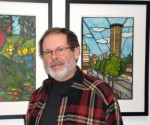
She wanted him to be a doctor, and he followed her advice. He doesn’t regret his choice. “At least I’m not starving,” he said with a smile. But he continued his involvement with the arts as a hobby, albeit a serious one. His first solo show of paintings, Stained Glass in Watercolor, opened on March 20 at the Sidney and Gertrude Zack Gallery.

Every painting in the show resembles a stained-glass panel; every shape is delineated by a dark outline. Inside the outlines, color rules. Yellow torches of the autumn trees stand along a street like soldiers on parade. Red tulips glow like candles above the grey flagstones of a backyard. Bluish sky melts into the pearly sea at the horizon, while the dramatic black borders cut across nature’s immensity, bringing it closer to humans and to the boulders on the beach.

Stained-glass technique is Rothschild’s latest creative mode. He is exploring its possibilities and shares his discoveries with viewers. “When our eye looks at two objects side by side,” he explained, “it sees a black separation line between them. When I insert the black lines myself, I can contain the shapes. I have control over them, and each object is discrete. I place them wherever I want in the picture.”

His images are never photographic. Whether the inspiration for a painting comes from a photo or a scene he has witnessed, or from his own poems, the end result is invariably his impressions of the objects that attracted his interest. “I saw those red trees and I wanted to paint them. I placed them in the painting, but they couldn’t be alone, they needed a street, a house, so I painted them, too.”

Besides shapes and lines, the stained-glass technique also fascinates Rothschild because of the texture and color variations in every glass fragment, he said. He tries to replicate the effect in his paintings, so his colors are muted, fluctuating inside the shapes he has imposed. “I like rounded lines; they’re easier on the eye,” he admitted. “It’s like the lines are dancing.”

His creative process implies a deep knowledge of the subject, but he is mostly self-taught. “I only started taking regular art lessons three years ago,” he said. “I was unsure whether I should continue painting. I visited a friend and talked to him about it. He had some watercolors by Susan Pearson on his walls. I liked them, and he said he knows the artist, why don’t I talk to her. So I did. I took my sketchbooks to this [artist] and I said I wanted to know where I was in my art. Am I an artist? Should I continue? She said: ‘Yes, of course, you’re an artist.’ Since then, I’ve been taking lessons with her every week.”

Those lessons contributed to another of his recent creative endeavors: in 2013, he published a book of drawings and poems, Almost Missed, on sale alongside his paintings at the gallery. “Only one painting in the book is done in the stained-glass technique, the first one I ever tried,” he said. “It was for my poem ‘In Memory of My Father’s Death.’ I liked it and started painting other pictures the same way.”

Most other illustrations in the book originated from one or another of Pearson’s lessons. They are either classic watercolor landscapes, airy and light, almost transparent, still-life pictures and abstracts based on the ideas and images of still life.

The connections between the poetry and pictures are intimate and allusive, and are woven together throughout the book. “Art is a synthetic process,” he said. “It comes out in whatever you do: poetry, visual art, furniture making. I always made art. Once, my family moved into a new home, and the previous owners left a stack of wooden kitchen cabinet doors in the basement. I started carving those doors. I don’t know what happened to them when we moved again. I also tried sculpture. When I was at university, my friend needed help in making dental samples. I helped him, and then used the same material for small sculptures. I also made a chess set for a friend.”

The modest Rothschild said he regards his constant creative output as relatively insignificant, but his sensitivity and artistry is unmistakable. Despite a medical degree and a psychiatric practice, in his heart, Rothschild is definitely an artist.

Stained Glass in Watercolor is on exhibit at Zack Gallery until April 27.

Olga Livshin is a Vancouver freelance writer. She can be reached at [email protected].

Format ImagePosted on March 28, 2014May 5, 2014Author Olga LivshinCategories Visual ArtsTags Almost Missed, Carl Rothschild, Stained Glass in Watercolor, Susan Pearson, Zack Gallery

Posts pagination

Previous page Page 1 … Page 652 Page 653 Page 654 … Page 661 Next page
Proudly powered by WordPress