Skip to content
  • Home
  • Subscribe / donate
  • Events calendar
  • News
    • Local
    • National
    • Israel
    • World
    • עניין בחדשות
      A roundup of news in Canada and further afield, in Hebrew.
  • Opinion
    • From the JI
    • Op-Ed
  • Arts & Culture
    • Performing Arts
    • Music
    • Books
    • Visual Arts
    • TV & Film
  • Life
    • Celebrating the Holidays
    • Travel
    • The Daily Snooze
      Cartoons by Jacob Samuel
    • Mystery Photo
      Help the JI and JMABC fill in the gaps in our archives.
  • Community Links
    • Organizations, Etc.
    • Other News Sources & Blogs
    • Business Directory
  • FAQ
  • JI Chai Celebration
  • JI@88! video

Recent Posts

  • Story of Israel’s north
  • Sheltering in train stations
  • Teach critical thinking
  • Learning to bridge divides
  • Supporting Iranian community
  • Art dismantles systems
  • Beth Tikvah celebrates 50th
  • What is Jewish music?
  • Celebrate joy of music
  • Women share experiences 
  • Raising funds for Survivors
  • Call for digital literacy
  • The hidden hand of hate
  • Tarot as spiritual ritual
  • Students create fancy meal
  • Encouraging young voices
  • Rose’s Angels delivers
  • Living life to its fullest
  • Drawing on his roots
  • Panama City welcoming
  • Pesach cleaning
  • On the wings of griffon vultures
  • Vast recipe & story collection
  • A word, please …
  • מארק קרני לא ממתין לטראמפ
  • On war and antisemitism
  • Jews shine in Canucks colours
  • Moment of opportunity
  • Shooting response
  • BC budget fails seniors
  • Ritual is what makes life holy
  • Dogs help war veterans live again
  • Remain vital and outspoken
  • An urgent play to see
  • Pop-up exhibit popular
  • An invite to join JWest

Archives

Follow @JewishIndie
image - The CJN - Visit Us Banner - 300x600 - 101625

Author: Lauren Kramer

Israeli worker is worried about his future in Canada

For 25-year-old Israeli Anton Soloviov, the dream of working in Canada turned into a nightmare. Brought into the country as a temporary foreign worker seven months ago, he and others in the same situation allegedly worked without pay for their former employers, who are accused of using the threat of deportation to keep their employees in line.

photo - Anton Soloviov
Anton Soloviov (photo from Anton Soloviov)

Last fall, while still in Israel, Soloviov said he saw an online advertisement for work abroad that promised earnings of up to $5,000 a month. Though his best friend warned him it looked too good to be true, it was an opportunity Soloviov couldn’t pass up. He applied online, interviewed with Canadian business owner and former Israeli Dor Mordechai over the phone and flew into Vancouver in October 2013. Mordechai and his wife Anna Lepski hired Soloviov as a foreign worker for their company, 0860005 B.C. Ltd., which operates kiosks in British Columbia malls, both in the Lower Mainland and on Vancouver Island. Soloviov, 25, said he met two fellow workers, also Israelis, on the ferry to the island and worked with them at Nanaimo’s Woodgrove Centre, at kiosks selling the Pinook Massage device and cosmetics, among other products. Soloviov said Mordechai and Lepski arranged housing for him and his fellow workers in a sparsely furnished house in Nanaimo, charging them $450 per month each in rent.

At first things were OK. “The first few weeks were wonderful, they showed us around and took us to Service Canada to get our SIN numbers,” Soloviov recalled in an interview. Left with $300 after paying for his $1,900 airfare to Vancouver – a fee that is supposed to be paid by the employer of a temporary foreign worker – Soloviov managed to pay for food for the first month. But payday offered the first indication, he said, that the work was far from kosher.

“Instead of paying us for a month’s work, our supervisor, Azi Qizel, also an Israeli, announced that we were working on commission so, after rent deductions and paying him $500 for our work permits, we didn’t actually earn anything,” Soloviov claimed. When he objected, Soloviov alleges that Qizel informed him that if he didn’t want to work, his work permit could be canceled and he would be deported by Immigration Canada.

By December 2013, Soloviov said he had worked hundreds of hours and made a total of $300 after the fines for which he claimed he and his fellow workers were penalized. “I was fined for everything you can imagine,” he alleged. “Qizel would come up to the kiosk, see something missing and fine everyone who worked that day $100. If we were seen on our phones, we’d be fined. If we were caught talking to each other, we were fined $100.”

Over the course of those months, Soloviov said he did some research and contacted a lawyer. He said he approached his then employers and asked to be paid what he was owed, “or else I’d file a complaint with Employment Standards.” That’s when Soloviov said that he and his family were threatened, though he was less worried about himself than his family. “I’m ex-military, I can take care of myself. But the threat to my family was a blow. I was afraid for my mother, who lives with my baby sister. She didn’t do anything wrong.”

A few days before New Year’s, Soloviov went to the Nanaimo RCMP with his story, and then to the Salvation Army Emergency Shelter, since he had no money or accommodation. What’s more, he was unemployable, since his temporary foreign worker permit allowed him to work only for Mordechai’s company.

Today, thanks to the intervention of the Central Vancouver Island Multicultural Society, which helped Soloviov find an immigration lawyer, he now has an open work permit and has found employment at a fast-food outlet in Nanaimo. A friend has offered him a place to stay for the time being. But Soloviov’s future still feels uncertain.

“I want to stay on in Canada but I’m not going back to that mall because I know they’re still there,” he said, referring to his former employers. “My friend still gets approached by people asking where I am and I don’t want to have to look over my shoulder all the time.”

Immigration officials say that Soloviov fits in the category of a “victim of trafficking in persons.” He has filed a complaint against Mordechai and Lepski with Employment Standards and the RCMP are investigating the death-threat complaint against Qizel.

Some of Mordechai and Lepski’s mall kiosks are still operating today. The pair are now being formally investigated, according to the office of Jason Kenney, Canada’s minister of employment. Since the case deals with potential human trafficking, it is being handled by the Ministry of Public Safety.

Citizenship and Immigration spokesperson Rémi Larivière said the Government of Canada takes the issue of exploitation and mistreatment of temporary foreign workers (TFWs) very seriously and that improvements to the program took effect on Dec. 31, 2013. These include allowing Citizenship and Immigration and Employment and Social Development Canada officials to conduct inspections of employers who hire TFWs to ensure that they’re meeting the conditions of employment. Service Canada has also made some changes, launching a public tip line to encourage Canadians who have any complaints, to share them with the agency’s Integrity Services.

Lauren Kramer, an award-winning writer and editor, lives in Richmond, B.C. To read her work online, visit laurenkramer.net.

Posted on May 16, 2014May 14, 2014Author Lauren KramerCategories Local
Retirement is something for which we must prepare, or “rewire”

Retirement is something for which we must prepare, or “rewire”

It was a capacity crowd at Jewish Senior Alliance’s Spring Forum on May 4. (photo by Binny Goldman)

Gyda Chud, co-convener and current board member of the Jewish Seniors Alliance of Greater Vancouver, as well as an original member of the Peretz Centre for Secular Jewish Culture, enthusiastically welcomed a capacity crowd of 180 to this year’s annual JSA Spring Forum, which took place on May 4 at the Peretz. The theme was “Retired/Rewired.”

Chud acquainted those attending with the philosophy, programs and purpose of JSA and reminded us that life learning leads to the best quality of life. She advocated that we should all be volunteers, saying, “Volunteers are not paid – not because they are worthless but rather because they are priceless.”

Bev Cooper read her poem about how she came up with the word “rewired,” rather than retired. For Cooper, the word “rewirement” has become her cue to search for ways to ride the waves in the difficult times. And, in the more comfortable times, rewirement propels her to use the opportunity to seek out new challenges.

Cooper then called upon Gloria Levi, social worker, consultant in the field of gerontology and co-author of Dealing with Memory Changes as You Grow Older, to be the moderator of the afternoon’s forum. She spoke of her personal connection to JSA and introduced gerontologist Roz Kaplan, director of the seniors program at Simon Fraser University’s continuing studies.

Kaplan said that most people nowadays will live some 30 years after retirement and that we need to prepare for that time. Retirement is not a destiny but a journey for which we should “pack” essentials and, as with all journeys, some of us will be better equipped and prepared than others for the trip.

With the average life span for Canadians now into the 80s, we were encouraged to keep learning: an instrument, a language, dance steps, the means to rise to challenges and accept change.

We were told we needed confidants, connections, community and having a passion. This journey would be a path to opportunity and, as we age, we should divest ourselves of “extra luggage” to enable us to reinvent ourselves. Most of us got through life identifying ourselves with our work, noted Kaplan, and reinvention would allow us a chance to ease into retirement.

The stages of life usually encompass birth, education, work, retirement, death. It is up to us to fill in the gaps with personal growth. Many of us return to an encore career. Family, friends, fitness, travel, volunteering and various hobbies serve to keep us vital. A recommended read was Creating a Healthy Retirement by Dr. Ronald and Lois Richardson.

After a brief question period, Levi introduced speaker John F. Helliwell, an officer of the Order of Canada, a fellow of the Royal Society and senior fellow and co-director of the Canadian Institute for Advanced Research. As a professor emeritus at the University of British Columbia, Helliwell has written articles on “how to build happy lives,” the topic of his talk, and is a co-editor of The World Happiness Report.

We started by singing “If You’re Happy and You Know It.” Helliwell asked if we were any happier after the shared singing than before, and most, if not all, of us were.

How do we measure happiness? Usually this is not a question asked by our doctor or therapist; rather, we are asked if we are sad or depressed or possess negative feelings. Negativity is not only a state of mind but also affects our physical well-being, Helliwell explained.

An example was given of students in a hotel room who were all exposed to the rhinovirus. Those with negative feelings/attitude generally succumbed to the cold germ, whereas those with a positive outlook were much less affected, with some even escaping being sick entirely. It was also suggested that we need to concentrate more on health building rather than health repair.

Economic factors are far less important to happiness than bonds with other people and assisting each other to overcome strife and difficult circumstances. Iceland and Ireland were given as examples of quality of life because the people living there showed, on average, more concern and care for one another.

Aristotle stated that a fine quality of life brings happiness to individuals in a variety of forms but we all agreed on aspects needed for good quality of life: food, health, trust, freedom (to make decisions and feel actively engaged in one’s life) and generosity (doing nice things for others raises one’s own happiness).

Another example offered by Helliwell was of a care home in Denmark, where the staff had been asked to design the home as if they themselves were to be its residents. Their advice was to do away with uniforms for staff, to dispense with bibs and to make mealtimes variable. At one of the homes, the chef even drove the residents to a local movie theatre and they all enjoyed annual holidays together, more like one would expect if one were with close family.

In a residence where there were two floors, one known as generally happy, the other, unhappy, residents on the “unhappy floor” were asked to design the space in which they would be living in a new building and suggestions were made, followed and increased happiness ensued.

In another instance, a seniors residence was combined with a day care, and seniors and juniors interacted happily, all benefiting, a little like symbiosis. No one broke the rules, nobody wandered away searching for the home they had left – they all felt they were home.

During the question period, it was asked why Israelis are happy even though they live such stressful lives. The answer seemed to be that there really is no time for introspection. As well, all are united in the common bond to continue to defend and build their country and that aim/purpose builds happiness.

A last question was about how we can continue to be selfishly happy if many of the rest of the world seems so unhappy. The answer was, “Whose misery is lessened by our being unhappy?”

After summarizing the two speakers’ talks, Levi spoke of JSA president Serge Haber and his countless contributions to the community through the years and of his being one of those honored at the Louis Brier Jewish Aged Foundation’s Eight Over Eighty (on May 25).

Haber asked everyone to rise for a moment’s silence to mark Yom Hazikaron, commemorating fallen soldiers; he pointed out the Israeli flags in the centre of each flower arrangement, celebrating Israel’s Independence Day. As refreshments prepared by Bagel Club Catering were served by JSA volunteers, Haber thanked those who had convened the forum and emphasized that much of this would not have been possible without the efforts of the amazing staff, Karon Shear and Rita Propp. Shear also took a video of the forum, which will appear on the JSA website.

Herb Calderwood, the afternoon’s musical entertainer, handed out songbooks and charmed the crowd by announcing that he may not know all the songs in the book, as he does not read music, but he asked us to call out our request by number. He delighted us as well with a game of “Name That Tune,” and those who guessed the tune were rewarded with a prize. Door prizes further kept the happiness quotient high and the afternoon came to a happy conclusion, as the audience did indeed leave rewired.

Binny Goldman is a member of the Jewish Seniors Alliance of Greater Vancouver board.

Format ImagePosted on May 16, 2014May 14, 2014Author Binny GoldmanCategories LocalTags Bagel Club Catering, Bev Cooper, Gloria Levi, Gyda Chud, Herb Calderwood, Jewish Seniors Alliance of Greater Vancouver, John F. Helliwell, Karon Shear, Louis Brier Jewish Aged Foundation, retirement, Rita Propp, Roz Kaplan, Serge Haber
Reenvisioning women at the Zack

Reenvisioning women at the Zack

The centrepieces of the show, two large paintings by Jazmin Sasky, are both based on Anita Diamant’s novel The Red Tent. (photo by Olga Livshin)

Across centuries, artists in different countries have depicted women in their multiple incarnations – among them, mother, muse, beloved, temptress. The new show at the Sidney and Gertrude Zack Gallery, called Envisioning Women, brings a new slant to the theme: how 21st-century Canadian artists see women.

The centrepieces of the show, two large paintings by Jazmin Sasky, are both based on Anita Diamant’s novel The Red Tent and, therefore, on the Torah. The women in the paintings could be just as easily from biblical or contemporary times, friends going on a camping trip or visiting a spa. The paintings’ festive red palette with its multiple nuances communicates the women’s contentment at being together, sharing the space. While the red tent in the novel refers to a place reserved for the females of the tribe, a place where they find mutual support and encouragement, in the paintings, the space alludes to a wider interpretation.

“I explored the sisterhood of women,” said Sasky. “It’s as relevant today as it was then, although in the biblical times, they all lived together. No secrets were possible, unlike us. We are much more private, but it was interesting to imagine those women, their lives.”

Her women don’t belong exclusively to the ancient tribe. They also live in the here and now, share our workspace and our holidays, walk along the same streets and into the same buildings. They are not afraid of change, of bursting out of the artificial confines of the “red tent” and into life.

photo - In Lori-Ann Latremouille’s “Emerging,” a woman transforms out of her restrictive silken shroud into wings and the world
In Lori-Ann Latremouille’s “Emerging,” a woman transforms out of her restrictive silken shroud into wings and the world. (photo by Olga Livshin)

This courage and strength resonates in many other works in the show. The women in them assert their place in history and are willing to rebel, if necessary.

Nancy Henderson’s painting with the title “Sk8r grrl one” is one example of such a rebellion. It depicts a young female hockey player in a ridiculous costume of the beginning of the 20th century. The artist’s fiery words about her work read as a tribute to every Canadian woman: “I salute women of every generation who have defied everything from societal disapproval to outright bullying in order to get into every game, including the great frozen one.”

Carly Belzberg’s “Eve” doesn’t look like a traditional Eve of old either. This Eve participates; she gets into games. In her shorts and a tank top, sitting in a meditation pose, perhaps doing yoga, she is not afraid of the world unfolding around her, and her quiet courage transmits to everyone who comes into the gallery.

Life is changing, and we’re changing with it, coming out of our traditional cocoon of domesticity, where women were confined (by choice and not) for generations – that seems to be the message of the show.

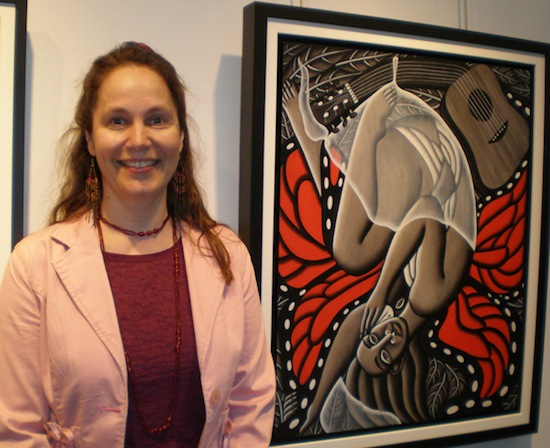
Lori-Ann Latremouille’s painting “Emerging” embodies this idea. Her woman is transforming out of her restrictive silken shroud into wings and the world. She will fly and sing, and the guitar incorporated into the image signifies the connection between music and freedom. “Rebirth after dormancy,” commented the artist. Not surprisingly, she is a professional musician herself, and her painting is a story of metamorphosis. “It’s a new painting technique for me, too. I used to do drawings,” she said.

photo - In her photography, Kathryn Gibson O’Regan tries to “find what unites women of all times and cultures”
In her photography, Kathryn Gibson O’Regan tries to “find what unites women of all times and cultures.” (photo by Olga Livshin)

The line of timelessness, of connectivity, continues in Kathryn Gibson O’Regan’s serene photographs. “I travel a lot and always try to find what unites women of all times and cultures. Creativity is common: weaving and spinning and making textiles, from the Bible to our times. I visited villages in many countries in Asia.” Her photos of the weavers in India and Thailand emanate peacefulness, their deep colors soft and bright simultaneously.

In contrast, there is little that is peaceful in Linda Lewis’ display of pottery cups. Each one has a face painted on it, or rather a hint of a face, the eyes. They are called collectively “Hints.” About two dozen of the cups are arranged in two glass cases in the middle of the gallery, similar in shape and size, but varied in their facial expression. Some cups stand in groups, like friends gossiping. Others are alone, in pain or pleasure. Still others resemble family clans, with love and antipathy intermixed. The whimsical complexity of women’s lives in pottery is fresh and unexpected.

It’s impossible in a short article to tell about each of the 15 artists participating in the exhibit – all of them add their unique perspective to the image of “contemporary woman,” and readers are encouraged to visit the gallery. Unfortunately, they won’t be able to experience one aspect of the show – the JCC Shalom Dancers. As the exhibit is in collaboration with Festival Ha’Rikud, its opening night featured a group of young dancers, led by Marla Simcoff and Jessica Bradbury, who presented a short but beautiful routine, a teaser of their full-length performance. Six young women in long black dresses, trimmed with red and yellow, with large red fans, danced in the atrium of the community centre, bringing dramatic energy and gladness to gallery patrons. They were the real-life embodiment of the paintings, women of the 21st century.

Envisioning Women will be on display until May 25.

Olga Livshin is a Vancouver freelance writer. She can be reached at [email protected].


Format ImagePosted on May 16, 2014May 14, 2014Author Olga LivshinCategories Visual ArtsTags Carly Belzberg, Envisioning Women, Festival Ha’Rikud, Jazmin Sasky, JCC Shalom Dancers, Jessica Bradbury, Kathryn Gibson O’Regan, Lori-Ann Latremouille, Marla Simcoff, Nancy Henderson, Zack Gallery

Plan your giving in Leave a Legacy Month

If you don’t have a will, get it done. That’s the message of the Canadian Association of Gift Planners, an organization that’s designated the month of May as Leave a Legacy Month. Calvin Fong, chair of the national program titled Leave a Legacy, said the program’s goal is to raise awareness of the importance of having a will, as well as the idea that people consider leaving a gift to charity in their will.

“If you die without a will you really have no control over how your estate gets distributed – legislation will dictate that instead,” Fong told the Independent. “Without a will, for example, you have no way of leaving a gift to your favorite charity or creating a trust for your spouse. Having a will ensures your wishes are articulated and carried out after your death.”

Just six weeks ago there were changes to the Wills, Estates and Succession Act (WESA) with important implications. The minimum age to create a will has been lowered from 19 to 16, wills created prior to marriage are still valid after marriage, and the courts have been granted authority to recognize non-compliant documents as wills, and ensure that a deceased person’s last wishes will be respected. For example, legislation now allows for the possibility that electronic versions of wills might be recognized. “The changes modernize legislation created over 100 years ago and streamlines things for the public,” Fong explained.

Tax savings is another reason to consider creating a will. Gifting money or assets to charity makes your estate eligible for a tax deduction upon your death, while creating a trust in your estate allows you to defer taxation of certain assets.

If considering gifting money to charity, start by figuring out what you want your personal legacy to be, advised Marcie Flom, director of the Jewish Community Foundation, which is housed at the Jewish Federation of Greater Vancouver. JCF works one-on-one with donors to create their legacies, using bequests, gifts of life insurance, gifts of cash and in-kind donations, annuities and charitable trusts. To date, it has 330 endowment funds and assets of $42 million that it manages on behalf of donors in the community.

With gifts of life insurance, donors name JCF as the owner and beneficiary. Upon their death, the proceeds of the policy enter an endowment fund they created during their lifetime, supporting causes that were important to them. “Some donors have various life insurance policies and discover that they no longer need them, so they decide to donate them to the foundation,” Flom explained.

With bequests, individuals stipulate a gift to the foundation in their will to support those causes. “It can take various forms, such as a set amount or a percentage of their estate,” Flom said. “It’s very personal, and usually people meet with me to talk about what they want to do, the idea being that we want to help increase your current income or estate value, while also creating a lasting legacy for the community.”

That legacy can involve donations to Jewish and non-Jewish causes, as the JCF distributes funds to both. And there’s a broad range of donors, Flom said, with some funds established with as little as $1,000, or no assets at all if it’s a planned gift. “Some donors make a modest contribution to their fund each year to build it over time,” she explained, “but legacy planning is not limited to those with means. Anyone can establish a fund in any amount and build it over time or establish a fund with a planned future gift.”

Some individuals use their legacy to involve and engage their children in active philanthropy. “They work with us on their philanthropy during their lives, but also use it as a method to engage their kids to take over that philanthropy after they’re gone,” Flom said. The children continue their parents’ legacy of lifetime giving by working together to direct support to their parents’ favorite charities and/or the charities that they are passionate about.

For more information, call the Jewish Community Foundation at 604-257-5100 or visit jewishcommunityfoundation.com. For more on Leave a Legacy Month, WESA changes and more, visit leavealegacy.ca or cra-arc.gc.ca.

Lauren Kramer, an award-winning writer and editor, lives in Richmond, B.C. To read her work online, visit laurenkramer.net.
Posted on May 16, 2014May 14, 2014Author Lauren KramerCategories LifeTags Calvin Fong, Jewish Community Foundation, Leave a Legacy, Marcie Flom, planned giving
Critics peek under the Conference umbrella

Critics peek under the Conference umbrella

President Barack Obama meets with leaders of the Conference of Presidents of Major American Jewish Organizations in the state dining room at the White House on  March 1, 2011. (Official White House photo by Pete Souza)

Since the Conference of Presidents of Major American Jewish Organizations voted April 30 to reject the membership application of the self-labeled “pro-Israel, pro-peace” lobby J Street, the umbrella group has come under siege with accusations of not being adequately representative of U.S. Jewry’s views and for being controlled by a faction of right-wing members.

Yet a closer look at the Conference’s makeup reveals the prevalence of politically centrist or apolitical organizations – particularly among its largest members – such as Jewish National Fund, Hadassah, Anti-Defamation League, American Jewish Committee, B’nai B’rith International, Jewish Federations of North America and American Jewish Joint Distribution Committee. Also included in the Conference are openly liberal groups such as Ameinu and Americans for Peace Now.

“A majority of the groups voting against J Street were secular, centrist groups, not religious or right-wing,” Zionist Organization of America national president Morton A. Klein suggested, noting that by his count there are no more than 11 religious or right-wing groups among the Conference’s 50 members.

“To say it’s not inclusive when you have Peace Now, Ameinu, [American Friends of] Likud and ZOA in the Conference, is an absurd statement,” Klein added.

J Street responded to the vote with a letter on its website addressed to Conference of Presidents executive vice-chairman/chief executive officer Malcolm Hoenlein, stating, “Dear Malcolm: Thank you for finally making it clear that the Conference of Presidents is not representative of the voice of the Jewish community. We recognize the need for an open and honest conversation on Israel in the United States. We appreciate you being honest. Now we’ll work on the openness.”

To gain membership in the Conference, J Street needed the support of two-thirds of the body’s members. Forty-two members showed up for the vote, whose final tally was 22 against J Street, 17 in favor and three abstentions.

Read more at jns.org.

Format ImagePosted on May 16, 2014May 14, 2014Author Jacob Kamaras JNS.ORGCategories WorldTags American Jewish Committee, American Jewish Joint Distribution Committee, Anti-Defamation League, B’nai B’rith International, Conference of Presidents of Major American Jewish Organizations, Hadassah, J Street, Jewish Federations of North America, Jewish National Fund, Malcolm Hoenlein, Morton A. Klein, Zionist Organization of America

Connect with “inner reality”

There is an elderly gentleman at a long-term care facility in Ottawa. I have not met him, but I have seen his photograph. At 99, he still possesses a spark in his eye. He looks much more physically robust than his biological age would suggest. And his features still retain the handsomeness I imagine he was said to possess as a younger man.

Recently, I spoke with his daughter, who I’ll call Leah. Leah is keenly aware of the disconnect between how people may perceive her father – living to an age most of us will only dream of, still in decent physical shape, happy and smiling – and her awareness that he once was so much more.

It’s not truly him, she explains, her voice cracking. Her father was always fastidiously groomed, courteous and extremely gentle. Now, under the spell of dementia, what she calls a “cruel” and “insidious” disease, on some days her father must be cajoled into showering. He has, on occasion, resorted to physical outbursts. And he has lost the social filter that we all depend on to carry us through everyday interactions. “It destroys me on a daily basis,” Leah says. Every time she sees him, she adds, she feels he has “died a little bit more.”

But bring him to music, and his spirit comes alive again. Leah sometimes performs at the facility where her father lives. When she does, her father rises from his seat, singing, filled with joy. “That’s my daughter!” he beams with pride.

Rabbi Neal Rose has recently retired as the spiritual director of the Simkin Centre, the Jewish long-term care facility in Winnipeg. He focuses on what he calls “spiritual care,” connecting with the person’s “inner reality,” he told me in a phone interview. This may be achieved through the esthetic markers of identity – things like food, music, language and holiday celebrations – or through more formal religious practice, like synagogue services.

Sometimes, this means entering the person’s current reality. A resident, who I’ll call Mr. Cohen, Rabbi Rose recounts, was getting agitated. “Call the police!” Mr. Cohen yelled, as his children surrounded him, perplexed. Rabbi Rose put his arm around him. “Mr. Cohen,” he said, “I’ve placed the call. The police will be here in five minutes.” Mr. Cohen relaxed, and went on his way.

It’s not lying, it’s not deception, Rabbi Rose emphasizes. It’s entering into their reality.

There’s a fascinating paradox at work. While dementia in many ways robs the sufferer of their identity, it also forces their caregivers and loved ones to be in the moment with them, to engage in pure empathy.

I recently visited an elderly relative who is suffering from Alzheimer’s. She seemed thrilled to see me, though she did not recall who I was. I realized I was desperately trying to penetrate through her fuzzy memory, to crack the code, as if she had a cinematic form of amnesia. “Do you recall the sharp corners on your glass coffee tables?” I asked her. “You used to place blankets over them when I brought my toddler daughter to visit.”

I wanted to fill her metaphorical candy jar with memories, I explained to Rabbi Rose, when we later spoke. I knew how much pleasure my visits had brought to her and how much I enjoyed chatting over Rideau Bakery challah and hard-boiled eggs at her home, the house she had lived in with her family for decades.

My instinct was understandable, but not realistic. “Not if she no longer has a candy jar to fill,” Rabbi Rose offered back. What’s more, too much pressing the dementia sufferer to remember can only leave both the sufferer and their family members in a circle of frustration and anxiety. This is a dynamic that Rabbi Rose emphasized, and which was echoed by Dr. Lee Blecher, a primary care physician in Virginia who treats dementia patients.

Still, Rabbi Rose emphasizes that it’s important for loved ones and caregivers to comprehend the whole person. At the Simkin Centre, a glass box is placed outside every room. Family members fill it with mementos. Of course, the totality of who a person is can never fit inside a glass box. But it’s a gentle reminder of the tension that exists between engaging a person as they are, right here and right now, and imagining a past that puts the present into sharp, sometimes wistful, but ultimately poetic, relief.

Mira Sucharov is an associate professor of political science at Carleton University. She blogs at Haaretz and the Jewish Daily Forward. This article was originally published in the Ottawa Jewish Bulletin.

Posted on May 16, 2014May 14, 2014Author Mira SucharovCategories Op-Ed

Israel in both hearts and minds

Nurturing connections between Israel and young Jews in the Diaspora can take many forms. An Avi Chai Foundation report, released this month, suggests that affiliation with Israel can come from Israel-related curriculums in Jewish day schools, but it is just as likely to come from a more generalized – and positive – affiliation with the Jewish people.

The report, titled Hearts and Minds: Israel in North American Jewish Day Schools, suggests that affiliation with Israel results from a much wider range of educational approaches than what we generally define as “advocacy.” While Israel is an important “glue” that helps bind Jewish students together (outside the Orthodox school sector, it is the most important glue), affiliation with Israel comes more from affiliation with Jewish peoplehood than vice versa, apparently. More than this, students are most likely to demonstrate connections to Israel if their parents demonstrate connections to the Jewish community. Seeing parents involved in (even non-Israel-specific) Jewish community activities can build a young person’s affiliation with Jewish life and, by extension, the Jewish state.

Interviewing almost 100 day school teachers and thousands of students, the three authors found that the role model of engaged Jewish parents is as likely to drive children to feel connection to Israel as is a trip to that country. For kids without Jewishly engaged parents, day school is the next most important factor in building affinity.

Importantly, the study indicates that frankly addressing the complexities of Israeli history and current affairs does not diminish the positive associations students hold. This is an important finding and should be recognized and remembered. Younger students may tend to associate with Israel in symbolic ways – as a somewhat abstract entity – while older students tend to have a better understanding of day-to-day life in the country and the realities of Israel’s place its region and the world. At a younger age, in other words, kids are taught to affiliate with Israel through their hearts. As they mature, students are taught to engage with their minds. This is fair. We do not expect younger children to assimilate the level of nuance and complexity we demand of high schoolers. This may also be a lesson many older Jews could learn. Too often, we find (adult) Diaspora Jews discussing, arguing and debating Israel-related issues with perhaps too much heart and not enough head.

By and large, it seems, our day schools are doing a good job at the significant task of affiliating young Jewish people with the Jewish homeland. In fact, as parents, teachers and as a community, we may be doing it in ways we do not even understand, simply by demonstrating the importance of connecting with other Jews as individuals and as a collective.

A piece of general advice useful to parents is also appropriate on the specific matter of raising kids who share our emotional and cognitive connection to the Jewish state: kids may not always listen, but they’re always watching.

Posted on May 16, 2014May 14, 2014Author The Editorial BoardCategories From the JITags Avi Chai Foundation, Hearts and Minds: Israel in North American Jewish Day Schools, Israel education, Jewish day schools

David Matas – a distinguished alum

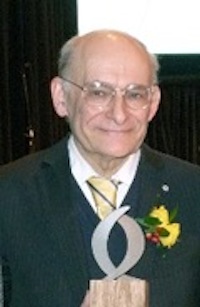
Winnipeg lawyer David Matas received a distinguished alumni award from the University of Manitoba (U of M) at a gala on the evening of May 1. Matas joined four others – Chau Pham (young alumni), Scott Cairns (professional achievement), John Bockstael (service to U of M) and Bruce Miller (community leadership) – in receiving the award. The event featured performances by U of M alumni, including Juno-nominated performers Erin Propp, Larry Roy and Desiree Dorion.

photo - David Matas
David Matas (photo by Ian McCausland)

On stage, Matas told attendees he is currently working on an autobiography, with the working title Why Did You Do That? He said, “The book seeks to justify my human rights activism. Writing the manuscript has made me introspective, attempting to justify my behavior to myself.”

There are pluses and minuses to receiving this award, said Matas, with a smile. “To be sure, it’s a boost to my self-esteem … [though the] downside is the increased expectations.”

Matas, who is a human rights lawyer in Winnipeg and senior legal counsel for B’nai Brith Canada, said that after having received the Order of Canada, “it didn’t become any easier. To the contrary, afterwards, my court opponents continued as before – disagreeing with everything I had said and adding that my arguments weren’t worthy of the Order of Canada. I hate to think what lies in store for me in court now that I’ve won the distinguished alumni award,” he joked, receiving warm applause.

Outside the courtroom, Matas more seriously added that the award might add welcomed weight to his positions and opinions. “I draw your attention to one particular position of mine: that the University of Manitoba should not be hosting Israel Apartheid Week.

“The decision this year to allow Israel Apartheid Week to go forward was particularly troubling in light of the fact that the University Student Union had stripped the sponsoring group of its student status and funding.”

Next year, as in past years, Matas said, he will be telling the university, “Don’t give this week a university forum.”

Later, he added, “Human rights advocacy, I realize, is often not one-dimensional – opposing rights against wrongs – but, rather, rights and against rights, and determining where the balance lies.”

Thanking the Alumni Association, Matas said, “It gives me the incentive and reinforcement to engage in this debate in years to come. The debate about where the balance lies is one in which we must all take part.

“I never drop a human rights cause until it’s resolved. I’ll be at it until the problem disappears – or I disappear.”

Rebeca Kuropatwa is a Winnipeg freelancer writer.

Posted on May 16, 2014May 14, 2014Author Rebeca KuropatwaCategories NationalTags B’nai Brith Canada, David Matas, human rights, University of Manitoba
Inclusive and accessible playgrounds

Inclusive and accessible playgrounds

Equipment like the Roller Table can help children develop their upper body muscles. (photo by Deborah Rubin Fields)

Not all playground equipment is created equal. Some equipment is accessible while some is not. Certain equipment is accessible to young wheelchair users, yet cannot be labeled inclusive play apparatus. However, some playground items are both accessible and inclusive and, notably, provide wheelchair-bound children with opportunities for either muscle toning and/or creative play.

Landscape Structures has designed a number of accessible and inclusive pieces of playground equipment. Take, for example, the new ZipKrooz. This is a scaled-down version of the popular adult zip line. The young passenger sits in a hard, high-back seat, secured with a harness. For safety, the chair runs fairly close to the ground. Gravity propels the child across the line. Close to the end of the line, the chair rocks back toward the centre before coming to a stop. The launching action is repeated, as many times as desired. A child using a wheelchair might need help from a grown escort to assist with the transfer to and from the wheelchair to the zip seat, to position the child at the beginning of the line, and to gently push the back of the chair to launch the occupant.

The Play Booster Sway Fun Glider is a roomy, communal “landed” boat that artificially creates wave motion. The “sailors” can either rock the boat from their seated positions or assistants can stand outside the bow or stern, swaying the boat. Wheelchair access is provided via a pull-down ramp. Sitting around a bolted-down table, two wheelchair-using youngsters may join in imagery play with other passengers. Wheelchairs are apparently not locked down; instead, wheelchair users either stabilize themselves with their chair’s brakes and with the table’s hand holds or have their attendants sit behind them, holding the chair’s back hand grips.

The next three play lot items not only promote inclusion and accessibility, but also muscle strengthening. The Accessible Stationary Cycler, the Accessible Power Lifter chinning bar and the Roller Table, for example, help children develop the muscles in their upper body – in their arms, upper back, neck and/or chest. Each apparatus is built low enough so that children using wheelchair mobility (and who have use of their arms and hands) can either reach up to raise themselves out of their chairs or sit in their chairs to comfortably play.

The following two pieces of equipment provide for inclusion and accessibility while focusing on creative enterprise.

Landscape Structures manufactures what it calls an Elevated Sand Table. This raised sandbox allows juvenile wheelchair users (who have use of their arms and hands) to build sandcastles from their chairs. From a standing position, children without physical disabilities play alongside.

The Chimes Reach Panel lets wheelchair users and non-physically challenged children to literally play harmoniously. They may make music together by ringing a row of chimes.

On the other side of the accessibility spectrum (and geographically on the other side of the world), there is the Australian-made Liberty Swing. With its design to accommodate most wheelchairs, this swing is apparently a big hit in Australia, yet this equipment sometimes stands off to the side of the other playground equipment, fenced off and under lock and key.

Admittedly, vandalism and theft are problems playground officials face worldwide. But this reality means that while the swing is accessible to children who use wheelchair mobility, it is not necessarily mainstream integrated.

Play is necessary for a child’s physical and mental development. In the Western world, playing with one’s peers, regardless of one’s physical or mental ability, has been deemed a child’s right. Overall, the surveyed play items show significant progress has been made in fulfilling this objective. Physical and occupational therapists who work with children would do well to encourage their young clients and their families to make use of such equipment, and to try and make playgrounds everywhere as accessible and inclusive as possible.

Deborah Rubin Fields is an Israel-based features writer. She is also the author of Take a Peek Inside: A Child’s Guide to Radiology Exams, published in English, Hebrew and Arabic (take-a-peek-inside.com).

Format ImagePosted on May 16, 2014May 14, 2014Author Deborah Rubin FieldsCategories LifeTags accessibility, Accessible Power Lifter, Accessible Stationary Cycler, Chimes Reach Panel, Elevated Sand Table, Landscape Structures, Liberty Swing, Play Booster, Roller Table, Sway Fun Glider, wheelchair, ZipKrooz
Hold a newborn like a kangaroo

Hold a newborn like a kangaroo

Premature babies experience long-term benefits from skin-to-skin contact with their mothers for a short time every day. (photo from israel21c.org)

A new Israeli study reveals that “kangaroo care” for premature babies has life-long effects on neurological and psychological development. Conducted by Dr. Ruth Feldman – a professor in the department of psychology and in the Brain Research Centre at Bar-Ilan University and adjunct professor at the Child Study Centre at Yale – the study shows that skin-to-skin contact between mother and newborn improves brain functioning later in life.

The concept of “kangaroo care” (named for the way that this marsupial carries her unformed offspring in her pouch) is not new. Introduced by neonatologist Edgar Rey Sanabria in 1978 in Bogota, Colombia – where access to incubators was limited – it is a method of using maternal body heat to prevent hypothermia in preemies. That it proved effective in keeping infants warm made sense, but Feldman and her research team set out to examine whether it had a measurable influence.

They began performing a double-blind longitudinal study in 1996 and 1998, looking at one group of 73 premature babies in a neonatal unit receiving standard incubator care, and another set of 73 whose mothers provided skin-to-skin contact for one hour a day for two weeks in a row. The parents in the control group were not aware of the kangaroo-care study, but were offered ongoing psychological and medical care for their babies.

At seven intervals over the course of the next decade, all 146 of these children were tested with brain scans. Today, they are 16 to 18 years old.

“What we found was that the children in the kangaroo-care group had better cognitive skills, sleep patterns and a higher functioning autonomic nervous system, better able to cope with stress,” Feldman said. “And their mothers were more sensitive parents.”

Read more at israel21c.org.


Format ImagePosted on May 16, 2014May 14, 2014Author Ruthie Blum ISRAEL21CCategories World

Posts pagination

Previous page Page 1 … Page 644 Page 645 Page 646 … Page 661 Next page
Proudly powered by WordPress