The cast of Spamalot, with Josh Epstein at centre, on one knee. (photo by David Cooper)
In any great adventure, that you don’t want to lose, victory depends upon the people that you choose. So, listen, Arthur darling, closely to this news: We won’t succeed on Broadway, If you don’t have any Jews.
– Sir Robin, Spamalot
Of all the Monty Python films, perhaps none has deposited as many “Pythonisms” as Monty Python and the Holy Grail. Who can forget the airspeed of an African swallow, horse hoofs portrayed by empty coconut halves, the knights who say “ni,” the killer rabbit and, that old chestnut, “It’s only a flesh wound.”
Produced in 1975, Holy Grail was the second in a string of five successful Python films that included And Now for Something Completely Different (1971), Life of Brian (1979), Live at the Hollywood Bowl (1982) and The Meaning of Life (1983).
Funny thing is, although I’ve seen Holy Grail perhaps a dozen times over the years, I don’t recall the presence of a giant Magen David dangling in a spotlight as the cast sings, “You haven’t got a clue if you don’t have a Jew.” Call me crazy but I don’t think that was in the original.
But then Spamalot does not suggest that it’s anything other than a rip off (albeit lovingly done), so, although it’s based on the movie, be prepared for the use of monumental artistic licence. And yet, what better piece for physical comedian/actor/musical theatre devotee Josh Epstein to sing as he prances around the stage in one of the funniest performances you’ll see this year.
Josh Epstein, as the taunting Frenchman in Spamalot. (photo by David Cooper)
Epstein has already proven his prowess in memorable productions such as The Producers in 2008 and The 25th Annual Putnam County Spelling Bee in 2010. But seeing him frolic in chain mail, bedecked with Orlando Bloom hair, or hurling brilliant insults as a French soldier wearing the equivalent of a Conehead helmet, is gut-wrenchingly hysterical.
For those not familiar with the story, the plot centres on King Arthur’s attempt to round up some knights (or “ke-nicts” as Epstein mispronounces in his French “aksant”) to search for the grail. On his path, he encounters challenges of outrageous (in size and humor) proportions. He can’t even convince the local serfs that he deserves their respect as a king after relating how he acquired the title from the Lady of the Lake. “Strange women lying in ponds distributing swords is a bad way to choose a government,” he is told.
The hapless Arthur (David Marr) continues undaunted, however, eventually rounding up four knights – the Homicidally Brave Sir Lancelot (Jay Hindle); Sir Robin, the Not-Quite-So-Brave-as-Sir-Lancelot (Epstein); Sir Galahad, the Dashingly Handsome (Jonathan Winsby); and Sir Bedevere, the Strangely Flatulent (Ashley O’Connell). His biggest challenge comes when he is told by the knights who say “ni” that he can only continue his quest if he puts on a successful Broadway musical.
“Can it be done?” he asks Sir Robin. Yes, he responds, but only if you have Jews in the production. After all, “It’s a very small percentile who want to see a dancing gentile.”
Enter the Magen David, a menorah on a piano and four knights and one king who suddenly transform into Chassidic Yiddim.
As it turns out, Arthur’s sidekick Patsy is a member of the tribe, but has been keeping it a secret.
“It’s not the sort of thing you say to a heavily armed Christian,” he responds to Arthur when asked why he was not forthcoming.
Beyond the brilliant writing, kudos have to be given to choreographer Lisa Stevens and costume coordinator Rebekka Sorensen-Kjelstrup. The look, the sound and the dancing all elevate the production into stratospheric entertainment.
Monty Python’s Spamalot, with book and lyrics by Eric Idle, runs until June 29 at the Arts Club’s Stanley Industrial Alliance Stage, artsclub.com. Warning: profane language.
Baila Lazarus is a freelance writer, editor and photographer. Her work can be seen at orchiddesigns.net.
The Art of Stealing grew from Barton’s desire to explore what’s considered right and wrong in a post-apocalyptic world. (photo by Chris Barton)
When Amber Funk Barton was constantly dancing around her house at the age of 4, she didn’t realize that one day she would become a professional dancer and choreographer. But the Vancouver-born artist, now 33, is living her dream. Her latest production, The Art of Stealing, created by her choreography company, the response, premières on May 28 at the Firehall Arts Centre.
“I didn’t think I had a future as a professional dancer, I thought choreography was one way I could still be involved in dance,” said Barton. “My dream was to have my own company and to choreograph.”
The Art of Stealing grew from Barton’s desire to explore a dark theme, what she describes as a “post-apocalyptic world” and the difficulties in understanding what’s right and wrong in this haunted, mysterious future.
“The small picture is the obvious thing – the obvious literal act of stealing, that’s physical, taking something physical without consent,” she said. “I found it very interesting in this post-apocalyptic world that all of sudden it’s OK to steal – and if you don’t steal, you’re gonna die. It’s related to survival. On the bigger level, I started really thinking about it – the stealing that we can’t control at all – our time, our energy, our youth. Essentially to me, death is the ultimate thief in life.”
The 60-minute piece is the third full-length work that the response has created. Established in 2008, the company’s two previous pieces, RISK (2008) and Portraits and Scenes of Female Creatures (2011), also premièred at the Firehall.
Choreographer and dancer Amber Funk Barton. (photo by Chris Barton)
Although Barton said she had been dancing since she was a little girl, she only started dancing professional at 21. Perhaps her maiden name, “Funk,” was a glimpse of the career trajectory her life would take.
But Barton isn’t just making her mark in the dance world. While creating the piece, she teamed up with active-wear clothing line lululemon’s innovation hub, called lululemon lab. “The lab is very inspired by different groups in the community and works with them to make functional fashion for people specifically in our community,” said Barton. She was introduced to Jean Okada, team director at lululemon lab, who was impressed by Barton’s creative piece.
“She came up with the idea that she would like to pitch what the lab calls a capsule collection. So they essentially designed our costumes,” said Barton. In addition to designing the dancers’ costumes, they created a collaborative clothing line, which launched last week, on May 16. “They’re selling it in stores and we’re wearing [that] same clothing on stage. It’s a really beautiful exchange,” Funk said. The clothing is in line with the dance piece’s theme – it’s dark and edgy and promotes Barton’s unique ideas about the struggle for survival in a dark world. The limited edition capsule collection produced three pieces for women and three for men and will be available only until the items are sold out.
“First of all, having a line designed is beyond what I was imaging in the first place. It was amazing. They had such respect for what we were doing as artists. They asked dancers thorough questions, what our needs are. I was able to share images and whatever I had collected in terms of inspiration. They actually took what I wanted and integrated it into the line. I was part of fittings. It was beyond what I was hoping for,” said Barton.
Reflecting on her beginnings and how far she’s come, Barton said, “I started dancing probably around 4 years old and it was with ballet and I had some kind of alignment issues. I had weak mobility in my legs so the doctor recommended ice skating or dance to strengthen the alignment of my legs. My mom noticed I was dancing around the house all the time anyways and she also didn’t want to sit in an ice rink at 5 a.m., so she enrolled me in ballet classes and that’s basically how it all started.”
Now, she wants to focus on choreography and creating more unique pieces, as she embarks on what she calls her “mid-career artist years.”
“I feel very fortunate and very grateful,” she said. “My company is a small, project-based company. It’s like a little home where I can make what I’m interested in and make my art. Sometimes I just pinch myself.”
The Art of Stealing is on stage May 28-31 at the Firehall Arts Centre. There is an artist talk back after the performance on Thursday, May 29. For tickets, contact the Firehall at 604-689-0926 or visit firehallartscentre.ca.
Vicky Tobianah is a freelance writer and editor based in Toronto. Connect with her on Twitter, @vicktob, or at [email protected].
Details are slowly emerging about a major initiative to strengthen Jewish identity in the Diaspora. The plan, coming from the office of Israeli Prime Minister Binyamin Netanyahu, has been in the works for months. But details are seeping out slowly – and reaction from the Diaspora is keeping pace.
The plan, called the Prime Minister’s Initiative, is expected to pour $300 million a year into programs that enhance Jewish identity among non-Israeli Jews and to build connections between Israel and the Diaspora. The project is overwhelmingly aimed at the young, proposing a Birthright-style program for teens, more Israeli peers deployed to Diaspora university campuses, and a Global Jewish Service Corps providing young adults an opportunity to work on Jewish-oriented projects.
An editorial in the American Jewish newspaper the Forward took exception to aspects of the plan. “Why should Diaspora Jews – Americans, in particular – trust, depend on and defer to Israelis to strengthen our Jewish identity?” the paper asked. “Why should Israelis pay for Jewish identity programs in the Diaspora when there are pressing needs at home?” the editorial continues, and: “Is making the Israeli government the driver of Jewish identity the best and only way to reach younger, disaffected Diaspora Jews?” A commentator elsewhere has suggested the plan is intended to reshape Diaspora Judaism into a form that serves Israel’s best interests.
There are several factors here that deserve unpacking. Among the first is the amusing scene of American Jews getting defensive about Israelis deigning to intervene in Diaspora Jewish affairs. Has there been any topic more obsessive to Diaspora – especially American – Jews over the past decades than Israel? There is hardly a Diaspora Jew who doesn’t think they could run Israel better than can Israelis. Yet, turn the tables and suggest Israelis might have something to say about the way Jewish life unfolds around the world and suddenly it’s time for everyone to mind our own business.
It is not surprising that American Jews should be among the first to call out the Israeli initiative. For one thing, the proposal suggests an upturning of the traditional relationship, in which American Jews send money and volunteers to the Jewish state with an underlying sense of benevolent paternalism. Jewish Americans still send huge proportions of philanthropic budgets to Israel and so it may strike them as counterproductive that Israel is now planning on spending $300 million a year on programming for the Diaspora. But it’s about more than the money. Jewish Americans are familiar with their role as the rich, generous benefactors to their younger Israeli cousins. And Americans – Jewish or not – are unaccustomed to having outsiders tell them how they should run their affairs. It is also notable that the strongest reaction should come from American Jews because, statistically, Diaspora Jews are American Jews, for the most part. Seventy percent of Diaspora Jews are Americans. The next largest Diaspora Jewish population is France, with fewer than one-tenth the number of Jews as the United States. Unless explicitly targeting the few thousand Jews of Venezuela, India or Latvia, the term “Diaspora,” numerically speaking, can be interpreted to mean “mostly American.”
It is certainly true, as some commentators have pointed out, that Israel has not really deciphered what Judaism in the 21st century means within the Jewish state, so it may be premature to start exporting a half-baked and often troubled understanding abroad.
But there is no reason to believe that the Prime Minister’s Initiative will seek to tell Reform, Conservative or Orthodox Jews how to daven or order an all-new Chumash for Diaspora synagogues.
In reality, the initiative is perhaps long overdue, an opportunity for the Diaspora-Israel relationship to recalibrate to a more symbiotic dialogue, rather than the unidirectional tradition in which money (and advice) flows only to Israel. It is, in fact, a sign of a maturing of both Israel and the Israel-Diaspora relationship. The question now seems to be whether the Diaspora is mature and secure enough to adapt to the new balance in that relationship.
Debbie Rootman, community developer and program coordinator for the Jewish Food Bank.
On Sunday, June 1, from 1-4 p.m., the Jewish Community Centre of Greater Vancouver will be the site of Project Sustenance, a major food drive in support of the Jewish Food Bank. Community members, who are encouraged to bring non-perishable food items to donate, will be treated to live entertainment, a kosher barbecue and a kids-oriented crafts table hosted by Vancouver Talmud Torah. The drive is organized in partnership between the Jewish Family Service Agency (JFSA), Beth Tikvah Synagogue, Jewish Women International (JWI) and the JCCGV.
The idea for the drive came from Beth Tikvah’s Francie Steen and Shelley Ail, who is the lead food bank volunteer, said Debbie Rootman, community developer and program coordinator for the Jewish Food Bank. Steen and Ail are event co-chairs.
This is the first year of Project Sustenance, but JFSA “hopes to have it annually, because hunger is 365 days a year,” Rootman told the Independent. In an average month, she said, the Jewish Food Bank provides meals for 250 people, 65 of whom are children. “On top of helping so many people in the community,” Rootman said, “on special times of the year, like Passover and Rosh Hashanah, we distribute hampers to another 170 clients of Jewish Family Service Agency.”
Project Sustenance is meant to be the second food drive of the year for the Jewish Food Bank, which organizes Project Isaiah each High Holiday season with the help of local synagogues. Rootman and her colleagues had “always talked about doing another one in the spring, but haven’t had the time or volunteer power to do it,” she said. In fact, by about January every year, the food bank has usually run out of the goods donated in the fall. Typically, after January, the food bank has had to largely rely on cash donations, “so that way we can buy food, which we do bi-weekly for fresh vegetables and fresh bread and other things that we need,” she added.
“It was started as a temporary measure, but we’ve still got it today. So, it has grown. Many of the reasons [for that growth] are because Vancouver is very expensive, so some of the people we see are working poor … disabled people, elderly people, people on fixed incomes we are helping, as well as people going through tough times … everybody has challenges in their life, so we are here to help for those times.”
The Jewish Food Bank “was started 33 years ago by two women,” Rootman said. “It was started as a temporary measure, but we’ve still got it today. So, it has grown. Many of the reasons [for that growth] are because Vancouver is very expensive, so some of the people we see are working poor … disabled people, elderly people, people on fixed incomes we are helping, as well as people going through tough times.” She added, “everybody has challenges in their life, so we are here to help for those times.” Her personal philosophy, she said, is that “charity begins at home.”
The Jewish Food Bank operates out of the Peretz Centre for Secular Jewish Culture every other Thursday and is organized and staffed by volunteers. Elaborating on the scope and value of those contributions, Rootman said, “The Jewish Food Bank could not operate without the many volunteers.” She said there is always a need for volunteers to drive goods to clients who lack mobility, to organize food at the bi-weekly food banks and to sort Project Isaiah food donations in the fall. Right now, they are hoping that more volunteers will step forward to help with “set up and take down on June 1, as well as sorting” the donations.
The Jewish Food Bank is a community-wide effort, and Project Sustenance is no different. Aside from Steen and Ail, JWI’s Sara Ciacci has been involved in Project Sustenance through “major fundraising for the Jewish Food Bank,” said Rootman, and the JCCGV has donated the space for the June 1 drive. Some of the other major sponsors include Broadway Moving, which has donated a truck to transport the donated food, Omnitsky’s Kosher, which is providing kosher hot dogs, and Signarama Richmond.
Project Sustenance follows Beth Tikvah Synagogue’s presentation of A Place at the Table, a film that screened on May 13 to raise awareness about hunger in the community. The documentary explores the various issues surrounding hunger and the means to solving this serious problem. The screening was followed by a panel discussion, which included Rootman, who said she found the film to be “very powerful,” and Alex Nixon from the Richmond Food Bank. The panelists connected the information in A Place at the Table to Canada and the local Jewish community.
For those who are unable to attend on June 1, “food donations can be dropped off at any synagogue, Jewish school, the JFSA office or the JCC,” Rootman said. Community members can also make a cash or credit card donation by calling JFSA at 604-257-5151.
There I stood, 13 and terrified. At Beth Torah Congregation in Toronto, on a bimah that my grandfather had literally helped build, I was chanting from a Torah scroll that his father had saved from their synagogue in eastern Poland and smuggled through the war – the same parchment from which my father, uncles and cousins had all read in turn.
The congregation’s eyes seemed to bore tiny holes into my skull as I read the most infamous words of my Torah portion, Acharei Mot: “Thou shalt not lie with mankind as with womankind: it is abomination.”
Bathed in family history and tradition, I thought I was about to drown. I may not have been the first gay shlemazel to have to swallow the words of Leviticus 18:22 during his bar mitzvah, but as the text passed my lips, I still felt completely alone.
The following year, as I was beginning to come out to my family and friends, the Supreme Court of Canada told an evangelical Christian university that it was free to exclude gays from its teacher education program. More than a decade later, the same university, Trinity Western, is invoking that ruling – and my bar mitzvah portion – as it claims the right to open an anti-gay law school.
They’re wrong, and anyone who truly cares about religious freedom should say so.
It’s far from clear that the Supreme Court’s 2001 decision – written, as it was, at a different time and on different facts – still empowers Trinity Western to discriminate against gays and lesbians. Yet, even if it does, the university’s anti-gay policy makes a mockery of freedom of religion. It’s one thing for people of faith to believe that gays are doomed to eternal hellfire, but it’s quite another to exclude them from a law school on that basis.
Read a Christian Bible cover to cover. It doesn’t end well for the Jews, either. Still, those of us who don’t accept Jesus Christ as lord and savior are welcome at Trinity Western University – provided that we don’t sleep with anyone of the same sex while we’re there.
If allowing Jewish students to practise Judaism isn’t a threat to Trinity Western’s religious freedom, what’s so different about allowing gay students to be gay? After all, according to evangelical Christians, we’re all going to end up shvitzing in the same place.
Imagine if the university required Jewish students to promise to abstain from Judaism. If that isn’t discrimination, neither was the Spanish Inquisition.
Can Christian scripture provide a basis for homophobia? Of course it can. Look no further than Leviticus 18:22. But the same set of texts might just as readily forgive racism, slavery or antisemitism. Why doesn’t Trinity Western discriminate against Jews or blacks the way it discriminates against gays? Because only fanatics would ever accept religious excuses for the former, and nothing does more to discredit religious freedom than using it to justify bigotry.
Anti-gay discrimination should be no exception. Those of us who depend on freedom of religion to protect our own beliefs should be the first to condemn its misuse. That doesn’t mean asking Christians (or Jews, or Muslims) to ignore scripture that prohibits homosexuality – though many do, and more should – but it does require us never to condone its use as a basis for odious discrimination. After centuries of blood libel, Jews are only too familiar with intolerance preached from the pulpit.
Those words that darkened my bar mitzvah portion – “v’et zachar lo tishkav mishk’vei ishah to’evah hu” – are chanted in synagogues around the world each year. After more than a decade, they still sting.
We can’t rewrite Leviticus, nor can we force the faithful to overlook passages that give us pause. But that doesn’t mean we can’t distinguish religious belief from religious pretext. If freedom of religion can justify almost anything, then it will be good for almost nothing. It’s up to those of us who need it to defend it from itself.
Adam Goldenberg is a Kirby Simon Human Rights Fellow at Yale Law School, a former Liberal speechwriter and a contributor to CBC News: The National. Follow him at twitter.com/adamgoldenberg. This article originally appeared in the Canadian Jewish News and is reprinted with permission. For more national Jewish news, visit cjnews.com.
With the collapse of the U.S.-brokered peace negotiations, the Palestinian leadership has embarked on a plan of unilateral action to gain recognition of a Palestinian state and to isolate Israel internationally. Couple those developments with the Fatah movement’s unity pact with the terrorist group Hamas, and Israel is facing a complex reality. Without peace talks, what options does Israel have? Will Israel be forced to take its own unilateral steps?
“If [an] agreement is unachievable, then moving independently to shape the borders of Israel is the better course,” suggested Amos Yadlin, a retired Israeli air force general and former head of the Israel Defence Forces Military Intelligence Directorate. “While it is not the [ideal] alternative, it is better than the status quo or a bad agreement.”
Yadlin, who now serves as director of the Institute for National Security Studies (INSS), is among a growing number of respected Israeli leaders putting forth proposals for unilateral steps. In a proposal posted earlier this month on the INSS website, Yadlin argued that Israel has more than the two options usually discussed: a peace agreement and the status quo. According to Yadlin, Israel’s four strategic options are a peace agreement along the parameters established by former U.S. president Bill Clinton at Camp David in 2000, an “unacceptable” peace agreement on Palestinian terms, a status quo in which the Palestinians dictate their own terms or a status quo in which Israel dictates its own terms.
Yadlin argued that while the Clinton parameters – which include the Palestinians agreeing to end the conflict and give up both the “right of return” of Palestinian refugees and dividing Jerusalem – are Israel’s “best option,” it is “highly unlikely” that such an agreement will ever be realized. Instead, Yadlin believes that Israel should promote an “Israeli option” that preserves Israel’s objectives to remain a “Jewish, democratic, secure and just state.” He said this would allow Israel to “independently shape its own borders,” with a strategy towards “advancing a two-state solution.”
Linda Cohen, author of 1,000 Mitzvahs, spoke at King David High School’s Teaching for Tomorrow earlier this month.
Imagine channeling your grief at the loss of a loved one into something exceptionally positive and using that something to honor their memory.
That’s what Linda Cohen, 45, set out to do two years ago when she undertook the lofty goal of doing 1,000 mitzvot in honor of her late father. “My goal was to heal from the grief I was feeling,” said the Portland, Ore., mother of two. “The idea of doing 1,000 mitzvahs came to me in the night, during a dream. When I woke up and told my husband about it, he wondered how I might keep track of my mitzvahs, which is why I started a blog. But I never expected people would actually read the blog!” she admitted. “It was just a place to track what I was doing.”
Linda Cohen’s blog became the book 1,000 Mitzvahs.
The blog evolved into a book, 1,000 Mitzvahs, published in 2011 by Seal Press. The book contains stories about those mitzvot, why they matter and what readers might glean from each one. Each mitzvah is described in a page or two with another paragraph on why it is important and what readers might do to implement something similar in their own lives. Last week, Cohen flew into Vancouver as the guest speaker at King David High School’s Teaching for Tomorrow annual lecture program and fundraiser, to discuss her mitzvah project. The Teaching for Tomorrow event supports the school’s chesed programming.
The word mitzvah literally means commandment, but Cohen defined her mitzvahs as good deeds and acts of loving kindness. The mitzvot she documents in her book range from fundraising for important causes to giving someone else’s kid a ride home, from volunteering on a committee to giving someone a cake. She said none of the mitzvot she took on was life-changing or particularly huge but they did change her life. “It made me more aware of opportunities to do good things, more attuned to what other people were doing,” she reflected. “Though my mitzvah project ended two-and-a-half years ago, I think I’m still as aware today of the importance of doing mitzvahs.”
The mitzvah that stands out most in her mind was a visit to her rabbi, Rabbi Yonah Geller, when he was on his deathbed. She had been conflicted about visiting during his short illness but, in the end, felt she had to be there. “My five minutes with him made me so happy,” she recalled. “For me, that was the most significant mitzvah.”
On a personal level, focusing her energies on mitzvot helped Cohen heal from the loss of her father in December 2006, a man with whom she admittedly had a troubled relationship for many years. “My dad was an amazing man and though our personal relationship was challenging, I feel gifted by the fact that we knew he was dying and had a year to put our affairs in order,” she said. “But I do feel sad that we wasted some of our years together struggling.” In her book, she writes of her grief and describes feeling very connected to her father. “Whenever I need him and am unsure of anything, he’s right near me, holding my hand and helping me get through the experience,” she said. “I feel like he visits me as a black crow.”
Lauren Kramer, an award-winning writer and editor, lives in Richmond, B.C. To read her work online, visit laurenkramer.net.
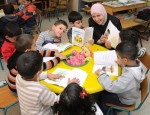
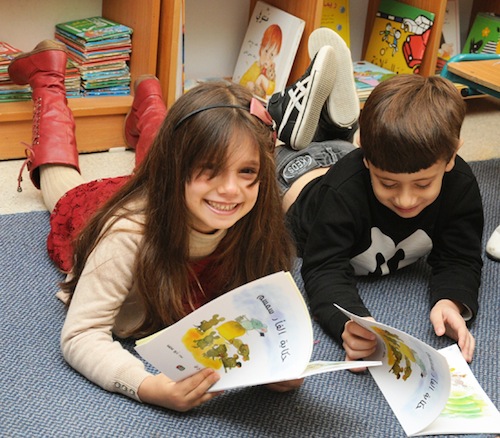
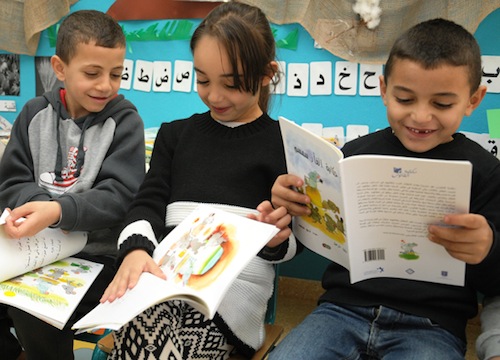
Children in Baka al-Gharbiyah enjoying Maktabat al-Fanoos books and working with their teacher on their storytelling skills. (photo by Akmal Nagnagy)
PJ (aka “pajama”) Library is taking the PJ concept to Israel’s Arab population, with the creation of the Lantern Library (Maktabat al-Fanoos, in Arabic). Now Arab, Bedouin and Druze kindergartens, special-education Israeli schools and some preschools will start receiving books.
The first book to be distributed is a story about a mouse named Soumsoum, and it has already become quite a sensation in Arab, Bedouin and Druze state-run schools in Israel.
Children enjoying their books about Soumsoum the Mouse as part of the Maktabat al-Fanoos program, which fosters a love of reading. (photo by Akmal Nagnagy)
Galina Vromen, former international correspondent for Reuters who joined the Harold Grinspoon Foundation more than 10 years ago, launched the Israeli version of PJ Library in 2009, called Sifriyat Pijama, for the Jewish Israeli population.
Like its North American parent program, PJ Library, Sifriyat Pijama aims to inspire discussion at home about values and Jewish heritage and to instil a love of books. Unlike the North American program, Sifriyat Pijama books are distributed via government preschools and are then taken home.
“Some 215,000 children and their families receive the books, which is about 80 percent of all children in Hebrew-language state preschools,” said Vromen. “The children receive eight books a year. By the time they finish their three years of preschool, they have a 24-book home library.”
Lantern Library is a sister program to Sifriyat Pijama and, like its counterpart, Lantern Library books are delivered by courier to each classroom, with a copy for each child and two classroom copies.
After the teacher introduces a book and usually also conducts book-related activities (i.e. a discussion, a play, an art project), the book goes home to each student and his/her family.
“The books are culturally appropriate, but still chosen with a view to inviting discussion on values – universal, humanistic values rather than Judaism’s specific take on a value,” said Vromen. “But often, it comes down to much the same concepts, like honoring parents, being hospitable, visiting the sick, caring for one’s community and helping others.”
Lantern Library, like Sifriyat Pijama, is funded and operated in partnership with the Israeli Ministry of Education. But with Lantern Library, “We also work with the California-based Price Family Charitable Fund, which has long been active in funding and operating programs for young children and their parents in the Israeli Arab community through its Bidayat (Beginnings) Early Childhood Centres,” said Vromen.
The foundation and the Price Family Charitable Fund committed to start a pilot project this year, with or without the ministry, offering to provide additional matching funds if the ministry came on board.
“The ministry did find some funding, so instead of our initial plans to start with 5,000 children, we ended up launching a program for close to 50,000 kids,” said Vromen.
reschoolers in Baka al-Gharbiyah receiving their picture book, to enjoy at school and with their families at home. (photo by Akmal Nagnagy)
The most immediate goal was to get good books out to every classroom and to each child. Other goals were to ensure teachers understand how to effectively integrate the books into the classroom and to understand their role in encouraging parents to read at home.
“Ultimately, we want children to love books, so they’ll be motivated to read,” said Vromen. “We don’t aim to teach children to read. Before children learn to read, they need to want to read through having positive experiences with books and being excited about the stories and the places they take you. We hope to encourage those positive, crucial experiences with books.”
The books have been received with great enthusiasm, added Vromen. “The teachers are extremely positive and send us lots of pictures of the activities they do with the kids. We post some on the program website, which is also exciting for the class.
“The parents are delighted to be getting the free, quality books. Arab parents, like Jewish ones, recognize the importance of education for their kids, and know that starts with books.”
According to Vromen, some Arab families have many books in their home and some have none. “Like elsewhere, people who don’t have a tradition of reading or don’t have the resources to buy books, don’t have as many as those who do,” she said. “Arabs have a long, honored tradition of oral storytelling. In many cases, this takes the place of a tradition of reading. We hope the practice of reading books together in the family will flourish alongside the oral tradition, reinforcing and complementing it.”
Vromen said with a smile, “I’ve yet to meet a child who, when given a choice between going straight to bed or being read a story first, chooses to go to bed without a story. It’s not just the reading. It’s the cuddling together, the looking at the illustrations together, and talking about what the characters feel or what might happen to them next that creates an emotional attachment to books, as well as, of course, enhancing the parent-child relationship.”
The foundation has considered electronic books, but has found that, for now, the time is not yet right. “The online book industry is much less developed in Israel than in America, so it’s still rare for Israelis to read books in Hebrew online,” said Vromen. “The issue is whether or not online books can provide the same emotional experience between parent and child as a paper book. The jury is still out on that, but as an avid electronic book reader myself, I personally don’t see a problem.”
Maktabat al-Fanoos, Sifriyat Pijama and PJ Library, according to Vromen, are all based on the concept known in Judaism as “girsa d’yankuta” (Aramaic for “learning with one’s mother’s milk”). This idea “assumes we develop a lifelong attachment to the stories, narratives, rituals and concepts we imbibe as young children,” said Vromen. “Parents don’t always realize how fleeting those early childhood years are – how sweet and also how precious is the opportunity to read and talk to children about things that matter. So, I hope they seize that opportunity.”
To learn more about Lantern Library, visit al-fanoos.org. English is available by clicking on the top left “En” button on the home page.
(Haber, Hayes and Korsch photos by Lorne Greenberg)
Louis Brier Jewish Aged Foundation’s Eight Over Eighty celebration honors eight individuals/couples who have shown exemplary leadership and vision in the community. Last week, the Independent profiled honorees Dr. Marvin and Rita Weintraub, Rita Akselrod, Dr. Jimmy White and Chaim Kornfeld. This week, the JI features honorees Serge Haber, Dr. Arthur and Arlene Hayes, Stan and Seda Korsch, and Samuel and Frances Belzberg.
SERGE HABER Zeal and vision
Serge Haber was born in Romania in 1928. After the war, he spent two years in Cuba, arriving in Montreal in 1949, where he worked in the garment business. Amid growing Quebec nationalism, Serge moved his family to Vancouver in 1978 and bought Kaplan’s delicatessen.
It wasn’t hard to move West, Serge told the JI. And, he said, “It turned out that it was the best move I made because my trade took a terrible nosedive two years later; I would not have been able to remain in business. I got out just in time by sheer luck.”
Telling his wife was another matter. “I came home and my wife almost killed me. ‘What do you know about the restaurant business?’ So, I told her, I said, ‘If I survived for so many years in the textile business with the sharpest Jewish people in the trade, I will in the business of restaurants, and I will do well,’ and I did.” He sold Kaplan’s in 1993.
Serge has been involved in synagogue life since arriving in Montreal, where he helped found a Conservative congregation in Laval and held leadership positions in United Synagogue of Conservative Judaism. In Vancouver, he joined Beth Israel. “It’s not just that I find a cause – I have to love that cause … [and] feel that it’s needed for the community, for the development of my life … and, once I got involved, I embraced it totally, in the sense that I ate, slept and drank the organization that I was working for.”
For 20-plus years, Serge has been leading services at Louis Brier, where he served on the board for 17 years. Serge has also been on the board of Jewish National Fund, Vancouver.
“When I was young, I got involved with B’nai B’rith Hillel Foundation and I became the president … I created an environment in which things can grow and develop from that point on…. It was not a question of being president or anything else. I felt that we can do something good for the community … my intent was to help out as much as I can.”
In “retirement,” Serge co-founded and is president of the Jewish Seniors Alliance of Greater Vancouver. About community work, he said, it “is a question of ideals and what you want to accomplish in life and how do you want to be regarded in the community in which you live.”
He pointed to his parents as role models. His father, in particular worked very hard, said Serge, “so I had a model to look at and I felt that every community embraced me and gave me whatever I needed, nurturing a common sense of family and community, so I should give back whatever I can, and that’s what I did.”
Serge is particularly concerned with the availability of seniors services and programming. He believes that “the need of the Jewish seniors in Greater Vancouver will be tenfold greater than what it is today because … the Jewish seniors community will at least double what it is today.” The time to prepare is now, he said, adding that he would like to see the building of a Jewish seniors centre here like they have in Montreal, Winnipeg and other cities, “a community centre specifically related to seniors.”
About being part of Eight Over Eighty, he said he is “overwhelmed” by the tribute because it was unexpected, and he felt good about his work regardless. “I’m not a person who works for the honoring, that is far removed from my mind … but I think it’s good in the sense that there are many people in the community that are doing phenomenal work and sometimes the community bypasses them and takes it for granted that they are supposed to volunteer and do all kinds of things without being recognized.”
DR. ARTHUR AND ARLENE HAYES Selflessness, Yiddishkeit, devotion
Art Hayes grew up in rural Alberta. “A few miles away was another small town – Rumsey – and it is in this general area where a group of Jewish farmers, mainly from Russia, settled,” he said. “They built a synagogue, which was in use during Jewish holidays. At one time, they were even able to employ a Jewish teacher.”
He spoke fondly of his childhood, and highlighted the special role his grandparents played. They lived close to the one-room school that was eventually built, “and this was our stopping point on the way home. Here, we were treated with love and kindness, and lavished with special treats.
“After we left the farm, my father was involved in business in small mining towns in Alberta where we were usually the only Jews. I envied the Jewish life my cousins had in Calgary and enjoyed it with them whenever I was able to visit. Fortunately, my grandparents now lived eight miles away and I would spend my weekends with them. I learned about Judaism from my kind zaida, whom I loved dearly. Their love and attention to me was so complete that seemingly I was the centre of their universe.
“I was inspired by both my parents and grandparents – their selflessness, their Yiddishkeit and devotion to family and their love gave me my outlook on life.”
Arriving in Vancouver in 1947 after graduating in dentistry from the University of Alberta, Art pursued specialty training in orthodontics at Columbia University in New York. “When I returned two years later,” he recalled, “I found a community that functioned almost entirely with volunteers. There was respect for those who accepted the responsibility to take on the work and high regard if not reverence for the pioneers of the community.”
Art highlighted two projects undertaken when he was president of Beth Israel. “The first was to raise the funds pay off the $50,000 for our share of one-third ownership with synagogues in Seattle and Portland of Camp Solomon Schechter.” The second was providing their assistant rabbi – who came when their rabbi was on sabbatical – with a residence. “We bought a house in excess off $100,000, which we paid for by fundraising over the next year. This same house was recently sold by Beth Israel for more than $2 million and became the largest single contribution to the fund for the reconstruction of the synagogue.”
Art also co-founded Shaarey Tefilah and has been involved with the Louis Brier, Canadian Friends of Hebrew University locally, Vancouver Holocaust Education Centre, the Jewish Historical Society of British Columbia, Richmond Country Club, Jewish Federation/United Jewish Appeal, among others, and day school education. Noting the many attempts to open a Jewish high school, Art thanked Gordon and Leslie Diamond for their contribution to King David High School, “an outstanding institution,” and shared that some of the remaining assets of Shaarey Tefilah were used to establish an endowment fund for KDHS with Federation “to assist students who are financially unable to pay full tuition. In this way, Shaarey Tefilah will continue to be an influence to further Judaism in this community.”
Leadership “evolves during participation in the work of the community to the best of one’s ability,” Art said. “Anything that is achieved in the community is the result of the efforts of many people working together in harmony. Leadership is historically inherent in Judaism, which emphasizes the need to create a tolerant Jewish society with a very deep concern for all its members, the old and young, the rich and poor, the sick and well.”
“I grew up in a wonderful Jewish community in Regina, Sask. I was very fortunate, indeed,” Arlene Hayes said of her early years. “I had an idyllic childhood filled with a good elementary and secondary education system, a rabbi, a shul and an active Young Judaea movement, which played a huge part in my life. We even had a Young Judaean summer camp for six years in a row. My wonderful parents saw to it that I attended every one. Who could ask for anything more?
“I attended the University of Saskatchewan for three years in Saskatoon, met my husband-to-be on a summer visit to Vancouver, was married six weeks later and, as the saying goes, the rest is history.”
In Vancouver, Arlene worked as a lab technician while Art got established.
Art said of Arlene’s commitment to the community, “At the time, we were just starting out and, with three young children and a household to manage without help, Arlene was on her own many nights of the week. There was never a complaint from her, only encouragement and interest in the work being done. It was Arlene alone that it made it possible for me to participate and she is equally if not more responsible for whatever was accomplished.”
“I think is important to recognize people who have been community leaders for two reasons,” said Arlene. “One, it is the right thing to do. Secondly, one hopes these deeds will motivate others to ‘step up to the plate.’ I hope that, going forward, succeeding generations will learn from the examples of their predecessors. People of Art’s generation, and the preceding generation, have been true ‘chalutzim.’ They have given unstintingly of their time – after a full day’s work – to build their community. They believed in the teachings of Judaism: be generous, be kind, help the disenfranchised, share, build Israel, reinforce Jewish life in our own community.”
Of her hopes for the community, she said, “If successive generations follow in the footsteps of their predecessors, the community will continue to flourish.”
STANFORD AND SEDA KORSCH From the ground up
While Stan Korsch was born and raised in Vancouver, Seda was born in Winnipeg and raised in Calgary before coming to Vancouver. Stan met Seda at a Beth Israel youth dance and they married in 1948, a week before the synagogue opened at Oak and 27th.
After moving around a bit, they settled back in Vancouver and into the family business, which was real estate. Stan was inducted as a fellow of the Real Estate Institute of Canada in 1958 and, today, is its oldest continuous member.
Seda’s involvement with Hadassah is longstanding and she has held many roles within the organization, including being a founding member and president of Shalom chapter, assisting with the bazaar’s silent auction, and serving as vice-president, card-chair and men’s youth aliyah chair on the council. Her kitchen was the annual headquarters for the baking of kiffles for the bazaar. She was also a member of the Beth Israel Sisterhood.
“I started a chapter of Hadassah in 1947 and we did a lot of money raising,” said Seda, later sharing, “On our first trip to Israel, we toured all the Hadassah projects and I realized that we just had to keep on doing this because there was such need. It was very gratifying to see some of the accomplishments we had done in Israel through our money raising. Hadassah was my main forte.”
Stan’s Jewish community involvement began before the Second World War. Over the years, he has held leadership positions with Young Judaea, Beth Israel Synagogue, the Menorah Society student group at the University of British Columbia, B’nai B’rith Lion’s Gate Lodge, Jewish Community Fund and Council (Federation’s predecessor), Canadian Zionist Federation, Lion’s Gate Building Society, Louis Brier Home and Weinberg Residence. He still is an active member of his synagogue, especially in its daily morning minyan. For his work with the Lion’s Gate Lodge, in 1999, he was awarded a Tikkun Olam Award for exceptional service to the community.
“I had three major influences in my life,” Stan said. “They were all something to do with being Jewish. Israel has always been in my heart, and right from my high school days, before Israel was there. We wanted to provide a homeland for the Jewish people…. We were good at what we did. We had the youth group, which was active and, by that, I mean we also communicated with other Jewish young people in other Canadian cities.
“My goal was always to keep Israel in mind, and the other one was housing. Because I was realtor, I realized there was a need – not cooperative housing – but for housing for those who are financially in need. I’ve always been a part of that in the community here; that’s why I was on the oversight committee and it took a lot of our time and effort those big projects,” including Haro Park, which took some 10 years to come to fruition.
“It was the only time in Canada that three levels of government were able to work together,” Stan said. “It was very difficult because each time the government changed, you had to start again with the new government. It was a miracle that we managed to build Haro Park. And we built some others. That was one of the main parts of my activities. The other one, of course, is the synagogue…. My parents were part of the group that formed the charter members. Right from day one I was involved…. I was there the day they opened, their first installation, back in the old Jewish community centre days, and then we moved onto 27th and Oak and now, today, we are now just completing a new facility on 27th and Oak. It’s quite gratifying.”
Stan said he’s seen many changes in the community over the years, and he is optimistic about its future. Seda is also positive: “I feel that the young people are taking over, which is great,” she said. “I know my daughter is quite active in Hadassah. I’m happy to see that, and it’s time the old people step back and enjoy it!”
Both are honored to be one of the Eight Over Eighty. However, said Stan, “We don’t do these things for kavod. We can see the need and we are not just talk. We see the need and we get out there and do it.
“Seda and I believe that when one joins a society, one should be active in it, and that’s the way we’ve lived our life.”
SAMUEL AND FRANCES BELZBERG Combining business with philanthropy
International businessman and philanthropist Sam Belzberg was awarded the Order of Canada, as well as an honorary doctorate from Simon Fraser University in 1989. He received the Governor General of Canada Award in 1992 and, in 2002, was promoted to Officer of the Order of Canada. In 2009, he was awarded the Order of British Columbia for his extraordinary philanthropy and community leadership.
Investing leadership, time and resources, Sam helped found the Simon Wiesenthal Centre in Los Angeles in 1977 with a donation of $500,000. He is also the founder of both the Canadian and American Dystonia Medical Research Foundations.
As an Action Canada co-founder and co-chair of the board, Sam is called “one of British Columbia’s most forward-thinking philanthropists” who “specializes in ambitious and innovative solutions to pressing issues, focusing his prodigious efforts on causes that appeal to his deep caring for humanity.” In addition to his many other accomplishments, Sam led and inspired SFU’s first fundraising campaign, which raised $68 million. His company, Gibralt Capital, today owns and manages real estate and capital investments.
Frances Belzberg was raised in Los Angeles. Also involved with Action Canada, Fran is noted for her early involvement with racial issues as well as her early commitment to the state of Israel.
Frances and Sam married in 1950 and settled in Edmonton, where Fran was involved with several charities and became active in amateur theatre. The family moved to Vancouver in 1968 and Frances sat on the boards of Vancouver Art Gallery, Vancouver Playhouse and Vancouver Children’s Hospital. She was awarded the Order of Canada in 1995.