There’s immense beauty along Chuckanut Drive whatever time of day you choose to meander those winding roads. (photo by Robert James)
The spring sunshine is warming your car, tempting you with a day drive on an open road that promises breathtaking scenery and interesting stops along the way. Where do you go? Head south, I say. An hour from Vancouver across the Peace Arch border, just as you veer out of Bellingham, there’s a sign for Chuckanut Drive. Take it. You won’t be disappointed.
The scenic byway that connects Whatcom County to Skagit Valley, Chuckanut Drive begins in Bellingham’s historic neighborhood of Fairhaven. From there, it winds along the rocky shoulder of the Chuckanut Mountains, following the shoreline 200 feet above sea level. On its curvaceous route, it offers incredible views of Chuckanut Bay and Samish Bay, the Olympic Mountains, the San Juan Islands and Lummi Island. We’re not just talking about pretty scenery. These are the kind of views that compel you to stop, take out your camera and marvel at the beauty of the Pacific Northwest, delivering “aha!” moments that remind you exactly why you chose to live in this part of the world.
There are continuous canopies of trees shading the bridges on Chuckanut Drive, a lush landscape of forest and mountain. (photo by Sommer Cronck)
Some drives can get monotonous, but this is not one of them. Chuckanut traverses two very different landscapes. At its northern end, there are mountains, ocean, cliffs, trees, bays and islands. Its southern end takes you through the delta of the Skagit River, past wide, open farmland. It’s a great route for a long, peaceful drive.
The place to begin is in Fairhaven, an historic district filled with galleries, restaurants, bookshops, crafts and artisans. Consider picking up a picnic lunch for the drive at one of the many delis and restaurants in the village, unless you’re planning to eat at a restaurant on Chuckanut Drive.
Once you leave Fairhaven, don your sunglasses, wind down the windows and set your car stereo to your favorite music. If you’re in the mood for a short hike, pull over at Mile 18, the Teddy Bear Cove trailhead, where a wooden staircase takes you down a steep trail to the beach. It’s the unofficial nudist beach, so don’t be surprised if you encounter a bit of bare skin along the way. The beach is a great place for spotting seals and is full of nooks and crannies where you can enjoy a private picnic lunch surrounded by sea gulls, crashing waves and whiffs of salt in the air.
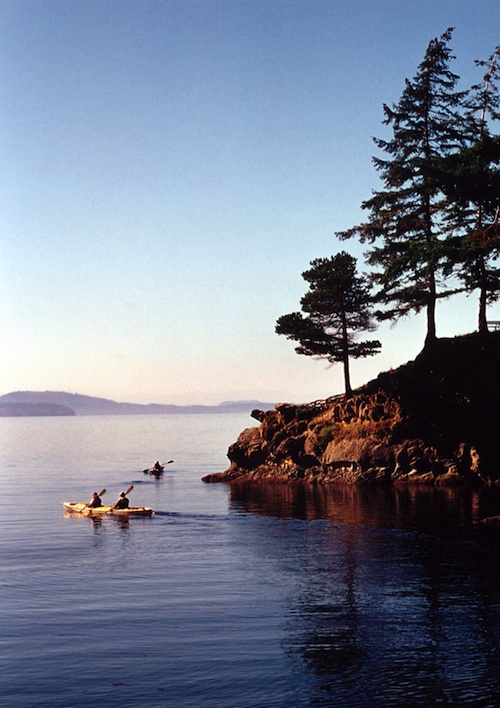
Kayaking in Wildcat Cove provides a close-up view of the life in the beautiful bay. (photo by Robert James)
An alternative place, one where exposed flesh is much less likely to be seen, is Larrabee State Park, a magnificent, 1,885-acre site along the shores of Samish Bay, with a lush growth of Northwest foliage. A short walk gets you down to Clayton Beach and tidal pools. Bring water shoes and a swimsuit – it’s so beautiful that you might even find the courage to defy the cold Pacific with a quick dip. This is another great place for your picnic lunch, if you’re having one. If not, your next stop could be the Oyster Bar on Chuckanut Drive (theoysterbar.net; 1-360-766-6185), a seafood restaurant with ocean views to die for and cuisine that’s just as inspiring. Much of its fare is local and, in fact, some of the non-kosher variety is grown minutes away at Taylor Shellfish on Samish Bay. However, if seafood isn’t your preference, there are more restaurants along the way.
If you are feeling energetic, there are several trailheads leading to hikes that range from three to six miles long. Regardless, make sure you’ve brought along U.S. dollars, as you might need them when you reach Mile 8, at which point organic produce and farm stands come into view, selling local honey, vegetables, cheese and flowers. Miles seven through one careen past farmland, with a few stores along the way, such as the antique shop, espresso stop and hot dog stand at Mile 3. When you reach Burlington, you’ve come to the exhilarating end of Chuckanut Drive, at which point you may well choose to turn around and do it again the other way. If you’re ready for home, though, take the faster route back to Canada on the Interstate 5 – filling up on gas before you hit the border!
If you go:
• Remember your passport! You cannot cross the U.S.-Canada border without one.
• Check border waits before you go to avoid long lines. On the radio, News 1130 AM delivers the wait times every 10 minutes with its traffic report.
• To get to the exit for the northernmost end of Chuckanut Drive, take #250 off the I-5.
• Pick up a driving guide to Chuckanut from Whatcom County Tourism’s Visitors Centre at 904 Potter St. in Bellingham, call 1-800-487-2032 or visit bellingham.org.
Lauren Kramer, an award-winning writer and editor, lives in Richmond, B.C. To read her work online, visit laurenkramer.net.
Artist Jody Kramer will be leading one of Draw Down’s many free workshops. (photo by Olga Livshin)
Vancouver Draw Down, a city-wide festival of drawing, is turning five this summer. In 2010, it started as a collaboration between the Roundhouse Community Centre, the Museum of Anthropology at University of British Columbia and the Vancouver Art Gallery, but its roots are found in the United Kingdom and its charitable Big Draw campaign. Their motto reads: “Drawing helps us to understand our world and to interpret and communicate ideas. We campaign to improve visual literacy. The campaign has one aim – to get everyone drawing!”
Marie Lopes, a Roundhouse programmer of arts, culture and environment and one of the founding members of the event in Vancouver, said, “The name Draw Down was inspired by our goal to help people get over the idea that drawing is a precious, frightening activity only practised by artists who have some kind of a mystical talent. Many people who do not think of themselves as artists see drawing as a dividing line between artists and non-artists. We hope to inspire people to get over their performance anxiety and just throw down and draw. We seek to reveal that drawing is a way to think, to dream, to plan and explain, to map, to share ideas and stories, to spend time together, to laugh. It’s intensely satisfying and a lot of fun.”
According to Lopes, in the first year, the Draw Down hosted free workshops at the Roundhouse, MOA, VAG and four community centres, with about a dozen artists participating. “In the four years since we started, we have grown to [more than] 43 free workshops, happening in all 23 Park Board community centres and 20 arts partner venues as diverse as Satellite Gallery and Mountainview Cemetery. We’re hoping to see over 5,000 ‘drawers’ coming out on the Draw Down day,” which will be June 14.
One of the artists who will be leading a workshop, called Dragon Ball, at Strathcona Community Centre is Jody Kramer, a local artist and animation filmmaker. In an interview with the Independent, Kramer said that this will be her second time participating in the event.
“Last year, Marie Lopes called me and asked if I would lead a workshop. I agreed. My workshop was stationed under the Main Street Poodle on Main and 17th. Of course, our theme was a poodle. Over 100 people came to my station to draw during the three hours of my time block. This year, I’ll be leading a workshop at Strathcona. We’ll be drawing basketball players and turning them into dragons.”
The theme isn’t mandatory for participants, just a prompt for those who don’t know where to start. “Anyone who comes to draw with us will have lots of creative freedom,” assured Kramer. “It’s about exploration, making your mark on the world. You don’t have to be an artist to draw. You just have to be brave.”
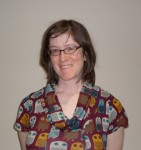
Jody Kramer, a self-portrait by the artist.
Kramer said people of all ages came to her drawing session under the poodle: toddlers with parents and senior citizens, art students and neighbors. “Children always draw; they are curious and not afraid. Adults often think that there is only one way to draw, the legitimate way, so they stand aside and let professionals do the job, but artists have been challenging such assumptions for generations, breaking with rules. Anyone can draw. There is no right way.”
Her goal is to see everyone who comes to her workshop drawing and happy, “to see their eyes light up with their own ideas,” although she is always ready to answer questions and provide guidance. “I like to give people confidence,” she said. “Let’s take away the idea of beautiful, high art. Let’s simplify art. You don’t have to be Emily Carr. You can draw a map and still make your mark.”
Kramer herself has always liked art but she didn’t consider herself a professional artist until she was in her 20s. “I always doodled, made up stories in pictures, but I didn’t know any professional artists. I thought I would be a writer or a teacher. After university, I worked in an office and I finally met people my age from Emily Carr. Then, I knew. I listened to them talk and I understood them. So, I went back to school, to Emily Carr, to study animation and I loved it. Still do. It makes me feel alive.”
To date, Kramer has created several animated shorts, quirky and expressive visual narratives that make people smile. She produces them in the old-fashioned way – by drawing. “Each film takes about two or three reams of paper [a ream is 500 sheets] for five minutes of film time, 12 pictures per second,” she explained.
She also has taught art, but pointed out that she doesn’t like a classroom setting. “I like teaching in a public environment. I worked as an educator for the Vancouver Art Gallery, conducted school tours and kids activities. I also worked for the R2R Film Festival, where children watch movies and make movies.”
Creating art in any form and shape makes her happy, and she will try to instil the same delight in everyone who comes to her drawing station on June 14. To learn more about Kramer’s art, visit jukimuseum.com; for more information on Drawn Down, visit vancouverdrawdown.com.
Olga Livshin is a Vancouver freelance writer. She can be reached at [email protected].
Jillian Fargey, back, and Emma Slipp in The Concessions. (photo by Emily Cooper)
Sitting outside an East Vancouver rehearsal hall in the bright sunshine of an early spring day, Mishelle Cuttler is philosophical about going unnoticed. The 26-year-old sound designer and music composer, currently working on the play The Concessions for Touchstone Theatre, mused of her field, “I think it is a discipline that is often unnoticed. It’s kind of like lighting in the way that if you don’t notice it, it probably means that it’s done well.”
Cuttler’s sound design and music may not draw attention to themselves, she said, but they can have a profound effect on an audience. “Music,” she pointed out, “kind of bypasses your brain and goes straight to your emotional centre. Sound in general does that.”
Some of the work that will go unnoticed in The Concessions, then, includes complex sound effects and an original musical score. She will provide the production with digital recordings of animal sounds and rainstorms. She will compose and orchestrate music for scene changes and to underscore some of the action.
The Concessions, by Briana Brown, is the story of a shocking murder in a small Ontario town. Fear pervades the community, as the killer remains at large. Suspects are everywhere, safety nowhere, and the supernatural makes an appearance. The production is part of Touchstone Theatre’s Flying Start program that showcases work by new playwrights. It runs from June 6 to 14 at the Firehall Arts Centre.
The first time she reads any play, said Cuttler, “I keep my eye out for anything audible.” To her, The Concessions has a lot of noise in it, much of it coming from the outdoors. “This play is really about its environment. It’s about this town and there’s a lot of reference to the weather and these storms that are happening,” she said. “There’s the lake and then there’s this forest where this tragedy happens. I think the fact that this place is rural and in nature is very important to the script.”
She said her “number one” task is to create the weather. “It comes up all the time,” she said. “Raining and thunder and wind, there are also some animals referenced in the script that might come out. There’s water … and there’s a lot of silence.”
Knowing when to be quiet is also part of her job. “As a sound designer, I have to be constantly reminding myself that silence can be very important, and sometimes it’s better,” she said.
Touchstone artistic director Katrina Dunn, the director of The Concessions, said one of Cuttler’s greatest challenges is to create the important radio broadcasts that occur throughout the play. Speaking by phone, Dunn said the play has a “whole through-line” that involves the radio. “The local radio station is the conduit through which we feel the larger city,” she said. The play contains an element of magic and, during one five-minute radio broadcast, “the radio goes crazy and goes into another realm. That’s an interesting thing for a sound designer to get to do.”
“I’ve always found composing comes much easier to me when it’s for a purpose, when I’m trying to do something to further a story.”
Cuttler is also writing and orchestrating the play’s original musical score. “In this show, it seems like there will be some pretty complex and interesting scene changes, which is always the most important moment for me,” said Cuttler, whose music will cover the scene changes and underscore some of the action. On a show like this, she has only weeks to compose and, during rehearsal, it’s a matter of days. “I’ve always found composing comes much easier to me when it’s for a purpose, when I’m trying to do something to further a story,” she said.
Cuttler’s work continued through the rehearsal period. As The Concessions took shape, the music and sound design changed. “The music is the stuff that takes the most massaging and figuring out because it’s really tailored to the script specifically,” she explained. That meant composing on the fly, which, she said, is just part of working on a new play. The script “can be very fluid up until the last minute.”
The busy designer, actor and musician will spend the summer playing accordion for Caravan Theatre in the Okanagan. She has a sound design job lined up for next season, and her original musical, Stationary, will be produced at the Cultch in April 2015. “I think that I always dreamed of a life where I was doing lots of different things and I’m fortunate that I’ve sort of achieved that,” she said.
Cuttler was recently nominated for a Jessie Richardson Theatre Award for her sound design on Itsazoo’s April production of Killer Joe. Winners will be announced at the June 23 ceremony.
Mahapach-Taghir’s national coordinator Itamar Hamiel and Palestinian co-director Fidaa Nara Abu-Dbai at the organization’s last residents conference in Tel Aviv. (photo from Itamar Hamiel)
On June 10, Itamar Hamiel of Mahapach-Taghir will be in Vancouver to speak about his organization and new models of activism focused on the Israeli peripheria, the socioeconomic and geographic fringes of the country.
Sponsored by New Israel Fund of Canada (NIFC) and hosted by Temple Sholom Synagogue, the lecture is the latest in a series of NIFC events in the city. Mahapach-Taghir, a project that NIF supports, defines itself as a feminist, grassroots, Jewish-Arab organization that focuses on education and community development. Its origins are in the Israeli students’ tuition strike of 1998, with a group of students from the Hebrew University of Jerusalem. Believing that social change must go beyond themselves and also include marginalized communities, they began volunteering in the Katamonim neighborhood in Jerusalem, eventually establishing an after-school education and mentoring program. This program grew into Mahapach-Taghir’s first “learning community,” which has been replicated in eight neighborhoods across Israel, and remains the organization’s core program.
In anticipation of his visit, the Independent spoke with Hamiel, who is Mahapach-Taghir’s national coordinator.
JI: What is the relationship between NIF and your organization?
IH: NIF has supported Mahapach-Taghir since our founding in 1998…. Our organization is sometimes hard to understand: we are a feminist, grassroots, Jewish-Arab organization that focuses on education and community activism. Because of this, sometimes it is hard for us to find funding from foundations that have more specific focus. NIF understands this complexity and supports us in it. Because we insist on Jewish-Palestinian partnership on all levels of our organization, some Jewish foundations aren’t interested in our work. They have a narrow view of what supporting Israel means, and NIF breaks that mold.
Around 14 percent of our funding from last year was from NIF, but our experience is that long-term support is more critical than the amount of funding, and NIF has provided that.
JI: How did you become involved in Mahapach-Taghir?
IH: I became involved in Mahapach-Taghir around 15 years ago, a few months after it was established, as a student volunteer in our community in Florentine (Tel Aviv). After the students in Jerusalem founded the organization in Katamonim, they decided to open communities around the country, including in Florentine.
I saw an ad in the university library and thought it looked interesting – 15 years later, I still haven’t left. I was a student volunteer, a coordinator, a board member, and now work on the national staff. Mahapach-Taghir became my “ideological home.” I know many organizations that focus on feminism, Jewish-Arab partnership, community work, etc., but there are no other organizations that combine these inherently interconnected issues in the way that Mahapach-Taghir does.
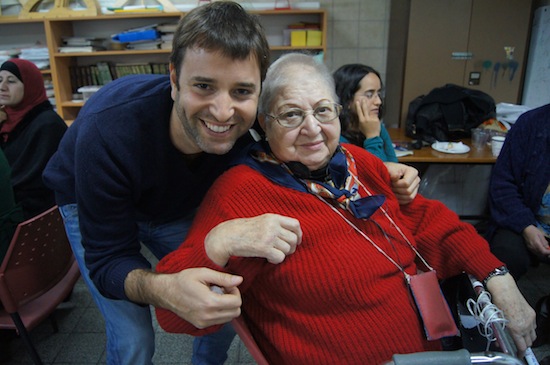
Itamar Hamiel with with Rosa Feldesh, one of Mahapach-Taghir’s veteran activists from Florentine, Tel Aviv. (photo from Itamar Hamiel)
JI: Looking at the staff list on the website, all of the staff are women except for you. What are your thoughts on leading a feminist organization?
IH: I am here representing Mahapach-Taghir, but I wouldn’t say that I lead the organization, and I don’t think it would be right if I did. Our Palestinian co-director is Fidaa Nara Abu Dbai and we are currently looking for a Jewish co-director. I won’t even apply for that job because I don’t believe a man should lead an organization that is comprised primarily of women. Usually, even in civil society, most of the staff and volunteers are women and the directors are still men. We believe that it is important to break that paradigm.
JI: How does the Jewish-Arab aspect of the organization get expressed?
IH: Our communities come together for national conferences and seminars at least six times a year. One of our communities is a mixed Jewish-Arab community and, in our communities that are not mixed, there are partnerships between Jewish and Arab communities in geographic proximity.
Mainly, though, we do not think that the only way to do Jewish-Palestinian partnership work is through direct meetings…. For example, in Jerusalem, the Mahapach-Taghir activists in Kiryat HaYovel started a project called Second Opportunity, in which women who had no high school degree were able to pursue a bachelor’s degree. This might not seem political but through Mahapach-Taghir, they drew the link between their lack of education and the political marginalization they face as women in a Mizrahi community. They also understand the link between their marginalization and that of Palestinian women in Israel. The women shared their project with the rest of the communities in a national event, and that inspired the women from Tamra (a Palestinian town inside Israel) to start their own version of the project where the graduates from Jerusalem will serve as mentors. For me, this is the true meaning of partnership: each community works for its own empowerment, while acknowledging the rights and needs of other communities and inspiring one another. They work in solidarity.
JI: What is the feminist aspect of the learning communities? Are fathers also invited to participate?
IH: Each learning community is led by a steering committee that is comprised of residents, almost all of whom are women. We didn’t set out to exclude men but, when you talk about education and community empowerment, women tend to show up. The students who founded Mahapach-Taghir didn’t set out to establish a feminist organization but their view of social justice, and the fact that most of the activists that got involved were women, made it clear that feminism is one of our core values. The very fact that even today when we open a new community it is women who show up, confirms this value. Being a feminist organization doesn’t necessarily mean excluding men, but this country will be a better place when more women have active leadership roles.
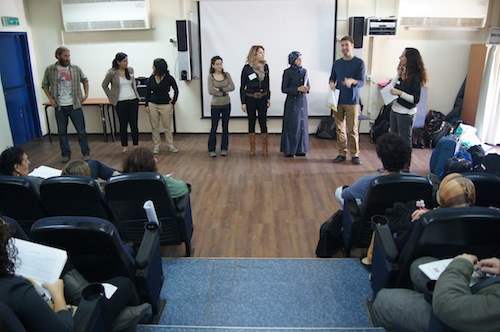
Itamar Hamiel with the coordinators of 7 of Mahapach-Taghir’s communities at a national activists’ seminar. (photo from Itamar Hamiel)
JI: Organizations focusing on community development, education and youth take a long view of social change compared to political groups. Why have you chosen this form of activism?
IH: Your question assumes a dichotomy between political and social change. We in Mahapach-Taghir see community development, education and youth work as highly political. Especially in the Israeli context there is a separation between talking about the Israeli-Palestinian conflict (political) and doing work in marginalized communities (social). As always in Mahapach-Taghir, we see this holistically. These issues are interconnected and we need to engage with them as such.
For this reason, we use this form of activism. We have a long view of social change and want to support communities in engaging in activism that will improve the lives of their families, communities and eventually their societies more generally while encouraging solidarity between Jews and Palestinians inside Israel.
JI: Are there measurable outcomes from Mahapach-Taghir’s learning communities?
IH: There are many measurable outcomes from our learning communities but the most important outcomes are not easy to measure. How do you measure empowerment, solidarity and sense of community? In recent years, the perspectives of the corporate world have increasingly influenced expectations of civil society. Organizations like Mahapach-Taghir are expected to provide products and measurable outcomes, and I think that this view is mistaken. I understand that foundations want to know if their money is being well spent but I don’t think that social change can be measured so easily. I am happy to share countless success stories. We can see changes in the communities where we work and in the activists and students that we work with. The stories that are most exciting are usually from activists who have been involved for many years and have gone through a slow but meaningful process of change.
JI: You are coming to Vancouver to solicit donations for NIF from the Diaspora Jewish community. Do you also do resource development in the Arab community (either locally or in the Diaspora)?
IH: Most of our funding comes from European foundations, not from the Jewish Diaspora. We hope that this will change and that more Diaspora Jews will see the value in our work. We also do fundraising locally in each of our communities because we believe in the value of sustainability and local partnership. We have had much more success doing this in our Arab communities. Last year, we raised over 50,000 shekels from our local communities and most of this was from our Arab communities.
JI: What do you hope to share with the Jewish community in Vancouver?
IH: I want to share with them a complex understanding of the society in Israel. I see the tension that Diaspora Jews face of feeling the need to be either “with us or against us,” but I believe that supporting Israel means supporting a more democratic, diverse, pluralistic society in Israel. I hope to bring the voice of our activists, who are doing incredible work in their communities, Jewish and Palestinian, marginalized communities around the country.
Maayan Kreitzman is a freelance writer living in Vancouver.
***
To register for the June 10 event at Temple Sholom, which starts at 7 p.m., go to nifcan.org/our-events/upcoming. In addition to Hamiel, NIFC has invited a local counterpart in community building as a parallel to the work being done in Israel: Lindsay Vander Hoek of Mission Possible will describe her organization’s work with residents of Vancouver’s Downtown Eastside.
Artist Robin Atlas in studio. (photo from Robin Atlas)
Midrash has been an integral part of Jewish culture for centuries, mainly in literary form. It also branches into the visual arts, however, and there exists a vibrant, international alliance of artists investigating the sacred texts through their paintings and sculpture, fibre art and theatre. Robin Atlas, a Seattle-based mixed-media artist, is part of the movement, and she considers it a personal challenge to raise the awareness of visual midrash in the Jewish community and beyond.
Atlas has been exploring visual midrash for the past four years. Her new show at the Zack Gallery, Lashon Hara, A Narrative on the Consequences of Evil Speech, highlights some of the results of her exploration.
“I turned to this theme after I suffered from an evil tongue myself,” she shared in an interview with the Independent. “Someone gossiped about me. She said very unpleasant things behind my back and then to my face. I was very upset. I talked to my rabbi’s wife, and she sensed my disquiet. She asked me what happened. When I told her, she said, ‘What lashon hara!’ I asked her what that meant, and she told me. It means ‘evil speech’ or ‘evil tongue.’ I started thinking about it. I felt it was a powerful subject to explore through art. Lashon hara creates pain and darkness. How do we turn this darkness into light? What could I, as an artist, say about it? Our community needed such a conversation.”
The exhibition is Atlas’ contemplation on the topic, its different approaches and consequences. Through the use of textile art, she examines how lashon hara impacts the spiritual realm and the physical world. The show consists of 20 small, framed canvas squares decorated with various materials: beads, appliqués, strings, paint and so on. Each piece is imbued with its own symbolism, and the artist’s explanations of her vision are handwritten on the attached labels.
“I started this project by researching the subject for several months,” she said. “I began with seven titles and then created the pieces to match them. But I felt that seven wasn’t enough, so I thought of 13 more titles and the related art pieces.”
One piece in particular, “Feather Pillow,” encompasses the idea behind the show. It might be seen as an illustration to a story. “It’s a Jewish folk story. I heard it first when I was a young girl,” Atlas recalled. “I did something bad, gossiped about someone, and my grandmother told me that story. When I started investigating lashon hara, I remembered the story again, and it became the foundation for one of the pieces.”
A small panel with the full text of that story hangs next to the artwork. The story compares gossip to a feather. Once on the air, flying away, it can’t be caught and retracted, and those who spread the gossip commit three murders: they kill the souls of the speaker, the listener and the one about whom they gossip. “Three Murders,” another piece in the show, illustrates the point.
Several pieces reflect the artist’s personal way of dealing with gossip, converting its darkness into light. One is called “Bomb,” but Atlas’ depiction is not a weapon: the beautiful, sparkling-with-golden-beads image depicts an unusual bomb, a bomb of kindness. “It’s a retaliation of love,” Atlas said. “We have to stop the circle of evil speech. It’s about that woman who spoke evil of me.”
Although she used the vehicle of the Torah to convey her introspections, lashon hara is not confined to the Torah or the Jewish community, of course. There are examples of “evil tongue” everywhere, in our personal and work lives, in the public sphere. In this respect, the show is both timely and timeless, resonating with everyone of every nation or culture, and age.
The show also has an interactive aspect. “We invite the public to write down small notes: how lashon hara affected them, whether it was something they said or something said about them. The notes are anonymous,” Atlas explained. “Anyone can pin his or her note about their experience of lashon hara to a special board. We provide the papers, the pencils and the pins. At the end of the show, we’ll collect all the notes, shred them and turn them into mulch, to be used for a plant at the JCC. We will, this way, symbolically turn the darkness of lashon hara into light.”
During the opening reception on May 29, Rabbi Carey Brown of Temple Sholom joined Atlas for the Artist’s Beit Midrash, a discussion of lashon hara. The exhibit runs until June 22.
Olga Livshin is a Vancouver freelance writer. She can be reached at [email protected].
Woody Allen, left, and John Turturro in Fading Gigolo. (photo from Millennium Entertainment)
“My big thing was to not have him wear khaki pants and an army coat,” said John Turturro with a broad smile. “And I got him out of that. I said, ‘That’s not in my color scheme. I’m an Italian director.’”
This dash of bravado might sound pretentious, or even ludicrous, on paper. But when it comes from a tall, impeccably groomed man in an elegant blue velvet suit (double-breasted, blue shirt buttoned to the top, no tie), it seems perfectly reasonable.
For his fifth feature behind the camera, Fading Gigolo, the renowned actor and filmmaker solicited ongoing (and ruthless) feedback from another New York icon, Woody Allen, during the lengthy screenwriting process. Allen accepted a rare acting assignment in the film, hence the discussion of his costume.
Allen plays a newly retired Manhattan bookstore owner who, in need of money, convinces his friend, floral arranger Fioravante (Turturro), to provide sexual services to affluent women. Murray claims a fee for arranging the liaisons, which take Fioravante in an unexpected and ultimately poignant direction.
John Turturro in Fading Gigolo. (photo from Millennium Entertainment)
Fading Gigolo starts out as a slightly absurd sex comedy and deepens into a mature, empathetic study of big-city loneliness against a backdrop of cross-cultural and ethnic identity. The crucial relationship in the film is between Fioravante and Avigal (French actress Vanessa Paradis), an astute mother of six and the widow of a Chassidic rabbi. Sex isn’t part of the equation, but Dovi, a protective and covetous neighborhood Satmar watchman (a touching Liev Schreiber), can’t know that.
“I met all these people who’ve left the [Satmar] community” in the course of his research, Turturro said in a recent interview at a San Francisco hotel. “They’re like the strays of the community. They gather in this place, people who left and people who hadn’t left who just went there to see what was going on.”
Paradis got to know one woman in particular who had left the Satmar community and explained the various directives, such as keeping her hair concealed under a wig.
“All these things are made up by men,” Turturro declared. “Women didn’t make these rules. And, to me, that says it all.”
Fading Gigolo is unambiguously respectful toward observant Jewish practice, while inviting us to empathize with a woman trying to reconcile autonomy and conformity.
“Avigal’s not looking to escape,” Turturro explained. “She’s just looking to receive.”
Fading Gigolo climaxes with a religious trial where Murray is confronted with the query, “Are you proud to be a Jew?” It’s the question we’ve long wanted Allen to answer onscreen and, at that moment, it’s difficult not to conflate the character and the actor.
Turturro’s experience of Judaism goes well beyond growing up in New York and now living in the Park Slope neighborhood of Brooklyn. His wife is Jewish and his son went to Hebrew school, and Turturro confides that he’s spent a fair amount of time in Reform synagogues. He has played several Jewish characters onscreen, most famously in the Coen Brothers’ Miller’s Crossing and Barton Fink, and immersed himself in the life of Primo Levi to portray the Italian-Jewish Holocaust survivor in Francesco Rosi’s The Truce.
“If you’re raised a Catholic, you realize there’s not a debate that goes on,” Turturro said. “And, if you’re raised a Jew, there’s a debate that goes on. And I really like that. Therein lies one of the greatnesses of Judaism.”
At Allen’s behest, Turturro brushed up on Isaac Bashevis Singer’s short stories while he wrote the Fading Gigolo screenplay. But, after all his various and diligent research, certain things came down to intuition – and style.
“I only chose Satmar because I liked the hats the best,” Turturro said. “I don’t want the Borsalino. I’m Italian. It’s an esthetic choice, understand. That’s how it goes with me. The hat dictates. That’s it.”
Fading Gigolo is playing at Fifth Avenue Cinemas. It’s rated R for some sexual content, language and brief nudity.
Michael Fox is a writer and film critic living in San Francisco.
If there’s one act of tikkun olam to which David Katz is dedicated, it’s an effort to clean up the oceans and waterways of the world by recycling and reprocessing plastic waste.
The 45-year-old Port Moody, B.C.-based founder of the Plastic Bank recently returned from Greece, where he was awarded the Global Citizen of the Year Award from the Entrepreneurs Organization. The honor recognizes an entrepreneur who is making a mark on the global landscape, impacting communities, inspiring support and effecting positive change.
David Katz, founder of the Plastic Bank. (photo from plasticbank.org)
Katz’s approach to the clean up of plastic at the world’s shorelines is innovative and, if it succeeds, its potential is huge. The idea is that waste-pickers in the most poverty-stricken countries will collect the plastic garbage and deliver it to reprocessing facilities where they’ll receive a credit at the Plastic Bank. They can then use the credit towards education, loans and access to 3-D print shops, where the plastic can be transformed into tools, parts and household items.
Katz is engaged in a pilot project with Ciuda Saludable in Peru, an organization that works with communities to increase the volume of plastics collected. He’s in partnership talks with similar organizations in Columbia and has had partnership requests from organizations in 40 different countries to date.
Back at home, he worked with the University of British Columbia to develop an extruder, which creates recycled plastic 3-D printing filament, and he’s working with a local plastic reprocessor to create Social Plastic, a brand of recycled plastic. Katz hopes to convince companies to purchase it as a socially responsible alternative to creating new plastics.
“There’s enough plastic in the world right now that we would never have to make more of it,” he explained. “And once it’s reprocessed, the plastic doesn’t degrade, which means it can be used for a wide variety of purposes and continue to be upcycled. It could be turned into fibre for clothing, or into prosthetics.”
Lush Cosmetics is one of the companies that has shown an interest in using Social Plastic in their cosmetics tubs and, at the time of publication, Katz was awaiting the final paperwork on Lush’s participation. Convincing companies to come on board with the concept of Social Plastic may be challenging, though. “Potential customers are concerned that once they start using Social Plastic, they’ll always have to use it,” he said.
Katz said he’s always been drawn to the shore, and with that attraction has come an exposure to its continuous degradation. “It’s a symbol of the global catastrophe occurring because of people’s misunderstanding of environmental issues,” he said. “We’re hoping that by turning plastic waste into a currency that can be exchanged, we can help lift people out of poverty and transition them into a self-sustaining life of entrepreneurship.”
Lauren Kramer, an award-winning writer and editor, lives in Richmond, B.C. To read her work online, visit laurenkramer.net.
If there was any doubt that Jews around the world have strong feelings and opinions about Israel, it was disabused by a major new paper produced by the Jewish People Policy Institute (JPPI).
Jewish and Democratic: Perspectives from World Jewry was released several weeks ago at a conference in New York state. It is the result of 40 discussion groups and seminars around the world, as well as questionnaires and an analysis of existing research. The process included participants from much of Canada, though none from Vancouver.
The diversity of comments and the consensus that appears from the document are not particularly startling, but they are interesting for their quantification of some things we probably already assumed. The most significant “finding” seems to be that Jews around the world take great interest in Israel, its security, future, successes, failures and ethical challenges.
The report was undertaken in response to Israel’s Ministry of Justice considering legislation that would codify Israel’s Jewish and democratic character “at a time when different ideological groups within Israel hold conflicting views of how these components should be prioritized.” Israel has always tried to be democratic and Jewish. Long-term concerns are that high Arab and low Jewish birthrates could imperil the Jewish majority and, therefore, the Jewish and democratic system, particularly if some resolution is not found for the stateless Palestinians in the West Bank and the Gaza Strip. More immediately, tensions have existed over questions of whether Israel is Jewish enough and/or democratic enough. Given the range of opinion on the matter, efforts to pin down the perfect recipe for a democratic Jewish state will be like nailing Jell-O to the wall.
We suspect that any proposed legislation will flounder in a tsunami of pilpul, much like the continual but inconclusive debate over “who is a Jew,” which revives itself several times in this report. Even so, the discussion is worth having and the report is full of provocative nuggets.
Jews of all ages are apparently more willing to criticize Israeli policies than was the case several decades ago. In considering Israel’s “Jewish and democratic” nature, the most common concern among Diaspora Jews is the inequality between Jews and Arabs within Israel, as well as political and military control over non-citizen Palestinians in the West Bank. Concern over treatment of Bedouins also arises. As small minorities in their home countries, Diaspora Jews have a “special sensitivity to minority rights,” says the report. (We like that the report uses the term “world-Jews,” which sounds like a hip neologism, like “world music.”)
Many participants express concerns over the enforcement of Orthodox standards in civil society. One comment is that Israel is now a “Jewish Orthodox democracy.” Another participant asserts that, “As a Jewish state, Israel needs to be pluralistic and Jewishly diverse.”
Previous research has indicated that many Jewish Americans (and others) resent that the Kotel has a strict gender separation and that enforcement is controlled by the Orthodox. At the conference where the report was released, one Conservative woman expressed her view: “Our support of Israel is unambiguous, it’s wall-to-wall. But I want to know there is a place for me where I can put on my tallit every morning. May I do that in the state of Israel and not have things thrown at me? Will the government arrest me? Is there a place for me in Israel?”
It turns out we’re not so different, Diaspora and Israel. Nearly three-quarters of Israelis disapprove of the way their governments handle religious issues.
Overall, the report suggests that Diaspora Jews on the far right prioritize Israel’s Jewish character over its democratic nature, while those on the far left view Israel’s Jewish character as an anachronism. The majority, the report says, want to have it both ways – and believe it is possible to do so.
Despite recent suggestions of a weakening of the bond between Israel and Diaspora Jews, particularly among young people, Jews in diverse countries overwhelmingly declare themselves connected with Israel and identify as Zionist. The report acknowledges that some younger Jews, particularly in the United States, as evidenced in the Hillel movement, are reacting against strictures laid down by their elders over what are appropriate views to hold on topics around Israel. The report takes some pains to note that these young people do not necessarily disagree with the broader consensus around Israel, its Jewish and democratic nature or other factors, but do resent being told what they are allowed to believe, hear and say.
Breaking news? Not much. Still, the report – and, most especially the constructive dialogues that went into creating it – is a sort of snapshot in time of the Diaspora’s thoughts on Israel. Beyond the details, which are themselves interesting, is the tremendous consensus that we care about Israel very, very deeply.
Mira Sucharov’s debate with Max Blumenthal is on CPAC.
In a previous blog post on haaretz.com, I discussed what appears to be an increasing chill factor in our Jewish communities. By way of example, I mentioned a then upcoming debate on the topic of whether Israel is and can be a “Jewish and democratic state” between prominent anti-Zionist Max Blumenthal and me, a liberal Zionist. Given the event sponsors (Independent Jewish Voices), many in the audience were primed for Blumenthal’s points – a scenario that makes supporters of Israel uneasy. But, unlike a “hasbarah” activist or a right-winger or even a centrist, we liberal Zionists tend to be both emotionally connected to Israel and critical of Israeli policies. So, on the heels of that event, here are some reflections on what happens when a liberal Zionist debates an anti-Zionist.
When it comes to Israeli democracy, liberal Zionists focus on what is possible. From the government actions of the day, anti-Zionists infer absolute limits.
There were times in the debate where, after I had addressed the central question, namely whether Israel’s Jewish and democratic character are mutually exclusive, Blumenthal would imply that we need to move away from pie-in-the-sky ideals and toward how things actually are. But, as with any experiment in nation building, I see Israel’s democracy as a work in progress. The contradictions need to be seen for what they are: temporary challenges to democracy, and requiring key legal reforms that Israel’s supporters and concerned citizens must continue to push for. Which brings me to my next point: