A window on to Indonesia

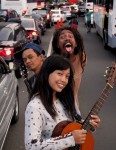
Left to right, Boni Putera, Titi Juwariyah and Bambang “Ho” Mulyono are the charismatic musicians at the heart of Daniel Ziv’s (inset) documentary Jalanan(photo from jalananmovie.com)

Daniel Ziv’s first feature-length documentary, the multiple-award-winning Jalanan (Streetside), tells the uplifting, engaging story of three musicians who are part of a bustling street scene in Jakarta: Boni Putera, Bambang “Ho” Mulyono and Titi Juwariyah. Instead of playing on street corners, these captivating and charismatic buskers board city buses, transforming ordinary commutes into musical, spiritual and political journeys through Indonesia’s capital, a mega city of 10 million.

Ziv, who was raised in Vancouver, spoke with the Independent by email after the Vancouver International Film Festival, where Jalanan had its North American première. An author and political commentator, Ziv has lived in Indonesia since 1999.

JI: How did you get started with filmmaking and how did you come to this project in particular?

DZ: Jalanan is my first film, and I never intended to be a filmmaker. Rather, the amazing story of these Jakarta street buskers, and how I felt that story, could illuminate so much about Indonesia as a society, and even globalization, sort of appeared in front of me and kept lingering there until I felt it needed to be told. Since the tale naturally contained so much music and energy and movement across this gritty urban space, I felt that film would be the right medium. So, I spent awhile getting to know the tools, and then learned through trial and error. Although filmmaking skills would have come in handy, I still believe that having a good story and good access are what really make a strong documentary. No degree of technical wizardry can replace those things.

JI: How were Boni, Ho and Titi chosen as the protagonists? Were there security concerns?

DZ: I knew that for the film to work, to really grab the attention and win the hearts of viewers, I needed strong lead characters – people with charm and charisma and agency, people with something to say about life. When I met Boni, Ho and Titi, I knew in each case that they would stand out as colorful individuals that viewers would be happy to spend two hours with in a theatre, or a few days with on the street, or even five years, as I did. They weren’t the archetypical victims that poor people are so often made out to be in social documentaries. They took control of their own fate, and they were fun to be with. And, of course, I looked for buskers with some musical talent and, more importantly, who composed their own songs and lyrics, which in turn reflected their condition. This added a whole other narrative device to the film that wouldn’t be there if it was just people talking into a camera.

In terms of safety, there actually weren’t really any issues. People assume since Jakarta is an enormous, chaotic, unruly, corrupt city, that it’s also somehow dangerous, but it’s not…. I spent five years shooting the film, totally exposed in some of the poorest parts of the city, carrying perhaps $10,000 worth of camera and sound equipment on me, yet I was never once harassed or mugged or even pickpocketed. I think if you’re at ease with your environment, the environment accepts you, but, of course, it helped that I’m fluent in Indonesian and that people knew I was with Boni, Ho and Titi. It provided me with a kind of street cred and belonging. I wasn’t some tourist leering in.

JI: What attracted you to Indonesia?

DZ: I didn’t plan any of this. I discovered Indonesia as a young backpacker in the early ’90s and was captivated by the country and its people, and then just kept going back. I did an MA in Southeast Asian studies and began a PhD in Indonesian politics, which is what moved me to Jakarta in 1999 for a year of field research. Then, I just got drawn into the dynamic changes that were happening to Indonesia at that time and into some irresistible job opportunities ranging from journalism and humanitarian aid work to book writing and filmmaking. And I got to work with the most amazing people, many of whom were the next generation of Indonesian artists and politicians and media personalities and social entrepreneurs. All of this has added up to a pretty fascinating career and life, but I also feel it’s been the result of deliberate choices: I didn’t opt for a safe, conventional path; I didn’t care about pedigree or official titles or big salaries. I only chose jobs that were truly meaningful.

JI: What were the challenges (rewards) of working on this project?

DZ: I guess the thing that is both the most challenging and rewarding is the intense experience of dreaming something up out of nothing, having the chutzpah and persistence to think you can create something that comes from inside you that wasn’t there before, and that it can actually find an audience and resonate with others…. [W]hen you make a film like this, that contains so much of your own experience and sensibility and sweat and tears, it’s really scary to wrap it up and then just watch the lights dim in a packed theatre and wonder if it will even work, if your vision and story will connect with people from a totally different culture and experience. And, when it does, it’s truly exhilarating.

JI: The response to the film has been positive. What’s that been like?
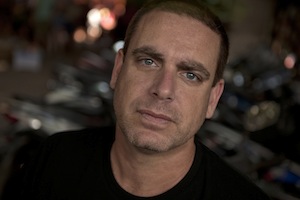
photo - Jalanan is Daniel Ziv's first film
Jalanan is Daniel Ziv’s first film. (photo from jalananmovie.com)

DZ: Of course, it’s immensely gratifying. My greatest fear after all the hard years of work was that it would just go nowhere … but the opposite has happened, and the film’s political and social impact in Indonesia in particular has been incredible. Jalanan captured the imagination of the public and the media, and contributed to concrete policy changes at the highest level of government, which is something none of us dreamed of.

Boni, Ho and Titi are now mini-celebrities in Indonesia, so, of course, it’s been amazing for three marginalized individuals to be publicly acknowledged in that way and to become role models within their community.

JI: Boni, Titi and Ho have multiple challenges, but they seem to be living satisfying lives. Are there lessons for those of us who, by many accounts, have more privilege or opportunity?

DZ: Certainly. But I’ve always been averse to simplistic, clichéd responses like “If poor people aren’t complaining, who are we to be discontent with our lives?” I mean, of course it’s important to recognize that we have privileged lives, but I think anyone’s pain or challenges are independently valid and very real. Having money and comfort doesn’t immunize us from pain, and being dirt poor doesn’t deny them immense joy. This is why it was so important for me to not let Jalanan become an exercise in finger waving or audience guilt. In fact, what I think many viewers respond to most is not how different they are than Boni, Ho and Titi, but how much of ourselves we see in them, and them in us. I think poverty needs to be de-fetishized and dealt with at face value, and poor people need to be seen as our friends and equals, rather than as objects to be analyzed or pitied. I know they prefer it that way.

JI: Are you still in touch with Boni, Ho and Titi?

DZ: We are close friends, and in almost daily contact. They are doing well, and enjoying a whole slew of new opportunities opening up to them as a result of the exposure from the film, but … they are still members of Jakarta’s marginalized poor, they are vulnerable and face multiple challenges. This is why I’ve started up a fundraising campaign that aims to buy each of them a small, humble house in a simple Jakarta neighborhood, something that will put a roof over their heads for life (details at jalananmovie.com/housingfund).

JI: I read an article in which you said that the buskers “were really just the lens through which we could manage a far bigger, more complex view of the country today.” Can you expand on that? Why do you think it took an expat to make an Indonesian film that had such global appeal?

DZ: That’s a great question. My interest from the start was in trying to understand, and hopefully shedding light on, Indonesia. I don’t think there’d have been anything inherently fascinating or important in a film that merely focuses on street busking, so my agenda was to probe deeper and treat my protagonists as a kind of microcosm for the country at this really fascinating juncture in time.

I’m not convinced an Indonesian couldn’t have made this film and, strangely, quite a few reviewers in Jakarta remarked that Jalanan feels “like a totally Indonesian film” rather than a documentary shot by a foreigner…. But this is probably because I created the space for Boni, Ho and Titi to tell their own very Indonesian story in their own voices and perspectives, and left space for my very talented Indonesian editor, Ernest Hariyanto, to lend his local sensibility to the cut. My goal was to open a window on to Indonesia, not to interpret it in my own image.

JI: Were you raised in a Jewish environment and, if yes, did it affect your choice of profession or other aspects of your life/filmmaking?

DZ: It’s probably fair to say my choice of profession was despite my Vancouver Jewish environment, not because of it. I grew up surrounded by a community of lawyers and doctors and academics and business folks, and most of my childhood friends didn’t stray far from that. I was lucky to have parents who secretly admired the creative and adventurous tendencies my sisters and I harbored.

One of my sisters became a ceramic artist and urban heritage expert; my other sister is a professional chef and musician. Our parents never pushed us toward establishment careers. They taught us a love for travel and culture, and that it was more important to lead an interesting life than a safe one. They probably got more than they bargained for in my case, and lament the fact that I live halfway across the world, but I doubt they’d be any happier if I were a senior partner at a downtown law firm. And, I dare say, they seemed pretty proud when the lights came on at the end of our screening … at VIFF.

Basya Laye is a Vancouver freelance writer and former editor of the Jewish Independent.

 

Gilbert’s TIFF hat trick

Bron Studios has won multiple awards for its work. (bronstudios.com screenshot)

Aaron L. Gilbert had every reason to be smiling broadly at the Toronto International Film Festival in September. The Burnaby-based producer had three film screenings: Welcome to Me (starring Kristen Wiig and Tim Robbins); Kill Me Three Times (starring Simon Pegg) and Miss Julie (starring Jessica Chastain and Colin Farrell).

“This is one of the top three most prestigious film festivals in the world, rivaling Cannes in terms of its importance to our industry,” Gilbert said. “Having three there was pretty exciting. It’s tough to get in, it’s an honor to be there and it’s a wonderful launching ground to create awareness of your film.”

As a result of the TIFF screenings, all three of Gilbert’s films are closing deals with American distributors. Welcome to Me (which also screened at the Vancouver International Film Festival to rave reviews) will be released in March, and the other two are also likely to be on the big screen in the United States and Canada over the next year, he said.

photo - Aaron L. Gilbert (photo from bronstudios.com)
Aaron L. Gilbert (photo from bronstudios.com)

The 42-year-old from London, Ont., was studying at McMaster University when he had an opportunity to work in the music industry in 1993. That changed his life track, and Gilbert found himself moving between Vancouver and Los Angeles doing music management, managing artists and handling the international licensing of music. He credits his passion for the arts to his parents, Gloria and Joseph Gilbert.

“We’ve always been a family where the arts was important,” he reflected. “My parents introduced me and my siblings to theatre and music and gave us an opportunity to see and do a lot of things. Today, my brother and sister are also active in theatre and arts, and our love for it comes from the introduction our parents gave us as kids.”

Today, Gilbert is managing director of Bron Studios in Burnaby, which he co-founded with his wife Brenda in 2010, and where he wears many different hats. “Financially, I’m involved in putting the different pieces together for our films and with production partners, but I’m also very involved in all creative elements, such as finding a script, working on it and developing it, and selecting editors, directors of photography, talent agents, managers, casting directors and marketing people,” he explained.

Bron Studios specializes in live action and animation, and the tremendous talent pool in Vancouver’s animation industry makes this an excellent place to be, he said. “There’s a very mature film and TV industry here, and tremendous incentives for tax and government support for the animation industry in Vancouver, but it’s also about quality of life. I love the proximity to L.A. that Vancouver gives me and I often fly into L.A. for the day. This is as close to L.A. as I want to be!”

In the last few years, Gilbert has worked with Olivia Wilde, Will Ferrell, Helen Hunt, Jennifer Hudson and Julianne Moore, among many other Hollywood actors. “I’ve met such incredible, talented people, and to watch them perform just blows my mind,” he admitted. “I’m often astonished by how down-to-earth the actors are and, in many cases, we become friends. Will Ferrell, for example, is an incredible guy in addition to being crazy talented.”

Gilbert is actively working on several projects, one of them based on an original play about the inner workings of a Jewish family. Being Jewish certainly influences his decisions and the kinds of material he’s attracted to, he said. “My parents have always been so active in the Jewish community and that’s part of who I am and how I live my life, overall. I’m not in synagogue every Saturday, but I’m Jewish and culturally aware, and I know my roots. I’m definitely attracted to real-life stories about how Jews live in our existing world.”

Gilbert is also particularly attracted to films containing serious thematic material. “A lot of films I’ve done cover difficult subject matters in ways that can be accepted by wider audiences,” he explained. Welcome to Me, for example, is about a woman who is bipolar, while Decoding Annie Parker (2013) deals with breast cancer and heredity. “We want to approach difficult subject matters in a way that can be entertaining, but never preachy, to our audiences.”

Recently, he partnered with Niv Fichman of Rhombus Media on the psychological drama Into the Forest, from Canadian writer/director Patricia Rozema. And, in October, he was in Shreveport, La., working on I Saw the Light, a Hank Williams biopic, in partnership with Brett Ratner.

Lauren Kramer, an award-winning writer and editor, lives in Richmond, B.C. To read her work online, visit laurenkramer.net. This article was originally published on cjnews.com.

Are we Bolsheviks?

Israel’s Knesset gave preliminary approval to a bill that would make it illegal to distribute free newspapers. On the face, it seems an odd move. Why prevent the (literally) free circulation of ideas? On principle, it is worse. Democratic governments should not be getting involved in who can print news and how much they must charge to distribute it.

A nearly identical bill was defeated in 2010, and the target of both bills is Israel Hayom, a free-distribution newspaper that is owned by Sheldon Adelson, the mega-rich American casino owner and right-wing funder. Israel Hayom has shaken up Israel’s media and political scene, recently becoming the country’s most-read (or, at the very least, most-printed) newspaper. Critics see the paper as a shill for Prime Minister Binyamin Netanyahu and causes associated with the political right.

The Labor party MK who initiated the bill puts it another way.

“This is a bill in favor of pluralism and multiple opinions,” said Eitan Cabel, according to JTA. “It is a battle so that, in a few years, we do not become a country with only one newspaper. Sheldon Adelson wants to bury a market that is fighting for its life. Israel Hayom does not exist because of its success as a newspaper but because of the hundreds of millions in gambling funds that are funneled to it from overseas. Does anyone in this room honestly think that this is how a model for a normal newspaper looks? That this is how fair competition looks?” He assured the public, Israel Hayom “will continue to be published after the law comes into effect, and can even be sold for a symbolic price.”

He is certainly correct that print media is fighting for its life, and he is likewise correct in his implication that print media plays a crucial role in the diversity of ideas and information. But he is wrong to condemn the business model Adelson has employed. For one thing, in an ostensibly free market (society), the government should not be making arbitrary judgments about how a business funds its operations, even when that business is one as vital as the news industry, whose freedom is integral to the health of democracy.

The recent bill “would ban distribution of a free daily newspaper that is published six days a week and has at least 30 pages on weekdays and 100 pages in its weekend edition. The bill allows free distribution only for six months.” According to the Jerusalem Post, the text of the bill claims it seeks to “strengthen written journalism in Israel and ensure equal and fair conditions of competition between newspapers,” but the bill is impotent, its rules easy to circumvent. Even if they weren’t, the drowning out of voices is not the way to increase competition and free speech.

There are many threats to traditional newspapers – the internet chief among them and, if that hasn’t bled print dry yet, then neither will Israel Hayom.

A robust democracy requires a chorus of competing ideas and free-flowing public discourse – and not just for the sake of freedom. It is only on such a path that we can hope to find solutions to the problems we face, from poverty and illness to what form our news media takes.

Likud MK Moshe Feiglin probably summed it up most succinctly. “What is this?” he asked. “Since when do parliaments close newspapers? Are we Bolsheviks?”

It is heartening to see that, according to the Jewish Press, 77 percent of Israelis oppose the bill. Banning newspapers is not the way to save newspapers. Let’s hope that after the second or third reading, this bill ends up in the Knesset’s recycling bin.

The Klinghoffer controversy

Even if you’re not a fan of opera, you may have heard about the worldwide dust-up over the recent staging by the New York Metropolitan Opera of The Death of Klinghoffer by John Adams, an eminent American composer. (The opera closed Nov. 15.)

The opera is based on the 1985 hijacking of a Mediterranean cruise ship, the Achille Lauro, by Palestinian terrorists demanding the release of their allies from Israeli jails. Tragically, one of the passengers, a retired Jewish American named Leon Klinghoffer, was murdered and tossed overboard, along with his wheelchair.

Since its debut in 1991, the opera has aroused condemnation by some who claim that the opera merely glorifies antisemitism and Palestinian terrorism. On Oct. 20, a few hundred people protested outside the Met, led by politicians such as Rudy Giuliani, a former New York mayor. One Jewish leader spoke of protesting “until the set is burned to the ground.” Under censorship pressure, performances of The Death of Klinghoffer have been relatively rare since 1991, and the Met decided to cancel its usual cinecast to movie theatres.

The Klinghoffers’ daughters continue to condemn the opera, as they believe it “rationalizes, romanticizes and legitimizes the terrorist murder of our father…. Terrorism cannot be rationalized. It cannot be understood.”

What’s the cause of the condemnation? The opera begins with a chorus of exiled Palestinians that acknowledges the forcible eviction of Palestinian Arabs in 1948: “Of that house not a wall was left to stand / Israel laid all to waste.” (This is followed, though, by a chorus of exiled Jews, which acknowledges Jewish suffering in the Holocaust, and the great sense of hope accompanying a return to the Holy Land.) Later, one of the hijackers briefly mouths antisemitic comments about Jews getting fat off poor people, and criticizes both British and American society: “America is one big Jew.”

However, Adams’ opera (with a libretto by Alice Goodman, who was raised a Reform Jew) has been widely hailed as a fine work of art. For example, on Oct. 21, Anthony Tommasini, the respected New York Times music reviewer, called Adams’ opera “a searching, spiritual and humane work.”

… those who consider this opera as an opinion-editorial or a speech are missing the point of a work of art that has despair, solitude and love at its core….

I am in sympathy with Tommasini. I’ve carefully watched the London Symphony Orchestra production on DVD, winner of the Prix Italia, and found the opera to be powerful, spiritual, lyric – and not a screed against Jews or Israel. There’s an attempt at balance in recalling the background of the conflict that on the whole succeeds, and a rather profound exploration of the roots of a common sense of exile, despair and misery in the Mideast. Adams himself has noted that the “situation … is much too complex to fall into one easy answer or another.” In any case, those who consider this opera as an opinion-editorial or a speech are missing the point of a work of art that has despair, solitude and love at its core – like most operas, “a song of love and death,” in the words of Peter Conrad, an opera scholar.

It seems to me there are three key points, above and beyond the obvious one that censorship of art is virtually always wrong, and is a familiar tactic of totalitarian states.

First, the opera does not romanticize or legitimize the hijackers. While there are some fleeting complexities attributed to one or two of them, which is to the credit of the work, they are portrayed as brutal, hysterical thugs on the boat – “punks” as Mrs. Klinghoffer calls them. When the ship’s captain suggests to the most articulate hijacker that he speak to his enemies of his misery, the hijacker demurs and posits death as the only outcome. Palestinian activists assault and pour acid on the face of a young Arab woman who is deemed too Western.

Certainly, the boat’s bystanders are not the mortal core. One Swiss grandmother with her grandson in tow comments with satisfaction, “At least we are not Jews.”

Actually, the moral core of the opera – the heroes, if one can use that term – is the Klinghoffers. Leon delivers a brave, outspoken speech against terrorism to one of the hijackers, condemning those who would throw gasoline around a loaded bus and burn it. His wife’s eloquent lament that ends the opera is a tribute to the love and resistance to evil of ordinary people.

Second, as with other art works, the portrayal of a character’s attitudes, declarations or motivations is not an endorsement of these. In Ulysses by James Joyce, for example, a repugnant Irish nationalist is given outrageous lines against Jews, but Joyce obviously meant these words to express his disgust with such bigotry. Joyce’s Jew Leopold Bloom rather abashedly follows with his condemnation of hate and injustice.

Third, the idea that “terrorism … cannot be understood” leaves me uneasy. For example, to analyze and to understand Nazism is not to condone or accept it. Our understanding of bigotry and evil has come a long way since the early 1960s with the thousands of works by scholars on Nazism and the Holocaust. In the words of two Holocaust scholars, “We must look into the abyss to look beyond it” (Robert Lifton); “Explaining is not excusing; understanding is not forgiving” (Christopher Browning). If people come away from the opera with insights into what Adams calls the complexities, all the better.

In the end, the opera shows us that in a sense we are all in the same boat, whether it be the Achille Lauro or a larger craft. We share a pervasive sense of isolation, exile and despair that perhaps can be mitigated by the humble love of which Mrs. Klinghoffer sings.

Goodman’s libretto includes the point that “Islamic fundamentalism flourishes in a climate of despair.” She has the captain of the ship observe the “comprehensive solitude” of the characters on the boat. “Evil grows exponentially…. Violence speaks a single long sentence inflicted and endured in hell by those who have despaired.” Given the two solitudes, sadly, there’s more than enough despair to go around among the many peoples of the Middle East.

Gene Homel teaches liberal studies at the B.C. Institute of Technology, including a course on the Holocaust. He holds a PhD from the University of Toronto, and has published numerous articles on history, politics and culture.

Enter short film contest

The Conference on Jewish Material Claims Against Germany (Claims Conference) has launched Short Film, Large Subject: The Holocaust Film Competition. This is the organization’s first film contest, and it is open to entrants from around the world.

Recognizing the potential of movies to reach large numbers of people and to spark powerful discussions among audiences, the Claims Conference is putting out a call for talented, rising filmmakers to submit screenplays or treatments for short films about the Holocaust.

Short Film, Large Subject: The Holocaust Film Competition invites directors either currently enrolled in a graduate film program at an accredited university or who have successfully completed such a program no earlier than Jan. 1, 2012, to submit a screenplay or documentary treatment for a short film about the Holocaust (the systematic persecution and murder of Jews by the Nazis and their collaborators between 1933 and 1945) and/or the experiences of Jewish Holocaust victims. While the film can tell a fictional story, information relating to the Holocaust must be historically accurate.

The entry deadline is March 15, 2015. After being judged by a panel of Holocaust scholars and film industry professionals, selected entrants will proceed to the finalist round. The winner will receive a prize of $40,000 toward the production of a 20-minute short film about the Holocaust and/or survivors.

In the tradition of films such as Sophie’s Choice, Shoah, Schindler’s List and The Pianist, the Claims Conference, by launching this competition, aims to encourage a new generation of directors to tackle the Holocaust as a subject matter in their work and to use their creativity and skills to portray new perspectives and observations about a dark era in human history.

”We believe that this competition will engage up-and-coming filmmakers in the difficult but important topic of the Holocaust. Films about the Holocaust have great potential to educate and raise awareness at a time when fewer and fewer eyewitnesses are with us. By taking on this subject, filmmakers will not only expand their own horizons, but help preserve a piece of history that must never be forgotten,” said Julius Berman, Claims Conference president.

Separate from the competition, the Claims Conference distributes grants for selected projects and programs of Holocaust education, documentation and research. Among recent grantee films is the theatrical release of No Place on Earth. This work raises public awareness about the Holocaust and preserves the evidence of it; the funding of these projects will be even more critical when the eyewitnesses are gone. For more information, see claimscon.org/red.

Information about the short film competition, its rules and entry form are at filmcontest.claimscon.org.

Chanukah gifts aplenty

Shlomo and Hagar Yekutieli’s tablecloths feature many different designs, including Chanukah and other holiday motifs. (photo from shlomohagar.com)

As Chanukah appears on the horizon, our thoughts inevitably turn to two things: gifts, and fatty foods. If you’ve distributed all the socks, dreidels and menorahs in years past and are all out of ideas, rest assured, there’s more out there. Lots more.

Light it up

Most families are going to need Chanukah candles as the festival approaches, so a gift of decorative candles never has time to get stale. If your pet peeve is Chanukah candles that drip hard-to-remove wax all over your countertops, you’re not alone. A good alternative is Safed Candles’ dripless Chanukah candles at $9.95 for a box of 45 (traditionsjewishgifts.com). Another option: Rite Lite Judaica sells eco-friendly, hand-dipped multicolored beeswax Chanukah candles ($17.99) or regular hand-dipped candles at $15.04 without the eco-friendly label.

Decorate with it

Vancouver couple Shlomo and Hagar Yekutieli manufacture beautiful tablecloths decorated with Jewish motifs, among them menorah designs. Using 100 percent cotton fabric and a combination of vegetable and regular dye, the pair has been crafting cloths from their home for the past 26 years. They have designs for all the Jewish holidays, as well as waterproof sukkah hangings. Prices start at $35 and go up to $180 depending on the size of the table. For information, visit shlomohagar.com or call 604-603-4629.

Just for laughs

Cafepress.com is a website with a variety of cute gift ideas for Chanukah, some of them bordering on ridiculous. There are T-shirts that say “I Wanna be a Maccabee ($22+), baby clothes that ask “Got gelt?” and $23 baseball jerseys with the words “Blowing the shofar can get you only so far.”

Play it

Who needs Monopoly on Chanukah when you can play the Maccabee Adventure Game? (amazon.com, $29) In this board game, players must lead a band of Maccabees to find enough oil to light the menorah, trying to avoid the roaming remnants of the Seleucid Empire on the way. The game comes with instructions in Hebrew and English and offers around 45 minutes of entertainment for up to four players age 8 and older.

Read it

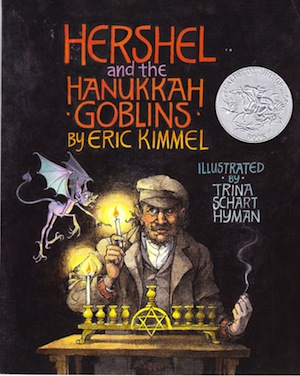
image - Hershel and the Hanukkah Goblins book cover
Read about Hershel of Ostropol, who gives a Jewish village the gift of celebrating Chanukah by taking care of some nasty goblins that haunt the synagogue.

Chanukah is all about kids, so if you’re stuck for a gift for the special children in your circle, look no further than Eric Kimmel’s Hershel and the Hanukkah Goblins (Scholastic, 1990, scholastic.com, $3.71 paperback). In this story, Hershel of Ostropol gives a Jewish village the gift of celebrating Chanukah by taking care of a series of nasty goblins that haunt the old synagogue, blow out Chanukah candles, throw potato latkes on the floor and break dreidels.

Illustrated by the careful hand of Trina Shart Hyman, the goblins are mesmerizingly hideous and the story of their defeat is at once scary, defiant, courageous and humorous as they are shown to be cowards, easily fooled by Hershel’s tricks. This book is a must for any Jewish kids’ bookshelf, a text that gets pulled out year after year and captivates kids as young as 3 and as old as 8.

Make it

A great resource for Chanukah crafts for kids is Crafting Jewish by Rivky Koenig (Mesorah Publications, 2008, artscroll.com, $26.99). Featuring a chapter for each of the Jewish holidays, the Chanukah section has seven crafts and two recipes, as well as ideas for a doughnut and ice cream party where everyone makes his/her own dessert combinations. The crafts are varied and include creating a glowing glass menorah, making dreidel-stamped gift wrap, crafting clay dreidel charm jewelry and building a Chanukah tray made from a large picture frame. The activities are beautifully explained, with a list of needed items, an estimated duration for the craft and a picture on the opposite page showing the finished product as inspiration. If there’s a crafty kid in your house, this book will be well used.

Lauren Kramer, an award-winning writer and editor, lives in Richmond, B.C. To read her work online, visit laurenkramer.net.

Building a society together

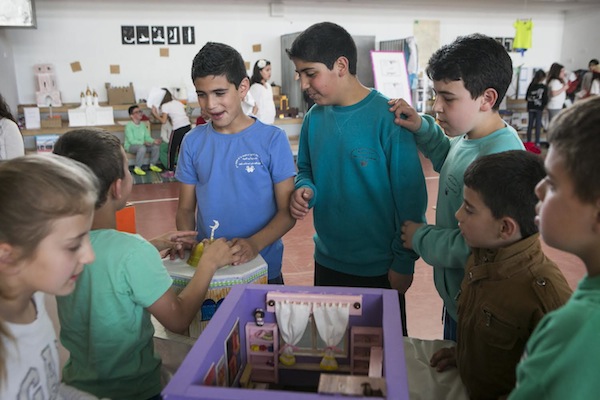
Hand in Hand was started in 1997, with the goal of creating integrated schools wherein both Arab and Jewish kids could study together in a bilingual (Hebrew and Arabic) framework within the public school system. (photo from Hand in Hand)

Starting with just two classes in 1998 – a kindergarten and a Grade 1 class – Hand in Hand now has five schools throughout Israel, serving 1,200 students.

Hand in Hand is the brainchild of Lee Gordon and Amin Kalaf. Gordon grew up in Portland, Ore., before making aliyah; he lived in Israel for 20 years, returning to the United States a few years ago. Kalaf grew up in a small village near Afula and now lives in Jerusalem. They founded Hand in Hand in 1997, with the goal of creating integrated schools wherein both Arab and Jewish kids could study together in a bilingual (Hebrew and Arabic) framework within the public school system. The concept involves both improving the quality of education and being a model for partnership between Jewish and Arab citizens, as well as the public and private sectors.

“We have mayors in the various towns supporting our projects and giving us buildings to use and some funding … so, it’s a public-private partnership,” said Gordon. “There is public funding from Israel and also a lot of private philanthropic support [from] around the world,” he said, referring to the United States, Canada, Europe and, of course, Israel. When Gordon moved back to the United States, he created (and heads) American Friends of Hand in Hand, a nonprofit fundraising organization.

Kalaf’s oldest child graduated from Hand in Hand’s first class of Grade 12 graduates. “We’ve had four high school graduating classes now at our only high school in Jerusalem,” said Gordon. “That’s our biggest school, with 600 students from pre-k to 12th grade.”

Two years ago, Hand in Hand added another component to the organization. “We’ve been doing a community initiative, which we call Shared Communities, in which we’re working to build relationships between Jewish and Arab adults, not just kids,” said Gordon.

Today, there is a whole range of programs for adults, including language classes, holiday celebrations, discussion groups and a men’s basketball team. “We probably have about 3,000 adults in programs around each of our schools,” said Gordon. “Sometimes, the programs are at the schools in the evenings, or in other places.

“They really stood out this past summer when there was all the violence – the kidnappings, the revenge murder of the Palestinian teen, and the two-month-long war in Gaza.”

Shared Communities was active throughout Operation Protective Edge. Despite the tensions and differing views, participants found common ground. One example of this was the program organizing Jerusalem adults and kids going on evening walks together, wearing T-shirts that read, “We refuse to be enemies.”

“They weren’t really protests, but they were saying not everything about Jews and Arabs is about war and conflict,” said Gordon. “Here, we are working together in our school … and, in a little town, people came out onto the side of the roads with signs that read, ‘We are neighbors in peace,’ which is more than just saying, ‘We are peaceful neighbors.’”

photo - Today, there is a whole range of programs for adults, including language classes, holiday celebrations, discussion groups and a men’s basketball team
Today, there is a whole range of programs for adults, including language classes, holiday celebrations, discussion groups and a men’s basketball team. (photo from Hand in Hand)

At the schools, Hand in Hand works toward keeping the numbers balanced between Arabs and Jews, and between boys and girls.

“These are the main prerequisites,” said Gordon. “Earlier on, we had more Arabs than Jews. Now, we have waiting lists on both sides, though there’s a larger waiting list on the Arab side.

“Most importantly, they are growing fast. For example, in the new school in Tel Aviv (which is a preschool and kindergarten for now), last year, we had one class of 30 students. This year, we have three classes with 100 students in total. And, there was enough interest that we could’ve had 150 kids if we’d have had enough room.”

Gordon added, “There are great teachers and a wonderful curriculum. It looks at multiculturalism, backgrounds and narratives of different religions, because we have Christians, Muslims, Arabs and Jews…. In the younger grades, they have two full-time teachers in each class, one Arab and one Jewish.”

Gordon spoke of the schools’ broad reach.

“You can have an Arab friend the same way you can have a Jewish friend,” he said. “It can help you in the workplace, academia or your social life, and I think that’s a direct impact of Hand in Hand…. From the very beginning, when a Jewish child was invited to an Arab’s home for a birthday party, this involved the parents taking that child in and they’d meet each other. So, there are a lot of friendships happening beyond the walls of the schools … and sometimes the parents’ friendships were long-lasting, even if the children changed friends…. And the families aren’t just the parents. They are uncles, aunts, sister, brothers, cousins…. People hear about it and are impacted.

“We want to be visible because we want the rest of Israel to know about this and to be an example, as an alternative. Things can be different. Jews and Arabs can get along.”

Canadians can make a tax-deductible donation to Hand in Hand via the Jerusalem Foundation of Canada, with which it has a partnership.

“Our goal is to bring this model to as many places as there is interest and to work with populations to help them build a model school in the community,” said Gordon.

For more information, visit handinhandk12.org.

Rebeca Kuropatwa is a Winnipeg freelance writer.

Dogs break down barriers

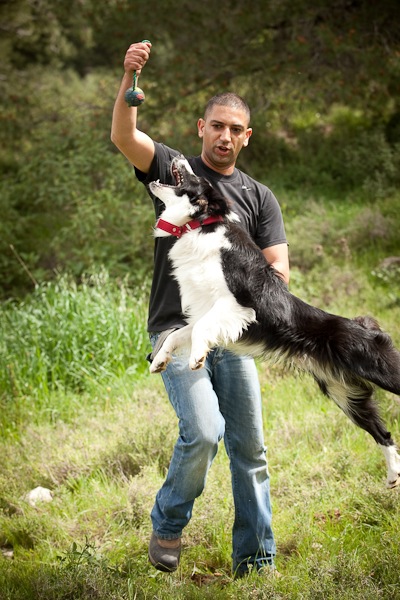
Ofer Biton with a therapy dog. (photo from Ofer Biton)

For years, therapists and other professionals have used animals to break down barriers and achieve breakthroughs in a multitude of situations. Recently, a pair of educators from Israel found a way to combine two of their passions – dogs and helping children with mental challenges.

Ofer Biton and Liat Bartov succeeded in getting recognition for the practice of canine therapy, and have since been teaching the how-to’s at universities across Israel.

Biton and Bartov met 20 years ago while working in special education. Some 10 years ago, “We started to think about dog training and teenagers [at risk],” said Bartov. “We started doing courses for teenagers in a youth group, and we had a lot of people wanting us in other schools in Jerusalem.”

Bartov and Biton found it challenging to find others to take on some of the rapidly increasing workload, which led them to teaching, beginning with one course in Jerusalem and one at Bar-Ilan University. Two years ago, they moved their base of operations to the Broshim campus of Tel-Aviv University, offering a one-year course that teaches both dog training and therapy methodology.

photo - Ofer Biton with a therapy dog. The dog is the tool for the therapist, facilitating the initial connection with the client
Ofer Biton with a therapy dog. The dog is the tool for the therapist, facilitating the initial connection with the client. (photo from Ofer Biton)

“We really like to teach the students how to deal with dogs and special education kids,” said Bartov. “The students who come to learn this dog training love animals, and dogs in particular. They come because they had a dream, they remember when they were kids, when the dog was their best friend, and now they still want to do something with dogs.”

Bartov emphasized that students learn that it is not the dog that is the therapist. The dog is the tool for the therapist, facilitating the initial connection with the client.

“The kids enjoy working with the dogs,” she said. “They feel like someone is waiting for them and they want to take care of someone else, so it gives you a very good starting point. Then, you must do what you learn in the course – build on that connection and create a triangle of trust.”

Anyone can benefit from this kind of therapy, according to Bartov. “It could be a very young child and it could be a very old man. It depends if there is connection with animals and dogs, especially. And, if you have this connection, you can do [the therapy] with anyone.”

Contrasting canine therapy to equine (horse) therapy, she explained, “The difference is in the size of the animal and the connection to it. The dog is waiting for you, wants to connect with you. You can do lots of things with him and he can come to your place, the hospital or your school.”

While schools that specialize in working with young students with attention deficit disorder (ADD) and attention deficit hyperactivity disorder (ADHD) were the initial focus for Bartov and Biton’s canine therapy, they are also doing some work with young offenders. As well, private therapists who have heard about the program are approaching Biton and Bartov for advice.

“Typically, people with the financial ability have started to use the service, because of the name of it,” said Bartov. “They like to show their kids that they’re not going to a ‘psychologist’ – that they’re taking them to a dog trainer or to play with dogs, then they move on to very long-term therapy.”

She added, “These are mainly private [clients] as well as special education schools. Regular education schools don’t have the funding to support it, so they’re not doing it yet.”

Overall, Bartov said canine therapy is currently “very trendy … and it’s been growing for the last five years. It begins with schools, and then people hear about it and are really interested. We can see it in how much work our students get. There are over 100 practising dog therapists in Israel, with over 50 students graduating every year.”

The university offers a summer and winter session course for dog therapy. The summer course has had waiting lists.

“My dream is that every school will use dog therapists,” said Bartov. “I hope we can do this and that people will understand the benefit of the school. Ideally, every place that has kids will have a small kennel with a few dogs, and the children can be with the dogs and can have this therapy.”

Bartov and Biton hope to one day bring government-supported canine therapy to public schools. Currently, no Israeli insurance provider covers the costs associated with canine therapy, although Bartov and Biton have begun working with insurance companies to one day make that part of the coverage options.

Rebeca Kuropatwa is a Winnipeg freelance writer.

Review by OSCE at 10

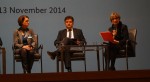
The Hon. Lynne Yelich, Canada’s minister of state (foreign affairs and consular), right, with two fellow panelists, moderator Melissa Eddy, New York Times correspondent in Berlin, and Miroslav Lajcák, deputy prime minister and minister of foreign and European affairs, Slovak Republic. (photo from Foreign Affairs, Trade and Development Canada)

On Nov. 13, the Hon. Lynne Yelich, Canada’s minister of state (foreign affairs and consular), concluded her participation at the High-Level Commemorative Event and Civil Society Forum on the 10th Anniversary of the Organization for Security and Cooperation in Europe’s (OSCE’s) Berlin Conference on Antisemitism.

The Berlin Declaration was proclaimed 10 years ago; it spelled out a series of commitments for OSCE member states, including Canada. Canada is deeply engaged in the fight against antisemitism, both at home and abroad, and remains committed to enhancing Holocaust education, remembrance and research.

Yelich participated in a panel that reviewed efforts over the past 10 years in addressing antisemitism throughout the OSCE. The panel analyzed ways that member states can counter contemporary antisemitism and discussed recommendations put forward by civil society groups.

Yelich reiterated that Canada encourages all states to take a similar, zero-tolerance approach to antisemitism. “As we commemorate the 10th anniversary of the Berlin Declaration on antisemitism, we must acknowledge that antisemitism continues to be a sad reality,” she said.

The complete address delivered by Yelich at the conference, as it was written, follows:

It is both a pleasure and a privilege to represent Canada at this important event in Berlin today and to reflect upon what has been achieved in fighting antisemitism throughout the Organization for Security and Cooperation in Europe over the past 10 years.

As a matter of priority and principle, Canada supports efforts to combat all forms of racism and discrimination. However, the Government of Canada understands that hatred can manifest itself in specific ways requiring specific responses.

We recognize that antisemitism constitutes a unique form of racism, whose extreme manifestations have led to some of the darkest hours in the history of mankind. As Prime Minister Stephen Harper has said, antisemitism is “a pernicious evil that must be exposed, confronted and repudiated whenever and wherever it appears, an evil so profound that it is ultimately a threat to us all.”

As we commemorate the 10th anniversary of the Berlin Declaration on antisemitism, we must acknowledge that antisemitism continues to be a sad reality.

Our Nationally Standardized Data Collection Strategy on Hate-Motivated Crime indicates that Jews are the most likely religious group to be targeted for hate crimes, even though Jews constitute less than one percent of the Canadian population.

Too often, not enough is done to ensure our societies, and especially our younger generations, remember the lessons of the Holocaust.

On April 23, 2013, the Government of Canada announced that a site had been selected in our capital city of Ottawa to build Canada’s National Holocaust Monument. This monument, to be inaugurated in fall 2015, will encourage people to reflect upon the events of the Holocaust, remember the victims and pay tribute to the survivors. It will also encourage people to reflect on the responsibilities each of us has to protect human rights and dignity.

In the same spirit of education, reflection and prevention, the recently opened Canadian Museum for Human Rights in Winnipeg, Man., houses a permanent exhibition devoted to the Holocaust.

With respect to law enforcement and protection, the Canadian government continues to develop its systems for collecting data on hate crime. Combined with law enforcement training, these systems allow the authorities to better address violence against groups at risk, including the Jewish community.

In this context, to help protect communities against hate-motivated crimes, we created a program called Communities at Risk: Security Infrastructure Program. Renewed in February 2013, this program allows not-for-profit organizations to apply for funding to allay the costs of security infrastructure improvements for places of worship and community centres vulnerable to hate-motivated crime.

Canada is also at the forefront of the fight against antisemitism on the international stage.

In November 2010, Canada hosted the second Inter-parliamentary Coalition for Combating Antisemitism Conference. Parliamentarians from around the world came together to develop mechanisms to combat antisemitism and address antisemitic propaganda in the media and on the Internet.

By unanimous consent, parliamentarians issued the Ottawa Protocol on Combating Antisemitism, which seeks commitments from governments to collect and report data on hate crimes, including antisemitism; to monitor and share best practices; to propose a common working definition of antisemitism; and to engage further with the United Nations on this issue.

Through our Office of Religious Freedom, established within Foreign Affairs, Trade and Development Canada and headed by Andrew Bennett, Canada works internationally to combat antisemitism and other forms of intolerance on the basis of religion or belief, including by supporting projects implemented by the OSCE’s Office for Democratic Institutions and Human Rights.

The Government of Canada also recognizes the scourge of the “new” antisemitism. This sometimes-violent movement, which often portrays itself as anti-Zionism, rejects the right of the Jewish people to a homeland. We made our stand clear when Canada – the first country to do so – decided to withdraw from the United Nations Durban Review Conference because of profound concerns about the manifestations of antisemitism that had marred the first Durban Conference, as well as the participation of such overtly antisemitic regimes as Iran in the planning of the review conference.

As we collectively seek ways to improve our response to antisemitism, Canada encourages all states to take a similar, zero-tolerance approach to antisemitism. This can include supporting the principles of the Declaration of the Stockholm International Forum on the Holocaust, the London Declaration on Combating Antisemitism and the Ottawa Protocol; further developing data collection systems on hate crimes; and fully implementing the provisions of the 2004 OSCE Berlin Declaration on antisemitism.

Thank you.